REVIEW 3 major objections 4 minor 4 cited by
Nowhere left to hide: revealing realistic gravitational-wave populations in high dimensions and high resolution with PixelPop
T0 review · 3 major / 4 minor · reviewed 2026-08-06 · deepseek-v4-flash
Pith's one-line read A hybrid nonparametric model that includes all significant correlations recovers the true black-hole merger rate on 400 simulated detections, while simpler models produce biased rates.
desk verdict A transparent, technically substantial mock-catalog study showing that high-dimensional nonparametric inference can recover most—but not all—of a correlated BBH population, with an abstract that overstates the 'no bias' result. read the letter →
The pith
A machine-rendered reading of the paper's core claim, the machinery that carries it, and where it could break.
The reading
What carries the argument
PixelPop is a Bayesian nonparametric model that discretizes the joint parameter space into fine bins and infers the merger rate in each bin under a conditional autoregressive prior; this work uses the intrinsic (ICAR) limit, an improper prior whose normalization term is dropped because $\det(D-A)=0$. The Hybrid extension keeps PixelPop three-dimensional in $(m_1,q,\chi_{\rm eff})$ and models the redshift power-law index as a cubic spline in $\chi_{\rm eff}$, capturing the $\chi_{\rm eff}$–$z$ correlation while keeping the problem computationally feasible. Mutual information, normalized to $\rho_I\in[0,1]$, provides the criterion for which correlations are 'significant' and therefore must be modeled.
What would settle it
Run the Hybrid PixelPop pipeline on a 400-event mock catalog drawn from the SMT or CHE population without first computing the mutual-information matrix from the true simulation, and check for credible-region violations; if an unanticipated correlation is omitted and the recovered rate leaves the 90% credible interval in any well-detected region, the claim that this procedure correctly measures the rate in practice is refuted.
Extended reading notes
Core claim
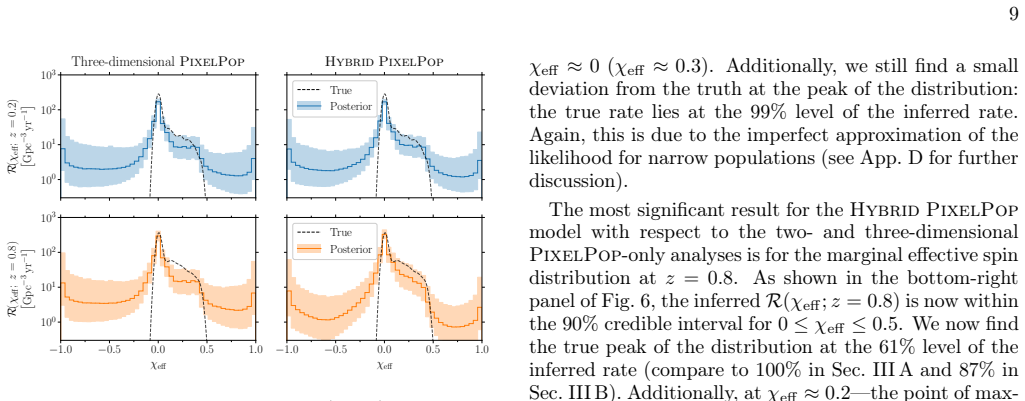
The central discovery is that the merger rate of binary black holes cannot be inferred reliably from realistic catalogs unless the population model reproduces the correlations between source parameters. For a common-envelope population simulated with population synthesis, the most correlated pairs are $(m_1,q)$, $(m_1,\chi_{\rm eff})$, $(q,\chi_{\rm eff})$, and $(\chi_{\rm eff},z)$. A two-dimensional PixelPop model that treats spin and redshift parametrically biases the spin rate; a three-dimensional PixelPop model that ignores the $\chi_{\rm eff}$–$z$ correlation biases the spin rate at $z=0.8$. The Hybrid model—nonparametric in $(m_1,q,\chi_{\rm eff})$ with redshift evolution $(1+z)^{\varphi(\chi_{\rm eff})}$ where $\varphi$ is a cubic spline—recovers the joint comoving merger-rate density within the 90% credible interval in all source parameters. The paper further shows that the inferred population can be compared to population-synthesis channels via an average log-likelihood similarity, separating common envelope from chemically homogeneous evolution but not from stable mass transfer.
Load-bearing premise
The analysis assumes the analysts already know which correlations are important, because it picks them using the true simulated population; real observations do not come with that knowledge.
Editorial extensions
If this is right
- For O4-scale catalogs of about 400 events, any population analysis that treats masses, spins, and redshift as independent will return biased merger rates in at least some source-parameter regions.
- A semiparametric model that is nonparametric in $(m_1, q, \chi_{\rm eff})$ and lets the redshift power-law index depend on $\chi_{\rm eff}$ recovers the joint merger-rate density within 90% credible intervals for the common-envelope population.
- One-dimensional posterior predictive checks cannot validate a population model; the biased two- and three-dimensional models pass them, so correlation-aware model checks are needed.
- Formation channels with substantially different physical processes, such as common envelope vs chemically homogeneous evolution, can be distinguished from a 400-event catalog, while channels sharing evolutionary stages cannot.
- The relative rate uncertainties achieved with 400 O4-like events approach those of the fiducial parametric model on GWTC-3, but with much weaker modeling assumptions.
Reading between the lines
- Applied to existing observational catalogs, the same analysis could reveal that previously reported spin-dependent merger rates carry systematic biases, since the paper shows such biases appear already at 400 detections.
- The indistinguishability of common-envelope and stable-mass-transfer channels suggests that their mixture fractions are likely unidentifiable from nonparametric analyses at 400 events, and may remain hard to pin down even with the larger catalogs expected in the fifth observing run.
- The paper's mutual-information-based correlation selection could be made fully data-driven by estimating MI from the posterior predictive distribution instead of the known simulation, which would be required for real applications.
- A full four-dimensional nonparametric analysis is blocked by the unbounded selection-efficiency estimator in bins with no injection samples; smoothing or adaptive binning would test whether the Hybrid approach's residual peak bias disappears at higher resolution.
Editorial analysis
A structured set of objections, weighed in public.
Referee Report
Summary. The paper uses the PixelPop Bayesian nonparametric model to infer the multidimensional merger-rate distribution R(m1, q, chi_eff; z) for a mock catalog of 400 detectable binary-black-hole mergers at O4 sensitivity, drawn from a population-synthesis common-envelope simulation. The authors quantify pairwise correlations by mutual information, then progressively build a two-dimensional model (m1, q), a three-dimensional model (m1, q, chi_eff), and a 'Hybrid' model that adds a chi_eff-dependent redshift power-law index. They report that neglecting correlations biases the inferred rate, while the Hybrid model recovers the astrophysical merger rate across all source parameters. They also propose an average-log-likelihood similarity metric to compare formation channels, finding that a CE population is distinguishable from CHE but not from SMT.
Significance. If the central claim held, this would be a valuable demonstration that high-resolution nonparametric inference can capture realistic multidimensional correlations in gravitational-wave populations and that correlation-neglecting models produce biased rates. The paper is unusually transparent: it reports the percentile level at which the true rate falls in the inferred posterior, runs point-estimate catalogs to separate parameter-estimation artifacts from model systematics, and acknowledges that posterior predictive checks passed even for misspecified models. The proposed channel-similarity metric is a useful idea. However, the central 'no bias across all source parameters' claim is directly contradicted by the paper's own Appendix E, which shows a persistent bias for chi_eff near zero at z > 1. The strength of the validation therefore does not currently support the abstract's unqualified conclusion.
major comments (3)
- [Sec. IIIC, Eq. (7), App. E] The abstract and Sec. V claim that the Hybrid model 'correctly measures the astrophysical merger rate across all source parameters' and recovers it 'with no bias.' Appendix E explicitly shows otherwise: at chi_eff ≈ 0 and z > 1, the inferred R(chi_eff; z) deviates significantly from the true rate, and the authors attribute this to the redshift dependence 'evolving more steeply around the chi_eff ≈ 0 peak than allowed for by our chi_eff-dependent spline model.' The bias persists in the point-estimate catalog, so it is not a parameter-estimation artifact; it is a misspecification inside the Hybrid model. This is a load-bearing inconsistency with the paper's headline result, and the claims must be revised or the model must be made flexible enough to capture this behavior.
- [Sec. IIIA and Sec. V] The model-selection workflow uses oracle knowledge of the true population's correlation structure: the mutual-information matrix in Fig. 2 is computed from the simulated population, and Sec. IIIA states 'we leverage our knowledge of the true distributions.' Section V acknowledges that real observations will not have this knowledge. Since the paper also shows that posterior predictive checks passed for the misspecified two- and three-dimensional models, the method as presented does not yet provide an operational way to know which correlations to include when analyzing real data. The simulation study is still informative, but the 'realistic' framing needs a clear caveat that the unbiasedness result assumes the correlation structure is known in advance.
- [Sec. IIIC and App. D] The statement in Sec. V that deviations from the 90% credible region are 'not attributable to model systematics' is too broad. In Sec. IIIC the true chi_eff rate at z = 0.2 lies at the 99% level of the posterior, and App. D attributes this to an imperfect likelihood approximation; however, App. E shows that the z > 1 bias at chi_eff ≈ 0 persists with point estimates and is caused by spline rigidity. The latter is a model systematic, so the qualifier should be restricted to the specific q-region and peak artifact discussed in App. D, not applied to all observed deviations.
minor comments (4)
- [Throughout] There are several typographical and formatting issues, including missing spaces in 'withPixelPop,' 'Power La w,' and 'We usePixelPop'; these likely result from LaTeX macro spacing but should be corrected.
- [Sec. V] The word 'undistinguishable' should be 'indistinguishable.'
- [App. E] The discussion of adaptive binning as future work is useful, but the sentence 'To better resolve the fast evolution... we aim to explore in the future...' makes the known limitation explicit and should be reflected in the main-text claims, not only in the appendix.
- [App. B] The explanation of the improper ICAR prior is slightly confusing: the text says the determinant is dropped because it is zero, then calls it a constant; clarifying that the singular determinant removes a normalization term that would be undefined would help the reader.
Circularity Check
No equation-level reduction: the rate inference is externally validated against a simulated truth; the caveats are oracle-informed model selection (admitted in Sec. V) and an overbroad 'no bias' claim contradicted by App. E.
-
other
[Secs. IIIA, IIIC, and V; Fig. 2 (MI matrix)]
"To model the remaining parameters, we leverage our knowledge of the true distributions (we discuss the implications of doing so in Sec. V). ... there is a more significant correlation between χeff and z, with ρI(χeff, z) ≈ 0.41. Therefore, we consider a 'semiparametric' approach: we use the parametric Powerlaw redshift evolution model from before, but attempt to capture the χeff–z correlation by modeling the redshift power-law index κ with a cubic spline. ... However, in pursuing our multi-step approach, we utilized our knowledge of the true population."
The headline claim — 'modeling all significant correlations with PixelPop allows us to correctly measure the astrophysical merger rate across all source parameters' — is demonstrated with a model whose correlation structure is selected from the MI matrix of the true simulated population (Fig. 2), i.e., from the very target the measurement claims to recover. The paper concedes this in Sec. V: real observations would not know which correlations are significant. This is partial self-reference in the demonstration: rates are still inferred from event posteriors and checked against an external truth, so the MI input does not fix the rate values. App.
full rationale
The derivation chain in this paper is an end-to-end hierarchical inference: event posteriors from Bilby/IMRPhenomXP on 400 simulated detections, a Poisson population likelihood with Monte Carlo selection functions, and the PixelPop binned rate model. The claimed result — recovery of R(m1, q, chi_eff; z) — is checked against the external Zevin et al. CE simulation (KDEs of the true population), so the quantitative content is genuine forward measurement, not a restatement of an input. I find no equation-level circularity: no fitted parameter is renamed as a prediction, and no claim is true by definition of the model. The main self-referential element is model selection. The MI matrix in Fig. 2 is computed from the true simulated population; Sec. IIIA states 'we leverage our knowledge of the true distributions'; Sec. IIIC chooses the hybrid spline structure using those MI coefficients; and Sec. V concedes that real observations would not have such knowledge. The abstract's 'correctly measure the merger rate across all source parameters' therefore holds only in an oracle-conditional setting, which limits the generality of the demonstration and justifies the score of 3 — but it is not a reduction of the inferred rates to the input. Self-citations to Refs. [79, 107] (same author group) supply the PixelPop algorithm and the observation that the CAR correlation parameter peaks at kappa=1 (App. B, ICAR prior); the present validation against an external simulated catalog is independent, so these are not load-bearing circularity. I also flag App. E explicitly: for chi_eff ≈ 0 and z > 1 the Hybrid model deviates significantly from the truth even with point estimates, in the authors' words because the redshift dependence 'evolv[es] more steeply around the chi_eff ≈ 0 peak than allowed for by our chi_eff-dependent spline model for the redshift power-law index.' This contradicts Sec. V's 'no bias ... in all source parameters' and is a correctness/scope problem rather than a circular derivation; indeed, the failure demonstrates the recovery is not tautological. Technical limitations (selection via optimal SNR rather than a physical statistic, Sec. IIC; imperfect likelihood approximation for narrow features, App. D) are disclosed by the authors and likewise do not constitute circularity.
Assumptions & free parameters
free parameters (4)
- PixelPop binning resolution =
45 bins per dimension (3D/hybrid), 100 per dimension (2D)
- Redshift power-law spline nodes =
6 evenly spaced nodes in chi_eff in [-1,1]
- Peak+Tukey spin model prior ranges =
mu, sigma, Tx0, Tk, Tr, lambda ranges in Table I
- Non-prior-dominated reporting regions =
m1 in [4,50] Msun, q in [0.4,1]
assumptions (5)
- domain assumption Zevin+21 population-synthesis simulations with chi_b=0 and alpha_CE=1 are a realistic representation of the CE formation channel.
- domain assumption The optimal-SNR threshold rho_opt>=11 approximates the true detection selection function with negligible bias for O(100)-event catalogs.
- ad hoc to paper The analyst knows the true population's correlation structure before model selection (oracle knowledge).
- domain assumption Monte Carlo approximation of the population likelihood is accurate except for very narrow features like the chi_eff peak.
- domain assumption The m1-z and q-z correlations are negligible (rho_I ~ 0.13 and ~0), justifying a parametric redshift model.
Cite this review
Pith. "Pith review of Nowhere left to hide: revealing realistic gravitational-wave populations in high dimensions and high resolution with PixelPop." pith.science (2026). https://pith.science/paper/57SUWUAG
@misc{pith2026250620731,
  author       = {Pith},
  title        = {Pith review of: Nowhere left to hide: revealing realistic gravitational-wave populations in high dimensions and high resolution with PixelPop},
  year         = {2026},
  howpublished = {\url{https://pith.science/paper/57SUWUAG}},
  note         = {Machine review of arXiv:2506.20731}
}
read the original abstract
The origins of merging compact binaries observed by the LIGO-Virgo-KAGRA gravitational-wave detectors remain uncertain, with multiple astrophysical channels possibly contributing to the merger rate. Formation processes can imprint nontrivial correlations in the underlying distribution of source properties, but current understanding of the overall population relies heavily on simplified and uncorrelated parametric models. In this work, we use PixelPop-a high-resolution Bayesian nonparametric model with minimal assumptions-to analyze multidimensional correlations in the astrophysical distribution of masses, spins, and redshifts of black-hole mergers from mock gravitational-wave catalogs constructed using population-synthesis simulations. With full parameter estimation on 400 detections at current sensitivities, we show explicitly that neglecting population-level correlations biases inference. In contrast, modeling all significant correlations with PixelPop allows us to correctly measure the astrophysical merger rate across all source parameters. We then propose a nonparametric method to distinguish between different formation channels by comparing the PixelPop results back to astrophysical simulations. For our simulated catalog, we find that only formation channels with significantly different physical processes are distinguishable, whereas channels that share evolutionary stages are not. Given the substantial uncertainties in source formation, our results highlight the necessity of multidimensional astrophysics-agnostic models like PixelPop for robust interpretation of gravitational-wave catalogs.
Figures


Figures from the paper (9 more)



Forward citations
Cited by 4 Pith papers
-
A Four-dimensional Model-agnostic Probe into the Astrophysical Origins of Binary Black Hole Subpopulations
A GPU-accelerated binned Gaussian process yields the first model-agnostic 4D BBH population in (m1, q, χeff, χp), revealing four mass-based subpopulations and new spin-mass-ratio correlations.
-
When (not) to trust Monte Carlo approximations for hierarchical Bayesian inference
A unified error statistic E-hat measures information lost to Monte Carlo noise in hierarchical Bayesian inference, with a recommended cutoff of 0.2 bits.
-
Characterizing Binary Black Hole Subpopulations in GWTC-4 with Binned Gaussian Processes: On the Origins of the $35M_{\odot}$ Peak
In GWTC-4, only the subpopulation near 35 M_sun is equal-mass, low-spin, and randomly oriented, matching globular-cluster dynamical formation with BH birth spins 0.1-0.2.
-
The first decade of gravitational-wave measurements of black hole spins
A review summarizing formation-channel predictions, waveform effects, and population-level constraints on stellar-mass black hole spins from the first decade of gravitational-wave observations.
Reference graph
Works this paper leans on
-
[1]
Aasiet al.(LIGO Scientific), Class
J. Aasiet al.(LIGO Scientific), Class. Quant. Grav.32, 074001 (2015), arXiv:1411.4547 [gr-qc]
arXiv 2015
-
[2]
F. Acerneseet al.(VIRGO), Class. Quant. Grav.32, 024001 (2015), arXiv:1408.3978 [gr-qc]
arXiv 2015
-
[3]
Akutsuet al.(KAGRA), PTEP2021, 05A101 (2021), arXiv:2005.05574 [physics.ins-det]
T. Akutsuet al.(KAGRA), PTEP2021, 05A101 (2021), arXiv:2005.05574 [physics.ins-det]
arXiv 2021
-
[4]
Abbottet al.(KAGRA, VIRGO, LIGO Scientific), Phys
R. Abbottet al.(KAGRA, VIRGO, LIGO Scientific), Phys. Rev. X13, 041039 (2023), arXiv:2111.03606 [gr- qc]
arXiv 2023
-
[5]
Vitale, D
S. Vitale, D. Gerosa, W. M. Farr, and S. R. Taylor, in Handbook of Gravitational Wave Astronomy(Springer,
-
[6]
E. Thrane and C. Talbot, Publ. Astron. Soc. Austral. 36, e010 (2019), arXiv:1809.02293 [astro-ph.IM]
arXiv 2019
-
[7]
T.A.Callister, (2024),arXiv:2410.19145[astro-ph.HE]
arXiv 2024
-
[8]
Abbottet al.(LIGO Scientific, Virgo), Astrophys
B. Abbottet al.(LIGO Scientific, Virgo), Astrophys. J. Lett.882, L24 (2019), arXiv:1811.12940 [astro-ph.HE]
arXiv 2019
Show all 149 references
-
[9]
Abbottet al.(LIGO Scientific, Virgo), Astrophys
R. Abbottet al.(LIGO Scientific, Virgo), Astrophys. J. Lett.913, L7 (2021), arXiv:2010.14533 [astro-ph.HE]
2021 arXiv
-
[10]
Abbottet al.(KAGRA, VIRGO, LIGO Scientific), Phys
R. Abbottet al.(KAGRA, VIRGO, LIGO Scientific), Phys. Rev. X13, 011048 (2023), arXiv:2111.03634 [astro-ph.HE]
2023 arXiv
-
[11]
Mapelli, Front
M. Mapelli, Front. Astron. Space Sci.7, 38 (2020), arXiv:2105.12455 [astro-ph.HE]
2020 arXiv
-
[12]
Ivanovaet al., Astron
N. Ivanovaet al., Astron. Astrophys. Rev.21, 59 (2013), arXiv:1209.4302 [astro-ph.HE]
2013 arXiv
-
[13]
S. S. Baveraet al., Astron. Astrophys.647, A153 (2021), arXiv:2010.16333 [astro-ph.HE]
2021 arXiv
-
[14]
Gerosa and M
D. Gerosa and M. Fishbach, Nature Astron.5, 8 (2021), arXiv:2105.03439 [astro-ph.HE]
2021 arXiv
-
[15]
Mapelli, N
M. Mapelli, N. Giacobbo, F. Santoliquido, and M. C. Artale, Mon. Not. Roy. Astron. Soc.487, 2 (2019), arXiv:1902.01419 [astro-ph.HE]
2019 arXiv
-
[16]
Mandel and F
I. Mandel and F. S. Broekgaarden, Living Rev. Rel.25, 1 (2022), arXiv:2107.14239 [astro-ph.HE]
2022 arXiv
-
[17]
E. P. J. van den Heuvel, S. F. Portegies Zwart, and S. E. de Mink, Mon. Not. Roy. Astron. Soc.471, 4256 (2017), arXiv:1701.02355 [astro-ph.SR]
2017 arXiv
-
[18]
C. J. Neijssel, A. Vigna-Gómez, S. Stevenson, J. W. Barrett, S. M. Gaebel, F. Broekgaarden, S. E. de Mink, D. Szécsi, S. Vinciguerra, and I. Mandel, Mon. Not. Roy. Astron. Soc.490, 3740 (2019), arXiv:1906.08136 [astro- ph.SR]
2019 arXiv
-
[19]
Gallegos-Garcia, C
M. Gallegos-Garcia, C. P. L. Berry, P. Marchant, and V. Kalogera, Astrophys. J.922, 110 (2021), arXiv:2107.05702 [astro-ph.HE]
2021 arXiv
-
[20]
M. M. Briel, H. F. Stevance, and J. J. Eldridge, Mon. Not. Roy. Astron. Soc.520, 5724 (2023), 17 arXiv:2206.13842 [astro-ph.HE]
2023 arXiv
-
[21]
Eggleton, S
P. Eggleton, S. Mitton, and J. Whelan, eds.,Structure and Evolution of Close Binary Systems, IAU Sympo- sium, Vol. 73 (1976)
1976
-
[22]
Paczynski, Symposium - International Astronomical Union73, 75–80 (1976)
B. Paczynski, Symposium - International Astronomical Union73, 75–80 (1976)
1976
-
[23]
A. V. Tutukov and L. R. YungelSon, Mon. Not. Roy. Astron. Soc.260, 675 (1993)
1993
-
[24]
H. A. Bethe and G. E. Brown, Astrophys. J.506, 780 (1998), arXiv:astro-ph/9802084
1998 arXiv
-
[25]
Belczynski, V
K. Belczynski, V. Kalogera, and T. Bulik, Astrophys. J. 572, 407 (2002), arXiv:astro-ph/0111452 [astro-ph]
2002 arXiv
-
[26]
Stevenson, A
S. Stevenson, A. Vigna-Gómez, I. Mandel, J. W. Bar- rett, C. J. Neijssel, D. Perkins, and S. E. de Mink, Na- tureCommun.8,14906(2017),arXiv:1704.01352[astro- ph.HE]
2017 arXiv
-
[27]
Giacobbo and M
N. Giacobbo and M. Mapelli, Mon. Not. Roy. Astron. Soc.480, 2011 (2018), arXiv:1806.00001 [astro-ph.HE]
2018 arXiv
-
[28]
Dominik, K
M. Dominik, K. Belczynski, C. Fryer, D. Holz, E. Berti, T. Bulik, I. Mandel, and R. O’Shaughnessy, Astrophys. J.759, 52 (2012), arXiv:1202.4901 [astro-ph.HE]
2012 arXiv
-
[29]
P. C. Peters, Phys. Rev.136, B1224 (1964)
1964
-
[30]
I: SMT and CHE
and introduced in Sec. I: SMT and CHE. Similar to Fig. 1, in Fig. 9 we show the populations of SMT and CHE sources, in comparison to the CE population. Though these are all BBH isolated evolution channels, the astrophysical properties of the progenitors in CHE binaries (e.g., ...
-
[31]
Zevin, S
M. Zevin, S. S. Bavera, C. P. L. Berry, V. Kalogera, T. Fragos, P. Marchant, C. L. Rodriguez, F. Antonini, D. E. Holz, and C. Pankow, Astrophys. J.910, 152 (2021), arXiv:2011.10057 [astro-ph.HE]
2021 arXiv
-
[32]
S. E. de Mink, M. Cantiello, N. Langer, O. R. Pols, I. Brott, and S. C. Yoon, Astron. Astrophys.497, 243 (2009), arXiv:0902.1751 [astro-ph.SR]
2009 arXiv
-
[33]
Mandel and S
I. Mandel and S. E. de Mink, Mon. Not. Roy. Astron. Soc.458, 2634 (2016), arXiv:1601.00007 [astro-ph.HE]
2016 arXiv
-
[34]
S. E. de Mink and I. Mandel, Mon. Not. Roy. Astron. Soc.460, 3545 (2016), arXiv:1603.02291 [astro-ph.HE]
2016 arXiv
-
[35]
P.Marchant, N.Langer, P.Podsiadlowski, T.M.Tauris, and T. J. Moriya, Astron. Astrophys.588, A50 (2016), arXiv:1601.03718 [astro-ph.SR]
2016 arXiv
-
[36]
du Buisson, P
L. du Buisson, P. Marchant, P. Podsiadlowski, C. Kobayashi, F. B. Abdalla, P. Taylor, I. Mandel, S. E. de Mink, T. J. Moriya, and N. Langer, Mon. Not. Roy. Astron. Soc.499, 5941 (2020), arXiv:2002.11630 [astro- ph.HE]
2020 arXiv
-
[37]
Sigurdsson and L
S. Sigurdsson and L. Hernquist, Nature364, 423 (1993)
1993
-
[38]
Sigurdsson and E
S. Sigurdsson and E. S. Phinney, Astrophys. J.415, 631 (1993)
1993
-
[39]
S. F. Portegies Zwart and S. McMillan, Astrophys. J. Lett.528, L17 (2000), arXiv:astro-ph/9910061
2000 arXiv
-
[40]
M. C. Miller and D. P. Hamilton, Astrophys. J.576, 894 (2002), arXiv:astro-ph/0202298
2002 arXiv
-
[41]
A. P. Lightman and S. L. Shapiro, Rev. Mod. Phys.50, 437 (1978)
1978
-
[42]
P. Hut, S. McMillan, J. Goodman, M. Mateo, E. S. Phinney, C. Pryor, H. B. Richer, F. Verbunt, and M. Weinberg, Publ. Astron. Soc. Pac.104, 981 (1992)
1992
-
[43]
J. M. Fregeau and F. A. Rasio, Astrophys. J.658, 1047 (2007), arXiv:astro-ph/0608261
2007 arXiv
-
[44]
R. M. O’Leary, F. A. Rasio, J. M. Fregeau, N. Ivanova, and R. W. O’Shaughnessy, Astrophys. J.637, 937 (2006), arXiv:astro-ph/0508224
2006 arXiv
-
[45]
J. M. B. Downing, M. J. Benacquista, M. Giersz, and R. Spurzem, Mon. Not. Roy. Astron. Soc.407, 1946 (2010), arXiv:0910.0546 [astro-ph.SR]
2010 arXiv
-
[46]
C. L. Rodriguez, M. Morscher, B. Pattabiraman, S. Chatterjee, C.-J. Haster, and F. A. Rasio, Phys. Rev. Lett.115, 051101 (2015), [Erratum: Phys.Rev.Lett. 116, 029901 (2016)], arXiv:1505.00792 [astro-ph.HE]
2015 arXiv
-
[47]
C. L. Rodriguez, S. Chatterjee, and F. A. Rasio, Phys. Rev. D93, 084029 (2016), arXiv:1602.02444 [astro- ph.HE]
2016 arXiv
-
[48]
C. L. Rodriguez, M. Zevin, P. Amaro-Seoane, S. Chat- terjee, K. Kremer, F. A. Rasio, and C. S. Ye, Phys. Rev. D100, 043027 (2019), arXiv:1906.10260 [astro-ph.HE]
2019 arXiv
-
[49]
Askar, M
A. Askar, M. Szkudlarek, D. Gondek-Rosińska, M. Giersz, and T. Bulik, Mon. Not. Roy. Astron. Soc. 464, L36 (2017), arXiv:1608.02520 [astro-ph.HE]
2017 arXiv
-
[50]
Miller and V
M. Miller and V. M. Lauburg, Astrophys. J.692, 917 (2009), arXiv:0804.2783 [astro-ph]
2009 arXiv
-
[51]
Banerjee, H
S. Banerjee, H. Baumgardt, and P. Kroupa, Mon. Not. Roy. Astron. Soc.402, 371 (2010), arXiv:0910.3954 [astro-ph.SR]
2010 arXiv
-
[52]
J. P. Zahn, Astron. Astrophys.57, 383 (1977)
1977
-
[53]
Antonini and F
F. Antonini and F. A. Rasio, Astrophys. J.831, 187 (2016), arXiv:1606.04889 [astro-ph.HE]
2016 arXiv
-
[54]
Mckernanet al., Astrophys
B. Mckernanet al., Astrophys. J.866, 66 (2018), arXiv:1702.07818 [astro-ph.HE]
2018 arXiv
-
[55]
McKernan, K
B. McKernan, K. E. S. Ford, R. O’Shaughnessy, and D. Wysocki, Mon. Not. Roy. Astron. Soc.494, 1203 (2020), arXiv:1907.04356 [astro-ph.HE]
2020 arXiv
-
[56]
N. C. Stone, B. D. Metzger, and Z. Haiman, Mon. Not. Roy. Astron. Soc.464, 946 (2017), arXiv:1602.04226 [astro-ph.GA]
2017 arXiv
-
[57]
Tagawa, Z
H. Tagawa, Z. Haiman, and B. Kocsis, Astrophys. J. 898, 25 (2020), arXiv:1912.08218 [astro-ph.GA]
2020 arXiv
-
[58]
Tagawa, Z
H. Tagawa, Z. Haiman, I. Bartos, B. Kocsis, and K. Omukai, Mon. Not. Roy. Astron. Soc.507, 3362 (2021), arXiv:2104.09510 [astro-ph.HE]
2021 arXiv
-
[59]
Bartos, B
I. Bartos, B. Kocsis, Z. Haiman, and S. Márka, The Astrophysical Journal835, 165 (2017)
2017
-
[60]
Y. Yang, I. Bartos, Z. Haiman, B. Kocsis, S. Márka, and H. Tagawa, Astrophys. J.896, 138 (2020), arXiv:2003.08564 [astro-ph.HE]
2020 arXiv
-
[61]
Sana, J.-B
H. Sana, J.-B. Le Bouquin, S. Lacour, J.-P. Berger, G. Duvert, L. Gauchet, B. Norris, J. Olofsson, D. Pickel, G. Zins,et al., The Astrophysical Journal Supplement Series215, 15 (2014)
2014
-
[62]
Silsbee and S
K. Silsbee and S. Tremaine, Astrophys. J.836, 39 (2017), arXiv:1608.07642 [astro-ph.HE]
2017 arXiv
-
[63]
C. L. Rodriguez and F. Antonini, Astrophys. J.863, 7 (2018), arXiv:1805.08212 [astro-ph.HE]
2018 arXiv
-
[64]
Gupta, H
P. Gupta, H. Suzuki, H. Okawa, and K.-i. Maeda, Phys. Rev. D101, 104053 (2020), arXiv:1911.11318 [gr-qc]
2020 arXiv
-
[65]
Toonen, S
S. Toonen, S. P. Zwart, A. Hamers, and D. Bandopad- hyay, Astronomy & Astrophysics640, A16 (2020)
2020
-
[66]
Talbot and E
C. Talbot and E. Thrane, Astrophys. J.856, 173 (2018), arXiv:1801.02699 [astro-ph.HE]
2018 arXiv
-
[67]
Fishbach, D
M. Fishbach, D. E. Holz, and W. M. Farr, Astrophys. J. Lett.863, L41 (2018), arXiv:1805.10270 [astro-ph.HE]
2018 arXiv
-
[68]
I. M. Romero-Shaw, E. Thrane, and P. D. Lasky, Publ. Astron. Soc. Austral.39, e025 (2022), arXiv:2202.05479 [astro-ph.IM]
2022 arXiv
-
[69]
A. Q. Cheng, M. Zevin, and S. Vitale, Astrophys. J. 955, 127 (2023), arXiv:2307.03129 [astro-ph.HE]
2023 arXiv
-
[70]
J. W. Barrett, I. Mandel, C. J. Neijssel, S. Steven- son, and A. Vigna-Gomez, IAU Symp.325, 46 (2016), arXiv:1704.03781 [astro-ph.HE]
2016 arXiv
-
[71]
S. R. Taylor and D. Gerosa, Phys. Rev. D98, 083017 (2018), arXiv:1806.08365 [astro-ph.HE]
2018 arXiv
-
[72]
K. W. K. Wong, K. Breivik, K. Kremer, and T. Callis- ter, Phys. Rev. D103, 083021 (2021), arXiv:2011.03564 18 [astro-ph.HE]
2021 arXiv
-
[73]
Mould, D
M. Mould, D. Gerosa, and S. R. Taylor, Phys. Rev. D 106, 103013 (2022), arXiv:2203.03651 [astro-ph.HE]
2022 arXiv
-
[74]
Riley and I
J. Riley and I. Mandel, Astrophys. J.950, 80 (2023), arXiv:2303.00508 [astro-ph.SR]
2023 arXiv
-
[75]
Leyde, S
K. Leyde, S. R. Green, A. Toubiana, and J. Gair, Phys. Rev. D109, 064056 (2024), arXiv:2311.12093 [gr-qc]
2024 arXiv
-
[76]
Mastrogiovanni, A
S. Mastrogiovanni, A. Lamberts, R. Srinivasan, T. Bruel, and N. Christensen, Mon. Not. Roy. Astron. Soc.517, 3432 (2022), arXiv:2207.00374 [gr-qc]
2022 arXiv
-
[77]
Colloms, C
S. Colloms, C. P. L. Berry, J. Veitch, and M. Zevin, (2025), arXiv:2503.03819 [astro-ph.HE]
2025 arXiv
-
[78]
Bouffanais, M
Y. Bouffanais, M. Mapelli, F. Santoliquido, N. Gia- cobbo, G. Iorio, and G. Costa, Mon. Not. Roy. Astron. Soc.505, 3873 (2021), arXiv:2010.11220 [astro-ph.HE]
2021 arXiv
- [79]
-
[80]
Heinzel, M
J. Heinzel, M. Mould, S. Álvarez-López, and S. Vitale, Phys. Rev. D111, 063043 (2025), arXiv:2406.16813 [astro-ph.HE]
2025 arXiv
-
[81]
Edelman, B
B. Edelman, B. Farr, and Z. Doctor, Astrophys. J.946, 16 (2023), arXiv:2210.12834 [astro-ph.HE]
2023 arXiv
-
[82]
Godfrey, B
J. Godfrey, B. Edelman, and B. Farr, Cosmic Cousins: Identification of a Subpopulation of Binary Black Holes Consistent with Isolated Binary Evolution (2023), arXiv:2304.01288 [astro-ph.HE]
2023 arXiv
-
[83]
Golomb and C
J. Golomb and C. Talbot, Phys. Rev. D108, 103009 (2023), arXiv:2210.12287 [astro-ph.HE]
2023 arXiv
-
[84]
Heinzel, S
J. Heinzel, S. Biscoveanu, and S. Vitale, Phys. Rev. D 109, 103006 (2024), arXiv:2312.00993 [astro-ph.HE]
2024 arXiv
-
[85]
Tiwari, Class
V. Tiwari, Class. Quant. Grav.38, 155007 (2021), arXiv:2006.15047 [astro-ph.HE]
2021 arXiv
-
[86]
Rinaldi and W
S. Rinaldi and W. Del Pozzo, Mon. Not. Roy. Astron. Soc.509, 5454 (2021), arXiv:2109.05960 [astro-ph.IM]
2021 arXiv
-
[87]
T. A. Callister and W. M. Farr, A Parameter-Free Tour of the Binary Black Hole Population (2023), arXiv:2302.07289 [astro-ph.HE]
2023 arXiv
-
[88]
Li, Y.-Z
Y.-J. Li, Y.-Z. Wang, M.-Z. Han, S.-P. Tang, Q. Yuan, Y.-Z. Fan, and D.-M. Wei, Astrophys. J.917, 33 (2021), arXiv:2104.02969 [astro-ph.HE]
2021 arXiv
-
[89]
A. Ray, I. Magaña Hernandez, S. Mohite, J. Creighton, and S. Kapadia, Astrophys. J.957, 37 (2023), arXiv:2304.08046 [gr-qc]
2023 arXiv
-
[90]
A. M. Farah, T. A. Callister, J. M. Ezquiaga, M. Zevin, and D. E. Holz, No need to know: astrophysics-free gravitational-wave cosmology (2024), arXiv:2404.02210 [astro-ph.CO]
2024 arXiv
-
[91]
Toubiana, M
A. Toubiana, M. L. Katz, and J. R. Gair, Mon. Not. Roy. Astron. Soc.524, 5844 (2023), arXiv:2305.08909 [gr-qc]
2023 arXiv
-
[92]
Sadiq, T
J. Sadiq, T. Dent, and M. Gieles, Astrophys. J.960, 65 (2024), arXiv:2307.12092 [astro-ph.HE]
2024 arXiv
-
[93]
Sadiq, T
J. Sadiq, T. Dent, and A. Lorenzo-Medina, (2025), arXiv:2502.06451 [gr-qc]
2025
-
[94]
Sadiq, T
J. Sadiq, T. Dent, and A. Lorenzo-Medina, (2025), arXiv:2506.02250 [astro-ph.HE]
2025
-
[95]
Mandel, W
I. Mandel, W. M. Farr, A. Colonna, S. Stevenson, P. Tiňo, and J. Veitch, Mon. Not. Roy. Astron. Soc. 465, 3254 (2017), 1608.08223 [astro-ph.HE]
2017 arXiv
-
[96]
C. M. Fabbri, D. Gerosa, A. Santini, M. Mould, A. Toubiana, and J. Gair, Phys. Rev. D111, 104053 (2025), arXiv:2501.17233 [astro-ph.HE]
2025 arXiv
-
[97]
Rinaldi, A
S. Rinaldi, A. Toubiana, and J. R. Gair, (2025), arXiv:2506.05153 [gr-qc]
2025
-
[98]
S. S. Bavera, M. Fishbach, M. Zevin, E. Zapartas, and T. Fragos, Astron. Astrophys.665, A59 (2022), arXiv:2204.02619 [astro-ph.HE]
2022 arXiv
-
[99]
Santini, D
A. Santini, D. Gerosa, R. Cotesta, and E. Berti, Phys. Rev. D108, 083033 (2023), arXiv:2308.12998 [astro- ph.HE]
2023 arXiv
-
[100]
Baibhav, Z
V. Baibhav, Z. Doctor, and V. Kalogera, Astrophys. J. 946, 50 (2023), arXiv:2212.12113 [astro-ph.HE]
2023 arXiv
-
[101]
L. A. C. van Son, S. E. de Mink, T. Callister, S. Justham, M. Renzo, T. Wagg, F. S. Broekgaarden, F. Kummer, R. Pakmor, and I. Mandel, Astrophys. J. 931, 17 (2022), arXiv:2110.01634 [astro-ph.HE]
2022 arXiv
-
[102]
Zevin andS
M. Zevin andS. S.Bavera, Astrophys. J.933, 86(2022), arXiv:2203.02515 [astro-ph.HE]
2022 arXiv
-
[103]
F. S. Broekgaarden, S. Stevenson, and E. Thrane, As- trophys. J.938, 45 (2022), arXiv:2205.01693 [astro- ph.HE]
2022 arXiv
-
[104]
S. S. Bavera, T. Fragos, Y. Qin, E. Zapartas, C. J. Nei- jssel, I. Mandel, A. Batta, S. M. Gaebel, C. Kimball, and S. Stevenson, Astron. Astrophys.635, A97 (2020), arXiv:1906.12257 [astro-ph.HE]
2020 arXiv
-
[105]
T. A. Callister, C.-J. Haster, K. K. Y. Ng, S. Vitale, and W. M. Farr, Astrophys. J. Lett.922, L5 (2021), arXiv:2106.00521 [astro-ph.HE]
2021 arXiv
-
[106]
Biscoveanu, T
S. Biscoveanu, T. A. Callister, C.-J. Haster, K. K. Y. Ng, S. Vitale, and W. M. Farr, Astrophys. J. Lett.932, L19 (2022), arXiv:2204.01578 [astro-ph.HE]
2022 arXiv
-
[107]
Adamcewicz and E
C. Adamcewicz and E. Thrane, Mon. Not. Roy. Astron. Soc.517, 3928 (2022), arXiv:2208.03405 [astro-ph.HE]
2022 arXiv
- [108]
-
[109]
Franciolini and P
G. Franciolini and P. Pani, Phys. Rev. D105, 123024 (2022), arXiv:2201.13098 [astro-ph.HE]
2022 arXiv
-
[110]
A. Ray, I. Magaña Hernandez, K. Breivik, and J. Creighton, Searching for binary black hole sub- populations in gravitational wave data using binned Gaussian processes (2024), arXiv:2404.03166 [astro- ph.HE]
2024 arXiv
-
[111]
Antonini, I
F. Antonini, I. M. Romero-Shaw, and T. Callister, Phys. Rev. Lett.134, 011401 (2025), arXiv:2406.19044 [astro- ph.HE]
2025 arXiv
- [112]
-
[113]
Pierra, S
G. Pierra, S. Mastrogiovanni, and S. Perriès, Astron. Astrophys.692, A80 (2024), arXiv:2406.01679 [gr-qc]
2024 arXiv
-
[114]
Tiwari, Astrophys
V. Tiwari, Astrophys. J.928, 155 (2022), arXiv:2111.13991 [astro-ph.HE]
2022 arXiv
-
[115]
Capoteet al., Phys
E. Capoteet al., Phys. Rev. D111, 062002 (2025), arXiv:2411.14607 [gr-qc]
2025 arXiv
-
[116]
Fragoset al., Astrophys
T. Fragoset al., Astrophys. J. Suppl.264, 45 (2023), arXiv:2202.05892 [astro-ph.SR]
2023 arXiv
-
[117]
Breiviket al., Astrophys
K. Breiviket al., Astrophys. J.898, 71 (2020), arXiv:1911.00903 [astro-ph.HE]
2020 arXiv
-
[118]
Paxton, L
B. Paxton, L. Bildsten, A. Dotter, F. Herwig, P. Lesaf- fre, and F. Timmes (MESA), Astrophys. J. Suppl.192, 3 (2011), arXiv:1009.1622 [astro-ph.SR]
2011 arXiv
-
[119]
Paxtonet al., Astrophys
B. Paxtonet al., Astrophys. J. Suppl.208, 4 (2013), arXiv:1301.0319 [astro-ph.SR]
2013 arXiv
-
[120]
Paxtonet al., Astrophys
B. Paxtonet al., Astrophys. J. Suppl.220, 15 (2015), arXiv:1506.03146 [astro-ph.SR]
2015 arXiv
-
[121]
Paxtonet al., Astrophys
B. Paxtonet al., Astrophys. J. Suppl.234, 34 (2018), arXiv:1710.08424 [astro-ph.SR]
2018 arXiv
-
[122]
Paxtonet al., Astrophys
B. Paxtonet al., Astrophys. J. Suppl.243, 10 (2019), arXiv:1903.01426 [astro-ph.SR]. 19
2019 arXiv
- [123]
-
[124]
Kraskov, H
A. Kraskov, H. Stögbauer, and P. Grassberger, Phys. Rev. E69, 066138 (2004)
2004
-
[125]
B. C. Ross, PLOS ONE9, 1 (2014)
2014
-
[126]
Laarne, M
P. Laarne, M. A. Zaidan, and T. Nieminen, SoftwareX 14, 100686 (2021)
2021
-
[127]
B. P. Abbottet al.(KAGRA, LIGO Scientific, Virgo), Living Rev. Rel.19, 1 (2016), arXiv:1304.0670 [gr-qc]
2016 arXiv
-
[128]
B. O. O’Reilly, M. Branchesi, S. Haino, et al., Noise curves used for Simulations in the update of the Ob- serving Scenarios Paper (2022)
2022
-
[129]
Essick and M
R. Essick and M. Fishbach, DAGnabbit! Ensuring Con- sistency between Noise and Detection in Hierarchical Bayesian Inference (2023), arXiv:2310.02017 [gr-qc]
2023 arXiv
-
[130]
Prattenet al., Phys
G. Prattenet al., Phys. Rev. D103, 104056 (2021), arXiv:2004.06503 [gr-qc]
2021 arXiv
-
[131]
N. J. Cornish, Fast Fisher Matrices and Lazy Likeli- hoods (2010), arXiv:1007.4820 [gr-qc]
2010 arXiv
-
[132]
N. J. Cornish, Phys. Rev. D104, 104054 (2021), arXiv:2109.02728 [gr-qc]
2021 arXiv
-
[133]
Zackay, L
B. Zackay, L. Dai, and T. Venumadhav, Relative Bin- ning and Fast Likelihood Evaluation for Gravitational Wave Parameter Estimation (2018), arXiv:1806.08792 [astro-ph.IM]
2018 arXiv
-
[134]
Krishna, A
K. Krishna, A. Vijaykumar, A. Ganguly, C. Talbot, S. Biscoveanu, R. N. George, N. Williams, and A. Zim- merman, arXiv preprint arXiv:2312.06009 (2023)
2023 arXiv
-
[135]
Ashtonet al., Astrophys
G. Ashtonet al., Astrophys. J. Suppl.241, 27 (2019), arXiv:1811.02042 [astro-ph.IM]
2019 arXiv
-
[136]
T. J. Loredo, AIP Conf. Proc.735, 195 (2004), arXiv:astro-ph/0409387
2004 arXiv
-
[137]
Mandel, W
I. Mandel, W. M. Farr, and J. R. Gair, Mon. Not. Roy. Astron. Soc.486, 1086 (2019), arXiv:1809.02063 [physics.data-an]
2019 arXiv
-
[138]
Tiwari, Class
V. Tiwari, Class. Quant. Grav.35, 145009 (2018), arXiv:1712.00482 [astro-ph.HE]
2018 arXiv
-
[139]
W. M. Farr, Research Notes of the AAS3, 66 (2019)
2019
-
[140]
Vitale, S
S. Vitale, S. Biscoveanu, and C. Talbot, Astron. Astro- phys.668, L2 (2022), arXiv:2209.06978 [astro-ph.HE]
2022 arXiv
-
[141]
Fuller and L
J. Fuller and L. Ma, Astrophys. J. Lett.881, L1 (2019), arXiv:1907.03714 [astro-ph.SR]
2019 arXiv
-
[142]
S. J. Miller, Z. Ko, T. Callister, and K. Chatziioannou, Phys. Rev. D109, 104036 (2024), arXiv:2401.05613 [gr- qc]
2024 arXiv
-
[143]
R. W. Kiendrebeogoet al., Astrophys. J.958, 158 (2023), arXiv:2306.09234 [astro-ph.HE]
2023 arXiv
-
[144]
Papamakarios, E
G. Papamakarios, E. Nalisnick, D. J. Rezende, S. Mo- hamed, and B. Lakshminarayanan, J. Machine Learning Res.22, 2617 (2021), arXiv:1912.02762 [stat.ML]
2021 arXiv
-
[145]
Kobyzev, S
I. Kobyzev, S. J. D. Prince, and M. A. Brubaker, IEEE Trans. Pattern Anal. Machine Intell.43, 3964 (2021), arXiv:1908.09257 [stat.ML]
2021 arXiv
-
[146]
D.Ward,FlowJAX:Distributionsandnormalizingflows in Jax ([2025])
2025
-
[147]
L. Dinh, J. Sohl-Dickstein, and S. Bengio, arXiv preprint arXiv:1605.08803 (2016)
2016 arXiv
-
[148]
Besag, Journal of the Royal Statistical Society: Series B (Methodological)36, 192 (1974), https://academic.oup.com/jrsssb/article- pdf/36/2/192/49096627/jrsssb_36_2_192.pdf
J. Besag, Journal of the Royal Statistical Society: Series B (Methodological)36, 192 (1974), https://academic.oup.com/jrsssb/article- pdf/36/2/192/49096627/jrsssb_36_2_192.pdf
1974
-
[149]
Besag and C
J. Besag and C. Kooperberg, Biometrika82, 733 (1995), https://academic.oup.com/biomet/article- pdf/82/4/733/699636/82-4-733.pdf
1995
Reviewed August 6, 2026 · model on record in the stance chip above.
Discussion (0). Sign in to comment.