Scalable Bayesian Inference for Nonlinear Conservation Laws
Pith reviewed 2026-06-28 23:16 UTC · model grok-4.3
The pith
A method integrates sparse Gaussian process approximations with classical conservative discretizations to enable scalable Bayesian inference for nonlinear conservation laws.
A machine-rendered reading of the paper's core claim, the machinery that carries it, and where it could break.
Core claim
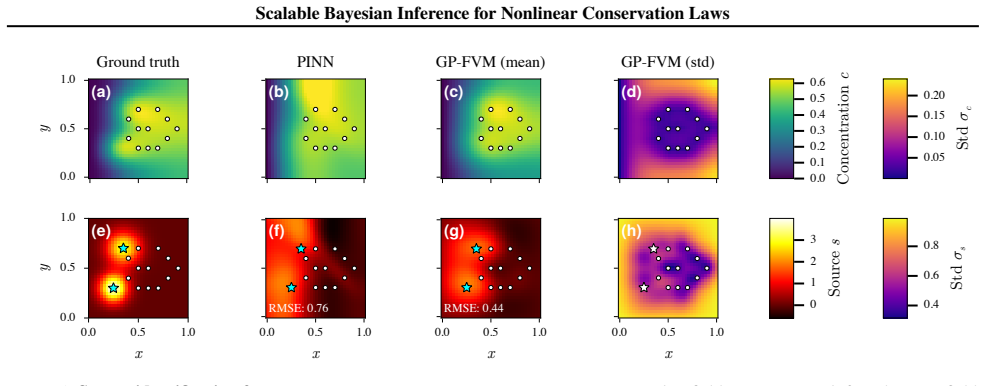
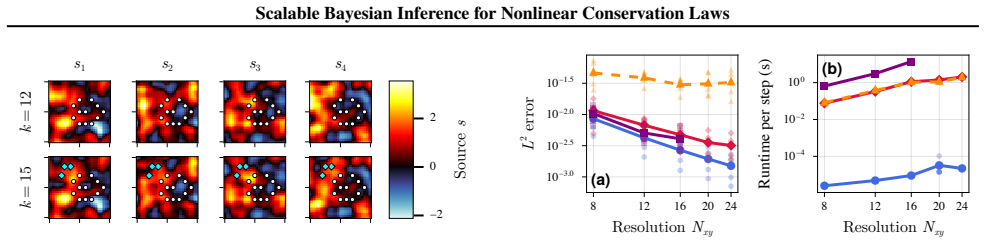
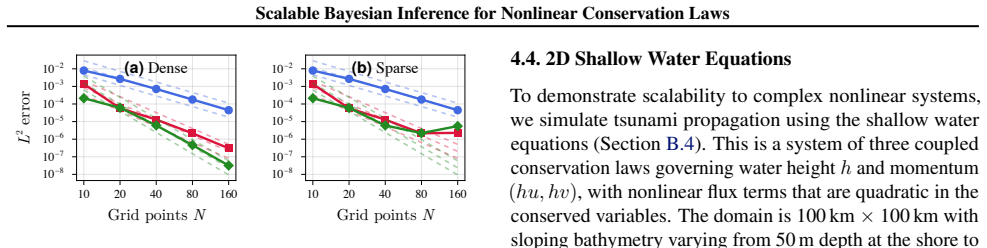
We develop a novel numerically conservative method for uncertainty-aware simulations of nonlinear conservation laws. We use recent sparse approximation techniques to scale up to large-scale forward and inverse problems. For forward simulation, we inherit the accuracy of classical solvers while providing structured uncertainty quantification. On inverse problems, we recover posteriors over nonparametric source fields in seconds -- outperforming neural baselines that take minutes to produce a less accurate point estimate.
What carries the argument
Sparse Gaussian process approximations integrated with classical conservative discretizations under Gaussian process priors, preserving numerical conservation while enabling uncertainty quantification.
If this is right
- Forward simulations match the accuracy of classical solvers while adding structured uncertainty quantification.
- Inverse problems recover posteriors over nonparametric source fields in seconds rather than minutes.
- The approach scales to large forward and inverse problems where prior methods struggle.
- Neural baselines are outperformed in both speed and accuracy for point estimates on inverse tasks.
Where Pith is reading between the lines
- The same integration pattern could be tested on other classes of PDEs if conservation is not the primary constraint.
- Structured uncertainty from this method might directly support risk-aware control in engineering systems with conservation constraints.
- Real-world validation would involve applying the method to measurement data from actual physical experiments rather than synthetic benchmarks.
Load-bearing premise
Sparse Gaussian process approximations can be integrated with classical conservative discretizations so that numerical conservation and accuracy properties hold for nonlinear problems.
What would settle it
A closed-system test case where the computed solutions violate a conservation law, such as total mass or momentum not remaining constant within machine precision over time.
Figures
read the original abstract
Nonlinear conservation laws are at the heart of many of the most important dynamical systems in science and engineering. In practical applications, such systems are often subject to various sources of uncertainty, e.g. due to sparse or noisy measurements. Inferring physical quantities and fields of interest then becomes an ill-posed problem which both classical numerical methods and modern deep learning-based methods struggle to treat appropriately. Recent work has framed classical numerical methods as Bayesian inference under Gaussian process priors, resulting in a physics-aware treatment of uncertainties. Following this line of work, we develop a novel numerically conservative method for uncertainty-aware simulations of nonlinear conservation laws. We use recent sparse approximation techniques to scale up to large-scale forward and inverse problems. For forward simulation, we inherit the accuracy of classical solvers while providing structured uncertainty quantification. On inverse problems, we recover posteriors over nonparametric source fields in seconds -- outperforming neural baselines that take minutes to produce a less accurate point estimate.
Editorial analysis
A structured set of objections, weighed in public.
Referee Report
Summary. The paper develops a novel numerically conservative Bayesian method for uncertainty-aware simulation of nonlinear conservation laws. It integrates sparse Gaussian process approximations with classical conservative discretizations to scale both forward problems (inheriting classical accuracy plus structured UQ) and inverse problems (recovering posteriors over nonparametric source fields in seconds, outperforming neural baselines that produce less accurate point estimates after minutes of computation).
Significance. If the claimed preservation of discrete conservation and accuracy under sparsification holds, the work would meaningfully advance physics-informed probabilistic inference for PDEs by enabling scalable, uncertainty-aware computations on problems where both classical solvers and neural methods currently fall short.
major comments (1)
- [Abstract and method description] The central claim that sparse GP approximations can be fused with conservative discretizations while exactly preserving the telescoping property (and thus discrete conservation) for nonlinear fluxes is load-bearing for both the forward and inverse results. The abstract asserts inheritance of accuracy and conservation, yet the integration step for nonlinear update maps is not guaranteed to survive sparsification (inducing points or variational approximations) without a modified stencil or re-derived scheme that retains the global sum. This must be shown explicitly, e.g., via a conservation-error table or proof in the method section.
Simulated Author's Rebuttal
We thank the referee for their careful reading and for emphasizing the need to explicitly verify preservation of discrete conservation. We address the single major comment below.
read point-by-point responses
-
Referee: [Abstract and method description] The central claim that sparse GP approximations can be fused with conservative discretizations while exactly preserving the telescoping property (and thus discrete conservation) for nonlinear fluxes is load-bearing for both the forward and inverse results. The abstract asserts inheritance of accuracy and conservation, yet the integration step for nonlinear update maps is not guaranteed to survive sparsification (inducing points or variational approximations) without a modified stencil or re-derived scheme that retains the global sum. This must be shown explicitly, e.g., via a conservation-error table or proof in the method section.
Authors: We agree that an explicit demonstration is required. The sparse variational approximation is constructed so that the inducing-point posterior is optimized under the same conservative finite-volume likelihood used in the dense case; the nonlinear flux evaluations therefore continue to telescope exactly on the grid. Nevertheless, to address the concern directly we will add (i) a short proof in Section 3 showing that the variational free-energy objective does not alter the global conservation identity for any nonlinear flux, and (ii) a conservation-error table in the numerical experiments that reports the discrete global-sum deviation (to machine precision) for both the full GP and several sparsification levels. revision: yes
Circularity Check
No circularity; novel conservative sparse-GP method builds on but does not reduce to prior framing
full rationale
The paper states it follows 'recent work' framing numerical methods as Bayesian inference under GP priors, then develops a novel numerically conservative method using sparse approximations. No quoted equations or steps show a prediction reducing to a fitted input by construction, a self-definitional loop, or a load-bearing self-citation whose validity is internal to this manuscript. The conservation and scaling claims are presented as new contributions whose validity is independent of the inputs.
Axiom & Free-Parameter Ledger
Reference graph
Works this paper leans on
-
[1]
Dynamics of Fluids in Porous Media
Bear, J. Dynamics of Fluids in Porous Media . Courier Corporation, January 1988. ISBN 978-0-486-65675-5
1988
-
[2]
A Dictionary of Closed-Form Kernel Mean Embeddings
Briol, F.-X., Karvonen, T., Gessner, A., and Mahsereci, M. A Dictionary of Closed-Form Kernel Mean Embeddings . In Proceedings of the First International Conference on Probabilistic Numerics , pp.\ 84--94. PMLR, August 2025
2025
-
[3]
Chen, Y., Davis, T. A., Hager, W. W., and Rajamanickam, S. Algorithm 887: CHOLMOD , Supernodal Sparse Cholesky Factorization and Update / Downdate . ACM Transactions on Mathematical Software, 35 0 (3): 0 1--14, October 2008. ISSN 0098-3500, 1557-7295. doi:10.1145/1391989.1391995
-
[4]
Sparse Cholesky factorization for solving nonlinear PDEs via Gaussian processes
Chen, Y., Owhadi, H., and Sch \"a fer, F. Sparse Cholesky factorization for solving nonlinear PDEs via Gaussian processes. Mathematics of Computation, 94 0 (353): 0 1235--1280, May 2025. ISSN 0025-5718, 1088-6842. doi:10.1090/mcom/3992
-
[5]
Bayesian Probabilistic Numerical Methods
Cockayne, J. Bayesian Probabilistic Numerical Methods . PhD thesis, University of Warwick, July 2019
2019
-
[6]
Eymard, R., Gallou \"e t, T., and Herbin, R. Finite Volume Methods . In Lions, J. L. and Ciarlet, P. (eds.), Solution of Equation in R n ( Part 3), Techniques of Scientific Computing ( Part 3) , volume 7 of Handbook of Numerical Analysis , pp.\ 713--1020. Elsevier, 2000. doi:10.1016/S1570-8659(00)07005-8
-
[7]
Hennig, P., Osborne, M. A., and Kersting, H. P. Probabilistic Numerics : Computation as Machine Learning . Cambridge University Press, Cambridge, 2022. ISBN 978-1-107-16344-7. doi:10.1017/9781316681411
-
[8]
and Dalle, G
Hill, A. and Dalle, G. Sparser, Better , Faster , Stronger : Sparsity Detection for Efficient Automatic Differentiation , June 2025
2025
-
[9]
Kaltenbach, S. and Koutsourelakis, P.-S. Incorporating Physical Constraints in a Deep Probabilistic Machine Learning Framework for Coarse-Graining Dynamical Systems . Journal of Computational Physics, 419: 0 109673, 2020. ISSN 0021-9991. doi:10.1016/j.jcp.2020.109673
-
[10]
Katzfuss, M. and Guinness, J. A general framework for Vecchia approximations of Gaussian processes. Statistical Science, 36 0 (1), February 2021. ISSN 0883-4237. doi:10.1214/19-STS755
-
[11]
Neural operator: Learning maps between function spaces
Kovachki, N., Li, Z., Liu, B., Azizzadenesheli, K., Bhattacharya, K., Stuart, A., and Anandkumar, A. Neural operator: Learning maps between function spaces. Journal of Machine Learning Research, 24 0 (89): 0 4061--4157, 2023. ISSN 1533-7928
2023
-
[12]
Probabilistic ODE Solutions in Millions of Dimensions
Kr \"a mer, N., Bosch, N., Schmidt, J., and Hennig, P. Probabilistic ODE Solutions in Millions of Dimensions . In Proceedings of the 39th International Conference on Machine Learning , volume 162 of Proceedings of Machine Learning Research, pp.\ 11634--11649. PMLR, 2022
2022
-
[13]
Finite-volume schemes for shallow-water equations
Kurganov, A. Finite-volume schemes for shallow-water equations. Acta Numerica, 27: 0 289--351, May 2018. ISSN 0962-4929, 1474-0508. doi:10.1017/S0962492918000028
-
[14]
Lauritzen, P., Jablonowski, C., Taylor, M., and Nair, R. (eds.). Numerical Techniques for Global Atmospheric Models , volume 80 of Lecture Notes in Computational Science and Engineering . Springer, Berlin, Heidelberg, 2011. ISBN 978-3-642-11639-1 978-3-642-11640-7. doi:10.1007/978-3-642-11640-7
-
[15]
C., Lu, J., Ying, L., and E, W
Lin, L., Yang, C., Meza, J. C., Lu, J., Ying, L., and E, W. SelInv---An Algorithm for Selected Inversion of a Sparse Symmetric Matrix . ACM Trans. Math. Softw., 37 0 (4): 0 40:1--40:19, February 2011. ISSN 0098-3500. doi:10.1145/1916461.1916464
-
[16]
Lipton, R. J., Rose, D. J., and Tarjan, R. E. Generalized Nested Dissection . SIAM Journal on Numerical Analysis, 16 0 (2): 0 346--358, 1979. doi:10.1137/0716027
-
[17]
O'Hagan, A. Bayes -- Hermite quadrature. Journal of Statistical Planning and Inference, 29 0 (3): 0 245--260, November 1991. ISSN 0378-3758. doi:10.1016/0378-3758(91)90002-V
-
[18]
Physics- Informed Gaussian Process Regression Generalizes Linear PDE Solvers , April 2024
Pf \"o rtner, M., Steinwart, I., Hennig, P., and Wenger, J. Physics- Informed Gaussian Process Regression Generalizes Linear PDE Solvers , April 2024
2024
-
[19]
T., and Kohandel, M
Podina, L., Rad, M. T., and Kohandel, M. Conformalized Physics-Informed Neural Networks , May 2024
2024
-
[20]
Raissi, M., Perdikaris, P., and Karniadakis, G. E. Physics-informed neural networks: A deep learning framework for solving forward and inverse problems involving nonlinear partial differential equations. Journal of Computational Physics, 378: 0 686--707, February 2019. ISSN 0021-9991. doi:10.1016/j.jcp.2018.10.045
-
[21]
Sparse Cholesky Factorization by Kullback--Leibler Minimization
Sch \"a fer, F., Katzfuss, M., and Owhadi, H. Sparse Cholesky Factorization by Kullback--Leibler Minimization . SIAM J. Sci. Comput., 43 0 (3): 0 A2019--A2046, January 2021. ISSN 1064-8275. doi:10.1137/20M1336254
-
[22]
A Probabilistic State Space Model for Joint Inference from Differential Equations and Data
Schmidt, J., Kr \"a mer, N., and Hennig, P. A Probabilistic State Space Model for Joint Inference from Differential Equations and Data . In Advances in Neural Information Processing Systems , volume 34, pp.\ 12374--12385. Curran Associates, Inc., 2021
2021
-
[23]
A probabilistic model for the numerical solution of initial value problems
Schober, M., S \"a rkk \"a , S., and Hennig, P. A probabilistic model for the numerical solution of initial value problems. Statistics and Computing, 29 0 (1): 0 99--122, January 2019. ISSN 1573-1375. doi:10.1007/s11222-017-9798-7
-
[24]
Stein, M. L. When does the screening effect hold? The Annals of Statistics, 39 0 (6), December 2011. ISSN 0090-5364. doi:10.1214/11-AOS909
-
[25]
Tronarp, F., Kersting, H., S \"a rkk \"a , S., and Hennig, P. Probabilistic solutions to ordinary differential equations as nonlinear Bayesian filtering: A new perspective. Statistics and Computing, 29 0 (6): 0 1297--1315, November 2019. ISSN 1573-1375. doi:10.1007/s11222-019-09900-1
-
[26]
B., Rizzi, A., Darracq, D., and Hirschel, E
Vos, J. B., Rizzi, A., Darracq, D., and Hirschel, E. H. Navier -- Stokes solvers in European aircraft design. Progress in Aerospace Sciences, 38 0 (8): 0 601--697, November 2002. ISSN 0376-0421. doi:10.1016/S0376-0421(02)00050-7
-
[27]
An Expert 's Guide to Training Physics-informed Neural Networks , August 2023
Wang, S., Sankaran, S., Wang, H., and Perdikaris, P. An Expert 's Guide to Training Physics-informed Neural Networks , August 2023
2023
-
[28]
GaussianMarkovRandomFields.jl , v0.9.1
Weiland, T. GaussianMarkovRandomFields.jl , v0.9.1. Zenodo, December 2025
2025
-
[29]
Scaling up Probabilistic PDE Simulators with Structured Volumetric Information , June 2024
Weiland, T., Pf \"o rtner, M., and Hennig, P. Scaling up Probabilistic PDE Simulators with Structured Volumetric Information , June 2024
2024
-
[30]
Flexible and Efficient Probabilistic PDE Solvers through Gaussian Markov Random Fields
Weiland, T., Pf \"o rtner, M., and Hennig, P. Flexible and Efficient Probabilistic PDE Solvers through Gaussian Markov Random Fields . In Proceedings of The 28th International Conference on Artificial Intelligence and Statistics , pp.\ 2746--2754. PMLR, April 2025
2025
-
[31]
Wendland, H. Scattered Data Approximation . Cambridge Monographs on Applied and Computational Mathematics . Cambridge University Press, Cambridge, 2004. ISBN 978-0-521-84335-5. doi:10.1017/CBO9780511617539
discussion (0)
Sign in with ORCID, Apple, or X to comment. Anyone can read and Pith papers without signing in.