REVIEW 3 major objections 8 minor 42 references
Combined simulations show radar echoes from cosmic-ray cascades in ice can be separated from radio emission and detected in RET-CR bandwidth.
Reviewed by Pith at T0; open to challenge. T0 means a machine referee read the full paper against a public rubric. the ladder, T0–T4 →
T0 review · grok-4.5
2026-07-31 04:59 UTC pith:5ANQXLIA
load-bearing objection Useful first joint FAERIE+MARES survey for RET-CR; the narrowband “radar beats Askaryan” claim is real but rests on single-path MARES and needs multi-path stress before you treat the heat map as settled. the 3 major comments →
Simulation of combined radio and radar signals at the Radar Echo Telescope for Cosmic Rays
The pith
A machine-rendered reading of the paper's core claim, the machinery that carries it, and where it could break.
Core claim
At the 136 W and 544 W transmit powers used in the 2024 RET-CR run, the radar echo is often detectable inside the receiver bandwidth and can exceed the vertically polarized in-ice Askaryan component inside a narrow 170–200 MHz window for most geometries of interest; arrival-time and spectral differences separate the three emission mechanisms.
What carries the argument
A chained simulation package: CORSIKA/CoREAS plus FAERIE/Geant4 produce the air-shower and in-ice cascade plus their radio fields, while the Geant4 energy-deposit profile sets the parameters of the analytic cascade that MARES uses to compute the radar echo, so all three signals share a common shower.
Load-bearing premise
The radar calculation is driven by an analytic cascade whose parameters are only approximately matched to the full particle simulation, and it still treats only one propagation path at a time, so the relative radar-to-Askaryan amplitudes that claim detectability can shift if that matching or single-path treatment is wrong.
What would settle it
In the 2024 RET-CR data, search the narrow band around 182 MHz for radar-like pulses whose arrival times relative to the earlier air-shower radio match the geometry-dependent delays predicted by the combined simulation; absence of such candidates at the expected rates and powers would falsify the detectability claim.
If this is right
- Radar-echo searches in existing RET-CR data can be restricted to narrow frequency windows and short time gates relative to the air-shower radio trigger.
- Geometry-dependent power-ratio maps tell which shower zenith and azimuth combinations are most favorable for radar over Askaryan.
- Bandpass filtering around the transmitter frequency suppresses much of the broadband radio power, improving radar contrast at the voltages actually recorded.
- A validated cosmic-ray radar channel would directly support scaling the same technique to a larger in-ice neutrino array.
Where Pith is reading between the lines
- Because the three signals share a common shower vertex, multi-receiver timing differences could reconstruct core location even when the radar pulse itself is weak.
- Omitting coherent interference between direct and surface-reflected illumination before scatter is the next simulation upgrade most likely to change predicted radar amplitudes at shallow depths.
- The same combined framework can be re-run at lower primary energies to forecast the threshold at which radar ceases to beat thermal noise inside the RET band.
Editorial analysis
A structured set of objections, weighed in public.
Referee Report
Summary. The manuscript presents the first combined simulation study of the full signal expected at the shallow in-ice receivers of the RET-CR pathfinder at Summit Station, Greenland. Three emission components are modeled for the same cosmic-ray events: in-air geomagnetic/Askaryan radio emission and in-ice Askaryan emission (via CORSIKA+CoREAS and Geant4 within the FAERIE framework, using the endpoint formalism), and the radar echo at 182.16 MHz from the in-ice cascade ionization trail (via MARES, with transmitter powers of 136 W and 544 W matching the 2024 campaign). The authors harmonize timing conventions across the codes, propagate the Geant4 energy-deposit profile into the NKG-based analytic cascade used by MARES, and study representative geometries: signal polarization content, arrival-time separations, and a zenith/azimuth heat map of the radar-to-Askaryan power ratio in a 170–200 MHz band. A first-order voltage-domain estimate with a simplified sin²Θ dipole response, bandpass filtering, and thermal noise suggests the radar echo can be visible above noise in-band. The central claim is that at the 2024 transmitter powers the radar echo is often detectable within the receiver bandwidth and can exceed the vertically polarized in-ice Askaryan component in 170–200 MHz for most geometries of interest, while timing and spectral features separate the three components.
Significance. If the results hold, this is a timely and practically important contribution: RET-CR's echo search is underway on 2024 data, and this work supplies the expected signal morphology — spectra, footprints, and arrival-time observables — needed to design and interpret that search. Strengths worth naming: it is a pure forward simulation of established emission/scattering physics, with outputs not fitted to the data it is meant to guide; the approximations (near-field cascade geometry, single-path MARES propagation, sin²Θ effective-length antenna, no full system response) are explicitly disclosed in §2.5 and §3.3; and it produces concrete, falsifiable guidance (the 170–200 MHz window, the 10–60 ns radar–Askaryan time separation, the geometry dependence in Fig. 8) that can be checked against the existing O(10^5)-event dataset. The main caveat on significance is that the quantitative headline — radar echo exceeding the Askaryan component in-band for most geometries — currently carries unquantified systematic uncertainty from the multipath and cascade-matching issues noted below.
major comments (3)
- [§2.5, Fig. 8, Eq. (1)] §2.5 / Figs. 5, 7, 8: the headline result — that the radar echo exceeds the in-ice Askaryan component in 170–200 MHz 'for most geometries of interest' (Fig. 8 heat map, Eq. 1) — rests on MARES runs that treat only one propagation path (direct or surface-reflected) at a time. At 182.16 MHz the in-firn wavelength is of order 0.9–1.3 m, while TX and RX are at 10 m depth with lateral separations of tens of meters, so the direct/reflected path difference spans many wavelengths across the geometry grid. The omitted coherent interference therefore modulates the illuminating field (and, reciprocally, the cascade-to-receiver path) by several dB, plausibly ±6–12 dB in received echo power — comparable to or larger than the margin by which the radar exceeds Askaryan in the yellow-band spectra of Figs. 5 and 7. Two things are needed: (i) state explicitly which path was used for each MARES run enterin
- [§2.4, Fig. 2] §2.4: the MARES radar amplitudes that underwrite the power-ratio map depend on the NKG-style analytic cascade whose parameters are 'informed' by the Geant4 energy-deposit profile from FAERIE, but no quantitative comparison of the two profiles is shown. Figure 2 displays the Geant4 deposit, yet there is no overlaid NKG fit, no statement of which parameters are matched (total energy? shower maximum? longitudinal profile?), and no estimate of the residual mismatch or its propagation into echo amplitude. Since MARES echo power scales with the ionization profile, the radar-vs-Askaryan comparison in Figs. 7–8 inherits whatever systematic offset this matching introduces. Please add a quantitative comparison figure (e.g., longitudinal deposit: Geant4 vs. the analytic cascade used) and state the resulting uncertainty on the radar amplitude, at least at the level of a dB-scale band on Fig. 8.
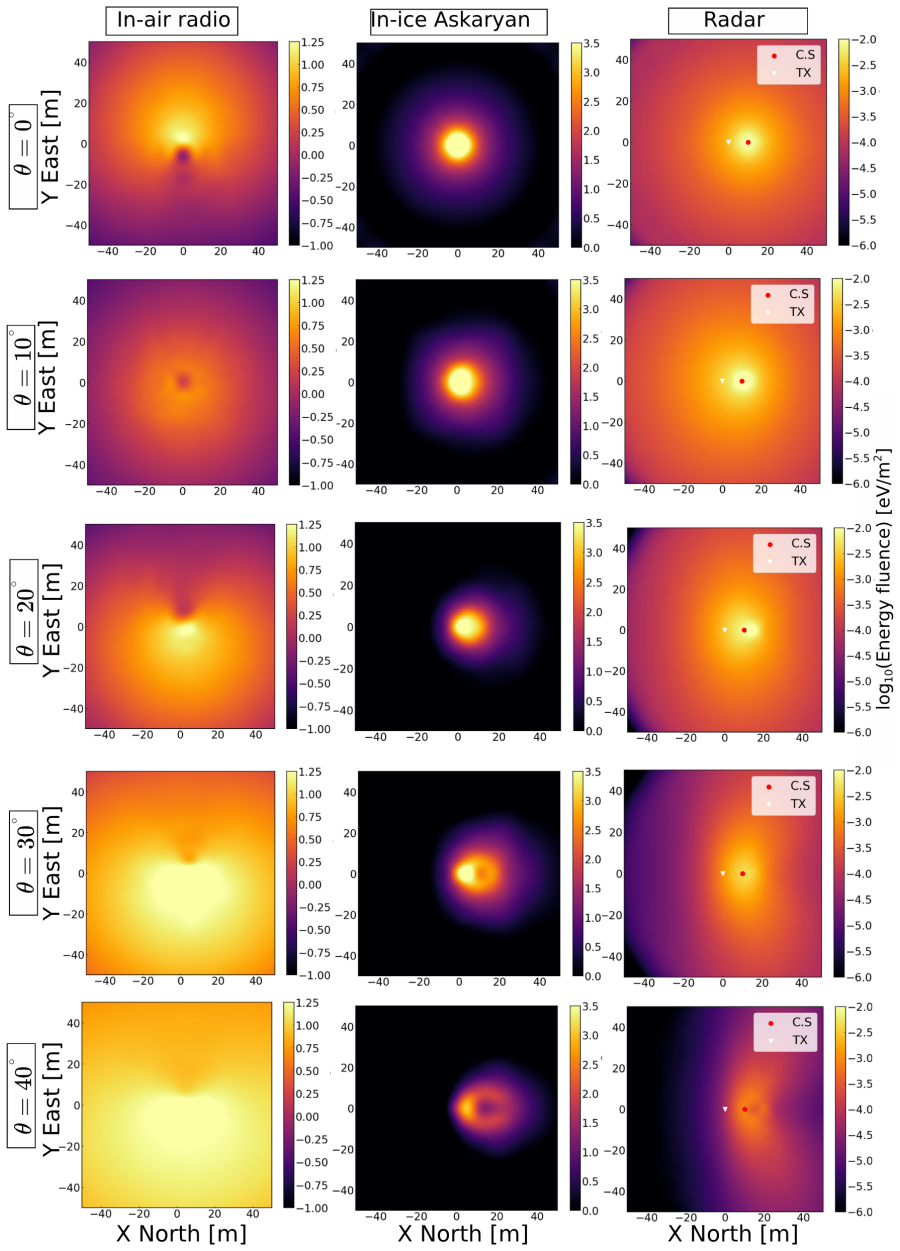
- [§3.2.2, Fig. 8, §4] §3.2.2 / Fig. 8: the heat map is built from five discrete zenith angles (0°, 10°, ..., 40°) at a single primary energy (10^18 eV) and two transmitter powers, yet the Conclusion generalizes to detectability 'depending on the cascade geometry' at 136/544 W. Given the known steep geometry dependence (Cherenkov-cone intersection, Doppler shift at r3), the map's coarse sampling makes 'most geometries of interest' hard to evaluate. Please state the azimuthal sampling used in Fig. 8, clarify whether points between the simulated zeniths are interpolated, and indicate how sensitive the >0 dB region boundaries are to the 10° zenith spacing and to the choice of 10^18 eV (e.g., does the conclusion survive at 10^17 eV, the energy used in §3.1–3.2.1?).
minor comments (8)
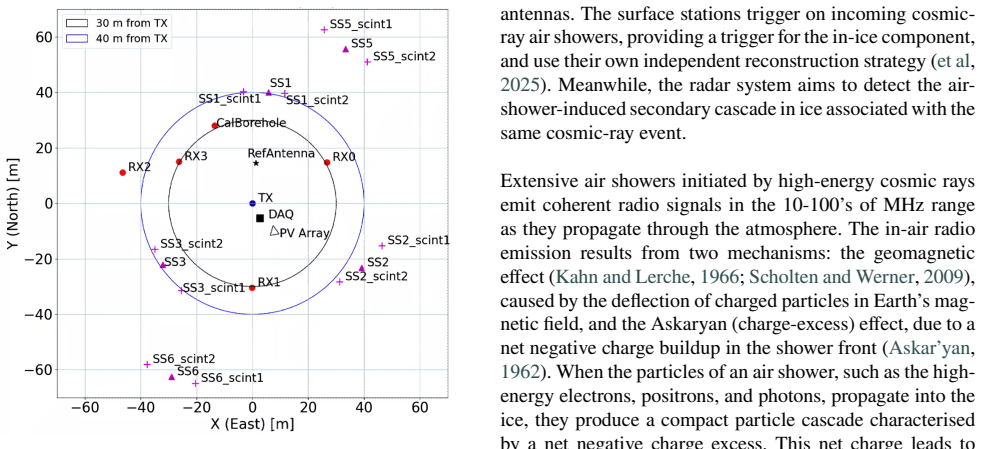
- [§1.1 vs §2.2] §1.1 states a maximum output of 20 W per transmitter element, while §2.2 uses 5 W nominal for the 2024 run (8.5 W effective with gain). Please clarify the discrepancy and add a sentence on how well coherent N² phasing is achieved in practice, since the 136/544 W figures enter the detectability conclusions directly.
- [Fig. 7 caption] The caption of Fig. 7 says the receivers 'are located on the ice surface,' but §3.2.2 and Fig. 3(iii) place all antennas at 10 m depth. Please correct the caption.
- [§3.3, Fig. 9] §3.3 states a 100–300 MHz bandpass to match the RET in-ice antennas, but Fig. 9 uses 150–250 MHz; the Vrms values are quoted for 200 MHz and 100 MHz bandwidths. Please make the bandwidth choices consistent throughout, or explain why they differ.
- [§3.3] The thermal-noise expression Vrms = √(k_B T R Δf) omits the conventional factor of 4 (i.e., √(4k_BTRΔf)); the quoted 6.33 μV corresponds to the former convention. Either convention is defensible for an available-power estimate, but please state which is used and why.
- [References; §1.1] Reference 'et al, G., 2025' (surface-station reconstruction, PoS 274) has a placeholder author name; please fix. Also 'output of of 20 W' in §1.1 is a typo.
- [§3.3, Eq. (2)] Eq. (2): L_eff is written as a function of (Θ, Φ) but depends only on Θ; either drop Φ or note the assumed azimuthal symmetry explicitly. Relatedly, since L_eff has no frequency dependence, a sentence noting how this affects the Fig. 9 spectra relative to a real LPDA/dipole response would help readers calibrate the 'first-order' caveat.
- [Figs. 4, 6, 11] Figs. 4, 6, 11: the scaling factors applied 'for clarity' (0.1 for radio, 10 for radar) are disclosed, which is good practice; consider also stating absolute peak field strengths for one representative trace in the text so readers can anchor amplitudes without reading off scaled axes.
- [Fig. 8] Fig. 8: the transmitter marker and shower-core marker are defined, but the angular/radial coordinates of the heat map (azimuth relative to +X vs. polar angle) could be labeled more explicitly; as drawn it takes effort to connect the map to the Fig. 3(iii) geometry.
Circularity Check
Forward multi-physics simulation; no prediction reduces to its inputs by construction.
full rationale
The paper builds a combined simulation chain (FAERIE/CORSIKA–Geant4 for in-air and in-ice radio; MARES for radar echoes) and reports electric-field traces, spectra, arrival-time differences, and a narrow-band power-ratio heat map over geometry. Those outputs are Monte Carlo / semi-analytic forward predictions under stated modeling choices (plasma lifetime 10 ns, NKG-informed cascade parameters matched to Geant4 deposits, single propagation path in MARES, simplified dipole response). Nothing is fitted to RET-CR echo-search data and then re-presented as a prediction of the same data; there is no uniqueness theorem, no ansatz smuggled in as a forced result, and no renaming of an empirical pattern as a derivation. Self-citations (FAERIE, MARES, SLAC T-576, RET-CR layout) supply codes, lab validation, and experimental context—they do not make the reported radar-vs-Askaryan ratios true by definition. Modeling limitations (single-path illumination, approximate cascade matching) affect correctness risk, not circularity. Score 0; steps empty.
Axiom & Free-Parameter Ledger
free parameters (5)
- plasma_lifetime =
10 ns
- transmitter_power_configs =
136 W and 544 W
- CORSIKA_thinning =
ε=1e-6, w_max=100
- simplified_L_eff_antenna =
sin²(Θ), bandpass 150–250 MHz
- thermal_noise_T_R =
T=290 K, R=50 Ω
axioms (5)
- domain assumption Endpoint formalism (as in CoREAS) correctly computes radio emission from air and in-ice cascades at the observer.
- domain assumption Macroscopic MARES radar scattering on an NKG-like ionization profile adequately represents the echo from the Geant4 cascade.
- domain assumption Greenland firn refractive-index / density profile from Deaconu et al. 2018 and the five-layer GDAS atmosphere in Table 1 describe the RET-CR site.
- ad hoc to paper Only one of direct or surface-reflected illumination is needed per MARES run; multi-path coherent interference before scatter can be neglected for this study.
- domain assumption Far-field Cherenkov-cone parameterizations (e.g. AMVZ) do not apply at RET-CR shallow depths; geometry-dependent interference must be simulated microscopically.
Cite this review
Pith. "Pith review of Simulation of combined radio and radar signals at the Radar Echo Telescope for Cosmic Rays." pith.science (2026). https://pith.science/paper/5ANQXLIA
@misc{pith2026260724955,
  author       = {Pith},
  title        = {Pith review of: Simulation of combined radio and radar signals at the Radar Echo Telescope for Cosmic Rays},
  year         = {2026},
  howpublished = {\url{https://pith.science/paper/5ANQXLIA}},
  note         = {Machine review of arXiv:2607.24955}
}
read the original abstract
To explore neutrino astronomy at high energies (> 10 PeV), the Radar Echo Telescope for Cosmic Rays (RET-CR) was developed to assess the feasibility of a radar technique for detecting particle cascades in ice, serving as a precursor to the Radar Echo Telescope for Neutrinos (RET-N). The main concept of RET-CR is that, as a high-energy cosmic-ray air-shower core propagates into the high-altitude ice sheet, a dense secondary-particle cascade is created, which is very similar to that of an in-ice high-energy neutrino-induced cascade. At RET-CR, the expected signal consists of three distinct components: radio emission from the in-air particle shower, Askaryan radio emission from the secondary in-ice cascade, and the radar signal itself arising from the reflection of the transmitted radio signal from the ionisation trail of the in-ice secondary cascade. In this work, we present the first combined simulation-based package and study aimed at characterising the combined radio and radar signals at the in-ice receivers at RET-CR. We describe the simulation framework and provide a detailed discussion of the salient features of the radio and radar signals, including their spatial footprints and temporal characteristics, as predicted for the shallow in-ice detectors.
Figures


Reference graph
Works this paper leans on
-
[1]
High-Energy Neutrino Astrophysics , volume =
Learned, John and Mannheim, Kai , year =. High-Energy Neutrino Astrophysics , volume =. Annual Review of Nuclear and Particle Science , doi =
-
[2]
and Klein, S
Halzen, F. and Klein, S. R. , title =. Rev. Sci. Instrum. , volume =. 2010 , pages =
2010
-
[3]
Aartsen, M. G. and others. Evidence for High-Energy Extraterrestrial Neutrinos at the IceCube Detector. Science. 2013. doi:10.1126/science.1242856. arXiv:1311.5238
Pith/arXiv arXiv 2013
-
[4]
Observation of High-Energy Astrophysical Neutrinos in Three Years of IceCube Data , author =. Phys. Rev. Lett. , volume =. 2014 , month =. doi:10.1103/PhysRevLett.113.101101 , url =
-
[5]
2025 , pages =
Observation of an ultra-high-energy cosmic neutrino with KM3NeT , journal =. 2025 , pages =
2025
-
[6]
Askar'yan, G. A. , title =. Sov. Phys. JETP , volume =. 1962 , pages =
1962
-
[7]
Askar'yan, G. A. , title =. Sov. Phys. JETP , volume =. 1965 , pages =
1965
-
[8]
The Giant Radio Array for Neutrino Detection (GRAND): Science and Design , journal =
Alvarez-Mu. The Giant Radio Array for Neutrino Detection (GRAND): Science and Design , journal =. 2020 , pages =. doi:10.1007/s11433-018-9385-7 , eprint =
-
[9]
and others , title =
Allison, P. and others , title =. Phys. Rev. D , volume =. 2020 , pages =
2020
-
[10]
Barwick, S. W. and others. Radio detection of air showers with the ARIANNA experiment on the Ross Ice Shelf. Astropart. Phys. 2017. doi:10.1016/j.astropartphys.2017.02.003. arXiv:1612.04473
Pith/arXiv arXiv 2017
-
[11]
Aguilar, J. A. and others , title =. J. Instrum. , volume =. 2021 , pages =
2021
-
[12]
Observation of Radar Echoes from High-Energy Particle Cascades , author =. Phys. Rev. Lett. , volume =. 2020 , month =. doi:10.1103/PhysRevLett.124.091101 , url =
-
[13]
and others , title =
Prohira, S. and others , title =. Phys. Rev. D , volume =. 2021 , pages =
2021
-
[14]
Prohira, S. and others , title =. Physical Review D , issn =. 2019 , month =. doi:10.1103/PhysRevD.100.072003 , url =
-
[15]
and others , title =
Allison, P. and others , title =. 2024 , eprint =
2024
-
[16]
Proceedings of the Royal Society of London Series A , year = 1966, month = jan, volume =
Radiation from Cosmic Ray Air Showers. Proceedings of the Royal Society of London Series A , year = 1966, month = jan, volume =. doi:10.1098/rspa.1966.0007 , adsurl =
arXiv 1966
-
[17]
Simulation of radio signals from cosmic-ray cascades in air and ice as observed by in-ice Askaryan radio detectors , author =. Phys. Rev. D , volume =. 2024 , month =. doi:10.1103/PhysRevD.110.023010 , url =
-
[18]
Huege, T. and Ludwig, M. and James, C. W. , title =. AIP Conf. Proc. , volume =. 2013 , pages =. doi:10.1063/1.4807534 , eprint =
-
[19]
and others , title =
Agostinelli, S. and others , title =. Nucl. Instrum. Meth. A , volume =. 2003 , pages =
2003
-
[20]
Macroscopic approach to the radar echo scatter from high-energy particle cascades , author =. Phys. Rev. D , volume =. 2024 , month =. doi:10.1103/PhysRevD.109.083012 , url =
-
[21]
and others , title =
Heck, D. and others , title =
-
[22]
James, C. W. and Falcke, H. and Huege, T. and Ludwig, M. , title =. Phys. Rev. E , volume =. 2011 , pages =. 1007.4146 , archivePrefix =
Pith/arXiv arXiv 2011
-
[23]
Deaconu, C. and others , title =. Phys. Rev. D , volume =. 2018 , pages =. doi:10.1103/PhysRevD.98.043010 , eprint =
-
[24]
and others , title =
Avva, J. and others , title =. J. Glaciol. , volume =. 2015 , pages =
2015
-
[25]
and Glaser, C
Coleman, A. and Glaser, C. and Barwick, S. and Besson, D. , title =. Astropart. Phys. , year =
-
[26]
and Kamata, K
Nishimura, J. and Kamata, K. , title =. Prog. Theor. Phys. Suppl. , volume =. 1958 , pages =
1958
-
[27]
High Energy Cosmic Ray reconstructions using the surface stations of the Radar Echo Telescope (RET) , doi =
Gopinath.K.N et al , year =. High Energy Cosmic Ray reconstructions using the surface stations of the Radar Echo Telescope (RET) , doi =
-
[28]
and Chen, C.-C
Hu, C.-Y. and Chen, C.-C. and Chen, P. , title =. 2010 , eprint =
2010
-
[29]
EPJ Web of Conferences , volume =
Haungs, Andreas for the IceCube Collaboration , title =. EPJ Web of Conferences , volume =. 2019 , doi =
2019
-
[30]
Wilson, J. G. and Greisen, K. , year =. Progress in
-
[31]
2023 , howpublished =
Latif, Uzair , title =. 2023 , howpublished =
2023
-
[32]
arXiv preprint arXiv:1810.01780 , year =
Winchen, Tobias , title =. arXiv preprint arXiv:1810.01780 , year =
-
[33]
and others , title =
de Vries, Krijn D. and others , title =. Astroparticle Physics , volume =. 2016 , doi =
2016
-
[34]
and de Vries, Krijn D
De Kockere, Simon and van Eijndhoven, Nick and Latif, Uzair A. and de Vries, Krijn D. , title =. Physical Review D , volume =. 2022 , doi =
2022
-
[35]
Nuclear Instruments and Methods in Physics Research Section A: Accelerators, Spectrometers, Detectors and Associated Equipment , volume =
Scholten, Olaf and Werner, Klaus , title =. Nuclear Instruments and Methods in Physics Research Section A: Accelerators, Spectrometers, Detectors and Associated Equipment , volume =. 2009 , doi =
2009
-
[36]
Proceedings of Science , volume =
Frikken, Dylan for the RET Collaboration , title =. Proceedings of Science , volume =. 2024 , publisher =
2024
-
[37]
Proceedings of Science: 39th International Cosmic Ray Conference (ICRC2025) , series =
Dylan Frikken , title =. Proceedings of Science: 39th International Cosmic Ray Conference (ICRC2025) , series =. 2025 , doi =
2025
-
[38]
2017 , series =
Anne Zilles , title =. 2017 , series =
2017
-
[39]
Alden, N. and others. Observation of In-Ice Askaryan Radiation from High-Energy Cosmic Rays. Phys. Rev. Lett. 2026. doi:10.1103/xwqy-yzrk. arXiv:2510.21104
Pith/arXiv arXiv 2026
-
[40]
Physical Review D—Particles, Fields, Gravitation, and Cosmology , volume=
Coherent radio pulses from showers in different media: A unified parametrization , author=. Physical Review D—Particles, Fields, Gravitation, and Cosmology , volume=. 2006 , publisher=
2006
-
[41]
Ackermann, Markus et al. , title =. Journal of High Energy Astrophysics , volume =. 2022 , doi =. 2203.08096 , archivePrefix =
Pith/arXiv arXiv 2022
-
[42]
Modelling
Loudon, Isha et al , month = jun, year =. Modelling. PoS , volume =
discussion (0)
Sign in with ORCID, Apple, or X to comment. Anyone can read and Pith papers without signing in.