REVIEW 3 major objections 4 minor 61 references
Momentum Dependence of the Nematic Order Parameter in Iron-Based Superconductors
T0 review · 3 major / 4 minor · reviewed 2026-08-14 · deepseek-v4-flash
Pith's one-line read The nematic order parameter has the same momentum dependence in FeSe and BaFe2As2, with a sign change between the Brillouin-zone center and the corner, implying a common microscopic mechanism for nematicity in iron-based superconductors.
desk verdict First strain-tuned ARPES on BaFe2As2 measures a momentum-resolved nematic splitting with a sign change, and the comparison with FeSe is suggestive—but the universality claim leans on an untested k-independence assumption. read the letter →
The pith
A machine-rendered reading of the paper's core claim, the machinery that carries it, and where it could break.
The reading
What carries the argument
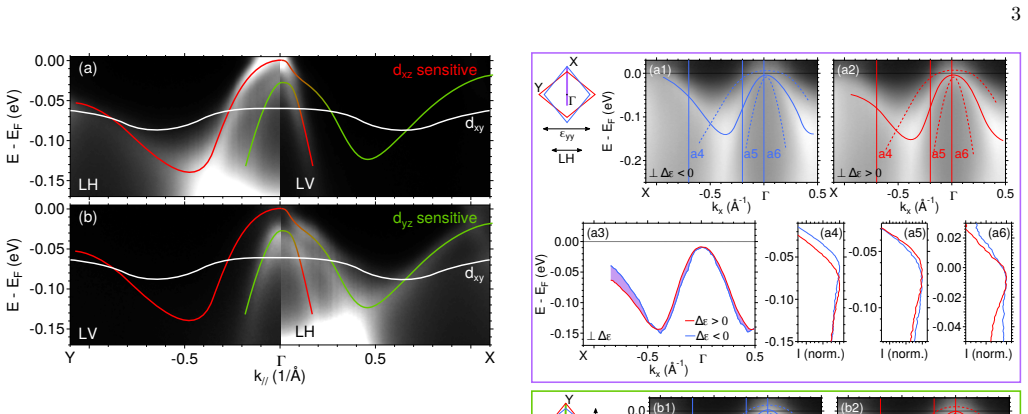
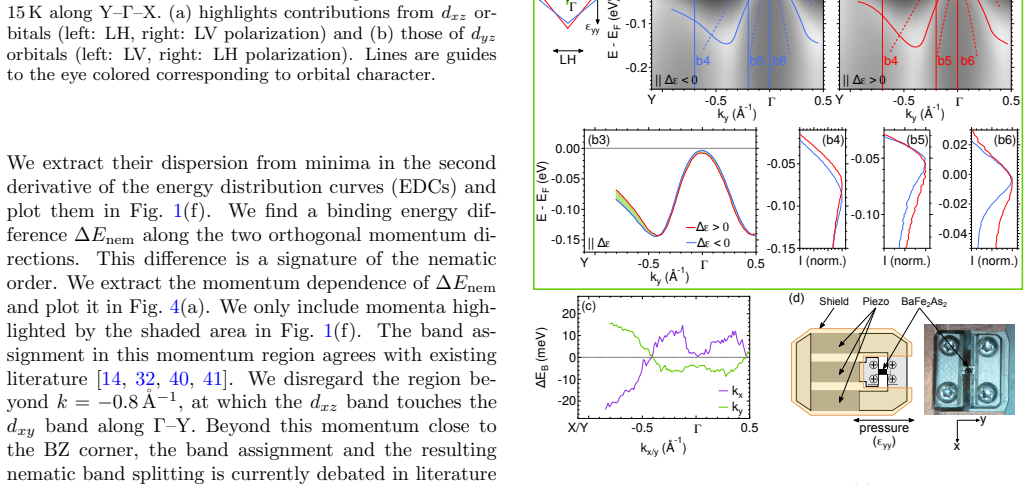
The central object is the momentum-resolved nematic order parameter $\varphi_{\rm nem}(k)$, defined experimentally as the difference in binding energy of the $d_{xz}$/$d_{yz}$ hole bands along two orthogonal momentum directions, $\Delta E_{\rm nem}(k) = E(k_x)-E(k_y)$. The load-bearing relation is the linear Ginzburg-Landau coupling between antisymmetric (B$_{2g}$) strain and the nematic order parameter, which makes it legitimate to measure the strain-induced splitting in the paramagnetic state of BaFe2As2 above $T_{\rm nem}$ and compare it, normalized by orthorhombic distortion $\delta$, with the spontaneous splitting in FeSe. The sign change in $\Delta E_{\rm nem}(k)$ is extracted from the middle hole band, whose pure orbital character at high-symmetry points guarantees that the band shift is proportional to $\varphi_{\rm nem}(k)$ there, and spin-orbit coupling is handled separately because it zeros $\Delta E_{\rm nem}$ at $\Gamma$ while $\varphi_{\rm nem}$ stays nonzero.
What would settle it
Apply the same strain-tunable ARPES measurement to BaFe2As2 at several strain magnitudes and check whether $\Delta E_{\rm nem}(k)/\delta$ is independent of $\delta$ for every momentum; any deviation would show that the proportionality is not momentum-independent. Alternatively, measure a fully detwinned BaFe2As2 crystal below $T_{\rm nem}$ and verify that the sign-change pattern in the spontaneous order matches the strained-paramagnetic response; a mismatch would falsify the common-momentum-dependence claim.
Extended reading notes
Core claim
The central discovery is that the momentum dependence of the nematic order parameter is not material-specific: $\varphi_{\rm nem}(k_x,k_y) = \varphi_0 f(k)$ has the same functional form $f(k)$ in FeSe and BaFe2As2, with a sign change between the center and the corner of the Brillouin zone. In FeSe, the spontaneous splitting below $T_{\rm nem}$ is measured on a detwinned crystal; in BaFe2As2 above $T_{\rm nem}$, tunable uniaxial strain induces a band splitting whose antisymmetric B$_{2g}$ part $\Delta E_{\rm nem}(k) = [\Delta E_B(k_y) - \Delta E_B(k_x)]/2$ is the strain-proportional equivalent. Away from the zone center, where spin-orbit coupling does not mix the $d_{xz}$ and $d_{yz}$ bands, $\Delta E_{\rm nem}(k)$ directly equals $\varphi_{\rm nem}(k)$. The sign change occurs near $|k| = 0.3\,\text{Å}^{-1}$, and $|\varphi_{\rm nem}|$ is about twice as large at the Brillouin-zone corner as at the center, where $\varphi_{\rm nem}(\Gamma) \approx 17$ meV for FeSe after accounting for spin-orbit coupling.
Load-bearing premise
The comparison rests on the assumption that the strain-induced band splitting in BaFe2As2 is proportional to the equilibrium nematic order parameter with a momentum-independent proportionality constant; if the strain coupling is momentum-dependent, the comparison with the spontaneous FeSe splitting is invalid and the claimed universality would collapse.
Editorial extensions
If this is right
- FeSe and BaFe2As2 share the same microscopic driver of nematic order, meaning theories must explain both materials with a single mechanism.
- Pure on-site ferro-orbital order is excluded for both systems, since it cannot produce the observed sign change.
- Candidate models (bond-orbital order, Pomeranchuk instabilities, orbital-selective spin fluctuations, frustrated magnetism, and spin-driven Ising-nematic order) must now reproduce the sign change near $|k| \approx 0.3\,\text{Å}^{-1}$.
- The comparable magnitude of the normalized nematic susceptibility $\Delta E_{\rm nem}/\delta$ indicates similar nematic coupling strengths in the two compounds.
- The sign-changing order parameter creates a d-wave-like Fermi-surface distortion that could be reflected in superconducting pairing anisotropies.
Reading between the lines
- The same strain-tunable ARPES approach could be applied to other iron-based superconductors (e.g., LiFeAs or Co-doped BaFe2As2) to test whether the sign-changing momentum profile is truly universal; a deviation in any of them would bound the universality claim.
- If the nematic order parameter's momentum dependence is universal, it likely imprints on the superconducting gap through orbital or spin-fluctuation pairing, so measuring the gap's sign structure would provide an independent cross-check.
- The analysis excludes the region beyond the $d_{xz}$–$d_{xy}$ crossing near the Brillouin-zone corner, so a future measurement with different photon energies or higher resolution could reveal whether the sign change persists into that region or is modified by band hybridisation.
Signed reviews
Editorial analysis
A structured set of objections, weighed in public.
Referee Report
Summary. The manuscript reports ARPES measurements of the momentum-dependent nematic band splitting in FeSe (T = 15 K, detwinned) and in BaFe2As2 (T = 160 K > T_nem, under tunable uniaxial strain). The authors define the nematic band splitting ΔE_nem(k) as half the difference between the binding-energy shifts along the two orthogonal in-plane directions and identify it with the momentum-resolved nematic order parameter φ_nem(k), accounting for spin-orbit-coupling effects near Γ. The central experimental result is that ΔE_nem(k) has the same k-dependence in both compounds, with a sign change between the zone center and the zone corner at |k| ≈ 0.3 Å^-1. On this basis the authors conclude that the same microscopic mechanism drives nematic order in Fe-based superconductors with and without magnetism.
Significance. If the comparison is valid, this is a significant experimental result: it extends the momentum-resolved characterization of nematicity from FeSe to a magnetic Fe-pnictide, provides a direct constraint that rules out purely on-site ferro-orbital order, and introduces a piezoelectric strain platform for ARPES that will be useful beyond this specific pair of compounds. The paper's strengths are the controlled detwinning/strain protocol, the direct extraction of band dispersions without fitting a model, and the explicit treatment of the distinction between ΔE_nem(k) and φ_nem(k) near Γ. The principal weakness is that the central FeSe/BaFe2As2 comparison rests on an assumption of momentum-independent proportionality between the strain-induced splitting and the equilibrium order parameter, which is not directly established by the data or by the cited bulk thermodynamic reference.
major comments (3)
- [Fig. 4(a,b) and text near Fig. 3] The central comparison assumes that the strain-induced splitting ΔE_nem(k) = [ΔE_B(k_y) - ΔE_B(k_x)]/2 measured in BaFe2As2 at 160 K is proportional to the equilibrium nematic order parameter φ_nem(k) with a k-independent coefficient. The linear coupling of a uniform antisymmetric strain to the B2g order parameter (Ref. 28) does not by itself guarantee this: the induced momentum-resolved splitting is in general a convolution of the bare electron-strain coupling g(k') with the nematic susceptibility χ(k,k'), and a k-dependent g(k') (for instance from strain-modulated hopping or bond-order terms) would imprint its own structure on the measured profile. Ref. 28 is a bulk thermodynamic measurement and cannot certify k-independence of g(k'). Because the zero crossing at |k| ≈ 0.3 Å^-1 and the claimed form-factor identity between the two compounds are read directly from this strain-induced profile, this assumption is load-bearing. Please provide a microscopic estimate or symmetry argument for g(k), perform a control measurement (for example on a second compound or with a different strain geometry), or explicitly reframe the conclusion as applying to the strain-induced susceptibility response and discuss how a k-dependent g could shift the crossing.
- [Page 3, text near 'We disregard the region beyond k = -0.8 Å^-1' and Fig. 4(a)] The manuscript acknowledges that the band assignment and the resulting splitting beyond |k| = 0.8 Å^-1 are debated in the literature and excludes that region from the analysis, yet the abstract and conclusions state a sign change 'between the BZ center and the BZ corner.' The measured zero crossing at |k| ≈ 0.3 Å^-1 lies outside the excluded region, so the sign-change claim is not invalidated by this exclusion. However, the statement that '|φ_nem| is approximately twice as large at the BZ corner' and the assertion that the functional form is 'the same' in both compounds rely on data near the edge of, or extrapolating beyond, the included window. Please either restrict the claims to the measured k-range or provide a quantitative analysis of the band-crossing region showing that the form-factor and magnitude statements are insensitive to the band-assignment ambiguity.
- [Fig. 4(a,b), comparison of ΔE_nem/δ] The comparison of normalized magnitudes between FeSe and BaFe2As2 via ΔE_nem/δ assumes that the proportionality between the applied/measured strain δ and the induced band splitting is the same in both materials, or at least that residual differences do not affect the order-of-magnitude statement. Since the electron-strain coupling and the nematic susceptibility are material-specific, the claim that the two compounds have 'a similar strength of the nematic order' is not established to the same standard as the sign-change claim. This does not affect the central sign-change result, but the magnitude comparison should be softened or supported by an explicit discussion of the material-dependent couplings.
minor comments (4)
- [Acknowledgements, page 7] The name 'R. Fernendes' appears to be a typo and should read 'R. Fernandes.'
- [Fig. 4(a,b)] Only 'representative error bars' are shown; please state how the errors were estimated and, if possible, show error bars for all points or a typical error envelope, since the comparison of the shapes of the two curves is central to the paper.
- [Page 4, near 'we estimate δ = Δl/2l = 0.08%'] Please clarify whether Δl/l is the total length change or the antisymmetric strain component; for uniaxial stress the antisymmetric strain involves the Poisson ratio, so this normalization could change the magnitudes in Fig. 4(b) by an O(1) factor.
- [Fig. 1(f) and Fig. 4(a)] The axis label 'X/Y -0.5 Γ' is ambiguous; a reader may not immediately see that the Γ–X and Γ–Y dispersions are plotted on the same negative-k axis. Please make the legend and axis annotation self-explanatory.
Circularity Check
No significant circularity: the nematic band splitting is directly measured and compared, with no fitted parameter renamed as a prediction.
full rationale
The paper's central claim is an experimental comparison of the momentum-dependent nematic band splitting ΔEnem(k) measured by ARPES in FeSe (spontaneous, T < T_nem) and BaFe2As2 (strain-induced, T > T_nem). The order parameter φ_nem(k) is defined as the measured difference in binding energy between orthogonal momentum directions (Fig. 4c3), so the extracted momentum profile is a direct observable, not the output of a fitted model. No parameter is fitted to a subset of data and then 'predicted.' The strain-induced splitting in BaFe2As2 is analyzed as ΔEnem(k) = [ΔEB(ky) − ΔEB(kx)]/2, relying on the antisymmetric-strain coupling to the B2g order parameter; this coupling is taken from prior experimental work (Ref. 28) and is not derived from or fit to the present data. The comparison of ΔEnem/δ between the two compounds normalizes by independently determined distortions δ, and the paper explicitly lists caveats (different T/T_nem, orbital admixture, SOC near Γ). The skeptic's concern that the electron-strain coupling could be momentum dependent is a substantive assumption about the validity of the comparison, but it is not a circular reduction: the manuscript does not use the FeSe profile to construct the BaFe2As2 result, nor vice versa. Self-citations (Refs. 25, 28, 41) provide supporting experimental context but do not carry a derived conclusion whose premises already contain the conclusion. Accordingly, no circular step meeting the evidence threshold can be identified.
Assumptions & free parameters
assumptions (4)
- domain assumption ARPES at 37 eV (FeSe) and 47 eV (BaFe2As2) probes kz close to the Brillouin zone center.
- domain assumption The middle hole band has pure orbital character (dyz along Gamma-X, dxz along Gamma-Y) at high-symmetry points.
- domain assumption Antisymmetric strain (epsilon_yy-epsilon_xx)/2 couples linearly to the nematic order parameter with a k-independent coupling.
- domain assumption No strain-induced magnetic order is present at 160 K in BaFe2As2.
Cite this review
Pith. "Pith review of Momentum Dependence of the Nematic Order Parameter in Iron-Based Superconductors." pith.science (2026). https://pith.science/paper/5ARBHXC3
@misc{pith2026190802790,
  author       = {Pith},
  title        = {Pith review of: Momentum Dependence of the Nematic Order Parameter in Iron-Based Superconductors},
  year         = {2026},
  howpublished = {\url{https://pith.science/paper/5ARBHXC3}},
  note         = {Machine review of arXiv:1908.02790}
}
abstract
The momentum dependence of the nematic order parameter is an important ingredient in the microscopic description of iron-based high-temperature superconductors. While recent reports on FeSe indicate that the nematic order parameter changes sign between electron and hole bands, detailed knowledge is still missing for other compounds. Combining angle-resolved photoemission spectroscopy (ARPES) with uniaxial strain tuning, we measure the nematic band splitting in both FeSe and BaFe$_2$As$_2$ without interference from either twinning or magnetic order. We find that the nematic order parameter exhibits the same momentum dependence in both compounds with a sign change between the Brillouin center and the corner. This suggests that the same microscopic mechanism drives the nematic order in spite of the very different phase diagrams.
Figures

Figures from the paper (1 more)

Reference graph
Works this paper leans on
-
[1]
Y. Ando, K. Segawa, S. Komiya, and A. N. Lavrov, Phys. Rev. Lett. 88, 137005 (2002)
work page 2002
-
[2]
Y. Kasahara, Y. Shimono, T. Shibauchi, Y. Matsuda, S. Yonezawa, Y. Muraoka, and Z. Hiroi, Phys. Rev. Lett. 96, 247004 (2006)
work page 2006
-
[3]
A. J. Achkar, M. Zwiebler, C. McMahon, F. He, R. Su- tarto, I. Djianto, Z. Hao, M. J. P. Gingras, M. H¨ ucker, G. D. Gu, A. Revcolevschi, H. Zhang, Y.-J. Kim, J. Geck, and D. G. Hawthorn, Science 351, 576 (2016)
work page 2016
-
[4]
F. Ronning, T. Helm, K. R. Shirer, M. D. Bachmann, L. Balicas, M. K. Chan, B. J. Ramshaw, R. D. McDonald, F. F. Balakirev, M. Jaime, E. D. Bauer, and P. J. W. Moll, Nature 548, 313 (2017)
work page 2017
-
[5]
Paglione and R
J. Paglione and R. L. Greene, Nat. Phys. 6, 645 (2010)
2010
-
[6]
D. C. Johnston, Adv. Phys. 59, 803 (2010)
2010
- [7]
-
[8]
R. M. Fernandes, A. V. Chubukov, and J. Schmalian, Nat. Phys. 10, 97 (2014)
work page 2014
Show all 61 references
-
[9]
S.-H. Baek, D. V. Efremov, J. M. Ok, J. S. Kim, J. van den Brink, and B. Bchner, Nat. Mater. 14, 210 6 (2015)
2015
-
[10]
A. E. B¨ ohmer, P. Burger, F. Hardy, T. Wolf, P. Schweiss, R. Fromknecht, M. Reinecker, W. Schranz, and C. Mein- gast, Phys. Rev. Lett. 112, 047001 (2014)
2014
-
[11]
M. Yi, Y. Zhang, Z.-X. Shen, and D. Lu, npj Quantum Materials 2, 57 (2017)
2017
-
[12]
T. M. McQueen, A. J. Williams, P. W. Stephens, J. Tao, Y. Zhu, V. Ksenofontov, F. Casper, C. Felser, and R. J. Cava, Phys. Rev. Lett. 103, 057002 (2009)
2009
-
[13]
Zhang, M
Y. Zhang, M. Yi, Z.-K. Liu, W. Li, J. J. Lee, R. G. Moore, M. Hashimoto, M. Nakajima, H. Eisaki, S.-K. Mo, Z. Hussain, T. P. Devereaux, Z.-X. Shen, and D. H. Lu, Phys. Rev. B 94, 115153 (2016)
2016
-
[14]
Suzuki, T
Y. Suzuki, T. Shimojima, T. Sonobe, A. Naka- mura, M. Sakano, H. Tsuji, J. Omachi, K. Yoshioka, M. Kuwata-Gonokami, T. Watashige, R. Kobayashi, S. Kasahara, T. Shibauchi, Y. Matsuda, Y. Yamakawa, H. Kontani, and K. Ishizaka, Phys. Rev. B 92, 205117 (2015)
2015
-
[15]
M. G. Kim, R. M. Fernandes, A. Kreyssig, J. W. Kim, A. Thaler, S. L. Bud’ko, P. C. Canfield, R. J. McQueeney, J. Schmalian, and A. I. Goldman, Phys. Rev. B 83, 134522 (2011)
2011
-
[16]
Hsieh, Y
D. Hsieh, Y. Xia, L. Wray, D. Qian, K. Gomes, A. Yaz- dani, G. F. Chen, J. L. Luo, N. L. Wang, and M. Z. Hasan, arXiv:0812.2289v1
-
[17]
L. X. Yang, Y. Zhang, H. W. Ou, J. F. Zhao, D. W. Shen, B. Zhou, J. Wei, F. Chen, M. Xu, C. He, Y. Chen, Z. D. Wang, X. F. Wang, T. Wu, G. Wu, X. H. Chen, M. Arita, K. Shimada, M. Taniguchi, Z. Y. Lu, T. Xiang, and D. L. Feng, Phys. Rev. Lett. 102, 107002 (2009)
2009
-
[18]
M. Yi, D. H. Lu, J. G. Analytis, J.-H. Chu, S.-K. Mo, R.-H. He, M. Hashimoto, R. G. Moore, I. I. Mazin, D. J. Singh, Z. Hussain, I. R. Fisher, and Z.-X. Shen, Phys. Rev. B 80, 174510 (2009)
2009
-
[19]
M. Yi, D. Lu, J.-H. Chu, J. G. Analytis, A. P. Sorini, A. F. Kemper, B. Moritz, S.-K. Mo, R. G. Moore, M. Hashimoto, W.-S. Lee, Z. Hussain, T. P. Devereaux, I. R. Fisher, and Z.-X. Shen, Proc. Natl. Acad. Sci. U.S.A. 108, 6878 (2011)
2011
-
[20]
Y. Kim, H. Oh, C. Kim, D. Song, W. Jung, B. Kim, H. J. Choi, C. Kim, B. Lee, S. Khim, H. Kim, K. Kim, J. Hong, and Y. Kwon, Phys. Rev. B 83, 064509 (2011)
2011
-
[21]
Q. Wang, Z. Sun, E. Rotenberg, F. Ronning, E. D. Bauer, H. Lin, R. S. Markiewicz, M. Lindroos, B. Barbiellini, A. Bansil, and D. S. Dessau, Phys. Rev. B 88, 235125 (2013)
2013
-
[22]
G. Liu, H. Liu, L. Zhao, W. Zhang, X. Jia, J. Meng, X. Dong, J. Zhang, G. F. Chen, G. Wang, Y. Zhou, Y. Zhu, X. Wang, Z. Xu, C. Chen, and X. J. Zhou, Phys. Rev. B 80, 134519 (2009)
2009
-
[23]
Kondo, R
T. Kondo, R. M. Fernandes, R. Khasanov, C. Liu, A. D. Palczewski, N. Ni, M. Shi, A. Bostwick, E. Roten- berg, J. Schmalian, S. L. Bud’ko, P. C. Canfield, and A. Kaminski, Phys. Rev. B 81, 060507(R) (2010)
2010
-
[24]
Fuglsang Jensen, V
M. Fuglsang Jensen, V. Brouet, E. Papalazarou, A. Nico- laou, A. Taleb-Ibrahimi, P. Le F` evre, F. Bertran, A. For- get, and D. Colson, Phys. Rev. B 84, 014509 (2011)
2011
-
[25]
H. Pfau, C. R. Rotundu, J. C. Palmstrom, S. D. Chen, M. Hashimoto, D. Lu, A. F. Kemper, I. R. Fisher, and Z.-X. Shen, Phys. Rev. B 99, 035118 (2019)
2019
-
[26]
Richard, K
P. Richard, K. Nakayama, T. Sato, M. Neupane, Y.-M. Xu, J. H. Bowen, G. F. Chen, J. L. Luo, N. L. Wang, X. Dai, Z. Fang, H. Ding, and T. Takahashi, Phys. Rev. Lett. 104, 137001 (2010)
2010
-
[27]
Shimojima, K
T. Shimojima, K. Ishizaka, Y. Ishida, N. Katayama, K. Ohgushi, T. Kiss, M. Okawa, T. Togashi, X.-Y. Wang, C.-T. Chen, S. Watanabe, R. Kadota, T. Oguchi, A. Chainani, and S. Shin, Phys. Rev. Lett. 104, 057002 (2010)
2010
-
[28]
Kuo and I
H.-H. Kuo and I. R. Fisher, Phys. Rev. Lett. 112, 227001 (2014)
2014
-
[29]
J.-H. Chu, J. G. Analytis, C. Kucharczyk, and I. R. Fisher, Phys. Rev. B 79, 014506 (2009)
2009
-
[30]
X. F. Wang, T. Wu, G. Wu, H. Chen, Y. L. Xie, J. J. Ying, Y. J. Yan, R. H. Liu, and X. H. Chen, Phys. Rev. Lett. 102, 117005 (2009)
2009
-
[31]
C. R. Rotundu, B. Freelon, T. R. Forrest, S. D. Wilson, P. N. Valdivia, G. Pinuellas, A. Kim, J.-W. Kim, Z. Is- lam, E. Bourret-Courchesne, N. E. Phillips, and R. J. Birgeneau, Phys. Rev. B 82, 144525 (2010)
2010
-
[32]
M. D. Watson, T. K. Kim, A. A. Haghighirad, N. R. Davies, A. McCollam, A. Narayanan, S. F. Blake, Y. L. Chen, S. Ghannadzadeh, A. J. Schofield, M. Hoesch, C. Meingast, T. Wolf, and A. I. Coldea, Phys. Rev. B 91, 155106 (2015)
2015
-
[33]
Brouet, M
V. Brouet, M. Marsi, B. Mansart, A. Nicolaou, A. Taleb- Ibrahimi, P. Le F` evre, F. Bertran, F. Rullier-Albenque, A. Forget, and D. Colson, Phys. Rev. B 80, 165115 (2009)
2009
-
[34]
Zhang, F
Y. Zhang, F. Chen, C. He, B. Zhou, B. P. Xie, C. Fang, W. F. Tsai, X. H. Chen, H. Hayashi, J. Jiang, H. Iwa- sawa, K. Shimada, H. Namatame, M. Taniguchi, J. P. Hu, and D. L. Feng, Phys. Rev. B 83, 054510 (2011)
2011
-
[35]
Brouet, M
V. Brouet, M. F. Jensen, P.-H. Lin, A. Taleb-Ibrahimi, P. Le F` evre, F. Bertran, C.-H. Lin, W. Ku, A. Forget, and D. Colson, Phys. Rev. B 86, 075123 (2012)
2012
-
[36]
T. Chen, Y. Chen, A. Kreisel, X. Lu, A. Schneidewind, Y. Qiu, J. T. Park, T. G. Perring, J. R. Stewart, H. Cao, R. Zhang, Y. Li, Y. Rong, Y. Wei, B. M. Andersen, P. J. Hirschfeld, C. Broholm, and P. Dai, Nature Materials 18, 709 (2019)
2019
-
[37]
C. W. Hicks, M. E. Barber, S. D. Edkins, D. O. Brod- sky, and A. P. Mackenzie, Rev. Sci. Instrum. 85, 065003 (2014)
2014
-
[38]
S. Ricc, M. Kim, A. Tamai, S. McKeown Walker, F. Y. Bruno, I. Cucchi, E. Cappelli, C. Besnard, T. K. Kim, P. Dudin, M. Hoesch, M. J. Gutmann, A. Georges, R. S. Perry, and F. Baumberger, Nature Communications 9, 4535 (2018)
2018
-
[39]
Fl¨ ototto, Y
D. Fl¨ ototto, Y. Bai, Y.-H. Chan, P. Chen, X. Wang, P. Rossi, C.-Z. Xu, C. Zhang, J. A. Hlevyack, J. D. Den- linger, H. Hong, M.-Y. Chou, E. J. Mittemeijer, J. N. Eckstein, and T.-C. Chiang, Nano Lett. 18, 5628 (2018)
2018
-
[40]
Fanfarillo, J
L. Fanfarillo, J. Mansart, P. Toulemonde, H. Cercellier, P. Le F` evre, F. m. c. Bertran, B. Valenzuela, L. Benfatto, and V. Brouet, Phys. Rev. B 94, 155138 (2016)
2016
-
[41]
M. Yi, Y. Zhang, H. Pfau, T. Chen, Z. Ye, M. Hashimoto, R. Yu, Q. Si, D.-H. Lee, P. Dai, Z. X. Shen, D. Lu, and R. J. Birgeneau, arXiv:1903.04557v1
1903 arXiv
-
[42]
Fedorov, A
A. Fedorov, A. Yaresko, T. K. Kim, Y. Kushnirenko, E. Haubold, T. Wolf, M. Hoesch, A. Grneis, B. Bchner, and S. V. Borisenko, Sci. Rep. 6, 36834 (2016)
2016
-
[43]
M. D. Watson, T. K. Kim, L. C. Rhodes, M. Eschrig, M. Hoesch, A. A. Haghighirad, and A. I. Coldea, Phys. Rev. B 94, 201107(R) (2016)
2016
-
[44]
R. M. Fernandes and O. Vafek, Phys. Rev. B 90, 214514 (2014). 7
2014
-
[45]
S. V. Borisenko, D. V. Evtushinsky, Z.-H. Liu, I. Moro- zov, R. Kappenberger, S. Wurmehl, B. Buchner, A. N. Yaresko, T. K. Kim, M. Hoesch, T. Wolf, and N. D. Zhigadlo, Nat Phys 12, 311 (2016)
2016
-
[46]
R. P. Day, G. Levy, M. Michiardi, B. Zwartsenberg, M. Zonno, F. Ji, E. Razzoli, F. Boschini, S. Chi, R. Liang, P. K. Das, I. Vobornik, J. Fujii, W. N. Hardy, D. A. Bonn, I. S. Elfimov, and A. Damascelli, Phys. Rev. Lett. 121, 076401 (2018)
2018
-
[47]
J. C. Palmstrom, A. T. Hristov, S. A. Kivelson, J.-H. Chu, and I. R. Fisher, Phys. Rev. B 96, 205133 (2017)
2017
-
[48]
M. S. Ikeda, T. Worasaran, J. C. Palmstrom, J. A. W. Straquadine, P. Walmsley, and I. R. Fisher, Phys. Rev. B 98, 245133 (2018)
2018
-
[49]
Graser, A
S. Graser, A. F. Kemper, T. A. Maier, H.-P. Cheng, P. J. Hirschfeld, and D. J. Scalapino, Phys. Rev. B 81, 214503 (2010)
2010
-
[50]
Horigane, H
K. Horigane, H. Hiraka, and K. Ohoyama, J. Phys. Soc. Jpn. 78, 074718 (2009)
2009
-
[51]
Huang, Y
Q. Huang, Y. Qiu, W. Bao, M. A. Green, J. W. Lynn, Y. C. Gasparovic, T. Wu, G. Wu, and X. H. Chen, Phys. Rev. Lett. 101, 257003 (2008)
2008
-
[52]
Chu, H.-H
J.-H. Chu, H.-H. Kuo, J. G. Analytis, and I. R. Fisher, Science 337, 710 (2012)
2012
-
[53]
Massat, D
P. Massat, D. Farina, I. Paul, S. Karlsson, P. Strobel, P. Toulemonde, M.-A. M´ easson, M. Cazayous, A. Sacuto, S. Kasahara, T. Shibauchi, Y. Matsuda, and Y. Gallais, Proc. Natl. Acad. Sci. U.S.A. 113, 9177 (2016)
2016
-
[54]
Y. Su, H. Liao, and T. Li, J. Phys.: Condens. Matter 27, 105702 (2015)
2015
-
[55]
Mukherjee, A
S. Mukherjee, A. Kreisel, P. J. Hirschfeld, and B. M. Andersen, Phys. Rev. Lett. 115, 026402 (2015)
2015
-
[56]
Li and Y
T. Li and Y. Su, J. Phys.: Condens. Matter 29, 425603 (2017)
2017
-
[57]
Onari, Y
S. Onari, Y. Yamakawa, and H. Kontani, Phys. Rev. Lett. 116, 227001 (2016)
2016
-
[58]
A. V. Chubukov, M. Khodas, and R. M. Fernandes, Phys. Rev. X 6, 041045 (2016)
2016
-
[59]
F. Wang, S. A. Kivelson, and D.-H. Lee, Nat. Phys. 11, 959 (2015)
2015
-
[60]
R. M. Fernandes, L. H. VanBebber, S. Bhattacharya, P. Chandra, V. Keppens, D. Mandrus, M. A. McGuire, B. C. Sales, A. S. Sefat, and J. Schmalian, Phys. Rev. Lett. 105, 157003 (2010)
2010
-
[61]
Yu and Q
R. Yu and Q. Si, Phys. Rev. Lett. 115, 116401 (2015)
2015
Reviewed August 14, 2026 · model on record in the stance chip above.
Discussion (0). Continue with ORCID to comment.