REVIEW 5 major objections 6 minor 50 references
ADCD-Net: Robust Document Image Forgery Localization via Adaptive DCT Feature and Hierarchical Content Disentanglement
T0 review · 5 major / 6 minor · reviewed 2026-08-06 · deepseek-v4-flash
Pith's one-line read ADCD-Net claims to make document forgery localization robust to cropping, resizing, and recompression by adaptively weighting DCT forensic features.
desk verdict Solid architecture with a genuinely new adaptive DCT-gating idea, but the headline 20.79% robustness gain rests on a figure with no supporting numbers, so the paper needs revision before its central claim can be trusted. read the letter →
The pith
A machine-rendered reading of the paper's core claim, the machinery that carries it, and where it could break.
The reading
What carries the argument
The load-bearing mechanism is the adaptive DCT alignment score: a small classification head on the deepest DCT feature predicts $\hat{s}_{aln}$, which multiplies the DCT feature at every encoder scale before fusion with RGB features (Eq. 1), trained with a cross-entropy loss against labels derived from whether the input was block-aligned. Two document-specific modules carry the rest of the argument: the Hierarchical Content Decoupling module splits each fused feature into content and forgery channels and enforces the split by reconstructing the image and DCT coefficients from content features plus a spatially shuffled forgery stream, and the Pristine Prototype Estimation module computes $\mathbf{p}^i_{prs}$ by averaging forgery features over background pixels identified by an OCR model (Eq. 3), then uses per-pixel cosine similarity to that prototype (Eq. 4) to scale and bias the penultimate feature (Eq. 5).
What would settle it
Take a set of forged documents where tampering is inserted into uniform background areas (or where the OCR mask is systematically wrong), run ADCD-Net with and without the Pristine Prototype Estimation module, and compare F1; if the assumption holds, disabling that module should barely matter on foreground-only forgeries, while background-embedded forgeries should show a measurable drop in the full model relative to the ablated one.
Extended reading notes
Core claim
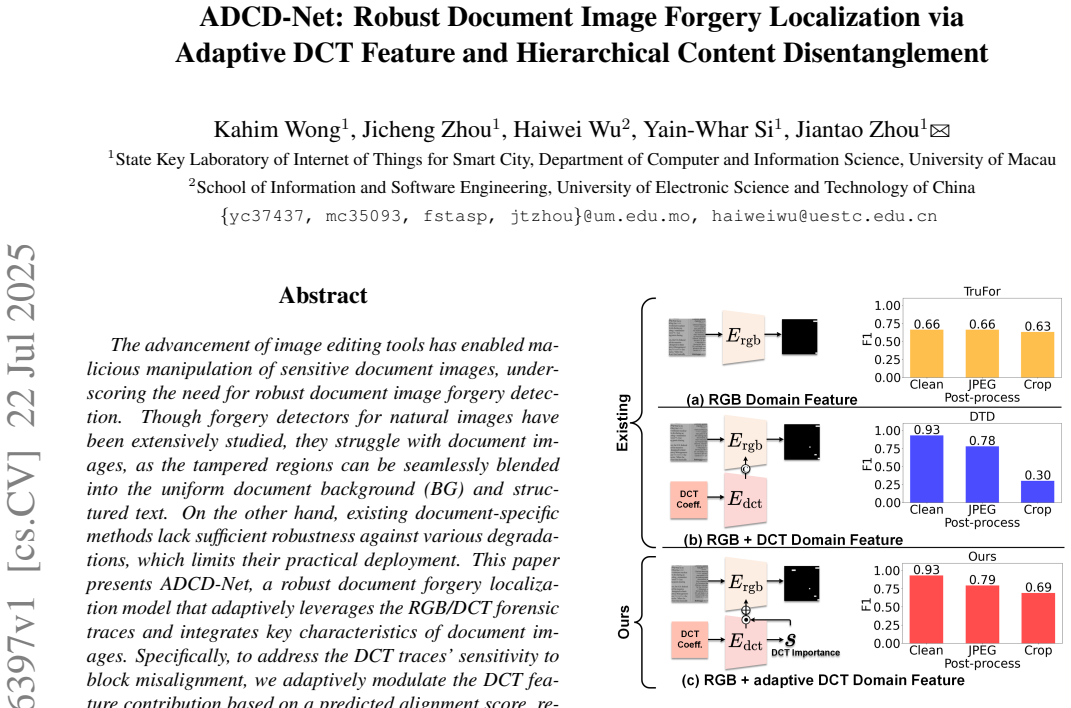
The central claim is that DCT-based forensic features can be made robust rather than discarded. The authors propose to modulate the DCT branch by a predicted alignment score $\hat{s}_{aln}=f_{asp}(F^L_{dct})\in(0,1)$, so that the fused features are $F^i_{fuse}=f^i_{fuse}(F^i_{rgb}+\hat{s}_{aln}\,F^i_{dct})$ at each scale. A Hierarchical Content Decoupling module separates content from forgery features across scales, and a Pristine Prototype Estimation module averages forgery features over OCR-marked background pixels (Eq. 3) to build a pristine reference that re-weights the penultimate features. With these components, the network is claimed to consistently outperform state-of-the-art methods by 20.79% averaged over 5 types of distortions while attaining an average F1 of 0.787 on the standard recompression benchmark and the lowest false alarm rate (1.2%) among compared methods on pristine documents.
Load-bearing premise
The load-bearing assumption is that background regions in a document are predominantly pristine, so averaging forgery features over OCR-marked background yields a clean pristine prototype; if a forgery sits in the background or the OCR mask mislabels text, that prototype is contaminated and the contrast it creates is distorted.
Editorial extensions
If this is right
- DCT-based detectors no longer need to choose between accuracy on recompressed images and robustness to cropping, resizing, and pixel shifts.
- A single model with 23M parameters can hold its own against much larger general-purpose detectors on standard recompression while far exceeding them under five distortion types.
- The OCR-driven pristine prototype gives the model a very low false alarm rate (1.2%) on pristine documents, which is important for practical screening.
- Content disentanglement with reconstruction from shuffled forgery features provides a mechanism to suppress text-background bias, improving localization of small tampered text.
Reading between the lines
- Inference: the alignment-score idea is a general recipe: any forensic trace whose reliability depends on a measurable precondition (block alignment, JPEG grid, camera noise consistency) could be gated by a learned scalar, so the same architecture could be adapted to other fragile features.
- Inference: because the pristine prototype is built from OCR-marked background, forgeries deliberately placed in uniform background regions—or OCR errors that label text as background—should degrade the Pristine Prototype Estimation module; a natural test is to compare ADCD-Net with and without that module on background-embedded tampering.
- Inference: the multi-scale content/forgery disentanglement might transfer to other document forensics tasks such as detecting synthetic text or AI-generated documents, where the separation of what the content is from how it was produced is the same underlying distinction.
Editorial analysis
A structured set of objections, weighed in public.
Referee Report
Summary. The paper proposes ADCD-Net, a document image forgery localization network with three main components: an adaptive RGB-DCT encoder that modulates DCT features with a learned alignment score, a Hierarchical Content Decoupling (HCD) module that separates content from forgery features via reconstruction with shuffled forgery features, and a Pristine Prototype Estimation (PPE) module that constructs a pristine prototype from OCR-background pixels. The model is trained on DocTamper and evaluated on cross-domain test sets under five distortion types, with the central claim of a 20.79% average F1 improvement over TruFor, as well as a competitive result on the standard DocTamper benchmark (average F1 0.787). The paper also presents ablations in Table 4 and analyses of the alignment score, feature gradients, and text-background bias.
Significance. If the robustness claim is substantiated, the work is significant: existing DCT-based document forgery localizers degrade sharply under resizing, cropping, and block misalignment, and ADCD-Net's adaptive gating of DCT features offers a plausible and practical remedy. The architecture is described in enough detail to be re-implemented, the code is released, public benchmarks are used, and the ablation in Table 4 broadly supports the contribution of each module. The analysis in Table 3 and Fig. 6 showing that the predicted score tracks distortion types is a useful diagnostic. However, the headline robustness number is not currently verifiable from the reported data, and the PPE module's core assumption about pristine backgrounds is not stress-tested. These gaps prevent the paper from being accepted in its present form.
major comments (5)
- [§4.3, Fig. 4] The headline robustness claim that ADCD-Net outperforms TruFor by 20.79% on average over five distortions is not supported by a numerical table, per-distortion F1 values, error bars or confidence intervals, or a definition of the averaging protocol (how severity levels are aggregated, whether the clean condition is included, and whether the percentage is absolute or relative). Please add a table with per-distortion, per-severity F1 values in the format of Table 1, state the exact aggregation formula, and provide variance estimates; without these, the central claim cannot be independently checked.
- [§3.3, Eq. (3)] The PPE prototype is computed by averaging forgery features over OCR-background pixels, which assumes that background regions are pristine and that the CRAFT mask is correct. Neither assumption is tested. If a tampered region lies in the background or if the OCR mask mislabels text, contaminated prototypes directly enter Eq. (4) and the modulation in Eq. (5). Please add a sensitivity analysis with synthetic OCR-mask corruptions and with a set of forged-background test cases, and report the impact on the PPE rows of Table 4.
- [§4.3, Table 1] The statement that ADCD-Net "consistently outperforms" state-of-the-art methods is not supported by the standard benchmark in Table 1: the average F1 margin over PS-Net is 0.002, and on the FCD subset ADCD-Net (0.815) is below both PS-Net (0.827) and DTD (0.816). Please either qualify the wording to "competitive on DocTamper" or provide a statistical test of the differences; also specify clearly whether the 20.79% figure refers only to the robustness protocol of Fig. 4.
- [§4.5, Table 4] The ablation attributes performance gains to individual modules, but every row reports a single F1 value on a 3000-sample subset with no standard deviation or repeated-run information. Several adjacent rows differ by less than 0.02 (e.g., rows #5 and #6 differ by 0.026, rows #7 and #8 by 0.041), so without variance estimates the module-attribution claims are not statistically supported. Please report means and standard deviations over at least three training runs or over bootstrap resamples of the test subset.
- [Supplementary material] The paper repeatedly refers to "the supplementary" for implementation details, more severe degradations, and additional PPE and HCD analysis, but the arXiv submission contains no supplementary material. Since part of the evidence for robustness and module design may reside there, please include the supplementary in this submission or state explicitly which details are omitted.
minor comments (6)
- [Throughout] The acronym is inconsistent: "ADCD-Net" appears in the title and abstract, while "ACDC-Net" appears in Fig. 3, Tables 1-2, and the GitHub URL in the abstract; please unify the naming.
- [§3.1, Eq. (1)] Equation (1) uses F^{i+1}_{fuse} on the left-hand side but defines the feature set as {F^i_fuse}_{i=1}^L; please clarify the indexing so that the multi-scale fusion is unambiguous.
- [§4.4, Table 3] The reported gains of "8.37%" and "7.06%" do not state whether they are absolute F1 differences or relative percentages; please specify the calculation.
- [Table 2] "TurFor" in the table header should be "TruFor".
- [§3.3, first paragraph] The sentence "This phenomenon can be easily verified in many datasets, e.g. [27, 29]" cites FaceForensics++ [29], which contains face images rather than documents; please replace with a document-specific dataset or remove the citation.
- [Fig. 4 caption] The caption describes "Clean" as no distortion, but it is unclear whether the clean condition is included in the "5 types of distortions" average; please clarify in the caption or text.
Circularity Check
No significant circularity: the reported gains are measured on external benchmarks and the internal modules are learned from auxiliary labels or supervised objectives, not fitted to the target metric.
full rationale
ADCD-Net's derivation chain contains no step where a reported prediction reduces to a fitted constant or to the paper's own assumptions. The alignment score in Eq. (1) is trained with an explicit binary alignment label derived from augmentation status (Section 3.1), and its effect on F1 is measured on held-out distorted test images; the final forgery map comes from supervised segmentation losses on the public DocTamper training set with evaluation on the DocTamper test sets. The PPE prototype in Eq. (3) is computed from OCR-derived background features and used as a learned modulation; although it relies on the stated 'predominantly pristine' assumption (Section 3.3) and is not stress-tested against OCR errors, this is a robustness limitation rather than a circular derivation. The HCD module's disentanglement is enforced by reconstruction and localization objectives, not by folding the evaluation metric into the objective. No load-bearing uniqueness theorem or prior-work claim by the same authors is invoked, and self-citations appear only as background references. The reviewer concern that the headline 20.79% number lacks a numeric table and statistical details behind Fig. 4 is a reproducibility and reportability matter, not evidence that the result is equivalent to its inputs. Therefore the circularity score is 0.
Assumptions & free parameters
free parameters (3)
- Loss weights λ_aln, λ_rec, λ_frg, λ_con =
not reported
- Contrastive sampling size n =
not reported
- Synthetic alignment-disruption magnitudes =
random resizing, cropping, pixel shifts with n mod 8 != 0
assumptions (4)
- domain assumption Most document background regions are pristine and contain no tampering.
- domain assumption The CRAFT OCR mask Xbg reliably separates text pixels from background pixels.
- ad hoc to paper Shuffling the forgery features Ffrg before reconstruction forces content information into the content branch Fcnt.
- ad hoc to paper Synthetic alignment disruptions, such as resizing, cropping, and pixel shifting, are a valid proxy for the real distortions that break the 8x8 DCT grid.
Cite this review
Pith. "Pith review of ADCD-Net: Robust Document Image Forgery Localization via Adaptive DCT Feature and Hierarchical Content Disentanglement." pith.science (2026). https://pith.science/paper/5AWCTEWX
@misc{pith2026250716397,
  author       = {Pith},
  title        = {Pith review of: ADCD-Net: Robust Document Image Forgery Localization via Adaptive DCT Feature and Hierarchical Content Disentanglement},
  year         = {2026},
  howpublished = {\url{https://pith.science/paper/5AWCTEWX}},
  note         = {Machine review of arXiv:2507.16397}
}
read the original abstract
The advancement of image editing tools has enabled malicious manipulation of sensitive document images, underscoring the need for robust document image forgery detection.Though forgery detectors for natural images have been extensively studied, they struggle with document images, as the tampered regions can be seamlessly blended into the uniform document background (BG) and structured text. On the other hand, existing document-specific methods lack sufficient robustness against various degradations, which limits their practical deployment. This paper presents ADCD-Net, a robust document forgery localization model that adaptively leverages the RGB/DCT forensic traces and integrates key characteristics of document images. Specifically, to address the DCT traces' sensitivity to block misalignment, we adaptively modulate the DCT feature contribution based on a predicted alignment score, resulting in much improved resilience to various distortions, including resizing and cropping. Also, a hierarchical content disentanglement approach is proposed to boost the localization performance via mitigating the text-BG disparities. Furthermore, noticing the predominantly pristine nature of BG regions, we construct a pristine prototype capturing traces of untampered regions, and eventually enhance both the localization accuracy and robustness. Our proposed ADCD-Net demonstrates superior forgery localization performance, consistently outperforming state-of-the-art methods by 20.79\% averaged over 5 types of distortions. The code is available at https://github.com/KAHIMWONG/ACDC-Net.
Figures


Figures from the paper (5 more)


Reference graph
Works this paper leans on
-
[1]
Character region awareness for text de- tection
Youngmin Baek, Bado Lee, Dongyoon Han, Sangdoo Yun, and Hwalsuk Lee. Character region awareness for text de- tection. In IEEE Conf. Comput. Vis. Pattern Recog. , pages 9365–9374, 2019. 6
work page 2019
-
[2]
Belhassen Bayar and Matthew C Stamm. Constrained con- volutional neural networks: A new approach towards general purpose image manipulation detection. IEEE Transactions on Information Forensics and Security , 13(11):2691–2706,
-
[3]
Maxim Berman, Amal Rannen Triki, and Matthew B Blaschko. The lov´asz-softmax loss: A tractable surrogate for the optimization of the intersection-over-union measure in neural networks. In IEEE Conf. Comput. Vis. Pattern Recog., pages 4413–4421, 2018. 5
work page 2018
-
[4]
A conditional random field model for font forgery detection
Romain Bertrand, Oriol Ramos Terrades, Petra Gomez- Kr¨amer, Patrick Franco, and Jean-Marc Ogier. A conditional random field model for font forgery detection. In ICDAR, pages 576–580. IEEE, 2015. 3
work page 2015
-
[5]
Rru-net: The ringed residual u-net for image splicing forgery detec- tion
Xiuli Bi, Yang Wei, Bin Xiao, and Weisheng Li. Rru-net: The ringed residual u-net for image splicing forgery detec- tion. In IEEE Conf. Comput. Vis. Pattern Recog. Worksh. ,
-
[6]
Self-supervised image local forgery detection by jpeg compression trace
Xiuli Bi, Wuqing Yan, Bo Liu, Bin Xiao, Weisheng Li, and Xinbo Gao. Self-supervised image local forgery detection by jpeg compression trace. In AAAI, pages 232–240, 2023. 1, 2, 3, 4
work page 2023
-
[7]
Gradnorm: Gradient normalization for adaptive loss balancing in deep multitask networks
Zhao Chen, Vijay Badrinarayanan, Chen-Yu Lee, and An- drew Rabinovich. Gradnorm: Gradient normalization for adaptive loss balancing in deep multitask networks. InICML, pages 794–803. PMLR, 2018. 7
work page 2018
-
[8]
Noiseprint: A cnn- based camera model fingerprint
Davide Cozzolino and Luisa Verdoliva. Noiseprint: A cnn- based camera model fingerprint. IEEE Trans. Inf. Forensics Secur., 15:144–159, 2019. 1, 3
work page 2019
Show all 50 references
-
[9]
Mvss-net: Multi-view multi-scale supervised net- works for image manipulation detection
Chengbo Dong, Xinru Chen, Ruohan Hu, Juan Cao, and Xirong Li. Mvss-net: Multi-view multi-scale supervised net- works for image manipulation detection. IEEE Trans. Pat- tern Anal. Mach. Intell., 45(3):3539–3553, 2022. 2, 3, 6
2022
-
[10]
Robust text image tampering localization via forgery traces enhancement and multiscale attention
Li Dong, Weipeng Liang, and Rangding Wang. Robust text image tampering localization via forgery traces enhancement and multiscale attention. IEEE Trans. Consum. Electron. ,
-
[11]
Rich models for steganal- ysis of digital images
Jessica Fridrich and Jan Kodovsky. Rich models for steganal- ysis of digital images. IEEE Transactions on information Forensics and Security, 7(3):868–882, 2012. 2
2012
-
[12]
Trufor: Leveraging all-round clues for trustworthy image forgery detection and localiza- tion
Fabrizio Guillaro, Davide Cozzolino, Avneesh Sud, Nicholas Dufour, and Luisa Verdoliva. Trufor: Leveraging all-round clues for trustworthy image forgery detection and localiza- tion. In IEEE Conf. Comput. Vis. Pattern Recog. , pages 20606–20615, 2023. 1, 2, 3, 4, 6
2023
-
[13]
Adaptive mixtures of local experts.Neu- ral computation, 3(1):79–87, 1991
Robert A Jacobs, Michael I Jordan, Steven J Nowlan, and Geoffrey E Hinton. Adaptive mixtures of local experts.Neu- ral computation, 3(1):79–87, 1991. 4
1991
-
[14]
Learning docu- ment graphs with attention for image manipulation detection
Hailey Joren, Otkrist Gupta, and Dan Raviv. Learning docu- ment graphs with attention for image manipulation detection. In ICPRAI, pages 263–274. Springer, 2022. 2, 3
2022
-
[15]
Supervised contrastive learning
Prannay Khosla, Piotr Teterwak, Chen Wang, Aaron Sarna, Yonglong Tian, Phillip Isola, Aaron Maschinot, Ce Liu, and Dilip Krishnan. Supervised contrastive learning. Proc. Adv. Neural Inf. Process. Syst., pages 18661–18673, 2020. 5
2020
-
[16]
Learning jpeg compression artifacts for image manipulation detection and localization
Myung-Joon Kwon, Seung-Hun Nam, In-Jae Yu, Heung- Kyu Lee, and Changick Kim. Learning jpeg compression artifacts for image manipulation detection and localization. Int. J. Comput. Vis., 130(8):1875–1895, 2022. 2, 3, 6
2022
-
[17]
Artifacts-disentangled adversarial learning for deep- fake detection
Xin Li, Rongrong Ni, Pengpeng Yang, Zhiqiang Fu, and Yao Zhao. Artifacts-disentangled adversarial learning for deep- fake detection. IEEE Trans. Circuit Syst. Video Technol., 33 (4):1658–1670, 2022. 5
2022
-
[18]
Fast and effective image copy-move forgery detection via hierarchical feature point matching
Yuanman Li and Jiantao Zhou. Fast and effective image copy-move forgery detection via hierarchical feature point matching. IEEE Trans. Inf. Forensics Secur. , 14(5):1307– 1322, 2018. 1, 3
2018
-
[19]
Transformer-based image inpaint- ing detection via label decoupling and constrained adversar- ial training
Yuanman Li, Liangpei Hu, Li Dong, Haiwei Wu, Jinyu Tian, Jiantao Zhou, and Xia Li. Transformer-based image inpaint- ing detection via label decoupling and constrained adversar- ial training. IEEE Trans. Circuit Syst. Video Technol., 2023. 1, 3
2023
-
[20]
Exploring disentangled content information for face forgery detection
Jiahao Liang, Huafeng Shi, and Weihong Deng. Exploring disentangled content information for face forgery detection. In Eur. Conf. Comput. Vis., pages 128–145. Springer, 2022. 5
2022
-
[21]
Fast, automatic and fine-grained tampered jpeg image detection via dct coefficient analysis
Zhouchen Lin, Junfeng He, Xiaoou Tang, and Chi-Keung Tang. Fast, automatic and fine-grained tampered jpeg image detection via dct coefficient analysis. Pattern Recognition, 42(11):2492–2501, 2009. 1, 3
2009
-
[22]
Pscc-net: Progressive spatio-channel correlation network for image manipulation detection and localization
Xiaohong Liu, Yaojie Liu, Jun Chen, and Xiaoming Liu. Pscc-net: Progressive spatio-channel correlation network for image manipulation detection and localization. IEEE Trans. Circuit Syst. Video Technol., 32(11):7505–7517, 2022. 2, 3
2022
-
[23]
On disentan- gling spoof trace for generic face anti-spoofing
Yaojie Liu, Joel Stehouwer, and Xiaoming Liu. On disentan- gling spoof trace for generic face anti-spoofing. InComputer Vision–ECCV 2020: 16th European Conference, Glasgow, UK, August 23–28, 2020, Proceedings, Part XVIII 16, pages 406–422. Springer, 2020. 5
2020
-
[24]
A convnet for the 2020s
Zhuang Liu, Hanzi Mao, Chao-Yuan Wu, Christoph Feicht- enhofer, Trevor Darrell, and Saining Xie. A convnet for the 2020s. In IEEE Conf. Comput. Vis. Pattern Recog. , pages 11976–11986, 2022. 6
2022
-
[25]
Icdar 2023 competition on detecting tam- pered text in images
Dongliang Luo, Yu Zhou, Rui Yang, Yuliang Liu, Xianjin Liu, Jishen Zeng, Enming Zhang, Biao Yang, Ziming Huang, Lianwen Jin, et al. Icdar 2023 competition on detecting tam- pered text in images. In ICDAR, pages 587–600. Springer,
2023
-
[26]
Jpeg grid detection based on the number of dct zeros and its appli- cation to automatic and localized forgery detection
Tina Nikoukhah, J ´er´emy Anger, Thibaud Ehret, Miguel Colom, Jean-Michel Morel, and R Grompone von Gioi. Jpeg grid detection based on the number of dct zeros and its appli- cation to automatic and localized forgery detection. In IEEE Conf. Comput. Vis. Pattern Recog. Worksh.,...
2019
-
[27]
Towards robust tampered text detection in document image: New dataset and new solution
Chenfan Qu, Chongyu Liu, Yuliang Liu, Xinhong Chen, Dezhi Peng, Fengjun Guo, and Lianwen Jin. Towards robust tampered text detection in document image: New dataset and new solution. In IEEE Conf. Comput. Vis. Pattern Recog. , pages 5937–5946, 2023. 1, 2, 3, 4, 6
2023
-
[28]
Towards modern image manipulation localization: A large-scale dataset and novel methods
Chenfan Qu, Yiwu Zhong, Chongyu Liu, Guitao Xu, Dezhi Peng, Fengjun Guo, and Lianwen Jin. Towards modern image manipulation localization: A large-scale dataset and novel methods. In IEEE Conf. Comput. Vis. Pattern Recog., pages 10781–10790, 2024. 2, 3, 6
2024
-
[29]
Faceforen- sics++: Learning to detect manipulated facial images
Andreas Rossler, Davide Cozzolino, Luisa Verdoliva, Chris- tian Riess, Justus Thies, and Matthias Nießner. Faceforen- sics++: Learning to detect manipulated facial images. In Proceedings of the IEEE/CVF international conference on computer vision, pages 1–11, 2019. 2
2019
-
[30]
Grad-cam: Visual explanations from deep networks via gradient-based localization
Ramprasaath R Selvaraju, Michael Cogswell, Abhishek Das, Ramakrishna Vedantam, Devi Parikh, and Dhruv Batra. Grad-cam: Visual explanations from deep networks via gradient-based localization. In IEEE Conf. Comput. Vis. Pat- tern Recog., pages 618–626, 2017. 7
2017
-
[31]
Progressive supervision for tampering lo- calization in document images
Huiru Shao, Kaizhu Huang, Wei Wang, Xiaowei Huang, and Qiufeng Wang. Progressive supervision for tampering lo- calization in document images. In ICONIP, pages 140–151. Springer, 2023. 2, 3, 6
2023
-
[32]
Outra- geously large neural networks: The sparsely-gated mixture- of-experts layer
Noam Shazeer, Azalia Mirhoseini, Krzysztof Maziarz, Andy Davis, Quoc Le, Geoffrey Hinton, and Jeff Dean. Outra- geously large neural networks: The sparsely-gated mixture- of-experts layer. arXiv preprint arXiv:1701.06538, 2017. 4
2017 arXiv
-
[33]
Document forgery detection in the context of double jpeg compression
Th ´eo Taburet, Kais Rouis, Micka ¨el Coustaty, Petra Gomez Kr¨amer, Nicolas Sid `ere, Saddok K ´ebairi, and Vin- cent Poulain d’Andecy. Document forgery detection in the context of double jpeg compression. In Int. Conf. Pattern Recog., pages 57–69. Springer, 2022. 2, 3
2022
-
[34]
Text-line examination for document forgery detection
Joost Van Beusekom, Faisal Shafait, and Thomas M Breuel. Text-line examination for document forgery detection. IJ- DAR, 16:189–207, 2013. 3
2013
-
[35]
Media forensics and deepfakes: an overview
Luisa Verdoliva. Media forensics and deepfakes: an overview. IEEE J. Sel. Top. Signal Process., 14(5):910–932,
-
[36]
Detecting tampered scene text in the wild
Yuxin Wang, Hongtao Xie, Mengting Xing, Jing Wang, Shenggao Zhu, and Yongdong Zhang. Detecting tampered scene text in the wild. In European Conference on Computer Vision, pages 215–232. Springer, 2022. 2
2022
-
[37]
Iid-net: Image inpainting de- tection network via neural architecture search and attention
Haiwei Wu and Jiantao Zhou. Iid-net: Image inpainting de- tection network via neural architecture search and attention. IEEE Trans. Circuit Syst. Video Technol., 32(3):1172–1185,
-
[38]
Deep generative model for image inpainting with local binary pattern learning and spatial attention
Haiwei Wu, Jiantao Zhou, and Yuanman Li. Deep generative model for image inpainting with local binary pattern learning and spatial attention. IEEE Trans. on Multimedia, 24:4016– 4027, 2021. 1
2021
-
[39]
Robust image forgery detection against transmission over online social networks
Haiwei Wu, Jiantao Zhou, Jinyu Tian, Jun Liu, and Yu Qiao. Robust image forgery detection against transmission over online social networks. IEEE Trans. Inf. Forensics Secur., 17:443–456, 2022. 2, 3
2022
-
[40]
Rethinking im- age forgery detection via contrastive learning and unsuper- vised clustering
Haiwei Wu, Yiming Chen, and Jiantao Zhou. Rethinking im- age forgery detection via contrastive learning and unsuper- vised clustering. IEEE Trans. Dependable Secure Comput.,
-
[41]
Unified perceptual parsing for scene understand- ing
Tete Xiao, Yingcheng Liu, Bolei Zhou, Yuning Jiang, and Jian Sun. Unified perceptual parsing for scene understand- ing. In Eur. Conf. Comput. Vis., pages 418–434, 2018. 6
2018
-
[42]
Ucf: Uncovering common features for generalizable deep- fake detection
Zhiyuan Yan, Yong Zhang, Yanbo Fan, and Baoyuan Wu. Ucf: Uncovering common features for generalizable deep- fake detection. In IEEE Conf. Comput. Vis. Pattern Recog., pages 22412–22423, 2023. 5
2023
-
[43]
Swaptext: Image based texts transfer in scenes
Qiangpeng Yang, Jun Huang, and Wei Lin. Swaptext: Image based texts transfer in scenes. In IEEE Conf. Comput. Vis. Pattern Recog., pages 14700–14709, 2020. 1
2020
-
[44]
Decoupling forgery se- mantics for generalizable deepfake detection
Wei Ye, Xinan He, and Feng Ding. Decoupling forgery se- mantics for generalizable deepfake detection. arXiv preprint arXiv:2406.09739, 2024. 5
2024 arXiv
-
[45]
Restormer: Efficient transformer for high-resolution image restoration
Syed Waqas Zamir, Aditya Arora, Salman Khan, Mu- nawar Hayat, Fahad Shahbaz Khan, and Ming-Hsuan Yang. Restormer: Efficient transformer for high-resolution image restoration. In IEEE Conf. Comput. Vis. Pattern Recog. , pages 5728–5739, 2022. 6
2022
-
[46]
Docres: A generalist model toward unifying document image restoration tasks
Jiaxin Zhang, Dezhi Peng, Chongyu Liu, Peirong Zhang, and Lianwen Jin. Docres: A generalist model toward unifying document image restoration tasks. In IEEE Conf. Comput. Vis. Pattern Recog., pages 15654–15664, 2024. 6
2024
-
[47]
At- tention guided enhancement network for weakly supervised semantic segmentation
Zhe Zhang, Bilin Wang, Zhezhou Yu, and Fengzhi Zhao. At- tention guided enhancement network for weakly supervised semantic segmentation. Chin. J. Electronics, pages 896–907,
-
[48]
A new benchmark and model for challenging image manipula- tion detection
Zhenfei Zhang, Mingyang Li, and Ming-Ching Chang. A new benchmark and model for challenging image manipula- tion detection. In AAAI, pages 7405–7413, 2024. 2
2024
-
[49]
Exif as language: Learning cross-modal associations be- tween images and camera metadata
Chenhao Zheng, Ayush Shrivastava, and Andrew Owens. Exif as language: Learning cross-modal associations be- tween images and camera metadata. In IEEE Conf. Comput. Vis. Pattern Recog., pages 6945–6956, 2023. 1, 3
2023
-
[50]
Balanced contrastive learning for long-tailed visual recognition
Jianggang Zhu, Zheng Wang, Jingjing Chen, Yi-Ping Phoebe Chen, and Yu-Gang Jiang. Balanced contrastive learning for long-tailed visual recognition. In IEEE Conf. Comput. Vis. Pattern Recog., pages 6908–6917, 2022. 5
2022
Reviewed August 6, 2026 · model on record in the stance chip above.
Discussion (0). Continue with ORCID to comment.