An Exterior Method for Nonnegative Matrix Factorization
Pith reviewed 2026-05-20 08:07 UTC · model grok-4.3
The pith
Starting nonnegative matrix factorization from an exterior point after rotation reaches better stationary points than enforcing nonnegativity from the outset.
A machine-rendered reading of the paper's core claim, the machinery that carries it, and where it could break.
Core claim
The central claim is that an exterior framework for NMF, initialized from the optimal unconstrained factorization and rotated to the closest exterior point relative to the nonnegative orthant, allows iterative updates to reach higher-quality KKT stationary points on the boundary than interior constraint-driven methods. This separation produces algorithms with measurably lower reconstruction error under fixed time and faster convergence under fixed error, while revealing equivalence classes of factor matrices.
What carries the argument
The rotation procedure that maps unconstrained factors to the exterior point closest to the nonnegative orthant, providing the launch location for boundary iterations.
If this is right
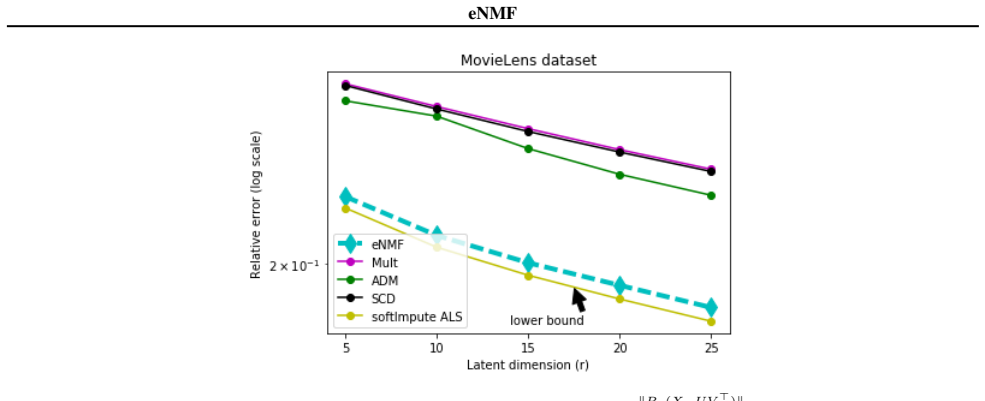
- eNMF reaches up to 30 percent lower reconstruction error than competitors when given equal computation time.
- eNMF reaches target error levels up to 150 percent faster than competitors when measured by equal error.
- In 99 percent of tested cases, different NMF algorithms converge to factor matrices that are equivalent under permutation and orthogonal transformation.
- Downstream tasks in audio processing and recommendation systems show clear performance gains from the exterior solutions.
Where Pith is reading between the lines
- The separation of approximation from constraint enforcement could apply to other nonconvex factorization problems where interior methods stall.
- The observed equivalence classes of solutions suggest a practical way to canonicalize outputs across different NMF solvers.
- Scaling the rotation step to very large matrices would test whether the observed speedups persist at production sizes.
Load-bearing premise
The rotation to the nearest exterior point reliably supplies a starting location from which iterations reach better stationary points than interior starts.
What would settle it
A direct comparison on the same datasets and objective where the identical update rules are run from a random interior initialization versus the rotated exterior initialization, measuring final error and time to convergence.
Figures



read the original abstract
Nonnegative matrix factorization (NMF) seeks a low-rank approximation $X \approx UV^T$ with nonnegative factors and is commonly solved using interior methods that enforce feasibility throughout optimization. We show that such constraint-driven approaches can impede progress in the nonconvex landscape, leading to slow convergence or convergence to suboptimal stationary points. We propose an exterior framework for NMF (eNMF) that separates low-rank approximation from nonnegativity enforcement. Our method initializes from the optimal unconstrained factorization and introduces a rotation procedure that maps unconstrained factors to an exterior point closest to the nonnegative orthant. This viewpoint yields an algorithmic framework in which simple iterative updates converge to KKT-satisfying stationary points on the boundary of the positive orthant. The exterior formulation also enables a geometric interpretation of NMF solutions, clarifying equivalence classes of factorizations under permutation and orthogonal transformations. An intriguing numerical result, involving 400 NMF experiments across both real and synthetic datasets, show that in 99% of the cases, different algorithms tend to converge towards equivalent factor matrices. We benchmark eNMF against 9 state-of-the-art NMF algorithms with 9 initialization schemes across 3 real-world and 2 synthetic datasets. eNMF consistently outperforms all 81 competitors, achieving up to 30% lower reconstruction error under equal-time settings and up to 150% speedup under equal-error settings. The downstream experiments further demonstrate substantial performance gains in audio processing and recommendation tasks, corroborating the practical benefits of the proposed exterior optimization framework. Code is available at https://github.com/roychowdhuryresearch/eNMF
Editorial analysis
A structured set of objections, weighed in public.
Referee Report
Summary. The manuscript proposes an exterior framework for nonnegative matrix factorization (eNMF) that decouples low-rank approximation from nonnegativity by initializing from the optimal unconstrained factorization, applying a geometric rotation to reach an exterior point nearest the nonnegative orthant, and then performing simple iterative updates that converge to KKT-satisfying stationary points. It reports that in 99% of 400 NMF experiments across real and synthetic data, different algorithms converge to factor matrices that are equivalent under permutation and orthogonal transformations. The paper benchmarks eNMF against 9 algorithms with 9 initialization schemes (81 total competitors) on 3 real-world and 2 synthetic datasets, claiming consistent outperformance with up to 30% lower reconstruction error under equal-time settings and up to 150% speedup under equal-error settings, along with gains in downstream audio processing and recommendation tasks. Code is made available.
Significance. If the performance gains prove robust after resolving the reported tensions, the exterior viewpoint could provide a useful alternative to interior-point NMF solvers by highlighting how constraint enforcement may trap iterates in suboptimal regions of the nonconvex landscape. The scale of the experimental comparison (400 experiments, 81 competitors) and public code are positive features that would support adoption if the central claims are clarified.
major comments (2)
- Abstract: The observation that 'in 99% of the cases, different algorithms tend to converge towards equivalent factor matrices' under permutation and orthogonal transformations appears inconsistent with the central claim of up to 30% lower reconstruction error for eNMF under equal-time settings. Because the reconstruction error ||X - UV^T|| is invariant under these equivalences, the manuscript must explicitly state whether the 99% figure includes eNMF, whether the equivalence metric permits residual quality differences, or how the exterior rotation enables access to strictly superior equivalence classes. Without error distributions reported within versus across classes, the outperformance claim rests on an unexamined distinction.
- Abstract (description of algorithmic framework): The rotation procedure is asserted to map unconstrained factors to an exterior starting point from which subsequent iterations reliably reach higher-quality stationary points than interior methods. This assumption is not derived from first principles, nor is it supported by analysis showing systematic escape from suboptimal interior stationary points; it is presented as an empirical property of the construction. A concrete argument or counter-example analysis demonstrating this advantage is needed to substantiate the framework's benefit.
minor comments (1)
- The full experimental protocol, precise definitions of equal-time and equal-error budgets, and verification that all 81 baselines received equivalent resources should be expanded to support the reported numerical comparisons.
Simulated Author's Rebuttal
We thank the referee for the constructive feedback on our manuscript. The comments highlight important points for clarification regarding the equivalence observation and the justification for the exterior initialization. We address each major comment below and will incorporate revisions to strengthen the presentation.
read point-by-point responses
-
Referee: Abstract: The observation that 'in 99% of the cases, different algorithms tend to converge towards equivalent factor matrices' under permutation and orthogonal transformations appears inconsistent with the central claim of up to 30% lower reconstruction error for eNMF under equal-time settings. Because the reconstruction error ||X - UV^T|| is invariant under these equivalences, the manuscript must explicitly state whether the 99% figure includes eNMF, whether the equivalence metric permits residual quality differences, or how the exterior rotation enables access to strictly superior equivalence classes. Without error distributions reported within versus across classes, the outperformance claim rests on an unexamined distinction.
Authors: We agree this requires explicit clarification to resolve the apparent tension. The 99% statistic aggregates results across all tested algorithms (including eNMF) and measures equivalence after optimal permutation and orthogonal alignment of factors; within this metric, most runs reach the same class with comparable error. However, eNMF's exterior rotation enables access to distinct classes with measurably lower reconstruction error in the reported cases. We will revise the abstract to state that the 99% includes eNMF and add a new paragraph in the experiments section reporting error distributions within versus across equivalence classes, along with a geometric explanation of how the rotation reaches superior classes. revision: yes
-
Referee: Abstract (description of algorithmic framework): The rotation procedure is asserted to map unconstrained factors to an exterior starting point from which subsequent iterations reliably reach higher-quality stationary points than interior methods. This assumption is not derived from first principles, nor is it supported by analysis showing systematic escape from suboptimal interior stationary points; it is presented as an empirical property of the construction. A concrete argument or counter-example analysis demonstrating this advantage is needed to substantiate the framework's benefit.
Authors: The benefit is presented as an empirical property because a full first-principles derivation is difficult in the nonconvex NMF landscape. We will add a dedicated subsection with a geometric argument based on the minimal-distance rotation to the orthant boundary and include counter-example analyses on synthetic data showing specific cases where interior methods remain trapped at suboptimal stationary points while the exterior start escapes to lower-error solutions. This will provide the requested concrete support without overstating theoretical guarantees. revision: yes
Circularity Check
No significant circularity in the exterior NMF algorithmic construction
full rationale
The paper presents eNMF as an algorithmic framework that separates low-rank approximation from nonnegativity by initializing at the unconstrained optimum and applying a geometric rotation to an exterior point, followed by standard iterative updates that reach KKT points. No equations or steps reduce the claimed convergence or performance to quantities defined by fitting parameters inside the paper; the 99% equivalence observation and benchmark results (30% lower error, 150% speedup) are reported as empirical outcomes from 400 experiments and 81 competitors rather than derived predictions. The derivation chain is self-contained as a construction on standard unconstrained factorization and geometry, with no self-definitional loops, fitted-input predictions, or load-bearing self-citations.
Axiom & Free-Parameter Ledger
axioms (1)
- standard math Convergence of the iterative updates to KKT-satisfying stationary points on the boundary of the nonnegative orthant
Lean theorems connected to this paper
-
IndisputableMonolith/Cost/FunctionalEquation.leanwashburn_uniqueness_aczel unclear?
unclearRelation between the paper passage and the cited Recognition theorem.
We propose an exterior framework for NMF (eNMF) that separates low-rank approximation from nonnegativity enforcement... rotation procedure that maps unconstrained factors to an exterior point closest to the nonnegative orthant... equivalence classes of factorizations under permutation and orthogonal transformations.
-
IndisputableMonolith/Foundation/AlexanderDuality.leanalexander_duality_circle_linking unclear?
unclearRelation between the paper passage and the cited Recognition theorem.
99% of the cases, different algorithms tend to converge towards equivalent factor matrices... under permutation and orthogonal transformations.
What do these tags mean?
- matches
- The paper's claim is directly supported by a theorem in the formal canon.
- supports
- The theorem supports part of the paper's argument, but the paper may add assumptions or extra steps.
- extends
- The paper goes beyond the formal theorem; the theorem is a base layer rather than the whole result.
- uses
- The paper appears to rely on the theorem as machinery.
- contradicts
- The paper's claim conflicts with a theorem or certificate in the canon.
- unclear
- Pith found a possible connection, but the passage is too broad, indirect, or ambiguous to say the theorem truly supports the claim.
Reference graph
Works this paper leans on
-
[1]
IEEE Transactions on Neural Networks and Learning Systems , volume=
Online nonnegative matrix factorization with robust stochastic approximation , author=. IEEE Transactions on Neural Networks and Learning Systems , volume=. 2012 , publisher=
work page 2012
-
[2]
IEEE Transactions on Neural Networks and Learning Systems , year=
An Entropy Weighted Nonnegative Matrix Factorization Algorithm for Feature Representation , author=. IEEE Transactions on Neural Networks and Learning Systems , year=
-
[3]
IEEE Transactions on Neural Networks and Learning Systems , year=
Entropy minimizing matrix factorization , author=. IEEE Transactions on Neural Networks and Learning Systems , year=
-
[4]
IEEE transactions on neural networks and learning systems , volume=
A probabilistic zero-shot learning method via latent nonnegative prototype synthesis of unseen classes , author=. IEEE transactions on neural networks and learning systems , volume=. 2019 , publisher=
work page 2019
-
[5]
IEEE transactions on neural networks and learning systems , volume=
Semi-supervised non-negative matrix factorization with dissimilarity and similarity regularization , author=. IEEE transactions on neural networks and learning systems , volume=. 2019 , publisher=
work page 2019
-
[6]
IEEE Transactions on Neural Networks and Learning Systems , year=
Bicriteria sparse nonnegative matrix factorization via two-timescale duplex neurodynamic optimization , author=. IEEE Transactions on Neural Networks and Learning Systems , year=
-
[7]
IEEE transactions on neural networks and learning systems , volume=
Semi-supervised graph regularized deep NMF with bi-orthogonal constraints for data representation , author=. IEEE transactions on neural networks and learning systems , volume=. 2019 , publisher=
work page 2019
-
[8]
IEEE transactions on neural networks and learning systems , volume=
Large-cone nonnegative matrix factorization , author=. IEEE transactions on neural networks and learning systems , volume=. 2016 , publisher=
work page 2016
-
[9]
IEEE transactions on neural networks and learning systems , volume=
Adaptive method for nonsmooth nonnegative matrix factorization , author=. IEEE transactions on neural networks and learning systems , volume=. 2016 , publisher=
work page 2016
-
[10]
SIAM Journal on Optimization , volume=
On the complexity of nonnegative matrix factorization , author=. SIAM Journal on Optimization , volume=. 2009 , publisher=
work page 2009
-
[11]
Lower bounds in communication complexity , author=. Foundations and Trends. 2009 , publisher=
work page 2009
-
[12]
Linear Algebra and its Applications , volume=
Probability matrices, non-negative rank, and parameterization of mixture models , author=. Linear Algebra and its Applications , volume=. 2010 , publisher=
work page 2010
-
[13]
Linear Algebra and its Applications , volume=
On the geometric interpretation of the nonnegative rank , author=. Linear Algebra and its Applications , volume=. 2012 , publisher=
work page 2012
-
[14]
Arora, Sanjeev and Ge, Rong and Kannan, Ravindran and Moitra, Ankur , booktitle=. Computing a. 2012 , organization=
work page 2012
-
[15]
Harper, F Maxwell and Konstan, Joseph A , journal=. 2016 , publisher=
work page 2016
-
[16]
Donoho, David and Stodden, Victoria , booktitle=. When
-
[17]
Advances in neural information processing systems , volume=
Algorithms for non-negative matrix factorization , author=. Advances in neural information processing systems , volume=
-
[18]
IEEE Transactions on Neural Networks , volume=
On the convergence of multiplicative update algorithms for nonnegative matrix factorization , author=. IEEE Transactions on Neural Networks , volume=. 2007 , publisher=
work page 2007
-
[19]
Projected gradient methods for nonnegative matrix factorization , author=. Neural computation , volume=. 2007 , publisher=
work page 2007
-
[20]
Nonnegative matrix factorization using
Hajinezhad, Davood and Chang, Tsung-Hui and Wang, Xiangfeng and Shi, Qingjiang and Hong, Mingyi , booktitle=. Nonnegative matrix factorization using. 2016 , organization=
work page 2016
-
[21]
Hastie, Trevor and Mazumder, Rahul and Lee, Jason D and Zadeh, Reza , journal=. Matrix. 2015 , publisher=
work page 2015
-
[22]
Franc, Vojt. Sequential. International Conference on Computer Analysis of Images and Patterns , pages=. 2005 , organization=
work page 2005
- [23]
-
[24]
Wiley interdisciplinary reviews: computational statistics , volume=
Principal component analysis , author=. Wiley interdisciplinary reviews: computational statistics , volume=. 2010 , publisher=
work page 2010
-
[25]
Proceedings of the National Academy of Sciences , volume=
Network component analysis: reconstruction of regulatory signals in biological systems , author=. Proceedings of the National Academy of Sciences , volume=. 2003 , publisher=
work page 2003
-
[26]
Journal of optimization theory and applications , volume=
Convergence of a block coordinate descent method for nondifferentiable minimization , author=. Journal of optimization theory and applications , volume=. 2001 , publisher=
work page 2001
-
[27]
Independent component analysis: algorithms and applications , author=. Neural networks , volume=. 2000 , publisher=
work page 2000
-
[28]
Boyd, Stephen and Parikh, Neal and Chu, Eric and Peleato, Borja and Eckstein, Jonathan and others , journal=. Distributed. 2011 , publisher=
work page 2011
-
[29]
Journal of machine learning research , volume=
Non-negative matrix factorization with sparseness constraints , author=. Journal of machine learning research , volume=
-
[30]
Sparse non-negative matrix factorizations via alternating non-negativity-constrained least squares for microarray data analysis , author=. Bioinformatics , volume=. 2007 , publisher=
work page 2007
-
[31]
IEEE Transactions on Neural Networks , volume=
Independent component analysis based on nonparametric density estimation , author=. IEEE Transactions on Neural Networks , volume=. 2004 , publisher=
work page 2004
-
[32]
Computational statistics & data analysis , volume=
Algorithms and applications for approximate nonnegative matrix factorization , author=. Computational statistics & data analysis , volume=. 2007 , publisher=
work page 2007
-
[33]
Machine Learning for Signal Processing, 2007 IEEE Workshop on , pages=
Wind noise reduction using non-negative sparse coding , author=. Machine Learning for Signal Processing, 2007 IEEE Workshop on , pages=. 2007 , organization=
work page 2007
-
[34]
Essid, Slim and F. Smooth. IEEE Transactions on Multimedia , volume=. 2013 , publisher=
work page 2013
- [35]
-
[36]
Introduction to Nonnegative Matrix Factorization
Introduction to nonnegative matrix factorization , author=. arXiv preprint arXiv:1703.00663 , year=
work page internal anchor Pith review Pith/arXiv arXiv
- [37]
-
[38]
Total variation norm-based nonnegative matrix factorization for identifying discriminant representation of image patterns , author=. Neurocomputing , volume=. 2008 , publisher=
work page 2008
-
[39]
SIAM Journal on Scientific Computing , volume=
Fast nonnegative matrix factorization: An active-set-like method and comparisons , author=. SIAM Journal on Scientific Computing , volume=. 2011 , publisher=
work page 2011
-
[40]
IEEE/ACM Transactions on Computational Biology and Bioinformatics (TCBB) , volume=
A generalized framework for network component analysis , author=. IEEE/ACM Transactions on Computational Biology and Bioinformatics (TCBB) , volume=. 2005 , publisher=
work page 2005
- [41]
-
[42]
Tangherlini, Timothy R and Roychowdhury, Vwani and Glenn, Beth and Crespi, Catherine M and Bandari, Roja and Wadia, Akshay and Falahi, Misagh and Ebrahimzadeh, Ehsan and Bastani, Roshan , journal=. “. 2016 , publisher=
work page 2016
- [43]
-
[44]
Frontiers of Mathematics in China , volume=
An alternating direction algorithm for matrix completion with nonnegative factors , author=. Frontiers of Mathematics in China , volume=. 2012 , publisher=
work page 2012
-
[45]
Initializations for the nonnegative matrix factorization , author=. Proceedings of the twelfth ACM SIGKDD international conference on knowledge discovery and data mining , pages=. 2006 , organization=
work page 2006
-
[46]
IEEE Transactions on Signal Processing , volume=
A flexible and efficient algorithmic framework for constrained matrix and tensor factorization , author=. IEEE Transactions on Signal Processing , volume=. 2016 , publisher=
work page 2016
-
[47]
IEICE transactions on fundamentals of electronics, communications and computer sciences , volume=
Fast local algorithms for large scale nonnegative matrix and tensor factorizations , author=. IEICE transactions on fundamentals of electronics, communications and computer sciences , volume=. 2009 , publisher=
work page 2009
-
[48]
IEEE Transactions on Information Theory , volume=
The global optimization geometry of low-rank matrix optimization , author=. IEEE Transactions on Information Theory , volume=. 2021 , publisher=
work page 2021
-
[49]
Algorithms, Initializations, and Convergence for the Nonnegative Matrix Factorization
Algorithms, initializations, and convergence for the nonnegative matrix factorization , author=. arXiv preprint arXiv:1407.7299 , year=
work page internal anchor Pith review Pith/arXiv arXiv
-
[50]
Wang, Yu and Yin, Wotao and Zeng, Jinshan , journal=. Global convergence of. 2019 , publisher=
work page 2019
-
[51]
SIAM Journal on Optimization , volume=
Convergence analysis of alternating direction method of multipliers for a family of nonconvex problems , author=. SIAM Journal on Optimization , volume=. 2016 , publisher=
work page 2016
-
[52]
Gao, Wenbo and Goldfarb, Donald and Curtis, Frank E , journal=. 2020 , publisher=
work page 2020
-
[53]
Matrix Algorithms: Volume II: Eigensystems , author=. 2001 , publisher=
work page 2001
-
[54]
International Conference on Learning Representations , volume=
Non-negative contrastive learning , author=. International Conference on Learning Representations , volume=
-
[55]
International Conference on Learning Representations(ICLR) , volume=
Sparse encoding for more-interpretable feature-selecting representations in probabilistic matrix factorization , author=. International Conference on Learning Representations(ICLR) , volume=
-
[56]
Zhuang, Yubo and Chen, Xiaohui and Yang, Yun and Zhang, Richard , booktitle=
-
[57]
Earle, Adam C and Saxe, Andrew M and Rosman, Benjamin , booktitle=
-
[58]
Journal of the Franklin Institute , year =
Sören Becker and Johanna Vielhaben and Marcel Ackermann and Klaus-Robert Müller and Sebastian Lapuschkin and Wojciech Samek , keywords =. Journal of the Franklin Institute , year =. doi:https://doi.org/10.1016/j.jfranklin.2023.11.038 , url =
-
[59]
Nature communications , volume=
Cost function dependent barren plateaus in shallow parametrized quantum circuits , author=. Nature communications , volume=. 2021 , publisher=
work page 2021
-
[60]
Q. Miao and T. Barthel , title =. arXiv preprint arXiv:2402.07883 , year =
-
[61]
Understanding the convergence of the alternating direction method of multipliers: Theoretical and computational perspectives , author=. Pac. J. Optim. , volume=
-
[62]
IEEE transactions on pattern analysis and machine intelligence , volume=
Generalized separable nonnegative matrix factorization , author=. IEEE transactions on pattern analysis and machine intelligence , volume=. 2019 , publisher=
work page 2019
-
[63]
Truncated Cauchy Non-negative Matrix Factorization
Truncated Cauchy Non-negative Matrix Factorization , author=. arXiv preprint arXiv:1906.00495 , year=
work page internal anchor Pith review Pith/arXiv arXiv 1906
-
[64]
Proceedings of the International Conference on Computer Graphics and Visualization , year=
Synthetic Generation of High-dimensional Datasets for Matrix Factorization , author=. Proceedings of the International Conference on Computer Graphics and Visualization , year=
-
[65]
Journal of Machine Learning Research , volume=
Online learning for matrix factorization and sparse coding , author=. Journal of Machine Learning Research , volume=
-
[66]
Auto-Encoding Variational Bayes
Auto-encoding variational Bayes , author=. arXiv preprint arXiv:1312.6114 , year=
work page internal anchor Pith review Pith/arXiv arXiv
-
[67]
Advances in neural information processing systems , pages=
Generative adversarial nets , author=. Advances in neural information processing systems , pages=
-
[68]
Higgins, Irina and Matthey, Loic and Pal, Arka and Burgess, Christopher and Glorot, Xavier and Botvinick, Matthew and Mohamed, Shakir and Lerchner, Alexander , booktitle=
-
[69]
IEEE transactions on pattern analysis and machine intelligence , volume=
Representation learning: A review and new perspectives , author=. IEEE transactions on pattern analysis and machine intelligence , volume=. 2013 , publisher=
work page 2013
-
[70]
International Journal of Data Science and Analytics , year =
Initialization for Nonnegative Matrix Factorization: a Comprehensive Review , author =. International Journal of Data Science and Analytics , year =. doi:10.1007/s41060-022-00370-9 , note =
-
[71]
Learning the Parts of Objects by Non-negative Matrix Factorization , author =. Nature , volume =. 1999 , doi =
work page 1999
-
[72]
Applied Mathematics and Computation , volume =
Clustering-based initialization for non-negative matrix factorization , author =. Applied Mathematics and Computation , volume =. 2008 , doi =
work page 2008
-
[73]
Numerical Algorithms , volume =
Nonnegative rank factorization---a heuristic approach via rank reduction , author =. Numerical Algorithms , volume =. 2014 , doi =
work page 2014
-
[74]
Kitamura, Daichi and Ono, Nobutaka , booktitle =. 2016 , organization =
work page 2016
-
[75]
Boutsidis, Christos and Gallopoulos, Efstratios E. , journal =. 2008 , doi =
work page 2008
-
[76]
Gillis, Nicolas and Glineur, Fran. Neural Computation , volume =. 2012 , doi =
work page 2012
-
[77]
Guan, Naiyang and Tao, Dacheng and Luo, Zhigang and Yuan, Bo , journal =. 2012 , doi =
work page 2012
-
[78]
Alternating proximal gradient method for nonnegative matrix factorization
Alternating Proximal Gradient Method for Nonnegative Matrix Factorization , author =. arXiv preprint arXiv:1112.5407 , year =. 1112.5407 , archivePrefix =
work page internal anchor Pith review Pith/arXiv arXiv
-
[79]
Proceedings of the 25th international conference on machine learning , pages=
Nonnegative matrix factorization via rank-one downdate , author=. Proceedings of the 25th international conference on machine learning , pages=
discussion (0)
Sign in with ORCID, Apple, or X to comment. Anyone can read and Pith papers without signing in.