Bit flips are erasures in dissipative cat qubits
Pith reviewed 2026-07-03 20:06 UTC · model grok-4.3
The pith
In dissipative cat qubits bit flips produce strong photon bursts that herald logical errors via monitoring.
A machine-rendered reading of the paper's core claim, the machinery that carries it, and where it could break.
Core claim
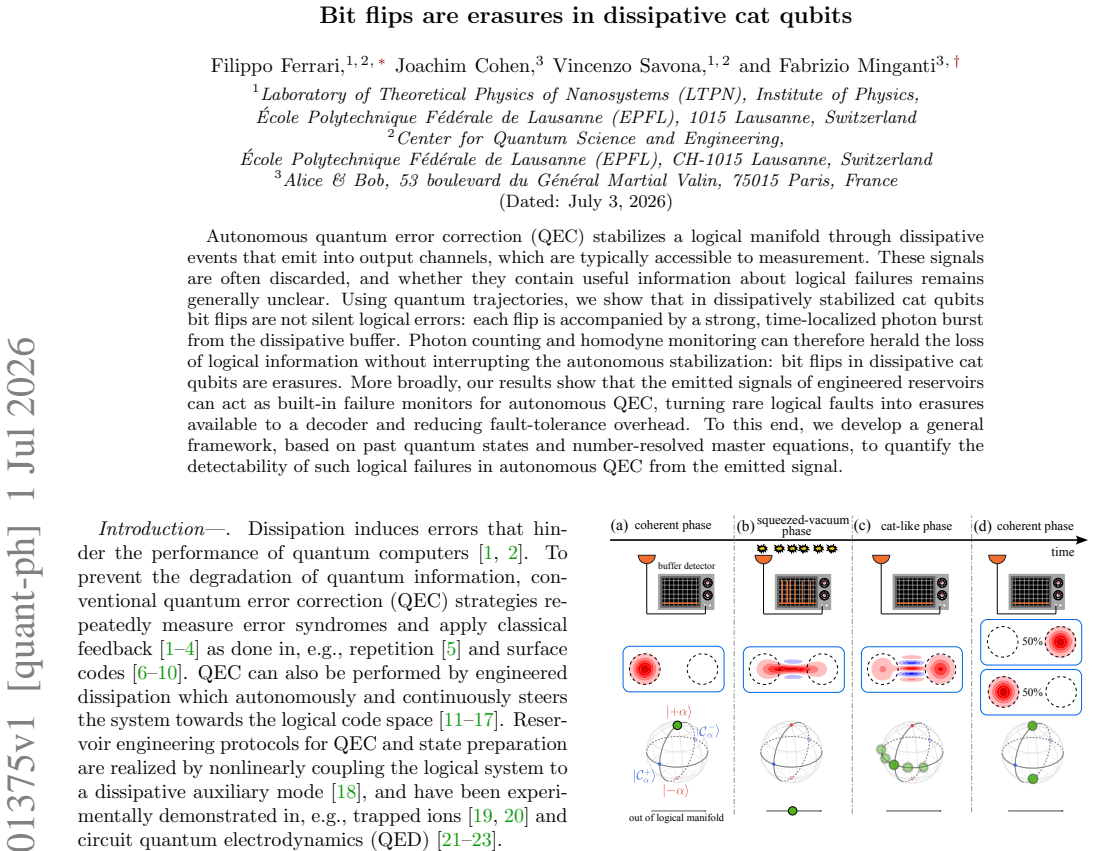
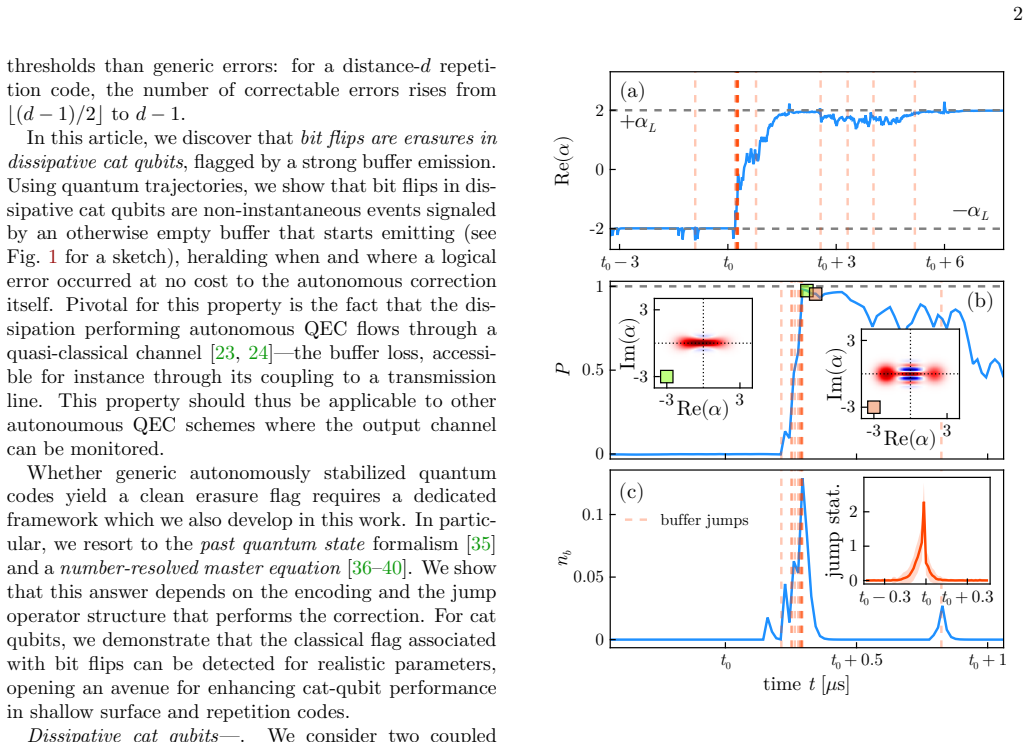
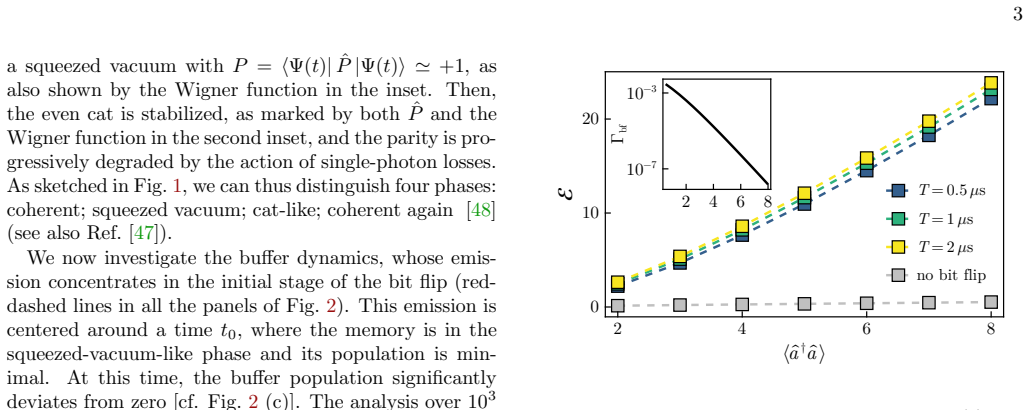
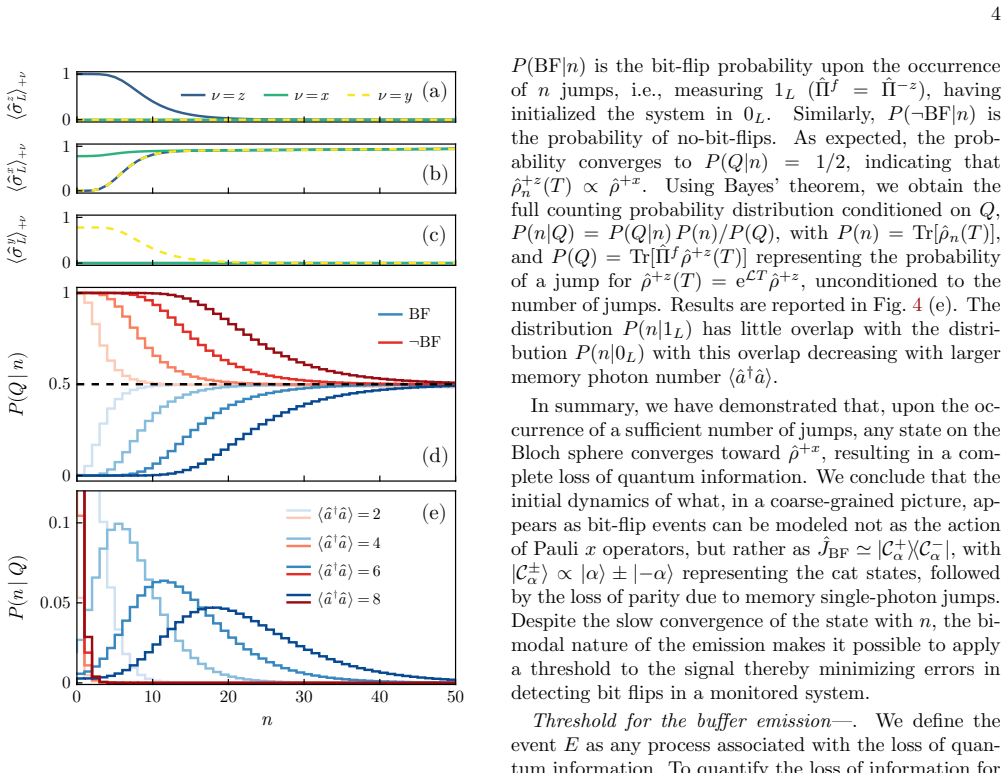
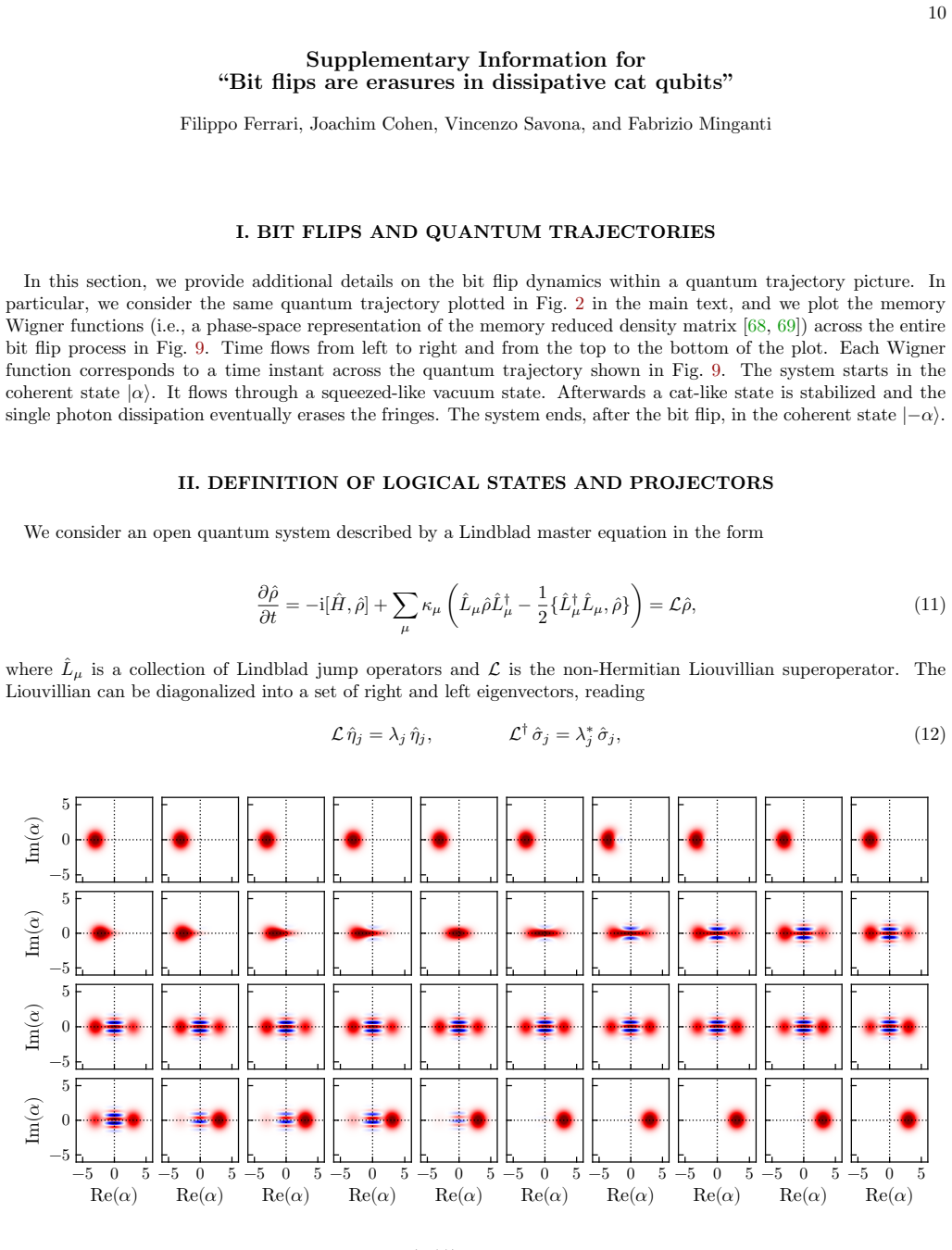
Using quantum trajectories, bit flips in dissipatively stabilized cat qubits are accompanied by strong time-localized photon bursts from the dissipative buffer. Photon counting and homodyne monitoring therefore herald the loss of logical information without interrupting autonomous stabilization, so that bit flips are erasures. Emitted signals from engineered reservoirs can serve as built-in failure monitors for autonomous QEC.
What carries the argument
Framework based on past quantum states and number-resolved master equations that quantifies detectability of logical failures from the emitted signal.
If this is right
- Bit flips become erasures that are available to a decoder.
- Rare logical faults are converted into detectable events that reduce fault-tolerance overhead.
- Engineered reservoirs supply built-in failure monitors for autonomous quantum error correction.
Where Pith is reading between the lines
- The same monitoring of reservoir signals could detect errors in other autonomous QEC schemes beyond cat qubits.
- Incorporating this heralding may allow experimental systems to reach lower logical error rates without separate detection hardware.
Load-bearing premise
The photon bursts are sufficiently strong, time-localized, and distinguishable from background noise to allow reliable heralding without degrading the autonomous stabilization.
What would settle it
An experiment in which bit flips occur with no photon burst above background levels or in which monitoring the buffer visibly degrades the stabilization.
Figures
read the original abstract
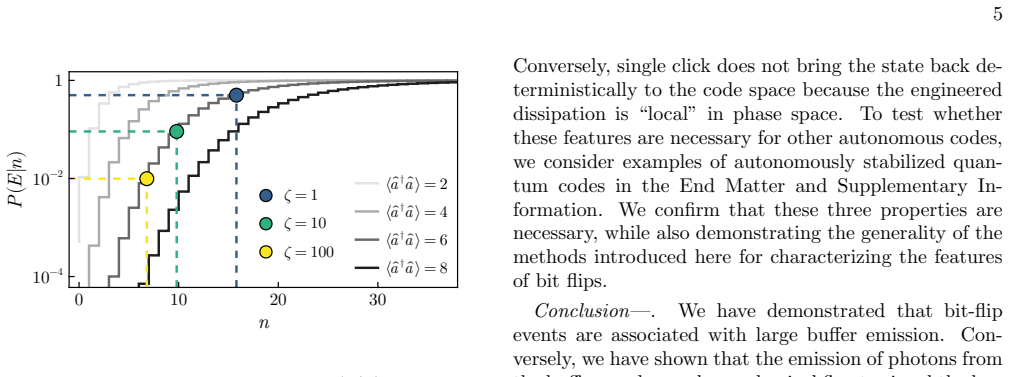
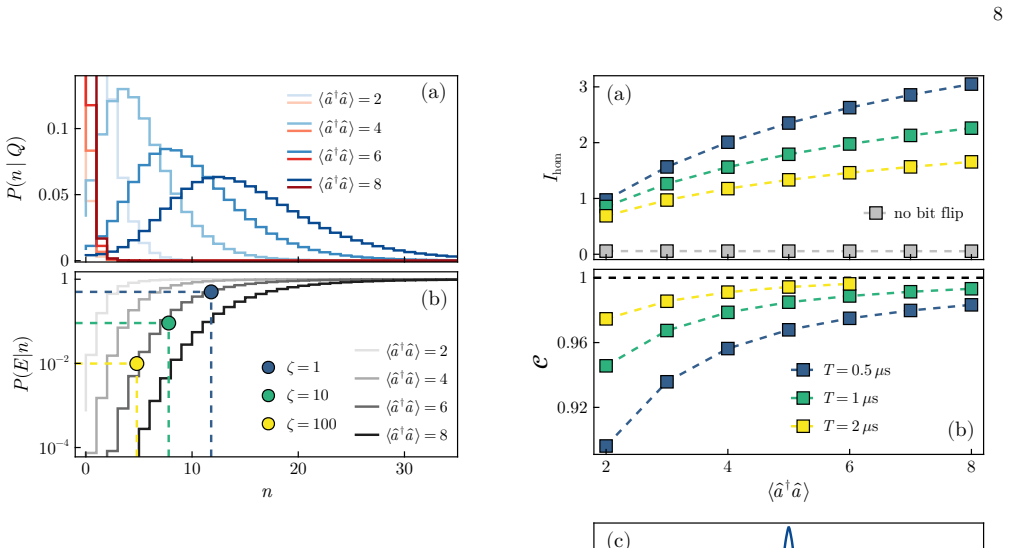
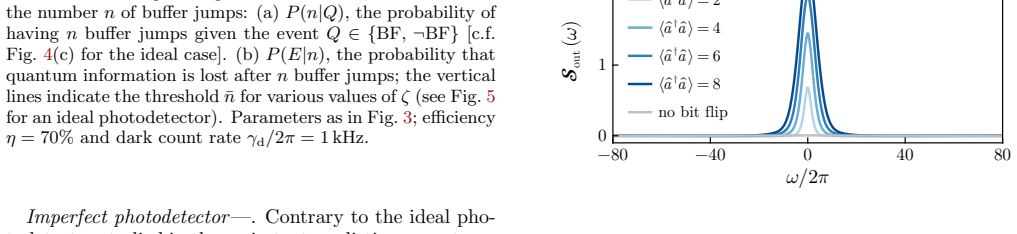
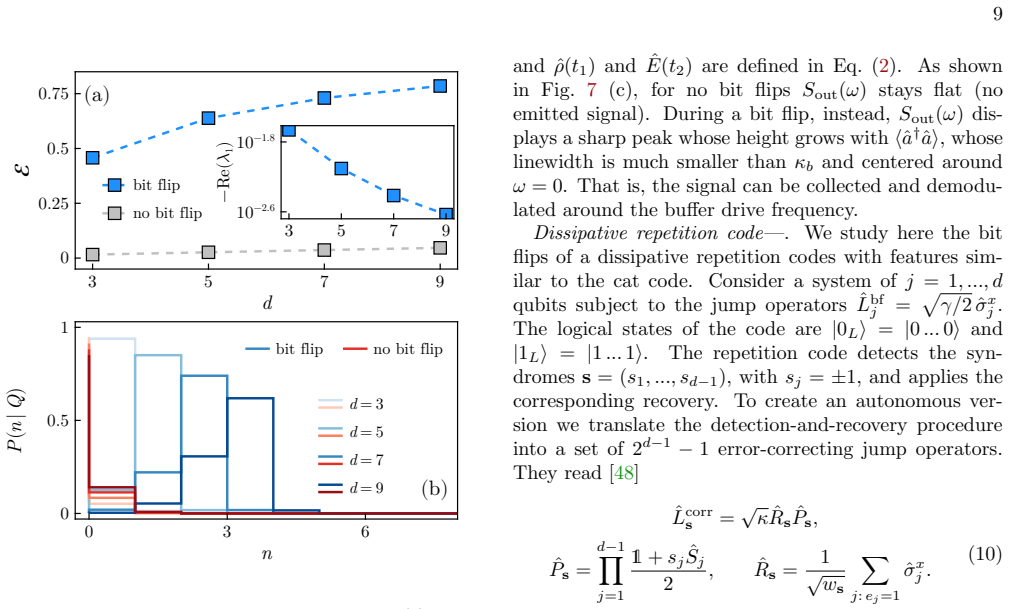
Autonomous quantum error correction (QEC) stabilizes a logical manifold through dissipative events that emit into output channels, which are typically accessible to measurement. These signals are often discarded, and whether they contain useful information about logical failures remains generally unclear. Using quantum trajectories, we show that in dissipatively stabilized cat qubits bit flips are not silent logical errors: each flip is accompanied by a strong, time-localized photon burst from the dissipative buffer. Photon counting and homodyne monitoring can therefore herald the loss of logical information without interrupting the autonomous stabilization: bit flips in dissipative cat qubits are erasures. More broadly, our results show that the emitted signals of engineered reservoirs can act as built-in failure monitors for autonomous QEC, turning rare logical faults into erasures available to a decoder and reducing fault-tolerance overhead. To this end, we develop a general framework, based on past quantum states and number-resolved master equations, to quantify the detectability of such logical failures in autonomous QEC from the emitted signal.
Editorial analysis
A structured set of objections, weighed in public.
Referee Report
Summary. The manuscript claims that in dissipatively stabilized cat qubits, bit-flip errors are not silent: each is accompanied by a strong, time-localized photon burst emitted by the dissipative buffer. Using quantum trajectories and a number-resolved master equation, the authors show that photon counting or homodyne monitoring of the output channel can herald these events, converting bit flips into erasures without interrupting autonomous stabilization. A general framework based on past quantum states is introduced to quantify detectability of such logical failures from the emitted signals.
Significance. If the central claim holds with quantitative support, the result offers a concrete mechanism to extract logical-error information from the engineered reservoir output already present in autonomous QEC, potentially lowering fault-tolerance overhead by turning rare bit flips into detectable erasures. The development of the past-quantum-state plus number-resolved-master-equation framework is a methodological contribution that could be applied to other dissipative encodings.
major comments (2)
- [Abstract and framework section (past quantum states + number-resolved ME)] The central claim that each bit flip produces a 'strong, time-localized photon burst' distinguishable from the continuous dissipative output rests on the quantum-trajectory and number-resolved-master-equation analysis, yet the manuscript supplies no numerical values for burst contrast (integrated photon number above background), temporal width relative to the stabilization timescale, or false-positive rate once finite detector efficiency, dark counts, and cavity loss are included.
- [Quantum-trajectory simulations] The heralding argument assumes that monitoring the output channel does not degrade the autonomous stabilization; however, the quantitative trade-off between detection probability and the back-action or added loss on the cat manifold is not reported, leaving the 'without interrupting the autonomous stabilization' statement unverified.
minor comments (2)
- Notation for the dissipative buffer operators and the logical bit-flip operator should be introduced with explicit definitions before the first use of the number-resolved master equation.
- Figure captions for the trajectory plots should state the specific parameter values (drive strength, two-photon dissipation rate, etc.) used in the simulations.
Simulated Author's Rebuttal
We thank the referee for the careful reading of our manuscript and the constructive comments. We address each major comment below and will incorporate revisions where appropriate to strengthen the quantitative support for our claims.
read point-by-point responses
-
Referee: [Abstract and framework section (past quantum states + number-resolved ME)] The central claim that each bit flip produces a 'strong, time-localized photon burst' distinguishable from the continuous dissipative output rests on the quantum-trajectory and number-resolved-master-equation analysis, yet the manuscript supplies no numerical values for burst contrast (integrated photon number above background), temporal width relative to the stabilization timescale, or false-positive rate once finite detector efficiency, dark counts, and cavity loss are included.
Authors: We agree that explicit numerical quantification of burst contrast, temporal width, and false-positive rates (including realistic detector imperfections) would strengthen the central claim. The past-quantum-state and number-resolved master-equation framework introduced in the manuscript is precisely designed to enable such calculations from the emitted signal. In the revised version we will add these metrics, computed for representative parameter regimes of the dissipative cat qubit, together with estimates under finite efficiency and dark counts. revision: yes
-
Referee: [Quantum-trajectory simulations] The heralding argument assumes that monitoring the output channel does not degrade the autonomous stabilization; however, the quantitative trade-off between detection probability and the back-action or added loss on the cat manifold is not reported, leaving the 'without interrupting the autonomous stabilization' statement unverified.
Authors: Monitoring is performed on the output field of the dissipative buffer that is already required for autonomous stabilization; therefore no additional loss channel is introduced. Nevertheless, we acknowledge that a quantitative characterization of any residual trade-off between heralding fidelity and stabilization fidelity is desirable. In the revision we will report detection probability versus monitoring strength (or integration time) and explicitly verify that the cat-manifold stabilization remains intact under the considered continuous monitoring. revision: yes
Circularity Check
No circularity: standard open-system methods applied to cat-qubit dynamics
full rationale
The derivation applies quantum trajectories and number-resolved master equations (standard tools) to the dissipatively stabilized cat-qubit model to show that bit flips produce time-localized photon bursts. No step reduces by construction to a fitted input, self-defined quantity, or load-bearing self-citation; the emitted-signal detectability follows directly from the Lindblad dynamics and trajectory unraveling without reparameterization or renaming of known results. The framework is self-contained against external benchmarks.
Axiom & Free-Parameter Ledger
axioms (1)
- standard math Standard quantum mechanics and open-system master equations govern the dissipative cat-qubit dynamics.
Reference graph
Works this paper leans on
-
[1]
M. A. Nielsen and I. L. Chuang,Quantum Computation and Quantum Information: 10th Anniversary Edition, 1st ed. (Cambridge University Press, 2012)
2012
-
[2]
An Introduction to Quantum Error Correction and Fault-Tolerant Quantum Computation
D. Gottesman, An introduction to quantum error cor- rection and fault-tolerant quantum computation (2009), arXiv:0904.2557 [quant-ph]
work page internal anchor Pith review Pith/arXiv arXiv 2009
-
[3]
Knill and R
E. Knill and R. Laflamme, Theory of quantum error- correcting codes, Phys. Rev. A55, 900 (1997)
1997
-
[4]
Knill, R
E. Knill, R. Laflamme, and L. Viola, Theory of Quantum 6 Error Correction for General Noise, Phys. Rev. Lett.84, 2525 (2000)
2000
-
[5]
Puttermanet al., Hardware-efficient quantum error correction via concatenated bosonic qubits, Nature638, 927 (2025)
H. Puttermanet al., Hardware-efficient quantum error correction via concatenated bosonic qubits, Nature638, 927 (2025)
2025
-
[6]
Dennis, A
E. Dennis, A. Kitaev, A. Landahl, and J. Preskill, Topo- logical quantum memory, J. Math. Phys.43, 4452 (2002)
2002
-
[7]
A. G. Fowler, M. Mariantoni, J. M. Martinis, and A. N. Cleland, Surface codes: Towards practical large-scale quantum computation, Phys. Rev. A86, 032324 (2012)
2012
-
[8]
Krinner, N
S. Krinner, N. Lacroix, A. Remm, A. Di Paolo, E. Genois, C. Leroux, C. Hellings, S. Lazar, F. Swiadek, J. Her- rmann, G. J. Norris, C. K. Andersen, M. M¨ uller, A. Blais, C. Eichler, and A. Wallraff, Realizing repeated quantum error correction in a distance-three surface code, Nature 605, 669 (2022)
2022
-
[9]
Google Quantum AI, Suppressing quantum errors by scaling a surface code logical qubit, Nature614, 676 (2023)
2023
-
[10]
Google Quantum AI and Collaborators, Quantum error correction below the surface code threshold, Nature638, 920 (2025)
2025
-
[11]
J. F. Poyatos, J. I. Cirac, and P. Zoller, Quantum Reser- voir Engineering with Laser Cooled Trapped Ions, Phys. Rev. Lett.77, 4728 (1996)
1996
-
[12]
Verstraete, M
F. Verstraete, M. M. Wolf, and J. Ignacio Cirac, Quan- tum computation and quantum-state engineering driven by dissipation, Nat. Phys.5, 633 (2009)
2009
-
[13]
Pastawski, L
F. Pastawski, L. Clemente, and J. I. Cirac, Quantum memories based on engineered dissipation, Phys. Rev. A 83, 012304 (2011)
2011
-
[14]
Cohen and M
J. Cohen and M. Mirrahimi, Dissipation-induced contin- uous quantum error correction for superconducting cir- cuits, Phys. Rev. A90, 062344 (2014)
2014
-
[15]
Kapit, Hardware-Efficient and Fully Autonomous Quantum Error Correction in Superconducting Circuits, Phys
E. Kapit, Hardware-Efficient and Fully Autonomous Quantum Error Correction in Superconducting Circuits, Phys. Rev. Lett.116, 150501 (2016)
2016
-
[16]
Reiter, A
F. Reiter, A. S. Sørensen, P. Zoller, and C. A. Muschik, Dissipative quantum error correction and application to quantum sensing with trapped ions, Nat. Commun.8, 1822 (2017)
2017
-
[17]
J.-M. Lihm, K. Noh, and U. R. Fischer, Implementation- independent sufficient condition of the Knill-Laflamme type for the autonomous protection of logical qudits by strong engineered dissipation, Phys. Rev. A98, 012317 (2018)
2018
-
[18]
P. M. Harrington, E. J. Mueller, and K. W. Murch, Engi- neered dissipation for quantum information science, Nat. Rev. Phys.4, 660 (2022)
2022
-
[19]
Y. Lin, J. P. Gaebler, F. Reiter, T. R. Tan, R. Bowler, A. S. Sørensen, D. Leibfried, and D. J. Wineland, Dissi- pative production of a maximally entangled steady state of two quantum bits, Nature504, 415 (2013)
2013
-
[20]
S. D. Cole, S. D. Erickson, G. Zarantonello, K. P. Horn, P.-Y. Hou, J. J. Wu, D. H. Slichter, F. Reiter, C. P. Koch, and D. Leibfried, Resource-efficient dissipative entangle- ment of two trapped-ion qubits, Phys. Rev. Lett.128, 080502 (2022)
2022
-
[21]
Shankar, M
S. Shankar, M. Hatridge, Z. Leghtas, K. M. Sliwa, A. Narla, U. Vool, S. M. Girvin, L. Frunzio, M. Mir- rahimi, and M. H. Devoret, Autonomously stabilized en- tanglement between two superconducting quantum bits, Nature504, 419 (2013)
2013
-
[22]
J. M. Gertler, B. Baker, J. Li, S. Shirol, J. Koch, and C. Wang, Protecting a bosonic qubit with autonomous quantum error correction, Nature590, 243 (2021)
2021
-
[23]
Z. Li, T. Roy, D. Rodr´ ıguez P´ erez, K.-H. Lee, E. Kapit, and D. I. Schuster, Autonomous stabilization with pro- grammable stabilized state, Nat. Commun.15, 6978 (2024)
2024
-
[24]
Mirrahimi, Z
M. Mirrahimi, Z. Leghtas, V. V. Albert, S. Touzard, R. J. Schoelkopf, L. Jiang, and M. H. Devoret, Dynamically protected cat-qubits: a new paradigm for universal quan- tum computation, New J. Phys.16, 045014 (2014)
2014
-
[25]
Leghtas, S
Z. Leghtas, S. Touzard, I. M. Pop, A. Kou, B. Vlas- takis, A. Petrenko, K. M. Sliwa, A. Narla, S. Shankar, M. J. Hatridge, M. Reagor, L. Frunzio, R. J. Schoelkopf, M. Mirrahimi, and M. H. Devoret, Confining the state of light to a quantum manifold by engineered two-photon loss, Science347, 853 (2015)
2015
-
[26]
Lescanne, M
R. Lescanne, M. Villiers, T. Peronnin, A. Sarlette, M. Delbecq, B. Huard, T. Kontos, M. Mirrahimi, and Z. Leghtas, Exponential suppression of bit-flips in a qubit encoded in an oscillator, Nat. Phys.16, 509 (2020)
2020
-
[27]
Grimm, N
A. Grimm, N. E. Frattini, S. Puri, S. O. Mundhada, S. Touzard, M. Mirrahimi, S. M. Girvin, S. Shankar, and M. H. Devoret, Stabilization and operation of a Kerr-cat qubit, Nature584, 205 (2020)
2020
-
[28]
R´ eglade, A
U. R´ eglade, A. Bocquet, R. Gautier, J. Cohen, A. Marquet, E. Albertinale, N. Pankratova, M. Hall´ en, F. Rautschke, L.-A. Sellem, P. Rouchon, A. Sarlette, M. Mirrahimi, P. Campagne-Ibarcq, R. Lescanne, S. Je- zouin, and Z. Leghtas, Quantum control of a cat qubit with bit-flip times exceeding ten seconds, Nature629, 778 (2024)
2024
-
[29]
J. P. Bonilla Ataides, D. K. Tuckett, S. D. Bartlett, S. T. Flammia, and B. J. Brown, The XZZX surface code, Nat. Commun.12, 2172 (2021)
2021
-
[30]
Guillaud and M
J. Guillaud and M. Mirrahimi, Repetition Cat Qubits for Fault-Tolerant Quantum Computation, Phys. Rev. X9, 041053 (2019)
2019
-
[31]
Grassl, T
M. Grassl, T. Beth, and T. Pellizzari, Codes for the quan- tum erasure channel, Phys. Rev. A56, 33 (1997)
1997
-
[32]
Y. Wu, S. Kolkowitz, S. Puri, and J. D. Thompson, Era- sure conversion for fault-tolerant quantum computing in alkaline earth Rydberg atom arrays, Nat. Commun.13, 4657 (2022)
2022
-
[33]
J. D. Teoh, P. Winkel, H. K. Babla, B. J. Chapman, J. Claes, S. J. De Graaf, J. W. O. Garmon, W. D. Kalfus, Y. Lu, A. Maiti, K. Sahay, N. Thakur, T. Tsun- oda, S. H. Xue, L. Frunzio, S. M. Girvin, S. Puri, and R. J. Schoelkopf, Dual-rail encoding with super- conducting cavities, Proc. Natl. Acad. Sci. U.S.A120, e2221736120 (2023)
2023
-
[34]
Kubica, A
A. Kubica, A. Haim, Y. Vaknin, H. Levine, F. Brand˜ ao, and A. Retzker, Erasure Qubits: Overcoming the T 1 Limit in Superconducting Circuits, Phys. Rev. X13, 041022 (2023)
2023
-
[35]
Gammelmark, B
S. Gammelmark, B. Julsgaard, and K. Mølmer, Past Quantum States of a Monitored System, Phys. Rev. Lett. 111, 160401 (2013)
2013
-
[36]
L. S. Levitov, H. Lee, and G. B. Lesovik, Electron count- ing statistics and coherent states of electric current, J. Math. Phys.37, 4845 (1996)
1996
-
[37]
D. A. Bagrets and Y. V. Nazarov, Full counting statistics of charge transfer in Coulomb blockade systems, Phys. Rev. B67, 085316 (2003)
2003
-
[38]
Flindt, T
C. Flindt, T. Novotn´ y, and A.-P. Jauho, Full counting 7 statistics of nano-electromechanical systems, EPL69, 475 (2005)
2005
-
[39]
G. T. Landi, M. J. Kewming, M. T. Mitchison, and P. P. Potts, Current Fluctuations in Open Quantum Systems: Bridging the Gap Between Quantum Continuous Mea- surements and Full Counting Statistics, PRX Quantum 5, 020201 (2024)
2024
-
[40]
Menczel, C
P. Menczel, C. Flindt, F. Brange, F. Nori, and C. Gneit- ing, Full Counting Statistics and First-Passage Times in Quantum Markovian Processes: Ensemble Relations, Metastability, and Fluctuation Theorems, PRX Quan- tum7, 010304 (2026)
2026
-
[41]
Guillaud, J
J. Guillaud, J. Cohen, and M. Mirrahimi, Quantum com- putation with cat qubits, SciPost Phys. Lect. Notes , 72 (2023)
2023
-
[42]
Dalibard, Y
J. Dalibard, Y. Castin, and K. Mølmer, Wave-function approach to dissipative processes in quantum optics, Phys. Rev. Lett.68, 580 (1992)
1992
-
[43]
Mølmer, Y
K. Mølmer, Y. Castin, and J. Dalibard, Monte Carlo wave-function method in quantum optics, J. Opt. Soc. Am. B10, 524 (1993)
1993
-
[44]
A. J. Daley, Quantum trajectories and open many-body quantum systems, Adv. Phys.63, 77 (2014)
2014
-
[45]
Bartolo, F
N. Bartolo, F. Minganti, J. Lolli, and C. Ciuti, Homodyne versus photon-counting quantum trajectories for dissipa- tive Kerr resonators with two-photon driving, Eur. Phys. J. Spec. Top.226, 2705 (2017)
2017
-
[46]
Minganti,Out-of-Equilibrium Phase Transitions in Nonlinear Optical Systems, Ph.d
F. Minganti,Out-of-Equilibrium Phase Transitions in Nonlinear Optical Systems, Ph.d. thesis, Universit´ e Paris Diderot (2018)
2018
-
[47]
Bit flips, saturation, and quantum chaos in dissipative cat qubits
F. Ferrari, J. Cohen, V. Savona, and F. Minganti, Bit flips, saturation, and quantum chaos in dissipative cat qubits (2026), arXiv:2605.24100 [quant-ph]
work page internal anchor Pith review Pith/arXiv arXiv 2026
-
[48]
For more details, see the Supplementary Information
-
[49]
Breuer and F
H.-P. Breuer and F. Petruccione,The Theory of Open Quantum Systems, 1st ed. (Oxford University PressOx- ford, 2007)
2007
-
[50]
Y.-F. Chen, D. Hover, S. Sendelbach, L. Maurer, S. T. Merkel, E. J. Pritchett, F. K. Wilhelm, and R. Mc- Dermott, Microwave photon counter based on josephson junctions, Phys. Rev. Lett.107, 217401 (2011)
2011
-
[51]
Besse, S
J.-C. Besse, S. Gasparinetti, M. C. Collodo, T. Wal- ter, P. Kurpiers, M. Pechal, C. Eichler, and A. Wallraff, Single-shot quantum nondemolition detection of individ- ual itinerant microwave photons, Phys. Rev. X8, 021003 (2018)
2018
-
[52]
S. Kono, K. Koshino, Y. Tabuchi, A. Noguchi, and Y. Nakamura, Quantum non-demolition detection of an itinerant microwave photon, Nat. Phys.14, 546 (2018)
2018
-
[53]
Dassonneville, R
R. Dassonneville, R. Assouly, T. Peronnin, P. Rouchon, and B. Huard, Number-resolved photocounter for prop- agating microwave mode, Phys. Rev. App.14, 044022 (2020)
2020
-
[54]
Lescanne, S
R. Lescanne, S. Del´ eglise, E. Albertinale, U. R´ eglade, T. Capelle, E. Ivanov, T. Jacqmin, Z. Leghtas, and E. Flurin, Irreversible qubit-photon coupling for the de- tection of itinerant microwave photons, Phys. Rev. X10, 021038 (2020)
2020
-
[55]
S. Ma, G. Liu, P. Peng, B. Zhang, S. Jandura, J. Claes, A. P. Burgers, G. Pupillo, S. Puri, and J. D. Thompson, High-fidelity gates and mid-circuit erasure conversion in an atomic qubit, Nature622, 279 (2023)
2023
-
[56]
Koottandavida, I
A. Koottandavida, I. Tsioutsios, A. Kargioti, C. R. Smith, V. R. Joshi, W. Dai, J. D. Teoh, J. C. Curtis, L. Frunzio, R. J. Schoelkopf, and M. H. Devoret, Erasure Detection of a Dual-Rail Qubit Encoded in a Double-Post Superconducting Cavity, Phys. Rev. Lett.132, 180601 (2024)
2024
-
[57]
Levineet al., Demonstrating a Long-Coherence Dual- Rail Erasure Qubit Using Tunable Transmons, Phys
H. Levineet al., Demonstrating a Long-Coherence Dual- Rail Erasure Qubit Using Tunable Transmons, Phys. Rev. X14, 011051 (2024)
2024
-
[58]
A. L. Shaw, P. Scholl, R. Finkelstein, R. B.-S. Tsai, J. Choi, and M. Endres, Erasure cooling, control, and hyperentanglement of motion in optical tweezers, Science 388, 845 (2025)
2025
-
[59]
S. J. De Graaf, S. H. Xue, B. J. Chapman, J. D. Teoh, T. Tsunoda, P. Winkel, J. W. O. Garmon, K. M. Chang, L. Frunzio, S. Puri, and R. J. Schoelkopf, A mid- circuit erasure check on a dual-rail cavity qubit using the joint-photon number-splitting regime of circuit QED, npj Quantum Inf.11, 1 (2025)
2025
-
[60]
Zhang, G
B. Zhang, G. Liu, G. Bornet, S. P. Horvath, P. Peng, S. Ma, S. Huang, S. Puri, and J. D. Thompson, Logical qubits with erasure conversion using metastable neutral atoms, Nat. Phys.22, 910 (2026)
2026
-
[61]
Z. K. Minev, S. O. Mundhada, S. Shankar, P. Reinhold, R. Guti´ errez-J´ auregui, R. J. Schoelkopf, M. Mirrahimi, H. J. Carmichael, and M. H. Devoret, To catch and re- verse a quantum jump mid-flight, Nature570, 200–204 (2019)
2019
-
[62]
Mercurio, Y.-T
A. Mercurio, Y.-T. Huang, L.-X. Cai, Y.-N. Chen, V. Savona, and F. Nori, QuantumToolbox.jl: An efficient Julia framework for simulating open quantum systems, Quantum9, 1866 (2025)
2025
-
[63]
Johansson, P
J. Johansson, P. Nation, and F. Nori, QuTiP: An open- source Python framework for the dynamics of open quan- tum systems, Comput. Phys. Commun.183, 1760 (2012)
2012
-
[64]
Guilmin, A
P. Guilmin, A. Bocquet, ´E. Genois, D. Weiss, and R. Gautier, Dynamiqs: an open-source python library for gpu-accelerated and differentiable simulation of quantum systems (2025)
2025
-
[65]
H. M. Wiseman and G. J. Milburn, Quantum theory of field-quadrature measurements, Phys. Rev. A47, 642 (1993)
1993
-
[66]
H. M. Wiseman and G. J. Milburn, Quantum theory of optical feedback via homodyne detection, Phys. Rev. Lett.70, 548 (1993)
1993
-
[67]
H. M. Wiseman and G. J. Milburn,Quantum Measure- ment and Control, 1st ed. (Cambridge University Press, 2009)
2009
-
[68]
H. J. Carmichael,Statistical Methods in Quantum Optics 1(Springer Berlin Heidelberg, Berlin, Heidelberg, 1999)
1999
-
[69]
Polkovnikov, Phase space representation of quantum dynamics, Ann
A. Polkovnikov, Phase space representation of quantum dynamics, Ann. Phys.325, 1790 (2010)
2010
-
[70]
V. V. Albert and L. Jiang, Symmetries and conserved quantities in Lindblad master equations, Phys. Rev. A 89, 022118 (2014)
2014
-
[71]
Macieszczak, M
K. Macieszczak, M. Gut ¸˘ a, I. Lesanovsky, and J. P. Gar- rahan, Towards a Theory of Metastability in Open Quan- tum Dynamics, Phys. Rev. Lett.116, 240404 (2016)
2016
-
[72]
code emission
K. Macieszczak, D. C. Rose, I. Lesanovsky, and J. P. Gar- rahan, Theory of classical metastability in open quantum systems, Phys. Rev. Res.3, 033047 (2021). End Matter 8 P(n|Q ) 0 0.05 0.1 (a) n 0 10 20 30 P(E|n) 10−4 10−2 1 (b) ⟨a ̂†a ̂⟩= 2 ⟨a ̂†a ̂⟩= 4 ⟨a ̂†a ̂⟩= 6 ⟨a ̂†a ̂⟩= 8 ⟨â†a ̂⟩= 2 ⟨â†a ̂⟩= 4 ⟨â†a ̂⟩= 6 ⟨â†a ̂⟩= 8 𝜁 = 1 𝜁 = 10 𝜁 = 100 FIG. 6....
2021
discussion (0)
Sign in with ORCID, Apple, or X to comment. Anyone can read and Pith papers without signing in.