REVIEW 3 major objections 4 minor 1 cited by
The gravitational-wave follow-up program of the Cherenkov Telescope Array
T0 review · 3 major / 4 minor · reviewed 2026-08-14 · deepseek-v4-flash
Pith's one-line read The CTA gravitational-wave follow-up program can issue real-time science alerts in under 30 seconds and recover a modeled short-GRB counterpart at 8σ in simulated observations.
desk verdict A clear CTA status report that describes a sensible GW follow-up program and a reusable simulation pipeline, but the example 8σ detection likely ignores EBL attenuation and should not be read as a realistic sensitivity claim. read the letter →
The pith
A machine-rendered reading of the paper's core claim, the machinery that carries it, and where it could break.
The reading
What carries the argument
The machinery that carries the argument is the follow-up scheduler plus real-time analysis pipeline, combined with a simulation chain that produces the expected VHE signal. The scheduler optimises three axes: low-zenith (low-energy-threshold) observations, probability-coverage ordering over the GW localisation map, and dynamic observation windows satisfying the condition that the time-integrated flux over the window equals the 5σ sensitivity. The real-time pipeline makes a run-by-run test-statistic fit and issues alerts in under 30 seconds. The simulation chain links a sample of synthetic BNS mergers to a phenomenological short-GRB VHE model ($t^2$ rise to $t_{\rm peak}=3$ s, $t^{-1.4}$ decay, $E^{-2.1}$ spectrum to 10 TeV, homogeneous jet with a 5-degree opening angle, normalised by the isotropic-energy-to-GeV-luminosity correlation) and folds the signal through CTA instrument response functions. This machinery converts a GW alert into a concrete observation schedule and a detection decision, and produces the 8σ recovery that supports feasibility.
What would settle it
A targeted search: take the first on-axis BNS-merger short GRB observed by CTA in follow-up mode and compare its VHE light curve and spectrum to the assumed template ($t^2$ rise, $t_{\rm peak}=3$ s, $t^{-1.4}$ decay, photon index $-2.1$). A substantial mismatch—or a non-detection where the template predicts a 5σ detection—would show the phenomenological model does not describe real sources.
Extended reading notes
Core claim
The paper's central claim is that CTA can conduct a complete low-latency gravitational-wave follow-up: upon receiving an alert, a short-term scheduler computes observation windows optimised along three axes—low zenith angle to keep the energy threshold low, a probability-ordered tiling of the gravitational-wave localisation map (optionally weighted by a galaxy catalog), and dynamic window lengths set by the time needed to reach a 5σ detection given the assumed source decay. The accompanying real-time analysis pipeline is stated to detect sub-minute emission and to issue science alerts below 30 seconds. To test the strategy, the authors simulate BNS mergers with public waveforms and detection criteria, attach a VHE light curve to each: the flux rises as $t^2$ to a peak at 3 s, decays as $t^{-1.4}$, has a photon index of $-2.1$, is extrapolated to 10 TeV, normalised via a correlation between isotropic energy and GeV luminosity, and corrected for viewing angle assuming a homogeneous 5-degree jet. Simulating a CTA observation of one such event with instrument response functions and analysing it run-by-run with a test-statistic fit, they recover the modeled GRB at 8σ. They do not yet report joint detection rates—that is the stated next step—but the simulation infrastructure is explicitly built for that purpose.
Load-bearing premise
The simulation rests on the assumption that short-GRB very-high-energy emission follows the GRB 090510 template—the $t^2$ rise to a 3 s peak, the $t^{-1.4}$ decay, the $-2.1$ photon index, the extrapolation to 10 TeV, and the 5-degree homogeneous jet—and that real events behave this way.
Editorial extensions
If this is right
- A BNS merger whose short GRB emits VHE light along the model's template can be caught by CTA within seconds of the alert, and the detection can be broadcast to other observatories in under 30 seconds.
- The simulation bank, once detection rates are computed, will let the collaboration state how many GW events per year CTA should expect to observe at VHE, and how that number depends on source distance and orientation.
- The run-by-run test-statistic analysis is appropriate for real-time transient searches, since it recovered a point source at 8σ in a 2-second exposure without needing a stacked analysis.
- Favouring low-zenith angles and probability-ordered tiling increases the chance that the first observation windows cover the true counterpart.
Reading between the lines
- If the true VHE emission from short GRBs is fainter or decays faster than the GRB 090510 template, the 8σ recovery and any future detection-rate numbers would degrade, but the pipeline's sub-30-second alert latency would remain valid; the conclusion that CTA can respond fast is more robust than the conclusion that it will detect.
- The same scheduling machinery could be applied to other poorly localised transients, such as neutrino alerts, where probability-ordered tiling and low-energy prioritisation are also the limiting factors.
- A direct way to benchmark the pipeline is to replay archival VHE observations of GRB 190114C through the same run-by-run test-statistic analysis and compare recovery significance and latency.
Signed reviews
Editorial analysis
A structured set of objections, weighed in public.
Referee Report
Summary. This paper describes the planned gravitational-wave (GW) follow-up program of the Cherenkov Telescope Array (CTA). It outlines an observation scheduling strategy that optimizes low-energy coverage, sky-probability coverage, and dynamic observation windows, and it describes a Real-Time Analysis (RTA) system that is claimed to issue science alerts with latencies below 30 seconds. The paper then presents simulations built from the public GWCOSMoS catalog of mock BNS mergers, a phenomenological model of very-high-energy (VHE) emission from short GRBs based on the Fermi-LAT behavior of GRB 090510, and Gammapy-based CTA observations using instrument response functions. The central demonstration is a simulated follow-up observation in which an injected GRB is reported as detected at 8-sigma significance (Section 3.3, Figure 3). The paper explicitly states that the derivation of GW-EM detection rates is left to future work.
Significance. If the program performs as described, the paper is a useful description of an important multimessenger follow-up capability. The use of public simulation tools and databases (GWCOSMoS, Gammapy, CTA IRFs) is a strength, and the simulated detection is an internally consistent proof-of-concept that the pipeline can find an injected source. However, the concrete 8-sigma claim rests on a single simulated observation and on several unstated or unvalidated modeling choices, so the validation is weaker than the abstract and Section 3.3 suggest. The paper does not yet provide the detection-rate estimates that would motivate the follow-up program quantitatively; it explicitly defers them. The contribution is therefore best read as a program description and a preliminary pipeline demonstration, not as a measured sensitivity statement.
major comments (3)
- [Section 3.2, Figure 3] The simulation extrapolates a 0.1-10 GeV power law with photon index -2.1 up to 10 TeV but does not state whether extragalactic background light (EBL) attenuation is applied. Since the GWCOSMoS sample extends to 500 Mpc and the EBL optical depth is of order unity above several TeV for such distances, an unattenuated extrapolation can overproduce the expected VHE flux and inflate the reported 8-sigma significance. The authors should either explicitly state that EBL absorption is included, with the adopted model, or rerun the simulation with EBL attenuation and report the resulting significance.
- [Section 3.3, Figure 3] The claimed 8-sigma detection is based on a single simulated observation of a single injected event, and the paper provides no test-statistic distribution, no background-only comparison, and no accounting for the number of trials or hot-spots searched. Without this statistical context, the significance cannot be interpreted and the statement that the pipeline is validated is not fully supported. At minimum, the authors should specify how the 8-sigma value is derived from the TS analysis and show that it is not an artifact of a particular noise realization or of multiple testing across the field of view.
- [Section 3.2] The simulated VHE signal is built entirely from a phenomenological model of one short GRB (GRB 090510): a t^2 rise, an onset at 3 s, a t^-1.4 decay, a photon index of -2.1, and a homogeneous jet with a 5-degree opening angle extrapolated to 10 TeV. Because this model is used to generate the injected source in the 8-sigma validation, the simulation is conditional on that unvalidated assumption. The paper should either present a bracketing study over plausible short-GRB VHE models or state explicitly that the detection claim holds only under this model, so that readers can judge the robustness of the pipeline demonstration.
minor comments (4)
- [Abstract and Introduction] The short GRB detected by MAGIC is named '1901114C' in the abstract but '190114C' in the Introduction; the correct name, GRB 190114C, should be used consistently.
- [Section 3] The sentence 'In order to asses the proposed strategy' contains a typo: 'asses' should be 'assess'.
- [Section 2, Eq. (2.1)] The notation 'Fint_5σ' is used without a definition, and the phrase 'T obs → inf' in the text should read 'T_obs → ∞'.
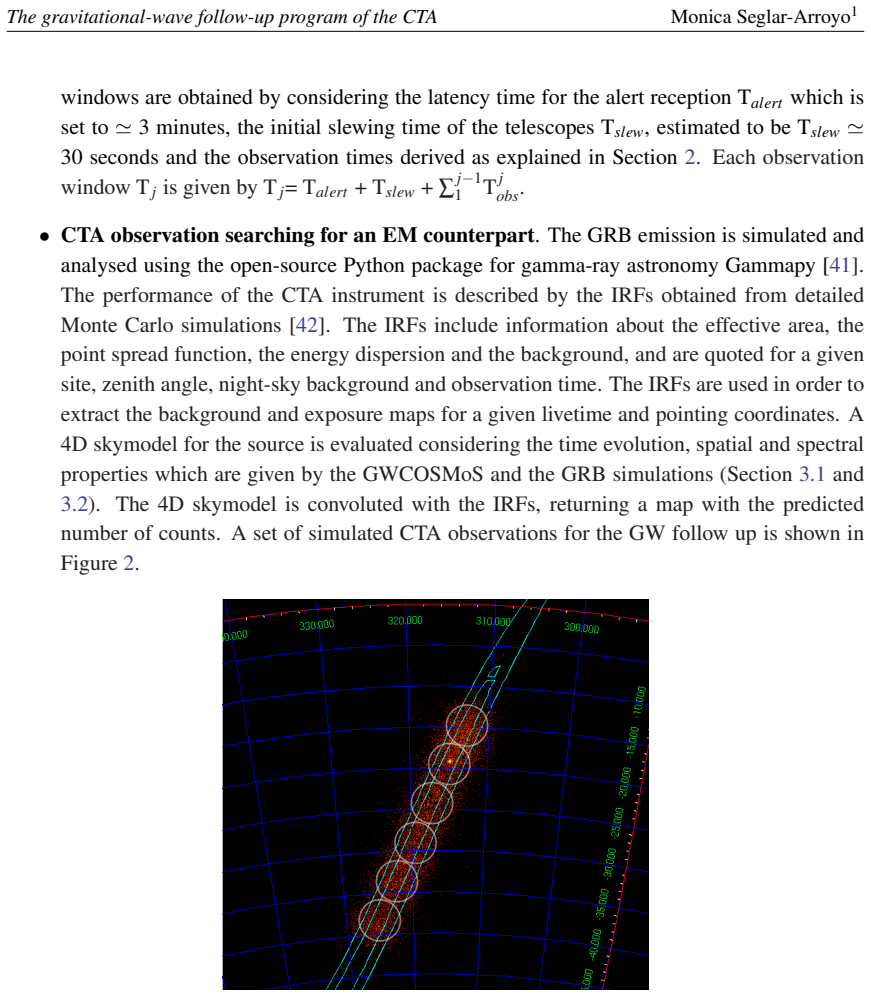
- [Figures 2 and 3] Figure 2 shows six observations of 15 seconds while Figure 3 shows a single observation with Tobs=2 s; the relationship between these two exposure choices should be stated explicitly so the reader does not infer an inconsistency.
Circularity Check
Closed-loop injection test gives a mild self-consistency circularity; the program description itself is not circular.
-
self definitional
[Eq. (2.1), Section 2; Figure 3, Section 3.3]
"For each observation window the duration Tobs is set to the time required to make a 5 sigma detection at the sensitivity that has been quoted for those observation conditions using the instrument response functions (IRFs) [42] at a given time post-merger. Tobs is selected so that the following condition is fulfilled: ∫_{t0}^{t0+Tobs} dF(t)/dt dt = Fint_5σ(t0,t0+Tobs) (2.1) ... the GRB is detected at 8σ."
The same GRB light curve dF/dt and the same CTA IRFs are used twice: first to set Tobs via Eq. (2.1) as the time needed to reach a 5σ detection, and second as the injected source in the Gammapy simulation whose TS map yields the reported 8σ detection. Choosing Tobs to make the source reach 5σ means the simulated detection is built into the inputs, so the 8σ excess is a consistency check of the scheduling/analysis chain rather than an independent validation that CTA will detect VHE counterparts. The paper explicitly frames this as a strategy proof, so the circularity is minor and does not compromise the program description.
full rationale
The paper is primarily a program description and an end-to-end simulation study. The follow-up scheduling, RTA latency claims, and survey strategies are not derived from circular inputs: they rest on public/independent inputs (GWCOSMoS BNS catalogs, Fermi-LAT GRB observations, CTA instrument response functions, Gammapy, BAYESTAR, external galaxy catalogs). The GRB VHE model in Sec. 3.2 is an explicitly phenomenological set of assumptions (t^2 rise, t_peak=3s, t^-1.4 decay, photon index -2.1, extrapolation to 10 TeV, 5-degree jet) based on external GRB data and the Nava et al. correlation; these are model inputs, not parameters fitted to the CTA simulation output. No parameter is fitted to a subset of data and then rediscovered as a prediction, and no uniqueness theorem or load-bearing self-citation is invoked. The only mildly circular element is the closed loop between Eq. (2.1) and Figure 3: Tobs is defined as the time to reach 5σ for the same model source and IRFs that are then injected into the Gammapy simulation, so the resulting 8σ detection is partly by construction. Because the paper presents this as a strategy proof/injection test rather than as a physical prediction, the circularity is minor (score 2). The skeptic concern about missing EBL absorption is a realism/completeness risk for the simulation, not a circularity, and does not raise this score.
Assumptions & free parameters
free parameters (5)
- Eiso distribution parameters =
short-GRB intrinsic distribution from [38]
- Spectral photon index =
-2.1
- Afterglow light-curve shape =
t^2 rise, t_peak=3 s, t^-1.4 decay
- Jet opening angle =
5 degrees
- BNS merger rate =
830 Gpc^-3 yr^-1
assumptions (4)
- domain assumption VHE emission from short GRBs follows the Fermi-LAT phenomenology extrapolated to 10 TeV.
- domain assumption CTA instrument response functions from Monte Carlo simulations represent the future real array.
- domain assumption GW candidates require combined SNR > 12 in at least two detectors with consistent time delay.
- domain assumption Galaxy catalog overlap and avoidance zone are valid priors for narrowing the counterpart search.
Cite this review
Pith. "Pith review of The gravitational-wave follow-up program of the Cherenkov Telescope Array." pith.science (2026). https://pith.science/paper/5BD7L4XP
@misc{pith2026190808393,
  author       = {Pith},
  title        = {Pith review of: The gravitational-wave follow-up program of the Cherenkov Telescope Array},
  year         = {2026},
  howpublished = {\url{https://pith.science/paper/5BD7L4XP}},
  note         = {Machine review of arXiv:1908.08393}
}
read the original abstract
The birth of gravitational-wave / electromagnetic astronomy was heralded by the joint observation of gravitational waves (GWs) from a binary neutron star (BNS) merger by Advanced LIGO and Advanced Virgo, GW170817, and of gamma-rays from the short gamma-ray burst GRB170817A by the Fermi Gamma-ray Burst Monitor (GBM) and INTEGRAL. This detection provided the first direct evidence that at least a fraction of BNSs are progenitors of short GRBs. GRBs are now also known to emit very-high-energy (VHE, > 100 GeV) photons as has been shown by recent independent detections of the GRBs 1901114C and 180720B by the ground-based gamma-ray detectors MAGIC and H.E.S.S. In the next years, the Cherenkov Telescope Array (CTA) will boost the searches for VHE counterparts thanks to its unprecedented sensitivity, rapid response and capability to monitor large sky areas via survey-mode operation. In this contribution, we present the CTA program of observations following the detection of GW events. We discuss various follow-up strategies and links to multi-wavelength and multi-messenger observations. Finally we outline the capabilities and prospects of detecting VHE emission from GW counterparts.
Figures


Forward citations
Cited by 1 Pith paper
-
Gravitational-wave follow-up with CTA after the detection of GRBs in the TeV energy domain
Given TeV emission similar to GRB 090510, CTA could detect short-GRB counterparts of gravitational-wave mergers even when follow-up starts more than an hour after the event.
Reference graph
Works this paper leans on
-
[1]
Abbott, B.P., Abbott, R., Abbott, T.D., et al. 2017, Phys. Rev. Lett. , 119, 161101
work page 2017
-
[2]
Classical and Quantum Gravity 27, 084006 (2010)
Harry, G.M., and LIGO Scientific Collaboration. Classical and Quantum Gravity 27, 084006 (2010)
work page 2010
-
[3]
Classical and Quantum Gravity 32.2 (2014): 024001
Acernese, F., et al. Classical and Quantum Gravity 32.2 (2014): 024001
work page 2014
- [4]
- [5]
-
[6]
D., Margutti, R., Blanchard, et al., 2018, Astrophys
Alexander, K. D., Margutti, R., Blanchard, et al., 2018, Astrophys. J. Lett. , 863(2), L18
work page 2018
- [7]
-
[8]
2019, Science, 363, 968 6 The gravitational-wave follow-up program of the CTA Monica Seglar-Arroyo1
Ghirlanda et al. 2019, Science, 363, 968 6 The gravitational-wave follow-up program of the CTA Monica Seglar-Arroyo1
work page 2019
Show all 44 references
-
[9]
I., Novikov, I
Blinnikov, S. I., Novikov, I. D., Perevodchikova, T. V ., et al.,1984, Sov. Astron. Lett. , 10, 177-179
1984
-
[10]
2007, Phys
Nakar, E. 2007, Phys. Rer. , 442(1-6), 166-236
2007
-
[11]
Woosley, S. E. , 1993, ApJ, 405, 273-277
1993
-
[12]
,2018, International Journal of Modern Physics D 27.13, p
Nava, L. ,2018, International Journal of Modern Physics D 27.13, p. 1842003
2018
-
[13]
Noda, and E
Mirzoyan, R., K. Noda, and E. et al. Moretti, GCN Circular, No. 23701
-
[14]
Ruiz Velasco et al
E.L. Ruiz Velasco et al. (H.E.S.S. Collaboration), 1st CTA Symposium, Bologna(2019)
2019
-
[15]
CTA Consortium, 2017, Science with the Cherenkov Telescope Array, arXiv:1709.07997
2017 arXiv
-
[16]
Monthly Notices of the Royal Astronomical Society 443, 738 (2014)
Bartos, Imre, et al. Monthly Notices of the Royal Astronomical Society 443, 738 (2014)
2014
-
[17]
2016, JCAP, 11, 056
Patricelli, B., Razzano, M., Cella, G., et al. 2016, JCAP, 11, 056
2016
-
[18]
Monthly Notices of the Royal Astronomical Society 477, 639 (2018)
Bartos, Imre, et al. Monthly Notices of the Royal Astronomical Society 477, 639 (2018)
2018
-
[19]
2018, JCAP, 5, 056
Patricelli, B., Stamerra, A., Razzano, M., et al. 2018, JCAP, 5, 056
2018
-
[20]
Bulgarelli, V
A. Bulgarelli, V . Fioretti, A. Zoli, A. Aboudan, et al., 34th ICRC2015, vol. 34, p. 763, Jul, 2015
2015
-
[21]
Ajello, M., et al., Astrophys. J. , 878(1), 52
-
[22]
2012, A&A 539, A124
Abadie, J et al. 2012, A&A 539, A124
2012
-
[23]
P., et al., 2017, Phys
Abbott, B. P., et al., 2017, Phys. Rev. Lett. , 119(16), 161101
2017
-
[24]
Fioretti, V ., Bulgarelli, A., Zoli, A., Markoff, S., Ribo, M., Inoue, S. et al. , 2015, PoS, 34 , 699
2015
-
[25]
Bulgarelli et al., Proc
A. Bulgarelli et al., Proc. SPIE Int. Soc. Opt. Eng. 9913 (2016) 991331
2016
-
[26]
Patricelli, B., Razzano, M., Cella, G., et al., 2018 (figshare), https://doi.org/10.6084/m9.figshare.c.4243595
2018 doi
-
[27]
Abbott B.P. et al. 2018, Living Rev Relativ, 21, 3
2018
-
[28]
2009, Phys
Buonanno, A., Iyer, B.R., Ochsner, E., et al. 2009, Phys. Rev. D 80 , 084043
2009
-
[29]
and Zubakov, V
Wainstein, L.A. and Zubakov, V . D. Prentice-Hall, Englewood Cliffs, 1962
1962
-
[30]
Dal Canton, T., Nitz, A. H. , Lundgren, A. P. et al. 2014, Phys. Rev. D 90, 082004
2014
-
[31]
Veitch, J., Raymond, V ., Farr, B. et al. 2015, Phys. Rev. D 91, 042003
2015
-
[32]
2016, Classical and Quantum Gravity 33, 175012
Adams, T., Buskulic, D., Germain, V ., et al. 2016, Classical and Quantum Gravity 33, 175012
2016
-
[33]
A., Nitz, A
Usman, S. A., Nitz, A. H., Harry, I. W. et al. 2016, Classical and Quantum Gravity 33, 215004
2016
-
[34]
Cannon, K., Cariou, R., Chapman, A., et al., 2012, ApJ 748, 136
2012
-
[35]
Messick, C., Blackburn, K., Brady, P. et al. 2017, Phys. Rev. D 95, 042001
2017
-
[36]
H., Dent, T., Dal Canton, T., et al
Nitz, A. H., Dent, T., Dal Canton, T., et al. 2017, ApJ 849, 118
2017
-
[37]
P., Price, L
Singer, L. P., Price, L. R., Farr, B., et al. 2014, ApJ 795, 105
2014
-
[38]
Ghirlanda G., et al., 2016, A&A, 594, A84
2016
-
[39]
Nava L., et al., 2014, MNRAS, 443, 3578
2014
-
[40]
2002, ApJ, 570, L61
Granot, J., Panaitescu, A., Kumar, P., et al. 2002, ApJ, 570, L61
2002
-
[41]
& Coto, R
Deil, C., Zanin, R., Lefaucheur, J., Boisson, C., Khélifi, B., Terrier, R., ... & Coto, R. L. (2017)
2017
-
[42]
https://www.cta-observatory.org/science/cta-performance/
-
[43]
A&A 495.3, pp
Stewart, IM 2009. A&A 495.3, pp. 989-1003
2009
-
[44]
Schüssler, F., PoS (ICRC2019) 788 7
Reviewed August 14, 2026 · model on record in the stance chip above.
Discussion (0). Continue with ORCID to comment.