REVIEW 3 major objections 4 minor 76 references
Reconfigurable Defect States in Non-Hermitian Topolectrical Chains with Gain and Loss
T0 review · 3 major / 4 minor · reviewed 2026-08-07 · deepseek-v4-flash
Pith's one-line read In a non-Hermitian SSH chain, staggered gain and loss alone can park a defect state at the defect site, push it to either edge, or erase it.
desk verdict Worth refereeing for its numerical and circuit-simulation study of defect states under combined NHSE and PT symmetry, but the analytical localization argument has a large-n flaw that needs repair. read the letter →
The pith
A machine-rendered reading of the paper's core claim, the machinery that carries it, and where it could break.
The reading
What carries the argument
The load-bearing object is the pair of non-Bloch factors $\beta_<$ and $\beta_>$, the generalized Bloch roots (decay/growth factors) of the bulk characteristic equation for the zero-energy manifold, together with the sublattice-weight amplitudes $\alpha_<$ and $\alpha_>$. On either side of the defect, the zero-energy wavefunction is written as a combination of $\beta_<^m$ and $\beta_>^m$ components, and the condition for the state to be pinned at the defect is that the left factor decays rightward and the right factor decays leftward, i.e. $|\beta_<|<1$ and $|\beta_>|>1$. The critical values $\gamma_{c1},\gamma_{c2},\gamma_{c3},\gamma_{c4}$ mark precisely where $|\beta_<|$ or $|\beta_>|$ crosses unity or where the two factors become equal, so the whole three-regime classification follows from tracking these two complex-plane radii.
What would settle it
Exact diagonalization of the finite defective chain at several sizes ($n=5,10,20$) can be checked against the predicted peak position of the zero-energy state: it should sit at the defect node for the PT and APT regimes, move to an edge when the $\beta$-magnitude conditions fail, and show no defect-localized zero mode in the broken-PT window. A mismatch between the numerically obtained peak and the $\beta$-based boundaries would falsify the analytical mechanism, as would a topolectrical-circuit measurement that shows voltage accumulation at the defect node in the broken-PT regime.
Extended reading notes
Core claim
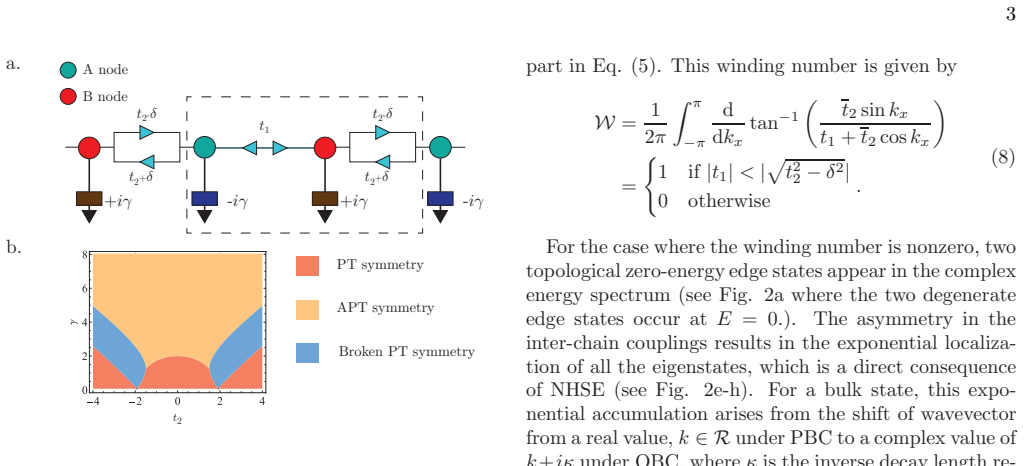
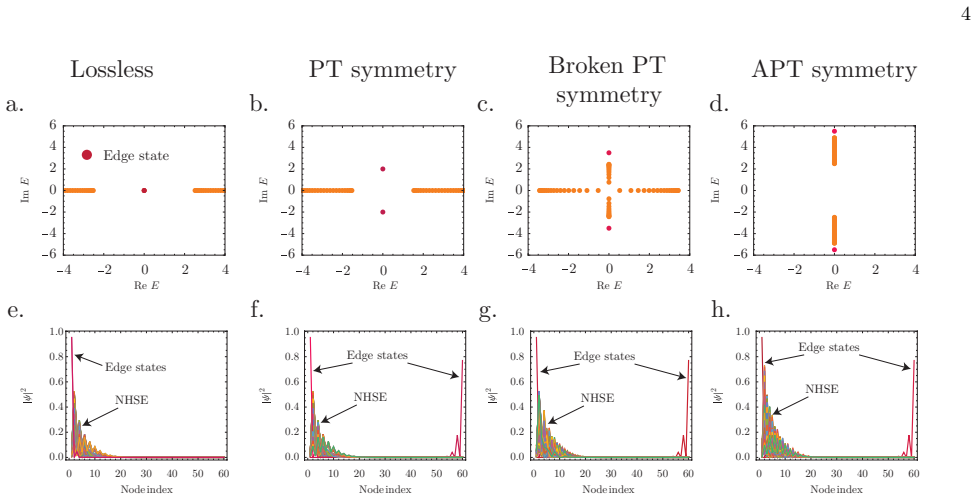
On its own terms, the paper's central claim is that the zero-energy defect state in a finite non-Hermitian SSH chain is reconfigurable by staggered gain/loss: depending on $\gamma$ it localizes at the defect site, shifts to an edge of the chain, or becomes completely delocalized. The control mechanism is the magnitude ordering of the two non-Bloch factors $\beta_<$ and $\beta_>$ obtained from the bulk characteristic equation; defect-localized wavefunctions require $|\beta_<|<1$ and $|\beta_>|>1$, and the four critical values $\gamma_{c1} = \sqrt{(|t_2|-|t_1|)^2-\delta^2}$, $\gamma_{c2} = \sqrt{t_2^2-\delta^2}-|t_1|$, $\gamma_{c3} = \sqrt{t_2^2-\delta^2}+|t_1|$, and $\gamma_{c4} = \sqrt{(|t_1|+|t_2|)^2-\delta^2}$ are exactly the points where these inequalities change. The paper further claims that introducing gain/loss restores the two topological edge states to opposite ends of the chain even while the bulk non-Hermitian skin effect persists, and that defect states survive only in the PT- and APT-symmetric regimes.
Load-bearing premise
The classification assumes that the finite-chain defect wavefunction is faithfully described by the two bulk non-Bloch factors $\beta_<$ and $\beta_>$, with terms of order $\beta_<^{n-1}$ and $\beta_>^{-(n-1)}$ dropped; if the defect itself renormalizes these factors, the critical $\gamma$ values and the three-regime picture would shift.
Editorial extensions
If this is right
- Tuning $\gamma$ across the four critical values acts as a three-position switch for a topological zero mode: at the defect site, at an edge, or absent.
- In the proposed topolectrical circuit, the defect node's voltage and zero-admittance accumulation should appear only in the PT and APT regimes, giving an electrical readout of the phase.
- Because the bulk states remain NHSE-localized at one edge, the restored edge states at opposite ends can be read out separately from the bulk background.
- The closed-form expressions for $\gamma_{c1},\ldots,\gamma_{c4}$ mean the regime boundaries are predictable from the circuit capacitances and resistances before fabrication.
Reading between the lines
- The mechanism is stated in terms of generic $\beta$ factors, so the same three-regime classification should carry over to other one-dimensional non-Hermitian bipartite lattices with a domain wall and a sublattice-pinned zero mode, including photonic or mechanical arrays with balanced loss.
- Because the defect amplitude grows roughly as $|\beta_>|^n$, the switch near $\gamma_{c1}$ and $\gamma_{c4}$ should become sharper as the chain grows, so finite-size effects in the proposed 39-node circuit are a natural place to test the approximation.
- The model leaves the defect node passive; adding gain or loss on the defect itself is a direct variation that would reveal how much of the zero-energy pinning depends on the defect remaining unpaired.
Editorial analysis
A structured set of objections, weighed in public.
Referee Report
Summary. The manuscript studies a finite non-Hermitian SSH chain with non-reciprocal inter-cell hopping and staggered gain/loss, including a central defect site. The authors show that in the absence of gain/loss the non-Hermitian skin effect drags both bulk and edge states to one edge, and that staggered gain/loss restores the two edge states to opposite edges. For the defect state, they identify three regimes controlled by the gain/loss strength γ: localization at the defect site in the PT and anti-PT regimes, localization at the system edges in the broken-PT regime, and a claimed complete delocalization/suppression in the broken-PT regime. The analytical argument uses the non-Bloch factors β< and β> obtained from the zero-energy bulk condition, with the defect wavefunction constructed from the corresponding eigenvectors. The paper closes with an LTSpice-based topolectrical circuit realization and a comparison of voltage and admittance spectra with the numerical model.
Significance. If the central claim holds, the work provides a concrete route to reconfigurable defect-state engineering in non-Hermitian systems, extending the earlier defect activation/suppression picture of Stegmaier et al. to models with non-reciprocal hopping and the non-Hermitian skin effect. The manuscript is unusually transparent in presenting its analytical construction, and the numerical and LTSpice data are consistent with each other for the system sizes shown. The model has no fitted free parameters, and the circuit proposal is plausible. However, the analytical derivation of the three-regime classification contains a size-dependent asymptotic error that directly affects the paper's central claim, so the presented evidence is not yet sufficient as it stands.
major comments (3)
- [EFFECT OF GAIN/LOSS ON THE DEFECT STATES, Eqs. (38)-(40)] The statement after Eq. (40) that, at large n, the defect amplitude (39) becomes exponentially larger than the right-end amplitude (40) is inconsistent with the displayed formulas for the paper's own parameters. The zero-energy quadratic gives β<β> = (t2+δ)/(t2−δ), so for t1=1.2, t2=4, δ=−1.5 one has |β<β>| = 2.5/5.5 ≈ 0.455 and |1/(β<β>)|^{n+1} ≈ (2.2)^{n+1}. Equation (40) therefore grows exponentially with n, while Eq. (39) grows as |β>|^n ≈ (1.69)^n for the same parameters. The prefactor α</α> ≈ 0.034 does not remove this growth; for large enough n the right-edge amplitude dominates. The claimed exponential hierarchy and the resulting three-regime classification cannot be read off from |β<| and |β>| alone; the matching coefficients α<, α>, and c>,R, together with the n-dependent factor in Eq. (40), determine the localization. The authors should re-derive the full matching conditions, identify the actual condition under which the defect amplitude dominates the right-edge amplitude (e.g. involving |β>|^2|β<| and the prefactors), and test numerically for larger n than n=10 whether the defect-localized regime persists.
- [EFFECT OF GAIN/LOSS ON THE DEFECT STATES, Fig. 5d and text defining γc1...γc4] The critical values γc1...γc4 are derived purely from the conditions |β<|=1, |β>|=1, and |β<|=|β>|, which are properties of the bulk generalized Brillouin zone. The localization of the defect zero mode is, however, governed by the defect-matching problem, including the boundary condition on both sides of the defect and the normalization of the full wavefunction. Since the matching coefficients in Eqs. (38)-(40) are n-dependent, the points where the defect amplitude crosses the edge amplitudes generally differ from the bulk β-crossings. Without an explicit comparison of the full amplitudes, the identification of γc1...γc4 as the boundaries of the three localization regimes is not established. The authors should either prove that the matching coefficients do not affect the exponential hierarchy in the regimes they claim, or replace the γc values by size-dependent crossover values computed from the exact wavefunctions.
- [Abstract and Conclusion] The abstract states that in the three regimes the defect states 'localize at the defect site, shift to the system's edges, or become completely delocalized.' The main text and Fig. 4e instead show that in the broken-PT regime the defect state is absent or suppressed, not spread over the chain, and the conclusion similarly says 'suppress the localization of the defect state completely.' This is an inconsistency in the central claim as stated: 'completely delocalized' is not the same as 'absent.' The authors should clarify what is meant in the broken-PT regime, and adjust the abstract and conclusion accordingly.
minor comments (4)
- [Eq. (32)] The stated condition δ²+γ²−t1²−t2²<0 is violated for the APT case shown in Fig. 4, e.g. γ=5.5 with the stated parameters gives δ²+γ²−t1²−t2²≈15.06>0. Please specify how the β roots are obtained in that regime (e.g. analytic continuation or a different branch choice).
- [Fig. 5b] The text says the white line denoting high probability density shifts to the defect site when γ exceeds approximately 0.5×10⁻⁶, but the horizontal axis of Fig. 5b appears to be γ on a scale of 0 to 6. The quoted threshold seems inconsistent with the figure scale or the stated parameters; please clarify.
- [General presentation] There are several typos and OCR-style artifacts in the equations and text, e.g. 'Schroedinger', the duplicated '2' in the denominator of Eq. (32), and the garbled rendering of Eq. (39). A careful proofreading pass would improve readability.
- [Circuit section] The circuit validation is a simulation (LTSpice) of the same model, not an independent experimental measurement. The wording is mostly careful, but the phrase 'validate our theoretical predictions' in the conclusion could be read as claiming more than a consistency check. Please rephrase to emphasize that the circuit is a proposed experimental realization supported by circuit simulations.
Circularity Check
No significant circularity: the three-regime defect-state prediction is derived analytically from the non-Bloch roots without fitted parameters or load-bearing self-citation.
full rationale
The paper's central claim—that the zero-energy defect state localizes at the defect site in the PT and APT regimes, shifts to the edges in the broken-PT regime, and is suppressed there—is obtained by constructing zero-energy eigenvectors from the non-Bloch roots β< and β> of the bulk characteristic equation, solving the Schrödinger equations at the three defect nodes, and then tracking when |β<| and |β>| cross unity. No parameter is fitted to the predicted quantity; the critical values γc1...γc4 are algebraic conditions on those roots, not inputs. The LTSpice circuit simulation instantiates the same Hamiltonian and therefore confirms consistency rather than providing independent experimental data, but that is not circularity in the derivation. Self-citations appear in the introduction, for INIC circuit elements, and for skin-effect background; none is load-bearing for the new three-regime result. The zero-energy pinning is justified by an external theorem (Ref. [75]) and by the authors' numerical observation. A separate mathematical concern—that Eq. (40) contains (β>β<)^{-(n+1)}, which grows when |β>β<|<1, seemingly contradicting the claim that the defect amplitude dominates at large n for δ<0—is an internal correctness or approximation issue, not a circularity, because it does not reduce the prediction to the model's inputs. Hence no circular step is identified.
Assumptions & free parameters
assumptions (4)
- domain assumption Open-boundary eigenstates of the non-Hermitian chain are captured by non-Bloch factors β that solve the characteristic equation of the Bloch Hamiltonian, with the generalized Brillouin zone given by |β<| = |β>|.
- domain assumption Zero-energy defect states remain pinned at E=0 for the non-Hermitian bipartite chain, per the generalized Lieb theorem for noninteracting non-Hermitian n-partite lattices.
- standard math The similarity transform S (Eq. 6) maps H0 to a Hermitian Hamiltonian with the same eigenvalues, so the topological winding number can be computed from the Hermitian counterpart.
- domain assumption In the large-N limit, the edge Hamiltonian projection retains only the N+N- t1 terms and yields edge-state energies ±sqrt((N+N- t1)^2 - γ^2) approaching ±iγ.
Cite this review
Pith. "Pith review of Reconfigurable Defect States in Non-Hermitian Topolectrical Chains with Gain and Loss." pith.science (2026). https://pith.science/paper/5BUJAMQH
@misc{pith2026250520791,
  author       = {Pith},
  title        = {Pith review of: Reconfigurable Defect States in Non-Hermitian Topolectrical Chains with Gain and Loss},
  year         = {2026},
  howpublished = {\url{https://pith.science/paper/5BUJAMQH}},
  note         = {Machine review of arXiv:2505.20791}
}
read the original abstract
We investigate the interplay between the non-Hermitian skin effect (NHSE), parity-time (PT) symmetry, and topological defect states in a finite non-Hermitian Su-Schrieffer-Heeger (SSH) chain. In the conventional NHSE regime, non-reciprocal hopping leads to an asymmetric localization of all eigenstates at one edge of the system, including the bulk and topological edge states. However, the introduction of staggered gain and loss restores the symmetric localization of topological edge states while preserving the bulk NHSE. We further examine the response of defect states in this system, demonstrating that their spatial localization is dynamically controlled by the combined effects of NHSE and PT symmetry. Specifically, we identify three distinct regimes in which the defect states localize at the defect site, shift to the system's edges, or become completely delocalized. These findings extend beyond previous works that primarily explored the activation and suppression of defect states through gain-loss engineering. To validate our theoretical predictions, we propose an experimental realization using a topolectrical circuit, where non-Hermitian parameters are implemented via impedance converter-based non-reciprocal elements. Circuit simulations confirm the emergence and tunability of defect states through voltage and admittance measurements, providing a feasible platform for experimental studies of non-Hermitian defect engineering. Our results establish a route for designing reconfigurable non-Hermitian systems with controllable topological defect states, with potential applications in robust signal processing and sensing.
Figures

Figures from the paper (3 more)


Reference graph
Works this paper leans on
- [1]
-
[2]
(40) Notice that at large n, the wavefunction at the defect (see Eq
−it1γ) ) ⏐ ⏐ ⏐ ⏐ (39) |⟨x = 4n − 1|ψ⟩| = ⏐ ⏐ ⏐ ⏐ α< α> t2 +δ t2 −δ 1 (β>β<)n+1 (β> −α>α<β<) ⏐ ⏐ ⏐ ⏐. (40) Notice that at large n, the wavefunction at the defect (see Eq. 39) becomes exponentially larger than the wave- functions at the left and right ends of the system (Eq. 38 and Eq. 40) because of the factor of βn > in the former. This results in the loc...
-
[3]
Saturation Dynamics in Non-Hermitian Topological Sensing Systems
S. Rafi-Ul-Islam, Z. B. Siu, M. S. H. Razo, and M. Jalil, Saturation dynamics in non-hermitian topological sens- ing systems, ArXiv preprint arXiv:2406.19629 (2024)
work page Pith review arXiv 2024
-
[4]
Ashida, Z
Y. Ashida, Z. Gong, and M. Ueda, Non-hermitian physics, Adv. Phys. 69, 249 (2020)
2020
-
[5]
Z. B. Siu, S. Rafi-Ul-Islam, and M. B. Jalil, Terminal- coupling induced critical eigenspectrum transition in closed non-hermitian loops, Sci. Rep. 13, 22770 (2023)
work page 2023
-
[6]
Exceptional Points and Braiding Topology in Non-Hermitian Systems with long-range coupling
S. Rafi-Ul-Islam, Z. B. Siu, M. S. H. Razo, and M. Jalil, Exceptional points and braiding topology in non-hermitian systems with long-range coupling, ArXiv preprint arXiv:2407.04691 (2024)
work page Pith review arXiv 2024
-
[7]
E. J. Bergholtz, J. C. Budich, and F. K. Kunst, Ex- ceptional topology of non-hermitian systems, Rev. Mod. Phys. 93, 015005 (2021)
2021
-
[8]
Twisted topology and Bipolar Non-Hermitian Skin Effect induced by long-range asymmetric coupling
S. Rafi-Ul-Islam, Z. B. Siu, H. Sahin, M. S. H. Razo, and M. Jalil, Twisted topology and bipolar non-hermitian skin effect induced by long-range asymmetric coupling, ArXiv preprint arXiv:2312.12780 (2023)
work page Pith review arXiv 2023
Show all 76 references
-
[9]
Z. Gong, Y. Ashida, K. Kawabata, K. Takasan, S. Hi- gashikawa, and M. Ueda, Topological phases of non- hermitian systems, Phys. Rev. X 8, 031079 (2018)
2018
-
[10]
Q. Yan, B. Zhao, R. Zhou, R. Ma, Q. Lyu, S. Chu, X. Hu, and Q. Gong, Advances and applications on non- hermitian topological photonics, Nanophotonics (2023)
2023
-
[11]
L. Feng, R. El-Ganainy, and L. Ge, Non-hermitian pho- tonics based on parity–time symmetry, Nat. Photon. 11, 752 (2017)
2017
-
[12]
Longhi, Parity-time symmetry meets photonics: A new twist in non-hermitian optics, Europhys
S. Longhi, Parity-time symmetry meets photonics: A new twist in non-hermitian optics, Europhys. Lett. 120, 64001 (2018)
2018
-
[13]
Santra and L
R. Santra and L. S. Cederbaum, Non-hermitian electronic theory and applications to clusters, Phys. Rep. 368, 1 (2002)
2002
-
[14]
M. Wang, L. Ye, J. Christensen, and Z. Liu, Valley physics in non-hermitian artificial acoustic boron nitride , Phy. Rev. Lett. 120, 246601 (2018)
2018
-
[15]
Bagarello, R
F. Bagarello, R. Passante, and C. Trapani, Non- hermitian hamiltonians in quantum physics, Springer Proc. Phys. 184 (2016)
2016
-
[16]
Rafi-Ul-Islam, Z
S. Rafi-Ul-Islam, Z. B. Siu, M. S. H. Razo, H. Sahin, and M. B. Jalil, From knots to exceptional points: Emergence of topological features in non-hermitian systems with long-range coupling, Phys. Rev. B 110, 045444 (2024)
2024
-
[17]
Zhang, Q.-h
D.-J. Zhang, Q.-h. Wang, and J. Gong, Time-dependent pt-symmetric quantum mechanics in generic non- hermitian systems, Phys. Rev. A 100, 062121 (2019)
2019
-
[18]
Longhi, Optical realization of relativistic non- hermitian quantum mechanics, Phy
S. Longhi, Optical realization of relativistic non- hermitian quantum mechanics, Phy. Rev. Lett. 105, 013903 (2010)
2010
-
[19]
C. M. Bender, D. C. Brody, H. F. Jones, and B. K. Meis- ter, Faster than hermitian quantum mechanics, Phy. Rev. Lett. 98, 040403 (2007)
2007
-
[20]
C.-Y. Ju, A. Miranowicz, G.-Y. Chen, and F. Nori, Non- hermitian hamiltonians and no-go theorems in quantum information, Phys. Rev. A 100, 062118 (2019)
2019
-
[21]
C. Hahn, Y. Choi, J. W. Yoon, S. H. Song, C. H. Oh, and P. Berini, Observation of exceptional points in recon- figurable non-hermitian vector-field holographic lattices , Nat. Commun. 7, 12201 (2016)
2016
-
[22]
El-Ganainy, K
R. El-Ganainy, K. G. Makris, M. Khajavikhan, Z. H. Musslimani, S. Rotter, and D. N. Christodoulides, Non- hermitian physics and pt symmetry, Nat. Phys. 14, 11 (2018)
2018
-
[23]
Sahin, H
H. Sahin, H. Akg¨ un, Z. B. Siu, S. Rafi-Ul-Islam, J. F. Kong, M. B. Jalil, and C. H. Lee, Protected chaos in a topological lattice, Adv. Sci. , e03216 (2024)
2024
-
[24]
Zhang, B
X. Zhang, B. Zhang, H. Sahin, Z. B. Siu, S. Rafi-Ul- Islam, J. F. Kong, B. Shen, M. B. Jalil, R. Thomale, and C. H. Lee, Anomalous fractal scaling in two-dimensional electric networks, Commun. Phys. 6, 151 (2023)
2023
-
[25]
Okuma, K
N. Okuma, K. Kawabata, K. Shiozaki, and M. Sato, Topological origin of non-hermitian skin effects, Phy. Rev. Lett. 124, 086801 (2020)
2020
-
[26]
S. M. Rafi-Ul-Islam, Z. B. Siu, H. Sahin, M. S. H. Razo, and M. B. A. Jalil, Twisted topology of non-hermitian 12 systems induced by long-range coupling, Phys. Rev. B 109, 045410 (2024)
2024
-
[27]
Rafi-Ul-Islam, Z
S. Rafi-Ul-Islam, Z. B. Siu, M. S. H. Razo, and M. Jalil, Dynamic manipulation of non-hermitian skin effect through frequency in topolectrical circuits, ArXiv preprint arXiv:2410.16914 (2024)
2024 arXiv
-
[28]
Rafi-Ul-Islam, Z
S. Rafi-Ul-Islam, Z. B. Siu, M. S. H. Razo, and M. B. Jalil, Critical non-hermitian skin effect in a cross-couple d hermitian chain, Phys. Rev. B 111, 115415 (2025)
2025
-
[29]
L. Li, C. H. Lee, S. Mu, and J. Gong, Critical non- hermitian skin effect, Nat. Commun. 11, 5491 (2020)
2020
-
[30]
Zhang, Z
K. Zhang, Z. Yang, and C. Fang, Universal non-hermitian skin effect in two and higher dimensions, Nat. Commun. 13, 2496 (2022)
2022
-
[31]
F. Song, S. Yao, and Z. Wang, Non-hermitian skin effect and chiral damping in open quantum systems, Phy. Rev. Lett. 123, 170401 (2019)
2019
-
[32]
Zhong, K
J. Zhong, K. Wang, Y. Park, V. Asadchy, C. C. Wojcik, A. Dutt, and S. Fan, Nontrivial point-gap topology and non-hermitian skin effect in photonic crystals, Phys. Rev. B 104, 125416 (2021)
2021
-
[33]
X. Zhu, H. Wang, S. K. Gupta, H. Zhang, B. Xie, M. Lu, and Y. Chen, Photonic non-hermitian skin ef- fect and non-bloch bulk-boundary correspondence, Phys. Rev. Res. 2, 013280 (2020)
2020
-
[34]
Y. Song, W. Liu, L. Zheng, Y. Zhang, B. Wang, and P. Lu, Two-dimensional non-hermitian skin effect in a synthetic photonic lattice, Phys. Rev. Appl. 14, 064076 (2020)
2020
-
[35]
Rafi-Ul-Islam, Z
S. Rafi-Ul-Islam, Z. Bin Siu, and M. B. Jalil, Topoelectri- cal circuit realization of a weyl semimetal heterojunction , Commun. Phys. 3, 72 (2020)
2020
-
[36]
S. Liu, R. Shao, S. Ma, L. Zhang, O. You, H. Wu, Y. J. Xiang, T. J. Cui, and S. Zhang, Non-hermitian skin effect in a non-hermitian electrical circuit, Research (2021)
2021
-
[37]
Rafi-Ul-Islam, Z
S. Rafi-Ul-Islam, Z. B. Siu, C. Sun, and M. B. Jalil, Re- alization of weyl semimetal phases in topoelectrical cir- cuits, New J. Phys. 22, 023025 (2020)
2020
-
[38]
Sahin, Z
H. Sahin, Z. B. Siu, S. Rafi-Ul-Islam, J. F. Kong, M. B. Jalil, and C. H. Lee, Impedance responses and size- dependent resonances in topolectrical circuits via the method of images, Phys. Rev. B 107, 245114 (2023)
2023
-
[39]
Rafi-Ul-Islam, H
S. Rafi-Ul-Islam, H. Sahin, Z. B. Siu, and M. B. Jalil, Interfacial skin modes at a non-hermitian heterojunction, Phys. Rev. Res. 4, 043021 (2022)
2022
-
[40]
Helbig, T
T. Helbig, T. Hofmann, S. Imhof, M. Abdelghany, T. Kiessling, L. Molenkamp, C. Lee, A. Szameit, M. Gre- iter, and R. Thomale, Generalized bulk–boundary corre- spondence in non-hermitian topolectrical circuits, Nat. Phys. 16, 747 (2020)
2020
-
[41]
Rafi-Ul-Islam, Z
S. Rafi-Ul-Islam, Z. B. Siu, H. Sahin, and M. B. Jalil, Valley hall effect and kink states in topolectrical circuits , Phys. Rev. Res. 5, 013107 (2023)
2023
-
[42]
Rafi-Ul-Islam, Z
S. Rafi-Ul-Islam, Z. B. Siu, and M. B. Jalil, Non- hermitian topological phases and exceptional lines in topolectrical circuits, New J. Phys. 23, 033014 (2021)
2021
-
[43]
Hofmann, T
T. Hofmann, T. Helbig, F. Schindler, N. Salgo, M. Brzezi´ nska, M. Greiter, T. Kiessling, D. Wolf, A. Voll- hardt, A. Kabaˇ si, et al. , Reciprocal skin effect and its realization in a topolectrical circuit, Phys. Rev. Res. 2, 023265 (2020)
2020
-
[44]
Rafi-Ul-Islam, Z
S. Rafi-Ul-Islam, Z. B. Siu, H. Sahin, C. H. Lee, and M. B. Jalil, Unconventional skin modes in generalized topolec- trical circuits with multiple asymmetric couplings, Phys. Rev. Res. 4, 043108 (2022)
2022
-
[45]
Rafi-Ul-Islam, Z
S. Rafi-Ul-Islam, Z. B. Siu, and M. B. Jalil, Topologi- cal phases with higher winding numbers in nonreciprocal one-dimensional topolectrical circuits, Phys. Rev. B 103, 035420 (2021)
2021
-
[46]
K. Xu, X. Zhang, K. Luo, R. Yu, D. Li, and H. Zhang, Coexistence of topological edge states and skin effects in the non-hermitian su-schrieffer-heeger model with long- range nonreciprocal hopping in topoelectric realizations , Phys. Rev. B 103, 125411 (2021)
2021
-
[47]
Zhang, Y
X. Zhang, Y. Tian, J.-H. Jiang, M.-H. Lu, and Y.-F. Chen, Observation of higher-order non-hermitian skin ef- fect, Nat. Commun. 12, 5377 (2021)
2021
-
[48]
Rafi-Ul-Islam, Z
S. Rafi-Ul-Islam, Z. B. Siu, H. Sahin, and M. B. Jalil, Conductance modulation and spin/valley polar- ized transmission in silicene coupled with ferroelectric layer, Journal of Magnetism and Magnetic Materials 571, 170559 (2023)
2023
-
[49]
Kawabata, M
K. Kawabata, M. Sato, and K. Shiozaki, Higher-order non-hermitian skin effect, Phys. Rev. B 102, 205118 (2020)
2020
-
[50]
Rafi-Ul-Islam, Z
S. Rafi-Ul-Islam, Z. B. Siu, H. Sahin, and M. Jalil, Engineering higher-order dirac and weyl semimetal- lic phase in 3d topolectrical circuits, ArXiv preprint arXiv:2303.10911 (2023)
2023 arXiv
-
[51]
Z. Lin, S. Ke, X. Zhu, and X. Li, Square-root non-bloch topological insulators in non-hermitian ring resonators, Opt. Express 29, 8462 (2021)
2021
-
[52]
Rafi-Ul-Islam, Z
S. Rafi-Ul-Islam, Z. B. Siu, M. S. H. Razo, and M. Jalil, Anomalous non-hermitian skin effects in coupled hermitian chains with cross-coupling, ArXiv preprint arXiv:2410.21846 (2024)
2024 arXiv
-
[53]
Okuma and M
N. Okuma and M. Sato, Quantum anomaly, non- hermitian skin effects, and entanglement entropy in open systems, Phys. Rev. B 103, 085428 (2021)
2021
-
[54]
Rafi-Ul-Islam, Z
S. Rafi-Ul-Islam, Z. B. Siu, H. Sahin, C. H. Lee, and M. B. Jalil, System size dependent topological zero modes in coupled topolectrical chains, Phys. Rev. B 106, 075158 (2022)
2022
-
[55]
Fujita, M
T. Fujita, M. Jalil, S. Tan, and S. Murakami, Gauge fields in spintronics, J. Appl. Phys. 110 (2011)
2011
-
[56]
Rafi-Ul-Islam, Z
S. Rafi-Ul-Islam, Z. B. Siu, H. Sahin, and M. B. Jalil, Chiral surface and hinge states in higher-order weyl semimetallic circuits, Phys. Rev. B 109, 085430 (2024)
2024
-
[57]
Obana, F
D. Obana, F. Liu, and K. Wakabayashi, Topological edge states in the su-schrieffer-heeger model, Phys. Rev. B 100, 075437 (2019)
2019
-
[58]
Hafezi, S
M. Hafezi, S. Mittal, J. Fan, A. Migdall, and J. Taylor, Imaging topological edge states in silicon photonics, Nat. Photon. 7, 1001 (2013)
2013
-
[59]
Rafi-Ul-Islam, Z
S. Rafi-Ul-Islam, Z. B. Siu, H. Sahin, and M. B. Jalil, Type-ii corner modes in topolectrical circuits, Phys. Rev. B 106, 245128 (2022)
2022
-
[60]
Yuce, Edge states at the interface of non-hermitian systems, Phys
C. Yuce, Edge states at the interface of non-hermitian systems, Phys. Rev. A 97, 042118 (2018)
2018
-
[61]
Esaki, M
K. Esaki, M. Sato, K. Hasebe, and M. Kohmoto, Edge states and topological phases in non-hermitian systems, Phys. Rev. B 84, 205128 (2011)
2011
-
[62]
C. Poli, M. Bellec, U. Kuhl, F. Mortessagne, and H. Schomerus, Selective enhancement of topologically induced interface states in a dielectric resonator chain, Na.Commun. 6, 6710 (2015)
2015
-
[63]
Blanco-Redondo, I
A. Blanco-Redondo, I. Andonegui, M. J. Collins, G. Harari, Y. Lumer, M. C. Rechtsman, B. J. Eggleton, 13 and M. Segev, Topological optical waveguiding in silicon and the transition between topological and trivial defect states, Phys. Rev. Lett. 116, 163901 (2016)
2016
-
[64]
L.-J. Lang, Y. Wang, H. Wang, and Y. D. Chong, Effects of non-Hermiticity on Su-Schrieffer-Heeger defect states, Phys. Rev. B 98, 094307 (2018), publisher: American Physical Society
2018
-
[65]
W.-X. Cui, L. Qi, Y. Xing, S. Liu, S. Zhang, and H.- F. Wang, Localized photonic states and dynamic process in nonreciprocal coupled su-schrieffer-heeger chain, Opt. Express 28, 37026 (2020)
2020
-
[66]
Kong, Y.-F
Z.-X. Kong, Y.-F. Zhang, H.-X. Hao, and W.-J. Gong, Energy spectra of coupled su-schrieffer-heeger chains with-symmetric imaginary boundary potentials, Phys. Scr. 95, 115801 (2020)
2020
-
[67]
Garmon and K
S. Garmon and K. Noba, Reservoir-assisted symmetry breaking and coalesced zero-energy modes in an open pt- symmetric su-schrieffer-heeger model, Phys. Rev. A 104, 062215 (2021)
2021
-
[68]
J. C. Teo and T. L. Hughes, Topological defects in symmetry-protected topological phases, Annu. Rev. Con- dens. Matter Phys. 8, 211 (2017)
2017
-
[69]
Stegmaier, S
A. Stegmaier, S. Imhof, T. Helbig, T. Hofmann, C. H. Lee, M. Kremer, A. Fritzsche, T. Feichtner, S. Klembt, S. H¨ ofling,et al. , Topological defect engineering and p t symmetry in non-hermitian electrical circuits, Phys. Rev. Lett. 126, 215302 (2021)
2021
-
[70]
Barkeshli, C.-M
M. Barkeshli, C.-M. Jian, and X.-L. Qi, Classification of topological defects in abelian topological states, Phys . Rev. B 88, 241103 (2013)
2013
-
[71]
M. Pan, H. Zhao, P. Miao, S. Longhi, and L. Feng, Pho- tonic zero mode in a non-hermitian photonic lattice, Nat. Commun. 9, 1308 (2018)
2018
-
[72]
Rafi-Ul-Islam, Z
S. Rafi-Ul-Islam, Z. B. Siu, H. Sahin, C. H. Lee, and M. B. Jalil, Critical hybridization of skin modes in coupled non- hermitian chains, Phys. Rev. Res. 4, 013243 (2022)
2022
-
[73]
Yao and Z
S. Yao and Z. Wang, Edge states and topological in- variants of non-hermitian systems, Phys.Rev. Lett. 121, 086803 (2018)
2018
-
[74]
Munoz, F
F. Munoz, F. Pinilla, J. Mella, and M. I. Molina, Topo- logical properties of a bipartite lattice of domain wall states, Sci. Rep. 8, 17330 (2018)
2018
-
[75]
Zurita, C
J. Zurita, C. E. Creffield, and G. Platero, Fast quantum transfer mediated by topological domain walls, Quantum 7, 1043 (2023)
2023
-
[76]
Marques and R
A. Marques and R. Dias, Generalized lieb’s theorem for noninteracting non-hermitian n-partite tight-binding la t- tices, Phys. Rev. B 106, 205146 (2022)
2022
Reviewed August 7, 2026 · model on record in the stance chip above.
Discussion (0). Continue with ORCID to comment.