REVIEW 2 major objections 5 minor 19 references
Hardware-aware Graph Neural Networks prunning for embedded event-based vision
T0 review · 2 major / 5 minor · reviewed 2026-07-10 · grok-4.5
Pith's one-line read Hardware-aware pruning and quantization of event-based graph convolutional nets cut on-chip BRAM by 26–31% with only small accuracy loss on embedded FPGAs.
desk verdict Solid, usable hardware-aware compression for EFGCN feature memories; first of its kind for event GCNNs, backed by real ZCU104 numbers. read the letter →
The pith
A machine-rendered reading of the paper's core claim, the machinery that carries it, and where it could break.
The reading
What carries the argument
The pair of closed-form channel families C(BRAM)_m = m·18/gcd(q,18) and C(URAM)_n that guarantee full utilisation of every memory half-block, together with the two-stage FG+GLID search that walks those families while tracking the accuracy–BRAM Pareto front.
What would settle it
An unstructured or activation-aware pruning method that produces a model with lower BRAM count and higher accuracy than the FG+GLID result on the same three datasets and the same ZCU104 fabric would falsify the claim that the hardware-aligned families plus the described search are near-optimal.
Extended reading notes
Core claim
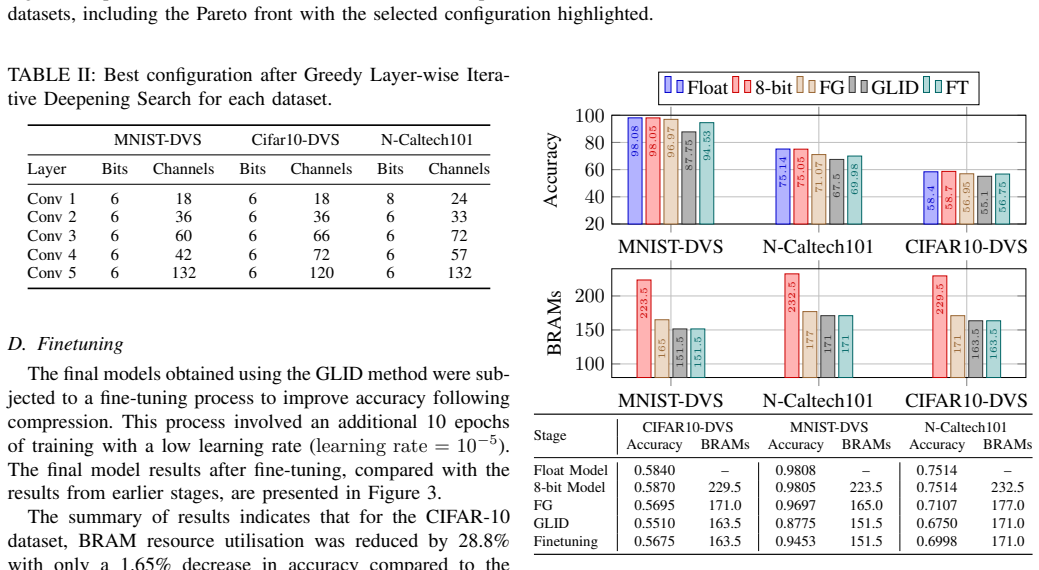
By forcing the number of channels and the bit-width of each feature map to belong to the discrete families that fully pack BRAM-18 kb halves or URAM-72 kb blocks, and by searching those families with Fine Grid Search plus Greedy Layer-wise Iterative Deepening, the EFGCN architecture can be reduced by 26.5–31.4 % in BRAM while losing only 1.65–5.18 % accuracy on CIFAR10-DVS, MNIST-DVS and N-Caltech101.
Load-bearing premise
The claim rests on the premise that the only configurations worth considering are those that completely fill BRAM or URAM blocks and that a short two-stage heuristic search is enough to find the best accuracy–memory trade-off among them.
Editorial extensions
If this is right
- Larger event-based GCNNs can now fit entirely inside on-chip memory of smaller SoC FPGAs, removing the need for external DRAM and its latency and energy cost.
- Designers can dial the accuracy–BRAM operating point after the first search stage simply by choosing a different knee on the Pareto front, matching a given platform’s memory budget without retraining from scratch.
- The same channel-alignment equations apply to any PointNet-style graph convolution whose feature maps are stored in dual-port FPGA memories, not only to the five-layer EFGCN.
- Logic-resource savings accompany the memory reduction because smaller feature vectors shrink the LUT-based multipliers and allow some 6-bit arithmetic.
- A working ZCU104 module already demonstrates a 30.6 % overall BRAM cut and a 3.55 % accuracy drop for MNIST-DVS classification.
Reading between the lines
- The same packing rule could be applied to the asynchronous early layers if their feature memories were also forced onto BRAM/URAM, potentially extending the savings beyond the synchronous part of the pipeline.
- Because the search returns an explicit Pareto front, the method can be re-run at design time whenever a new FPGA family changes the BRAM or URAM geometry, giving an automatic portability path.
- If edge or temporal importance scores were added to the pruning criterion, the same hardware families might yield still better accuracy for a given BRAM budget, a natural next experiment.
Signed reviews
Editorial analysis
A structured set of objections, weighed in public.
Referee Report
Summary. The paper proposes a hardware-aware pruning and quantization strategy for Graph Convolutional Neural Networks (specifically the EFGCN architecture) targeting event-based vision on embedded SoC FPGAs. The method constrains channel counts and bit-widths so that feature memories fully utilize BRAM-18 kb halves or URAM-72 kb blocks (Eqs. 1–5), then explores the resulting discrete design space with Fine Grid Search followed by Greedy Layer-wise Iterative Deepening Search. Evaluated on MNIST-DVS, CIFAR10-DVS and N-Caltech101, the approach reports BRAM reductions of 28.8–31.4 % relative to the floating-point baseline at accuracy drops of 1.65–5.18 % after fine-tuning; a ZCU104 synthesis of the MNIST-DVS model confirms a 30.6 % overall BRAM reduction together with LUT/FF savings.
Significance. If the reported trade-offs hold, the work supplies a practical, platform-aware compression recipe for the still-small literature on FPGA-accelerated event-based GCNNs. Strengths include explicit channel tables, Pareto plots, fine-tuning results, and a synthesised proof-of-concept module that validates the memory numbers on real hardware. The contribution is primarily engineering rather than algorithmic novelty, yet it directly addresses the on-chip memory bottleneck that limits larger models on mobile platforms and therefore has clear utility for the embedded-event-vision community.
major comments (2)
- Section IV and Figure 3 report only single-run accuracy and BRAM figures; no error bars, multiple random seeds or statistical tests are provided. Given that the accuracy drops (especially the 5.18 % on N-Caltech101) are modest, the absence of variance estimates makes it difficult to judge whether the observed trade-offs are robust or sensitive to training stochasticity.
- Related-work discussion (Section II-B) and the experimental protocol omit any quantitative comparison against magnitude-based unstructured pruning, activation-aware criteria, or other structured pruners that ignore the BRAM/URAM families of Eqs. 4–5. Without such baselines it remains unclear how much of the reported memory–accuracy trade-off is attributable to the hardware-aware constraints versus ordinary channel pruning.
minor comments (5)
- Title and several headings contain the typo “prunning”; correct to “pruning” throughout.
- Abstract and Section IV inconsistently refer to “CIFAR-10” versus “CIFAR10-DVS”; standardise on the neuromorphic dataset name.
- Equation (6) and the surrounding text state that k=2 yields 1024 configurations, yet later claim equivalence to a k=5 FG search; a short clarification of the combinatorial accounting would help.
- Table III shows an increase in DSP usage; a one-sentence explanation of the automatic mapping of 6-bit multiplies would improve readability.
- Index terms contain “Nerual” and “Prunning”; fix spelling.
Circularity Check
Empirical hardware-aware pruning results measured on held-out data and FPGA synthesis; only mild self-citation of the authors' prior EFGCN architecture as the starting model.
-
self citation load bearing
[Section II-A / III-A / IV-A (baseline model)]
"In this work, we have chosen to utilise the third system — EFGCN. In [7], the authors propose an architecture divided into two parts... For our study, we utilised the large model from [7], which consists of five convolutional layers and two pooling layers."
The unpruned starting architecture, memory layout (temporal channel matrices, feature memories), and initial channel counts are taken directly from the authors' own prior work [7]. This is ordinary self-citation of a baseline system rather than a uniqueness claim or definitional loop; the pruning results themselves remain independent empirical measurements. Mild only.
full rationale
The paper's central claims are measured engineering outcomes: channel counts constrained to the BRAM/URAM full-utilization families (Eqs. 1-5), two-stage FG+GLID search over a discrete design space, fine-tuning, and ZCU104 synthesis produce the reported BRAM reductions (26.5-31.4%) and accuracy drops (1.65-5.18%) relative to floating-point and 8-bit baselines. These numbers are obtained by training, evaluating on standard event datasets, and synthesizing hardware modules; they are not algebraic identities or tautological restatements of the inputs. The sole mild circularity is the use of the authors' own prior EFGCN architecture [7] as the unpruned starting point (Section II-A, III-A, IV-A). That citation supplies the baseline model and memory layout, but the pruning/quantization method, search procedures, accuracy-resource trade-offs, and hardware proof-of-concept are independent measurements performed in the present work. No uniqueness theorem, fitted parameter renamed as prediction, or self-definitional step appears. Score 1 reflects ordinary self-citation of prior architecture without load-bearing circularity in the claimed results.
Assumptions & free parameters
free parameters (4)
- FG downward steps k =
2
- GLID accuracy-delta stopping criterion =
5%/10%
- quantisation bit-widths =
6 or 8
- fine-tuning learning rate and epochs =
1e-5 / 10 epochs
assumptions (3)
- domain assumption Feature-memory width is the dominant BRAM/URAM consumer and must be an integer multiple of the physical block widths (18 kb halves or 72 kb URAM) for full utilisation.
- domain assumption The EFGCN architecture (asynchronous PointNetConv layers + 3-D MaxPool + synchronous part) is a suitable base model for event classification on SoC FPGAs.
- ad hoc to paper One URAM block is cost-equivalent to two BRAM blocks for the utilisation metric.
invented entities (1)
-
Fine Grid Search (FG) + Greedy Layer-wise Iterative Deepening (GLID) procedure
Cite this review
Pith. "Pith review of Hardware-aware Graph Neural Networks prunning for embedded event-based vision." pith.science (2026). https://pith.science/paper/5BYC6EXO
@misc{pith2026260706739,
  author       = {Pith},
  title        = {Pith review of: Hardware-aware Graph Neural Networks prunning for embedded event-based vision},
  year         = {2026},
  howpublished = {\url{https://pith.science/paper/5BYC6EXO}},
  note         = {Machine review of arXiv:2607.06739}
}
read the original abstract
Event-based cameras are gaining popularity as the sensor of choice for mobile robotics, due to their high performance in dynamic environments. However, these applications require efficient real-time data processing with low latency and power consumption. One strategy to meet these stringent requirements is hardware acceleration of efficient algorithms that preserve the temporal sparsity of event data. In this work, we propose an optimization strategy for Graph Convolutional Neural Networks models aimed at adapting their architecture to the limited resources of embedded heterogeneous FPGA platforms. Our method incorporates hardware-aware pruning and quantization, taking into account the trade-off between on-chip memory savings and inference accuracy. Strategic exploration of the design space with Fine Grid Search and Greedy layer-wise Iterative Deepening Search methods enables flexible adaptation of the model architecture to the target platform. Our approach was evaluated across various network configurations and multiple datasets, resulting in BRAM memory reductions of 28.8% for CIFAR-10 (with a 1.65% decrease in accuracy), 31.4% for MNIST-DVS (accuracy drop of 3.55%), and 26.5% for N-Caltech101 (with a 5.18% accuracy reduction).
Figures


Reference graph
Works this paper leans on
-
[1]
Event- based vision: A survey,
G. Gallego, T. Delbr ¨uck, G. Orchard, C. Bartolozzi, B. Taba, A. Censi, S. Leutenegger, A. J. Davison, J. Conradt, K. Daniilidiset al., “Event- based vision: A survey,”IEEE transactions on pattern analysis and machine intelligence, vol. 44, no. 1, pp. 154–180, 2020
work page 2020
-
[2]
Learning to detect objects with a 1 megapixel event camera,
E. Perot, P. De Tournemire, D. Nitti, J. Masci, and A. Sironi, “Learning to detect objects with a 1 megapixel event camera,”Advances in Neural Information Processing Systems, vol. 33, pp. 16 639–16 652, 2020
work page 2020
-
[3]
Recurrent vision transformers for object detection with event cameras,
M. Gehrig and D. Scaramuzza, “Recurrent vision transformers for object detection with event cameras,” inProceedings of the IEEE/CVF confer- ence on computer vision and pattern recognition, 2023, pp. 13 884– 13 893
work page 2023
-
[4]
Event- based angular velocity regression with spiking networks,
M. Gehrig, S. B. Shrestha, D. Mouritzen, and D. Scaramuzza, “Event- based angular velocity regression with spiking networks,” in2020 IEEE International Conference on Robotics and Automation (ICRA). IEEE, 2020, pp. 4195–4202
work page 2020
-
[5]
Aegnn: Asynchronous event-based graph neural networks,
S. Schaefer, D. Gehrig, and D. Scaramuzza, “Aegnn: Asynchronous event-based graph neural networks,” inProceedings of the IEEE/CVF conference on computer vision and pattern recognition, 2022, pp. 12 371–12 381
work page 2022
-
[6]
Low-latency automotive vision with event cameras,
D. Gehrig and D. Scaramuzza, “Low-latency automotive vision with event cameras,”Nature, vol. 629, no. 8014, pp. 1034–1040, 2024
work page 2024
-
[7]
Embedded Graph Convolutional Networks for Real-Time Event Data Processing on SoC FPGAs
K. Jeziorek, P. Wzorek, K. Blachut, A. Pinna, and T. Kryjak, “Embedded graph convolutional networks for real-time event data processing on soc fpgas,”arXiv preprint arXiv:2406.07318, 2024
work page Pith review arXiv 2024
-
[8]
Recent event camera innovations: A survey,
B. Chakravarthi, A. A. Verma, K. Daniilidis, C. Fermuller, and Y . Yang, “Recent event camera innovations: A survey,” inEuropean Conference on Computer Vision. Springer, 2025, pp. 342–376
work page 2025
Show all 19 references
-
[9]
Event-based vision on fpgas-a survey,
T. Kryjak, “Event-based vision on fpgas-a survey,” in2024 27th Eu- romicro Conference on Digital System Design (DSD). IEEE, 2024, pp. 541–550
2024
-
[10]
A composable dynamic sparse dataflow architecture for efficient event-based vision processing on fpga,
Y . Gao, B. Zhang, Y . Ding, and H. K.-H. So, “A composable dynamic sparse dataflow architecture for efficient event-based vision processing on fpga,” inProceedings of the 2024 ACM/SIGDA International Sym- posium on Field Programmable Gate Arrays, 2024, pp. 246–257
2024
-
[11]
Evgnn: An event-driven graph neural network accelerator for edge vision,
Y . Yang, A. Kneip, and C. Frenkel, “Evgnn: An event-driven graph neural network accelerator for edge vision,”IEEE Transactions on Circuits and Systems for Artificial Intelligence, 2024
2024
-
[12]
Prun- ing graph neural networks by evaluating edge properties,
L. Wang, W. Huang, M. Zhang, S. Pan, X. Chang, and S. W. Su, “Prun- ing graph neural networks by evaluating edge properties,”Knowledge- Based Systems, vol. 256, p. 109847, 2022
2022
-
[13]
Cp3: Channel pruning plug-in for point-based networks,
Y . Huang, N. Liu, Z. Che, Z. Xu, C. Shen, Y . Peng, G. Zhang, X. Liu, F. Feng, and J. Tang, “Cp3: Channel pruning plug-in for point-based networks,” inProceedings of the IEEE/CVF Conference on Computer Vision and Pattern Recognition, 2023, pp. 5302–5312
2023
-
[14]
A survey on deep neural network pruning: Taxonomy, comparison, analysis, and recommendations,
H. Cheng, M. Zhang, and J. Q. Shi, “A survey on deep neural network pruning: Taxonomy, comparison, analysis, and recommendations,”IEEE Transactions on Pattern Analysis and Machine Intelligence, 2024
2024
-
[15]
Fpga resource-aware structured pruning for real-time neural networks,
B. Ramhorst, V . Lonˇcar, and G. A. Constantinides, “Fpga resource-aware structured pruning for real-time neural networks,” in2023 International Conference on Field Programmable Technology (ICFPT). IEEE, 2023, pp. 282–283
2023
-
[16]
Hardware-aware pruning for fpga deep learning accelerators,
J. Plochaet and T. Goedem ´e, “Hardware-aware pruning for fpga deep learning accelerators,” inProceedings of the IEEE/CVF Conference on Computer Vision and Pattern Recognition, 2023, pp. 4482–4490
2023
-
[17]
Poker-dvs and mnist-dvs. their history, how they were made, and other details,
T. Serrano-Gotarredona and B. Linares-Barranco, “Poker-dvs and mnist-dvs. their history, how they were made, and other details,” Frontiers in Neuroscience, vol. V olume 9 - 2015, 2015. [Online]. Available: https://www.frontiersin.org/journals/neuroscience/articles/10. 3389/fni...
2015
-
[18]
Cifar10-dvs: An event-stream dataset for object classification,
H. Li, H. Liu, X. Ji, G. Li, and L. Shi, “Cifar10-dvs: An event-stream dataset for object classification,”Frontiers in Neuroscience, vol. V olume 11 - 2017, 2017. [Online]. Available: https://www.frontiersin. org/journals/neuroscience/articles/10.3389/fnins.2017.00309
2017 doi
-
[19]
Converting static image datasets to spiking neuromorphic datasets using saccades,
G. Orchard, A. Jayawant, G. K. Cohen, and N. Thakor, “Converting static image datasets to spiking neuromorphic datasets using saccades,” Frontiers in Neuroscience, vol. V olume 9 - 2015, 2015. [Online]. Available: https://www.frontiersin.org/journals/neuroscience/articles/10. ...
2015
Reviewed July 10, 2026 · model on record in the stance chip above.
Discussion (0). Continue with ORCID to comment.