REVIEW 3 major objections 5 minor 20 references
SHARP: Synthesizing High-quality Aligned Reasoning Problems for Large Reasoning Models Reinforcement Learning
T0 review · 3 major / 5 minor · reviewed 2026-08-07 · deepseek-v4-flash
Pith's one-line read A self-alignment prompt pipeline (SHARP) generated roughly 190,000 verifiable STEM problems that, when used to distill or RL-train 7B models, improved GPQA Diamond accuracy in the reported runs.
desk verdict A plausible and useful synthetic-data pipeline for STEM reasoning, undercut by an unverified 'ground-truth' premise and thin statistics; the chemistry example in Table 4 is genuinely inconsistent. read the letter →
The pith
A machine-rendered reading of the paper's core claim, the machinery that carries it, and where it could break.
The reading
Extended reading notes
Core claim
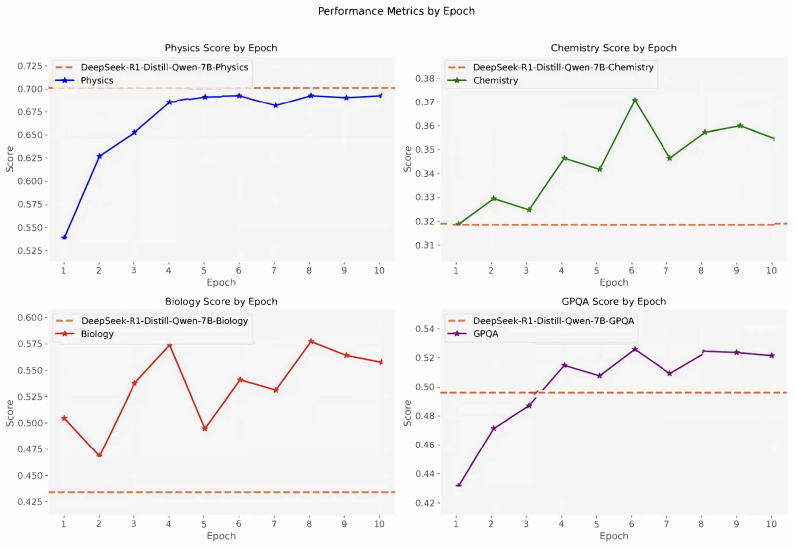
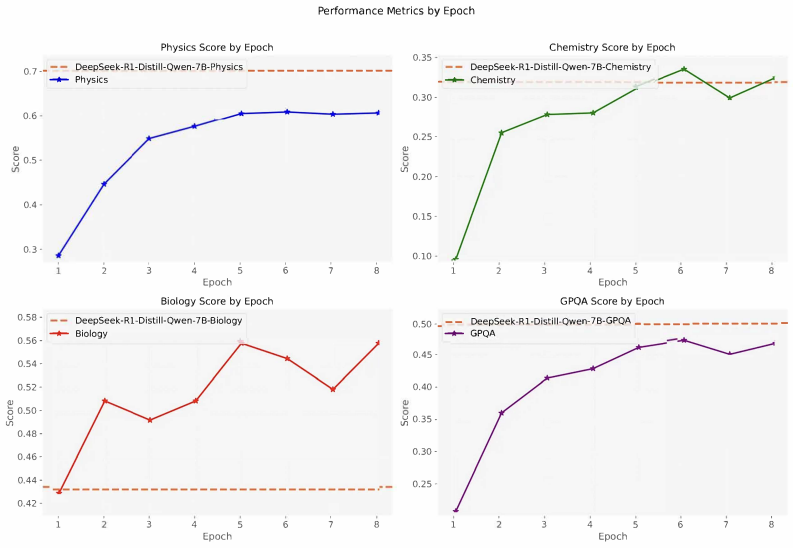
The paper's central claim is that training on SHARP-generated problems improves complex STEM reasoning: the distilled model reaches 54.7 GPQA Diamond versus 46.4 baseline and 49.9 DeepSeek-R1-Distill-Qwen-7B, and the RL Zero model reaches 37.0 versus 35.5 baseline. The abstract states SHARP-augmented training 'substantially outperforms existing methods' and pushes performance 'closer to expert-level proficiency.' If correct, it means a self-aligned synthesis pipeline can produce large volumes of verifiable hard STEM problems that transfer to benchmark reasoning performance.
Load-bearing premise
SHARP trusts model-generated reference answers as ground truth. The Verifying stage combines a model self-check and a rule-based verifier (Math-Verify) but includes no human expert validation; Appendix B.2 says the answer is 'similar to the ground truth solution a_i prime' where the ground truth is itself generated by the prompting pipeline. If a meaningful fraction of these reference answers are wrong, RL rewards and distillation labels will reinforce incorrect reasoning. This is structurally distinct from the claim, because the claim depends on the correctness of the training signal.
Signed reviews
Editorial analysis
A structured set of objections, weighed in public.
Referee Report
Summary. The paper introduces SHARP, a three-phase pipeline (Alignment, Instantiation, Inference) plus a Verifying stage for synthesizing graduate- and Olympiad-level STEM reasoning problems with a state-of-the-art LRM (DeepSeek R1). The pipeline is governed by explicit self-alignment principles, uses a three-tier subject taxonomy seeded by a topic library that is partly derived from GPQA knowledge-point distributions, and filters outputs through a model self-check and Math-Verify. The resulting problems are used for SFT distillation and for GRPO-based RLVR training. Experiments report GPQA Diamond accuracy of 54.7 for a SHARP-distilled Qwen2.5-7B model versus 46.4 for the baseline and 49.9 for DeepSeek-R1-Distill-Qwen-7B, and 37.0 versus 35.5 for RL-Zero training. The paper claims that SHARP-augmented training substantially improves complex STEM reasoning.
Significance. If the claims hold, SHARP would provide a scalable route to generating verifiable hard STEM training data with reduced human annotation, which is a valuable contribution. The paper is unusually detailed about its pipeline, prompts, hyperparameters, and dataset-distribution analyses, and the distillation gains (+8.3 points on GPQA Diamond) are substantial and consistent across subjects. However, two load-bearing issues temper the significance. First, the training-data topic distribution is deliberately aligned to the evaluation benchmark, so the GPQA results are partly a benchmark-loop artifact. Second, the 'verified ground truth' is model-generated and filtered without human validation; the chemistry example in Table 4 is internally inconsistent, so the verification stage demonstrably passes domain-level errors. The RL-Zero gain of 1.5 points is also within plausible sampling noise. These issues must be addressed before the general claim of expert-level STEM reasoning gains is established.
major comments (3)
- [§3.2, §C.1, Tables 1–2] The seed-topic library is constructed in part by extracting topic keypoints from GPQA, and §C.1 states that the authors 'sampled according to the distribution of disciplines and the corresponding knowledge points' so that the synthetic data 'fully covers the relevant knowledge points of GPQA.' Evaluation is then reported on GPQA. The authors state that they do not directly rephrase validation queries, and this is a meaningful distinction, but aligning the training-data topic distribution to the test benchmark is still a benchmark-loop burden: the reported gains may reflect distribution matching rather than improved general reasoning. To support the paper's central claim, the authors should evaluate on held-out STEM benchmarks (e.g., MMLU-STEM, SciBench, or other graduate-level STEM sets) or, at minimum, ablate the evaluation with topic sampling that is independent of GPQA. The paper's decontamination step is described as exact-duplicate removal; it does not address this topical overlap.
- [§3.3, Appendix B.2, Table 4, Algorithm 1] The reference answers used for both distillation labels and RLVR rewards are generated by the same LRM pipeline and filtered only by a model self-check and Math-Verify. Appendix B.2 defines R_acc(a_i, a'_i) = 1 iff the model's answer 'is similar to the ground truth solution a'_i,' but a'_i is itself the pipeline's output. No human expert validation is reported. The chemistry example in Table 4 shows that this verification is not airtight: a mass loss of 2.64 g of CO2 implies 0.0600 mol of ZnCO3 and therefore 3.92 g of zinc, whereas the problem states that 5.89 g of zinc is produced, which requires 0.0901 mol of ZnO and a corresponding CO2 loss of 3.96 g. The stated reference answer of 58.9% is not derivable from the data as written without an unstated additional assumption. This example passed the SHARP verification pipeline, demonstrating that domain-level correctness is not reliably enforced. Since incorrect reference answers directly corrupt the reward signal and the distillation supervision, the paper should quantify reference-answer accuracy (e.g., a human expert audit of a random sample, or agreement with an independent solver) and either strengthen the verification or soften the 'verified ground truth' language.
- [Table 2, Checklist item 7] The RL-Zero result in Table 2 reports a GPQA Diamond gain of 1.5 points (37.0 vs. 35.5). GPQA Diamond contains roughly 198 questions, so this difference corresponds to about 3 questions and lies within one binomial standard error (approximately 3.4 points). The paper's own NeurIPS checklist item 7 answers 'No' to error bars or statistical significance tests. Appendix B.2 states that accuracy is averaged over '16 independent inference runs,' but no variance or confidence interval is reported, and it is unclear what varies between runs if decoding is greedy. The abstract's claim that SHARP-augmented training 'substantially outperforms existing methods' is not supported by the RL-Zero evidence alone. Please report confidence intervals, the number of evaluation questions, and the run-to-run variance; if the 16 runs are independent samples, report the standard error across them.
minor comments (5)
- [Table 4] The first example in Table 4 is labeled 'Particle Physics, High Energy Physics' but the problem text opens with 'Solve the following chemical problem'; this subject-label/content mismatch should be corrected.
- [Algorithm 1, §3.3 (Verifying)] The Verifying stage is described only as checking that 'all alignment checks' pass; the concrete checks performed by the model self-check and by Math-Verify, and any thresholds used (e.g., confidence score, pass-rate filter), are not specified. Please provide these details, including the pass-rate filtering threshold used to reduce the 229,452 generated pairs to the reported 190,000.
- [Appendix B.2] The reward function R_acc uses 'equal(a_i, a'_i)' but the equality relation is not defined; please specify whether it is exact string matching, numeric tolerance, or Math-Verify equivalence.
- [Appendix C.3] The pass-rate comparisons use different numbers of responses for the two models (10 vs. 5 for physics, 5 vs. 1 for biology, 10 vs. 5 for chemistry in the text and figures), which makes the cross-model comparisons difficult to interpret; please standardize the evaluation protocol or justify the differences.
- [Section 4, Appendix C.2] The dataset size is reported as 190,000 in Section 4 and as 229,452 generated in Appendix C; while the appendix clarifies that about 190,000 remain after filtering, the main text should state both the generated and post-filter counts for consistency. Also, the phrase 'disinfection' in Appendix C.2 should be 'detoxification' (as used elsewhere) or be defined.
Assumptions & free parameters
free parameters (3)
- GPQA knowledge-point sampling distribution =
aligned to GPQA benchmark categories
- Pass-rate filtering threshold =
not disclosed
- K in K-means clustering =
about 1,000
assumptions (4)
- domain assumption Math-Verify correctly determines whether a generated answer matches the reference answer
- domain assumption DeepSeek R1 generated reference answers are scientifically correct
- domain assumption The GPQA knowledge-point distribution can be used to seed training data without leaking GPQA problems
- domain assumption Training on problems from the seed topics transfers to GPQA performance
Cite this review
Pith. "Pith review of SHARP: Synthesizing High-quality Aligned Reasoning Problems for Large Reasoning Models Reinforcement Learning." pith.science (2026). https://pith.science/paper/5CA5JGEL
@misc{pith2026250514147,
  author       = {Pith},
  title        = {Pith review of: SHARP: Synthesizing High-quality Aligned Reasoning Problems for Large Reasoning Models Reinforcement Learning},
  year         = {2026},
  howpublished = {\url{https://pith.science/paper/5CA5JGEL}},
  note         = {Machine review of arXiv:2505.14147}
}
read the original abstract
Training large reasoning models (LRMs) with reinforcement learning in STEM domains is hindered by the scarcity of high-quality, diverse, and verifiable problem sets. Existing synthesis methods, such as Chain-of-Thought prompting, often generate oversimplified or uncheckable data, limiting model advancement on complex tasks. To address these challenges, we introduce SHARP, a unified approach to Synthesizing High-quality Aligned Reasoning Problems for LRMs reinforcement learning with verifiable rewards (RLVR). SHARP encompasses a strategic set of self-alignment principles -- targeting graduate and Olympiad-level difficulty, rigorous logical consistency, and unambiguous, verifiable answers -- and a structured three-phase framework (Alignment, Instantiation, Inference) that ensures thematic diversity and fine-grained control over problem generation. We implement SHARP by leveraging a state-of-the-art LRM to infer and verify challenging STEM questions, then employ a reinforcement learning loop to refine the model's reasoning through verifiable reward signals. Experiments on benchmarks such as GPQA demonstrate that SHARP-augmented training substantially outperforms existing methods, markedly improving complex reasoning accuracy and pushing LRM performance closer to expert-level proficiency. Our contributions include the SHARP strategy, framework design, end-to-end implementation, and experimental evaluation of its effectiveness in elevating LRM reasoning capabilities.
Figures


Figures from the paper (24 more)



Reference graph
Works this paper leans on
-
[1]
problems synthesized through traditional COT, 2) problems augmented synthesized referencing to real challenging chemistry exercises and 3) problems synthesized SHARP approach. Through the experimental comparison of each stage, the difficulty of the sample problems generated by our SHARP approach has significantly increased the response length for the corr...
work page 2024
-
[2]
Limitations Question: Does the paper discuss the limitations of the work performed by the authors? Answer: [Yes] Justification: The paper identifies several limitations in the end. Future work could explore applying this approach to other domains and more complex reasoning tasks, and further optimizing the SHARP approach on various larger-scale RL reasoni...
-
[3]
Theory assumptions and proofs Question: For each theoretical result, does the paper provide the full set of assumptions and a complete (and correct) proof? Answer: [NA] Justification: The paper introduces a new approach (SHARP) and a framework, supported by experimental results. It does not appear to present new theoretical results in the form of theorems...
-
[4]
and subject characteristics to ensure that the first-level sub-disciplines, second-level self- disciplines, and basic concepts of each discipline are covered. Then we built high-quality seed 22 Figure 11: The K-means clustering results based on question embedding features extracted using BGE-m3 from problems generated by the SHARP approach. documents to s...
work page 2024
-
[5]
It claimsSHARP encompasses self-alignment principles and a three-phase framework
Claims Question: Do the main claims made in the abstract and introduction accurately reflect the paper’s contributions and scope? Answer: [Yes] Justification: The abstract states that this paper introduces SHARP, a unified approach for synthesizing high-quality reasoning problems for LRMs reinforcement learning with verifiable rewards (RLVR). It claimsSHA...
-
[6]
It names the models used for comparison
Experimental setting/details Question: Does the paper specify all the training and test details (e.g., data splits, hyper- parameters, how they were chosen, type of optimizer, etc.) necessary to understand the results? Answer: [Yes] Justification: The paper specifies the training data used (baseline CoT samples and 190,000 SHARP-generated samples). It nam...
-
[7]
If needed, we will include them in the camera-ready version
Experiment statistical significance Question: Does the paper report error bars suitably and correctly defined or other appropriate information about the statistical significance of the experiments? Answer: [No] Justification: The tables presenting the main experimental results (Table 1 and Table 2) show performance scores (e.g., GPQA Diamond scores, score...
-
[8]
It specifies the comparison models used for distillation and RL Zero training
Experimental result reproducibility Question: Does the paper fully disclose all the information needed to reproduce the main ex- perimental results of the paper to the extent that it affects the main claims and/or conclusions of the paper (regardless of whether the code and data are provided or not)? Answer: [Yes] Justification: The paper describes the tr...
Show all 20 references
-
[9]
Moreover, we will open-source all necessary codes and related data for industry use during the review period
Open access to data and code Question: Does the paper provide open access to the data and code, with sufficient instruc- tions to faithfully reproduce the main experimental results, as described in supplemental material? Answer: [Yes] Justification: Essential SHARP strategy pr...
-
[10]
It discusses the potential to push LRM performance closer to expert-level proficiency and superintelligence in STEM
Broader impacts Question: Does the paper discuss both potential positive societal impacts and negative societal impacts of the work performed? Answer: [No] Justification: The paper focuses on the technical contributions of the SHARP approach in enhancing LRM reasoning capabili...
-
[11]
The generated data consists of STEM problems
Safeguards Question: Does the paper describe safeguards that have been put in place for responsible release of data or models that have a high risk for misuse (e.g., pretrained language models, image generators, or scraped datasets)? 43 Answer: [NA] Justification: The paper fo...
-
[12]
Guidelines: • The answer NA means that the paper does not include experiments
Experiments compute resources Question: For each experiment, does the paper provide sufficient information on the com- puter resources (type of compute workers, memory, time of execution) needed to reproduce the experiments? Answer: [Yes] Justification: The computational resou...
-
[13]
It does not involve human subjects or obviously ethically sensitive applications, and we assume it conforms to the NeurIPS Code of Ethics
Code of ethics Question: Does the research conducted in the paper conform, in every respect, with the NeurIPS Code of Ethics https://neurips.cc/public/EthicsGuidelines? Answer: [Yes] Justification: The research involves algorithmic development and evaluation on standard optimi...
-
[14]
The process involves using LLMs to generate and verify problems, and then training other LLMs
Crowdsourcing and research with human subjects Question: For crowdsourcing experiments and research with human subjects, does the paper include the full text of instructions given to participants and screenshots, if applicable, as well as details about compensation (if any)? A...
-
[15]
Guidelines: • The answer NA means that the paper does not involve crowdsourcing nor research with human subjects
Institutional review board (IRB) approvals or equivalent for research with human subjects Question: Does the paper describe potential risks incurred by study participants, whether such risks were disclosed to the subjects, and whether Institutional Review Board (IRB) approvals...
-
[16]
However, the specific licenses and terms of use for these assets are not explicitly mentioned in the paper text or the appendix
Licenses for existing assets Question: Are the creators or original owners of assets (e.g., code, data, models), used in the paper, properly credited and are the license and terms of use explicitly mentioned and properly respected? Answer: [No] Justification: The paper properl...
-
[17]
New assets Question: Are new assets introduced in the paper well documented and is the documentation provided alongside the assets? Answer: [Yes] Justification: The main new asset introduced is the SHARP methodology and the dataset of 190,000 STEM problems generated using this...
-
[20]
We implement SHARP by leveraging a state-of-the-art LRM to infer and verify challenging STEM questions
Declaration of LLM usage Question: Does the paper describe the usage of LLMs if it is an important, original, or non-standard component of the core methods in this research? Note that if the LLM is used only for writing, editing, or formatting purposes and does not impact the ...
2025
-
[757]
calculate total moles of all possible products
URL https://aclanthology.org/2024.emnlp-main.757/. Guanting Dong, Keming Lu, Chengpeng Li, Tingyu Xia, Bowen Yu, Chang Zhou, and Jingren Zhou. Self-play with execution feedback: Improving instruction-following capabilities of large language models. In The Thirteenth Internatio...
2024 arXiv
-
[2025]
I don‘t know
URL https://arxiv.org/abs/2501.12948. Yang Deng, Yong Zhao, Moxin Li, See-Kiong Ng, and Tat-Seng Chua. Don‘t just say “I don‘t know”! self-aligning large language models for responding to unknown questions with explanations. In Yaser Al-Onaizan, Mohit Bansal, and Yun-Nung Chen...
2024 arXiv
Reviewed August 7, 2026 · model on record in the stance chip above.
Discussion (0). Continue with ORCID to comment.