Phase-field analysis of fracture in heterogeneous wellbore systems: effects of casing eccentricity and cement-formation interface strength
Pith reviewed 2026-06-27 02:40 UTC · model grok-4.3
The pith
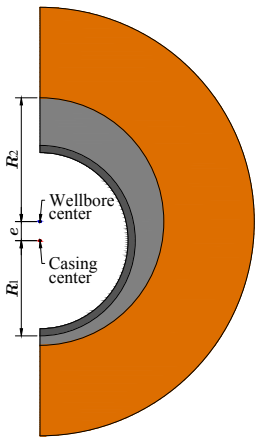
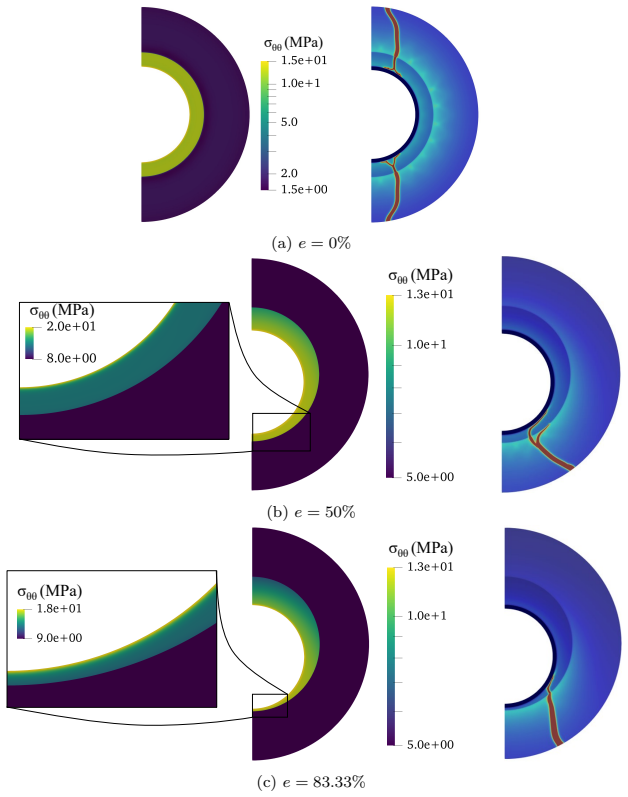
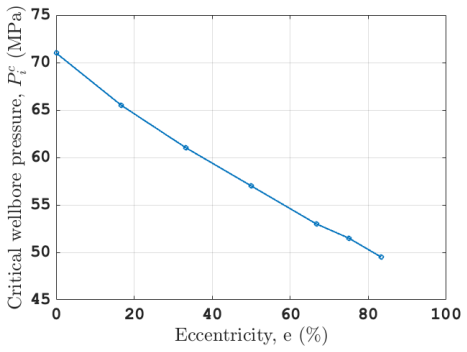
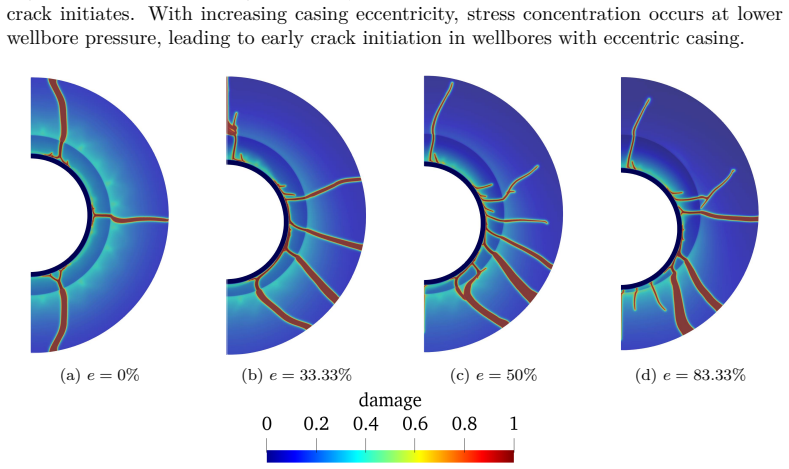
Casing eccentricity in wellbores lowers crack initiation pressure by up to 30 percent and triggers extra inclined cracks in the formation past a 50 percent threshold.
A machine-rendered reading of the paper's core claim, the machinery that carries it, and where it could break.
Core claim
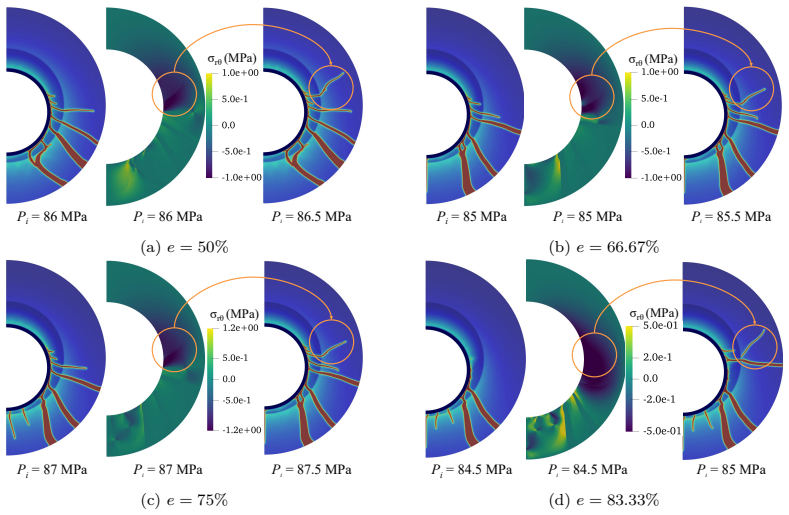
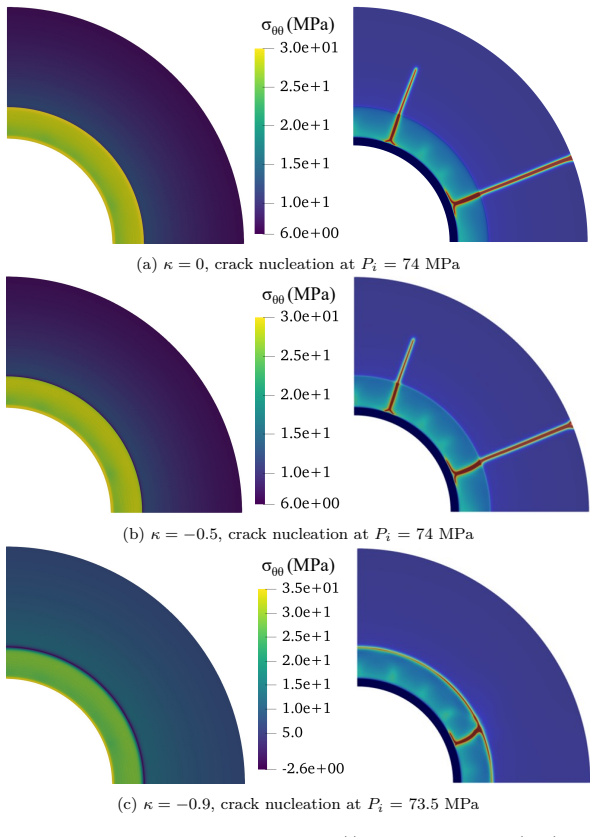
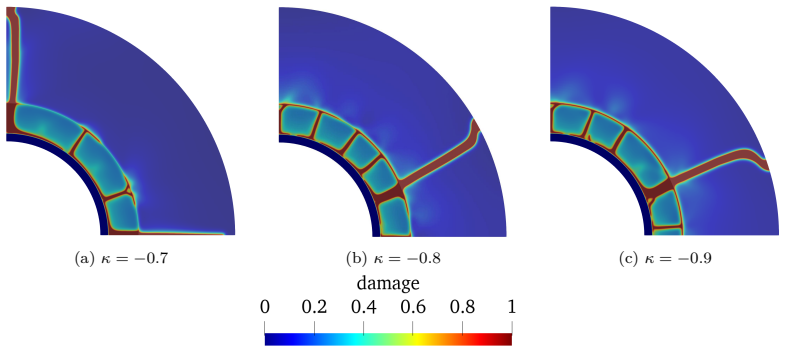
The hybrid phase-field fracture framework, after validation on benchmark problems, shows that casing eccentricity strongly influences both the pressure at crack initiation and the resulting crack paths, reducing the crack initiation pressure by up to 30% relative to the concentric configuration; beyond a critical eccentricity threshold of 50%, localized shear stresses drive the nucleation of inclined cracks in the formation in addition to radial cracking, while sufficiently weak interfaces (30% of bulk strength) deflect radially propagating cracks along the cement-formation interface, delaying stress relaxation, promoting additional radial cracks, and increasing the risk of sustained casing
What carries the argument
Hybrid phase-field fracture framework that models crack nucleation and deflection at weak cement-formation interfaces in heterogeneous wellbore geometries under internal pressure.
If this is right
- Crack initiation pressure drops with rising eccentricity, reaching a 30% reduction at high offsets.
- Inclined cracks nucleate in the formation once eccentricity exceeds 50% due to localized shear.
- Cracks deflect along interfaces at 30% bulk strength, leading to more radial cracks and delayed stress relief.
- Three-dimensional models capture depth-dependent nucleation and stress-shadow suppression absent in plane-strain cases.
Where Pith is reading between the lines
- Well completion guidelines could incorporate eccentricity limits to avoid the observed pressure drop and extra crack modes.
- The deflection mechanism at weak interfaces suggests that cement bond quality directly controls the number of radial cracks that form.
- Coupling the framework to fluid flow or poroelastic effects would allow direct prediction of sustained casing pressure risk.
Load-bearing premise
The hybrid phase-field fracture framework accurately captures the dominant mechanisms of crack nucleation and deflection in heterogeneous wellbore systems under the chosen material parameters and loading conditions.
What would settle it
Laboratory experiments on scaled wellbore samples with controlled casing eccentricity levels and measured interface strengths that either reproduce or contradict the predicted 30% pressure reduction and the switch to inclined cracks above 50% eccentricity.
Figures
read the original abstract
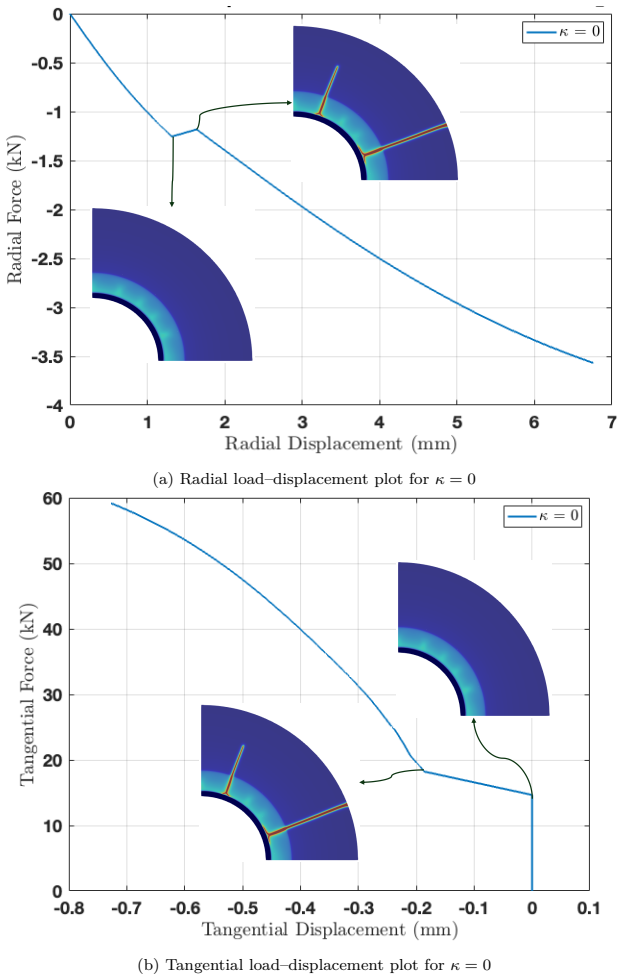
Predicting the initiation and propagation of cracks in heterogeneous wellbore systems under complex in-situ conditions remains challenging. We present a hybrid phase-field fracture framework to model crack growth in heterogeneous wellbore systems with weak interfaces. The framework is first validated against benchmark problems with available analytical and numerical solutions. Subsequently, numerical experiments are conducted to isolate the effects of interface strength and casing eccentricity on crack growth. The results show that casing eccentricity strongly influences both the pressure at crack initiation and the resulting crack paths, reducing the crack initiation pressure by up to 30% relative to the concentric configuration. Beyond a critical eccentricity threshold of 50%, localized shear stresses drive the nucleation of inclined cracks in the formation in addition to radial cracking -- a failure mode absent in concentric configurations. For sufficiently weak interfaces (i.e., interfaces with 30% of the strength of the surrounding bulk material), radially propagating cracks in the cement sheath are deflected along the interface rather than penetrating into the formation. This deflection delays stress relaxation within the sheath, promotes the nucleation of additional radial cracks, and increases the risk of sustained casing pressure and wellbore failure. Finally, a three-dimensional simulation reveals depth-dependent crack nucleation, stress-shadow effects that suppress full-depth crack growth and crack coalescence along the cement-formation interface -- phenomena that are fundamentally inaccessible under plane-strain assumptions - demonstrating the applicability of the framework to realistic heterogeneous wellbore systems.
Editorial analysis
A structured set of objections, weighed in public.
Referee Report
Summary. The manuscript presents a hybrid phase-field fracture framework for modeling crack initiation and propagation in heterogeneous wellbore systems consisting of casing, cement sheath, and formation with a weak cement-formation interface. The framework is validated on benchmark problems, after which 2D and 3D numerical experiments isolate the effects of casing eccentricity (up to and beyond 50%) and interface strength (down to 30% of bulk), reporting up to 30% reduction in crack initiation pressure due to eccentricity, deflection of radial cracks along weak interfaces, nucleation of inclined cracks, and depth-dependent 3D effects such as stress shadowing and incomplete crack coalescence.
Significance. If the interface deflection predictions hold, the results would be significant for wellbore integrity analysis in petroleum engineering, as they quantify how eccentricity and weak interfaces alter failure modes and pressures in ways inaccessible to plane-strain models, with the 3D simulation demonstrating phenomena like stress-shadow suppression of full-depth growth.
major comments (2)
- [Abstract, Numerical Experiments] Abstract and Numerical Experiments section: The validation is described only against 'benchmark problems with available analytical and numerical solutions,' which the text indicates are standard homogeneous cases. No benchmark reproducing known analytical deflection/penetration criteria at bi-material interfaces (e.g., He-Hutchinson or Hutchinson-Suo) is reported. This is load-bearing for the central claim that cracks deflect along interfaces at exactly the 30% strength ratio rather than penetrate, as the outcome is known to depend on the ratio of interface to bulk toughness and the phase-field length scale relative to interface thickness.
- [Numerical Experiments] Numerical Experiments section: The reported 30% reduction in crack initiation pressure for eccentric configurations and the 50% eccentricity threshold for inclined crack nucleation rest on specific material parameters and implementation choices (e.g., how the weak interface is regularized). No sensitivity study or full parameter table is referenced, making the quantitative thresholds dependent on unexamined details.
minor comments (2)
- No error bars or convergence checks with respect to mesh size or phase-field length scale are mentioned for the quantitative pressure values.
- Material parameters for the cement, formation, and interface are not tabulated in full, hindering reproducibility of the 30% strength ratio results.
Simulated Author's Rebuttal
We thank the referee for the constructive comments on our manuscript. The feedback highlights important aspects of validation and parameter sensitivity that we will address in revision.
read point-by-point responses
-
Referee: [Abstract, Numerical Experiments] Abstract and Numerical Experiments section: The validation is described only against 'benchmark problems with available analytical and numerical solutions,' which the text indicates are standard homogeneous cases. No benchmark reproducing known analytical deflection/penetration criteria at bi-material interfaces (e.g., He-Hutchinson or Hutchinson-Suo) is reported. This is load-bearing for the central claim that cracks deflect along interfaces at exactly the 30% strength ratio rather than penetrate, as the outcome is known to depend on the ratio of interface to bulk toughness and the phase-field length scale relative to interface thickness.
Authors: We acknowledge that the reported validation benchmarks are homogeneous problems and that a dedicated bi-material interface benchmark would provide stronger support for the deflection claims. The phase-field formulation follows established approaches in the literature that have been shown to capture interface behavior, but we agree this should be demonstrated explicitly. In the revised manuscript we will add a validation subsection reproducing the He-Hutchinson deflection/penetration criterion for a range of interface-to-bulk toughness ratios, including the 30% ratio used in the wellbore experiments, while also discussing the role of the phase-field length scale relative to interface thickness. revision: yes
-
Referee: [Numerical Experiments] Numerical Experiments section: The reported 30% reduction in crack initiation pressure for eccentric configurations and the 50% eccentricity threshold for inclined crack nucleation rest on specific material parameters and implementation choices (e.g., how the weak interface is regularized). No sensitivity study or full parameter table is referenced, making the quantitative thresholds dependent on unexamined details.
Authors: The quantitative thresholds are obtained with representative wellbore material parameters and a specific regularization of the weak interface. To improve transparency we will add a complete parameter table to the revised manuscript. We will also include a targeted sensitivity study varying the phase-field length scale and interface regularization thickness to demonstrate that the reported 30% pressure reduction and 50% eccentricity threshold for inclined cracks are robust within the chosen ranges. A comprehensive parametric exploration lies beyond the scope of the present study, which focuses on isolating the effects of eccentricity and interface strength. revision: partial
Circularity Check
No circularity: purely numerical outputs from validated simulation framework
full rationale
The paper presents a hybrid phase-field model applied to wellbore fracture problems. It validates the framework on benchmark problems with independent analytical/numerical solutions, then reports simulation results for eccentricity and interface strength effects. No analytical derivations, fitted parameters renamed as predictions, or self-citation chains are present in the provided text; all reported quantities (initiation pressures, crack paths, 30% reductions) are direct outputs of the numerical experiments rather than tautological restatements of inputs or model definitions. The derivation chain is therefore self-contained and non-circular.
Axiom & Free-Parameter Ledger
free parameters (2)
- interface strength ratio =
0.3
- critical eccentricity threshold =
0.5
axioms (1)
- domain assumption Phase-field model with appropriate length scale can represent both mode-I and shear-driven fracture at material interfaces.
Reference graph
Works this paper leans on
-
[1]
Driscoll, Groundwater and Wells, Johnson Screens, Minnesota, USA, 1986
F. Driscoll, Groundwater and Wells, Johnson Screens, Minnesota, USA, 1986
1986
-
[2]
A.T.Bourgoyne, K.K.Millheim, M.E.Chenevert, F.S.Young, Applied drilling engineering, (No Title) (1986)
1986
-
[3]
W. Wang, A. D. Taleghani, Three-dimensional analysis of cement sheath integrity around wellbores, Journal of Petroleum Science and Engineer- ing 121 (2014) 38–51
2014
-
[4]
C. Gu, X. Li, Y. Feng, J. Deng, K. Gray, Numerical investigation of cementinterfacedebondingindeviatedshalegaswellsconsideringcasing eccentricity and residual drilling fluid, International Journal of Rock Mechanics and Mining Sciences 158 (2022) 105197
2022
-
[5]
Y.Xi, Y.Yao, X.-L.Guo, J.Li, Y.-D.Tian, G.-H.Liu, Failureevaluation mechanism of cement sheath sealing integrity under casing eccentricity during multistage fracturing, Petroleum Science 21 (2024) 3428–3445
2024
-
[6]
X. Zhao, X. Yang, X. Lin, Y. Mei, A cohesive-element-based model to evaluate interfacial behavior of casing–cement sheath for high-pressure, high-temperature wellbore integrity considering casing eccentricity, Ad- vances in Mechanical Engineering 12 (2020) 1687814019898300
2020
-
[7]
Zheng, E
D. Zheng, E. Ozbayoglu, S. Miska, B. Silvio, Y. Liu, J. Wang, The influence of casing eccentricity on zonal isolation, in: ARMA US Rock Mechanics/Geomechanics Symposium, ARMA, 2023, pp. ARMA–2023
2023
-
[8]
Cheng, Y
W. Cheng, Y. Jin, M. Chen, G.-S. Jiang, Numerical stress analysis for the multi-casing structure inside a wellbore in the formation using the boundary element method, Petroleum Science 14 (2017) 126–137
2017
-
[9]
H. Dou, X. Dong, D. Gao, Numerical modelling of the cement sheath withradialcracksundercasingeccentricconditions, in: ARMAUSRock Mechanics/Geomechanics Symposium, ARMA, 2020, pp. ARMA–2020
2020
-
[10]
K. Liu, D. Gao, A. D. Taleghani, Impact of casing eccentricity on cement sheath, Energies 11 (2018) 2557. 34
2018
-
[11]
L. Zhao, H. Yang, Y. Wei, Y. Bu, S. Jing, P. Zhou, Integrity and fail- ure analysis of cement sheath subjected to coalbed methane fracturing., Fluid Dynamics & Materials Processing 19 (2023)
2023
-
[12]
Goodwin, R
K. Goodwin, R. Crook, Cement sheath stress failure, SPE drilling engineering 7 (1992) 291–296
1992
-
[13]
Y. Xi, J. Li, Q. Tao, B. Guo, G. Liu, Experimental and numerical inves- tigations of accumulated plastic deformation in cement sheath during multistage fracturing in shale gas wells, Journal of Petroleum Science and Engineering 187 (2020) 106790
2020
-
[14]
T. H. Nassan, M. Kirch, C. Freese, H. Alkan, D. Baganz, M. Amro, Experimentalinvestigationofwellboreintegrityduringgeologicalcarbon sequestration: Thermal-and pressure-cycling experiments, Gas Science and Engineering 124 (2024) 205253
2024
-
[15]
Vrålstad, R
T. Vrålstad, R. Skorpa, Digital cement integrity: A methodology for 3d visualization of cracks and microannuli in well cement, Sustainability 12 (2020) 4128
2020
-
[16]
Taghipour, A
A. Taghipour, A. Ghaderi, P. Cerasi, S. Gheibi, Novel laboratory setup for realistic wellbore cement and formation integrity studies, Journal of Petroleum Science and Engineering 208 (2022) 109664
2022
-
[17]
A. Anya, H. Emadi, M. Watson, A novel apparatus and method for lab- scale study of wellbore integrity using ct imaging and analysis, Journal of Petroleum Science and Engineering 220 (2023) 111209
2023
-
[18]
G. A. Francfort, J.-J. Marigo, Revisiting brittle fracture as an energy minimization problem, Journal of the Mechanics and Physics of Solids 46 (1998) 1319–1342
1998
-
[19]
Bourdin, G
B. Bourdin, G. A. Francfort, J.-J. Marigo, Numerical experiments in revisited brittle fracture, Journal of the Mechanics and Physics of Solids 48 (2000) 797–826
2000
-
[20]
Amor, J.-J
H. Amor, J.-J. Marigo, C. Maurini, Regularized formulation of the vari- ational brittle fracture with unilateral contact: Numerical experiments, Journal of the Mechanics and Physics of Solids 57 (2009) 1209–1229. 35
2009
-
[21]
Miehe, F
C. Miehe, F. Welschinger, M. Hofacker, Thermodynamically consistent phase-field models of fracture: Variational principles and multi-field fe implementations, International journal for numerical methods in engi- neering 83 (2010) 1273–1311
2010
-
[22]
J. Ding, T. Yu, W. Fang, S. Natarajan, An adaptive phase field modeling of fatigue crack growth using variable-node elements and explicit cycle jump scheme, Computer Methods in Applied Me- chanics and Engineering 429 (2024) 117200. URL:https://www. sciencedirect.com/science/article/pii/S0045782524004560. doi:https://doi.org/10.1016/j.cma.2024.117200
-
[23]
Seiler, T
M. Seiler, T. Linse, P. Hantschke, M. Kästner, An efficient phase-field model for fatigue fracture in ductile materials, Engineering Fracture Mechanics 224 (2020) 106807
2020
-
[24]
Zhang, X
P. Zhang, X. Hu, T. Q. Bui, W. Yao, Phase field modeling of fracture in fiber reinforced composite laminate, International Journal of Mechanical Sciences 161 (2019) 105008
2019
-
[25]
I. Jain, A. Muixí, C. Annavarapu, S. S. Mulay, A. Rodríguez-Ferran, Adaptive phase-field modeling of fracture in orthotropic composites, En- gineering Fracture Mechanics 292 (2023) 109673. URL:https://www. sciencedirect.com/science/article/pii/S0013794423006318. doi:https://doi.org/10.1016/j.engfracmech.2023.109673
-
[26]
I. Jain, C. Annavarapu, S. S. Mulay, A. Rodríguez-Ferran, Numerical modeling of fracture propagation in orthotropic composite materials us- ing an adaptive phase-field method, International Journal of Advances in Engineering Sciences and Applied Mathematics 15 (2023) 144–154
2023
-
[27]
S. Khan, A. Muixí, C. Annavarapu, A. Rodríguez-Ferran, Adaptive phase-field modeling of fracture propagation in bi-layered materials, En- gineering Fracture Mechanics 292 (2023) 109650
2023
-
[28]
S. Khan, A. Muixí, C. Annavarapu, A. Rodríguez-Ferran, Investigation on the effect of material mismatch between two dissimilar materials using an adaptive phase-field method, International Journal of Advances in Engineering Sciences and Applied Mathematics (2023). 36
2023
-
[30]
F. A. Denli, O. Gültekin, G. A. Holzapfel, H. Dal, A phase-field model forfractureofunidirectionalfiber-reinforcedpolymermatrixcomposites, Computational Mechanics 65 (2020) 1149–1166
2020
-
[31]
Messaoudi, H
I. Messaoudi, H. Mallek, H. Mellouli, M. Wali, F. Dammak, Fracture modeling of cnt/epoxy nanocomposites based on phase-field method us- ing multiscale strategy, Proceedings of the Institution of Mechanical Engineers, Part L: Journal of Materials: Design and Applications 239 (2025) 319–334
2025
-
[32]
Cusini, F
M. Cusini, F. Fei, Phase Field Modeling of Near-Wellbore Hydraulic Fracture Nucleation and Propagation, Technical Report, Lawrence Liv- ermore National Laboratory (LLNL), Livermore, CA (United States),
- [33]
-
[34]
W. N. Munshi, C. Annavarapu, S. S. Mulay, A. Rodriguez-Ferran, Mod- eling three-dimensional crack interaction in layered materials with im- perfectly bonded interfaces using a phase-field model, Available at SSRN 5289771 (2025)
2025
-
[35]
Munshi, C
W. Munshi, C. Annavarapu, S. Mulay, A. Rodriguez-Ferran, Phase-field modeling of crack propagation in layered materials with weak interfaces, International Journal for Computational Methods in Engineering Sci- ence and Mechanics (2025) 1–12
2025
-
[36]
C. Kuhn, R. Müller, Phase field modeling of interface effects on cracks in heterogeneous materials, PAMM 19 (2019) e201900378
2019
-
[37]
Ambati, T
M. Ambati, T. Gerasimov, L. De Lorenzis, A review on phase-field mod- els of brittle fracture and a new fast hybrid formulation, Computational Mechanics 55 (2015) 383–405. 37
2015
-
[38]
Bangerth, R
W. Bangerth, R. Hartmann, G. Kanschat, deal. ii—a general-purpose object-oriented finite element library, ACM Transactions on Mathemat- ical Software (TOMS) 33 (2007) 24–es
2007
-
[39]
W. N. Munshi, M. Fehling, W. Bangerth, C. Annavarapu, A detailed guidetoanopen-sourceimplementationofthehybridphasefieldmethod for 3d fracture modeling in deal.ii, Computer Physics Communications 319 (2026) 109901. URL:https://www.sciencedirect.com/science/ article/pii/S0010465525004023. doi:https://doi.org/10.1016/j. cpc.2025.109901
work page doi:10.1016/j 2026
-
[40]
G. B. Jeffery, Ix. plane stress and plane strain in bipolar co-ordinates, Philosophical Transactions of the Royal Society of London. Series A, Containing Papers of a Mathematical or Physical Character 221 (1921) 265–293
1921
-
[41]
Gustafsson, H
A. Gustafsson, H. Isaksson, Phase field models of interface failure for bone application-evaluation of open-source implementations, Theoreti- cal and Applied Fracture Mechanics 121 (2022) 103432
2022
-
[42]
Suo, Engineering sciences 247: Fracture mechanics,http:// imechanica.org/node/7448, 2010
Z. Suo, Engineering sciences 247: Fracture mechanics,http:// imechanica.org/node/7448, 2010. IMechanica post, 25 January 2010
2010
-
[43]
B. Xu, T. Xu, Y. Xue, M. J. Heap, P. Ranjith, P. Wasantha, Z. Li, Phase-field modeling of crack growth and interaction in rock, Geome- chanics and Geophysics for Geo-Energy and Geo-Resources 8 (2022) 180
2022
-
[44]
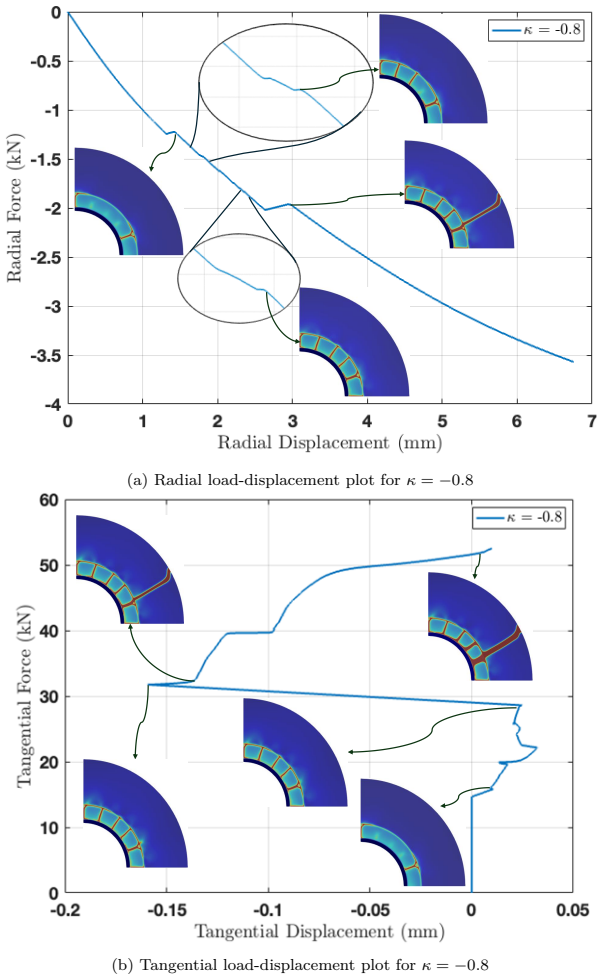
S. P. Clavijo, M. Addassi, T. Finkbeiner, H. Hoteit, A coupled phase- fieldandreactive-transportframeworkforfracturepropagationinporoe- lastic media, Scientific Reports 12 (2022) 17819. 38 (a) Radial load-displacement plot forκ=−0.8 (b) Tangential load-displacement plot forκ=−0.8 Figure 17: Load–displacement curves obtained by summing the values over the ...
2022
discussion (0)
Sign in with ORCID, Apple, or X to comment. Anyone can read and Pith papers without signing in.