REVIEW 4 major objections 5 minor 2 cited by
CWNet: Causal Wavelet Network for Low-Light Image Enhancement
T0 review · 4 major / 5 minor · reviewed 2026-08-06 · deepseek-v4-flash
Pith's one-line read CWNet is a low-light image enhancer that treats brightness and color shifts as removable confounders, using a wavelet-frequency architecture that it reports as state-of-the-art on four benchmarks.
desk verdict A competent, parameter-efficient LLIE architecture whose benchmark numbers are competitive but whose 'significant SOTA' claim is contradicted by its own tables, and whose causal framing is mostly a relabeling. read the letter →
The pith
A machine-rendered reading of the paper's core claim, the machinery that carries it, and where it could break.
The reading
What carries the argument
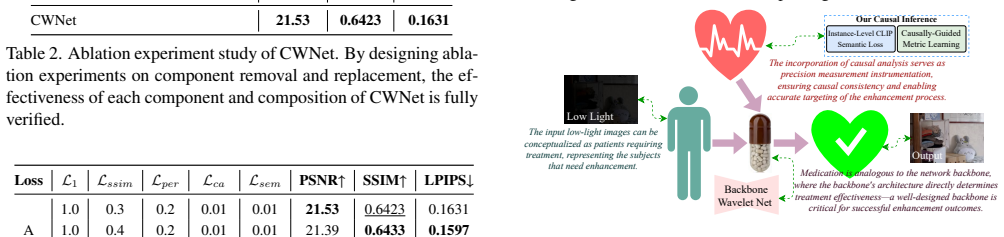
The load-bearing mechanism is a structural causal model in which S (semantic content) is the causal factor to preserve and U (brightness and color anomalies) is the non-causal factor to remove. The network enforces this separation with a causally-guided metric-learning loss, which builds counterfactual negatives from synthetic light and color interventions, and with an instance-level CLIP semantic loss, which matches each segmented object region to a semantic text prompt. On the representation side, the wavelet transform splits the image into L, H, V, and D sub-bands; the feature-extraction stage uses wavelet convolutions for low frequencies and directional convolutions for horizontal, vertical, and diagonal high frequencies; the High-Frequency Enhancement Block runs a Mamba-style state-space selective-scanning module along those three directions; and the Low-Frequency Enhancement Block uses fast Fourier convolution residual blocks to recover global brightness. The sub-band split is what lets the network brighten the image globally while keeping edges and textures intact.
What would settle it
Train CWNet and a non-causal variant on a paired dataset whose low-light images are produced by blur, haze, or sensor-noise processes rather than by Eqs. (1)-(2), and measure PSNR and SSIM on similarly degraded test images; if the causal loss provides little or no improvement over the wavelet backbone alone on these inputs, the causal separation is tied to the synthetic model rather than to low-light enhancement in general. The paper's own failure cases on blur and haze already point toward this test.
Extended reading notes
Core claim
The central claim is that low-light enhancement can be treated as a causal inference problem: the network should be invariant to interventions on illumination and color while remaining faithful to the image's semantic content. The authors define two synthetic interventions on normal-light images, one that multiplies an illumination map, applies a gamma curve, and adds Gaussian noise, and one that applies hue, saturation, and RGB-offset shifts, and they use the resulting counterfactual samples as negatives in a metric-learning loss. The anchor is the network-processed low-light image, the positive is its normal-light ground-truth reference, and the negatives are degraded normal-light images from different scenes, so the learned embedding is forced to encode what is invariant across scenes rather than what correlates with brightness or color. For local consistency, a pretrained segmentation model extracts instance sub-images and a CLIP vision-language alignment loss (a contrastive image-text matching model) checks that each instance still matches its semantic text prompt. The architecture that carries these losses is a wavelet U-Net whose Hierarchical Feature Restoration Block combines wavelet-convolution feature extraction, direction-specific selective scanning for high-frequency sub-bands, and fast-Fourier-convolution residual blocks for the low-frequency sub-band, with the enhanced high-frequency components guiding reconstruction of the low-frequency band. The paper reports that this combination outperforms or matches state-of-the-art baselines across four low-light datasets and several no-reference benchmarks.
Load-bearing premise
The argument assumes that the synthetic degradation process in Eqs. (1)-(2) — illumination-map multiplication, gamma, Gaussian noise, and hand-set color shifts — is a faithful model of how real low-light images differ from their normal-light counterparts, so that the counterfactual negatives really do leave semantic content unchanged.
Editorial extensions
If this is right
- Ablation results show that removing either causal loss or the semantic loss lowers PSNR, so the semantic-consistency mechanism is load-bearing rather than decorative.
- At 1.23M parameters and 11.3 GFLOPs, CWNet is small enough to serve as a preprocessing stage for downstream object detection; the supplementary experiments report improved detections on a challenging nighttime dataset.
- The LFEB is the most critical single component, since removing it drops PSNR from 21.53 to 20.41 dB, so further gains are most likely to come from better low-frequency or global-context modeling.
- The cross-dataset evaluation from LOL-v1 training to LOL-v2-Real testing reports the best SSIM (0.9005) and LPIPS (0.0383) in the table, implying that the causal invariance helps generalization to unseen capture conditions.
Reading between the lines
- Editorial inference: the intervention set could be widened to include blur, haze, and sensor noise; if counterfactual negatives are generated for those degradations too, the same metric-learning logic predicts CWNet would generalize to the multi-degradation cases its limitation section singles out as failures.
- Editorial inference: the directional alignment between wavelet sub-bands and scan directions is a testable design hypothesis; rotating inputs by 45 degrees or replacing the fixed H/V/D scans with a learned scan ordering would reveal whether the gains come from matching the wavelet geometry or from state-space modeling itself.
- Editorial inference: the same causal-invariance framing transfers to other tone-mapping and restoration tasks such as night dehazing or HDR recovery, where semantic content is again the invariant factor and the nuisance factors are task-specific degradations.
- Editorial inference: the instance-level semantic loss relies on a segmentation model trained on a fixed set of object categories; using an open-vocabulary segmenter could scale the local consistency constraint to novel scenes.
Editorial analysis
A structured set of objections, weighed in public.
Referee Report
Summary. The paper proposes CWNet, a low-light image enhancement network that combines a U-Net-like wavelet backbone with a causal-style training objective. The backbone uses wavelet transform to split features into low- and high-frequency branches, with a High-Frequency Mamba module for directional high-frequency scanning and a Low-Frequency Enhancement Block based on Fast Fourier Convolution. The training loss adds a causally-guided metric learning term that contrasts anchors with light-degraded and color-anomaly negatives, and an instance-level CLIP semantic loss using HRNet segmentation maps. The authors report results on LOL-v1, LOL-v2-Real, LOL-v2-Syn, and LSRW-Huawei, plus no-reference and downstream-task evaluations, and claim state-of-the-art performance with only 1.23M parameters.
Significance. If the empirical claims hold, CWNet would be a parameter-efficient and competitive low-light enhancement model, and the wavelet-Mamba combination with semantic guidance is a plausible contribution to the LLIE literature. The paper ships code, reports ablations for each architectural and loss component, and evaluates on several public benchmarks and downstream tasks, which are strengths. However, the headline claim of significantly outperforming the state of the art is not fully supported by the reported numbers, and the causal interpretation rests on assumptions that are not established; these issues need to be addressed before the contribution can be assessed at face value.
major comments (4)
- [Section 4.1, Table 1] Section 4.1 states that for LOL-v2-Real evaluation, CWNet uses the model trained on LOL-v1 to demonstrate cross-dataset generalization. The comparison methods in Table 1 are standardly trained on the LOL-v2-Real training split, so CWNet's LOL-v2-Real PSNR of 27.39 is not comparable to Wave-Mamba's 27.87, which was obtained under a different training protocol. This makes the reported LOL-v2-Real comparison not like-for-like and invalidates the claim of state-of-the-art performance on that dataset. Please either retrain CWNet on LOL-v2-Real and report those numbers, or clearly separate cross-dataset evaluation rows from same-dataset evaluation rows in the table and in the text.
- [Table 1 vs Table 2] The full CWNet model is reported as PSNR 21.50, SSIM 0.6397, LPIPS 0.1562 in Table 1, but the same full model is reported as PSNR 21.53, SSIM 0.6423, LPIPS 0.1631 in Tables 2 and 3 for the same LSRW-Huawei setting. No difference in evaluation protocol is described, so this discrepancy suggests either nondeterministic training or an error in one of the tables. In addition, the paper provides no error bars, confidence intervals, or multiple-seed results, so the reported margins over the next-best methods (0.27 dB on LSRW-Huawei, 0.89 dB on LOL-v1) cannot be distinguished from run-to-run noise. Please report mean and standard deviation over at least three runs and reconcile the inconsistent numbers across tables.
- [Section 3.1.2, Eq. (3)] The ATE analysis in Eq. (3) computes the expected PSNR drop under synthetic interventions on ground-truth images; this is a sensitivity measure, not an identified causal effect of enhancement factors on output quality. More importantly, the causal factors S and non-causal factors U are operationalized through the very losses used for training (the metric learning loss in Eq. (5) and the CLIP semantic loss in Eq. (6)), so the claimed causal separation is circular with respect to the training objective. The interventions in Eqs. (1)-(2) cover illumination scaling, gamma, Gaussian noise, and color shifts, and Section 4.4 concedes that the method performs poorly on blur and haze, so the causal claim is tied to the specific synthetic degradation model. Please either reframe the contribution as degradation-invariant representation learning or provide an out-of-distribution test that validates the causal separation independently of the training losses.
- [Abstract, Section 4.2] The claim that CWNet 'significantly outperforms current state-of-the-art methods across multiple datasets' is not supported by Table 1. Wave-Mamba has higher PSNR on LOL-v2-Real (27.87 vs 27.39) and DMFourLLIE has higher PSNR on LOL-v2-Syn (25.74 vs 25.50). The claim should be restricted to the specific metrics and datasets where CWNet actually leads, such as LPIPS on most datasets and SSIM on LOL-v2-Real and LOL-v2-Syn, or it should be backed by statistical significance testing based on repeated runs.
minor comments (5)
- [Section 3.2.3] The text says 'The fist block' but should read 'The first block'.
- [Table 2] The row label 'w/o Casual Inference' should be 'w/o Causal Inference'.
- [Section 4.2] The visualization comparison text cites 'Retinexformer [61]'; the reference list numbers Retinexformer as [3], so this citation appears incorrect.
- [Supplementary Table 6] The text states that the optimal number of negative samples is L=3, C=3, but the table shows the best PSNR (21.50) and LPIPS (0.1562) at L=2, C=2 and the best SSIM (0.6401) at L=3, C=3; please reconcile the text and the table.
- [Eq. (12)] The output equation uses 'y_t = Ch + Dx_t' without a subscript on h; for consistency with the other discrete equations it should be 'y_t = C h_t + D x_t'.
Circularity Check
No significant circularity: the core benchmark claim is grounded in held-out test sets, and the causal/non-causal split is a training prior rather than a fitted parameter renamed as a prediction.
full rationale
CWNet's central empirical claim—state-of-the-art low-light enhancement—is evaluated on standard held-out benchmarks (LOL-v1, LOL-v2, LSRW-Huawei) and against external methods, so it does not reduce to the paper's own inputs. The causal framing (Eqs. 1-2, 5-7) defines interventions and then directly enforces invariance to them via metric learning and CLIP losses; the 'separation' of causal from non-causal factors is therefore imposed by the loss design rather than discovered, but this is a modeling assumption, not a circular prediction. The ATE analysis (Eq. 3) uses PSNR, the same metric used later for evaluation, which limits its diagnostic independence but does not make the benchmark results circular. Self-citations ([53], [54]) appear only in related-work surveys and are not load-bearing. The acknowledged failure on blur and haze (Section 4.4) is a limitation, not a circular step. The discrepancy between Table 1 and Table 2 for the full model on LSRW-Huawei and the lack of error bars concern reproducibility, which is outside the circularity definition used here.
Assumptions & free parameters
free parameters (4)
- loss_weights_lambda1_lambda5 =
1.0, 0.3, 0.2, 0.01, 0.01
- negative_sample_counts_L_C =
3, 3
- intervention_ranges =
gamma in [2,5], noise var [0.03,0.08], hue [-30,30], saturation [-50,50], RGB offsets [-50,50]
- architecture_and_training_hyperparameters =
channels 16, block configs [1,3,4,3,1] and [1,2,2,2,1], lr 4e-4, iterations 3e5, batch 8, patch 256
assumptions (5)
- ad hoc to paper Low-light images decompose into causal semantic factors S and non-causal degradation factors U.
- domain assumption Synthetic degradations in Eqs. 1-2 are meaningful and harmless counterfactual interventions that preserve semantic content.
- domain assumption PSNR-based Average Treatment Effect in Eq. 3 is a valid measure of semantic region sensitivity.
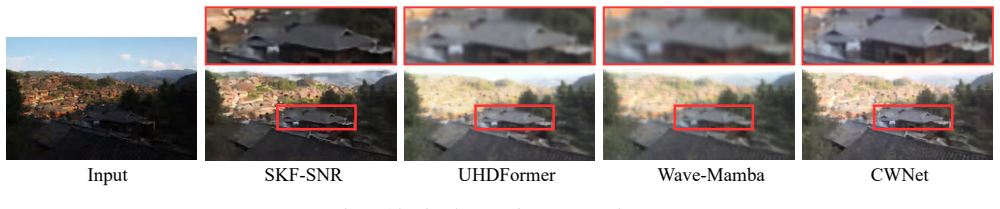
- standard math Wavelet transform gives a complete and invertible frequency decomposition.
- domain assumption Pretrained CLIP and HRNet features transfer to enhanced low-light images.
invented entities (2)
-
Causal semantic factors S
-
Non-causal factors U (color and brightness anomalies)
Cite this review
Pith. "Pith review of CWNet: Causal Wavelet Network for Low-Light Image Enhancement." pith.science (2026). https://pith.science/paper/5DI4RVYZ
@misc{pith2026250710689,
  author       = {Pith},
  title        = {Pith review of: CWNet: Causal Wavelet Network for Low-Light Image Enhancement},
  year         = {2026},
  howpublished = {\url{https://pith.science/paper/5DI4RVYZ}},
  note         = {Machine review of arXiv:2507.10689}
}
read the original abstract
Traditional Low-Light Image Enhancement (LLIE) methods primarily focus on uniform brightness adjustment, often neglecting instance-level semantic information and the inherent characteristics of different features. To address these limitations, we propose CWNet (Causal Wavelet Network), a novel architecture that leverages wavelet transforms for causal reasoning. Specifically, our approach comprises two key components: 1) Inspired by the concept of intervention in causality, we adopt a causal reasoning perspective to reveal the underlying causal relationships in low-light enhancement. From a global perspective, we employ a metric learning strategy to ensure causal embeddings adhere to causal principles, separating them from non-causal confounding factors while focusing on the invariance of causal factors. At the local level, we introduce an instance-level CLIP semantic loss to precisely maintain causal factor consistency. 2) Based on our causal analysis, we present a wavelet transform-based backbone network that effectively optimizes the recovery of frequency information, ensuring precise enhancement tailored to the specific attributes of wavelet transforms. Extensive experiments demonstrate that CWNet significantly outperforms current state-of-the-art methods across multiple datasets, showcasing its robust performance across diverse scenes. Code is available at https://github.com/bywlzts/CWNet-Causal-Wavelet-Network.
Figures


Figures from the paper (15 more)






Forward citations
Cited by 2 Pith papers
-
Uncertainty-Aware Spatial Color Correlation for Low-Light Image Enhancement
U2CLLIE is a lightweight network for brightening dark images using entropy-guided dual-domain denoising and causal correlation modules, with small PSNR/SSIM gains and mixed LPIPS results.
-
SPJFNet: Self-Mining Prior-Guided Joint Frequency Enhancement for Ultra-Efficient Dark Image Restoration
SPJFNet achieves efficient dark image restoration by generating guidance from the network itself and splitting processing into wavelet high-frequency and Fourier low-frequency branches.
Reference graph
Works this paper leans on
-
[1]
Identification and estima- tion of local average treatment effects, 1995
Joshua Angrist and Guido Imbens. Identification and estima- tion of local average treatment effects, 1995. 3
work page 1995
-
[2]
Retinexmamba: Retinex-based mamba for low-light image enhancement
Jiesong Bai, Yuhao Yin, and Qiyuan He. Retinexmamba: Retinex-based mamba for low-light image enhancement. arXiv preprint arXiv:2405.03349, 2024. 1, 2, 5, 6
arXiv 2024
-
[3]
Retinexformer: One-stage retinex- based transformer for low-light image enhancement
Yuanhao Cai, Hao Bian, Jing Lin, Haoqian Wang, Radu Tim- ofte, and Yulun Zhang. Retinexformer: One-stage retinex- based transformer for low-light image enhancement. In CVPR, pages 12504–12513, 2023. 1, 2, 6
work page 2023
-
[4]
Lu Chi, Borui Jiang, and Yadong Mu. Fast fourier convolu- tion. Advances in Neural Information Processing Systems , 33:4479–4488, 2020. 5
work page 2020
-
[5]
Incremental transformer structure enhanced image inpainting with mask- ing positional encoding
Qiaole Dong, Chenjie Cao, and Yanwei Fu. Incremental transformer structure enhanced image inpainting with mask- ing positional encoding. In ICCV, pages 11358–11368,
-
[6]
Wavelet convolutions for large receptive fields
Shahaf E Finder, Roy Amoyal, Eran Treister, and Oren Freifeld. Wavelet convolutions for large receptive fields. In ECCV, pages 363–380. Springer, 2025. 5, 1
work page 2025
-
[7]
A weighted variational model for simultane- ous reflectance and illumination estimation
Xueyang Fu, Delu Zeng, Yue Huang, Xiao-Ping Zhang, and Xinghao Ding. A weighted variational model for simultane- ous reflectance and illumination estimation. In CVPR, pages 2782–2790, 2016. 6
work page 2016
-
[8]
Efficiently modeling long sequences with structured state spaces
Albert Gu, Karan Goel, and Christopher R ´e. Efficiently modeling long sequences with structured state spaces. arXiv preprint arXiv:2111.00396, 2021. 2
arXiv 2021
Show all 66 references
-
[9]
Mambair: A simple baseline for image restoration with state-space model
Hang Guo, Jinmin Li, Tao Dai, Zhihao Ouyang, Xudong Ren, and Shu-Tao Xia. Mambair: A simple baseline for image restoration with state-space model. In ECCV, pages 222–241. Springer, 2025. 2, 5
2025
-
[10]
Low-light image enhancement via breaking down the darkness
Xiaojie Guo and Qiming Hu. Low-light image enhancement via breaking down the darkness. IJCV, 131(1):48–66, 2023. 1
2023
-
[11]
Lime: Low-light im- age enhancement via illumination map estimation
Xiaojie Guo, Yu Li, and Haibin Ling. Lime: Low-light im- age enhancement via illumination map estimation. IEEE TIP, 26(2):982–993, 2016. 3, 6, 2
2016
-
[12]
Onerestore: A universal restoration frame- work for composite degradation
Yu Guo, Yuan Gao, Yuxu Lu, Huilin Zhu, Ryan Wen Liu, and Shengfeng He. Onerestore: A universal restoration frame- work for composite degradation. In ECCV, pages 255–272. Springer, 2024. 3
2024
-
[13]
R2rnet: Low-light image enhancement via real-low to real-normal network
Jiang Hai, Zhu Xuan, Ren Yang, Yutong Hao, Fengzhu Zou, Fang Lin, and Songchen Han. R2rnet: Low-light image enhancement via real-low to real-normal network. Jour- nal of Visual Communication and Image Representation, 90: 103712, 2023. 6
2023
-
[14]
Deep fourier-based exposure correction network with spatial- frequency interaction
Jie Huang, Yajing Liu, Feng Zhao, Keyu Yan, Jinghao Zhang, Yukun Huang, Man Zhou, and Zhiwei Xiong. Deep fourier-based exposure correction network with spatial- frequency interaction. In ECCV, pages 163–180. Springer,
-
[15]
Localmamba: Visual state space model with windowed selective scan
Tao Huang, Xiaohuan Pei, Shan You, Fei Wang, Chen Qian, and Chang Xu. Localmamba: Visual state space model with windowed selective scan. arXiv preprint arXiv:2403.09338,
-
[16]
Irsrmamba: Infrared image super- resolution via mamba-based wavelet transform feature mod- ulation model
Yongsong Huang, Tomo Miyazaki, Xiaofeng Liu, and Shinichiro Omachi. Irsrmamba: Infrared image super- resolution via mamba-based wavelet transform feature mod- ulation model. arXiv preprint arXiv:2405.09873, 2024. 2, 5
2024 arXiv
-
[17]
Low-light image enhancement with wavelet-based diffusion models
Hai Jiang, Ao Luo, Haoqiang Fan, Songchen Han, and Shuaicheng Liu. Low-light image enhancement with wavelet-based diffusion models. ACM Transactions on Graphics (TOG), 42(6):1–14, 2023. 1, 2, 5
2023
-
[18]
Contrast en- hancement based on layered difference representation
Chulwoo Lee, Chul Lee, and Chang-Su Kim. Contrast en- hancement based on layered difference representation. In ICIP, pages 965–968. IEEE, 2012. 2
2012
-
[19]
Embedding fourier for ultra-high-definition low-light image enhancement
Chongyi Li, Chun-Le Guo, Man Zhou, Zhexin Liang, Shangchen Zhou, Ruicheng Feng, and Chen Change Loy. Embedding fourier for ultra-high-definition low-light image enhancement. arXiv preprint arXiv:2302.11831, 2023. 1, 2, 6
2023 arXiv
-
[20]
Light the night: A multi-condition diffusion framework for unpaired low-light enhancement in autonomous driving
Jinlong Li, Baolu Li, Zhengzhong Tu, Xinyu Liu, Qing Guo, Felix Juefei-Xu, Runsheng Xu, and Hongkai Yu. Light the night: A multi-condition diffusion framework for unpaired low-light enhancement in autonomous driving. In ICCV, pages 15205–15215, 2024. 2
2024
-
[21]
Towards deconfounded image-text matching with causal inference
Wenhui Li, Xinqi Su, Dan Song, Lanjun Wang, Kun Zhang, and An-An Liu. Towards deconfounded image-text matching with causal inference. In ACM MM, pages 6264–6273, 2023. 3
2023
-
[22]
Multimodal causal rea- soning benchmark: Challenging vision large language mod- els to infer causal links between siamese images
Zhiyuan Li, Heng Wang, Dongnan Liu, Chaoyi Zhang, Ao Ma, Jieting Long, and Weidong Cai. Multimodal causal rea- soning benchmark: Challenging vision large language mod- els to infer causal links between siamese images. arXiv preprint arXiv:2408.08105, 2024. 3
2024 arXiv
-
[23]
Semanti- cally contrastive learning for low-light image enhancement
Dong Liang, Ling Li, Mingqiang Wei, Shuo Yang, Liyan Zhang, Wenhan Yang, Yun Du, and Huiyu Zhou. Semanti- cally contrastive learning for low-light image enhancement. In AAAI, pages 1555–1563, 2022. 1
2022
-
[24]
Learning hierarchical dynamics with spatial adjacency for image enhancement
Yudong Liang, Bin Wang, Wenqi Ren, Jiaying Liu, Wenjian Wang, and Wangmeng Zuo. Learning hierarchical dynamics with spatial adjacency for image enhancement. InACM MM, pages 2767–2776, 2022. 1
2022
-
[25]
Microsoft coco: Common objects in context
Tsung-Yi Lin, Michael Maire, Serge Belongie, James Hays, Pietro Perona, Deva Ramanan, Piotr Doll´ar, and C Lawrence Zitnick. Microsoft coco: Common objects in context. In ECCV, pages 740–755. Springer, 2014. 3
2014
-
[26]
Ll- net: A deep autoencoder approach to natural low-light image enhancement
Kin Gwn Lore, Adedotun Akintayo, and Soumik Sarkar. Ll- net: A deep autoencoder approach to natural low-light image enhancement. Pattern Recognition, pages 650–662, 2017. 2
2017
-
[27]
Perceptual quality assessment for multi-exposure image fusion
Kede Ma, Kai Zeng, and Zhou Wang. Perceptual quality assessment for multi-exposure image fusion. IEEE TIP, 24 (11):3345–3356, 2015. 2
2015
-
[28]
completely blind
Anish Mittal, Rajiv Soundararajan, and Alan C. Bovik. Mak- ing a “completely blind” image quality analyzer. IEEE Sig- nal Processing Letters, 20(3):209–212, 2013. 2
2013
-
[29]
Local color correction using non-linear masking
Nathan Moroney. Local color correction using non-linear masking. In Color and Imaging conference, pages 108–111. Society of Imaging Science and Technology, 2000. 1
2000
-
[30]
The role of context for object detection and se- mantic segmentation in the wild
Roozbeh Mottaghi, Xianjie Chen, Xiaobai Liu, Nam-Gyu Cho, Seong-Whan Lee, Sanja Fidler, Raquel Urtasun, and Alan Yuille. The role of context for object detection and se- mantic segmentation in the wild. In CVPR, pages 891–898,
-
[31]
A total variation model for retinex
Michael K Ng and Wei Wang. A total variation model for retinex. SIAM Journal on Imaging Sciences , 4(1):345–365,
-
[32]
Contrast limited adaptive his- togram equalization image processing to improve the detec- tion of simulated spiculations in dense mammograms
Etta D Pisano, Shuquan Zong, Bradley M Hemminger, Marla DeLuca, R Eugene Johnston, Keith Muller, M Patricia Brae- uning, and Stephen M Pizer. Contrast limited adaptive his- togram equalization image processing to improve the detec- tion of simulated spiculations in dense mammo...
1998
-
[33]
Learning transferable visual models from natural language supervi- sion
Alec Radford, Jong Wook Kim, Chris Hallacy, Aditya Ramesh, Gabriel Goh, Sandhini Agarwal, Girish Sastry, Amanda Askell, Pamela Mishkin, Jack Clark, et al. Learning transferable visual models from natural language supervi- sion. In International conference on machine learning, ...
2021
-
[34]
Recovery of underwater visibility and structure by polarization analysis
Yoav Y Schechner and Nir Karpel. Recovery of underwater visibility and structure by polarization analysis. IEEE Jour- nal of oceanic engineering, 30(3):570–587, 2005. 2
2005
-
[35]
Causality for machine learning
Bernhard Sch ¨olkopf. Causality for machine learning. In Probabilistic and causal inference: The works of Judea Pearl, pages 765–804. 2022. 2
2022
-
[36]
Vmambair: Vi- sual state space model for image restoration
Yuan Shi, Bin Xia, Xiaoyu Jin, Xing Wang, Tianyu Zhao, Xin Xia, Xuefeng Xiao, and Wenming Yang. Vmambair: Vi- sual state space model for image restoration. arXiv preprint arXiv:2403.11423, 2024. 2, 5, 7
2024 arXiv
-
[37]
Causal infer- ence under multiple versions of treatment
Tyler J VanderWeele and Miguel A Hernan. Causal infer- ence under multiple versions of treatment. Journal of causal inference, pages 1–20, 2013. 3
2013
-
[38]
Fourllie: Boosting low-light image enhancement by fourier frequency informa- tion
Chenxi Wang, Hongjun Wu, and Zhi Jin. Fourllie: Boosting low-light image enhancement by fourier frequency informa- tion. In Proceedings of the 31st ACM International Confer- ence on Multimedia, pages 7459–7469, 2023. 1, 2, 6
2023
-
[39]
Cor- relation matching transformation transformers for uhd image restoration
Cong Wang, Jinshan Pan, Wei Wang, Gang Fu, Siyuan Liang, Mengzhu Wang, Xiao-Ming Wu, and Jun Liu. Cor- relation matching transformation transformers for uhd image restoration. In AAAI, pages 5336–5344, 2024. 1, 2, 6
2024
-
[40]
Deep high-resolution represen- tation learning for visual recognition
Jingdong Wang, Ke Sun, Tianheng Cheng, Borui Jiang, Chaorui Deng, Yang Zhao, Dong Liu, Yadong Mu, Mingkui Tan, Xinggang Wang, et al. Deep high-resolution represen- tation learning for visual recognition. IEEE TPAMI, 43(10): 3349–3364, 2020. 4
2020
-
[41]
Nat- uralness preserved enhancement algorithm for non-uniform illumination images
Shuhang Wang, Jin Zheng, Hai-Miao Hu, and Bo Li. Nat- uralness preserved enhancement algorithm for non-uniform illumination images. IEEE TIP, 22(9):3538–3548, 2013. 6, 2
2013
-
[42]
Deep retinex de- composition for low-light enhancement
C Wei, W Wang, W Yang, and J Liu. Deep retinex de- composition for low-light enhancement. arXiv preprint arXiv:1808.04560, 2018. 2
2018 arXiv
-
[43]
Learning semantic-aware knowledge guidance for low-light image enhancement
Yuhui Wu, Chen Pan, Guoqing Wang, Yang Yang, Jiwei Wei, Chongyi Li, and Heng Tao Shen. Learning semantic-aware knowledge guidance for low-light image enhancement. In ICCV, pages 1662–1671, 2023. 1, 6
2023
-
[44]
Snr-aware low-light image enhancement
Xiaogang Xu, Ruixing Wang, Chi-Wing Fu, and Jiaya Jia. Snr-aware low-light image enhancement. In CVPR, pages 17714–17724, 2022. 6
2022
-
[45]
Low-light image enhancement via structure modeling and guidance
Xiaogang Xu, Ruixing Wang, and Jiangbo Lu. Low-light image enhancement via structure modeling and guidance. In ICCV, pages 9893–9903, 2023. 5
2023
-
[46]
Causality-invariant interactive mining for cross-modal sim- ilarity learning
Jiexi Yan, Cheng Deng, Heng Huang, and Wei Liu. Causality-invariant interactive mining for cross-modal sim- ilarity learning. IEEE TPAMI, 2024. 2
2024
-
[47]
Learning adap- tive lighting via channel-aware guidance
Qirui Yang, Peng-Tao Jiang, Hao Zhang, Jinwei Chen, Bo Li, Huanjing Yue, and Jingyu Yang. Learning adap- tive lighting via channel-aware guidance. arXiv preprint arXiv:2412.01493, 2024. 1
2024 arXiv
-
[48]
Learning to see low-light images via feature domain adaptation
Qirui Yang, Qihua Cheng, Huanjing Yue, Le Zhang, Yihao Liu, and Jingyu Yang. Learning to see low-light images via feature domain adaptation. IEEE Transactions on Image Processing, 2025. 1
2025
-
[49]
Implicit neural representation for cooperative low-light image enhancement
Shuzhou Yang, Moxuan Ding, Yanmin Wu, Zihan Li, and Jian Zhang. Implicit neural representation for cooperative low-light image enhancement. In CVPR, pages 12918– 12927, 2023. 1
2023
-
[50]
Advancing image under- standing in poor visibility environments: A collective bench- mark study
Wenhan Yang, Ye Yuan, Wenqi Ren, Jiaying Liu, Wal- ter J Scheirer, Zhangyang Wang, Taiheng Zhang, Qiaoyong Zhong, Di Xie, Shiliang Pu, et al. Advancing image under- standing in poor visibility environments: A collective bench- mark study. IEEE TIP, 29:5737–5752, 2020. 2, 3
2020
-
[51]
Sparse gradient regularized deep retinex network for robust low-light image enhancement
Wenhan Yang, Wenjing Wang, Haofeng Huang, Shiqi Wang, and Jiaying Liu. Sparse gradient regularized deep retinex network for robust low-light image enhancement. IEEE TIP, 30:2072–2086, 2021. 6, 1
2021
-
[52]
Learning enriched features for real image restoration and enhancement
Syed Waqas Zamir, Aditya Arora, Salman Khan, Munawar Hayat, Fahad Shahbaz Khan, Ming-Hsuan Yang, and Ling Shao. Learning enriched features for real image restoration and enhancement. In ECCV, pages 492–511. Springer, 2020. 6, 1
2020
-
[53]
Dmfourllie: Dual-stage and multi-branch fourier network for low-light image enhancement
Tongshun Zhang, Pingping Liu, Ming Zhao, and Haotian Lv. Dmfourllie: Dual-stage and multi-branch fourier network for low-light image enhancement. In ACM MM, pages 7434– 7443, 2024. 1, 2, 6
2024
-
[54]
Cross-modal guided and refinement- enhanced retinex network for robust low-light image en- hancement
Tongshun Zhang, Pingping Liu, Mengen Cai, Xiaoyi Wang, and Qiuzhan Zhou. Cross-modal guided and refinement- enhanced retinex network for robust low-light image en- hancement. Information Fusion, page 103380, 2025. 1
2025
-
[55]
Adapt clip as aggregation instructor for image dehazing
Xiaozhe Zhang, Fengying Xie, Haidong Ding, Linpeng Pan, and Zhenwei Shi. Adapt clip as aggregation instructor for image dehazing. arXiv preprint arXiv:2408.12317, 2024. 1
2024 arXiv
-
[56]
Llemamba: Low-light enhancement via relighting-guided mamba with deep unfolding network
Xuanqi Zhang, Haijin Zeng, Jinwang Pan, Qiangqiang Shen, and Yongyong Chen. Llemamba: Low-light enhancement via relighting-guided mamba with deep unfolding network. arXiv preprint arXiv:2406.01028, 2024. 1, 2, 5
2024 arXiv
-
[57]
Kindling the darkness: A practical low-light image enhancer
Yonghua Zhang, Jiawan Zhang, and Xiaojie Guo. Kindling the darkness: A practical low-light image enhancer. In ACM MM, pages 1632–1640, 2019. 6, 1
2019
-
[58]
Beyond brightening low-light images
Yonghua Zhang, Xiaojie Guo, Jiayi Ma, Wei Liu, and Jiawan Zhang. Beyond brightening low-light images. IJCV, 129: 1013–1037, 2021. 6
2021
-
[59]
Deep color consistent network for low-light image enhancement
Zhao Zhang, Huan Zheng, Richang Hong, Mingliang Xu, Shuicheng Yan, and Meng Wang. Deep color consistent network for low-light image enhancement. In ICCV, pages 1899–1908, 2022. 1
1908
-
[60]
Eemefn: Low-light image enhancement via edge-enhanced multi- exposure fusion network
Minfeng Zhu, Pingbo Pan, Wei Chen, and Yi Yang. Eemefn: Low-light image enhancement via edge-enhanced multi- exposure fusion network. In AAAI, pages 13106–13113,
-
[61]
Wave-mamba: Wavelet state space model for ultra-high- definition low-light image enhancement
Wenbin Zou, Hongxia Gao, Weipeng Yang, and Tongtong Liu. Wave-mamba: Wavelet state space model for ultra-high- definition low-light image enhancement. InACM MM, pages 1534–1543, 2024. 1, 2, 5, 6 CWNet: Causal Wavelet Network for Low-Light Image Enhancement Supplementary Materi...
2024
-
[62]
In the first row, SKF-SNR produces distorted and overexposed results, which negatively impact the vi- sual quality
Fig.11 shows the qualitative comparison on the DICM dataset. In the first row, SKF-SNR produces distorted and overexposed results, which negatively impact the vi- sual quality. UHDFormer generates relatively natural re- sults but suffers from overexposure, particularly in the ...
-
[63]
SKF-SNR fails to achieve sufficient bright- ness enhancement, while UHDFormer and Wave-Mamba produce reasonable brightness but suffer from blurriness and lack of detail
Fig.12 presents the qualitative comparison on the LIME dataset. SKF-SNR fails to achieve sufficient bright- ness enhancement, while UHDFormer and Wave-Mamba produce reasonable brightness but suffer from blurriness and lack of detail. In contrast, CWNet generates sharper textur...
-
[64]
SKF-SNR produces unnatural flame colors and insufficient brightness enhancement
Fig.13 illustrates the qualitative comparison on the MEF dataset. SKF-SNR produces unnatural flame colors and insufficient brightness enhancement. UHDFormer and Wave-Mamba exhibit varying degrees of blurriness, while CWNet achieves the clearest and most visually pleasing en- h...
-
[65]
Similar to the MEF dataset, SKF-SNR fails to provide sufficient brightness enhancement, and both UHD- Former and Wave-Mamba suffer from blurriness
Fig.14 shows the qualitative comparison on the NPE dataset. Similar to the MEF dataset, SKF-SNR fails to provide sufficient brightness enhancement, and both UHD- Former and Wave-Mamba suffer from blurriness. CWNet, on the other hand, produces visually superior results with Met...
-
[66]
SKF-SNR generates distorted enhancement re- sults with significant noise artifacts
Fig.15 demonstrates the qualitative comparison on the VV dataset. SKF-SNR generates distorted enhancement re- sults with significant noise artifacts. UHDFormer suffers from overexposure, as observed in the highlighted facial regions, while Wave-Mamba produces blurry results. I...
Reviewed August 6, 2026 · model on record in the stance chip above.
Discussion (0). Sign in to comment.