REVIEW 4 major objections 5 minor 39 references
A Light and Smart Wearable Platform with Multimodal Foundation Model for Enhanced Spatial Reasoning in People with Blindness and Low Vision
T0 review · 4 major / 5 minor · reviewed 2026-08-15 · deepseek-v4-flash
Pith's one-line read Spatial fine-tuning of a vision-language model, delivered through a small glasses-mounted camera, yields real-time distance and navigation answers for people with blindness and low vision without sacrificing general visual…
desk verdict The hardware is a real prototype, but the model claim is unsupported: the evaluation is circular and even the paper's own tables contradict its abstract. read the letter →
The pith
A machine-rendered reading of the paper's core claim, the machinery that carries it, and where it could break.
The reading
What carries the argument
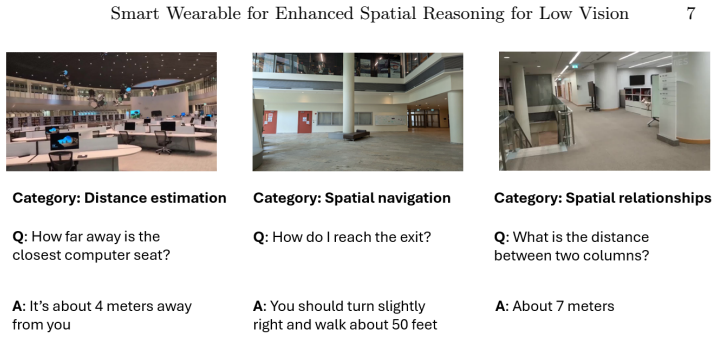
The load-bearing object is the Low Vision Spatial Question Answering (LVSQA) dataset together with the Low Vision Spatial-LLaVA model fine-tuned on it. LVSQA is built by selecting indoor images with navigation-relevant objects (exits, steps, elevators, hazards, seats, desks, people), annotating those objects, and using GPT-4 Vision and predefined templates to generate one question in each of three categories—navigational guidance, distance/proximity, and spatial relationships—with answers written by hand. The model is trained on LVSQA plus the original LLaVA instruction data, so the dataset supplies the spatial supervision that base LLaVA lacks; the paper evaluates that supervision with BLEU, ROUGE, CIDEr, and METEOR against the hand-written reference answers.
What would settle it
Split LVSQA into disjoint image sets, retrain only on the training half, and evaluate on the held-out half with freshly written question templates; if the lead over LLaVA and GPT-4 collapses, the reported spatial gains came from memorizing template answer patterns rather than from spatial reasoning.
Extended reading notes
Core claim
The central claim is that spatial reasoning—judging distance, direction, and the layout of objects—can be instilled into a general vision-language assistant by fine-tuning, and that a practical assistive device can be built around that. The authors' evidence is Low Vision Spatial-LLaVA, created by following the SpatialVLM recipe: CLIP-based image filtering, object-centric context extraction, depth estimation that turns scenes into 3D point clouds, unambiguous user-configurable captions, and GPT-4 Vision question templates. Training on LVSQA alongside the original LLaVA data yields a model whose answers beat base LLaVA and GPT-4 on all five evaluation metrics on LVSQA (distance estimation, navigation, and spatial relationships), while staying comparable to both on VizWiz. That last result is the paper's key argument that spatial specialization does not come at the cost of general VQA competence.
Load-bearing premise
The central claim stands on the LVSQA benchmark: the same data-generation pipeline that trains the model also provides the evaluation data, the paper never states that training and test images are disjoint, and the ground-truth answers were written manually without any independent validation.
Editorial extensions
If this is right
- A blind or low-vision user can ask a spoken question and receive a real-time, spoken answer about how far away an object is, how to reach it, or how it is arranged relative to other objects, using only the glasses-mounted camera and a phone.
- Because VizWiz scores stay level, spatial fine-tuning can be layered on existing vision-language assistive systems without a general question-answering regression.
- The LVSQA data-generation recipe can be reused to create spatial question-answer benchmarks for other object sets or environments, so the approach is not tied to the specific indoor scenes tested.
- The hardware design—a BLE camera clipped to glasses, a phone app, and a local server running the model—shows a low-cost path to hands-free assistive deployment.
Reading between the lines
- A natural extension is to pair the system with metric depth from the phone or a stereo camera, which would likely tighten distance estimates beyond the 5-meter range the paper flags as needing improvement.
- The same pipeline could be run on egocentric video from the wearable itself, generating training questions from the user's own viewpoint and potentially improving robustness to blur and missing objects.
- A controlled field study with blind participants measuring task completion time, obstacle avoidance, and cognitive load, rather than n-gram overlap, would test whether the reported metric gains translate into real mobility benefit.
- The dataset-generation approach could also produce non-verbal output variants—haptic or spatially localized audio—so that distance and direction answers are delivered without requiring the user to parse language.
Signed reviews
Editorial analysis
A structured set of objections, weighed in public.
Referee Report
Summary. The manuscript proposes a wearable assistive system for people with blindness and low vision, consisting of a glasses-mounted ESP32-S3 camera that streams images over BLE to an Android app, which sends them to a Flask backend running a fine-tuned LLaVA model called 'Low Vision Spatial LLaVA.' The authors construct a new LVSQA dataset by filtering images, extracting object-centric 3D context with depth estimators, and generating template-based navigation, distance, and spatial-relationship questions with manually written answers. The model is fine-tuned on LVSQA and evaluated on LVSQA and VizWiz, with an ablation against GPT-4 and LLaVA. The paper claims significant improvements in spatial reasoning, navigation, and user experience, but the reported experiments contain a circular evaluation setup and internal contradictions that undermine these claims.
Significance. If the central claim were established, this would be a useful contribution: a lightweight, practical wearable that brings spatial reasoning into MLLM-based assistive technology. The hardware integration is concrete and described in enough detail to be reproduced, and the LVSQA task categories (navigation guidance, distance/proximity, spatial relationships) are well motivated for blind and low-vision navigation. However, no code or dataset release is mentioned, and the quantitative evidence as presented does not support the claimed gains: the evaluation is circular, the ablation table contradicts its own text, and the VizWiz results show parity rather than superiority. The paper is best viewed as an engineering prototype description, not as a validated method for spatial-reasoning improvement.
major comments (4)
- [Section 3.1/3.2 and Section 4.1] The LVSQA dataset is used both as the training source and as the evaluation benchmark, and no train/test split is reported. Section 3.1 states that LV-LLaVA is trained on the LVSQA dataset, while Section 4.1 evaluates the model on the LVSQA dataset with 100 observations and 300 queries. Because the questions are generated from templates applied to the same manually annotated images used for fine-tuning, the reported BLEU/ROUGE/CIDEr/METEOR scores may reflect memorized template-answer patterns rather than spatial reasoning. The authors must report a disjoint split, ideally with unseen scenes and novel template variants, and evaluate on that split.
- [Section 4.2, Table 2] The text states that 'our model outperforms both GPT-4 and LLaVA across all evaluated metrics,' but Table 2 shows LLaVA with higher ROUGE (0.343 vs 0.318) and higher CIDEr (0.391 vs 0.389) than Ours. This is a direct contradiction in the central evidence. The claim must be corrected to the actual pattern, and ideally confidence intervals or significance tests should be provided; as it stands, the ablation does not support the claimed spatial-reasoning improvement.
- [Section 4.3 and Abstract] The abstract and conclusion claim 'substantial improvements in accuracy and user experience' on the VizWiz dataset, but Table 3 shows LLaVA ahead on BLEU-1 (0.650 vs 0.618) and CIDEr (0.424 vs 0.407), and no user-experience measurements are reported anywhere in the paper. The VizWiz experiment at best supports parity with existing models, not superiority, and the 'user experience' claim is unsupported by any data.
- [Section 5.1] Section 5.1 concedes that the evaluation was 'more qualitative' and that a rigorous quantitative framework for distance estimation is future work. Since the central claim is a quantitative improvement in spatial reasoning, including distance estimation, this concession is load-bearing: the current experiments cannot establish the abstract's claim of 'significantly improves the understanding of environmental context' or the conclusion's claim that the model 'significantly enhances navigation and spatial awareness.'
minor comments (5)
- [Section 1, Contribution 3] Contribution 3 contains a duplicated word: 'Low Vision Spatial Question Answering (LVSQA) dataset dataset.'
- [Section 4.1 vs Section 3.2] The query-category terminology is inconsistent: Section 3.2 defines Navigational Guidance, Distance and Proximity, and Spatial Relationships; Section 4.1 refers to distance estimation, object identification, and navigational questions; Table 1 uses Navigation, Distance Estimation, and Relationships. Please align the terminology throughout.
- [Section 3.3] The text refers to 'LLaVA15 ChatHandler,' which is presumably a typo for LLaVA-1.5; please correct it.
- [Section 3.2] The ground truth answers are described as manually created, but no inter-annotator agreement or independent validation is reported; please provide annotation statistics or a validation protocol.
- [Tables 1-3] All tables report single point estimates without variance, confidence intervals, or per-category sample counts; with only 100 observations and 300 queries, differences such as ROUGE 0.343 vs 0.318 may be within noise, so error bars or significance tests are needed.
Circularity Check
The claimed spatial-reasoning gain is measured on the same LVSQA dataset used for fine-tuning, with no stated disjoint split; the external VizWiz check does not show a gain.
-
fitted input called prediction
[Sections 3.1-3.2 (dataset construction and training) and 4.1 (evaluation), Tables 1-2]
"The LV-LLaVA model is trained on this dataset, integrating the spatial data with the original LLaVA training set. ... In this section, we conduct experiment on the proposed LVSQA dataset to evaluate the performance and usability of our assembled wearable device in providing navigation assistance and spatial awareness to visually impaired users."
The model is fine-tuned on LVSQA (Section 3.1) and then evaluated on 'the proposed LVSQA dataset' (Section 4.1). No train/test split or disjointness of images/questions is stated anywhere in Section 4. Because LVSQA questions are generated by applying templates to annotated images and ground truths are manually written for the same JSON entries, a model can fit template-answer patterns during fine-tuning and be rewarded for that memorization by BLEU/ROUGE/CIDEr/METEOR. The central claim that fine-tuning 'significantly improves' spatial reasoning thus rests on in-distribution scores on the training benchmark, not on an independent test of spatial reasoning; the only external benchmark (VizWiz) shows comparable rather than superior performance.
full rationale
The paper's central derivation is: fine-tune LLaVA on the LVSQA dataset, then report LVSQA metrics as evidence of improved spatial reasoning. That chain is circular as written because the evaluation benchmark is the same dataset used for training, and the paper never states that evaluation observations are disjoint from the training entries. The template-based question generation and manual ground truths make memorization a plausible confound, and the n-gram metrics used would reward verbatim template matching. The VizWiz experiment is an external check, but its results show no improvement from the spatial fine-tuning (e.g., BLEU-1 0.618 vs LLaVA 0.650), so it cannot independently support the capability claim. Section 5.1 further concedes that the evaluation was 'qualitative' and that a 'rigorous quantitative framework' for distance estimation is future work. Additionally, Section 4.2's text claims our model 'outperforms both GPT-4 and LLaVA across all evaluated metrics,' but Table 2 shows LLaVA higher on ROUGE and CIDEr, making the in-distribution evidence internally inconsistent. There are no self-citation chains or imported uniqueness theorems involved; the circularity is specifically that the claimed predictive gain is measured on the fitted dataset. Because the central claim reduces to in-distribution performance on the training distribution, a score of 6 is appropriate.
Assumptions & free parameters
assumptions (4)
- domain assumption Fine-tuning LLaVA on synthetic QA pairs generated by the SpatialVLM pipeline imparts usable spatial reasoning that transfers to real-world pBLV scenarios.
- domain assumption Manually written ground truth answers in LVSQA are accurate and sufficient for training and evaluation.
- domain assumption BLEU, ROUGE, CIDEr, and METEOR are appropriate measures of assistive spatial QA quality.
- domain assumption The 100 indoor observations and 300 queries are representative of real-world navigation needs.
Cite this review
Pith. "Pith review of A Light and Smart Wearable Platform with Multimodal Foundation Model for Enhanced Spatial Reasoning in People with Blindness and Low Vision." pith.science (2026). https://pith.science/paper/5DNKRFS7
@misc{pith2026250510875,
  author       = {Pith},
  title        = {Pith review of: A Light and Smart Wearable Platform with Multimodal Foundation Model for Enhanced Spatial Reasoning in People with Blindness and Low Vision},
  year         = {2026},
  howpublished = {\url{https://pith.science/paper/5DNKRFS7}},
  note         = {Machine review of arXiv:2505.10875}
}
read the original abstract
People with blindness and low vision (pBLV) face significant challenges, struggling to navigate environments and locate objects due to limited visual cues. Spatial reasoning is crucial for these individuals, as it enables them to understand and interpret the spatial relationships in their surroundings, enhancing their ability to navigate and interact more safely and independently. Current multi-modal large language (MLLM) models for low vision people lack the spatial reasoning capabilities needed to effectively assist in these tasks. Moreover, there is a notable absence of lightweight, easy-to-use systems that allow pBLV to effectively perceive and interact with their surrounding environment. In this paper, we propose a novel spatial enhanced multi-modal large language model based approach for visually impaired individuals. By fine-tuning the MLLM to incorporate spatial reasoning capabilities, our method significantly improves the understanding of environmental context, which is critical for navigation and object recognition. The innovation extends to a hardware component, designed as an attachment for glasses, ensuring increased accessibility and ease of use. This integration leverages advanced VLMs to interpret visual data and provide real-time, spatially aware feedback to the user. Our approach aims to bridge the gap between advanced machine learning models and practical, user-friendly assistive devices, offering a robust solution for visually impaired users to navigate their surroundings more effectively and independently. The paper includes an in-depth evaluation using the VizWiz dataset, demonstrating substantial improvements in accuracy and user experience. Additionally, we design a comprehensive dataset to evaluate our method's effectiveness in realworld situations, demonstrating substantial improvements in accuracy and user experience.
Figures


Figures from the paper (3 more)


Reference graph
Works this paper leans on
-
[1]
In: International Conference on Advanced Intelligent Systems and In- formatics
Ahmed, S.S., El-Basit, A.O.A., Hosny, A.K., Wahba, M.M., Saber, S.A., Ali, K.A.: Assistive technology for the visually impaired using computer vision and image processing. In: International Conference on Advanced Intelligent Systems and In- formatics. pp. 287–297. Springer (2022) 5
work page 2022
-
[2]
Banerjee, S., Lavie, A.: Meteor: An automatic metric for mt evaluation with im- proved correlation with human judgments. In: Proceedings of the acl workshop on intrinsic and extrinsic evaluation measures for machine translation and/or summa- rization. pp. 65–72 (2005) 11
work page 2005
-
[3]
In: Proceedings of the 23nd annual ACM symposium on User interface software and technology
Bigham, J.P., Jayant, C., Ji, H., Little, G., Miller, A., Miller, R.C., Miller, R., Tatarowicz, A., White, B., White, S., et al.: Vizwiz: nearly real-time answers to visual questions. In: Proceedings of the 23nd annual ACM symposium on User interface software and technology. pp. 333–342 (2010) 13
work page 2010
-
[4]
ASME Letters in Dynamic Systems and Control1(4), 041004 (2021) 5
Boldini, A., Garcia, A.L., Sorrentino, M., Beheshti, M., Ogedegbe, O., Fang, Y., Porfiri, M., Rizzo, J.R.: An inconspicuous, integrated electronic travel aid for visual impairment. ASME Letters in Dynamic Systems and Control1(4), 041004 (2021) 5
work page 2021
-
[5]
In: Nano-, Bio-, Info-Tech Sensors, and 3D Systems IV
Boldini, A., Rizzo, J.R., Porfiri, M.: A piezoelectric-based advanced wearable: ob- stacle avoidance for the visually impaired built into a backpack. In: Nano-, Bio-, Info-Tech Sensors, and 3D Systems IV. vol. 11378, p. 1137806. SPIE (2020) 5
work page 2020
-
[6]
Advances in neural information processing systems33, 1877–1901 (2020) 4
Brown, T., Mann, B., Ryder, N., Subbiah, M., Kaplan, J.D., Dhariwal, P., Nee- lakantan, A., Shyam, P., Sastry, G., Askell, A., et al.: Language models are few-shot learners. Advances in neural information processing systems33, 1877–1901 (2020) 4
work page 2020
-
[7]
Cardoso, Q., de Melo, A.V., Orué, A.L., et al.: Accessibility analysis for the visually impaired using lazarilloapp. Int. J. Innov. Educ. Res10, 21–30 (2019) 5
work page 2019
-
[8]
In: Proceedings of the IEEE/CVF Conference on Computer Vision and Pattern Recog- nition
Chen, B., Xu, Z., Kirmani, S., Ichter, B., Sadigh, D., Guibas, L., Xia, F.: Spa- tialvlm: Endowing vision-language models with spatial reasoning capabilities. In: Proceedings of the IEEE/CVF Conference on Computer Vision and Pattern Recog- nition. pp. 14455–14465 (2024) 6, 7
work page 2024
Show all 39 references
-
[9]
In- telligence and Robotics3(3), 420–435 (2023) 5
Chen, Y., Shen, J., Sawada, H.: A wearable assistive system for the visually im- paired using object detection, distance measurement and tactile presentation. In- telligence and Robotics3(3), 420–435 (2023) 5
2023
-
[10]
Universal Access in the Information Society18, 155–168 (2019) 3
Fernandes, H., Costa, P., Filipe, V., Paredes, H., Barroso, J.: A review of assistive spatial orientation and navigation technologies for the visually impaired. Universal Access in the Information Society18, 155–168 (2019) 3
2019
-
[11]
The engi- neering handbook of smart technology for aging, disability, and independence pp
Giudice, N.A., Legge, G.E.: Blind navigation and the role of technology. The engi- neering handbook of smart technology for aging, disability, and independence pp. 479–500 (2008) 5
2008
-
[12]
Journal of Visual Impairment & Blindness115(4), 277–285 (2021) 5
Granquist, C., Sun, S.Y., Montezuma, S.R., Tran, T.M., Gage, R., Legge, G.E.: Evaluation and comparison of artificial intelligence vision aids: Orcam myeye 1 and seeing ai. Journal of Visual Impairment & Blindness115(4), 277–285 (2021) 5
2021
-
[13]
International Journal of Engineering Pedagogy13(5) (2023) 6
Green, T., Goodridge, W.H., Kane, D., Shaheen, N.L.: Spatial strategies employed by blind and low-vision (blv) individuals on the tactile mental cutting test (tmct). International Journal of Engineering Pedagogy13(5) (2023) 6
2023
-
[14]
In: 2019 IEEE/RSJ International Con- ference on Intelligent Robots and Systems (IROS)
Gui, W., Li, B., Yuan, S., Rizzo, J.R., Sharma, L., Feng, C., Tzes, A., Fang, Y.: An assistive low-vision platform that augments spatial cognition through proprio- ceptive guidance: Point-to-tell-and-touch. In: 2019 IEEE/RSJ International Con- ference on Intelligent Robots and...
2019
-
[15]
In: 2017 International Conference on Indoor Positioning and Indoor Navigation (IPIN)
Gupta, T., Li, H.: Indoor mapping for smart cities—an affordable approach: Using kinect sensor and zed stereo camera. In: 2017 International Conference on Indoor Positioning and Indoor Navigation (IPIN). pp. 1–8. IEEE (2017) 5
2017
-
[16]
Survey of ophthalmology58(6), 513–528 (2013) 3
Hakobyan, L., Lumsden, J., O’Sullivan, D., Bartlett, H.: Mobile assistive tech- nologies for the visually impaired. Survey of ophthalmology58(6), 513–528 (2013) 3
2013
-
[17]
In: European Conference on Computer Vision
Hao, Y., Feng, J., Rizzo, J.R., Wang, Y., Fang, Y.: Detect and approach: Close- range navigation support for people with blindness and low vision. In: European Conference on Computer Vision. pp. 607–622. Springer (2022) 5
2022
-
[18]
Journal of Imaging10(5), 103 (2024) 5
Hao, Y., Yang, F., Huang, H., Yuan, S., Rangan, S., Rizzo, J.R., Wang, Y., Fang, Y.: A multi-modal foundation model to assist people with blindness and low vision in environmental interaction. Journal of Imaging10(5), 103 (2024) 5
2024
-
[19]
Silicon14(4), 1831–1849 (2022) 5
Kumar, P.A., Vivek, J., Senniangiri, N., Nagarajan, S., Chandrasekaran, K.: A study of added sic powder in kerosene for the blind square hole machining of cfrp using electrical discharge machining. Silicon14(4), 1831–1849 (2022) 5
2022
-
[20]
In: Text sum- marization branches out
Lin, C.Y.: Rouge: A package for automatic evaluation of summaries. In: Text sum- marization branches out. pp. 74–81 (2004) 11
2004
-
[21]
Advances in neural information processing systems36(2024) 2, 4, 6
Liu, H., Li, C., Wu, Q., Lee, Y.J.: Visual instruction tuning. Advances in neural information processing systems36(2024) 2, 4, 6
2024
-
[22]
PloS one13(7), e0199389 (2018) 3, 5
Massiceti, D., Hicks, S.L., van Rheede, J.J.: Stereosonic vision: Exploring visual-to- auditory sensory substitution mappings in an immersive virtual reality navigation paradigm. PloS one13(7), e0199389 (2018) 3, 5
2018
-
[23]
In: 2008 IEEE international workshop on haptic audio visual environments and games
McDaniel, T., Krishna, S., Balasubramanian, V., Colbry, D., Panchanathan, S.: Using a haptic belt to convey non-verbal communication cues during social in- teractions to individuals who are blind. In: 2008 IEEE international workshop on haptic audio visual environments and gam...
2008
-
[24]
OpenAI: Gpt-4 technical report (2023) 2, 4
2023
-
[25]
World Health Organization1(2014) 2
Organization, W.H., et al.: Visual impairment and blindness fact sheet n 282. World Health Organization1(2014) 2
2014
-
[26]
In: Proceedings of the 40th annual meeting of the Association for Computational Linguistics
Papineni, K., Roukos, S., Ward, T., Zhu, W.J.: Bleu: a method for automatic evaluation of machine translation. In: Proceedings of the 40th annual meeting of the Association for Computational Linguistics. pp. 311–318 (2002) 11
2002
-
[27]
British Journal of Ophthalmology96(5), 614–618 (2012) 2
Pascolini, D., Mariotti, S.P.: Global estimates of visual impairment: 2010. British Journal of Ophthalmology96(5), 614–618 (2012) 2
2012
-
[28]
In: 2023 36th International Conference on VLSI Design and 2023 22nd International Conference on Embedded Systems (VLSID)
Peraka, S., Ali, S.I., Sudheer, R., Kumar, P.P., Kondala, G., Samal, D.: A novel approach for assisting blind people using a smart wearable device. In: 2023 36th International Conference on VLSI Design and 2023 22nd International Conference on Embedded Systems (VLSID). pp. 383...
2023
-
[29]
In: International conference on machine learning
Radford, A., Kim, J.W., Hallacy, C., Ramesh, A., Goh, G., Agarwal, S., Sastry, G., Askell, A., Mishkin, P., Clark, J., et al.: Learning transferable visual models from natural language supervision. In: International conference on machine learning. pp. 8748–8763. PMLR (2021) 4
2021
-
[30]
In: Proceedings of the IEEE conference on computer vision and pattern recognition
Redmon, J., Divvala, S., Girshick, R., Farhadi, A.: You only look once: Unified, real-time object detection. In: Proceedings of the IEEE conference on computer vision and pattern recognition. pp. 779–788 (2016) 5
2016
-
[31]
IEEE transactions on pattern analysis and machine intelligence39(6), 1137–1149 (2016) 5
Ren, S., He, K., Girshick, R., Sun, J.: Faster r-cnn: Towards real-time object de- tection with region proposal networks. IEEE transactions on pattern analysis and machine intelligence39(6), 1137–1149 (2016) 5
2016
-
[32]
PM&R13(4) (2021) 5 Smart Wearable for Enhanced Spatial Reasoning for Low Vision 17
Rizzo, J.R., Beheshti, M., Fang, Y., Flanagan, S., Giudice, N.A.: Covid-19 and visual disability: Can’t look and now don’t touch. PM&R13(4) (2021) 5 Smart Wearable for Enhanced Spatial Reasoning for Low Vision 17
2021
-
[33]
arXiv preprint arXiv:1908.08530 (2019) 4
Su, W., Zhu, X., Cao, Y., Li, B., Lu, L., Wei, F., Dai, J.: Vl-bert: Pre-training of generic visual-linguistic representations. arXiv preprint arXiv:1908.08530 (2019) 4
2019 arXiv
-
[34]
Team, O.G.: Open glass project (2023),https://github.com/BasedHardware/ OpenGlass?tab=readme-ov-file9
2023
-
[35]
In: Proceedings of the IEEE conference on computer vision and pattern recognition
Vedantam, R., Lawrence Zitnick, C., Parikh, D.: Cider: Consensus-based image description evaluation. In: Proceedings of the IEEE conference on computer vision and pattern recognition. pp. 4566–4575 (2015) 11
2015
-
[36]
Visual impairment research 7(1), 27–42 (2005) 5
Whitmarsh, L.: The benefits of guide dog ownership. Visual impairment research 7(1), 27–42 (2005) 5
2005
-
[37]
Sensors23(23), 9598 (2023) 5
Xu, P., Song, A., Wang, K.: Intelligent head-mounted obstacle avoidance wearable for the blind and visually impaired. Sensors23(23), 9598 (2023) 5
2023
-
[38]
arXiv preprint arXiv:2404.02508 (2024) 2
Yang, B., He, L., Liu, K., Yan, Z.: Viassist: Adapting multi-modal large language models for users with visual impairments. arXiv preprint arXiv:2404.02508 (2024) 2
2024 arXiv
-
[39]
arXiv preprint arXiv:2310.00653 (2023) 2
Yu, T., Hu, J., Yao, Y., Zhang, H., Zhao, Y., Wang, C., Wang, S., Pan, Y., Xue, J., Li, D., et al.: Reformulating vision-language foundation models and datasets towards universal multimodal assistants. arXiv preprint arXiv:2310.00653 (2023) 2
2023 arXiv
Reviewed August 15, 2026 · model on record in the stance chip above.
Discussion (0). Continue with ORCID to comment.