JointEdit3D: Feed-Forward 3D Scene Editing in a Unified Latent Space
Reviewed by Pith T0 review T1 audit T2 compute T3 formal T4 kernel 2026-06-27 07:24 UTCgrok-4.3pith:5DOGPDOYrecord.jsonopen to challenge →
The pith
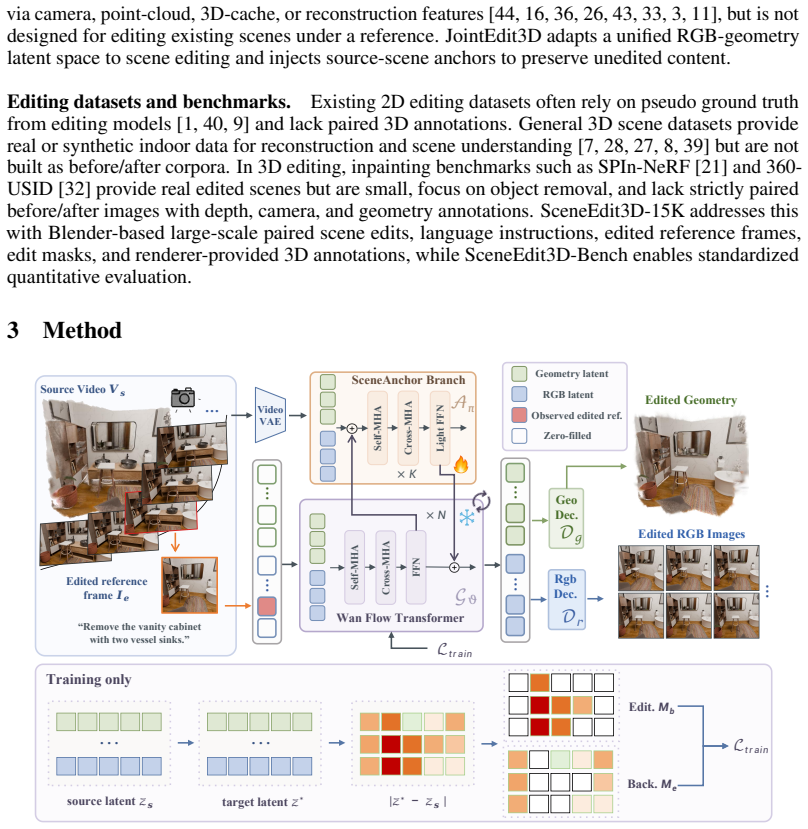
JointEdit3D performs 3D scene editing in a single forward pass by asymmetrically inpainting a unified RGB-geometry latent space while anchoring to the source scene.
A machine-rendered reading of the paper's core claim, the machinery that carries it, and where it could break.
Core claim
JointEdit3D adapts a unified RGB-geometry reconstruction-generation latent space to feed-forward 3D scene editing through asymmetric latent inpainting, where only a single edited RGB reference latent is observed, and the remaining RGB views along with edited geometry are generated under source-scene anchoring via a dedicated SceneAnchor Branch and edit/background-aware losses.
What carries the argument
Asymmetric latent inpainting performed in a unified RGB-geometry latent space, guided by a SceneAnchor Branch that injects source-scene structure without direct copying.
If this is right
- 3D editing no longer requires iterative per-scene optimization at test time.
- Edited regions show improved visual quality while overall 3D structural completeness increases.
- Background content remains competitive in preservation quality with earlier methods.
- Standardized comparison of 3D editing methods becomes possible through the released paired dataset and benchmark.
Where Pith is reading between the lines
- The feed-forward design could support interactive editing sessions where users make repeated changes without waiting for optimization.
- Similar asymmetric anchoring might apply to related tasks such as editing dynamic 3D content or multi-object scenes.
- If the latent space generalizes well, the approach could extend to editing scenes captured from consumer devices rather than controlled renders.
Load-bearing premise
The unified RGB-geometry latent space can be adapted to feed-forward editing via asymmetric inpainting and a SceneAnchor Branch without introducing structural inconsistencies.
What would settle it
Running the method on a scene with intricate geometry and observing whether the generated 3D structure in non-reference views matches the edited appearance without visible mismatches or holes.
Figures


read the original abstract
Existing 3D scene editing methods typically rely on per-scene optimization over explicit 3D representations or cascaded edit-and-reconstruct pipelines, resulting in high test-time cost, limited 3D awareness, and structural inconsistencies. To couple appearance synthesis and geometry prediction during editing, we build on a unified RGB-geometry reconstruction-generation latent space and adapt it to feed-forward 3D scene editing. The resulting framework, \textbf{JointEdit3D}, performs asymmetric latent inpainting by observing only a single edited RGB reference latent and generating the remaining RGB views and edited geometry latent under source-scene anchoring. JointEdit3D introduces a dedicated SceneAnchor Branch to inject source-scene structure without forcing direct copying, and adopts edit/background-aware losses to balance edited-region fidelity with unedited-content preservation. To address the lack of paired resources for standardized 3D scene editing evaluation, we introduce SceneEdit3D-15K, a dataset with 15K paired editing samples and renderer-provided 3D annotations, together with SceneEdit3D-Bench, a curated 100-sample benchmark. Experiments show that JointEdit3D improves edited-region quality and 3D structural completeness over prior baselines while maintaining competitive background preservation.
Editorial analysis
A structured set of objections, weighed in public.
Referee Report
Summary. The manuscript introduces JointEdit3D, a feed-forward 3D scene editing framework that adapts a unified RGB-geometry reconstruction-generation latent space via asymmetric latent inpainting (observing only a single edited RGB reference latent while generating remaining views and edited geometry under source-scene anchoring). It adds a SceneAnchor Branch to inject source structure without direct copying, employs edit/background-aware losses, and releases the SceneEdit3D-15K dataset (15K paired samples with 3D annotations) plus SceneEdit3D-Bench (100-sample curated benchmark). Experiments claim improvements in edited-region quality and 3D structural completeness over baselines while preserving competitive background fidelity.
Significance. If the central claims hold, the work offers a practical advance by replacing per-scene optimization and cascaded pipelines with a single feed-forward pass in a shared latent space, which could lower test-time cost and reduce structural inconsistencies in 3D editing. The new paired dataset and benchmark address a clear evaluation gap and would benefit the community regardless of the method's ultimate performance.
minor comments (1)
- Abstract: reports experimental improvements but supplies no equations, loss formulations, architecture diagrams, or data splits, preventing verification of whether gains are supported by the implementation or affected by post-hoc choices.
Simulated Author's Rebuttal
We thank the referee for their review of our manuscript. The report provides a clear summary of JointEdit3D and recognizes the potential significance of replacing per-scene optimization with a feed-forward approach in a unified latent space, as well as the contribution of the new dataset and benchmark. The recommendation is listed as uncertain, yet the report contains no specific major comments. We address this below and remain available to clarify any aspects that may have contributed to the uncertainty.
Circularity Check
No significant circularity detected
full rationale
The paper presents an empirical method that adapts an existing unified RGB-geometry latent space (described as built upon, not derived within this work) via asymmetric inpainting, a SceneAnchor Branch, and specialized losses. No equations, derivations, or self-referential definitions are present that would reduce outputs to inputs by construction. Evaluation relies on a newly introduced dataset and benchmark with comparisons to baselines, making the central claims externally falsifiable rather than tautological. No load-bearing self-citations or fitted predictions masquerading as results are identifiable from the text.
Axiom & Free-Parameter Ledger
axioms (1)
- domain assumption A unified RGB-geometry reconstruction-generation latent space can be adapted for editing tasks.
Reference graph
Works this paper leans on
-
[1]
Instructpix2pix: Learning to follow image editing instructions
Tim Brooks, Aleksander Holynski, and Alexei A Efros. Instructpix2pix: Learning to follow image editing instructions. InProceedings of the IEEE/CVF conference on computer vision and pattern recognition, pages 18392–18402, 2023
2023
-
[2]
MVInpainter: Learning multi-view consistent inpainting to bridge 2d and 3d editing
Chenjie Cao, Chaohui Yu, Fan Wang, Xiangyang Xue, and Yanwei Fu. MVInpainter: Learning multi-view consistent inpainting to bridge 2d and 3d editing. InThe Thirty-eighth Annual Conference on Neural Information Processing Systems, 2024. URLhttps://openreview.net/forum?id=XIScpCMUse
2024
-
[3]
Uni3c: Unifying precisely 3d-enhanced camera and human motion controls for video generation
Chenjie Cao, Jingkai Zhou, Shikai Li, Jingyun Liang, Chaohui Yu, Fan Wang, Xiangyang Xue, and Yanwei Fu. Uni3c: Unifying precisely 3d-enhanced camera and human motion controls for video generation. In Proceedings of the SIGGRAPH Asia 2025 Conference Papers, pages 1–12, 2025
2025
-
[4]
Omni-3DEdit: Generalized versatile 3D editing in one-pass
Liyi Chen, Pengfei Wang, Guowen Zhang, Zhiyuan Ma, and Lei Zhang. Omni-3DEdit: Generalized versatile 3D editing in one-pass. InProceedings of the IEEE/CVF Conference on Computer Vision and Pattern Recognition (CVPR), 2026
2026
-
[5]
Dge: Direct gaussian 3d editing by consistent multi-view editing
Minghao Chen, Iro Laina, and Andrea Vedaldi. Dge: Direct gaussian 3d editing by consistent multi-view editing. InEuropean conference on computer vision, pages 74–92. Springer, 2024
2024
-
[6]
Gaussianeditor: Swift and controllable 3d editing with gaussian splatting
Yiwen Chen, Zilong Chen, Chi Zhang, Feng Wang, Xiaofeng Yang, Yikai Wang, Zhongang Cai, Lei Yang, Huaping Liu, and Guosheng Lin. Gaussianeditor: Swift and controllable 3d editing with gaussian splatting. InProceedings of the IEEE/CVF conference on computer vision and pattern recognition, pages 21476–21485, 2024
2024
-
[7]
Scannet: Richly-annotated 3d reconstructions of indoor scenes
Angela Dai, Angel X Chang, Manolis Savva, Maciej Halber, Thomas Funkhouser, and Matthias Nießner. Scannet: Richly-annotated 3d reconstructions of indoor scenes. InProceedings of the IEEE conference on computer vision and pattern recognition, pages 5828–5839, 2017
2017
-
[8]
3d-front: 3d furnished rooms with layouts and semantics
Huan Fu, Bowen Cai, Lin Gao, Ling-Xiao Zhang, Jiaming Wang, Cao Li, Qixun Zeng, Chengyue Sun, Rongfei Jia, Binqiang Zhao, et al. 3d-front: 3d furnished rooms with layouts and semantics. InProceedings of the IEEE/CVF International Conference on Computer Vision, pages 10933–10942, 2021
2021
-
[9]
Effecterase: Joint video object removal and insertion for high-quality effect erasing
Yang Fu, Yike Zheng, Ziyun Dai, and Henghui Ding. Effecterase: Joint video object removal and insertion for high-quality effect erasing. InIEEE/CVF Conference on Computer Vision and Pattern Recognition (CVPR), 2026
2026
-
[10]
Instruct- nerf2nerf: Editing 3d scenes with instructions
Ayaan Haque, Matthew Tancik, Alexei A Efros, Aleksander Holynski, and Angjoo Kanazawa. Instruct- nerf2nerf: Editing 3d scenes with instructions. InProceedings of the IEEE/CVF international conference on computer vision, pages 19740–19750, 2023
2023
-
[11]
Gen3r: 3d scene generation meets feed-forward reconstruction
Jiaxin Huang, Yuanbo Yang, Bangbang Yang, Lin Ma, Yuewen Ma, and Yiyi Liao. Gen3r: 3d scene generation meets feed-forward reconstruction. InProceedings of the IEEE/CVF Conference on Computer Vision and Pattern Recognition (CVPR), 2026
2026
-
[12]
Fuse3d: Generating 3d assets controlled by multi-image fusion
Xuancheng Jin, Rengan Xie, Wenting Zheng, Rui Wang, Hujun Bao, and Yuchi Huo. Fuse3d: Generating 3d assets controlled by multi-image fusion. InProceedings of the SIGGRAPH Asia 2025 Conference Papers, pages 1–12, 2025
2025
-
[13]
3d gaussian splatting for real-time radiance field rendering.ACM Trans
Bernhard Kerbl, Georgios Kopanas, Thomas Leimkühler, George Drettakis, et al. 3d gaussian splatting for real-time radiance field rendering.ACM Trans. Graph., 42(4):139–1, 2023
2023
-
[14]
Editsplat: Multi-view fusion and attention-guided optimization for view-consistent 3d scene editing with 3d gaussian splatting
Dong In Lee, Hyeongcheol Park, Jiyoung Seo, Eunbyung Park, Hyunje Park, Ha Dam Baek, Sangheon Shin, Sangmin Kim, and Sangpil Kim. Editsplat: Multi-view fusion and attention-guided optimization for view-consistent 3d scene editing with 3d gaussian splatting. InProceedings of the Computer Vision and Pattern Recognition Conference, pages 11135–11145, 2025
2025
-
[15]
V oxhammer: Training-free precise and coherent 3d editing in native 3d space
Lin Li, Zehuan Huang, Haoran Feng, Gengxiong Zhuang, Rui Chen, Chunchao Guo, and Lu Sheng. V oxhammer: Training-free precise and coherent 3d editing in native 3d space. InThirteenth International Conference on 3D Vision, 2026. URLhttps://openreview.net/forum?id=UhHNN5lW67
2026
-
[16]
Director3d: Real-world camera trajectory and 3d scene generation from text.Advances in neural information processing systems, 37:75125–75151, 2024
Xinyang Li, Zhangyu Lai, Linning Xu, Yansong Qu, Liujuan Cao, Shengchuan Zhang, Bo Dai, and Rongrong Ji. Director3d: Real-world camera trajectory and 3d scene generation from text.Advances in neural information processing systems, 37:75125–75151, 2024. 11
2024
-
[17]
Dl3dv-10k: A large-scale scene dataset for deep learning-based 3d vision
Lu Ling, Yichen Sheng, Zhi Tu, Wentian Zhao, Cheng Xin, Kun Wan, Lantao Yu, Qianyu Guo, Zixun Yu, Yawen Lu, et al. Dl3dv-10k: A large-scale scene dataset for deep learning-based 3d vision. InProceedings of the IEEE/CVF Conference on Computer Vision and Pattern Recognition, pages 22160–22169, 2024
2024
-
[18]
Yaron Lipman, Ricky T. Q. Chen, Heli Ben-Hamu, Maximilian Nickel, and Matthew Le. Flow matching for generative modeling. InThe Eleventh International Conference on Learning Representations, 2023. URLhttps://openreview.net/forum?id=PqvMRDCJT9t
2023
-
[19]
Edit3r: Instant 3d scene editing from sparse unposed images.arXiv preprint arXiv:2512.25071, 2025
Jiageng Liu, Weijie Lyu, Xueting Li, Yejie Guo, and Ming-Hsuan Yang. Edit3r: Instant 3d scene editing from sparse unposed images.arXiv preprint arXiv:2512.25071, 2025
-
[20]
Nerf: Representing scenes as neural radiance fields for view synthesis.Communications of the ACM, 65 (1):99–106, 2021
Ben Mildenhall, Pratul P Srinivasan, Matthew Tancik, Jonathan T Barron, Ravi Ramamoorthi, and Ren Ng. Nerf: Representing scenes as neural radiance fields for view synthesis.Communications of the ACM, 65 (1):99–106, 2021
2021
-
[21]
Spin-nerf: Multiview segmentation and perceptual inpainting with neural radiance fields
Ashkan Mirzaei, Tristan Aumentado-Armstrong, Konstantinos G Derpanis, Jonathan Kelly, Marcus A Brubaker, Igor Gilitschenski, and Alex Levinshtein. Spin-nerf: Multiview segmentation and perceptual inpainting with neural radiance fields. InProceedings of the IEEE/CVF Conference on Computer Vision and Pattern Recognition, pages 20669–20679, 2023
2023
-
[22]
Chong Mou, Xintao Wang, Liangbin Xie, Yanze Wu, Jian Zhang, Zhongang Qi, and Ying Shan. T2I-adapter: Learning adapters to dig out more controllable ability for text-to-image diffusion models.Proceedings of the AAAI Conference on Artificial Intelligence, 38(5):4296–4304, 2024. doi: 10.1609/aaai.v38i5.28226
-
[23]
A benchmark dataset and evaluation methodology for video object segmentation
Federico Perazzi, Jordi Pont-Tuset, Brian McWilliams, Luc Van Gool, Markus Gross, and Alexander Sorkine-Hornung. A benchmark dataset and evaluation methodology for video object segmentation. In Proceedings of the IEEE conference on computer vision and pattern recognition, pages 724–732, 2016
2016
-
[24]
Editcast3d: Single-frame-guided 3d editing with video propagation and view selection
Huaizhi Qu, Ruichen Zhang, Shuqing Luo, Luchao Qi, Zhihao Zhang, Xiaoming Liu, Roni Sengupta, and Tianlong Chen. Editcast3d: Single-frame-guided 3d editing with video propagation and view selection. arXiv preprint arXiv:2510.13652, 2025
-
[25]
Common objects in 3d: Large-scale learning and evaluation of real-life 3d category reconstruction
Jeremy Reizenstein, Roman Shapovalov, Philipp Henzler, Luca Sbordone, Patrick Labatut, and David Novotny. Common objects in 3d: Large-scale learning and evaluation of real-life 3d category reconstruction. InProceedings of the IEEE/CVF international conference on computer vision, pages 10901–10911, 2021
2021
-
[26]
Gen3c: 3d-informed world-consistent video generation with precise camera control
Xuanchi Ren, Tianchang Shen, Jiahui Huang, Huan Ling, Yifan Lu, Merlin Nimier-David, Thomas Müller, Alexander Keller, Sanja Fidler, and Jun Gao. Gen3c: 3d-informed world-consistent video generation with precise camera control. InProceedings of the IEEE/CVF Conference on Computer Vision and Pattern Recognition, pages 6121–6132, 2025
2025
-
[27]
Hypersim: A photorealistic synthetic dataset for holistic indoor scene understanding
Mike Roberts, Jason Ramapuram, Anurag Ranjan, Atulit Kumar, Miguel Angel Bautista, Nathan Paczan, Russ Webb, and Joshua M Susskind. Hypersim: A photorealistic synthetic dataset for holistic indoor scene understanding. InProceedings of the IEEE/CVF international conference on computer vision, pages 10912–10922, 2021
2021
-
[28]
The Replica Dataset: A Digital Replica of Indoor Spaces
Julian Straub, Thomas Whelan, Lingni Ma, Yufan Chen, Erik Wijmans, Simon Green, Jakob J Engel, Raul Mur-Artal, Carl Ren, Shobhit Verma, et al. The replica dataset: A digital replica of indoor spaces.arXiv preprint arXiv:1906.05797, 2019
work page internal anchor Pith review Pith/arXiv arXiv 1906
-
[29]
Wan: Open and Advanced Large-Scale Video Generative Models
Team Wan, Ang Wang, Baole Ai, Bin Wen, Chaojie Mao, Chen-Wei Xie, Di Chen, Feiwu Yu, Haiming Zhao, Jianxiao Yang, et al. Wan: Open and advanced large-scale video generative models.arXiv preprint arXiv:2503.20314, 2025
work page internal anchor Pith review Pith/arXiv arXiv 2025
-
[30]
Vggt: Visual geometry grounded transformer
Jianyuan Wang, Minghao Chen, Nikita Karaev, Andrea Vedaldi, Christian Rupprecht, and David Novotny. Vggt: Visual geometry grounded transformer. InProceedings of the Computer Vision and Pattern Recognition Conference, pages 5294–5306, 2025
2025
-
[31]
Learning 3d geometry and feature consistent gaussian splatting for object removal
Yuxin Wang, Qianyi Wu, Guofeng Zhang, and Dan Xu. Learning 3d geometry and feature consistent gaussian splatting for object removal. InEuropean conference on computer vision, pages 1–17. Springer, 2024
2024
-
[32]
Aurafusion360: Augmented unseen region alignment for reference-based 360deg unbounded scene inpainting
Chung-Ho Wu, Yang-Jung Chen, Ying-Huan Chen, Jie-Ying Lee, Bo-Hsu Ke, Chun-Wei Tuan Mu, Yi- Chuan Huang, Chin-Yang Lin, Min-Hung Chen, Yen-Yu Lin, et al. Aurafusion360: Augmented unseen region alignment for reference-based 360deg unbounded scene inpainting. InProceedings of the Computer Vision and Pattern Recognition Conference, pages 16366–16376, 2025. 12
2025
-
[33]
Geometry forcing: Marrying video diffusion and 3d representation for consistent world modeling
Haoyu Wu, Diankun Wu, Tianyu He, Junliang Guo, Yang Ye, Yueqi Duan, and Jiang Bian. Geometry forcing: Marrying video diffusion and 3d representation for consistent world modeling. InThe Fourteenth International Conference on Learning Representations, 2026. URL https://openreview.net/forum? id=ULXYZCms41
2026
-
[34]
Gaussctrl: Multi-view consistent text-driven 3d gaussian splatting editing
Jing Wu, Jia-Wang Bian, Xinghui Li, Guangrun Wang, Ian Reid, Philip Torr, and Victor Adrian Prisacariu. Gaussctrl: Multi-view consistent text-driven 3d gaussian splatting editing. InEuropean conference on computer vision, pages 55–71. Springer, 2024
2024
-
[35]
Structured 3d latents for scalable and versatile 3d generation
Jianfeng Xiang, Zelong Lv, Sicheng Xu, Yu Deng, Ruicheng Wang, Bowen Zhang, Dong Chen, Xin Tong, and Jiaolong Yang. Structured 3d latents for scalable and versatile 3d generation. InProceedings of the IEEE/CVF conference on computer vision and pattern recognition, pages 21469–21480, 2025
2025
-
[36]
Prometheus: 3d-aware latent diffusion models for feed-forward text-to-3d scene generation
Yuanbo Yang, Jiahao Shao, Xinyang Li, Yujun Shen, Andreas Geiger, and Yiyi Liao. Prometheus: 3d-aware latent diffusion models for feed-forward text-to-3d scene generation. InProceedings of the IEEE/CVF Conference on Computer Vision and Pattern Recognition, pages 2857–2869, 2025
2025
-
[37]
IP-Adapter: Text Compatible Image Prompt Adapter for Text-to-Image Diffusion Models
Hu Ye, Jun Zhang, Sibo Liu, Xiao Han, and Wei Yang. Ip-adapter: Text compatible image prompt adapter for text-to-image diffusion models.arXiv preprint arXiv:2308.06721, 2023
work page internal anchor Pith review Pith/arXiv arXiv 2023
-
[38]
Gaussian grouping: Segment and edit anything in 3d scenes
Mingqiao Ye, Martin Danelljan, Fisher Yu, and Lei Ke. Gaussian grouping: Segment and edit anything in 3d scenes. InEuropean conference on computer vision, pages 162–179. Springer, 2024
2024
-
[39]
Scannet++: A high-fidelity dataset of 3d indoor scenes
Chandan Yeshwanth, Yueh-Cheng Liu, Matthias Nießner, and Angela Dai. Scannet++: A high-fidelity dataset of 3d indoor scenes. InProceedings of the IEEE/CVF International Conference on Computer Vision, pages 12–22, 2023
2023
-
[40]
Magicbrush: A manually annotated dataset for instruction-guided image editing.Advances in Neural Information Processing Systems, 36:31428–31449, 2023
Kai Zhang, Lingbo Mo, Wenhu Chen, Huan Sun, and Yu Su. Magicbrush: A manually annotated dataset for instruction-guided image editing.Advances in Neural Information Processing Systems, 36:31428–31449, 2023
2023
-
[41]
Adding conditional control to text-to-image diffusion models
Lvmin Zhang, Anyi Rao, and Maneesh Agrawala. Adding conditional control to text-to-image diffusion models. InProceedings of the IEEE/CVF international conference on computer vision, pages 3836–3847, 2023
2023
-
[42]
3ditscene: Editing any scene via language-guided disentangled gaussian splatting
Qihang Zhang, Yinghao Xu, Chaoyang Wang, Hsin-Ying Lee, Gordon Wetzstein, Bolei Zhou, and Ceyuan Yang. 3ditscene: Editing any scene via language-guided disentangled gaussian splatting. InThe Thirteenth International Conference on Learning Representations, 2025. URL https://openreview.net/forum? id=iKDbLpVgQc
2025
-
[43]
World-consistent video diffusion with explicit 3d modeling
Qihang Zhang, Shuangfei Zhai, Miguel Angel Bautista Martin, Kevin Miao, Alexander Toshev, Joshua Susskind, and Jiatao Gu. World-consistent video diffusion with explicit 3d modeling. InProceedings of the Computer Vision and Pattern Recognition Conference, pages 21685–21695, 2025
2025
-
[44]
Stable virtual camera: Generative view synthesis with diffusion models
Jensen Zhou, Hang Gao, Vikram V oleti, Aaryaman Vasishta, Chun-Han Yao, Mark Boss, Philip Torr, Christian Rupprecht, and Varun Jampani. Stable virtual camera: Generative view synthesis with diffusion models. InProceedings of the IEEE/CVF International Conference on Computer Vision, pages 12405– 12414, 2025
2025
-
[45]
Imaginarium: Vision-guided high-quality 3d scene layout generation
Xiaoming Zhu, Xu Huang, Qinghongbing Xie, Zhi Deng, Junsheng Yu, Yirui Guan, Zhongyuan Liu, Lin Zhu, Qijun Zhao, Ligang Liu, et al. Imaginarium: Vision-guided high-quality 3d scene layout generation. ACM Transactions on Graphics (TOG), 44(6):1–24, 2025
2025
-
[46]
Dreameditor: Text-driven 3d scene editing with neural fields
Jingyu Zhuang, Chen Wang, Liang Lin, Lingjie Liu, and Guanbin Li. Dreameditor: Text-driven 3d scene editing with neural fields. InSIGGRAPH Asia 2023 conference papers, pages 1–10, 2023
2023
-
[47]
tasks”: [{“operation
Jingyu Zhuang, Di Kang, Yan-Pei Cao, Guanbin Li, Liang Lin, and Ying Shan. Tip-editor: An accurate 3d editor following both text-prompts and image-prompts.ACM Transactions on Graphics (ToG), 43(4):1–12, 2024. 13 Source Image Edited Image RGB Latent RGB Mask RGB Region GEO Latent GEO Mask GEO Region Figure 7: Training-time response diagnostic for region-de...
2024
-
[48]
Parse the JSON layout file L and scene metadata M to recover object identities, support relations, parent-child links, approximate object extents, and navigable room bounds
-
[49]
Resolve affected object roots from q, expand them with the parent-child graph, and run layout validity checks to reject structural, too-small, or unsupported targets
-
[50]
For relocation, sample candidate target positions and run collision detection, support-surface checks, room-bound checks, and free-space validation before accepting a placement
-
[51]
Generate a seeded camera trajectory P={(R i, ti)}N i=1 from fixed templates such as horizontal sweeps, diagonal motions, rising motions, and drop-forward motions, centered on the affected object set
-
[52]
Run visibility checks along P for the source and edited states; reject or repair tasks whose targets are not sufficiently visible or whose edit is hidden by accidental occlusion
-
[53]
Save the initial object states and camera state so both branches start from the same scene
-
[54]
For each branch b∈ {before,after} : restore the saved scene state, apply the branch-specific edit operatorE b q, attach the same camera pathP, and render RGB/depth frames
-
[55]
Render binary masks through Blender object-index passes
Select branch-specific mask objects: deleted objects for deletion, moved objects in both relocation branches, and appearance-changed objects in both appearance branches. Render binary masks through Blender object-index passes
-
[56]
Export RGB videos, depth maps, masks, relative camera poses, intrinsics, task JSON, and completion sentinels
-
[57]
Derive inverse samples for deletion and relocation by swapping before/after branches and reversing frame, depth, mask, and pose order: delete→add and move→move-reverse
-
[58]
remove object chair_12
Discard samples with missing files, empty masks, invisible targets, corrupted frames, invalid physical placement, or failed collision/visibility checks. Eb q(S0) = hide(o), q= delete, b= after, move(o,∆), q= move, b= after, replace_mat(o, m′), q= appearance, b= after, identity,otherwise. Figure 15: Algorithmic view of the Blender execution pro...
discussion (0)
Sign in with ORCID, Apple, or X to comment. Anyone can read and Pith papers without signing in.