REVIEW 2 major objections 6 minor 58 references
Estimating decoding graphs and hypergraphs of memory QEC experiments
T0 review · 2 major / 6 minor · reviewed 2026-08-16 · deepseek-v4-flash
Pith's one-line read A memory QEC experiment's detector error model can be reconstructed from syndrome click statistics alone: two-point correlators for graph-like codes, multi-point correlators for hypergraphs, with the shot count independent of code size.
desk verdict Solid, practical extension of syndrome-based DEM calibration to hypergraphs; main caveat is that hyperedge support is oracle-supplied from Stim, so 'no prior information' overstates the case. read the letter →
The pith
A machine-rendered reading of the paper's core claim, the machinery that carries it, and where it could break.
The reading
What carries the argument
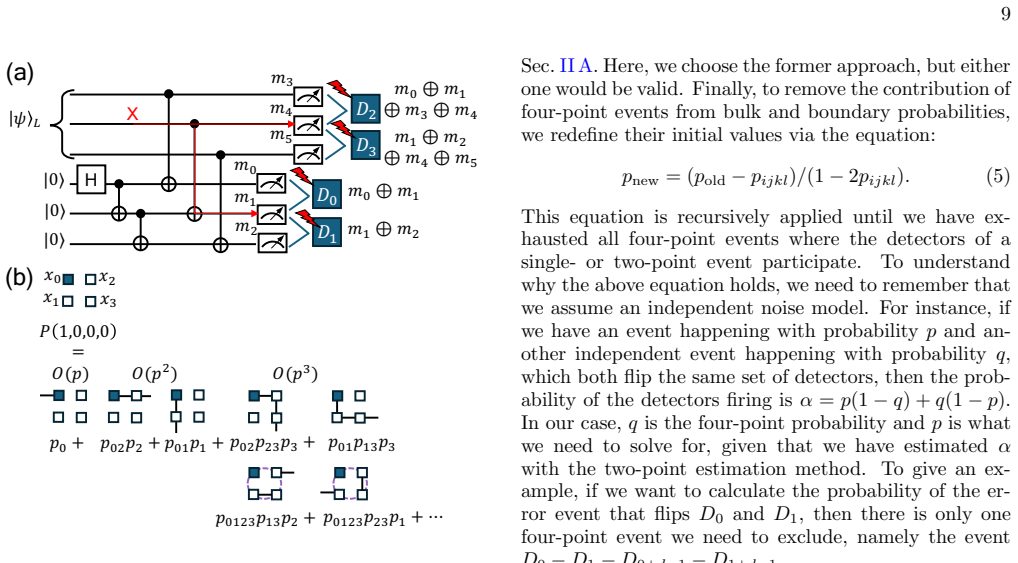
The central object is the detector error model (DEM): a graph or hypergraph whose nodes are detectors (parities of ancilla outcomes that flag errors) and whose weighted edges or hyperedges are independent error mechanisms, with edge weight $w=-\ln(p/(1-p))$. The estimation engine is a hierarchical correlator expansion: two-point closed forms for graph-like DEMs; and for hypergraph DEMs, a system of $2^m-1$ configuration-probability equations $P(x_0,x_1,\ldots)$ per local region, truncated in the error rate and solved by least squares. The load-bearing bookkeeping step is subtraction: the recovered high-order event probabilities are subtracted out of lower-order edge probabilities so that each final weight corresponds to a single independent error event.
What would settle it
Simulate a distance-3 surface code memory whose only noise is a coherent Z rotation through a known angle on each data qubit each round; estimate edge probabilities from two-point detector correlators using the paper's closed forms and compare with the exact Pauli-twirled DEM of the same circuit. A systematic, angle-dependent mismatch between reconstructed and twirled edge weights would pinpoint where the independent-Bernoulli assumption fails.
Extended reading notes
Core claim
The central discovery is that the error probabilities of a detector error model are identifiable from detector firing statistics alone, with a closed form for graph edges and a least-squares system for hyperedges. Bulk edge probabilities come from two-point coincidences via $p_{ij} = \frac{1}{2} - \sqrt{\frac{1}{4} - \frac{\langle v_iv_j\rangle - \langle v_i\rangle\langle v_j\rangle}{1-2(\langle v_i\rangle+\langle v_j\rangle)+4\langle v_iv_j\rangle}}$, and boundary edges are then fixed by subtracting all incident bulk contributions. When a single error can flip three or four detectors, the paper writes the probability of each detector-outcome configuration as a polynomial in the unknown DEM rates, solves by least squares, and then renormalizes lower-order edges with $p_{\mathrm{new}}=(p_{\mathrm{old}}-p_{ijkl})/(1-2p_{ijkl})$ to remove the high-order contribution. On repetition, surface, and color-code memories this recovers the DEM closely enough that decoding with the reconstructed graph reproduces the logical error rate of decoding with the exact model, including a color-code case where the hyperedges are recovered with relative error below about one percent.
Load-bearing premise
Every error event is an independent, fixed-probability Bernoulli draw, so correlated, coherent, crosstalk, leakage, or time-varying noise is outside what the reconstruction can faithfully represent.
Editorial extensions
If this is right
- A memory experiment can supply its own decoder weights from accumulated click statistics, removing the need for a separate noise-characterization calibration step.
- The number of shots for a fixed estimation accuracy stays bounded as code distance grows, as long as the maximum number of detectors flipped by one error remains a small constant.
- Decoding with the reconstructed DEM reproduces the logical error rate of exact-model decoding both below and above threshold for repetition, surface, and color-code memories.
- When physical error rates vary across qubits and gates, a decoder calibrated to the reconstructed fluctuating rates outperforms a decoder built from fixed mean rates, with up to about 44% better logical error suppression in the surface-code example.
Reading between the lines
- The same local least-squares and subtraction recipe should transfer to other hypergraph codes, including small hypergraph low-density parity-check memories, wherever the maximum correlation order is a bounded constant; the paper's own partitioning argument suggests cost grows with the number of local regions, not with region size.
- Because the method uses raw click statistics and no twirling, a natural on-line extension is drift tracking: re-estimating edge weights periodically could follow slowly varying stochastic noise and keep the decoder matched to current conditions.
- A direct experimental test would compare edge weights reconstructed this way with weights derived from Pauli-twirled gate estimates on the same device; systematic disagreements would localize crosstalk, leakage, or coherent effects to specific regions of the decoding graph.
- The d=3 color-code degeneracy between a detector error and an error-plus-logical-flip suggests a general recipe: any DEM region with such a degeneracy can be resolved by adding configuration equations that count logical-observable flips, not just detector states.
Signed reviews
Editorial analysis
A structured set of objections, weighed in public.
Referee Report
Summary. This paper presents a method for reconstructing the detector error model (DEM) of memory quantum error correction experiments from syndrome statistics, avoiding full state or process tomography. For graph-like DEMs, two-point detector correlations are used with closed-form expressions from Ref. [31] to estimate edge probabilities. The method is extended to hypergraph DEMs by solving systems of configuration-probability equations (up to O(p^7)) via least squares, applied to the color code with bare-ancilla extraction and to the repetition code with Steane-style extraction. The reconstructed DEMs are decoded with MWPM and compared with Stim's exact DEMs for distances d=3..9 and physical error rates spanning below and above threshold; the logical error rates agree well. The paper also demonstrates that calibrating the decoder to spatially fluctuating error rates can improve the logical error rate relative to a decoder using the mean rates. Simulation code is publicly available.
Significance. The graph-like reconstruction is well validated and essentially reproduces and extends Ref. [31] to surface codes with circuit-level noise; this part is a solid contribution. The hypergraph extension is the main novelty, and the reported relative errors (below 1% for hyperedges, below 4% for edges) and logical-rate matches are encouraging. The release of the code and the comparison against Stim's independent DEM are strengths. However, the hypergraph extension as presented calibrates rates on a support that is supplied by the exact circuit-level DEM, so the advertised claim of reconstructing the DEM from syndrome statistics alone is not fully achieved for the hypergraph case. This caveat is load-bearing for the paper's central novelty and should be addressed before the manuscript can be accepted.
major comments (2)
- [Sec. III D; Sec. II] The hypergraph results do not support the claim that the decoder graph is generated 'from the syndrome measurements alone without relying on prior information' (Sec. II). In Sec. III D, the estimator solves for 'any possible triplet that exists in the actual Z- or X-DEMs obtained by Stim,' and the d=3 color-code procedure collects 'all possible error mechanisms that exist in the DEM.' The support of the hypergraph—the set of detector subsets that can be flipped together—is therefore supplied by the exact circuit-level DEM, and the syndrome statistics are used only to fit rates on that known support. The manuscript never demonstrates that a hyperedge absent from the assumed support (for example, arising from crosstalk or an unknown hook error) would be detected, nor that a genuine hyperedge is distinguished from coincidental combinations of lower-order events. Thus the claim to 'learn exactly all the information contained in' the color-code DEM is conditional on oracle knowledge of the support. The abstract and Sec. II should be amended to state this condition, and the authors should either add a misspecification test or restrict the claim to rate calibration on a known hypergraph support.
- [Sec. III D] In the triplet equations for the color code, the paper lists the seven possible error events p0, p1, p2, p01, p02, p12, p012 and states that keeping terms to O(p^7) 'makes the equations exact since there are 7 unknown quantities in total.' This presumes that no error event involving one of the three detectors and a detector outside the triplet (e.g., a two-point edge between D0 and an external detector, or an additional hyperedge sharing D0) can affect the marginal configuration probabilities P(x0, x1, x2). In the color code, each detector participates in multiple hyperedges and neighboring two-point edges, so the closure of the triplet region is not obvious. The paper should justify this assumption or show that outside contributions are negligible for the simulated error rates.
minor comments (6)
- [Sec. II A, Eq. (4)] The text refers to 'the denominator of Eq. (4)' but the equation contains a product, not a denominator; the notation should be clarified, for example by making the product symbol explicit in the typeset formula.
- [Sec. II A and Fig. 1] The text says the estimation uses N = 8 x 10^5 shots, while the Fig. 1 caption reports N = 5 x 10^6 shots; these numbers should be reconciled.
- [Sec. III D and Fig. 9] The text states that Fig. 9(d) uses p = 0.001 and then says Fig. 9(e) uses 'the same physical error rate of p = 0.01'; either the rates are different and should be stated separately, or the second value is a typo.
- [References] Refs. [57] and [58] are the same paper; the duplicate citation should be removed or replaced with a distinct resource.
- [Fig. 10 caption] The caption contains a typo: 'hyperdeges' should be 'hyperedges.'
- [Sec. II B] The phrase 'given that the DEM contains a single event that flips at most m detectors simultaneously' is confusing because the method is intended for multiple hyperedges; rephrase to indicate the maximum order of any hyperedge in the region.
Circularity Check
Graph-like DEM estimation is self-contained; hypergraph results fit rates on Stim-supplied support rather than reconstructing the DEM from syndrome statistics alone.
-
other
[Section III D, color code with bare-ancilla syndrome extraction (also Sec. II overview)]
"We solve the equations numerically for any possible triplet that exists in the actual Z- or X-DEMs obtained by Stim."
The paper claims to generate the weighted decoder graph from syndrome measurements alone without relying on prior information, and to learn exactly all the information contained in the color-code DEM. For the hypergraph case, however, the set of possible hyperedges is taken from Stim's exact DEM: the estimator only solves for rates on that oracle-supplied support and never decides from syndrome statistics which detector triples are genuine hyperedges. The reconstructed DEM therefore reduces, by construction, to known hypergraph support plus fitted rate parameters; the structure is an input, not a learned quantity.
full rationale
The paper's core derivation is a legitimate parameter-inversion procedure, not a tautology. For graph-like detector error models, Eqs. (3)-(4) express edge probabilities as closed-form functions of detector marginals and two-point coincidence statistics under the independent-Bernoulli noise assumption; for hypergraphs, the paper sets up configuration-probability equations for single-, two-, and multi-point events and solves them by least squares. The reconstructed models are then decoded with MWPM and compared against logical error rates obtained from Stim's independently generated DEM, so the agreement is an external benchmark rather than an internal circular check. There is no load-bearing self-citation: the two-point method is attributed to Spitz et al. (Ref. [31]), the color-code decoder to Lee et al. (Ref. [57]), and the authors' own prior work appears only as ordinary references. The one circularity-adjacent weakness is confined to the hypergraph section: the support of the hypergraph—which detector triples are genuine error events—is supplied by the exact Stim DEM rather than inferred from the syndrome data. This makes the abstract and Sec. II claim of reconstructing the DEM 'without relying on prior information' an overstatement for the color-code case, and it means the 'learn exactly all the information' claim is conditional on knowing the structure in advance. The estimated rates themselves are still genuinely fitted from syndrome statistics and independently validated, so this is a partial limitation rather than a full collapse of the derivation. A score of 2 reflects this limited, support-level circularity while recognizing that the main estimation method has substantial independent content.
Assumptions & free parameters
free parameters (2)
- truncation order =
O(p^7)
- least-squares probability bounds =
[10^-12, 0.6]
assumptions (4)
- domain assumption Independent Bernoulli error events: the probability of a syndrome configuration factorizes into products of independent error probabilities, as stated in Sec II.
- ad hoc to paper Known DEM support: the set of possible hyperedges, which detector subsets can flip together, is given by the circuit-level error model and is not learned from data.
- domain assumption Small maximum correlation order: each error flips at most a small constant number m of detectors, two for graphs and three or four for the hypergraphs considered.
- domain assumption Pauli approximation of noise: coherent errors are neglected or assumed to be twirled away.
Cite this review
Pith. "Pith review of Estimating decoding graphs and hypergraphs of memory QEC experiments." pith.science (2026). https://pith.science/paper/5E7USXHT
@misc{pith2026250420212,
  author       = {Pith},
  title        = {Pith review of: Estimating decoding graphs and hypergraphs of memory QEC experiments},
  year         = {2026},
  howpublished = {\url{https://pith.science/paper/5E7USXHT}},
  note         = {Machine review of arXiv:2504.20212}
}
read the original abstract
Characterizing the error sources of quantum devices is essential for building reliable large-scale quantum architectures and tailoring error correction codes to the noise profile of the devices. Tomography techniques can provide detailed information on the noise or quality of quantum states but are typically both computationally and experimentally intensive with respect to the system's size. For QEC experiments, however, the information captured by a detector error model is sufficient for extracting the success rate of the experiment, as well as some information about the underlying noise. In this work, we estimate Pauli noise on detector error models, including hypergraphs, using only the syndrome statistics. We apply this method to well-known codes such as the repetition, surface, and 2D color codes. Under bare-ancilla syndrome extraction, two-point correlations are enough to reconstruct the detector error model for repetition or surface codes. For color codes or repetition codes under Steane-style syndrome extraction, we show how to extend the estimation method to multi-point correlators and extract the error rates of the hypergraphs. Finally, we find an increase in logical error suppression when we calibrate the decoder to noise fluctuations typically present in experiments.
Figures


Figures from the paper (10 more)




Reference graph
Works this paper leans on
-
[31]
S. T. Spitz, B. Tarasinski, C. W. J. Beenakker, and T. E. O’Brien, Adaptive weight estimator for quantum error correction in a time-dependent environment, Advanced Quantum Technologies 1, 1800012 (2018)
work page 2018
-
[1]
G. Q. AI and Collaborators, Quantum error correction below the surface code threshold, Nature 638, 920–926 (2025)
work page 2025
- [2]
-
[3]
C. Ryan-Anderson, N. C. Brown, C. H. Baldwin, J. M. Dreiling, C. Foltz, J. P. Gaebler, T. M. Gatterman, N. Hewitt, C. Holliman, C. V. Horst, J. Johansen, D. Lucchetti, T. Mengle, M. Matheny, Y. Matsuoka, K. Mayer, M. Mills, S. A. Moses, B. Neyenhuis, J. Pino, P. Siegfried, R. P. Stutz, J. Walker, and D. Hayes, High- fidelity and fault-tolerant teleportati...
arXiv 2024
-
[4]
G. Q. AI and Collaborators, Scaling and logic in the color code on a superconducting quantum processor (2024), arXiv:2412.14256 [quant-ph]
arXiv 2024
-
[5]
P. S. Rodriguez, J. M. Robinson, P. N. Jepsen, Z. He, C. Duckering, C. Zhao, K.-H. Wu, J. Campo, K. Bag- nall, M. Kwon, T. Karolyshyn, P. Weinberg, M. Cain, S. J. Evered, A. A. Geim, M. Kalinowski, S. H. Li, T. Manovitz, J. Amato-Grill, J. I. Basham, L. Bern- stein, B. Braverman, A. Bylinskii, A. Choukri, R. DeAn- gelo, F. Fang, C. Fieweger, P. Frederick,...
arXiv 2024
-
[6]
G. Q. AI and Collaborators, Demonstrating dynamic sur- face codes (2024), arXiv:2412.14360 [quant-ph]
arXiv 2024
-
[7]
I. L. Chuang and M. A. N. and, Prescription for ex- perimental determination of the dynamics of a quantum black box, Journal of Modern Optics 44, 2455 (1997)
work page 1997
Show all 58 references
-
[8]
Cramer, M
M. Cramer, M. B. Plenio, S. T. Flammia, R. Somma, D. Gross, S. D. Bartlett, O. Landon-Cardinal, D. Poulin, and Y.-K. Liu, Efficient quantum state tomography, Nat. Commun. 1, 149 (2010)
2010
-
[9]
G. M. D’Ariano and P. Lo Presti, Quantum tomography for measuring experimentally the matrix elements of an arbitrary quantum operation, Phys. Rev. Lett. 86, 4195 (2001)
2001
-
[10]
Knill, D
E. Knill, D. Leibfried, R. Reichle, J. Britton, R. B. Blakestad, J. D. Jost, C. Langer, R. Ozeri, S. Seidelin, and D. J. Wineland, Randomized benchmarking of quan- tum gates, Phys. Rev. A 77, 012307 (2008)
2008
-
[11]
Helsen, I
J. Helsen, I. Roth, E. Onorati, A. Werner, and J. Eisert, General framework for randomized benchmarking, PRX Quantum 3, 020357 (2022)
2022
-
[12]
Hines, M
J. Hines, M. Lu, R. K. Naik, A. Hashim, J.-L. Ville, B. Mitchell, J. M. Kriekebaum, D. I. Santiago, S. Seri- tan, E. Nielsen, R. Blume-Kohout, K. Young, I. Siddiqi, B. Whaley, and T. Proctor, Demonstrating scalable ran- domized benchmarking of universal gate sets, Phys. Rev. X...
2023
-
[13]
H. Wang, P. Liu, Y. Liu, J. Gu, J. Baker, F. T. Chong, and S. Han, Dgr: Tackling drifted and correlated noise in quantum error correction via decoding graph re- weighting (2024), arXiv:2311.16214 [quant-ph]
2024 arXiv
-
[14]
E. H. Chen, T. J. Yoder, Y. Kim, N. Sundaresan, S. Srini- vasan, M. Li, A. D. C´ orcoles, A. W. Cross, and M. Takita, Calibrated decoders for experimental quantum error cor- rection, Phys. Rev. Lett. 128, 110504 (2022)
2022
-
[15]
A. Remm, N. Lacroix, L. B¨ odeker, E. Genois, C. Hellings, F. Swiadek, G. J. Norris, C. Eichler, A. Blais, M. M¨ uller, S. Krinner, and A. Wallraff, Experimentally informed de- coding of stabilizer codes based on syndrome correlations (2025), arXiv:2502.17722 [quant-ph]
2025 arXiv
-
[16]
D. K. Tuckett, A. S. Darmawan, C. T. Chubb, S. Bravyi, S. D. Bartlett, and S. T. Flammia, Tailoring surface codes for highly biased noise, Phys. Rev. X 9, 041031 (2019)
2019
-
[17]
D. K. Tuckett, S. D. Bartlett, S. T. Flammia, and B. J. Brown, Fault-tolerant thresholds for the surface code in excess of 5% under biased noise, Phys. Rev. Lett. 124, 130501 (2020)
2020
-
[18]
Huang, A
E. Huang, A. Pesah, C. T. Chubb, M. Vasmer, and A. Dua, Tailoring three-dimensional topological codes for biased noise, PRX Quantum 4, 030338 (2023)
2023
-
[19]
J. A. Campos and K. R. Brown, Clifford-deformed com- pass codes (2024), arXiv:2412.03808 [quant-ph]
2024 arXiv
-
[20]
C. Song, K. Xu, W. Liu, C.-p. Yang, S.-B. Zheng, H. Deng, Q. Xie, K. Huang, Q. Guo, L. Zhang, P. Zhang, D. Xu, D. Zheng, X. Zhu, H. Wang, Y.-A. Chen, C.-Y. Lu, S. Han, and J.-W. Pan, 10-qubit entanglement and parallel logic operations with a superconducting circuit, Phys. Rev....
2017
-
[21]
Aaronson, Shadow tomography of quantum states (2018), arXiv:1711.01053 [quant-ph]
S. Aaronson, Shadow tomography of quantum states (2018), arXiv:1711.01053 [quant-ph]
2018 arXiv
-
[22]
C.-K. Hu, C. Wei, C. Liu, L. Che, Y. Zhou, G. Xie, H. Qin, G. Hu, H. Yuan, R. Zhou, S. Liu, D. Tan, T. Xin, and D. Yu, Experimental sample-efficient quantum state tomography via parallel measurements, Phys. Rev. Lett. 133, 160801 (2024)
2024
-
[23]
Gross, Y.-K
D. Gross, Y.-K. Liu, S. T. Flammia, S. Becker, and J. Eis- ert, Quantum state tomography via compressed sensing, Phys. Rev. Lett. 105, 150401 (2010)
2010
-
[24]
T. Xin, D. Lu, J. Klassen, N. Yu, Z. Ji, J. Chen, X. Ma, G. Long, B. Zeng, and R. Laflamme, Quantum state to- mography via reduced density matrices, Phys. Rev. Lett. 118, 020401 (2017)
2017
-
[25]
S. T. Flammia, Averaged Circuit Eigenvalue Sam- pling, in 17th Conference on the Theory of Quantum Computation, Communication and Cryptography (TQC 2022), Leibniz International Proceedings in Informatics (LIPIcs), Vol. 232, edited by F. Le Gall and T. Mori- mae (Schloss Dagstu...
2022
-
[26]
E. T. Hockings, A. C. Doherty, and R. Harper, Scal- able noise characterization of syndrome-extraction cir- cuits with averaged circuit eigenvalue sampling, PRX 17 Quantum 6, 010334 (2025)
2025
-
[27]
E. T. Hockings, A. C. Doherty, and R. Harper, Improv- ing error suppression with noise-aware decoding (2025), arXiv:2502.21044 [quant-ph]
2025 arXiv
-
[28]
Harper and S
R. Harper and S. T. Flammia, Learning correlated noise in a 39-qubit quantum processor, PRX Quantum 4, 040311 (2023)
2023
-
[29]
S. Chen, Y. Liu, M. Otten, A. Seif, B. Fefferman, and L. Jiang, The learnability of pauli noise, Nat Commun. 14, 52 (2023)
2023
-
[30]
S. Chen, Z. Zhang, L. Jiang, and S. T. Flammia, Efficient self-consistent learning of gate set pauli noise (2024), arXiv:2410.03906 [quant-ph]
2024
-
[32]
Wagner, H
T. Wagner, H. Kampermann, D. Bruß, and M. Kliesch, Optimal noise estimation from syndrome statistics of quantum codes, Phys. Rev. Res. 3, 013292 (2021)
2021
-
[33]
G. Q. AI, Exponential suppression of bit or phase errors with cyclic error correction, Nature 595, 383–387 (2021)
2021
-
[34]
G. Q. AI, Suppressing quantum errors by scaling a sur- face code logical qubit, Nature 614, 676–681 (2023)
2023
-
[35]
Gidney, Stim: a fast stabilizer circuit simulator, Quan- tum 5, 497 (2021)
C. Gidney, Stim: a fast stabilizer circuit simulator, Quan- tum 5, 497 (2021)
2021
-
[36]
Higgott and C
O. Higgott and C. Gidney, Sparse Blossom: correcting a million errors per core second with minimum-weight matching, Quantum 9, 1600 (2025)
2025
-
[37]
P.-J. H. S. Derks, A. Townsend-Teague, A. G. Burchards, and J. Eisert, Designing fault-tolerant circuits using de- tector error models (2024), arXiv:2407.13826 [quant-ph]
2024
-
[38]
Edmonds, Paths, trees, and flowers, Canadian Journal of Mathematics 17, 449–467 (1965)
J. Edmonds, Paths, trees, and flowers, Canadian Journal of Mathematics 17, 449–467 (1965)
1965
-
[39]
Higgott, Pymatching: A python package for decod- ing quantum codes with minimum-weight perfect match- ing, ACM T QUANTUM COMPUT 3, 10.1145/3505637 (2022)
O. Higgott, Pymatching: A python package for decod- ing quantum codes with minimum-weight perfect match- ing, ACM T QUANTUM COMPUT 3, 10.1145/3505637 (2022)
2022 doi
-
[40]
M. A. Nielsen, A simple formula for the average gate fi- delity of a quantum dynamical operation, Physics Letters A 303, 249 (2002)
2002
-
[41]
Greenbaum and Z
D. Greenbaum and Z. Dutton, Modeling coherent errors in quantum error correction, Quantum Sci. Technol. 3, 015007 (2017)
2017
-
[42]
G. A. Paz-Silva and D. A. Lidar, Optimally combining dynamical decoupling and quantum error correction, Sci. Rep. 3, 1530 (2013)
2013
-
[43]
Khodjasteh and D
K. Khodjasteh and D. A. Lidar, Fault-tolerant quan- tum dynamical decoupling, Phys. Rev. Lett. 95, 180501 (2005)
2005
-
[44]
Jiang and A
L. Jiang and A. Imambekov, Universal dynamical decou- pling of multiqubit states from environment, Phys. Rev. A 84, 060302 (2011)
2011
-
[45]
Z. Zhou, A. Ji, and Y. Ding, Characterization and mit- igation of crosstalk in quantum error correction (2025), arXiv:2503.04642 [quant-ph]
2025 arXiv
-
[46]
code to simulate noise estimation of dems
E. Takou, “code to simulate noise estimation of dems”, https://github.com/eva-takou/Noise estimation of DEMs (2025)
2025
-
[47]
A. M. Steane, Active stabilization, quantum computa- tion, and quantum state synthesis, Phys. Rev. Lett. 78, 2252 (1997)
1997
-
[48]
A. M. Steane, Fast fault-tolerant filtering of quantum codewords (2004), arXiv:quant-ph/0202036 [quant-ph]
2004 arXiv
-
[49]
Huang and K
S. Huang and K. R. Brown, Between shor and steane: A unifying construction for measuring error syndromes, Phys. Rev. Lett. 127, 090505 (2021)
2021
-
[50]
Postler, F
L. Postler, F. Butt, I. Pogorelov, C. D. Marciniak, S. Heußen, R. Blatt, P. Schindler, M. Rispler, M. M¨ uller, and T. Monz, Demonstration of fault-tolerant steane quantum error correction, PRX Quantum 5, 030326 (2024)
2024
-
[51]
Huang, K
S. Huang, K. R. Brown, and M. Cetina, Comparing shor and steane error correction using the bacon- shor code, Science Advances 10, eadp2008 (2024), https://www.science.org/doi/pdf/10.1126/sciadv.adp2008
2024 doi
-
[52]
Zhang, Y.-C
J. Zhang, Y.-C. Wu, and G.-P. Guo, Facilitating practical fault-tolerant quantum computing based on color codes, Phys. Rev. Res. 6, 033086 (2024)
2024
-
[53]
S.-H. Lee, F. Thomsen, N. Fazio, B. J. Brown, and S. D. Bartlett, Low-overhead magic state distillation with color codes (2025), arXiv:2409.07707 [quant-ph]
2025
-
[54]
Delfosse, Decoding color codes by projection onto sur- face codes, Phys
N. Delfosse, Decoding color codes by projection onto sur- face codes, Phys. Rev. A 89, 012317 (2014)
2014
-
[55]
Sahay and B
K. Sahay and B. J. Brown, Decoder for the triangular color code by matching on a m¨ obius strip, PRX Quantum 3, 010310 (2022)
2022
-
[56]
Gidney and C
C. Gidney and C. Jones, New circuits and an open source decoder for the color code (2023), arXiv:2312.08813 [quant-ph]
2023 arXiv
-
[58]
S.-H. Lee, A. Li, and S. D. Bartlett, Color code decoder with improved scaling for correcting circuit-level noise, Quantum 9, 1609 (2025)
2025
-
[59]
Pelaez, V
E. Pelaez, V. Omole, P. Gokhale, R. Rines, K. N. Smith, M. A. Perlin, and A. Hashim, Average circuit eigen- value sampling on nisq devices (2024), arXiv:2403.12857 [quant-ph]
2024 arXiv
Reviewed August 16, 2026 · model on record in the stance chip above.
Discussion (0). Continue with ORCID to comment.