REVIEW 4 major objections 4 minor 40 references
Preview WB-DH: Towards Whole Body Digital Human Bench for the Generation of Whole-body Talking Avatar Videos
T0 review · 4 major / 4 minor · reviewed 2026-08-05 · deepseek-v4-flash
Pith's one-line read This paper introduces WB-DH, an open two-million-clip benchmark for whole-body talking avatar generation, and reports initial results showing hands are the hardest region.
desk verdict A dataset-preview paper whose entire utility rests on an unverified GitHub repo and a 2M-clip claim the manuscript does not back up; the gap it targets is real, but the paper is not yet a citable resource. read the letter →
The pith
A machine-rendered reading of the paper's core claim, the machinery that carries it, and where it could break.
The reading
What carries the argument
The load-bearing object is the WB-DH dataset plus its region-specific evaluation protocol. Each video clip is annotated with six aligned modalities—body segmentation, landmark positions, bounding boxes for hands, legs, and the whole body, motion-text descriptions, and speech transcription—so the same clip can guide or test speech-driven whole-body animation. The evaluation protocol then scores generated clips independently for the full body, the face, and the hands, combining six reference-free metrics (DINO-based subject consistency, CLIP-based background consistency, optical-flow motion smoothness and dynamic degree, aesthetic and imaging quality) with six co-speech metrics (FID, FVD, SSIM
What would settle it
Open the linked repository and verify the numbers: count the clips to check the total is 2,000,000, confirm more than 10,000 identities, and inspect that each clip carries body segmentation, landmarks, bounding boxes, motion text, and transcription, with the 20,000-clip test split present. Independently, rerun the twelve metrics on the released test split and see whether the model rankings match the paper's table.
Extended reading notes
Core claim
The central claim is that whole-body talking avatar generation is a distinct evaluation problem and that WB-DH is the benchmark for it. The dataset is described as containing over 10,000 unique identities, each appearing in roughly 200 scene configurations, for a total of 2 million video clips, with 20,000 clips reserved for testing. Each clip carries aligned annotations for body segmentation, landmarks, bounding boxes around hands, legs, and the whole body, a motion-text description of pose semantics, and a speech transcription. The evaluation framework pairs six reference-free video-generation metrics with six co-speech metrics and applies them independently to three spatial regions—full b
Load-bearing premise
The entire contribution stands on the dataset being exactly what is advertised: two million video clips, ten thousand plus identities, and six aligned annotations per clip, all publicly downloadable from the linked repository.
Editorial extensions
If this is right
- WB-DH gives whole-body avatar systems a shared twelve-metric, three-region test, so different models can be compared on the same clips.
- The initial results imply that speech-to-gesture quality and full-body motion cannot be judged by face-only metrics; hand-region scores separate the models far more sharply than face scores.
- The multi-modal annotations let a system condition generation on motion text, pose boxes, and speech transcription at once, which the paper argues is necessary for fine-grained whole-body control.
- Because six of the twelve metrics are reference-free, the benchmark can score generated videos even when no ground-truth video exists, the common case in open-domain generation.
- The planned Version 1 extension to 60-second clips would let the benchmark test long-horizon audio-video coherence, not just short clips.
Reading between the lines
- A testable extension not in the paper: crop hand patches and compute hand-specific FID or FVD, to check whether the large hand-region gap is an artifact of small image area or a real generative failure.
- The paper's with- and without-pose-guidance comparison could be reused as an ablation: the gap between the two variants measures how much of talking-avatar quality comes from explicit body-pose conditioning.
- If the claimed alignment between motion text and speech transcription holds, the dataset could be used to train gesture-speech coupling models directly, a use the paper only motivates.
- The benchmark's two metric families often order models differently (pixel-level versus reference-free), so a reader should not assume they measure the same property.
Editorial analysis
A structured set of objections, weighed in public.
Referee Report
Summary. The paper proposes WB-DH, claimed to be an open-source multi-modal benchmark containing approximately 2M video clips with annotations such as segmentation, landmarks, bounding boxes, motion text, and speech transcription. It defines two evaluation protocols (six reference-free video metrics and six reference-based metrics) and reports initial results for eight models across whole-body, face, and hand regions in Table 1. The paper is explicitly a preview: dataset construction is described in a single paragraph, and the conclusion states that a formal Version 1 of the dataset is still being developed.
Significance. If fully realized, a large-scale whole-body talking-avatar benchmark with multi-modal annotations would fill a genuine gap, because current benchmarks are head/upper-body focused. The combination of region-specific evaluation and co-speech metrics is sensible. However, the paper ships no verifiable dataset, no collection protocol, no code, and no statistical analysis. The manuscript's own statement that a formal Version 1 is being developed undermines the central claim as it stands. The significance cannot be assessed without the actual artifact and a reproducible evaluation.
major comments (4)
- [Abstract and §3.1] The central claim that WB-DH is an open-source 2M-clip benchmark with detailed multi-modal annotations is not supported by the manuscript. Section 3.1 gives only the numbers (10,000 identities, 200 scene configurations, 2M clips, 20K test samples) and one illustrative keyframe in Figure 1. There is no collection protocol, annotation pipeline, inter-annotator agreement, quality control, license, or repository verification. The Conclusion further states that 'a formal Version 1 of the dataset' is being developed, implying the current artifact is preliminary. This is load-bearing: if the repository does not contain the advertised data, the paper's contribution fails. A data card and release status are required.
- [§4, Table 1] The evaluation is reported without any statistical support. No test-set size per model, no confidence intervals or error bars, and no significance testing are given. For example, the whole-body SC of 96.83% (Wan) vs 97.12% (OpenS) or FVD 750.51 vs 896.94 are treated as meaningful orderings without variance. Numerical claims of this precision are not interpretable. The authors should specify how the 20K samples are split across models and conditions and report repeated-run variance.
- [§3.2-3.3] The metric definitions are too underspecified to be reproducible. 'Motion Smoothness (MS): Smoothness and physical plausibility of motion, computed using optical flow continuity' does not give the exact formula, frame window, or threshold. Similarly, SC/BC need the precise DINO/CLIP layers, pooling, and frame sampling. For FID/FVD/SSIM/PSNR/E-FID/CSIM, the paper does not state which real videos are used as reference, how generated videos are aligned, or which region crops are fed to the embedding networks. Code release or a precise protocol is needed for any of these numbers to be meaningful.
- [§4] The experimental setup for the eight models is not described: no prompts for text-driven models, no audio files or pose sequences for talking-avatar models, no resolution/duration, no preprocessing. The abbreviations ecv2/w and ecv2/wo are not defined in the text (only in the table). Table 1's 'GT' row also needs explanation: it is not clear whether these are ground-truth values and how a PSNR of ∞ or SSIM of 1 is used for comparison. Without this information, Table 1 cannot be reproduced or interpreted.
minor comments (4)
- [§3.1] Typographical issues: 'over10,000', 'approximately200', '2M samples(video clips)', and '20K samplesare' are missing spaces. The sentence 'The annotation for each sample is demonstrated in Figure 1' should specify that Figure 1 shows one keyframe per column, not all samples.
- [Table 1] A caption should define GT, w/wo (with/without pose guidance), and make clear which direction is better for each metric. The table would benefit from bold-facing best non-GT values.
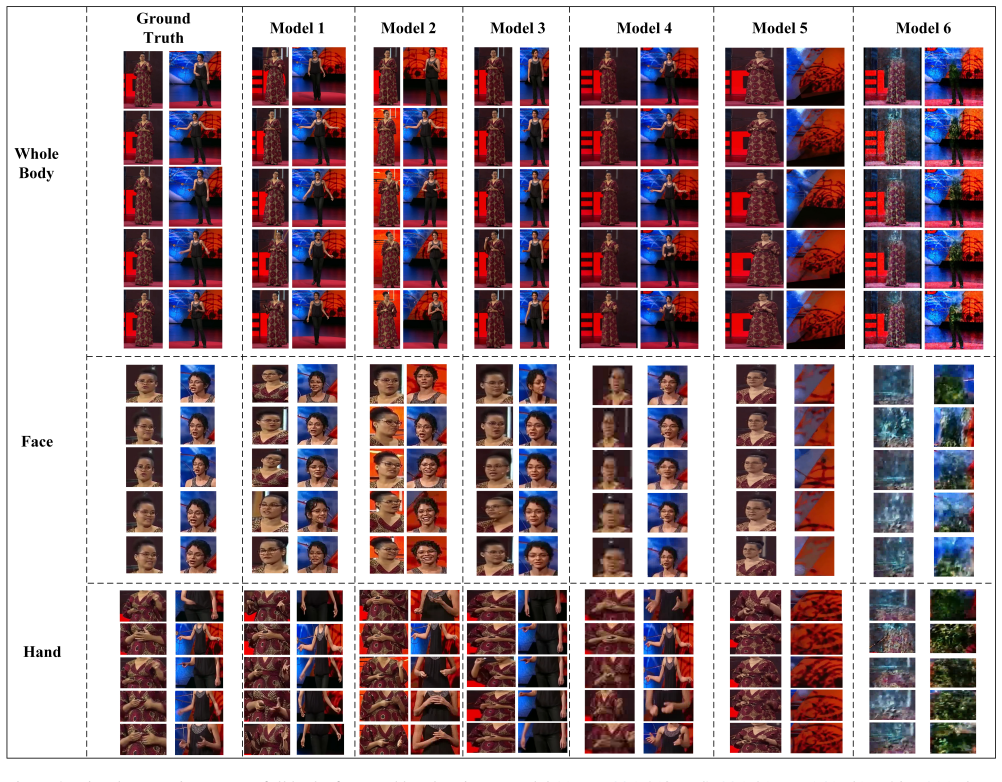
- [§3.2/Figure 2] Figure 2's qualitative comparison would be stronger with enlarged crops and a description of how frames were selected to avoid cherry-picking. The claim that Models 1-4 'show good performance' is not quantified in the figure.
- [References] Reference [25] appears to be an arXiv preprint with incomplete bibliographic information; verify all URLs and preprint IDs.
Circularity Check
No circularity: the paper is an empirical dataset/evaluation report using external standard metrics; no claimed result reduces by construction to its inputs.
full rationale
This paper is a dataset and evaluation report rather than a derivation. The central claims are (1) the existence and composition of WB-DH (10K identities, 2M clips, 20K test samples) and (2) evaluation scores of existing models under twelve metrics. Neither claim is derived from its own inputs. The dataset statistics are asserted without internal derivation; if unsupported by the external repository, that is a verification/trust issue, not circularity. The evaluation metrics (DINO, CLIP, optical flow, LAION aesthetic predictor, MUSIQ, FID, FVD, SSIM, PSNR, E-FID, CSIM) are all pre-existing, externally defined tools with fixed implementations; no parameter is fitted to a subset of the data and then renamed as a prediction. The GT row in Table 1 is simply the identity/reference value for each metric, not a fitted result. There are no load-bearing self-citations, no imported uniqueness theorem, and no ansatz smuggled in via citation. The only mild observation—that the benchmark's value is partly constituted by its metric choices—is normal for evaluation work and does not make any claimed result equivalent to its input by construction. Therefore the circularity score is 0.
Assumptions & free parameters
assumptions (3)
- domain assumption The reported dataset statistics (2M clips, 10k identities, 200 scenes each) are accurate.
- domain assumption The standard metrics (DINO/CLIP similarity, FID/FVD, etc.) are valid proxies for whole-body talking avatar quality.
- ad hoc to paper The GitHub repository at https://github.com/deepreasonings/WholeBodyBenchmark is accessible and contains the advertised data and tools.
Cite this review
Pith. "Pith review of Preview WB-DH: Towards Whole Body Digital Human Bench for the Generation of Whole-body Talking Avatar Videos." pith.science (2026). https://pith.science/paper/5EBS3DBJ
@misc{pith2026250808891,
  author       = {Pith},
  title        = {Pith review of: Preview WB-DH: Towards Whole Body Digital Human Bench for the Generation of Whole-body Talking Avatar Videos},
  year         = {2026},
  howpublished = {\url{https://pith.science/paper/5EBS3DBJ}},
  note         = {Machine review of arXiv:2508.08891}
}
read the original abstract
Creating realistic, fully animatable whole-body avatars from a single portrait is challenging due to limitations in capturing subtle expressions, body movements, and dynamic backgrounds. Current evaluation datasets and metrics fall short in addressing these complexities. To bridge this gap, we introduce the Whole-Body Benchmark Dataset (WB-DH), an open-source, multi-modal benchmark designed for evaluating whole-body animatable avatar generation. Key features include: (1) detailed multi-modal annotations for fine-grained guidance, (2) a versatile evaluation framework, and (3) public access to the dataset and tools at https://github.com/deepreasonings/WholeBodyBenchmark.
Figures

Reference graph
Works this paper leans on
-
[1]
Andreas Blattmann, Tim Dockhorn, Sumith Kulal, Daniel Mendelevitch, Maciej Kilian, Dominik Lorenz, Yam Levi, Zion English, Vikram V oleti, Adam Letts, et al. Stable video diffusion: Scaling latent video diffusion models to large datasets.arXiv preprint arXiv:2311.15127, 2023. 1
arXiv 2023
-
[2]
Emerg- ing properties in self-supervised vision transformers
Mathilde Caron, Hugo Touvron, Ishan Misra, Herv ´e J´egou, Julien Mairal, Piotr Bojanowski, and Armand Joulin. Emerg- ing properties in self-supervised vision transformers. InPro- ceedings of the IEEE/CVF international conference on com- puter vision, pages 9650–9660, 2021. 2
2021
-
[3]
Baptiste Chopin, Tashvik Dhamija, Pranav Balaji, Yaohui Wang, and Antitza Dantcheva. Dimitra: Audio-driven dif- fusion model for expressive talking head generation.arXiv preprint arXiv:2502.17198, 2025. 1
arXiv 2025
-
[4]
Jiahao Cui, Hui Li, Yao Yao, Hao Zhu, Hanlin Shang, Kaihui Cheng, Hang Zhou, Siyu Zhu, and Jingdong Wang. Hallo2: Long-duration and high-resolution audio-driven portrait im- age animation.arXiv preprint arXiv:2410.07718, 2024. 1, 3
arXiv 2024
-
[5]
Jiahao Cui, Hui Li, Yun Zhan, Hanlin Shang, Kaihui Cheng, Yuqi Ma, Shan Mu, Hang Zhou, Jingdong Wang, and Siyu Zhu. Hallo3: Highly dynamic and realistic portrait image an- imation with diffusion transformer networks.arXiv preprint arXiv:2412.00733, 2024. 1, 3, 4
arXiv 2024
-
[6]
Gemini 2.5 pro: Our most intelligent ai model, 2025
Google DeepMind. Gemini 2.5 pro: Our most intelligent ai model, 2025. Accessed: 2025-04-25. 1
work page 2025
-
[7]
Stylesync: High-fidelity generalized and personalized lip sync in style-based genera- tor
Jiazhi Guan, Zhanwang Zhang, Hang Zhou, Tianshu Hu, Kaisiyuan Wang, Dongliang He, Haocheng Feng, Jingtuo Liu, Errui Ding, Ziwei Liu, et al. Stylesync: High-fidelity generalized and personalized lip sync in style-based genera- tor. InProceedings of the IEEE/CVF Conference on Com- puter Vision and Pattern Recognition, pages 1505–1515,
-
[8]
Yuwei Guo, Ceyuan Yang, Anyi Rao, Zhengyang Liang, Yaohui Wang, Yu Qiao, Maneesh Agrawala, Dahua Lin, and Bo Dai. Animatediff: Animate your personalized text- to-image diffusion models without specific tuning.arXiv preprint arXiv:2307.04725, 2023. 1
arXiv 2023
Show all 40 references
-
[9]
Video dif- fusion models.Advances in Neural Information Processing Systems, 35:8633–8646, 2022
Jonathan Ho, Tim Salimans, Alexey Gritsenko, William Chan, Mohammad Norouzi, and David J Fleet. Video dif- fusion models.Advances in Neural Information Processing Systems, 35:8633–8646, 2022. 1
2022
-
[10]
Step-video-ti2v technical re- port: A state-of-the-art text-driven image-to-video genera- tion model.arXiv preprint arXiv:2503.11251, 2025
Haoyang Huang, Guoqing Ma, Nan Duan, Xing Chen, Changyi Wan, Ranchen Ming, Tianyu Wang, Bo Wang, Zhiying Lu, Aojie Li, et al. Step-video-ti2v technical re- port: A state-of-the-art text-driven image-to-video genera- tion model.arXiv preprint arXiv:2503.11251, 2025. 1, 4
2025 arXiv
-
[11]
The accu- racy of psnr in predicting video quality for different video scenes and frame rates.Telecommunication systems, 49:35– 48, 2012
Quan Huynh-Thu and Mohammed Ghanbari. The accu- racy of psnr in predicting video quality for different video scenes and frame rates.Telecommunication systems, 49:35– 48, 2012. 3
2012
-
[12]
Sonic: Shifting focus to global audio perception in portrait animation.arXiv preprint arXiv:2411.16331, 2024
Xiaozhong Ji, Xiaobin Hu, Zhihong Xu, Junwei Zhu, Chum- ing Lin, Qingdong He, Jiangning Zhang, Donghao Luo, Yi Chen, Qin Lin, et al. Sonic: Shifting focus to global audio perception in portrait animation.arXiv preprint arXiv:2411.16331, 2024. 1, 3
2024 arXiv
-
[13]
Loopy: Taming audio-driven portrait avatar with long-term motion dependency.arXiv preprint arXiv:2409.02634, 2024
Jianwen Jiang, Chao Liang, Jiaqi Yang, Gaojie Lin, Tianyun Zhong, and Yanbo Zheng. Loopy: Taming audio-driven portrait avatar with long-term motion dependency.arXiv preprint arXiv:2409.02634, 2024. 1
2024 arXiv
-
[14]
Musiq: Multi-scale image quality transformer
Junjie Ke, Qifei Wang, Yilin Wang, Peyman Milanfar, and Feng Yang. Musiq: Multi-scale image quality transformer. InProceedings of the IEEE/CVF international conference on computer vision, pages 5148–5157, 2021. 2
2021
-
[15]
Hunyuanvideo: A systematic framework for large video generative models.arXiv preprint arXiv:2412.03603, 2024
Weijie Kong, Qi Tian, Zijian Zhang, Rox Min, Zuozhuo Dai, Jin Zhou, Jiangfeng Xiong, Xin Li, Bo Wu, Jianwei Zhang, et al. Hunyuanvideo: A systematic framework for large video generative models.arXiv preprint arXiv:2412.03603, 2024. 1, 3, 4
2024 arXiv
-
[16]
Luma ray 2 video model.https : / / lumalabs.ai/ray
Luma Labs. Luma ray 2 video model.https : / / lumalabs.ai/ray. Accessed: 2025-04-25. 1
2025
-
[17]
Laion aesthetic predictor.https : / / github.com/LAION-AI/aesthetic-predictor,
LAION-AI. Laion aesthetic predictor.https : / / github.com/LAION-AI/aesthetic-predictor,
-
[18]
Latentsync: Au- dio conditioned latent diffusion models for lip sync.arXiv preprint arXiv:2412.09262, 2024
Chunyu Li, Chao Zhang, Weikai Xu, Jinghui Xie, Weiguo Feng, Bingyue Peng, and Weiwei Xing. Latentsync: Au- dio conditioned latent diffusion models for lip sync.arXiv preprint arXiv:2412.09262, 2024. 1
2024 arXiv
-
[19]
Videogen: A reference-guided latent diffusion ap- proach for high definition text-to-video generation.arXiv preprint arXiv:2309.00398, 2023
Xin Li, Wenqing Chu, Ye Wu, Weihang Yuan, Fanglong Liu, Qi Zhang, Fu Li, Haocheng Feng, Errui Ding, and Jingdong Wang. Videogen: A reference-guided latent diffusion ap- proach for high definition text-to-video generation.arXiv preprint arXiv:2309.00398, 2023. 1
2023 arXiv
-
[20]
Amt: All-pairs multi-field transforms for efficient frame interpolation
Zhen Li, Zuo-Liang Zhu, Ling-Hao Han, Qibin Hou, Chun- Le Guo, and Ming-Ming Cheng. Amt: All-pairs multi-field transforms for efficient frame interpolation. InProceedings of the IEEE/CVF Conference on Computer Vision and Pat- tern Recognition, pages 9801–9810, 2023. 2
2023
-
[21]
Echomimicv2: Towards striking, simplified, and semi-body human animation.arXiv preprint arXiv:2411.10061, 2024
Rang Meng, Xingyu Zhang, Yuming Li, and Chenguang Ma. Echomimicv2: Towards striking, simplified, and semi-body human animation.arXiv preprint arXiv:2411.10061, 2024. 1, 3, 4
2024
-
[22]
Styletalker: One-shot style-based audio-driven talk- ing head video generation.arXiv preprint arXiv:2208.10922,
Dongchan Min, Minyoung Song, Eunji Ko, and Sung Ju Hwang. Styletalker: One-shot style-based audio-driven talk- ing head video generation.arXiv preprint arXiv:2208.10922,
-
[23]
Open-sora 2.0: Train- ing a commercial-level video generation model in $200k
Xiangyu Peng, Zangwei Zheng, Chenhui Shen, Tom Young, Xinying Guo, Binluo Wang, Hang Xu, Hongxin Liu, Mingyan Jiang, Wenjun Li, Yuhui Wang, Anbang Ye, Gang Ren, Qianran Ma, Wanying Liang, Xiang Lian, Xiwen Wu, Yuting Zhong, Zhuangyan Li, Chaoyu Gong, Guojun Lei, Leijun Cheng, ...
2025 arXiv
-
[24]
A lip sync expert is all you need for speech to lip generation in the wild
KR Prajwal, Rudrabha Mukhopadhyay, Vinay P Nambood- iri, and CV Jawahar. A lip sync expert is all you need for speech to lip generation in the wild. InProceedings of the 28th ACM international conference on multimedia, pages 484–492, 2020. 1
2020
-
[25]
Versatile multimodal controls for whole-body talking human anima- tion.arXiv preprint arXiv:2503.08714, 2025
Zheng Qin, Ruobing Zheng, Yabing Wang, Tianqi Li, Zixin Zhu, Minghui Yang, Ming Yang, and Le Wang. Versatile multimodal controls for whole-body talking human anima- tion.arXiv preprint arXiv:2503.08714, 2025. 3
2025 arXiv
-
[26]
Skyreels-a1: Expressive portrait animation in video diffusion transform- ers.arXiv preprint arXiv:2502.10841, 2025
Di Qiu, Zhengcong Fei, Rui Wang, Jialin Bai, Changqian Yu, Mingyuan Fan, Guibin Chen, and Xiang Wen. Skyreels-a1: Expressive portrait animation in video diffusion transform- ers.arXiv preprint arXiv:2502.10841, 2025. 1
2025 arXiv
-
[27]
Learning transferable visual models from natural language supervi- sion
Alec Radford, Jong Wook Kim, Chris Hallacy, Aditya Ramesh, Gabriel Goh, Sandhini Agarwal, Girish Sastry, Amanda Askell, Pamela Mishkin, Jack Clark, et al. Learning transferable visual models from natural language supervi- sion. InInternational conference on machine learning, p...
2021
-
[28]
Make-a-video: Text-to-video generation without text-video data.arXiv preprint arXiv:2209.14792,
Uriel Singer, Adam Polyak, Thomas Hayes, Xi Yin, Jie An, Songyang Zhang, Qiyuan Hu, Harry Yang, Oron Ashual, Oran Gafni, et al. Make-a-video: Text-to-video generation without text-video data.arXiv preprint arXiv:2209.14792,
-
[29]
Diffused heads: Diffusion models beat gans on talking-face genera- tion
Michał Stypułkowski, Konstantinos V ougioukas, Sen He, Maciej Zikeba, Stavros Petridis, and Maja Pantic. Diffused heads: Diffusion models beat gans on talking-face genera- tion. InProceedings of the IEEE/CVF Winter Conference on Applications of Computer Vision, pages 5091–5100...
2024
-
[30]
Raft: Recurrent all-pairs field transforms for optical flow
Zachary Teed and Jia Deng. Raft: Recurrent all-pairs field transforms for optical flow. InComputer Vision–ECCV 2020: 16th European Conference, Glasgow, UK, August 23– 28, 2020, Proceedings, Part II 16, pages 402–419. Springer,
2020
-
[31]
Stableanimator: High- quality identity-preserving human image animation.arXiv preprint arXiv:2411.17697, 2024
Shuyuan Tu, Zhen Xing, Xintong Han, Zhi-Qi Cheng, Qi Dai, Chong Luo, and Zuxuan Wu. Stableanimator: High- quality identity-preserving human image animation.arXiv preprint arXiv:2411.17697, 2024. 1
2024 arXiv
-
[32]
To- wards accurate generative models of video: A new metric & challenges.arXiv preprint arXiv:1812.01717, 2018
Thomas Unterthiner, Sjoerd Van Steenkiste, Karol Kurach, Raphael Marinier, Marcin Michalski, and Sylvain Gelly. To- wards accurate generative models of video: A new metric & challenges.arXiv preprint arXiv:1812.01717, 2018. 3
2018 arXiv
-
[33]
Wan: Open and advanced large-scale video generative models.arXiv preprint arXiv:2503.20314, 2025
Ang Wang, Baole Ai, Bin Wen, Chaojie Mao, Chen-Wei Xie, Di Chen, Feiwu Yu, Haiming Zhao, Jianxiao Yang, Jianyuan Zeng, Jiayu Wang, Jingfeng Zhang, Jingren Zhou, Jinkai Wang, Jixuan Chen, Kai Zhu, Kang Zhao, Keyu Yan, Lianghua Huang, Mengyang Feng, Ningyi Zhang, Pandeng Li, Pin...
2025 arXiv
-
[34]
Lavie: High-quality video generation with cascaded latent diffusion models.International Journal of Computer Vision, pages 1–20, 2024
Yaohui Wang, Xinyuan Chen, Xin Ma, Shangchen Zhou, Ziqi Huang, Yi Wang, Ceyuan Yang, Yinan He, Jiashuo Yu, Peiqing Yang, et al. Lavie: High-quality video generation with cascaded latent diffusion models.International Journal of Computer Vision, pages 1–20, 2024. 1
2024
-
[35]
Image quality assessment: from error visibility to structural similarity.IEEE transactions on image processing, 13(4):600–612, 2004
Zhou Wang, Alan C Bovik, Hamid R Sheikh, and Eero P Si- moncelli. Image quality assessment: from error visibility to structural similarity.IEEE transactions on image processing, 13(4):600–612, 2004. 3
2004
-
[36]
Easyanimate: A high-performance long video generation method based on transformer architecture.arXiv preprint arXiv:2405.18991,
Jiaqi Xu, Xinyi Zou, Kunzhe Huang, Yunkuo Chen, Bo Liu, MengLi Cheng, Xing Shi, and Jun Huang. Easyanimate: A high-performance long video generation method based on transformer architecture.arXiv preprint arXiv:2405.18991,
-
[37]
Cogvideox: Text-to-video diffusion models with an expert transformer.arXiv preprint arXiv:2408.06072, 2024
Zhuoyi Yang, Jiayan Teng, Wendi Zheng, Ming Ding, Shiyu Huang, Jiazheng Xu, Yuanming Yang, Wenyi Hong, Xiao- han Zhang, Guanyu Feng, et al. Cogvideox: Text-to-video diffusion models with an expert transformer.arXiv preprint arXiv:2408.06072, 2024. 1
2024 arXiv
-
[38]
I2vgen-xl: High-quality image-to-video synthesis via cascaded diffusion models.arXiv preprint arXiv:2311.04145, 2023
Shiwei Zhang, Jiayu Wang, Yingya Zhang, Kang Zhao, Hangjie Yuan, Zhiwu Qin, Xiang Wang, Deli Zhao, and Jingren Zhou. I2vgen-xl: High-quality image-to-video synthesis via cascaded diffusion models.arXiv preprint arXiv:2311.04145, 2023. 1
2023 arXiv
-
[39]
Pose-controllable talking face generation by implicitly modularized audio-visual rep- resentation
Hang Zhou, Yasheng Sun, Wayne Wu, Chen Change Loy, Xiaogang Wang, and Ziwei Liu. Pose-controllable talking face generation by implicitly modularized audio-visual rep- resentation. InProceedings of the IEEE/CVF conference on computer vision and pattern recognition, pages 4176–4186,
-
[2022]
Accessed: 2025-04-21. 2
2025
Reviewed August 5, 2026 · model on record in the stance chip above.
Discussion (0). Sign in to comment.