REVIEW 4 major objections 6 minor 34 references
AI-driven visual monitoring of industrial assembly tasks
T0 review · 4 major / 6 minor · reviewed 2026-08-15 · deepseek-v4-flash
Pith's one-line read ViMAT claims that assembly monitoring can be recast as probabilistic state estimation: detecting which components occupy predefined workspace regions in multi-view video, then decoding the most likely executed step sequence over a…
desk verdict Solid engineering integration with a real observability gap: ViMAT only monitors actions that change per-tray presence, so the headline claim is narrower than advertised but still deserves refereeing. read the letter →
The pith
A machine-rendered reading of the paper's core claim, the machinery that carries it, and where it could break.
The reading
What carries the argument
The load-bearing mechanism is the pairing of a perception stack with a graph-structured probabilistic reasoner. The perception stack uses a single-stage CNN detector finetuned on synthetic renderings of task-specific digital twins; detections from three calibrated RGB-D views are projected into 3D, matched by pairwise point-cloud intersection-over-union, and averaged over time. The reasoner's state-transition graph is generated automatically from the initial configuration, the final configuration, and expert-defined steps with preconditions; nodes are configurations and edges are steps. Running Viterbi over this graph with observation likelihood $P(y|s) \propto \exp(-\|y - E_y(s)\|/\sigma)$ yields the most probable sequence of executed steps, turning partial and noisy detections into a commitment about which action is happening now.
What would settle it
Run ViMAT on a recorded sequence in which the worker swaps two already-mounted components in the work area while all tray contents remain unchanged; if the predicted Viterbi path is identical to the sequence without the swap, then the observation model cannot distinguish those states and the central monitoring claim fails.
Extended reading notes
Core claim
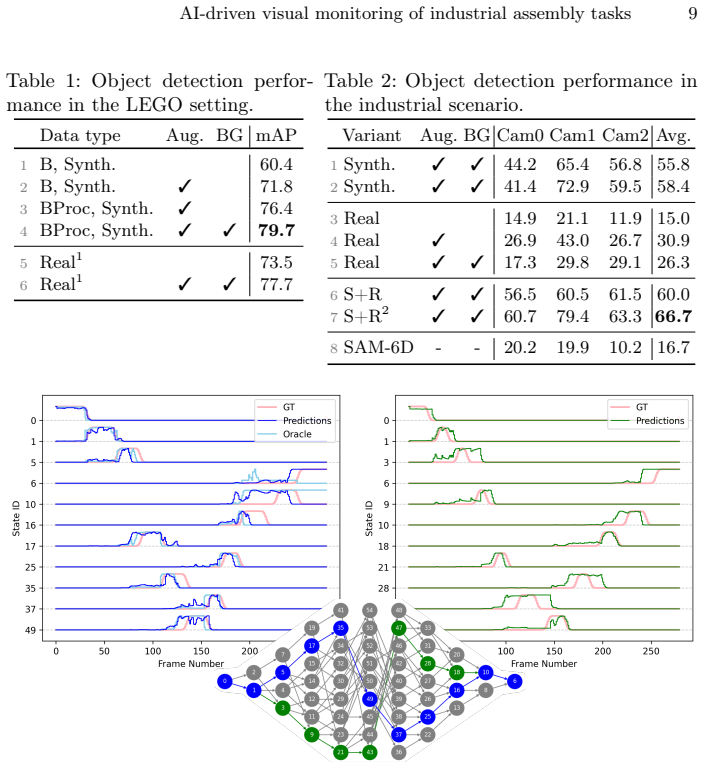
The central discovery is that monitoring can be reformulated as probabilistic state estimation: the system treats each valid plan as a path in a directed graph from initial to final configuration, and uses the Viterbi algorithm to find the most likely path given per-frame observations of which components appear in which workspace region. The observation likelihood is $P(y|s) \propto \exp(-\|y - E_y(s)\|/\sigma)$, comparing the observed presence vector with its expected value in each state. Multi-view detections are back-projected, fused by 3D intersection-over-union, and temporally smoothed before entering the reasoner. In the two test scenarios, ViMAT's predicted state sequence tracks the ground-truth plan, and in the LEGO case the detector-only predictions closely match oracle detections, supporting the claim that synthetic-only training is sufficient for real-world perception. The paper also finds that combined synthetic-plus-real training gives the best industrial detection accuracy, while a zero-shot pose baseline performs worse.
Load-bearing premise
The whole monitoring result rests on the assumption that the observation vector—which component is detected in each predefined tray region—is enough to tell every assembly state apart and to register every action; a procedural step that changes the assembly without changing tray contents would be invisible to the system.
Editorial extensions
If this is right
- Supervisors can see the executed step sequence and any deviations from the valid plan in real time, without instrumenting the worker or the parts.
- A new assembly task can be monitored using only CAD models and assembly instructions, because the detector is trained on synthetic renderings with automatically generated annotations.
- Multiple viewpoints plus probabilistic decoding tolerate partial occlusions, with ambiguous frames resolved by the most probable path through the state graph.
- The same reasoning module can serve different assemblies by regenerating the state-transition graph from the initial and final configurations, so component swaps require little re-engineering.
- When the inferred path leaves all valid plans, the controller can issue a warning before the operator proceeds to a dangerous configuration.
Reading between the lines
- The real bottleneck in this design is the observation model: any assembly step whose effect leaves tray-presence vectors unchanged is invisible to the Viterbi decoder, so monitoring swaps of already-mounted parts would require hand pose estimation or relational state observations.
- Because reasoning is decoupled from perception, the same graph-based decoder could monitor other procedural tasks such as maintenance checklists, packing workflows, or surgical counts, given a state graph and a per-state observation model.
- The gap between real-detector and oracle-detection precision and recall in the industrial scenario suggests the reasoning stage can hide some perception errors; measuring this gap across more sequences would show whether better detectors or better observation models matter more.
- The synthetic-only training result points to a deployment path: a manufacturer can stand up monitoring for a new assembly with CAD models and a rendering engine, then optionally finetune the detector with a small set of real images when available.
Signed reviews
Editorial analysis
A structured set of objections, weighed in public.
Referee Report
Summary. The paper introduces ViMAT, a system for real-time visual monitoring of industrial assembly tasks. The system combines a perception module, which detects assembly elements from multi-view RGB-D video using a YOLOv8 detector trained exclusively on synthetic data generated from digital twins, with a probabilistic reasoning module that runs a Viterbi algorithm over a state graph derived from expert-provided assembly instructions. The authors formalize assembly tasks as state-transition systems, construct the state graph by exploring all valid plans from an initial to a final configuration, and evaluate ViMAT on two real-world scenarios: a LEGO assembly task and a hydraulic-press mold reconfiguration task. Quantitative object-detection results are reported in terms of mAP, and monitoring results are reported as precision and recall of predicted active states against ground-truth states. The paper claims accurate real-time monitoring without rigid workspace setups or visual markers.
Significance. If the approach holds, ViMAT is a meaningful step toward practical visual monitoring of assembly processes: the use of digital twins to train the detector removes the need for manual real-world annotations, and the probabilistic reasoning over a formally defined state graph is a principled way to fuse partial observations with task knowledge. The paper demonstrates the pipeline end-to-end in two distinct real-world settings, including a genuine industrial environment, which is stronger than purely synthetic or lab-only evaluation. The strengths are the explicit state-transition formalization, the synthetic-data-only perception training, the multi-view fusion strategy, and the evidence that the detector generalizes from synthetic to real imagery. The main weakness is that the reasoning module's observation model is underspecified, which leaves the central claim that the system infers the most likely action from the observed assembly state only partially supported.
major comments (4)
- [Section 3.3] The observation model P(y|s) is left underspecified: the text states that P(y|s) is proportional to exp(-||y - Ey(s)||/sigma) but never defines how the expected observation vector Ey(s) is derived from the predicate-based state description. Because the predicates include relations such as is_joined and is_mounted, while the observation vector y records only per-tray presence and confidence, states that differ only in relational predicates can have identical expected observations. For instance, a state where E4 is mounted on E3 and a state where these two elements are split but remain in the same regions of the workspace are observationally equivalent under this model; the Viterbi recursion can then distinguish them only through transition priors, not through visual evidence. Section 4.2's own admission that the system 'struggles to distinguish between actions with subtle differences' is consistent with this gap. To make the central claim load-bearing, the authors should specify exactly how Ey(s) is computed and verify that every edge of the state graph changes the expected observation vector, or augment the observation vector with relation-level evidence.
- [Section 3.3] The transition matrix a is described only as 'estimated from G', with no detail on how edge weights are assigned, whether self-loops are permitted, or how the Viterbi recursion treats states that are not reachable at a given time. Since the Viterbi algorithm is the core of the reasoning module, this missing specification prevents replication and makes it impossible to assess how much of the reported accuracy is due to the observation model versus the transition priors. Please report the exact construction, including any normalization or smoothing.
- [Section 4.2] The monitoring results are reported without any measure of variability or chance level. Figure 3 reports a single precision/recall pair (72.9/77.9) for the LEGO scenario and Figure 4 reports 43.1/43.7 for the industrial scenario, but there are multiple test sequences (Table 1 mentions three) and no error bars, per-sequence breakdown, or baseline such as a most-frequent-state classifier. Given that the industrial precision and recall are near 43%, the reader cannot judge whether the system is performing well above chance or is dominated by the transition prior. Per-sequence precision and recall, and the number of states and actions in each graph, should be reported.
- [Section 3.2] The claim that ViMAT operates 'without rigid workspace setups' is only partially supported: the perception module requires trays at predefined fixed locations, and the observation vector y is built from detections cropped to exactly these regions. The paper neither reports the sensitivity of the system to tray localization errors nor discusses how the predefined tray positions are obtained in a new industrial environment. Since this requirement is part of the observation model, the stated advantage over commercial solutions that use fixed containers or markers should be qualified, and an analysis of robustness to tray placement should be added.
minor comments (6)
- [Section 4.2] The statement 'Models trained exclusively on real images outperform those trained solely on synthetic data' is contradicted by Table 1, where the best synthetic model (row 4, 79.7 mAP) beats both real-image models (rows 5 and 6, 73.5 and 77.7 mAP); please rephrase or clarify the intended comparison.
- [Section 3.2] The values of the free parameters sigma, the IoU radius r, the temporal smoothing weights, and the detection confidence threshold are not reported; please give the values used in the experiments or state how they were chosen.
- [Figures 3 and 4] The captions report precision and recall but do not state whether these numbers refer to a single representative video or to an average over all test sequences; please clarify.
- [Section 4.1] The dataset description for 'Real1' in Table 1 is unclear, and the footnote about training data overlap needs elaboration; please specify how many real images were used and why a subset of test sequences was needed.
- [Section 3.3] The Viterbi recurrence and the observation probability are not displayed with equation numbers, which makes referencing them in the text and in future work awkward; consider numbering the equations.
- [References] Reference [9] is a YouTube video; please replace it with a citable technical report or publication if available.
Circularity Check
No significant circularity: the perception and reasoning chains are self-contained and evaluated against manually annotated ground truth.
full rationale
ViMAT's derivation chain is not circular. The perception module finetunes an object detector on synthetic images generated from CAD-based digital twins and evaluates it with mAP on manually annotated real-world validation data (Tables 1 and 2), so the reported detection accuracy is external to the training data. The reasoning module (Section 3.3) treats the state graph G as prior knowledge, defines P(y|s) proportional to exp(-||y - Ey(s)||/sigma) with a hand-chosen sigma and no fitting to the test videos, and applies Viterbi to infer the most likely state sequence, which is then compared against manually annotated ground-truth active states. The only evaluation caveat is the footnote that real-image-only training runs overlap with some test sequences in Table 1 ('Real1'), but the central synthetic-trained results and the industrial scenario results are unaffected. A genuine limitation is that the observation vector y encodes per-tray presence, so states differing only by relation-level predicates such as is_joined are observationally hard to distinguish; the authors acknowledge this by noting that the system 'struggles to distinguish between actions with subtle differences.' This is an incomplete-observation limitation, not a circular reduction: the reasoning is not using the target state labels to define the observation model or the transition probabilities. No fitted parameter is renamed as a prediction, and no load-bearing claim rests solely on a self-citation. Therefore the circularity score is 0.
Assumptions & free parameters
free parameters (4)
- sigma (σ) in observation likelihood
- multi-view IoU radius threshold r
- temporal smoothing weights =
asymmetric weighting, values not reported
- detection confidence threshold
assumptions (6)
- domain assumption The expert-formalized assembly instructions, including the set of steps and their preconditions, correctly describe all valid ways to perform the task.
- domain assumption The expected observation vector Ey(s) is a known deterministic function of the state's predicates.
- domain assumption Synthetic renders of the digital twins are sufficiently photorealistic to train a detector that generalizes to the real workspace.
- standard math Camera calibration (intrinsics and extrinsics) is known and the pinhole model holds.
- domain assumption Tray regions are at predefined fixed locations that do not change during the assembly process.
- domain assumption The initial state C_init is known and set to probability 1.0.
Cite this review
Pith. "Pith review of AI-driven visual monitoring of industrial assembly tasks." pith.science (2026). https://pith.science/paper/5ELYCY2B
@misc{pith2026250615285,
  author       = {Pith},
  title        = {Pith review of: AI-driven visual monitoring of industrial assembly tasks},
  year         = {2026},
  howpublished = {\url{https://pith.science/paper/5ELYCY2B}},
  note         = {Machine review of arXiv:2506.15285}
}
read the original abstract
Visual monitoring of industrial assembly tasks is critical for preventing equipment damage due to procedural errors and ensuring worker safety. Although commercial solutions exist, they typically require rigid workspace setups or the application of visual markers to simplify the problem. We introduce ViMAT, a novel AI-driven system for real-time visual monitoring of assembly tasks that operates without these constraints. ViMAT combines a perception module that extracts visual observations from multi-view video streams with a reasoning module that infers the most likely action being performed based on the observed assembly state and prior task knowledge. We validate ViMAT on two assembly tasks, involving the replacement of LEGO components and the reconfiguration of hydraulic press molds, demonstrating its effectiveness through quantitative and qualitative analysis in challenging real-world scenarios characterized by partial and uncertain visual observations. Project page: https://tev-fbk.github.io/ViMAT
Figures


Figures from the paper (1 more)

Reference graph
Works this paper leans on
-
[1]
Blender, https://www.blender.org/, Accessed: April 2025
work page 2025
-
[2]
BlenderKit, https://github.com/BlenderKit/BlenderKit, Accessed: April 2025
work page 2025
-
[3]
BrickLink Stud.io., https://www.bricklink.com, Accessed: April 2025
work page 2025
-
[4]
LDraw, https://www.ldraw.org/, Accessed: April 2025
work page 2025
-
[5]
Ultralytics YOLOv8, https://docs.ultralytics.com, Accessed: April 2025
work page 2025
-
[6]
Procedia CIRP86, 198–203 (2019)
Andrianakos, G., Dimitropoulos, N., Michalos, G., Makris, S.: An approach for monitoring the execution of human based assembly operations using machine learning. Procedia CIRP86, 198–203 (2019)
work page 2019
-
[7]
In: ECCV (2020)
Carion, N., Massa, F., Synnaeve, G., Usunier, N., Kirillov, A., Zagoruyko, S.: End-to-end object detection with transformers. In: ECCV (2020)
2020
-
[8]
Computers in Industry113, 103–130 (2019)
Cimino, C., Negri, E., Fumagalli, L.: Review of digital twin applications in manu- facturing. Computers in Industry113, 103–130 (2019)
work page 2019
Show all 34 references
-
[9]
CSEM: Quality monitored assembly, https://www.youtube.com/watch?v= zBao3QunnGY&ab_channel=CSEMtechnologies, Accessed: April 2025
2025
-
[10]
In: CVPR (2005)
Dalal, N., Triggs, B.: Histograms of oriented gradients for human detection. In: CVPR (2005)
2005
-
[11]
Dean, T.L., Wellman, M.P.: Planning and control (1991)
1991
-
[12]
arXiv preprint arXiv:1911.01911 (2019)
Denninger, M., Sundermeyer, M., Winkelbauer, D., Zidan, Y., Olefir, D., Elbadrawy, M., Lodhi, A., Katam, H.: BlenderProc. arXiv preprint arXiv:1911.01911 (2019)
2019 arXiv
-
[13]
In: CoRL (2017)
Dosovitskiy, A., Ros, G., Codevilla, F., Lopez, A., Koltun, V.: CARLA: An open urban driving simulator. In: CoRL (2017)
2017
-
[14]
The international journal of advanced manufacturing technology129(5), 1917–1932 (2023) 12 M
Feddoul, Y., Ragot, N., Duval, F., Havard, V., Baudry, D., Assila, A.: Exploring human-machine collaboration in industry: A systematic literature review of digital twin and robotics interfaced with extended reality technologies. The international journal of advanced manufactur...
2023
-
[15]
TPAMI32(9), 1627–1645 (2010)
Felzenszwalb, P.F., Girshick, R.B., McAllester, D., Ramanan, D.: Object detection with discriminatively trained part-based models. TPAMI32(9), 1627–1645 (2010)
2010
-
[16]
Elsevier (2004)
Ghallab, M., Nau, D., Traverso, P.: Automated Planning: Theory and practice. Elsevier (2004)
2004
-
[17]
In: CVPR (2014)
Girshick, R., Donahue, J., Darrell, T., Malik, J.: Rich feature hierarchies for accurate object detection and semantic segmentation. In: CVPR (2014)
2014
-
[18]
In: ICIP (2019)
Hodaň, T., Vineet, V., Gal, R., Shalev, E., Hanzelka, J., Connell, T., Urbina, P., Sinha, S.N., Guenter, B.: Photorealistic image synthesis for object instance detection. In: ICIP (2019)
2019
-
[19]
Transactions on Intelligent Vehicles9(1), 593–612 (2023)
Hu, X., Li, S., Huang, T., Tang, B., Huai, R., Chen, L.: How simulation helps autonomous driving: A survey of sim2real, digital twins, and parallel intelligence. Transactions on Intelligent Vehicles9(1), 593–612 (2023)
2023
-
[20]
Jocher, G., Qiu, J., Chaurasia, A.: Ultralytics YOLO (2023),https://github.com/ ultralytics/ultralytics
2023
-
[21]
CIRP-JMST29, 36–52 (2020)
Jones, D., Snider, C., Nassehi, A., Yon, J., Hicks, B.: Characterising the Digital Twin: A systematic literature review. CIRP-JMST29, 36–52 (2020)
2020
-
[22]
In: CoRL (2022)
Labbé, Y., Manuelli, L., Mousavian, A., Tyree, S., Birchfield, S., Tremblay, J., Carpentier, J., Aubry, M., Fox, D., Sivic, J.: MegaPose: 6D pose estimation of novel objects via render & compare. In: CoRL (2022)
2022
-
[23]
In: CVPR (2024)
Lin, J., Liu, L., Lu, D., Jia, K.: SAM-6D: Segment anything model meets zero-shot 6d object pose estimation. In: CVPR (2024)
2024
-
[24]
Liu, M., Fang, S., Dong, H., Xu, C.: Review of digital twin about concepts, tech- nologies, and industrial applications. J. Manuf. Syst.58, 346–361 (2021)
2021
-
[25]
In: ECCV (2016)
Liu, W., Anguelov, D., Erhan, D., Szegedy, C., Reed, S., Fu, C.Y., Berg, A.C.: SSD: Single shot multibox detector. In: ECCV (2016)
2016
-
[26]
In: Digital Twins, Simulation, and the Metaverse: Driving Efficiency and Effectiveness in the Physical World through Simulation in the Virtual Worlds
Malik, A.A., Shao, G., Tarakhovsky, J.: Digital twins for robot systems in man- ufacturing. In: Digital Twins, Simulation, and the Metaverse: Driving Efficiency and Effectiveness in the Physical World through Simulation in the Virtual Worlds. Springer Nature Switzerland (2024)
2024
-
[27]
Robotics and Autonomous Systems35(3), 221–228 (2001)
Peixoto, P., Batista, J., Araujo, H.J.: Real-time human activity monitoring exploring multiple vision sensors. Robotics and Autonomous Systems35(3), 221–228 (2001)
2001
-
[28]
In: CVPR (2016)
Redmon, J., Divvala, S., Girshick, R., Farhadi, A.: You Only Look Once: Unified, real-time object detection. In: CVPR (2016)
2016
-
[29]
In: NeurIPS (2015)
Ren, S., He, K., Girshick, R., Sun, J.: Faster R-CNN: Towards real-time object detection with region proposal networks. In: NeurIPS (2015)
2015
-
[30]
Sustainable Manufacturing and Service Economics2 (2023)
Soori, M., Arezoo, B., Dastres, R.: Digital twin for smart manufacturing, A review. Sustainable Manufacturing and Service Economics2 (2023)
2023
-
[31]
CIRP Ann.68(1), 5–8 (2019)
Urgo, M., Tarabini, M., Tolio, T.: A human modelling and monitoring approach to support the execution of manufacturing operations. CIRP Ann.68(1), 5–8 (2019)
2019
-
[32]
CIRP Journal of Manufacturing Science and Technology50, 249–268 (2024)
Urgo, M., Terkaj, W., Simonetti, G.: Monitoring manufacturing systems using AI: A method based on a digital factory twin to train CNNs on synthetic data. CIRP Journal of Manufacturing Science and Technology50, 249–268 (2024)
2024
-
[33]
IEEE Trans
Viterbi, A.: Error bounds for convolutional codes and an asymptotically optimum decoding algorithm. IEEE Trans. Inf. Theory13(2), 260–269 (1967)
1967
-
[34]
In: ICOIN (2024)
Wang, K., Yu, T., Li, Z., Sakaguchi, K., Hashash, O., Saad, W.: Digital twins for autonomous driving: A comprehensive implementation and demonstration. In: ICOIN (2024)
2024
Reviewed August 15, 2026 · model on record in the stance chip above.
Discussion (0). Continue with ORCID to comment.