REVIEW 4 major objections 6 minor 103 references
Empirical modeling and hybrid machine learning framework for nucleate pool boiling on microchannel structured surfaces
T0 review · 4 major / 6 minor · reviewed 2026-08-10 · deepseek-v4-flash
Pith's one-line read A physics-seeded hybrid model predicts boiling heat transfer on microchannel surfaces with test-set $R^2 = 0.995$.
desk verdict A new microchannel boiling correlation with a real evaluation flaw: the hybrid framework's R²=0.995 is inflated because the baseline correlation was fit on the test data. read the letter →
The pith
A machine-rendered reading of the paper's core claim, the machinery that carries it, and where it could break.
The reading
What carries the argument
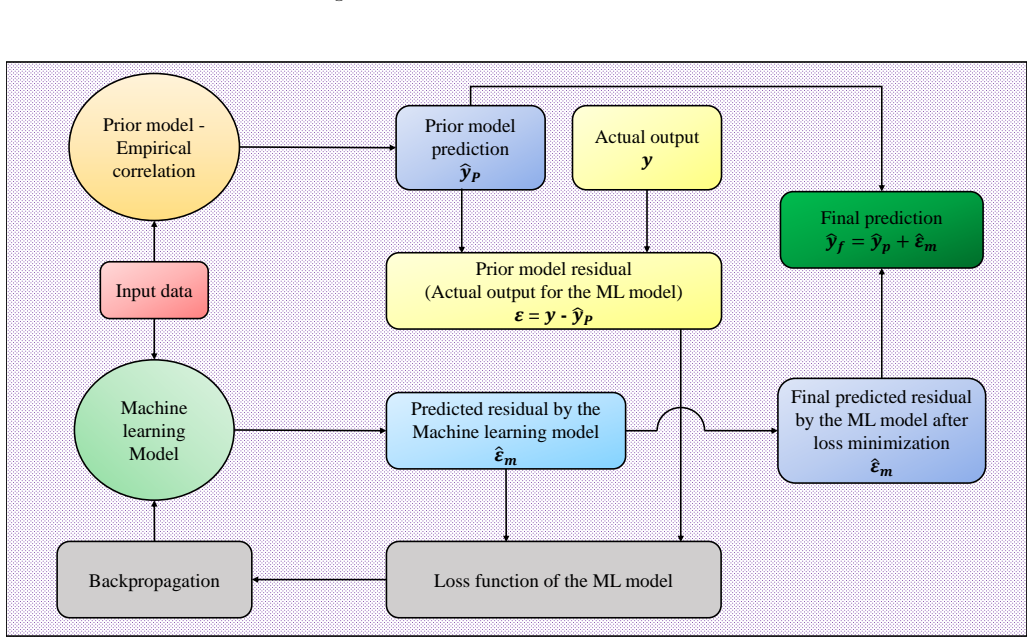
The load-bearing mechanism is the PIMLAF hybrid: a prior physics-based model predicts $\hat{y}_p$, a deep neural network predicts the residual $\hat{\epsilon}_m$, and the final prediction is $\hat{y}_f = \hat{y}_p + \hat{\epsilon}_m$. The prior is the proposed correlation, a modified Stephan--Preusser equation whose nine dimensionless groups carry all surface-geometry and fluid-property effects through fitted exponents; the residual network (8 hidden layers, 90 neurons per layer, ELU activation, L1/L2 regularization) captures whatever systematic error remains. A feature-attribution analysis then ranks the inputs' contributions, identifying surface roughness, fin height, area augmentation factor, and groove width as the dominant parameters across datasets.
What would settle it
Retrain the correlation and PIMLAF on all but one of the source studies, then predict the withheld study's HTC; if the held-out $R^2$ falls far below the reported 0.995 and 0.936, the model is memorizing study-specific offsets rather than learning transferable boiling physics.
Extended reading notes
Core claim
The central claim is that nine dimensionless groups -- the area augmentation factor $\lambda$, substrate-to-liquid conductivity ratio $k_w/k_l$, roughness-to-cavity-radius ratio $R_q/r_{\mathrm{cav}}$, normalized contact angle $\theta/90$, reduced pressure $P_r$, molecular-weight ratio $M_f/M_w$, fin aspect ratio $h_f/w_f$, groove-to-pitch ratio $w_g/p$, and hydraulic-diameter-to-pitch ratio $D_h/p$ -- can be multiplied into the Stephan--Preusser nucleate-boiling correlation with fitted exponents to describe the 7,128-point microchannel dataset with $R^2 = 0.936$ and MAE 4.94. Treating that correlation as a fixed prior and training a deep neural network to predict only the residual $\epsilon = y - \hat{y}_p$ gives the PIMLAF hybrid, which achieves $R^2 = 0.995$, MAE 0.907, and RMSE 2.999 on the test partition. These figures beat every one of the 19 individual ML models tested, the standalone DNN ($R^2 = 0.940$), and all 18 existing correlations evaluated, and the hybrid also reaches $R^2 = 0.992$ on a water-only subset and $R^2 = 0.997$ on other fluids.
Load-bearing premise
The load-bearing premise is that the nine chosen dimensionless parameters, with exponents fitted on the same 7,128-point dataset used to judge the correlation, fully capture how surface geometry and fluid properties control the boiling heat-transfer coefficient; if those groups are redundant, omit a governing variable, or have unstable exponents, the correlation baseline and therefore the hybrid model will not generalize.
Editorial extensions
If this is right
- The proposed correlation alone gives a closed-form HTC predictor for microchannel structured surfaces, improving on the best existing correlation (Stephan--Preusser) from $R^2 = 0.55$ to $R^2 = 0.936$ over the full 7,128-point dataset.
- PIMLAF's test-set accuracy ($R^2 = 0.995$, MAE 0.907) is higher than every conventional ML model and the standalone DNN, showing that a physics prior plus residual learning outperforms data-only modeling on this problem.
- The hybrid retains the correlation as a baseline, so predictions stay anchored to boiling physics even when the residual network is uncertain, which supports the paper's claim of better generalization to unseen datasets.
- The water-only and other-fluids splits both perform well ($R^2 = 0.992$ and 0.997), indicating the framework is not relying on one fluid's behavior.
- The feature-attribution analysis converts the model into design guidance: surfaces with larger area augmentation factor, taller fins, and smaller groove/fin widths and pitch should give higher HTC.
Reading between the lines
- A natural check the paper does not report is leave-one-study-out validation: if the residual network is absorbing calibration offsets specific to each source experiment, holding out an entire study should sharply reduce the hybrid's $R^2$.
- The same correlation-plus-residual recipe could be carried over to other structured-surface families (pin fins, reentrant cavities, V-grooves) once datasets of comparable size exist, because the hybrid mechanism does not depend on the microchannel-specific form of the prior.
- The identified dominant parameters could be turned into dimensionless design maps -- for example, HTC contours versus $h_f/w_f$ and $\lambda$ at fixed fluid conditions -- to guide fabrication choices, although the paper stops at feature rankings.
Signed reviews
Editorial analysis
A structured set of objections, weighed in public.
Referee Report
Summary. The paper compiles 7,128 pool-boiling data points on microchannel-structured surfaces from the literature, proposes a new empirical correlation obtained by multiplying the Stephan-Preusser correlation with nine dimensionless groups (Eq. 2), compares 18 existing correlations, trains 19 machine-learning regressors plus a deep neural network, and introduces a physics-informed machine-learning-aided framework (PIMLAF) in which a DNN learns the residuals of the proposed correlation. The authors report R² = 0.936 for the proposed correlation, R² = 0.940 for the standalone DNN, and R² = 0.995 for PIMLAF, together with SHAP-based feature importance analysis for the overall, water, and other-fluids datasets.
Significance. If the reported predictive performance were validated on genuinely held-out data, the work would be practically useful: a reliable HTC model for microchannel-structured surfaces is of clear engineering value, and the compilation of 7,128 points from multiple studies is a substantial contribution. The paper also provides a broad comparison of existing correlations and ML methods, and the SHAP analysis gives a physically interpretable account of feature effects. The hybrid-framework concept (correlation as prior, DNN on residuals) is a reasonable approach. However, the current evaluation protocol does not establish the central generalization claim, because the proposed correlation is fitted on the full dataset and then reused inside a train/test split, so all headline metrics are in-sample or leakage-affected numbers.
major comments (4)
- [3.1.1 (Eq. (2))] The exponents of the nine dimensionless groups in Eq. (2) are fitted to the entire 7,128-point dataset, and the reported R² = 0.936, MAE = 4.94 are evaluated on the same data. This makes the comparison against the fixed-coefficient correlations in Table 6 an in-sample fitting comparison, not a predictive comparison. The exponents should be fitted on training folds only and evaluated on held-out data (or via leave-one-study-out cross-validation) before any claim of predictive superiority is made.
- [3.3 (PIMLAF)] Because the prior correlation in Eq. (2) was fitted on the full dataset, the residual ε = y - ŷ_p for any point in the 20% test split is an in-sample residual: each test point already contributed to the coefficient estimates. The DNN in PIMLAF therefore learns on residuals that are artificially small, and the reported R² = 0.995, MAE = 0.907, RMSE = 2.999 do not establish that PIMLAF generalizes better than the standalone DNN, which was trained only on 80% of the data. The prior must be refitted inside each training split, or trained only on the training-study portion, before computing residuals.
- [2.4 and 3.2 (train/test split)] The manuscript does not report how the 80/20 split is stratified or grouped by source study. Since the dataset is compiled from a small number of experimental studies, near-duplicate points from the same surface and same study are likely to appear in both training and test sets, which can inflate all model metrics, including the standalone DNN. A group-wise split (e.g., leave-one-study-out), or at least a report of the study distribution across folds, is needed to assess generalization.
- [Abstract and Section 4] The abstract and the conclusions state that the hybrid framework 'is able to generalize well for different datasets,' but the only evidence is the overall 80/20 split and the water/other-fluid subsets of the same dataset. These are in-sample evaluations. An external dataset or a leave-one-study-out experiment is required to support the generalization claim.
minor comments (6)
- [2.4] The statement 'The percentage of data imputed in this analysis is 20%' is vague: which features had missing values, and is the imputation model fitted before or after the split? If fitted before, it is a source of leakage for all downstream models.
- [Table 6] The R² values for Rohsenow (-32,809,514.6) and Pioro (-1,334,090.4) are extreme; these large negative values are likely dominated by a few outliers. Reporting MAE/RMSE on a log scale or with clipped R² would make the table more readable.
- [Nomenclature] Pr is listed as 'Reduced pressure (bar)' in the nomenclature, but in Eq. (2) and in several correlations Pr is also used for the Prandtl number. Please use distinct symbols (e.g., p_r and Pr).
- [General] There are typographical errors: 'Rosenhow' should be 'Rohsenow', 'alogrithms' in the Section 3.2 heading, and the German title in reference [42] should be 'Wärmeübergang und maximale Wärmestromdichte beim Behältersieden binärer und ternärer Flüssigkeitsgemische'.
- [3.2] Hyperparameters are reported only for the DNN; the hyperparameter settings for the tree-based models (e.g., Extra Trees, LightGBM) after random search are not given, which limits reproducibility.
- [2.1] The paper does not state how the 7,128 data points were digitized from figures, or whether the compiled dataset will be made publicly available. Please include this information or provide the data in a repository.
Circularity Check
Correlation fit on the full dataset leaks the 20% test split into the PIMLAF prior, so the R²=0.995 hybrid 'prediction' is partly an in-sample fit rather than an independent generalization result.
-
fitted input called prediction
[Section 3.1.1, Eq. (2), Table 6]
"Thus, this empirical correlation has been modified with the addition of the above dimensionless parameters, and appropriate coefficients have been determined. The proposed correlation in Eq.(2) is able to predict the microchannel structured surfaces dataset with a R2 value of 0.936 and MAE of 4.94. ... These metrics are evaluated based on the entire dataset of microchannel structured surfaces."
The paper states the R²=0.936 'metrics are evaluated based on the entire dataset' after 'appropriate coefficients have been determined' for Eq. (2). Thus the exponents of the nine dimensionless groups were optimized on the same 7128 points that are then scored; there is no held-out split or leave-one-study-out validation. Reporting this as the correlation 'able to predict' the dataset presents an in-sample curve fit as if it were a predictive result, and Table 6's 0.55→0.936 improvement over Stephan-Preusser conflates fitted flexibility with generalization.
-
fitted input called prediction
[Sections 3.2–3.3, Fig. 9, Table 10]
"The new correlation proposed in this study is used to provide a good baseline prediction. Then, the DNN model with optimized hyperparameters as in Table 9 is developed to learn the correlation residual errors. Then, through backpropagation, the MSE loss function is minimized, yielding a highly accurate model for HTC prediction on microchannel structured surfaces with R2, MAE, and RMSE values as 0.995, 0.907, and 2.999, respectively. ... All the model performances are based on the test dataset."
The ML pipeline withholds 20% as test, but the PIMLAF prior is Eq. (2), whose exponents were determined from the entire dataset including those withheld points. For a test point, y_p is produced by a regression fitted to that point's target y, so the residual epsilon = y − y_p is not an out-of-sample error; it is partially an in-sample residual. The DNN then fits these residuals and the final y_f = y_p + epsilon_m is scored on the same contaminated test targets. The R²=0.995 therefore reflects leakage from the prior fit, and the comparison with a standalone DNN trained only on the 80% split is unfair. Grouping by source study is also not reported, so same-experiment points may straddle the split.
full rationale
The derivation chain is not circular at the level of self-citation: PIMLAF's residual-learning idea is attributed to external works [65,85–88], and no uniqueness theorem is imported from the authors' own prior papers. The 19 ML baselines and the standalone DNN use an 80/20 split and their test metrics are honest. However, the central 'prediction' claim is compromised by the proposed correlation being fitted on the full 7128-point dataset before being used as the PIMLAF prior in a split evaluation. The paper's own statements make this explicit: Eq. (2)'s coefficients are determined and then its R² is evaluated on 'the entire dataset,' while Section 3.3 applies that same correlation as the baseline whose residuals the DNN learns. As a result, the test-residual target is in-sample with respect to the baseline; R²=0.995 and the claimed superiority over the standalone DNN (R²=0.940) are inflated by target leakage. The appropriate fix is to fit Eq. (2) on the training split only (or per study) and then evaluate PIMLAF on truly held-out data. This is a partial circularity in the main generalization claim, not a fully definitional collapse; hence score 6.
Assumptions & free parameters
free parameters (3)
- Exponents of the nine dimensionless groups in the proposed correlation =
lambda^0.472, (kw/kl)^0.966, (Rq/rcav)^-0.197, (theta/90)^0.138, Pr^1.106, (Mf/Mw)^-2.175, (hf/wf)^-0.484…
- Data imputation model (LightGBM) =
not specified
- DNN hyperparameters for PIMLAF =
8 hidden layers, 90 neurons/layer, ELU, lr=0.001, L1=L2=0.001, 10,000 epochs
assumptions (4)
- domain assumption The Stephan-Preusser correlation is a valid baseline form for nucleate pool boiling on microchannel surfaces.
- domain assumption Liquid thermophysical properties evaluated at the film temperature T_film = (T_w + T_sat)/2 accurately capture interface effects.
- domain assumption The collected dataset from various studies is accurate and consistent with respect to surface geometry definitions and measurement conditions.
- ad hoc to paper The 20 percent of data imputed by LightGBM is reliable enough to train models on.
Cite this review
Pith. "Pith review of Empirical modeling and hybrid machine learning framework for nucleate pool boiling on microchannel structured surfaces." pith.science (2026). https://pith.science/paper/5EM4UW4C
@misc{pith2026250116867,
  author       = {Pith},
  title        = {Pith review of: Empirical modeling and hybrid machine learning framework for nucleate pool boiling on microchannel structured surfaces},
  year         = {2026},
  howpublished = {\url{https://pith.science/paper/5EM4UW4C}},
  note         = {Machine review of arXiv:2501.16867}
}
read the original abstract
Micro-structured surfaces influence nucleation characteristics and bubble dynamics besides increasing the heat transfer surface area, thus enabling efficient nucleate boiling heat transfer. Modeling the pool boiling heat transfer characteristics of these surfaces under varied conditions is essential in diverse applications. A new empirical correlation for nucleate boiling on microchannel structured surfaces has been proposed with the data collected from various experiments in previous studies since the existing correlations are limited by their accuracy and narrow operating ranges. This study also examines various Machine Learning (ML) algorithms and Deep Neural Networks (DNN) on the microchannel structured surfaces dataset to predict the nucleate pool boiling Heat Transfer Coefficient (HTC). With the aim to integrate both the ML and domain knowledge, a Physics-Informed Machine Learning Aided Framework (PIMLAF) is proposed. The proposed correlation in this study is employed as the prior physics-based model for PIMLAF, and a DNN is employed to model the residuals of the prior model. This hybrid framework achieved the best performance in comparison to the other ML models and DNNs. This framework is able to generalize well for different datasets because the proposed correlation provides the baseline knowledge of the boiling behavior. Also, SHAP interpretation analysis identifies the critical parameters impacting the model predictions and their effect on HTC prediction. This analysis further makes the model more robust and reliable. Keywords: Pool boiling, Microchannels, Heat transfer coefficient, Correlation analysis, Machine learning, Deep neural network, Physics-informed machine learning aided framework, SHAP analysis
Figures


Figures from the paper (14 more)




Reference graph
Works this paper leans on
-
[1]
A. E. Bergles, Enhancement of pool boiling, International Journal of Refrigeration 20 (1997) 545–551. doi:10.1016/S0140-7007(97)00063-7
-
[4]
M. Mahmoud, T. Karayiannis, Pool boiling review: Part ii – heat transfer enhancement, Thermal Science and Engineering Progress 25 (2021) 101023. doi: https://doi.org/10.1016/ j.tsep.2021.101023
- [5]
-
[6]
M. I. Hasan, Investigation of flow and heat transfer characteristics in micro pin fin heat sink with nanofluid, Applied Thermal Engineering 63 (2014) 598–607. doi: https://doi.org/10. 1016/j.applthermaleng.2013.11.059
2014
- [7]
-
[8]
A. Walunj, A. Sathyabhama, Comparative study of pool boiling heat transfer from various microchannel geometries, Applied Thermal Engineering 128 (2018) 672–683. doi:https://doi. org/10.1016/j.applthermaleng.2017.08.157. 37
-
[9]
R. Kaniowski, R. Pastuszko, Pool boiling of water on surfaces with open microchannels, Energies 14 (2021). doi: 10.3390/en14113062
-
[10]
A. Ranjan, A. Priy, I. Ahmad, M. Pathak, M. K. Khan, Pool boiling heat transfer characteristics of a stepped microchannel structured heating surface, International Journal of Multiphase Flow 160 (2023) 104351. doi: https://doi.org/10.1016/j.ijmultiphaseflow. 2022.104351
Show all 103 references
-
[11]
Y. K. Prajapati, M. Pathak, M. K. Khan, A comparative study of flow boiling heat transfer in three different configurations of microchannels, International Journal of Heat and Mass Transfer 85 (2015) 711–722. doi: 10.1016/j.ijheatmasstransfer.2015.02.016
2015 doi
-
[12]
B. Shah, K. Shah, P. Patel, V. J. Lakhera, Experimental investigations on nucleate pool boiling over micro-finned cylindrical surfaces, Proceedings of the Institution of Mechanical Engineers, Part C: Journal of Mechanical Engineering Science 236 (2022) 6284–6296. doi: 10. 1177...
2022
-
[13]
Kumar, B
R. Kumar, B. Premachandran, Enhancement of pool boiling performance through an asymmetric dual v-groove microchannel structured surface, International Journal of Heat and Mass Transfer 221 (2024) 125096. doi: https://doi.org/10.1016/j.ijheatmasstransfer. 2023.125096
2024
-
[14]
K. X. Cheng, Z. H. Foo, K. T. Ooi, Heat transfer enhancement through periodic flow area variations in microchannels, International Communications in Heat and Mass Transfer 111 (2020) 104456. doi: https://doi.org/10.1016/j.icheatmasstransfer.2019.104456
2020
-
[15]
A. F. Al-Neama, N. Kapur, J. Summers, H. M. Thompson, An experimental and numerical investigation of the use of liquid flow in serpentine microchannels for microelectronics cooling, Applied Thermal Engineering 116 (2017) 709–723. doi: https://doi.org/10.1016/ j.applthermaleng....
2017
-
[17]
A. Das, P. Das, P. Saha, Performance of different structured surfaces in nucleate pool boiling, Applied Thermal Engineering 29 (2009) 3643–3653. doi: https://doi.org/10.1016/ j.applthermaleng.2009.06.020. 38
2009
-
[18]
G. Pi, D. Deng, L. Chen, X. Xu, C. Zhao, Pool boiling performance of 3d-printed reentrant microchannels structures, International Journal of Heat and Mass Transfer 156 (2020) 119920. doi:https://doi.org/10.1016/j.ijheatmasstransfer.2020.119920
2020
-
[19]
A. Das, P. Das, P. Saha, Some investigations on the enhancement of boiling heat transfer from planer surface embedded with continuous open tunnels, Experimental Thermal and Fluid Science 34 (2010) 1422–1431. doi: https://doi.org/10.1016/j.expthermflusci.2010.06. 017
2010 doi
-
[20]
Jiang, X
H. Jiang, X. Yu, N. Xu, D. Wang, J. Yang, H. Chu, Effect of t-shaped micro-fins on pool boiling heat transfer performance of surfaces, Experimental Thermal and Fluid Science 136 (2022) 110663. doi: https://doi.org/10.1016/j.expthermflusci.2022.110663
2022
-
[21]
A. R. Betz, J. Jenkins, C. J. Kim, D. Attinger, Boiling heat transfer on superhydrophilic, superhydrophobic, and superbiphilic surfaces, International Journal of Heat and Mass Transfer 57 (2013) 733–741. doi: https://doi.org/10.1016/j.ijheatmasstransfer.2012.10.080
2013 doi
-
[22]
D. Y. Lim, I. C. Bang, Controlled bubble departure diameter on biphilic surfaces for enhanced pool boiling heat transfer performance, International Journal of Heat and Mass Transfer 150 (2020) 119360. doi: https://doi.org/10.1016/j.ijheatmasstransfer.2020.119360
2020
-
[23]
M. M. Rahman, M. McCarthy, Effect of length scales on the boiling enhancement of structured copper surfaces, Journal of Heat Transfer 139 (2017) 111508. doi: 10.1115/1.4036693
2017 doi
-
[24]
W. Li, R. Dai, M. Zeng, Q. Wang, Review of two types of surface modification on pool boiling enhancement: Passive and active, Renewable and Sustainable Energy Reviews 130 (2020) 109926. doi:https://doi.org/10.1016/j.rser.2020.109926
2020
-
[25]
L. J. Orman, N. Radek, J. Pietraszek, M. Szczepaniak, Analysis of enhanced pool boiling heat transfer on laser—textured surfaces, Energies 13 (2020). doi: 10.3390/en13112700
2020 doi
-
[26]
Cooke, S
D. Cooke, S. G. Kandlikar, Effect of open microchannel geometry on pool boiling enhancement, International Journal of Heat and Mass Transfer 55 (2012) 1004–1013. doi: https://doi.org/ 10.1016/j.ijheatmasstransfer.2011.10.010
2012 doi
-
[27]
Kalani, S
A. Kalani, S. G. Kandlikar, Pool boiling of fc-87 over microchannel surfaces at atmospheric pressure, in: ASME International Mechanical Engineering Congress and Exposition, volume Volume 7: Fluids and Heat Transfer, Parts A, B, C, and D of ASME International Mechanical Enginee...
2012 doi
-
[28]
Kalani, S
A. Kalani, S. G. Kandlikar, Pool boiling heat transfer over microchannel surfaces with ethanol at atmospheric pressure, in: International Conference on Nanochannels, Microchannels, and Minichannels, volume ASME 2012 10th International Conference on Nanochannels, Microchannels,...
2012 doi
-
[29]
B. A. Shah, P. Patel, V. J. Lakhera, Evaluation of pressure, surface characteristics, and fluid properties effect on pool boiling heat transfer over plain and external micro-finned cylindrical surfaces, Journal of Thermal Science and Engineering Applications 15 (2023) 111011. ...
2023
-
[30]
H. J. Kwak, J. H. Kim, B.-S. Myung, M. H. Kim, D. E. Kim, Behavior of pool boiling heat transfer and critical heat flux on high aspect-ratio microchannels, International Journal of Thermal Sciences 125 (2018) 111–120. doi: https://doi.org/10.1016/j.ijthermalsci. 2017.11.025
2018 doi
-
[31]
W. M. Rohsenow, A method of correlating heat-transfer data for surface boiling of liquids, Journal of Fluids Engineering 74 (1952) 969–975. doi: 10.1115/1.4015984
1952 doi
-
[32]
Pioro, Experimental evaluation of constants for the rohsenow pool boiling correlation, International Journal of Heat and Mass Transfer 42 (1999) 2003–2013
I. Pioro, Experimental evaluation of constants for the rohsenow pool boiling correlation, International Journal of Heat and Mass Transfer 42 (1999) 2003–2013. doi: 10.1016/ S0017-9310(98)00294-4
1999
-
[33]
Stephan, M
K. Stephan, M. Abdelsalam, Heat-transfer correlations for natural convection boiling, International Journal of Heat and Mass Transfer 23 (1980) 73–87. doi: https://doi.org/10. 1016/0017-9310(80)90140-4
1980
-
[34]
V. Borishanskii, Correlation of the effect of pressure on the critical heat flux and heat transfer rates using the theory of thermodynamic similarity, in: Problems of Heat Transfer and Hydraulics of Two-Phase Media, Elsevier, 1969, pp. 16–37
1969
-
[35]
D. Jung, Y. Kim, Y. Ko, K. Song, Nucleate boiling heat transfer coefficients of pure halogenated refrigerants, International Journal of Refrigeration 26 (2003) 240–248. doi: https://doi.org/ 10.1016/S0140-7007(02)00040-3
2003 doi
-
[36]
Labuntsov, Heat transfer problems with nucleate boiling of liquids, Therm
D. Labuntsov, Heat transfer problems with nucleate boiling of liquids, Therm. Eng.(USSR)(Engl. Transl.), v. 19, no. 9, pp. 21-28 (1973)
1973
-
[37]
Gorenflo, D
D. Gorenflo, D. Kenning, Vdi heat atlas, VDI-Verlag GmbH, Dusseldorf, Germany, (1993). 40
1993
-
[38]
Kruzhilin, Free-convection transfer of heat from a horizontal plate and boiling liquid, Doklady AN SSSR (reports of the USSR Academy of Sciences) 58 (1947) 1657–1660
G. Kruzhilin, Free-convection transfer of heat from a horizontal plate and boiling liquid, Doklady AN SSSR (reports of the USSR Academy of Sciences) 58 (1947) 1657–1660
1947
-
[39]
HussainTarrad, D
A. HussainTarrad, D. S. Khudor, A correlation for the pool boiling enhancement factor from low finned tubes, Global Journal of Research In Engineering 14 (2014). URL: https://api. semanticscholar.org/CorpusID:102484960
2014
-
[40]
Cornwell, S
K. Cornwell, S. Houston, Nucleate pool boiling on horizontal tubes: A convection-based correlation, International Journal of Heat and Mass Transfer 37 (1994) 303–309. doi: 10.1016/ 0017-9310(94)90031-0
1994
-
[41]
Cooper, Heat flow rates in saturated nucleate pool boiling-a wide-ranging examination using reduced properties, in: J
M. Cooper, Heat flow rates in saturated nucleate pool boiling-a wide-ranging examination using reduced properties, in: J. P. Hartnett, T. F. Irvine (Eds.), Advances in Heat Transfer, volume 16, Elsevier, 1984, pp. 157–239. doi: 10.1016/S0065-2717(08)70205-3
1984 doi
-
[42]
Stephan, P
K. Stephan, P. Preußer, W¨ arme¨ ubergang und maximale w¨ armestromdichte beim beh¨ altersieden bin¨ arer und tern¨ arer fl¨ ussigkeitsgemische, Chemie Ingenieur Technik 51 (1979) 37–37
1979
-
[43]
Ribatski, J
G. Ribatski, J. M. Jabardo, Experimental study of nucleate boiling of halocarbon refrigerants on cylindrical surfaces, International Journal of Heat and Mass Transfer 46 (2003) 4439–4451. doi:10.1016/S0017-9310(03)00252-7
2003 doi
-
[44]
Kichigin, N
M. Kichigin, N. Y. Tobilevich, Generalization of experimental data on heat transfer in boiling, Hydrodynamics and Heat Transfer in Boiling in High-Pressure Boilers (1955) 175–185
1955
-
[45]
V. M. B. S. S. Kutateladze, A Concise Encyclopedia of Heat Transfer, Pergamon Press, 1966. URL: https://books.google.co.in/books?id=MmbDvwEACAAJ
1966
-
[46]
S. S. Kutateladze, Heat transfer and hydrodynamic resistance: a reference guide, M.: Energoatomizdat (1990)
1990
-
[47]
I. H. Sarker, Machine learning: Algorithms, real-world applications and research directions, SN Computer Science 2 (2021) 160. doi: 10.1007/s42979-021-00592-x
2021 doi
-
[48]
Shanmugam, L
M. Shanmugam, L. S. Maganti, Machine learning-based thermal performance study of microchannel heat sink under non-uniform heat load conditions, Applied Thermal Engineering 253 (2024) 123769. doi: https://doi.org/10.1016/j.applthermaleng.2024.123769
2024
-
[49]
Shanmugam, L
M. Shanmugam, L. S. Maganti, Predicting the nusselt number of parallel microchannel and oblique pin-fin heat sinks using a machine learning approach, in: Proceedings of the 27th National and 5th International ISHMT-ASTFE Heat and Mass Transfer Conference December 41 14-17, 202...
2023 doi
-
[50]
Y. Oh, Z. Guo, Prediction of nusselt number in microscale pin fin heat sinks using artificial neural networks, Heat transfer research 54 (2023). doi: 10.1615/HeatTransRes.2022044987
2023 doi
-
[51]
Traverso, F
T. Traverso, F. Coletti, L. Magri, T. Karayiannis, O. Matar, A machine learning approach to the prediction of heat transfer coefficients in microchannels, in: International Heat Transfer Conference Digital Library, 2023, p. 8. doi: 10.1615/IHTC17.490-170
2023 doi
-
[52]
Loyola-Fuentes, S
J. Loyola-Fuentes, S. Mancin, E. Diaz-Bejarano, F. Coletti, Application of machine learning algorithms to predict the condensation heat transfer coefficient inside microfin tubes, in: International Heat Transfer Conference Digital Library, Begel House Inc., 2023, p. 10. doi:10...
2023 doi
-
[53]
Y. Sei, K. Enoki, S. Yamaguchi, K. Saito, Prediction of heat transfer coefficients for mini-channels, Multiphase Science and Technology (2022). doi: 10.1615/MultScienTechn. 2022039089
2022 doi
-
[54]
Huang, J
L. Huang, J. Zou, B. Liu, Z. Jin, J. Qian, Machine learning assisted microchannel geometric optimization—a case study of channel designs, Energies 17 (2024). doi: 10.3390/en17010044
2024 doi
-
[55]
Y. Qiu, D. Garg, S. M. Kim, I. Mudawar, C. R. Kharangate, Machine learning algorithms to predict flow boiling pressure drop in mini/micro-channels based on universal consolidated data, International Journal of Heat and Mass Transfer 178 (2021) 121607. doi: 10.1016/j. ijheatmas...
2021
-
[56]
Khosravi, J
A. Khosravi, J. Pabon, R. Koury, L. Machado, Using machine learning algorithms to predict the pressure drop during evaporation of R407C, Applied Thermal Engineering 133 (2018) 361–370. doi:10.1016/j.applthermaleng.2018.01.084
2018 doi
-
[57]
Alizadehdakhel, M
A. Alizadehdakhel, M. Rahimi, J. Sanjari, A. A. Alsairafi, Cfd and artificial neural network modeling of two-phase flow pressure drop, International Communications in Heat and Mass Transfer 36 (2009) 850–856. doi: https://doi.org/10.1016/j.icheatmasstransfer.2009. 05.005
2009 doi
-
[58]
N. Bar, S. K. Das, M. N. Biswas, Prediction of frictional pressure drop using artificial neural network for air-water flow through u-bends, Procedia Technology 10 (2013) 813–821. doi:https://doi.org/10.1016/j.protcy.2013.12.426, first International Conference on Computational ...
2013 doi
-
[59]
Azizi, E
S. Azizi, E. Ahmadloo, Prediction of heat transfer coefficient during condensation of r134a in inclined tubes using artificial neural network, Applied Thermal Engineering 106 (2016) 203–210. doi:https://doi.org/10.1016/j.applthermaleng.2016.05.189
2016 doi
-
[60]
Vijay, S
K. Vijay, S. Gedupudi, Machine learning based modeling and identification of key influencing parameters for nucleate pool boiling on plain and roughened surfaces, in: ASTFE Digital Library, Begellhouse, 2024, pp. 1299–1314. doi: 10.1615/TFEC2024.ml.050781
2024 doi
-
[61]
Kuberan, S
V. Kuberan, S. Gedupudi, Modelling of nucleate pool boiling on coated substrates using machine learning and empirical approaches, 2024. doi: https://arxiv.org/abs/2409.07811. arXiv:2409.07811
2024 arXiv
-
[62]
A. M. Aliyu, R. Choudhury, B. Sohani, J. Atanbori, J. X. Ribeiro, S. K. Ahmed, R. Mishra, An artificial neural network model for the prediction of entrained droplet fraction in annular gas-liquid two-phase flow in vertical pipes, International Journal of Multiphase Flow 164 (2...
2023
-
[63]
H. B. Arteaga-Arteaga, A. Mora-Rubio, F. Florez, N. Murcia-Orjuela, C. E. Diaz-Ortega, S. Orozco-Arias, M. A. Bravo-Ort ´ ız, M. Robinson, P. Guillen-Rondon, R. Tabares-Soto, et al., Machine learning applications to predict two-phase flow patterns, PeerJ Computer Science 7 (2021) e798
2021
-
[64]
Jalili, Y
D. Jalili, Y. Mahmoudi, Physics-informed neural networks for two-phase film boiling heat transfer, International Journal of Heat and Mass Transfer 241 (2025) 126680. doi: https: //doi.org/10.1016/j.ijheatmasstransfer.2025.126680
2025
-
[65]
K. M. Kim, P. Hurley, J. P. Duarte, Physics-informed machine learning-aided framework for prediction of minimum film boiling temperature, International Journal of Heat and Mass Transfer 191 (2022) 122839. doi: https://doi.org/10.1016/j.ijheatmasstransfer.2022. 122839
2022 doi
-
[66]
Y. Chen, R. Fu, Y. Yan, Enhanced pool boiling heat transfer on grooved surfaces by wettability modification with nanoparticle coatings, International Communications in Heat and Mass Transfer 137 (2022) 106298. doi: https://doi.org/10.1016/j.icheatmasstransfer.2022. 106298
2022 doi
-
[67]
I. H. Bell, J. Wronski, S. Quoilin, V. Lemort, Pure and pseudo-pure fluid thermophysical property evaluation and the open-source thermophysical property library CoolProp, Industrial & Engineering Chemistry Research 53 (2014) 2498–2508. doi: 10.1021/ie4033999. 43
2014 doi
-
[68]
E. W. Lemmon, I. H. Bell, M. L. Huber, M. O. McLinden, Thermophysical properties of fluid systems, NIST Chemistry WebBook, NIST Standard Reference Database Number 69, Linstrom, P.J. and Mallard, W.G., National Institute of Standards and Technology, Gaithersburg, MD, 20899, 202...
2023 doi
-
[69]
Fritz, Berechnung des maximalvolumes von dampfblasen, Physik
W. Fritz, Berechnung des maximalvolumes von dampfblasen, Physik. Zeitschr 36 (1935) 379–384
1935
-
[70]
G. Ke, Q. Meng, T. Finley, T. Wang, W. Chen, W. Ma, Q. Ye, T.-Y. Liu, LightGBM: A highly efficient gradient boosting decision tree, Advances in Neural Information Processing Systems 30 (2017)
2017
-
[71]
Ahsan, M
M. Ahsan, M. Mahmud, P. Saha, K. Gupta, Z. Siddique, Effect of data scaling methods on machine learning algorithms and model performance, Technologies 9 (2021) 52. doi: 10.3390/ technologies9030052
2021
-
[72]
Schmidhuber, Deep learning in neural networks: An overview, Neural Networks 61 (2015) 85–117
J. Schmidhuber, Deep learning in neural networks: An overview, Neural Networks 61 (2015) 85–117. doi:https://doi.org/10.1016/j.neunet.2014.09.003
2015 doi
-
[73]
Bishop, Pattern Recognition and Machine Learning, Springer, 2006
C. Bishop, Pattern Recognition and Machine Learning, Springer, 2006
2006
-
[74]
Cybenko, Continuous valued neural networks with two hidden layers are sufficient, department of computer science, Trfts
G. Cybenko, Continuous valued neural networks with two hidden layers are sufficient, department of computer science, Trfts. University 31 (1988)
1988
-
[75]
Chen, Back-propagation neural networks for nonlinear self-tuning adaptive control, IEEE Control Systems Magazine 10 (1990) 44–48
F.-C. Chen, Back-propagation neural networks for nonlinear self-tuning adaptive control, IEEE Control Systems Magazine 10 (1990) 44–48. doi: 10.1109/37.55123
1990 doi
-
[76]
A. F. Agarap, Deep learning using rectified linear units (relu), 2019. URL: https://arxiv. org/abs/1803.08375. arXiv:1803.08375
2019 arXiv
-
[77]
Maniatopoulos, N
A. Maniatopoulos, N. Mitianoudis, Learnable leaky relu (lelelu): An alternative accuracy-optimized activation function, Information 12 (2021). URL: https://www.mdpi. com/2078-2489/12/12/513. doi:10.3390/info12120513
2021 doi
-
[78]
Clevert, T
D.-A. Clevert, T. Unterthiner, S. Hochreiter, Fast and accurate deep network learning by exponential linear units (elus), 2016. URL: https://arxiv.org/abs/1511.07289. arXiv:1511.07289
2016 arXiv
-
[79]
Ruder, An overview of gradient descent optimization algorithms, 2017
S. Ruder, An overview of gradient descent optimization algorithms, 2017. URL: https:// arxiv.org/abs/1609.04747. arXiv:1609.04747. 44
2017 arXiv
-
[80]
Duchi, E
J. Duchi, E. Hazan, Y. Singer, Adaptive subgradient methods for online learning and stochastic optimization, Journal of Machine Learning Research 12 (2011) 2121–2159. URL:http://jmlr. org/papers/v12/duchi11a.html
2011
-
[81]
M. D. Zeiler, Adadelta: An adaptive learning rate method, 2012. URL: https://arxiv.org/ abs/1212.5701. arXiv:1212.5701
2012 arXiv
-
[82]
D. P. Kingma, J. Ba, Adam: A method for stochastic optimization, 2017. URL: https:// arxiv.org/abs/1412.6980. arXiv:1412.6980
2017 arXiv
-
[83]
Tibshirani, Regression shrinkage and selection via the lasso, Journal of the Royal Statistical Society: Series B (Methodological) 58 (2018) 267–288
R. Tibshirani, Regression shrinkage and selection via the lasso, Journal of the Royal Statistical Society: Series B (Methodological) 58 (2018) 267–288. doi: 10.1111/j.2517-6161. 1996.tb02080.x
2018 doi
-
[84]
A. E. Hoerl, R. W. Kennard, Ridge regression: Biased estimation for nonorthogonal problems, Technometrics 12 (1970) 55–67. doi: 10.1080/00401706.1970.10488634
1970
-
[86]
H.-T. Su, N. Bhat, P. Minderman, T. McAvoy, Integrating neural networks with first principles models for dynamic modeling, IF AC Proceedings Volumes 25 (1992) 327–332. doi: https:// doi.org/10.1016/S1474-6670(17)51013-7 , 3rd IF AC Symposium on Dynamics and Control of Chemical...
1992 doi
-
[87]
M. L. Thompson, M. A. Kramer, Modeling chemical processes using prior knowledge and neural networks, AIChE Journal 40 (1994) 1328–1340. doi: https://doi.org/10.1002/aic. 690400806
1994 doi
-
[88]
Acu˜ na, F
G. Acu˜ na, F. Cubillos, J. Thibault, E. Latrille, Comparison of methods for training grey-box neural network models, Computers & Chemical Engineering 23 (1999) S561–S564. doi:https://doi.org/10.1016/S0098-1354(99)80138-0 , european Symposium on Computer Aided Process Engineering
1999 doi
-
[89]
Fix, Discriminatory analysis: nonparametric discrimination, consistency properties, volume 1, USAF school of Aviation Medicine, 1985
E. Fix, Discriminatory analysis: nonparametric discrimination, consistency properties, volume 1, USAF school of Aviation Medicine, 1985
1985
-
[90]
Cover, P
T. Cover, P. Hart, Nearest neighbor pattern classification, IEEE Transactions on Information Theory 13 (1967) 21–27. doi: 10.1109/TIT.1967.1053964. 45
1967
-
[91]
Breiman, Random forests, Machine Learning 45 (2001) 5–32
L. Breiman, Random forests, Machine Learning 45 (2001) 5–32. doi: 10.1023/A: 1010933404324
2001 doi
-
[92]
Geurts, D
P. Geurts, D. Ernst, L. Wehenkel, Extremely randomized trees, Machine Learning 63 (2006) 3–42. doi:10.1007/s10994-006-6226-1
2006 doi
-
[93]
T. Chen, C. Guestrin, Xgboost, in: Proceedings of the 22nd ACM SIGKDD International Conference on Knowledge Discovery and Data Mining, ACM, 2016, pp. 785–794. doi:10.1145/ 2939672.2939785
2016
-
[94]
Bergstra, Y
J. Bergstra, Y. Bengio, Random search for hyper-parameter optimization., Journal of machine learning research 13 (2012)
2012
-
[95]
S. M. Lundberg, S.-I. Lee, A unified approach to interpreting model predictions, Advances in Neural Information Processing Systems 30 (2017)
2017
-
[96]
Pedregosa, G
F. Pedregosa, G. Varoquaux, A. Gramfort, V. Michel, B. Thirion, O. Grisel, M. Blondel, P. Prettenhofer, R. Weiss, V. Dubourg, J. Vanderplas, A. Passos, D. Cournapeau, M. Brucher, M. Perrot, ´Edouard Duchesnay, Scikit-learn: Machine learning in python, Journal of Machine Learni...
2011
-
[97]
Paszke, S
A. Paszke, S. Gross, F. Massa, A. Lerer, J. Bradbury, G. Chanan, T. Killeen, Z. Lin, N. Gimelshein, L. Antiga, A. Desmaison, A. K¨ opf, E. Yang, Z. DeVito, M. Raison, A. Tejani, S. Chilamkurthy, B. Steiner, L. Fang, J. Bai, S. Chintala, Pytorch: An imperative style, high-perfo...
2019 arXiv
-
[98]
J. P. McHale, S. V. Garimella, Bubble nucleation characteristics in pool boiling of a wetting liquid on smooth and rough surfaces, International Journal of Multiphase Flow 36 (2010) 249–260. doi:10.1016/j.ijmultiphaseflow.2009.12.004
2010 doi
-
[99]
P. Goel, A. K. Nayak, P. P. Kulkarni, J. B. Joshi, Experimental study on bubble departure characteristics in subcooled nucleate pool boiling, International Journal of Multiphase Flow 89 (2017) 163–176. doi: 10.1016/j.ijmultiphaseflow.2016.10.012
2017 doi
-
[100]
J. Kim, S. Jun, R. Laksnarain, S. M. You, Effect of surface roughness on pool boiling heat transfer at a heated surface having moderate wettability, International Journal of Heat and Mass Transfer 101 (2016) 992–1002. doi:https://doi.org/10.1016/j.ijheatmasstransfer. 2016.05.067. 46
2016 doi
-
[101]
H. T. Phan, N. Caney, P. Marty, S. Colasson, J. Gavillet, Surface wettability control by nanocoating: The effects on pool boiling heat transfer and nucleation mechanism, International Journal of Heat and Mass Transfer 52 (2009) 5459–5471. doi: https://doi.org/10.1016/j. ijheat...
2009 doi
-
[102]
Moˇ ze, M
M. Moˇ ze, M. Zupanˇ ciˇ c, I. Golobiˇ c, Pattern geometry optimization on superbiphilic aluminum surfaces for enhanced pool boiling heat transfer, International Journal of Heat and Mass Transfer 161 (2020) 120265. doi: https://doi.org/10.1016/j.ijheatmasstransfer.2020. 120265
2020 doi
-
[103]
Jaikumar, S
A. Jaikumar, S. G. Kandlikar, Ultra-high pool boiling performance and effect of channel width with selectively coated open microchannels, International Journal of Heat and Mass Transfer 95 (2016) 795–805. doi: https://doi.org/10.1016/j.ijheatmasstransfer.2015.12.061
2016 doi
-
[104]
Yao, Y.-W
Z. Yao, Y.-W. Lu, S. G. Kandlikar, Pool boiling heat transfer enhancement through nanostructures on silicon microchannels, Journal of Nanotechnology in Engineering and Medicine 3 (2013) 031002. doi: 10.1115/1.4007425
2013 doi
-
[105]
A. M. Gheitaghy, A. Samimi, H. Saffari, Surface structuring with inclined minichannels for pool boiling improvement, Applied Thermal Engineering 126 (2017) 892–902. doi: https:// doi.org/10.1016/j.applthermaleng.2017.07.200
2017 doi
-
[106]
Kumar, A
A. Kumar, A. K. Behura, D. K. Rajak, R. Kumar, M. H. Ahmadi, M. Sharifpur, O. Bamisile, Performance of heat transfer mechanism in nucleate pool boiling -a relative approach of contribution to various heat transfer components, Case Studies in Thermal Engineering 24 (2021) 10082...
2021
-
[107]
Y. An, C. Huang, X. Wang, Effects of thermal conductivity and wettability of porous materials on the boiling heat transfer, International Journal of Thermal Sciences 170 (2021) 107110. doi:10.1016/j.ijthermalsci.2021.107110. 47
2021
Reviewed August 10, 2026 · model on record in the stance chip above.
Discussion (0). Continue with ORCID to comment.