REVIEW 3 major objections 4 minor 46 references
Probing minimal observable length with dark modes in an optomechanical detector
T0 review · 3 major / 4 minor · reviewed 2026-08-05 · deepseek-v4-flash
Pith's one-line read This paper proposes a two-membrane optomechanical detector whose dark-mode noise spectrum can measure the generalized uncertainty principle parameter down to β0 below 10^24, four orders of magnitude tighter than the previous optomechanical
desk verdict A credible new dark-mode optomechanical scheme for GUP metrology, with real simulations of the effect, but the analytic calibration is sloppy and the headline resolution limit needs a null run before I'd trust it. read the letter →
The pith
A machine-rendered reading of the paper's core claim, the machinery that carries it, and where it could break.
The reading
What carries the argument
The bright–dark supermode decomposition: two oscillators with equal couplings define $A_b=(A_1+A_2)/\sqrt{2}$, which couples to the cavity field with effective coupling $\sqrt{2}g$, and $A_d=(A_2-A_1)/\sqrt{2}$, which is decoupled from the optical field. The carrying identity is the dark-mode Langevin equation, whose GUP term contains a contribution proportional to $2|A_b|^2 A_d$; this makes the dark-mode noise-spectrum peak position a linear-in-$|A_b|^2$ pointer for $\beta_{\mathrm{NL}}$ while the bright mode absorbs the drive. Supporting machinery includes mean-field linearization of the quantum Langevin equations, the Jacobi–Anger expansion of the optical sidebands, and Welch spectral est
What would settle it
Repeat the proposed measurement at bright-mode amplitudes small enough that the expected GUP shift is far below the spectral resolution, and perform the same linear fit of dark-mode noise-peak position versus $|A_b|^2$; a nonzero slope would indicate an optical-spring background rather than GUP. As a second check, repeat the fit at several cavity detunings $\Delta_1$: the GUP shift is detuning-independent, while $F_1$ and $F_3$ depend on it, so a detuning-dependent slope would falsify the attribution.
Extended reading notes
Core claim
The central discovery is a measurement principle: in a cavity optomechanical system with two membranes, interference splits the mechanical motion into a bright mode that couples to light and a dark mode that does not. The GUP-modified commutation relation $[\hat Q,\hat P_G]=i(1+\beta_{\mathrm{NL}}\hat P_G^2)$ generates an effective $\hat P^4$ Hamiltonian term, which shifts the frequency of the dark-mode noise spectrum by an amount set by both the bright-mode and dark-mode amplitudes. Since the dark mode is never directly driven, its noise peak is not swamped by the coherent drive, and the GUP shift is amplified by the bright-mode amplitude. The authors simulate the full quantum Langevin equa
Load-bearing premise
The quoted resolution assumes that the only amplitude-dependent contribution to the dark-mode noise-peak shift is the GUP term, i.e., the cavity-induced optical-spring terms $F_1$ and $F_3$ are constant or negligible; the paper does not show a $\beta_{\mathrm{NL}}=0$ control verifying that the fitted slope vanishes without GUP.
Editorial extensions
If this is right
- A positive detection would measure $\beta_0$ at a scale inaccessible to previous tabletop experiments; a null result would bound $\beta_0 < 10^{24}$, four orders of magnitude tighter than the previous optomechanical bound and ten orders below the electroweak scale.
- The resolution is set by data-acquisition time rather than the oscillator quality factor, so the same device can be pushed to $\beta_{\mathrm{NL,lim}}=10^{-16.75}$ simply by integrating longer, e.g., $\gamma t=60$.
- Oscillator mismatch does not ruin the measurement: it excites the dark mode, but the resulting peak can be separated by detuning, at the cost of a larger pump power and a degraded but still useful resolution.
- The dark-mode pointer is not specific to optomechanics; the same idea applies to other systems that support dark modes, such as nanomechanical resonators and cavity magnomechanics, and to sensing other weak effects such as spacetime curvature or collapse noise.
Reading between the lines
- The paper does not show a $\beta_{\mathrm{NL}}=0$ control: the quoted resolution presumes that the optical-spring terms $F_1$ and $F_3$ are amplitude-independent or negligible over the fitted range, so a linear fit performed with the GUP term switched off should give zero slope, and any residual slope would be a spurious background.
- Because the GUP shift is amplified by $|A_b|^2$, the device could be combined with the reported $Q\sim10^8$ resonators to push the bound further; the practical floor will eventually be set by thermal noise ($\bar n_b\sim40$ at 0.1 mK) and optical-spring stability rather than the quality factor.
- A case the paper does not treat is asymmetric GUP parameters ($\beta_{\mathrm{NL},1}\neq\beta_{\mathrm{NL},2}$); then the dark mode would inherit a GUP term proportional to the difference, which could mimic or mask the bright-mode-amplified signal.
Signed reviews
Editorial analysis
A structured set of objections, weighed in public.
Referee Report
Summary. The paper proposes a tabletop optomechanical scheme to measure the generalized uncertainty principle (GUP) parameter β0. Two mechanical resonators are coupled to a common optical cavity; their symmetric and antisymmetric combinations form bright and dark supermodes. The GUP-induced mechanical nonlinearity is argued to shift the dark-mode noise spectrum by an amount proportional to the bright-mode amplitude squared, while the bright mode carries the coherent drive and the cavity-induced back-action. A linear fit of the dark-mode noise-peak position versus |A_b|² yields an estimate of β_NL, and numerical simulations with experimentally motivated parameters give a projected resolution β_NL,lim = 10^-16.75 for an acquisition time γt=60, corresponding to β0,lim ≲ 10^24, roughly four orders below a previous optomechanical proposal. The protocol is also analyzed under resonator mismatch.
Significance. If the projected sensitivity is validated, this is a compelling proposal: a stationary dark-mode readout would evade the quality-factor-limited acquisition time of earlier non-stationary schemes, and the projected bound on β0 would be a significant step beyond current optomechanical limits. The paper's strengths are its concrete experimental context, the explicit simulation of the full Langevin equations, and the simple linear-fitting protocol. However, the central sensitivity claim currently relies on an untested calibration assumption and on a partially inconsistent analytic derivation. The missing β_NL=0 null control is the key load-bearing gap; the supermode GUP term in Eq. (27) also needs correction or explicit justification. These issues are fixable and do not undermine the overall idea, but they must be resolved before the quoted resolution can be accepted.
major comments (3)
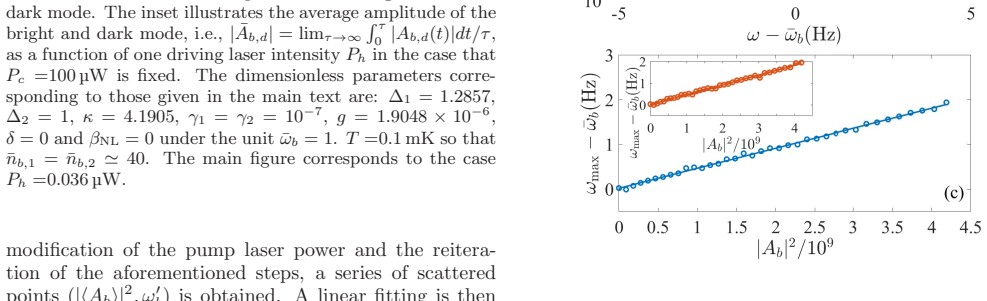
- [§IV A, Figs. 3–4 and Eq. (31)] The estimator β'_NL = k/ω̄_b assumes that the dark-mode noise-peak shift is due only to the GUP term β_NL ω̄_b |A_b|². However, the optical-spring terms F1, F2, F3 in Eqs. (22)–(24) depend on |A_b| through ξ = 2g_b|A_b|/Δ₂, and in the mismatched case (μ ≠ 0, Sec. IV B) these terms couple into the dark mode. No β_NL = 0 control simulation is reported for either the ideal or mismatched protocol. Without a null run showing that the fitted slope is statistically zero when the GUP term is absent, the reported resolution of 10^-16.75 cannot be attributed to GUP. This is the minimal missing control and I regard it as load-bearing.
- [§III B, Eqs. (27)–(28)] The local GUP term in Eq. (25) is iω_bj β_NL |A_j|² A_j. After the transformation to supermodes, this term should generate a self-shift proportional to |A_b|² A_b in the bright-mode equation. Equation (27), as written, contains only terms proportional to A_d (2|A_b|²A_d + A_b²A_d* + |A_d|²A_d) and no |A_b|²A_b term. The sentence immediately after Eq. (27) states that Eq. (27) reduces to a single-resonator equation when A_d terms are neglected, but in that limit the GUP term would vanish, contradicting Eq. (25). Please provide the full supermode transformation and state explicitly which terms are being neglected, or revise the bright-mode equation. This matters because the bright-mode amplitude calibration and the claimed GUP amplification both enter through these equations.
- [§II, Eq. (8)] The linearized equation is written as ˙δb = (-iω_b - γ)δb - i4ω_b β_NL [Im⟨b⟩]²(δb - δb†) + √(2γ) b_in. Dropping the δb† term by invoking RWA changes the effective frequency shift from 4β_NL[Im⟨b⟩]² to β_NL|⟨b⟩|², which requires the specific phase condition 4[Im⟨b⟩]² = |⟨b⟩|². The manuscript does not justify this phase or the RWA validity. Since the noise-spectrum peak position is the experimental observable, this step needs a more careful derivation or an explicit statement of the rotating frame and the phase of ⟨b⟩.
minor comments (4)
- [§III A] The text says 'both g_j/ω_bj and g_j/κ are always satisfied' but the intended inequalities (presumably ≪ 1) are missing. Please state the weak-coupling conditions explicitly.
- [Around Eq. (18)] 'Supermodel' should be 'super-mode'; there are also typos such as 'casued' in the Introduction and 'the the fluctuation peak' in Sec. II.
- [§IV A, Fig. 4] The paper uses R² < 0.1 as the resolution threshold, but this choice is not justified statistically. A detection threshold based on the confidence interval of the fitted slope excluding zero would be more conventional and would strengthen the resolution claim.
- [General] The numerical simulations are central to the paper, but no code or data availability statement is provided. A public simulation script or a detailed reproducibility statement would be helpful.
Circularity Check
No circular derivation: the GUP signal is derived from the modified commutator and then recovered in a self-consistency simulation; the missing β_NL=0 null run is a calibration/validity concern, not circularity.
full rationale
The paper's central claim is a model-based sensitivity projection, not a circular derivation. The GUP-induced frequency shift is obtained from the modified commutation relation (Eqs. 1-4) and the linearized Langevin equation (Eq. 8), leading to a noise-spectrum peak at ω_b,⟨b⟩ = ω_b(1+β_NL|⟨b⟩|^2) (Eq. 11). This is a standard GUP model, not an output that depends on the later measurement scheme. The bright-dark mode formalism is then built from the coupled Langevin equations (Eqs. 14-15), and the dark-mode noise spectrum is used as a readout. In Sec. IV, the numerical experiment presets β_NL in Eq. (15), simulates the noise spectrum, and estimates β'_NL from the fitted slope k via Eq. (31). This is a self-consistency and statistical-power check: the fitted slope is not fed back into the model to manufacture the result, and the resolution limit β_NL,lim = 10^-16.75 is defined by an R^2 threshold for recovering an input value, which is a legitimate sensitivity estimate. The absence of a β_NL=0 null control and the possibly |A_b|-dependent optical-spring terms F1-F3 (Eqs. 22-24) are a calibration/validity risk: the paper itself notes that F1 must be real to avoid confusing cavity-induced and GUP-induced shifts. This is a missing control, not a circular step. Self-citations [7,8,16,35] supply standard GUP treatments and experimental parameters and are not load-bearing in the derivation. No circularity found.
Assumptions & free parameters
assumptions (4)
- domain assumption GUP commutation relation [q̂,p̂] = iℏ(1 + β0(Lp p̂/ℏ)^2) and the resulting Hamiltonian H = ℏω(b†b + β_NL/12 (b†-b)^4) correctly describe low-energy quantum gravity corrections.
- domain assumption The rotating-wave approximation and linearization about a large coherent amplitude are valid, so the noise spectrum is a Lorentzian peaked at the GUP-shifted frequency.
- domain assumption The two resonators can be made nearly identical (δ ≤ 5 Hz) and the driven system reaches a stable stationary state without self-sustained oscillations.
- domain assumption Cavity-induced frequency modifications (F1 and F3 terms) do not produce an amplitude-dependent shift that contaminates the GUP slope.
Cite this review
Pith. "Pith review of Probing minimal observable length with dark modes in an optomechanical detector." pith.science (2026). https://pith.science/paper/5EMDLJFS
@misc{pith2026250810389,
  author       = {Pith},
  title        = {Pith review of: Probing minimal observable length with dark modes in an optomechanical detector},
  year         = {2026},
  howpublished = {\url{https://pith.science/paper/5EMDLJFS}},
  note         = {Machine review of arXiv:2508.10389}
}
abstract
Several theories that attempt to unify quantum theory and gravitational theory assume that space has an observable limiting resolution related to the Planck length, denoted by $\sqrt{\beta_0}L_p$. Quantum mechanically, this concept derives a generalized uncertainty principle (GUP) and the corresponding modified commutator. The prediction and observation of GUP-induced new physics, as well as the quantitative measurement of the value of $\beta_0$, may provide substantial support for the establishment of quantum gravity theory. In this paper, we propose a comprehensive quantum framework for measuring GUP at low energy scales by utilizing the interference-induced bright-dark mode effect of oscillators in an optomechanical system. The nonlinearity induced by GUP will be amplified by the bright mode dynamics, and then be quantitatively read out by the noise spectrum of the dark mode. The measurement limit resolution of the scheme is not constrained by the quality factor of the oscillator. Under experimentally achievable parameters, the measurement resolution has been shown to reach $\beta_{\text{NL,lim}}=10^{-16.75}$, which is $10$ orders of magnitude lower than the electroweak level.
Figures


Figures from the paper (3 more)


Reference graph
Works this paper leans on
-
[1]
L. G. Garay, Int. J. Mod. Phys. A 10, 145–165 (1995)
work page 1995
-
[2]
Equation (11) indicates that the noise spectrum can also be regarded as a pointer, with the peak of the spectrum located at the position of ωb,⟨b⟩. In contradistinction to the classi- cal spectrum, the coherent drive does not force the noise spectrum to resonate with it. Consequently, the noise spectrum can be measured while the coherent drive con- tinues...
-
[3]
Consequently, it corresponds to a “bright” mode. When both resonators have higher quality factors, the amplitude Ab(t) is much slower than the fast oscillations at ∆ 2. Thus, it can be regarded as a constant in the integration with the index t′′ [18]. Then Eq. (17) can be simplified as: a(t) =eiψb(t) × ∫ t 0 dt′eL(t−t′) [ Ehe−i∆2t′ +Ec ] e−iψb(t′), (19) wh...
work page 2010
- [4]
- [5]
-
[6]
D. J. Gross and P. F. Mende, Nucl. Phys. B 303, 407–454 (1988)
work page 1988
-
[7]
M. A. Maggiore, Phys. Lett. B 304, 65–69 (1993)
work page 1993
-
[8]
I. Pikovski, M. R. Vanner, M. Aspelmeyer, M. S. Kim, and ˇC. Brukner, Nature Phys. 8, 393–397 (2012)
work page 2012
Show all 46 references
-
[9]
Bawaj, C
M. Bawaj, C. Biancofiore, M. Bonaldi, F. Bonfigli, A. Borrielli, G. Di Giuseppe, L. Marconi, F. Marino, R. Na- tali, A. Pontin, G. A. Prodi, E. Serra, D. Vitali, and F. Marin, Nat. Commun. 6, 7503 (2015)
2015
-
[10]
Bonaldi, A
M. Bonaldi, A. Borrielli, A. Chowdhury, G. Di Giuseppe, W. Li, N. Malossi, F. Marino, B. Morana, R. Natali, P. Piergentili, G. A. Prodi, P. M. Sarro, E. Serra1, P. Vezio, D. Vitali, and F. Marin, Eur. Phys. J. D 74, 178 (2020)
2020
-
[11]
Das and E
S. Das and E. C. Vagenas, Phys. Rev. Lett. 101, 221301 (2008)
2008
-
[12]
Marin, F
F. Marin, F. Marino, M. Bonaldi, M. Cerdonio, L. Conti, P. Falferi, R. Mezzena, A. Ortolan, G. A. Prodi, L. Taf- farello, G. Vedovato, A. Vinante, and J. P. Zendri, Nature Phys. 9, 71–73 (2012)
2012
-
[13]
Marin, F
F. Marin, F. Marino, M. Bonaldi, M. Cerdonio, L. Conti, P. Falferi, R. Mezzena, A. Ortolan, G. A. Prodi, L. Taf- farello, G. Vedovato, A. Vinante and J. P. Zendri, New J. Phys. 16 085012 (2014)
2014
-
[14]
A. F. Ali, S. Das, and E. C. Vagenas, Phys. Rev. D 84, 044013 (2011)
2011
-
[15]
Quesne and V
C. Quesne and V. M. Tkachuk, Phys. Rev. A 81, 012106 (2010)
2010
-
[16]
Ghosh, Class
S. Ghosh, Class. Quantum Grav. 31, 025025 (2014)
2014
-
[17]
A. Das, S. Das, N. R. Mansour, and Elias C. Vagenas, Phys. Lett. B, 819, 136429 (2021)
2021
-
[18]
W. Li, P. Piergentili, F. Marzioni, M. Bonaldi, A. Bor- rielli, E. Serra, F. Marin, F. Marino, N. Malossi, R. Na- tali, G. Di Giuseppe and D. Vitali, Quantum Sci. Tech- nol. 10, 035055 (2025)
2025
-
[19]
Aspelmeyer, T
M. Aspelmeyer, T. J. Kippenberg, and F. Marquardt, Rev. Mod. Phys. 86, 1391 (2014)
2014
-
[20]
Marquardt, J
F. Marquardt, J. G. E. Harris, and S. M. Girvin, Phys. Rev. Lett. 96, 103901 (2006)
2006
-
[21]
Genes, D
C. Genes, D. Vitali, and P. Tombesi, New J. Phys. 10, 095009 (2008)
2008
-
[22]
Sheng, X
J. Sheng, X. Wei, C. Yang, and H. Wu, Phys. Rev. Lett. 124, 053604 (2020)
2020
-
[23]
Piergentili, W
P. Piergentili, W. Li, R. Natali, N. Malossi, D. Vitali, and G. Di Giuseppe, New J. Phys. 23, 073013 (2021)
2021
-
[24]
D. G. Lai, J. F. Huang, X. L. Yin, B. P. Hou, W. Li, D. Vitali, F. Nori, and J. Q. Liao, Phys. Rev. A 102, 011502(R) (2020)
2020
-
[25]
Piotrowski, D
J. Piotrowski, D. Windey, J. Vijayan, C. Gonzalez- Ballestero, A. de los R ´ ıos Sommer, N. Meyer, R. Quidant, O. Romero-Isart, R. Reimann, and L. Novotny, Nature Phys. 19, 1009-1013 (2023)
2023
- [26]
-
[27]
Y. Cao, C. Yang, J. Sheng, and H. Wu, Phys. Rev. Lett. 134, 043601 (2025)
2025
-
[28]
Giovannetti and D
V. Giovannetti and D. Vitali, Phys.Rev.A 63, 023812 (2001)
2001
-
[29]
C. W. Gardiner and P. Zoller Quantum Noise (Springer, Berlin, 2000)
2000
-
[30]
Vitali, S
D. Vitali, S. Gigan, A. Ferreira, H. R. Bohm, P. Tombesi, A. Guerreiro, V. Vedral, A. Zeilinger, and M. As- pelmeyer, Phys. Rev. Lett. 98, 030405 (2007)
2007
-
[31]
G. Wang, L. Huang, Y. C. Lai, and C. Grebogi, Phys. Rev. Lett. 112, 110406 (2014)
2014
-
[32]
Mari and J
A. Mari and J. Eisert, Phys. Rev. Lett. 103, 213603 (2009)
2009
-
[33]
Piergentili, L
P. Piergentili, L. Catalini, M. Bawaj, S. Zippilli, N. M al- ossi, R. Natali, D. Vitali and G. Di Giuseppe, New J. Phys. 20, 083024 (2018)
2018
-
[34]
N. Wu, K. Cui, Q. Xu, X. Feng, F. Liu, W. Zhang, and Y. Huang, Sci. Adv. 9, eabp8892 (2023)
2023
-
[35]
D. P. Lake, M. Mitchell, B. C. Sanders, and P. E. Barclay, Nat. Commun. 11, 2208 (2020)
2020
-
[36]
Weedbrook, S
C. Weedbrook, S. Pirandola, R. Garc ´ ıa-Patr´ on, N. J. Cerf, T. C. Ralph, J. H. Shapiro, and S. Lloyd, Rev. Mod. Phys. 84, 621 (2012)
2012
-
[37]
Li, P.Piergentili, J
W. Li, P.Piergentili, J. Li, S. Zippilli, R. Natali, N. M al- ossi, G. Di Giuseppe, and D. Vitali, Phys. Rev. A 101, 013802 (2020)
2020
-
[38]
Farace and V
A. Farace and V. Giovannetti, Phys. Rev. A 86, 013820 (2012)
2012
-
[39]
Verlot, A
P. Verlot, A. Tavernarakis, T. Briant, P.-F. Cohadon, and A. Heidmann, Phys. Rev. Lett. 102, 103601 (2009)
2009
-
[40]
H. J. Carmichael, Statistical Methods in Quantum Optic s 1 (Springer-Verlag, Berlin, 1999)
1999
-
[41]
Weiss, A
T. Weiss, A. Kronwald, and F. Marquardt, New J. Phys. 18, 013043 (2016)
2016
-
[42]
Bagheri, M
M. Bagheri, M. Poot, L. Fan, F. Marquardt, and H. X. Tang, Phys. Rev. Lett. 102, 103601 (2009)
2009
-
[43]
J. Li, S. Y. Zhu, and G. S. Agarwal, Phys. Rev. Lett. 121, 203601 (2018)
2018
-
[44]
H. Yang, H. Miao, D. S. Lee, B. Helou, and Y. Chen, Phys. Rev. Lett. 110, 170401 (2013)
2013
-
[45]
J. Li, S. Zippilli, J. Zhang, and D. Vitali, Phys. Rev. A 93, 050102(R) (2016)
2016
-
[46]
Marzioni, R
F. Marzioni, R. Natali, M. Bonaldi, A. Borrielli, E. Ser ra, B. Morana, F. Marin, F. Marino, N. Malossi, D. Vitali, G. Di Giuseppe, P. Piergentili, Appl. Phys. Lett. 126 174002 (2025)
2025
Reviewed August 5, 2026 · model on record in the stance chip above.
Discussion (0). Continue with ORCID to comment.