REVIEW 1 major objections 4 minor 1 cited by
Beyond Walking: A Large-Scale Image-Text Benchmark for Text-based Person Anomaly Search
T0 review · 1 major / 4 minor · reviewed 2026-08-12 · deepseek-v4-flash
Pith's one-line read The paper claims that text-based person anomaly search can be learned from one million synthetic image-text pairs and evaluated on real-world frames, with a pose-aware cross-modal model reaching 84.93% recall@1 on the new PAB test set.
desk verdict A genuinely new benchmark and task, but the headline R@1 is compromised by an unstated OOPS! split that must be resolved before the evaluation is credible. read the letter →
The pith
A machine-rendered reading of the paper's core claim, the machinery that carries it, and where it could break.
The reading
What carries the argument
The central mechanism is the identity-based hard negative pair. Because each synthetic image is generated from a caption describing either the normal or the anomalous moment of the same person, the opposite caption yields an image with similar appearance and background but a different action; pairing a text with the counterpart image creates a hard negative that differs only in behavior, forcing the model to learn action-discriminative features. The supporting mechanism is the pose-aware image encoder, which extracts keypoint maps with a human pose detector, passes them through a small convolutional module, and injects the resulting pose features into the image encoder via multi-head cross-attention so posture differences between actions become salient.
What would settle it
One concrete check is to compare the set of video identities behind the 989 real test image pairs with the caption pool used as prompts for synthetic training generation; any overlap in identity or event description would undermine the reported 84.93% recall@1. A second check is to retrain CMP on synthetic images generated only from captions whose source videos are explicitly withheld from the test set and observe whether the in-distribution recall drops materially.
Extended reading notes
Core claim
The authors claim that text-based person anomaly search is a distinct task requiring behavior-level discrimination beyond appearance, and that their PAB benchmark and Cross-Modal Pose-aware method make that task learnable and measurable. The training set is synthesized by using normal and anomaly captions from a public unintentional-action video dataset as prompts for a photorealistic diffusion generator, then re-captioning each generated image with a multimodal large language model; the real test set is extracted from the same video source with manual caption correction. The CMP method adds a pose-aware image encoder, which fuses human keypoint maps through cross-attention, and an identity-based hard negative mining scheme that forms image-text pairs differing only in action. With the full one million training pairs, CMP attains 84.93% recall@1 and 91.66% mAP on PAB, surpassing CLIP, X-VLM, and six text-based person search baselines, and 55.23% recall@1 on an out-of-distribution surveillance test, supporting the claim that synthetic data plus pose and hard-negative cues enable fine-grained anomaly retrieval.
Load-bearing premise
The whole generalization claim stands on the unstated assumption that the real test videos were never used to generate any of the one million synthetic training images; if that disjointness fails, the reported recall could reflect memorization of event descriptions rather than learned anomaly recognition.
Editorial extensions
If this is right
- If the benchmark is sound, a model trained on 1M synthetic pairs can retrieve real-world anomaly frames at 84.93% recall@1, meaning a text query such as “falling into a pool” can localize one specific person among 1,978 candidates.
- The paired normal/anomaly synthetic generation scheme could be reused to grow behavior-centric retrieval datasets without manual video annotation, since the data pipeline is automatic apart from quality filtering.
- The CMP results imply that adding pose maps and action-differing hard negatives is a reliable way to sharpen behavior discrimination beyond appearance-driven text-based person search.
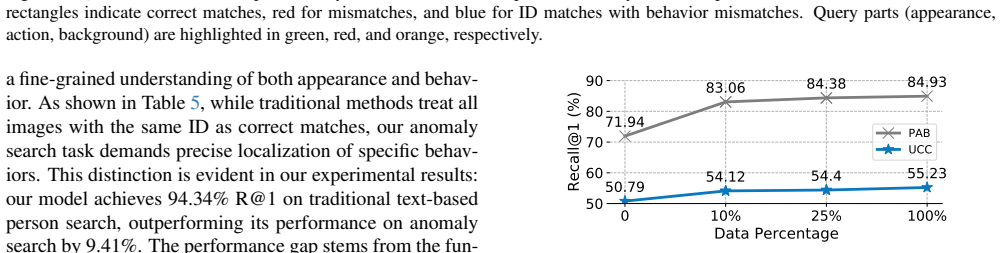
- The out-of-distribution result of 55.23% recall@1 on a surveillance-derived test set suggests the model transfers to unseen anomaly types, though with a sizeable drop from the in-distribution score.
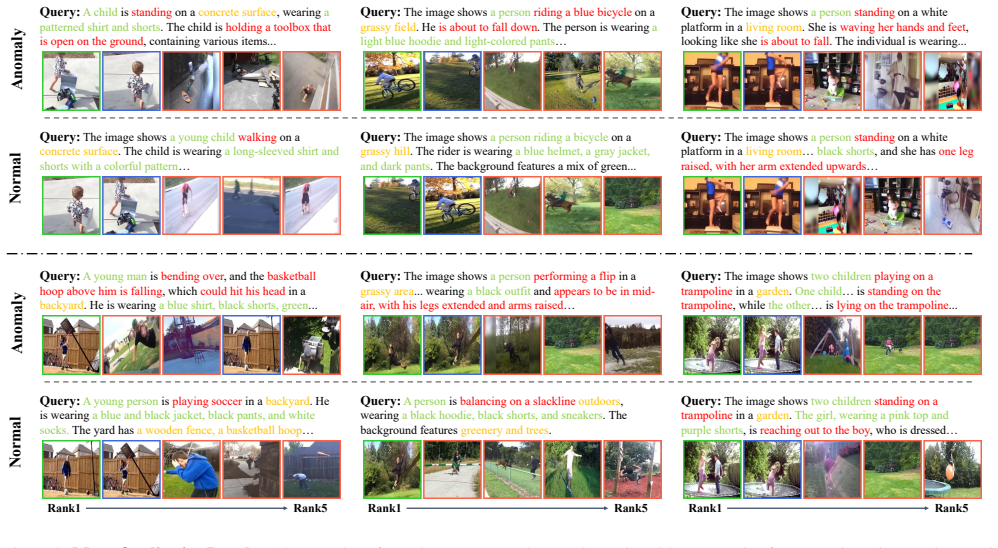
- Behavior search is harder than identity search on the same data—CMP gets 84.93% versus 94.34% recall@1—so anomaly retrieval should be measured separately from ordinary person search rather than treated as an incidental extension.
Reading between the lines
- Not stated in the paper, but if the video identities behind the real test pairs were not excluded from the caption pool used to prompt the synthetic training images, the reported generalization would be inflated; an explicit holdout audit would settle this.
- The pose-guided hard-negative idea could extend naturally to video anomaly search, where sequences of pose maps rather than single frames would distinguish falling from kneeling or running from stumbling.
- The synthetic training pipeline could be adapted to other anomalous human actions such as accidents or medical distress by changing the caption source, provided the test source is kept disjoint from training prompts.
- The benchmark’s frame-level text annotations for appearances, actions, and scenes may support future tasks like action grounding and scene-conditioned retrieval, not just end-to-end ranking.
Signed reviews
Editorial analysis
A structured set of objections, weighed in public.
Referee Report
Summary. The paper introduces a new task, text-based person anomaly search, in which a model retrieves a pedestrian image from a text query that describes appearance, action, and scene, including anomalous behaviors. To support this task, the authors construct the PAB benchmark: a training set of 1,013,605 synthetic image-text pairs generated from OOPS! captions using a diffusion model, and a real-world test set of 1,978 image-text pairs extracted from OOPS! videos. They also propose a Cross-Modal Pose-aware (CMP) framework that adds a pose-aware image encoder and identity-based hard negative mining to an X-VLM style baseline. Experiments report 84.93% R@1 on PAB and 55.23% R@1 on a newly assembled out-of-distribution UCC test set.
Significance. If the evaluation is sound, the paper addresses a practical gap: most text-based person search benchmarks focus on appearance and common actions, while safety and emergency applications require fine-grained retrieval of anomalous behaviors. The PAB benchmark is large in scale, and the authors provide a clear task formulation, a method, and a public release of dataset, model, and code. The inclusion of an OOD test set is a good practice and offers partial evidence of generalization. However, the central quantitative claim depends critically on a train/test disjointness condition that the paper does not establish, and the OOD result is considerably weaker than the headline PAB number.
major comments (1)
- [Figure 5 and §5] The training-data scaling experiment is interpreted as showing that 10% of the data already achieves a competitive recall rate, but the plotted curve is non-monotonic: the 0% point (X-VLM zero-shot) is 71.94% R@1 on PAB, while the 10% point drops to 50.79% R@1. This large drop is not discussed, and it weakens the claim that synthetic training data “facilitates” retrieval in a smooth, predictable way. Please explain the drop and clarify the comparison, or the scaling claim should be tempered.
minor comments (4)
- [Abstract and §5] The abstract says “1,013,605 synthesized image-text pairs” while Table 1 reports 1,015,583 total image-text pairs; the difference between training and total should be stated consistently in one place.
- [§3.2] The sentence “This process yields 6,739 Cn and 6,979 Ca captions” should specify whether these counts are before or after the deduplication and filtering steps described in Section 3.1; currently the pipeline order is ambiguous.
- [§4.2] The identity-based hard negative mining assumes that images generated from Cn and Ca of the same OOPS! video depict the same identity with similar appearance. Since the diffusion model may not preserve identity across independently generated images, please report a measure of appearance consistency or acknowledge this limitation.
- [Table 3 and §5] The compared methods are trained on 0.1M PAB pairs, but the paper does not state whether the same data sampling and augmentation procedures were used for all methods; this should be clarified for a fair comparison.
Circularity Check
No circularity: the benchmark and CMP method are evaluated empirically, with no derivation that reduces to its own inputs.
full rationale
The paper's central claims are empirical: (1) PAB is a new large-scale image-text benchmark for text-based person anomaly search, and (2) the proposed CMP model reaches 84.93% R@1 on PAB and 55.23% R@1 on the OOD UCC set, surpassing comparison methods. Neither claim is derived from a fitted parameter or from a self-citation. The training captions in Section 3.2 are generated from OOPS! captions (6,739 Cn and 6,979 Ca prompts) while the test set in Section 3.1 uses real OOPS! videos, so both originate from the same external source; this raises a possible train/test disjointness or data-hygiene concern, but that is a validity problem, not a circularity pattern under the defined categories. The IHNM strategy in Section 4.2 uses the known normal/anomaly caption pairing from the OOPS! data-generation process to construct hard negatives; this is a legitimate use of dataset structure rather than a fitted input renamed as a prediction. The losses in Section 4.3 (contrastive, ITM, MLM) are standard objectives and do not encode the test metric or the test labels. Self-citations to prior work by the same authors (MALS, WoRA, CAMeL, MRA) appear as comparison baselines, as related work, or as architectural precedent, but none of these citations is load-bearing for the benchmark's validity or for the reported improvement; the paper also compares against external methods such as CLIP, X-VLM, IRRA, and RaSa. No uniqueness theorem is imported, and no ansatz is smuggled in via a self-citation to justify the central claim. Consequently, the analysis finds no circular step that can be exhibited by quoting the paper and showing a reduction of a claimed result to its own inputs.
Assumptions & free parameters
free parameters (4)
- Contrastive temperature tau =
not reported
- Per-caption generated images =
75
- Anomaly to normal ratio =
3:2
- Image deduplication similarity threshold =
0.95
assumptions (4)
- domain assumption OOPS! timestamps accurately separate normal from anomalous moments
- domain assumption Synthetic images from paired normal/anomaly captions preserve identity across the pair
- domain assumption Train and test OOPS! video sets are disjoint
- domain assumption Qwen2-VL captions are sufficiently accurate for training and test
Cite this review
Pith. "Pith review of Beyond Walking: A Large-Scale Image-Text Benchmark for Text-based Person Anomaly Search." pith.science (2026). https://pith.science/paper/5F3A5MZ5
@misc{pith2026241117776,
  author       = {Pith},
  title        = {Pith review of: Beyond Walking: A Large-Scale Image-Text Benchmark for Text-based Person Anomaly Search},
  year         = {2026},
  howpublished = {\url{https://pith.science/paper/5F3A5MZ5}},
  note         = {Machine review of arXiv:2411.17776}
}
read the original abstract
Text-based person search aims to retrieve specific individuals across camera networks using natural language descriptions. However, current benchmarks often exhibit biases towards common actions like walking or standing, neglecting the critical need for identifying abnormal behaviors in real-world scenarios. To meet such demands, we propose a new task, text-based person anomaly search, locating pedestrians engaged in both routine or anomalous activities via text. To enable the training and evaluation of this new task, we construct a large-scale image-text Pedestrian Anomaly Behavior (PAB) benchmark, featuring a broad spectrum of actions, e.g., running, performing, playing soccer, and the corresponding anomalies, e.g., lying, being hit, and falling of the same identity. The training set of PAB comprises 1,013,605 synthesized image-text pairs of both normalities and anomalies, while the test set includes 1,978 real-world image-text pairs. To validate the potential of PAB, we introduce a cross-modal pose-aware framework, which integrates human pose patterns with identity-based hard negative pair sampling. Extensive experiments on the proposed benchmark show that synthetic training data facilitates the fine-grained behavior retrieval, and the proposed pose-aware method arrives at 84.93% recall@1 accuracy, surpassing other competitive methods. The dataset, model, and code are available at https://github.com/Shuyu-XJTU/CMP.
Figures


Figures from the paper (5 more)



Forward citations
Cited by 1 Pith paper
-
Efficient Vision Language Model Fine-tuning for Text-based Person Anomaly Search
Fine-tuning X-VLM on 10,000 image-text pairs from PAB reaches 85.49 Recall@1 on the TPAS test set, ranking fourth of six teams.
Reference graph
Works this paper leans on
-
[1]
Ub- normal: New benchmark for supervised open-set video anomaly detection
Andra Acsintoae, Andrei Florescu, Mariana-Iuliana Georgescu, Tudor Mare, Paul Sumedrea, Radu Tudor Ionescu, Fahad Shahbaz Khan, and Mubarak Shah. Ub- normal: New benchmark for supervised open-set video anomaly detection. In CVPR, pages 20143–20153, 2022. 2, 3, 4, 13
work page 2022
-
[2]
Robust real-time unusual event detection using mul- tiple fixed-location monitors
Amit Adam, Ehud Rivlin, Ilan Shimshoni, and Daviv Reinitz. Robust real-time unusual event detection using mul- tiple fixed-location monitors. IEEE transactions on pattern analysis and machine intelligence, 30(3):555–560, 2008. 2, 3, 13
work page 2008
-
[3]
Re-id done right: towards good practices for person re- identification
Jon Almazan, Bojana Gajic, Naila Murray, and Diane Lar- lus. Re-id done right: towards good practices for person re- identification. arXiv:1801.05339, 2018. 2
arXiv 2018
-
[4]
Qwen-vl: A frontier large vision-language model with versatile abilities
Jinze Bai, Shuai Bai, Shusheng Yang, Shijie Wang, Sinan Tan, Peng Wang, Junyang Lin, Chang Zhou, and Jingren Zhou. Qwen-vl: A frontier large vision-language model with versatile abilities. arXiv:2308.12966, 2023. 3, 4, 7, 12
arXiv 2023
-
[5]
Rasa: relation and sensitivity aware representation learning for text-based person search
Yang Bai, Min Cao, Daming Gao, Ziqiang Cao, Chen Chen, Zhenfeng Fan, Liqiang Nie, and Min Zhang. Rasa: relation and sensitivity aware representation learning for text-based person search. In IJCAI, pages 555–563, 2023. 3, 6, 7
work page 2023
-
[6]
Context recov- ery and knowledge retrieval: A novel two-stream framework for video anomaly detection
Congqi Cao, Yue Lu, and Yanning Zhang. Context recov- ery and knowledge retrieval: A novel two-stream framework for video anomaly detection. IEEE Transactions on Image Processing, 33:1810–1825, 2024. 3
work page 2024
-
[7]
Realtime multi-person 2d pose estimation using part affinity fields
Zhe Cao, Tomas Simon, Shih-En Wei, and Yaser Sheikh. Realtime multi-person 2d pose estimation using part affinity fields. In CVPR, pages 7291–7299, 2017. 3, 4, 5
work page 2017
-
[8]
Shikra: Unleashing multimodal llm’s referential dialogue magic
Keqin Chen, Zhao Zhang, Weili Zeng, Richong Zhang, Feng Zhu, and Rui Zhao. Shikra: Unleashing multimodal llm’s referential dialogue magic. arXiv:2306.15195, 2023. 3
arXiv 2023
Show all 72 references
-
[9]
Tipcb: A simple but effective part-based convolutional baseline for text-based person search
Yuhao Chen, Guoqing Zhang, Yujiang Lu, Zhenxing Wang, and Yuhui Zheng. Tipcb: A simple but effective part-based convolutional baseline for text-based person search. Neuro- computing, 494:171–181, 2022. 3
2022
-
[10]
BERT: Pre-training of deep bidirectional trans- formers for language understanding
Jacob Devlin, Ming-Wei Chang, Kenton Lee, and Kristina Toutanova. BERT: Pre-training of deep bidirectional trans- formers for language understanding. In NAACL-HLT, pages 4171–4186, Minneapolis, Minnesota, 2019. Association for Computational Linguistics. 6
2019
-
[11]
Semantically self-aligned network for text-to-image part-aware person re-identification
Zefeng Ding, Changxing Ding, Zhiyin Shao, and Dacheng Tao. Semantically self-aligned network for text-to-image part-aware person re-identification. arXiv:2107.12666,
-
[12]
Match4match: Enhancing text-video retrieval by maximum flow with minimum cost
Zhongjie Duan, Chengyu Wang, Cen Chen, Wenmeng Zhou, Jun Huang, and Weining Qian. Match4match: Enhancing text-video retrieval by maximum flow with minimum cost. In WWW, pages 3257–3267, 2023. 3
2023
-
[13]
Oops! pre- dicting unintentional action in video
Dave Epstein, Boyuan Chen, and Carl V ondrick. Oops! pre- dicting unintentional action in video. In CVPR, pages 919– 929, 2020. 3
2020
-
[14]
Convolutional trans- former based dual discriminator generative adversarial net- works for video anomaly detection
Xinyang Feng, Dongjin Song, Yuncong Chen, Zhengzhang Chen, Jingchao Ni, and Haifeng Chen. Convolutional trans- former based dual discriminator generative adversarial net- works for video anomaly detection. In ACM MM , pages 5546–5554, 2021. 3
2021
-
[15]
Multimodal motion con- ditioned diffusion model for skeleton-based video anomaly detection
Alessandro Flaborea, Luca Collorone, Guido Maria D’Amely Di Melendugno, Stefano D’Arrigo, Bardh Prenkaj, and Fabio Galasso. Multimodal motion con- ditioned diffusion model for skeleton-based video anomaly detection. In ICCV, pages 10318–10329, 2023. 3
2023
-
[16]
Contextual non-local alignment over full-scale repre- sentation for text-based person search
Chenyang Gao, Guanyu Cai, Xinyang Jiang, Feng Zheng, Jun Zhang, Yifei Gong, Pai Peng, Xiaowei Guo, and Xing Sun. Contextual non-local alignment over full-scale repre- sentation for text-based person search. arXiv:2101.03036,
-
[17]
Query in your tongue: Reinforce large language models with retrievers for cross-lingual search gen- erative experience
Ping Guo, Yue Hu, Yanan Cao, Yubing Ren, Yunpeng Li, and Heyan Huang. Query in your tongue: Reinforce large language models with retrievers for cross-lingual search gen- erative experience. In WWW, pages 1529–1538, 2024. 3
2024
-
[18]
Attribute-aware attention model for fine-grained representa- tion learning
Kai Han, Jianyuan Guo, Chao Zhang, and Mingjian Zhu. Attribute-aware attention model for fine-grained representa- tion learning. In ACM MM, pages 2040–2048, 2018. 2
2018
-
[19]
Text-based person search with limited data
Xiao Han, Sen He, Li Zhang, and Tao Xiang. Text-based person search with limited data. arXiv:2110.10807, 2021. 3
2021 arXiv
-
[20]
Deep residual learning for image recognition
Kaiming He, Xiangyu Zhang, Shaoqing Ren, and Jian Sun. Deep residual learning for image recognition. In CVPR, pages 770–778, 2016. 3
2016
-
[21]
Normalizing flows for hu- man pose anomaly detection
Or Hirschorn and Shai Avidan. Normalizing flows for hu- man pose anomaly detection. In ICCV, pages 13545–13554,
-
[22]
Cross-modal implicit relation rea- soning and aligning for text-to-image person retrieval
Ding Jiang and Mang Ye. Cross-modal implicit relation rea- soning and aligning for text-to-image person retrieval. In CVPR, pages 2787–2797, 2023. 3, 6, 7
2023
-
[23]
Cala: Complementary association learning for augmenting composed image retrieval
Xintong Jiang, Yaxiong Wang, Yujiao Wu, Bingwen Hu, and Xueming Qian. Cala: Complementary association learning for augmenting composed image retrieval. SIGIR, 2024. 3
2024
-
[24]
Align before fuse: Vision and language representation learn- ing with momentum distillation
Junnan Li, Ramprasaath Selvaraju, Akhilesh Gotmare, Shafiq Joty, Caiming Xiong, and Steven Chu Hong Hoi. Align before fuse: Vision and language representation learn- ing with momentum distillation. Advances in neural infor- mation processing systems, 34:9694–9705, 2021. 3
2021
-
[25]
Person search with natural lan- guage description
Shuang Li, Tong Xiao, Hongsheng Li, Bolei Zhou, Dayu Yue, and Xiaogang Wang. Person search with natural lan- guage description. In CVPR, pages 1970–1979, 2017. 1, 2, 3, 4
1970
-
[26]
Learning semantic- aligned feature representation for text-based person search
Shiping Li, Min Cao, and Min Zhang. Learning semantic- aligned feature representation for text-based person search. In ICASSP, pages 2724–2728. IEEE, 2022. 3
2022
-
[27]
Anomaly detection and localization in crowded scenes.IEEE transactions on pattern analysis and machine intelligence , 36(1):18–32, 2013
Weixin Li, Vijay Mahadevan, and Nuno Vasconcelos. Anomaly detection and localization in crowded scenes.IEEE transactions on pattern analysis and machine intelligence , 36(1):18–32, 2013. 2, 3, 13
2013
-
[28]
Improving person re-identification by attribute and identity learning
Yutian Lin, Liang Zheng, Zhedong Zheng, Yu Wu, Zhi- lan Hu, Chenggang Yan, and Yi Yang. Improving person re-identification by attribute and identity learning. Pattern recognition, 95:151–161, 2019. 2
2019
-
[29]
Improving person re-identification by multi-task learning
Hefei Ling, Ziyang Wang, Ping Li, Yuxuan Shi, Jiazhong Chen, and Fuhao Zou. Improving person re-identification by multi-task learning. Neurocomputing, 347:109–118, 2019. 2 9
2019
-
[30]
Swin transformer: Hierarchical vision transformer using shifted windows
Ze Liu, Yutong Lin, Yue Cao, Han Hu, Yixuan Wei, Zheng Zhang, Stephen Lin, and Baining Guo. Swin transformer: Hierarchical vision transformer using shifted windows. In ICCV, pages 10012–10022, 2021. 5
2021
-
[31]
Decoupled weight decay regularization
Ilya Loshchilov and Frank Hutter. Decoupled weight decay regularization. In ICLR, 2019. 7
2019
-
[32]
Abnormal event detec- tion at 150 fps in matlab
Cewu Lu, Jianping Shi, and Jiaya Jia. Abnormal event detec- tion at 150 fps in matlab. In ICCV, pages 2720–2727, 2013. 2, 3, 13
2013
-
[33]
A revisit of sparse coding based anomaly detection in stacked rnn framework
Weixin Luo, Wen Liu, and Shenghua Gao. A revisit of sparse coding based anomaly detection in stacked rnn framework. In ICCV, pages 341–349, 2017. 2, 3, 4, 13
2017
-
[34]
Aggregating deep pyramidal representations for person re- identification
Niki Martinel, Gian Luca Foresti, and Christian Micheloni. Aggregating deep pyramidal representations for person re- identification. In CVPR workshops, pages 0–0, 2019. 2
2019
-
[35]
Abnor- mal crowd behavior detection using social force model
Ramin Mehran, Alexis Oyama, and Mubarak Shah. Abnor- mal crowd behavior detection using social force model. In CVPR, pages 935–942. IEEE, 2009. 2, 13
2009
-
[36]
Im- proving description-based person re-identification by multi- granularity image-text alignments
Kai Niu, Yan Huang, Wanli Ouyang, and Liang Wang. Im- proving description-based person re-identification by multi- granularity image-text alignments. IEEE Transactions on Image Processing, 29:5542–5556, 2020. 3
2020
-
[37]
Plot: Text-based person search with part slot attention for corresponding part discovery
Jicheol Park, Dongwon Kim, Boseung Jeong, and Suha Kwak. Plot: Text-based person search with part slot attention for corresponding part discovery. In ECCV, pages 474–490. Springer, 2024. 3
2024
-
[38]
Image re-ranking based on topic diversity
Xueming Qian, Dan Lu, Yaxiong Wang, Li Zhu, Yuan Yan Tang, and Meng Wang. Image re-ranking based on topic diversity. IEEE Trans. Image Process. , 26(8):3734–3747,
-
[39]
Learn- ing transferable visual models from natural language super- vision
Alec Radford, Jong Wook Kim, Chris Hallacy, Aditya Ramesh, Gabriel Goh, Sandhini Agarwal, Girish Sastry, Amanda Askell, Pamela Mishkin, Jack Clark, et al. Learn- ing transferable visual models from natural language super- vision. In ICML, pages 8748–8763. PMLR, 2021. 3, 7
2021
-
[40]
Street scene: A new dataset and evaluation protocol for video anomaly detection
Bharathkumar Ramachandra and Michael Jones. Street scene: A new dataset and evaluation protocol for video anomaly detection. In WACV, pages 2569–2578, 2020. 2, 13
2020
-
[41]
Attribute-based representa- tions for accurate and interpretable video anomaly detection
Tal Reiss and Yedid Hoshen. Attribute-based representa- tions for accurate and interpretable video anomaly detection. arXiv:2212.00789, 2022. 3
2022 arXiv
-
[42]
Realvisxl v4.0, 2024
SG 161222. Realvisxl v4.0, 2024. https://huggingface.co/SG161222/RealVisXL V4.0. 4
2024
-
[43]
Learning granularity-unified representations for text-to-image person re-identification
Zhiyin Shao, Xinyu Zhang, Meng Fang, Zhifeng Lin, Jian Wang, and Changxing Ding. Learning granularity-unified representations for text-to-image person re-identification. In ACM MM, pages 5566–5574, 2022. 3
2022
-
[44]
See finer, see more: Implicit modality alignment for text-based person retrieval
Xiujun Shu, Wei Wen, Haoqian Wu, Keyu Chen, Yiran Song, Ruizhi Qiao, Bo Ren, and Xiao Wang. See finer, see more: Implicit modality alignment for text-based person retrieval. In ECCV workshop, 2023. 3
2023
-
[45]
Real-world anomaly detection in surveillance videos
Waqas Sultani, Chen Chen, and Mubarak Shah. Real-world anomaly detection in surveillance videos. In CVPR, pages 6479–6488, 2018. 2, 3, 7, 13
2018
-
[46]
From data deluge to data curation: A filtering-wora paradigm for efficient text-based person search
Jintao Sun, Hao Fei, Gangyi Ding, and Zhedong Zheng. From data deluge to data curation: A filtering-wora paradigm for efficient text-based person search. InWWW, pages 2341– 2351, 2025. 7
2025
-
[47]
Harnessing the power of mllms for transferable text-to-image person reid
Wentan Tan, Changxing Ding, Jiayu Jiang, Fei Wang, Yib- ing Zhan, and Dapeng Tao. Harnessing the power of mllms for transferable text-to-image person reid. In CVPR, pages 17127–17137, 2024. 3
2024
-
[48]
Multiple-environment self- adaptive network for aerial-view geo-localization
Tingyu Wang, Zhedong Zheng, Yaoqi Sun, Chenggang Yan, Yi Yang, and Tat-Seng Chua. Multiple-environment self- adaptive network for aerial-view geo-localization. Pattern Recognition, 152:110363, 2024. 7
2024
-
[49]
Uniad: Integrating geometric and semantic cues for unified anomaly detection
Xiaodong Wang, Hongmin Hu, Fei Yan, Junwen Lu, Zhiqiang Zeng, Weidong Hong, and Zhedong Zheng. Uniad: Integrating geometric and semantic cues for unified anomaly detection. In ACM Multimedia, 2025. 2
2025
-
[50]
Position focused attention network for image-text matching
Yaxiong Wang, Hao Yang, Xueming Qian, Lin Ma, Jing Lu, Biao Li, and Xin Fan. Position focused attention network for image-text matching. In Proceedings of the Twenty- Eighth International Joint Conference on Artificial Intelli- gence, pages 3792–3798, 2019. 3
2019
-
[51]
PFAN++: bi-directional image-text retrieval with position focused attention network
Yaxiong Wang, Hao Yang, Xiuxiu Bai, Xueming Qian, Lin Ma, Jing Lu, Biao Li, and Xin Fan. PFAN++: bi-directional image-text retrieval with position focused attention network. IEEE Trans. Multim., 23:3362–3376, 2021. 3
2021
-
[52]
Beyond general alignment: Fine-grained entity-centric image-text matching with multi- modal attentive experts
Yaxiong Wang, Lianwei Wu, Lechao Cheng, Zhun Zhong, Yujiao Wu, and Meng Wang. Beyond general alignment: Fine-grained entity-centric image-text matching with multi- modal attentive experts. SIGIR, 2025. 3
2025
-
[53]
Caibc: Capturing all-round infor- mation beyond color for text-based person retrieval
Zijie Wang, Aichun Zhu, Jingyi Xue, Xili Wan, Chao Liu, Tian Wang, and Yifeng Li. Caibc: Capturing all-round infor- mation beyond color for text-based person retrieval. In ACM MM, pages 5314–5322, 2022. 3
2022
-
[54]
Look before you leap: Improv- ing text-based person retrieval by learning a consistent cross- modal common manifold
Zijie Wang, Aichun Zhu, Jingyi Xue, Xili Wan, Chao Liu, Tian Wang, and Yifeng Li. Look before you leap: Improv- ing text-based person retrieval by learning a consistent cross- modal common manifold. In ACM MM, pages 1984–1992,
1984
-
[55]
Eda: Easy data augmentation tech- niques for boosting performance on text classification tasks
Jason Wei and Kai Zou. Eda: Easy data augmentation tech- niques for boosting performance on text classification tasks. arXiv:1901.11196, 2019. 13
1901 arXiv
-
[56]
Toward video anomaly retrieval from video anomaly detection: New benchmarks and model.IEEE Transactions on Image Processing, 33:2213–2225, 2024
Peng Wu, Jing Liu, Xiangteng He, Yuxin Peng, Peng Wang, and Yanning Zhang. Toward video anomaly retrieval from video anomaly detection: New benchmarks and model.IEEE Transactions on Image Processing, 33:2213–2225, 2024. 3
2024
-
[57]
Clip-driven fine-grained text-image person re-identification
Shuanglin Yan, Neng Dong, Liyan Zhang, and Jinhui Tang. Clip-driven fine-grained text-image person re-identification. arXiv:2210.10276, 2022. 3
2022 arXiv
-
[58]
When urban region profiling meets large language models
Yibo Yan, Haomin Wen, Siru Zhong, Wei Chen, Haodong Chen, Qingsong Wen, Roger Zimmermann, and Yuxuan Liang. When urban region profiling meets large language models. In WWW, 2024. 3
2024
-
[59]
Towards unified text-based person retrieval: A large-scale multi-attribute and language search benchmark
Shuyu Yang, Yinan Zhou, Zhedong Zheng, Yaxiong Wang, Li Zhu, and Yujiao Wu. Towards unified text-based person retrieval: A large-scale multi-attribute and language search benchmark. In ACM MM, pages 4492–4501, 2023. 3, 6, 7
2023
-
[60]
Minimizing the pretraining gap: Domain- aligned text-based person retrieval
Shuyu Yang, Yaxiong Wang, Yongrui Li, Li Zhu, and Zhe- dong Zheng. Minimizing the pretraining gap: Domain- aligned text-based person retrieval. arXiv preprint arXiv:2507.10195, 2025. 7 10
2025
-
[61]
Capenrich: Enrich- ing caption semantics for web images via cross-modal pre- trained knowledge
Linli Yao, Weijing Chen, and Qin Jin. Capenrich: Enrich- ing caption semantics for web images via cross-modal pre- trained knowledge. In WWW, pages 2392–2401, 2023. 3
2023
-
[62]
Camel: Cross- modality adaptive meta-learning for text-based person re- trieval
Hang Yu, Jiahao Wen, and Zhedong Zheng. Camel: Cross- modality adaptive meta-learning for text-based person re- trieval. IEEE Transactions on Information Forensics and Se- curity, 2025. 7
2025
-
[63]
Towards surveillance video-and-language understanding: New dataset baselines and challenges
Tongtong Yuan, Xuange Zhang, Kun Liu, Bo Liu, Chen Chen, Jian Jin, and Zhenzhen Jiao. Towards surveillance video-and-language understanding: New dataset baselines and challenges. In CVPR, pages 22052–22061, 2024. 2, 3, 13
2024
-
[64]
Generative cooper- ative learning for unsupervised video anomaly detection
M Zaigham Zaheer, Arif Mahmood, M Haris Khan, Mat- tia Segu, Fisher Yu, and Seung-Ik Lee. Generative cooper- ative learning for unsupervised video anomaly detection. In CVPR, pages 14744–14754, 2022. 3
2022
-
[65]
Multi-grained vi- sion language pre-training: Aligning texts with visual con- cepts
Yan Zeng, Xinsong Zhang, and Hang Li. Multi-grained vi- sion language pre-training: Aligning texts with visual con- cepts. ICML, 2022. 7
2022
-
[66]
Generative label fused network for image-text matching
Guoshuai Zhao, Chaofeng Zhang, Heng Shang, Yaxiong Wang, Li Zhu, and Xueming Qian. Generative label fused network for image-text matching. Knowl. Based Syst., 263: 110280, 2023. 2
2023
-
[67]
Scalable person re-identification: A benchmark
Liang Zheng, Liyue Shen, Lu Tian, Shengjin Wang, Jing- dong Wang, and Qi Tian. Scalable person re-identification: A benchmark. In ICCV, pages 1116–1124, 2015. 2
2015
-
[68]
Zhedong Zheng and Liang Zheng. 2. object re-identification: Problems, algorithms and responsible research practice. The Boundaries of Data, page 21, 2024. 1
2024
-
[69]
Unlabeled sam- ples generated by gan improve the person re-identification baseline in vitro
Zhedong Zheng, Liang Zheng, and Yi Yang. Unlabeled sam- ples generated by gan improve the person re-identification baseline in vitro. In ICCV, pages 3754–3762, 2017. 2
2017
-
[70]
Joint discriminative and generative learning for person re-identification
Zhedong Zheng, Xiaodong Yang, Zhiding Yu, Liang Zheng, Yi Yang, and Jan Kautz. Joint discriminative and generative learning for person re-identification. In CVPR, pages 2138– 2147, 2019. 2
2019
-
[71]
Dual-path convolutional image-text embeddings with instance loss
Zhedong Zheng, Liang Zheng, Michael Garrett, Yi Yang, Mingliang Xu, and Yi-Dong Shen. Dual-path convolutional image-text embeddings with instance loss. ACM Transac- tions on Multimedia Computing, Communications, and Ap- plications, 16(2):1–23, 2020. 3
2020
-
[72]
Anomaly:Normal
Aichun Zhu, Zijie Wang, Yifeng Li, Xili Wan, Jing Jin, Tian Wang, Fangqiang Hu, and Gang Hua. Dssl: Deep surroundings-person separation learning for text-based per- son retrieval. In ACM MM, pages 209–217, 2021. 1, 2, 4 11 Beyond Walking: A Large-Scale Image-Text Benchmark for...
2021
Reviewed August 12, 2026 · model on record in the stance chip above.
Discussion (0). Continue with ORCID to comment.