REVIEW 2 major objections 5 minor 34 references
A flexible, open-source radio-frequency driver for acousto-optic and electro-optic devices
T0 review · 2 major / 5 minor · reviewed 2026-08-14 · deepseek-v4-flash
Pith's one-line read This paper presents a two-board, open-source radio-frequency driver built around telecom amplifiers that delivers >1 W from 10 MHz to 1.1 GHz, ≥5 W from 20 to 100 MHz, and >90 dB extinction in digital switching.
desk verdict A genuinely useful, open-source RF driver with solid measured performance, but the headline power specs are stated under different drive conditions than the as-shipped VCO configuration. read the letter →
The pith
A machine-rendered reading of the paper's core claim, the machinery that carries it, and where it could break.
The reading
What carries the argument
The load-bearing mechanism is a two-stage amplification chain: a low-noise wideband preamplifier (HMC8410) that provides about 20 dB of gain, followed by a high-power GaN amplifier (HMC1099) whose saturated output exceeds 10 W. Around this core, four high-isolation RF switches (MASWSS0178) provide digital output switching and source selection, a voltage-variable attenuator (F2255) provides linear-in-dB analog amplitude control, and a custom power-sequencing circuit (LTC2924 and HMC920) enforces the correct order of gate, drain, and RF voltages. The RF switches with >50 dB isolation and ~20 ns switching time are what make the >90 dB extinction and 40 ns fall time possible.
What would settle it
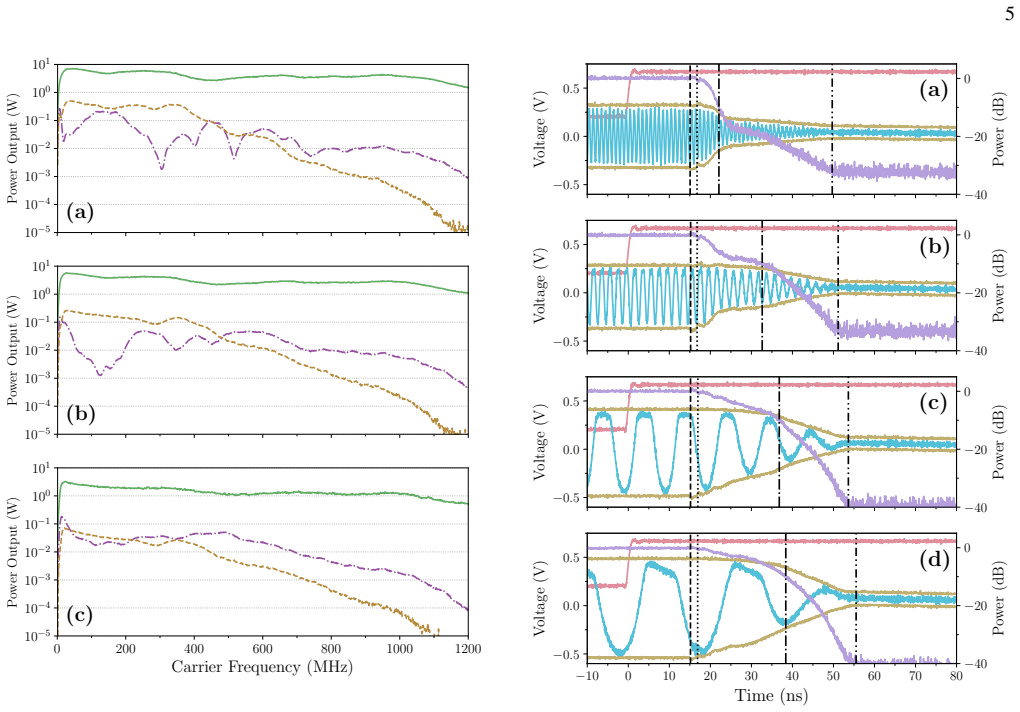
Take several drivers built from the released design files and measure, with an oscilloscope and network analyzer as in Figures 4 and 5, how long the output takes to fall by 30 dB and what the final extinction is across 10 MHz to 1.1 GHz; a single unit that takes more than 40 ns or extinguishes less than 90 dB would contradict the central switching claim.
Extended reading notes
Core claim
The paper's discovery is that telecom-grade microwave amplifiers, normally used for communications, can be repurposed into a laboratory RF driver if their strict power-on sequencing and thermal needs are handled. With an HMC8410 low-noise preamplifier followed by an HMC1099 GaN power amplifier, the driver reaches >1 W over 10 MHz–1.1 GHz and ≥5 W over 20–100 MHz, and the supporting RF switching and attenuator chain gives >30 dB extinction within 40 ns, final extinction >90 dB, and an analog amplitude-modulation bandwidth of about 70 kHz. The design also lets the user switch between an on-board voltage-controlled oscillator and an external RF source, and it protects the amplifiers through custom power sequencing that survived 100 deliberately improper power cycles. All design files are released so that others can build and adapt the driver.
Load-bearing premise
The headline switching speed, extinction, and analog modulation bandwidth were measured on one test driver; the 40-unit production run was only checked for output power, so those specifications are assumed to carry over to every unit.
Editorial extensions
If this is right
- Users can construct or order a driver from the released files and obtain >1 W from 10 MHz to 1.1 GHz and ≥5 W from 20 MHz to 100 MHz, covering the four AO/EO device classes the design targets.
- The same TTL-controlled unit achieves >30 dB extinction within 40 ns and final extinction >90 dB, compatible with fast amplitude control in quantum logic and laser switching.
- Analog amplitude modulation at ~70 kHz bandwidth and frequency modulation via an on-board VCO or an external source give one box the flexibility usually spread across several commercial drivers.
- The power-sequencing and thermal design lets telecom amplifiers run reliably, including through 100 intentionally improper power cycles, so the high-power stage is protected without extra user diligence.
- Output power in a 40-driver production run stayed within amplifier specifications, and the per-unit cost of about $1085 in that run is competitive with commercial alternatives.
Reading between the lines
- If the design is reproduced elsewhere, labs should re-measure switching time and extinction on more than one unit, since the production acceptance data cover only output power.
- The physical separation of the high-power amplifier board from the control board suggests the output stage could be swapped for a different amplifier to reach other frequency or power ranges without redesigning the control electronics.
- Because the ~70 kHz AM bandwidth is set largely by the chosen attenuator, swapping in a pin-compatible faster attenuator is the most direct route to wider analog modulation bandwidth; the paper identifies the option but does not demonstrate the replacement's performance.
Signed reviews
Editorial analysis
A structured set of objections, weighed in public.
Referee Report
Summary. The paper presents a two-PCB radio-frequency driver design for acousto-optic and electro-optic modulators, built around telecom amplifiers (HMC8410 pre-amplifier and HMC1099 high-power amplifier) with custom power-sequencing and thermal-management circuitry. The driver supports analog amplitude and frequency modulation, fast digital power switching, switching between an integrated VCO and an external RF source, and is packaged with a 2U rack enclosure. The authors report direct measurements on a test driver of output power, harmonics, switching time, extinction ratio, and AM bandwidth, plus output-power statistics from a 40-unit production run. All schematics, layouts, and bills of materials are provided on GitHub. The abstract claims >1 W over 10 MHz to 1.1 GHz, >=5 W from 20 to 100 MHz, ~70 kHz AM bandwidth, >30 dB extinction within 40 ns, and >90 dB final extinction.
Significance. If the reported performance is reproducible, this is a valuable open-source contribution to the atomic, molecular, and optical physics community. The paper's strengths are its direct, instrument-based measurements, the absence of any fitted or normalized parameters in the central claims, and the complete availability of design files, which makes the results independently checkable. The engineering details on power sequencing and thermal management are also useful beyond this specific design. The main weakness is that the headline power specifications are stated without the operating conditions under which they were measured, and the production-run data do not fully match the abstract's claims in the standard shipped configuration.
major comments (2)
- [Abstract; Section III, Fig. 3; Table I] The headline power claims are not tied to a single, well-defined operating configuration. The abstract states ">1 W of output power over a 10 MHz to 1.1 GHz frequency range, and >=5 W from 20 MHz to 100 MHz" without specifying the input drive. In Section III, the >1 W specification is demonstrated to 1 GHz at 1 mW external input, the extension to 1.1 GHz requires 3.2 mW input, and the >=5 W band is demonstrated only at 10 mW input. Table I shows that production units using the integrated VCO with the 3 dB fixed attenuator installed produce 4.6(2) W at 80 MHz and 3.7(1) W at 200 MHz, so a unit built and shipped in the standard configuration does not meet the advertised >=5 W specification across the stated band. Please revise the abstract and Section III to state explicitly the input power, VCO setting, and attenuator configuration for each power claim, and reconcile Table I with the >=5 W headline specification.
- [Section IV; Section III] The dynamic specifications (switching time, extinction ratio, AM bandwidth) are measured on a single test driver, whereas the production-run data in Section IV cover only output power. The paper is transparent that Section III describes one test unit, but the abstract presents these dynamic specifications as properties of the driver without qualification. Please add an explicit sentence in the abstract or conclusions stating that the dynamic specifications were characterized on a single test unit and have not been verified across the production run, so that users of the open-source files are not misled about unit-to-unit variation.
minor comments (5)
- [Abstract] The abstract states "total area $< 255$ cm"; the unit should be cm^2, as used in Section I, to avoid ambiguity.
- [Figure 3] The main power curves in Figure 3 have no error bars or estimated measurement uncertainty; adding a statement about the measurement uncertainty or showing representative error bars would strengthen the quantitative claims.
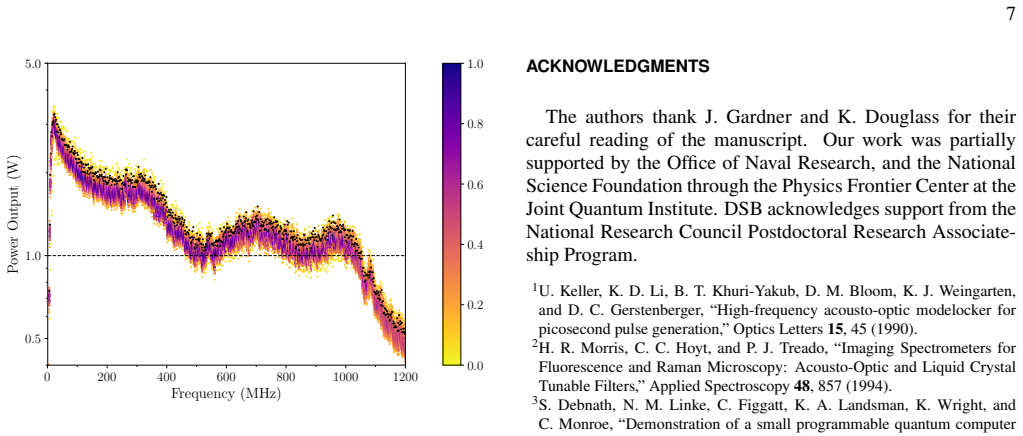
- [Figure 7 and Table I] Figure 7's color scale, normalized to the most probable output power in each frequency bin, is unconventional and makes the device-to-device variation difficult to assess; a conventional scatter plot or box plot would be clearer. Also, the 400 MHz row in Table I reports "1.9 W" with no standard deviation, which should be footnoted as a single-unit measurement.
- [Section III, Figure 4] The definition of Ppp in Eq. (2) uses Vupper and Vlower, but the text says the measurement noise floor is <= -30 dB; stating the absolute noise-floor level in watts or dBm would help readers interpret the switching data.
- [Section II C] The sentence "Condition (1) is valid for the HMC8410 pre-amplifier, but not the HMC1099 high-power amplifier" is clear, but the physical justification for why constant-gate-voltage biasing is preferred for the HMC1099 could be expanded by one sentence to help non-RF specialists.
Circularity Check
No significant circularity: the paper is an experimental hardware characterization whose claims are compared against external instruments and vendor datasheets.
full rationale
This paper reports the design and measurement of an RF driver for acousto-optic and electro-optic devices. Its central claims are output power, bandwidth, switching time, extinction ratio, and amplitude-modulation bandwidth. These are all empirical quantities measured with external instrumentation: a Rohde & Schwarz FSV scalar network analyzer with a tracking generator, a DSA72004B oscilloscope, and a DG4162 waveform generator. The power specifications are compared with the HMC1099 datasheet (e.g., harmonic distortion agrees with the HMC1099 datasheet), and the AM bandwidth is compared with the F2255 VVA datasheet (approximately 65 kHz). There is no fitted parameter that is then renamed as a prediction, no quantity is defined in terms of the result it is supposed to support, and no load-bearing argument relies on a self-citation. The production-run data in Table I are simply additional measurements of the same design, not inputs to the headline specifications. The closest thing to a possible concern is that the abstract's headline power figures are obtained under different external drive conditions than some production configurations, but that is a specification-conditions mismatch or correctness risk, not circularity: the measured values do not reduce to any assumed input. No self-citation chain is used to justify the central results, and the design files are made available for independent reproduction. Therefore the circularity score is 0.
Assumptions & free parameters
assumptions (3)
- domain assumption The HMC1099 and HMC8410 amplifiers behave as specified in their datasheets, including gain, saturated output power, isolation, and thermal resistance, when used with the typical application circuits referenced in Section II.A.
- domain assumption The thermal model in Section II.D, which neglects heat spreading through vias and assumes FR4 conductivity of 0.25 W/m/K, gives a conservative bound on the junction-to-heatsink temperature rise.
- domain assumption A 50 ohm impedance environment with AC coupling using 100 nF capacitors is adequate across the 10 MHz to 1.1 GHz operating band.
Cite this review
Pith. "Pith review of A flexible, open-source radio-frequency driver for acousto-optic and electro-optic devices." pith.science (2026). https://pith.science/paper/5FAZFBPI
@misc{pith2026190802156,
  author       = {Pith},
  title        = {Pith review of: A flexible, open-source radio-frequency driver for acousto-optic and electro-optic devices},
  year         = {2026},
  howpublished = {\url{https://pith.science/paper/5FAZFBPI}},
  note         = {Machine review of arXiv:1908.02156}
}
abstract
We present a design for a radio-frequency driver that leverages telecom amplifiers to achieve high power output and wide bandwidth. The design consists of two compact printed circuit boards (total area $< 255$ cm), which incorporate power (turn-on) and thermal management to prevent accidental damage to the amplifier circuitry. Our driver provides $>1$ W of output power over a $10$ MHz to $1.1$ GHz frequency range, and $\geq 5$ W from $20$ MHz to $100$ MHz. The driver circuit includes auxiliary components for analog frequency and amplitude modulation ($\approx 70$ kHz bandwidth), as well as digital power switching ($> 30$ dB of extinction within $40$ ns and final extinction $> 90$ dB). The radio-frequency source can also be digitally switched between an external input and an integrated voltage-controlled oscillator. Our design is motivated by the need for flexible, inexpensive drivers of optically active devices, such as acousto-optic and electro-optic modulators.
Figures


Figures from the paper (2 more)

Reference graph
Works this paper leans on
-
[1]
author author U. Keller , author K. D. \ Li , author B. T. \ Khuri-Yakub , author D. M. \ Bloom , author K. J. \ Weingarten ,\ and\ author D. C. \ Gerstenberger ,\ title title High-frequency acousto-optic modelocker for picosecond pulse generation , \ @noop journal journal Optics Letters \ volume 15 ,\ pages 45 ( year 1990 ) NoStop
work page 1990
-
[2]
author author H. R. \ Morris , author C. C. \ Hoyt ,\ and\ author P. J. \ Treado ,\ title title Imaging Spectrometers for Fluorescence and Raman Microscopy: Acousto-Optic and Liquid Crystal Tunable Filters , \ @noop journal journal Applied Spectroscopy \ volume 48 ,\ pages 857 ( year 1994 ) NoStop
work page 1994
-
[3]
author author S. Debnath , author N. M. \ Linke , author C. Figgatt , author K. A. \ Landsman , author K. Wright ,\ and\ author C. Monroe ,\ title title Demonstration of a small programmable quantum computer with atomic qubits , \ https://doi.org/10.1038/nature18648 journal journal Nature \ volume 536 ,\ pages 63 ( year 2016 ) NoStop
-
[4]
author author G. Camy , author C. J. \ Bord\'e ,\ and\ author M. Ducloy ,\ title title Heterodyne saturation spectroscopy through frequency modulation of the saturating beam , \ @noop journal journal Optics Communications \ volume 41 ,\ pages 325 ( year 1982 ) NoStop
work page 1982
-
[5]
author author G. C. \ Bjorklund ,\ title title Frequency-modulation spectroscopy: a new method for measuring weak absorptions and dispersions , \ @noop journal journal Optics Letters \ volume 5 ,\ pages 15 ( year 1980 ) NoStop
work page 1980
-
[6]
author author J. L. \ Hall , author L. Hollberg , author T. Baer ,\ and\ author H. G. \ Robinson ,\ title title Optical heterodyne saturation spectroscopy , \ https://doi.org/10.1063/1.92867 journal journal Applied Physics Letters \ volume 39 ,\ pages 680 ( year 1981 ) NoStop
-
[7]
author author V. Negnevitsky \ and\ author L. D. \ Turner ,\ title title Wideband laser locking to an atomic reference with modulation transfer spectroscopy , \ https://doi.org/10.1364/OE.21.003103 journal journal Optics Express \ volume 21 ,\ pages 3103 ( year 2012 ) NoStop
-
[8]
author author S. R. \ Granade , author M. E. \ Gehm , author K. M. \ O'Hara ,\ and\ author J. E. \ Thomas ,\ title title All-Optical Production of a Degenerate Fermi Gas , \ https://doi.org/10.1103/PhysRevLett.88.120405 journal journal Physical Review Letters \ volume 88 ,\ pages 120405 ( year 2002 ) NoStop
Show all 34 references
-
[9]
author author M. D. \ Barrett , author J. A. \ Sauer ,\ and\ author M. S. \ Chapman ,\ title title All-Optical Formation of an Atomic Bose-Einstein Condensate. \ https://doi.org/10.1103/PhysRevLett.87.010404 journal journal Physical Review Letters \ volume 87 ,\ pages 010404 (...
-
[10]
@noop howpublished https://dcc.ligo.org/LIGO-E1400445/public NoStop
-
[11]
o hlich , author T. Lahaye , author B. Kaltenh \
author author B. Fr \" o hlich , author T. Lahaye , author B. Kaltenh \" a user , author H. K \" u bler , author S. M \" u ller , author T. Koch , author M. Fattori ,\ and\ author T. Pfau ,\ title title Two-frequency acousto-optic modulator driver to improve the beam pointing ...
-
[12]
Eurocard, NIM)
note The PCBs could be adapted to fit in modular electronics crates ( e.g. Eurocard, NIM). The crate's bus would need to source \( 1 \) at \(24 \) per installed RF driver. Stop
-
[13]
@noop howpublished https://github.com/JQIamo/aom-driver NoStop
-
[14]
@noop howpublished https://github.com/JQIamo/GaN-Amplifier NoStop
-
[15]
@noop note The identification of commercial products is for information only and does not imply recommendation or endorsement by the National Institute of Standards and Technology NoStop
-
[16]
note Future versions of our design will use two directional couplers placed before SW3 and SW4 (see Figure Fig:RFCircuit ) to increase both flexibility and output power. Stop
-
[17]
note Results from a prototype suggest that similar performance can be achieved at lower cost using \(10 \) standard capacitors with a high self-resonant frequency. Stop
-
[18]
A NoStop
@noop title HMC1099 GaN Power Amplifier ,\ organization Analog Devices ( year 2016 a ),\ note Rev. A NoStop
2016
-
[19]
0 NoStop
@noop title HMC 8410 Low Noise Amplifier ,\ organization Analog Devices ( year 2016 b ),\ note Rev. 0 NoStop
2016
-
[20]
author author Analog Devices Technical Support ,\ @noop howpublished Private Communication ( year 2017 ) NoStop
2017
-
[21]
V4 NoStop
@noop title MASWSS0178 SPDT High Isolation Terminated Switch ,\ organization Macom ,\ note Rev. V4 NoStop
-
[22]
@noop title IDTF2255NLGK Datasheet ,\ organization Integrated Device Technology ( year 2017 ),\ note REV 1 NoStop
2017
-
[23]
@noop note Possible replacements include RFSA2033 and RFSA2113, which increase modulation bandwidth at the expense of dynamic range and power output, respectively. Stop
-
[24]
Bhandare , author A
author author A. Bhandare , author A. Patnaik , author D. Pommerenke , author S. Sharma ,\ and\ author D. Fischer ,\ title title Low cost fast frequency switching driver for Acousto-Optic Modulators used in laser cooling , \ https://doi.org/10.1016/j.ohx.2019.e00054 journal jo...
-
[25]
1.0 NoStop
@noop title TLP2767 ,\ organization Toshiba ( year 2016 ),\ note Rev. 1.0 NoStop
2016
-
[26]
E NoStop
@noop title AD9910 Direct Digital Synthesizer ( year 2016 a ),\ note Rev. E NoStop
2016
-
[27]
@noop howpublished https://github.com/JQIamo/ad9910-dds NoStop
-
[28]
F NoStop
@noop title AD9914 3.5 GSPS Direct Digital Synthesizer with 12-Bit DAC ,\ organization Analog Devices ( year 2016 b ),\ note Rev. F NoStop
2016
-
[29]
author author K. Kaya ,\ @noop title AN-1363 Application Note: Meeting the Biasing Requirements of Externally Biased RF/Microwave Amplifiers with Active Bias Controllers ,\ organization Analog Devices ( year 2016 ),\ note Rev. 0 NoStop
2016
-
[30]
@noop title HMC920LP5E Active Bias Controller ,\ organization Analog Devices ,\ note v07.1013 NoStop
-
[31]
@noop title LTC2924 Quad Power Supply Sequencer ,\ organization Linear Technology ( year 2016 ),\ note REV C NoStop
2016
-
[32]
These amplifiers require V _ DD > 24 , so an additional power supply would be necessary
@noop note Our power sequencing electronics could be adapted for other high-power amplifiers with superior 2nd harmonic distortion. These amplifiers require V _ DD > 24 , so an additional power supply would be necessary. Stop
-
[33]
note We find that RF pickup from the tracking generator, even when it is not attached to the RF driver, is an important contribution to the measured RF spectrum. Stop
-
[34]
The locking performance suggests that the VVA has reasonable phase margin at the \(3 \) point
note When using the RF driver to intensity stabilize laser beams, we have observed intensity locking bandwidths \( 60 \). The locking performance suggests that the VVA has reasonable phase margin at the \(3 \) point. Stop
Reviewed August 14, 2026 · model on record in the stance chip above.
Discussion (0). Continue with ORCID to comment.