Basis-Adaptive Sparse-State Simulation of Quantum Circuits
Pith reviewed 2026-06-29 17:30 UTC · model grok-4.3
The pith
Dynamically rotating qubits to their natural-orbital bases before truncation keeps sparse quantum simulation accurate longer.
A machine-rendered reading of the paper's core claim, the machinery that carries it, and where it could break.
Core claim
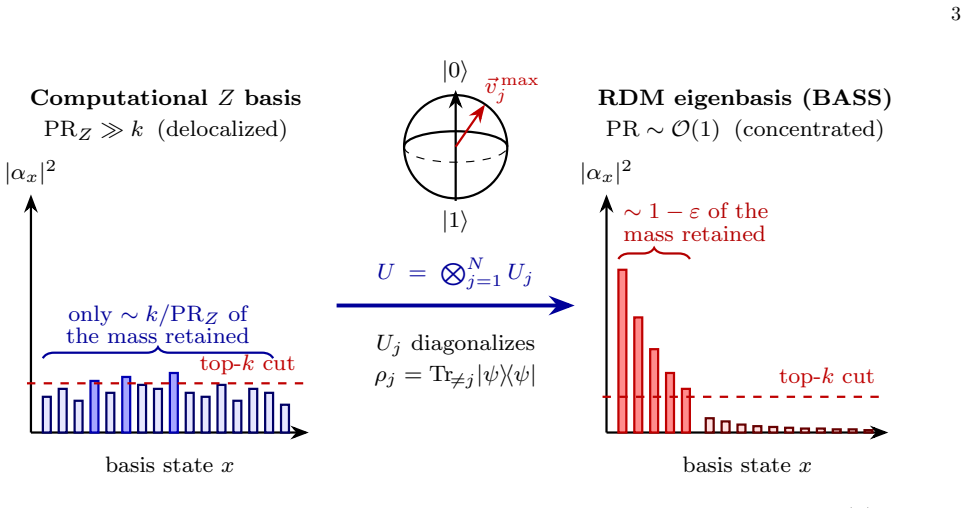
BASS rotates each qubit into the eigenbasis of its instantaneous single-qubit reduced density matrix before truncation, producing a product basis that remains stationary for the inverse participation ratio with a residual bounded by local entanglement coherence. This adaptive basis allows top-k truncation to retain higher overlap than a fixed computational basis throughout circuit evolution. Benchmarks confirm that the ratio k over PR_Z flags regimes of advantage, and that on disordered Ising circuits the method yields approximately one order of magnitude improvement in state overlap at fixed budget while incurring only moderate extra wall-clock time in the memory-limited regime.
What carries the argument
The natural-orbital product basis formed by the eigenbasis of each qubit's single-qubit reduced density matrix, which carries the argument by keeping the inverse participation ratio stationary enough for top-k truncation to remain near-optimal.
If this is right
- Top-k selection is uniquely optimal for one-step truncation in any fixed basis.
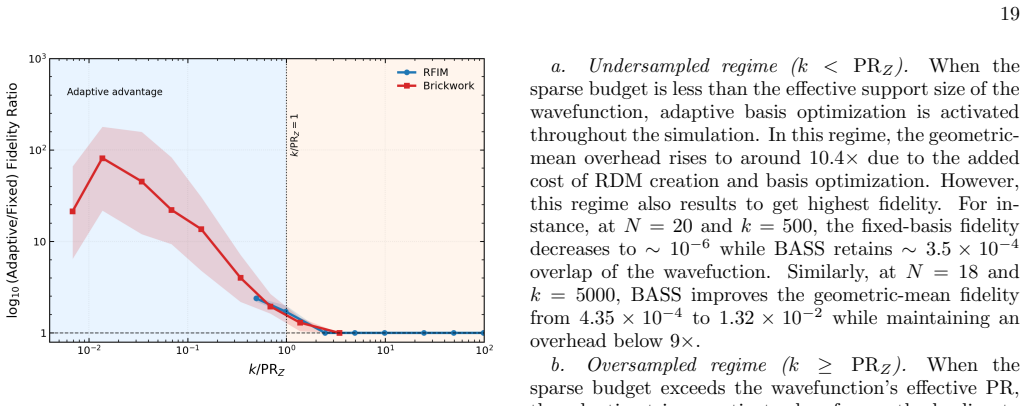
- The ratio k/PR_Z serves as an indicator for when adaptive measurement bases provide a performance advantage.
- On structured brickwork circuits BASS reaches substantially higher fidelity than fixed-basis methods with only moderate wall-clock increase.
- For disordered Ising circuits the method improves state overlap by approximately one order of magnitude at fixed computational budget.
Where Pith is reading between the lines
- The same adaptive-basis logic could be applied to other many-body Hamiltonians whose local reduced density matrices remain low-rank for moderate times.
- Hybrid schemes that switch between fixed and adaptive bases at detected entanglement thresholds might reduce overhead while preserving the overlap gain.
- Extending the stationarity proof to two-qubit reduced density matrices could tighten the residual bound and further improve truncation quality.
Load-bearing premise
Rotating each qubit to the eigenbasis of its instantaneous single-qubit reduced density matrix produces a product basis that keeps the inverse participation ratio stationary enough for top-k truncation to remain near-optimal throughout the circuit evolution.
What would settle it
Execute both BASS and fixed-basis sparse simulation on a disordered Ising circuit at identical k and budget, then compare final state overlap; absence of an approximately tenfold improvement would falsify the performance claim.
Figures
read the original abstract
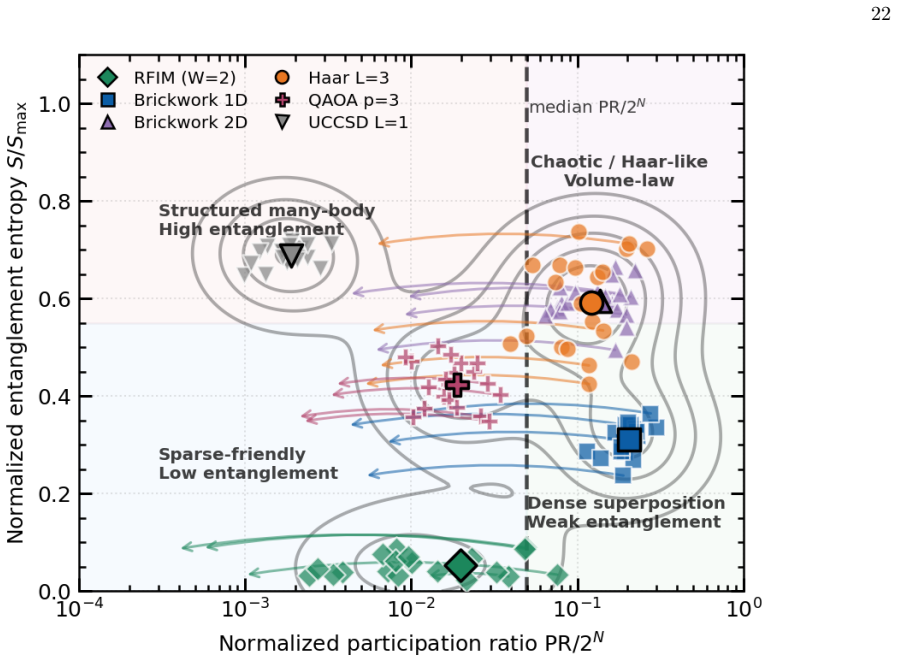
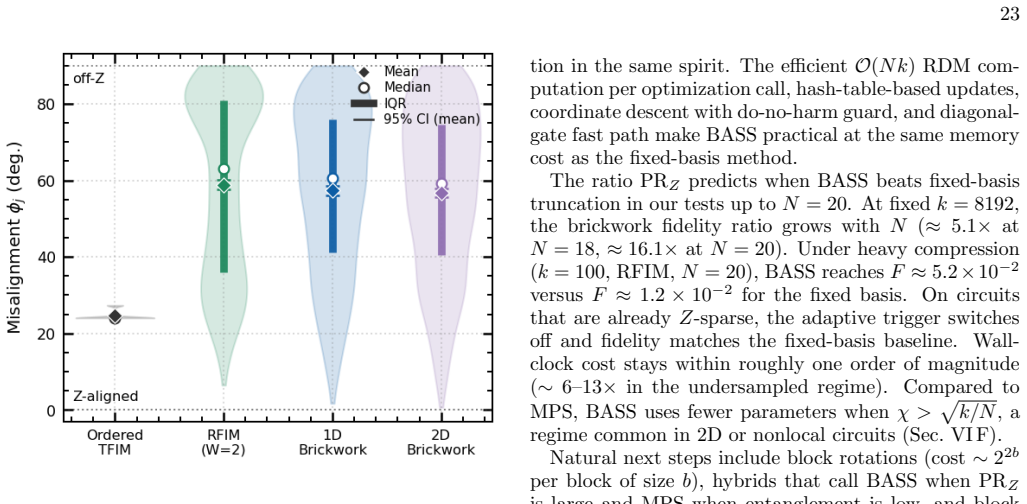
Classical simulation of many-body quantum systems remains economical only when wavefunction amplitudes stay localized in the working basis. Fixed-basis sparse-state simulators scale memory as $\mathcal{O}(k)$ by keeping the largest computational-basis amplitudes; however, fidelity drops once entanglement or basis rotations spread weight across the Hilbert space. In this work, we introduce an algorithm called Basis-Adaptive Sparse-State Simulation (BASS), which updates each qubit's local representation basis during execution rather than locking the computational basis for the entire circuit. Before truncation, each qubit is rotated into the eigenbasis of its single-qubit reduced density matrix, following the natural-orbital idea from quantum chemistry, so the retained amplitudes stay clustered. We prove that top-$k$ selection is uniquely optimal for one-step truncation in any fixed basis and that the one-body reduced-density-matrix eigenbasis is a stationary product basis for the inverse participation ratio (PR), with a residual bounded by local entanglement coherence. We perform a systematic benchmarking over a variety of quantum circuits and demonstrate that the ratio \(k/\text{PR}_Z\) (sparse budget over computational participation ratio) serves as an indicator for regimes in which adaptive measurement bases provide a performance advantage. On structured brickwork circuits, BASS achieves substantially higher fidelity than the fixed-basis approach, while incurring only a moderate increase in wall-clock time in the memory-limited regime. Moreover, for disordered Ising circuits, BASS systematically provides an improvement of approximately one order of magnitude in state overlap at a fixed computational budget.
Editorial analysis
A structured set of objections, weighed in public.
Referee Report
Summary. The manuscript introduces Basis-Adaptive Sparse-State Simulation (BASS), which rotates each qubit into the eigenbasis of its single-qubit reduced density matrix before top-k truncation in sparse-state quantum circuit simulation. It claims proofs that top-k truncation is uniquely optimal for one-step fidelity maximization in any fixed basis and that the one-body RDM eigenbasis is stationary for the inverse participation ratio (IPR) with a residual bounded by local entanglement coherence. The ratio k/PR_Z is proposed as an indicator for when adaptation yields advantage. Systematic benchmarks are presented, with the headline result that BASS yields an approximately one-order-of-magnitude improvement in state overlap for disordered Ising circuits at fixed computational budget, while incurring only moderate extra wall-clock cost in the memory-limited regime.
Significance. If the stationarity bound is shown to remain tight in the benchmarked regimes and the performance gains are reproducible, the method could extend the practical reach of sparse-state simulators for circuits whose entanglement structure permits a slowly varying product basis. The explicit proofs of optimality and stationarity constitute a clear technical strength.
major comments (2)
- [§3] §3 (stationarity theorem): the residual in the IPR stationarity bound is controlled by local entanglement coherence; the manuscript does not report numerical values or plots of this coherence term for the disordered Ising instances at the depths and disorder strengths used in the performance benchmarks, leaving open whether the residual stays negligible enough to preserve the claimed order-of-magnitude overlap gain.
- [§4.3] §4.3 and associated figures: the reported ~10× state-overlap improvement for disordered Ising circuits at fixed k rests on the assumption that the adaptive basis keeps the effective PR sufficiently stationary; without explicit verification that the coherence residual remains small or error bars on the overlap data, the central empirical claim cannot be fully assessed.
minor comments (2)
- [Abstract] The abstract states that proofs are supplied, yet the main text would benefit from a short self-contained derivation sketch of the one-step optimality result (currently referenced only by name) to aid readers who do not consult the supplement.
- [Notation] Notation for PR_Z and the indicator k/PR_Z is introduced without an explicit equation in the main text; adding the definition would improve clarity.
Simulated Author's Rebuttal
We thank the referee for the careful reading and constructive comments on our manuscript. We address each major comment below and will revise the manuscript accordingly to strengthen the presentation of the stationarity bound and empirical results.
read point-by-point responses
-
Referee: [§3] §3 (stationarity theorem): the residual in the IPR stationarity bound is controlled by local entanglement coherence; the manuscript does not report numerical values or plots of this coherence term for the disordered Ising instances at the depths and disorder strengths used in the performance benchmarks, leaving open whether the residual stays negligible enough to preserve the claimed order-of-magnitude overlap gain.
Authors: We agree that reporting the coherence residual explicitly would allow readers to verify the tightness of the bound for the specific benchmark instances. In the revised manuscript we will add numerical values (and, where appropriate, plots) of the local entanglement coherence term for the disordered Ising circuits at the depths and disorder strengths used in §4.3. This will directly address whether the residual remains small enough to support the observed performance advantage. revision: yes
-
Referee: [§4.3] §4.3 and associated figures: the reported ~10× state-overlap improvement for disordered Ising circuits at fixed k rests on the assumption that the adaptive basis keeps the effective PR sufficiently stationary; without explicit verification that the coherence residual remains small or error bars on the overlap data, the central empirical claim cannot be fully assessed.
Authors: We concur that the central empirical claim would be more robust with explicit verification of the coherence residual and, if feasible, error bars on the overlap data. The revised manuscript will include these quantities for the disordered Ising benchmarks, thereby confirming that the stationarity assumption holds in the reported regimes and allowing a fuller assessment of the order-of-magnitude overlap gain. revision: yes
Circularity Check
No significant circularity; proofs and benchmarks are independent of inputs
full rationale
The paper states explicit mathematical proofs for top-k optimality in any fixed basis and for the stationarity of the one-body RDM eigenbasis for the IPR (with residual bounded by local entanglement coherence). These are presented as derived results rather than reductions to fitted parameters or self-referential definitions. The k/PR_Z ratio is introduced as an indicator following from those proofs. Benchmarking claims (e.g., order-of-magnitude overlap improvement) rest on empirical comparisons, not on predictions forced by construction from the same data. No self-citations appear as load-bearing steps in the derivation chain. The work is self-contained against external benchmarks.
Axiom & Free-Parameter Ledger
free parameters (1)
- k
axioms (1)
- domain assumption The one-body reduced-density-matrix eigenbasis is a stationary product basis for the inverse participation ratio (PR), with residual bounded by local entanglement coherence.
Reference graph
Works this paper leans on
-
[1]
19 We seek to find the dominant eigenvector of a 2×2 Hermitian matrix (e.g., a single-qubit density matrix) analytically
Proof of Eq. 19 We seek to find the dominant eigenvector of a 2×2 Hermitian matrix (e.g., a single-qubit density matrix) analytically. By avoiding iterative numerical eigenvalue routines, we guarantee a predictable, constant computa- tional costO(1) per qubit during simulation loops. Consider a general 2×2 Hermitian matrix representing the single-qubit st...
-
[2]
Derivation of the 2-Qubit RDM This section details the derivation of the two-qubit RDM from ann-qubit pure state by tracing out the rest of the system. It explains the conceptual and compu- tational motivations behind splitting basis vectors into block and rest indices and provides a condensed step- by-step example for a 3-qubit system. Interpreting the n...
-
[3]
The group forr= 0 contains statesx 0 (s= 0) andx 1 (s= 1)
Grouping by the rest index yields two sets. The group forr= 0 contains statesx 0 (s= 0) andx 1 (s= 1). The group forr= 1 contains statesx 2 (s= 0) andx 3 (s= 1). To compute a specific matrix element such as [ρ 01]0,1, the formula dictates summing over pairs (i, i ′) with the same rest index wheres(x i) = 0 ands(x i′) = 1. Forr= 0, this pairs statex 0 with...
-
[4]
A.1.Empirical comparison of top-kand random-k truncation in fixed-basis simulation.Fidelity as a func- tion of retained subspace dimensionkforN= 16 and circuit depthL= 3
Empirical support for top-koptimality FIG. A.1.Empirical comparison of top-kand random-k truncation in fixed-basis simulation.Fidelity as a func- tion of retained subspace dimensionkforN= 16 and circuit depthL= 3. Top-ktruncation exhibits stable monotonic fi- delity growth with increasingk, while random-ktruncation remains near the stochastic noise floor ...
2048
-
[5]
The correspondence is structural rather than literal
Formal correspondence Table IX establishes a term-by-term mapping between the BASS framework and L¨ owdin’s natural-orbital the- ory [34]. The correspondence is structural rather than literal. In quantum chemistry, the wavefunction is expanded in Slater determinants built from molecular orbitals: 27 TABLE IX. Correspondence between BASS and natural- orbit...
-
[6]
First, there is a key difference in dimensionality
Key differences Despite the formal correspondence between these two settings, there are several important differences that sig- nificantly affect how reduced density matrices and basis optimizations are used in practice. First, there is a key difference in dimensionality. In quantum chemistry, the one-body reduced density ma- trix (RDM) is anM×Mmatrix, wh...
-
[7]
Algorithm 2Single-Qubit Basis Optimization 1:procedureBasisOptimize(| ˜ψ⟩,{U j}) 2:n passes ←3 3:forpass = 1,
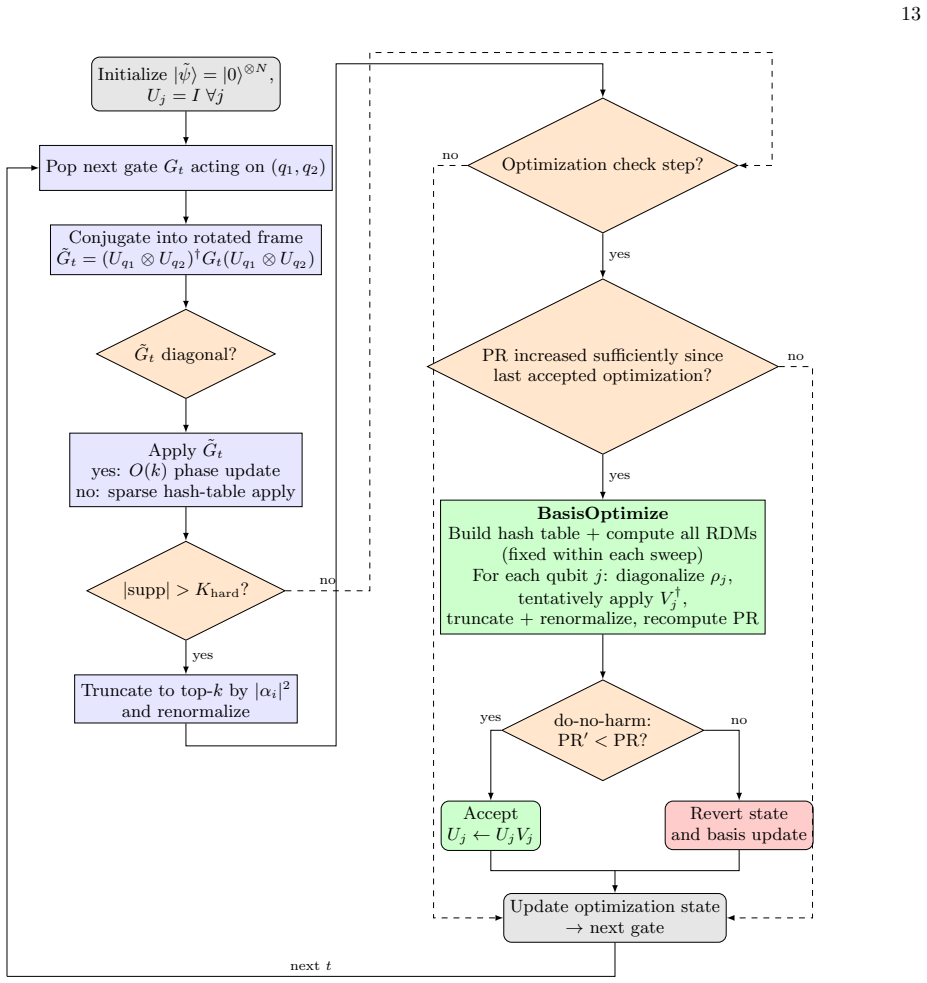
Main simulation loop Algorithm 1 drives the simulation: apply gates in the accumulated local basis, defer truncation where possible, and callBasisOptimizeonly when the schedule and PR- growth tests both pass. Algorithm 2Single-Qubit Basis Optimization 1:procedureBasisOptimize(| ˜ψ⟩,{U j}) 2:n passes ←3 3:forpass = 1, . . . , n passes do 4:improved←False 5...
-
[8]
V D, specialized to optimize the current basis via sequential single-qubit updates
Single-qubit basis optimization BasisOptimize is the coordinate-descent sweep de- scribed in Sec. V D, specialized to optimize the current basis via sequential single-qubit updates. A single ”pass” of this routine consists of visiting every qubit once and attempting a local rotation that lowers the chosen objec- tive (here, PR). At the beginning of each p...
-
[9]
rest in- dex
Optional two-qubit brick-wall optimization The optional brick-wall pass (Sec. V C) is designed to handle two-qubit rotations that cannot be decomposed into products of single-qubit unitaries. It operates us- ing an even/odd pairing schedule: in each sub-sweep, ei- ther all even edges or all odd edges are updated, so that within a given sub-sweep the algor...
-
[10]
(17)– (18)
Reduced-density-matrix kernels For a generaln-qubit state | ˜ψ⟩= N−1X i=0 αi|xi⟩, N= 2 n, we compute the single-qubit reduced density matrixρ j for qubitjusing the matrix elements given in Eqs. (17)– (18). Explicitly, (ρj)bb = X i:b j(xi)=b |αi|2, b∈ {0,1}, whereb j(xi) denotes thejth bit of computational basis state|x i⟩. Lines 8–10 of the code implement...
-
[11]
diagonal-only
Sparse gate application Algorithm 5 presents the fast path for applying a two- qubit diagonal gate to a compressed quantum state rep- resentation. Given a state| ˜ψ⟩with support indexed by bit stringsx i and a diagonal gate ˜Gacting on qubits (q1, q2), the procedure iterates over all basis states in the support. For each indexi, it first reads the active ...
-
[12]
Truncation, renormalization, and top-kselection Truncation selects the greatest|α i|2 and discards the remainder, while renormalization ensures P i |αi|2 = 1. This truncation-renormalization combination happens repeatedly in our procedure: after deferred cuts, after each trial rotation inBasisOptimize, and as the core inner step of the two-qubit rotate-tr...
-
[13]
Complexity summary Table X lists the asymptotic costs per subroutine for a state bounded by|supp| ≤K hard =O(k). TABLE X. Per-call complexity of BASS subroutines. Ex- pected hash costs assume well-distributed keys with load fac- tors<0.5; worst-case hash collisions degrade toO(k) per insertion. The logarithmic terms in optimization arise from the intermed...
-
[14]
Brickwork circuits (BW).-TheN-qubit brickwork cir- cuit of depthLconsists of alternating layers of nearest- neighbor two-qubit gates
Circuit family definitions All benchmark results in the main text use the follow- ing circuit constructions. Brickwork circuits (BW).-TheN-qubit brickwork cir- cuit of depthLconsists of alternating layers of nearest- neighbor two-qubit gates. Odd layers apply gates to pairs (0,1),(2,3), . . .; even layers apply gates to pairs (1,2),(3,4), . . .. Each gate...
-
[15]
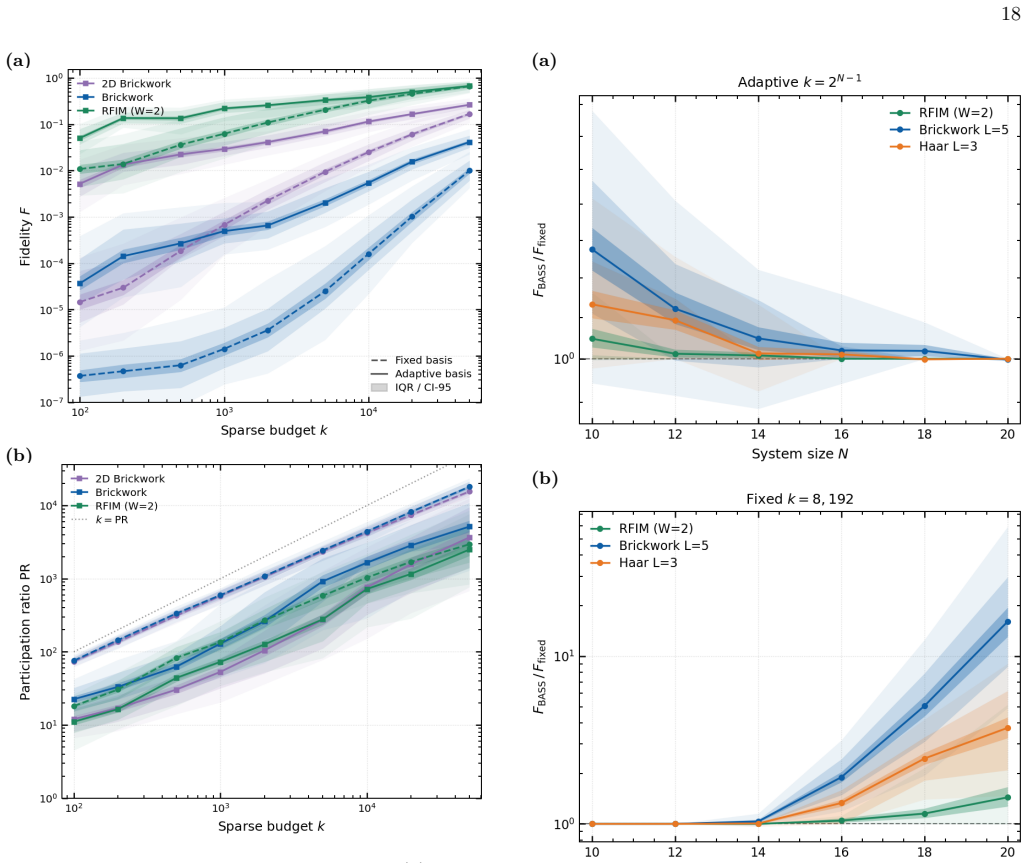
Extended scaling data Tables XI and XII report the complete fidelity datasets underlying the scaling analysis of Sec. VI. Reported fi- delities are geometric means over independent random circuit realizations, and the improvement ratio is defined as FBASS/Ffixed. Two complementary scaling regimes are considered. In the fixed-ksetting, the sparse budget is...
-
[16]
This behavior can be captured by fitting the scaling PRZ ∼2 αN, where the exponentαcharacterizes how quickly the participation ratio increases with system size
PR scaling The PR PR Z of exact states grows exponentially with Nfor circuits that generate substantial entanglement. This behavior can be captured by fitting the scaling PRZ ∼2 αN, where the exponentαcharacterizes how quickly the participation ratio increases with system size. A larger value ofαsignals that the state has support over a greater fraction o...
-
[17]
Across all tested configurations, the runtime overhead remains bounded to approximately one order of magni- tude despite the additional cost of basis optimization
Runtime scaling and fidelity tradeoffs Table XIII summarizes representative runtime and fi- delity tradeoffs for adaptive-basis truncation in brickwork circuits (L= 6). Across all tested configurations, the runtime overhead remains bounded to approximately one order of magni- tude despite the additional cost of basis optimization. At the same time, the ad...
-
[18]
Geometric means are appropriate be- cause fidelity ratios span several orders of magnitude and multiplicative variation is more natural than addi- tive
Statistical methodology All reported fidelity ratios are geometric means: for nindependent trials with ratiosr i, the reported ratio is ¯r= (Q i ri)1/n. Geometric means are appropriate be- cause fidelity ratios span several orders of magnitude and multiplicative variation is more natural than addi- tive. Error bars (where shown) indicate the multiplica- t...
-
[19]
Code-path equivalence A critical validation is that BASS with basis optimiza- tion disabled exactly reproduces the fixed-basis sparse- simulation code path. We verify this by running both code paths on identical circuits (N= 10-20, all five cir- cuit families, 10 trials each) and comparing the output state vectors component-by-component: max i |αBASS off ...
-
[20]
V D) were frequently termi- nated after only one to two passes
Adaptive-basis sweep convergence On the benchmark circuits studied, the multi-pass adaptive-basis sweeps (Sec. V D) were frequently termi- nated after only one to two passes. In brickwork circuits with depthL= 5, the average number of passes per op- timization call was 1.05±0.02, with no reverts recorded in the investigated circumstances. In this example,...
-
[21]
Numerical stability The 2×2 analytic eigensolver for single-qubit reduced density matrices (RDMs) exhibits robust numerical sta- bility provided that the separation between its eigenval- ues, quantified by the gap ∆λ, satisfies ∆λ >10 −14. In practical implementations, when the squared magni- tude of the off-diagonal elementbobeys|b| 2 < ϵ mach · max(|a|,...
-
[22]
We assess the sensitivity of BASS to these parameters on brickwork circuits with system size N= 16 and bond dimension budgetk= 2048, averag- ing results over 10 independent trials
Sensitivity to hyperparameters BASS exposes three main tunable hyperparameters that control the trade-offs between simulation fidelity, runtime, and memory usage: the optimization interval denoted byn opt, the hard-cap multiplierK hard/k, and the adaptive trigger threshold used to decide when to in- voke optimization. We assess the sensitivity of BASS to ...
2048
-
[23]
Theoretical basis In a single truncation step the retained probabilityγ 2 equals the step fidelity exactly. When the true state |ψ⟩= P x βx|x⟩is trimmed to itsklargest-amplitude components and renormalised to form |ψk⟩=N −1X x∈S ∗ βx|x⟩,N 2 ≡γ 2 = X x∈S ∗ |βx|2,(F1) the fidelityF=|⟨ψ|ψ k⟩|2 =γ 2 exactly, with no approxi- mation. For a multi-step simulatio...
-
[24]
Sys- tem sizesN∈ {14,16,18,20}and sparse budgetsk∈ {512,1024,2048,4096}are swept with 50 trials per con- figuration
Violation rates We measureF < γ 2 tot rates across 2 400 independent trials on three circuit families: Haar-random (L= 3), 1D brickwork (L= 5), and QAOA (p= 3). Sys- tem sizesN∈ {14,16,18,20}and sparse budgetsk∈ {512,1024,2048,4096}are swept with 50 trials per con- figuration. All configurations satisfyk≪PR Z for the tested circuit families and sizes. A t...
2048
-
[25]
Componentα B performs depth-dependent satu- ration adjustment
Calibrated bounding estimator To reduce residual violations, we introduce a gate- count-dependent correction factorR=α(γ 2 tot, M)·γ 2 tot, whereMis the total gate count and αA = 1−z s 1−γ 2 tot γ2 tot ·η·M ,(F3) αB = 1− γ2 tot M δ ,(F4) α= clip(min(α A, αB),0.01,1).(F5) Componentα A introduces a phase-error penalty that in- creases with 1−γ 2 tot (the un...
-
[26]
Universality We assess whether the calibration generalises using three cross-validation protocols. (i) Random 90/10 trial split.The held-out test set has a violation rate of 0.83% (2/240; Wilson 95% CI: [0.23%,2.99%]), which is completely statistically equiva- lent to the training set rate of 1.57% (CI: [1.13%,2.19%]). This indicates that the correction a...
-
[27]
Boixo, S
S. Boixo, S. V. Isakov, V. N. Smelyanskiy,et al., Charac- terizing quantum supremacy in near-term devices, Nat. Phys.14, 595 (2018)
2018
-
[28]
Huanget al., Classical simulation of quantum supremacy circuits, arXiv (2020), arXiv:2005.06787
C. Huanget al., Classical simulation of quantum supremacy circuits, arXiv (2020), arXiv:2005.06787
-
[29]
I. L. Markov and Y. Shi, Simulating quantum computa- tion by contracting tensor networks, SIAM J. Comput. 38, 963 (2008)
2008
-
[30]
Beguˇ si´ c, J
T. Beguˇ si´ c, J. Gray, and G. K.-L. Chan, Fast and con- verged classical simulations of evidence for the utility of quantum computing before fault tolerance, Sci. Adv.10, eadk4321 (2024)
2024
-
[31]
Tindall, M
J. Tindall, M. Fishman, E. M. Stoudenmire, and D. Sels, Efficient tensor network simulation of IBM’s eagle kicked Ising experiment, PRX Quantum5, 010308 (2024)
2024
-
[32]
K. Kechedzhiet al., Effective quantum volume, fidelity, and computational cost of noisy quantum processing ex- periments, arXiv (2024), arXiv:2306.15970
-
[33]
F. Pan, K. Chen, and P. Zhang, Solving the sampling problem of the Sycamore quantum circuits, Phys. Rev. Lett.129, 090502 (2022)
2022
-
[34]
Aruteet al., Quantum supremacy using a pro- grammable superconducting processor, Nature574, 505 (2019)
F. Aruteet al., Quantum supremacy using a pro- grammable superconducting processor, Nature574, 505 (2019)
2019
-
[35]
Wuet al., Strong quantum computational advantage using a superconducting quantum processor, Phys
Y. Wuet al., Strong quantum computational advantage using a superconducting quantum processor, Phys. Rev. Lett.127, 180501 (2021)
2021
-
[36]
Y. Kim, A. Eddins, S. Anand, K. X. Wei, E. van den Berg, S. Rosenblatt, H. Nayfeh, Y. Wu, M. Zaletel, K. Temme, and A. Kandala, Evidence for the utility of quantum computing before fault tolerance, Nature618, 500 (2023)
2023
-
[37]
S. R. White, Density matrix formulation for quantum renormalization groups, Phys. Rev. Lett.69, 2863 (1992)
1992
-
[38]
Vidal, Efficient classical simulation of slightly entan- gled quantum computations, Phys
G. Vidal, Efficient classical simulation of slightly entan- gled quantum computations, Phys. Rev. Lett.91, 147902 (2003)
2003
-
[39]
Schollw¨ ock, The density-matrix renormalization group in the age of matrix product states, Ann
U. Schollw¨ ock, The density-matrix renormalization group in the age of matrix product states, Ann. Phys.326, 96 (2011)
2011
-
[40]
Fishman, S
M. Fishman, S. R. White, and E. M. Stoudenmire, The ITensor software library for tensor network calculations, 40 SciPost Phys. Codebases , 4 (2022)
2022
-
[41]
Ayral, J
T. Ayral, J. Claudon, M. Dupont, K. Beck, and T. Lou- vet, Density-matrix renormalization group algorithm for simulating quantum circuits with a finite fidelity, PRX Quantum4, 020304 (2023)
2023
-
[42]
Or´ us, A practical introduction to tensor networks: Matrix product states and projected entangled pair states, Ann
R. Or´ us, A practical introduction to tensor networks: Matrix product states and projected entangled pair states, Ann. Phys.349, 117 (2014)
2014
-
[43]
Verstraete, V
F. Verstraete, V. Murg, and J. I. Cirac, Matrix prod- uct states, projected entangled pair states, and varia- tional renormalization group methods for quantum spin systems, Adv. Phys.57, 143 (2008)
2008
-
[44]
Y. Zhou, E. M. Stoudenmire, and X. Waintal, What lim- its the simulation of quantum computers?, Phys. Rev. X 10, 041038 (2020)
2020
-
[45]
The Heisenberg Representation of Quantum Computers
D. Gottesman, The Heisenberg representation of quan- tum computers, arXiv (1998), arXiv:quant-ph/9807006
work page internal anchor Pith review Pith/arXiv arXiv 1998
-
[46]
Aaronson and D
S. Aaronson and D. Gottesman, Improved simulation of stabilizer circuits, Phys. Rev. A70, 052328 (2004)
2004
-
[47]
Bravyi and D
S. Bravyi and D. Gosset, Improved classical simulation of quantum circuits dominated by Clifford gates, Phys. Rev. Lett.116, 250501 (2016)
2016
-
[48]
Bravyi, E
S. Bravyi, E. Campbell, D. Gosset, and M. Howard, Sim- ulation of quantum circuits by low-rank stabilizer decom- positions, Quantum3, 181 (2019)
2019
-
[49]
Haug and M
T. Haug and M. S. Kim, Scalable measures of magic re- source for quantum computers, PRX Quantum4, 010301 (2023)
2023
-
[50]
Leone, S
L. Leone, S. F. E. Oliviero, and A. Hamma, Stabilizer R´ enyi entropy, Phys. Rev. Lett.128, 050402 (2022)
2022
-
[51]
Zulehner and R
A. Zulehner and R. Wille, Advanced simulation of quan- tum computations, IEEE Trans. Comput.-Aided Des. In- tegr. Circuits Syst.38, 848 (2019)
2019
-
[52]
S. Hillmich, I. L. Markov, and R. Wille, Just like the real thing: Fast weak simulation of quantum computation, arXiv (2020), arXiv:2005.14085
-
[53]
Movassagh, The hardness of random quantum circuits, Nat
R. Movassagh, The hardness of random quantum circuits, Nat. Phys.19, 1719 (2023)
2023
-
[54]
A. M. Dalzell, N. Hunter-Jones, and F. G. S. L. Brand˜ ao, Random quantum circuits anticoncentrate in log depth, PRX Quantum3, 010333 (2022)
2022
-
[55]
F. G. S. L. Brand˜ ao, A. W. Harrow, and M. Horodecki, Local random quantum circuits are approximate polynomial-designs, Commun. Math. Phys.346, 397 (2016)
2016
- [56]
-
[57]
Heurtelet al., Perceval: A software platform for dis- crete variable photonic quantum computing, Quantum7, 931 (2023)
N. Heurtelet al., Perceval: A software platform for dis- crete variable photonic quantum computing, Quantum7, 931 (2023)
2023
-
[58]
N. M. Tubman, J. Lee, T. Y. Takeshita, M. Head- Gordon, and K. B. Whaley, A deterministic alternative to the full configuration interaction quantum Monte Carlo method, J. Chem. Phys.145, 044112 (2016)
2016
-
[59]
N. M. Tubman, C. D. Freeman, D. S. Levine, J. Hachmann, M. Head-Gordon, and K. B. Whaley, Mod- ern approaches to exact diagonalization and selected configuration interaction with the adaptive sampling CI method, J. Chem. Theory Comput.16, 2139 (2020)
2020
-
[60]
L¨ owdin, Quantum theory of many-particle systems
P.-O. L¨ owdin, Quantum theory of many-particle systems. I. physical interpretations by means of density matri- ces, natural spin-orbitals, and convergence problems in the method of configurational interaction, Phys. Rev.97, 1474 (1955)
1955
-
[61]
Ratini, C
L. Ratini, C. Capecci, and L. Guidoni, Mutual information-based selection of natural orbitals for quan- tum circuit simulation, J. Chem. Theory Comput.20, 3535 (2024)
2024
-
[62]
B. O. Roos, P. R. Taylor, and P. E. M. Siegbahn, A com- plete active space SCF method (CASSCF) using a den- sity matrix formulated super-CI approach, Chem. Phys. 48, 157 (1980)
1980
-
[63]
P. J. Fasano, C. Constantinou, M. A. Caprio, P. Maris, and J. P. Vary, Natural orbitals for the ab initio no-core configuration interaction approach, Physical Review C 105, 054301 (2022)
2022
-
[64]
Buijsman, V
W. Buijsman, V. Gritsev, and V. Cheianov, Many-body localization in the fock space of natural orbitals, SciPost Physics4, 038 (2018)
2018
-
[65]
Nahum, J
A. Nahum, J. Ruhman, S. Vijay, and J. Haah, Quantum entanglement growth under random unitary dynamics, Phys. Rev. X7, 031016 (2017)
2017
-
[66]
C. W. von Keyserlingk, T. Rakovszky, F. Pollmann, and S. L. Sondhi, Operator hydrodynamics, OTOCs, and en- tanglement growth in systems without conservation laws, Phys. Rev. X8, 021013 (2018)
2018
-
[67]
A. Chan, A. De Luca, and J. T. Chalker, Solution of a minimal model for many-body quantum chaos, Phys. Rev. X8, 041019 (2018)
2018
-
[68]
Bollob´ as, A probabilistic proof of an asymptotic for- mula for the number of labelled regular graphs, European Journal of Combinatorics1, 311 (1980)
B. Bollob´ as, A probabilistic proof of an asymptotic for- mula for the number of labelled regular graphs, European Journal of Combinatorics1, 311 (1980)
1980
-
[69]
A Quantum Approximate Optimization Algorithm
E. Farhi, J. Goldstone, and S. Gutmann, A quan- tum approximate optimization algorithm, arXiv (2014), arXiv:1411.4028
work page internal anchor Pith review Pith/arXiv arXiv 2014
-
[70]
G. E. Crooks, Performance of the quantum approximate optimization algorithm on the optimal feedback control problem, arXiv preprint (2018), arXiv:1811.08419
work page internal anchor Pith review Pith/arXiv arXiv 2018
-
[71]
Pal and D
A. Pal and D. A. Huse, Many-body localization phase transition, Physical Review B82, 174411 (2010)
2010
-
[72]
Oganesyan and D
V. Oganesyan and D. A. Huse, Localization of interact- ing fermions at high temperature, Physical Review B75, 155111 (2007)
2007
-
[73]
D. J. Luitz, N. Laflorencie, and F. Alet, Many-body local- ization edge in the random-field Heisenberg chain, Phys- ical Review B91, 081103 (2015)
2015
-
[74]
J. D. Whitfield, J. Biamonte, and A. Aspuru-Guzik, Sim- ulation of electronic structure Hamiltonians using quan- tum computers, Molecular Physics109, 735 (2011)
2011
-
[75]
Anand, P
A. Anand, P. Schleich, S. Alperin-Lea, P. W. K. Jensen, S. Sim, M. D´ ıaz-Tinoco, J. S. Kottmann, M. Degroote, P. Barkoutsos, and A. Aspuru-Guzik, A quantum com- puting view on unitary coupled cluster theory, Chemical Society Reviews51, 1160 (2022)
2022
-
[76]
Preskill, Quantum computing in the NISQ era and beyond, Quantum2, 79 (2018)
J. Preskill, Quantum computing in the NISQ era and beyond, Quantum2, 79 (2018)
2018
-
[77]
C. J. Hillar and L.-H. Lim, Most tensor problems are np-hard, J. ACM60, 45:1 (2013)
2013
discussion (0)
Sign in with ORCID, Apple, or X to comment. Anyone can read and Pith papers without signing in.