REVIEW 5 major objections 8 minor 52 references
Continually Self-Improving Language Models for Bariatric Surgery Question--Answering
T0 review · 5 major / 8 minor · reviewed 2026-08-07 · deepseek-v4-flash
Pith's one-line read The paper claims bRAGgen, an adaptive retrieval-augmented system that refreshes its knowledge when confidence dips, outperforms static RAG and zero-shot LLMs on bariatric surgery QA, and introduces the first large-scale expert-validated…
desk verdict Useful dataset, plausible system, but the evaluation lets bRAGgen train on the very questions it is scored on, so the headline claim of continual self-improvement is unsupported. read the letter →
The pith
A machine-rendered reading of the paper's core claim, the machinery that carries it, and where it could break.
The reading
What carries the argument
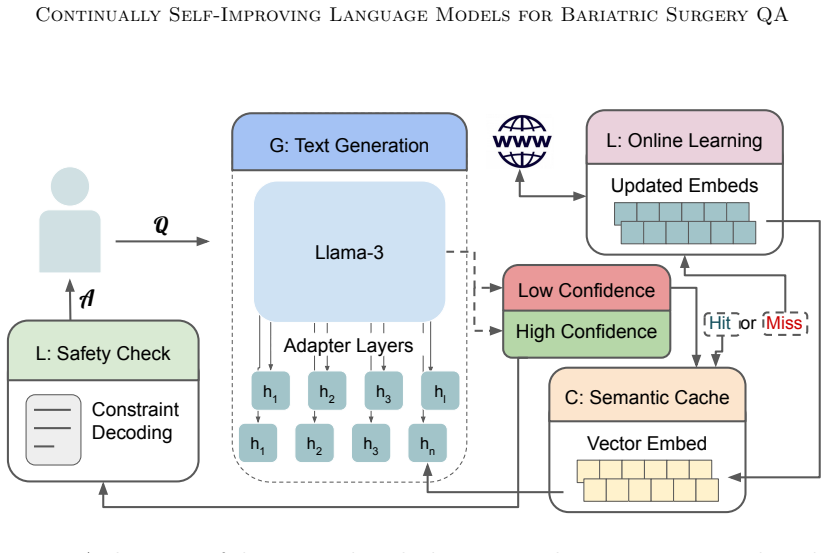
The mechanism is a confidence-gated self-update loop: a semantic cache (SentenceTransformer embeddings plus Faiss indexing) serves frequent queries, a multi-source web retrieval module guided by a Markov decision process with BM25 scoring and .gov/.edu domain filtering pulls authoritative documents, and a LoRA-based adaptation module updates the model's parameters using a regularized cross-entropy objective over an experience buffer. Generation perplexity is the confidence signal that decides when retrieval and adaptation should fire, with a threshold of 4.5. Constrained decoding and BERTScore validation are applied to keep outputs safe and semantically aligned with evidence.
What would settle it
Take the 105 expert-scored questions out of bRAGgen's adaptation loop, run the system on them with online updates disabled, and compare against MedGraphRAG; if the gap shrinks to zero, the claimed continual self-improvement is not demonstrated. Alternatively, withhold retrieved documents at generation time for already-seen questions and check whether scores collapse.
Extended reading notes
Core claim
The central claim is that an adaptive RAG framework which combines confidence-triggered web retrieval with online parameter updates can deliver continually improving, clinically accurate answers in a specialized medical domain. Specifically, the paper reports that bRAGgen with Llama3-8B achieves an average expert rating of 4.51 on a 1–5 scale, versus 4.05 for the best baseline (MedGraphRAG), with the largest gains in clinical relevance and comprehensiveness. The system triggers retrieval when generation perplexity exceeds 4.5, then fine-tunes a LoRA adapter on the retrieved query-document pairs, embedding new evidence into the model's parameters rather than only appending context at inference time. The authors also report that the same mechanism lifts smaller models (Phi-3, Mistral) by 0.6–0.7 points over their context-prompted variants, suggesting the approach is not tied to a single backbone.
Load-bearing premise
The evaluation scores the system on questions that may overlap with the data it adapts on, so the reported improvement could partly reflect memorization of retrieved evidence rather than generalizable learning.
Editorial extensions
If this is right
- If the reported gains hold, bariatric surgery programs could deploy a patient-facing QA system that automatically refreshes its knowledge as clinical guidelines evolve.
- The bRAGq benchmark provides a standardized, expert-validated test set for comparing future MBS question-answering systems across the full care pathway.
- Confidence-triggered retrieval plus parametric updates could be applied to other fast-moving medical specialties where static knowledge cutoffs are a known failure mode.
- The observed improvement on smaller models suggests resource-constrained clinics could use lightweight backbones without sacrificing as much accuracy as zero-shot or context-prompted variants.
- The high expert–LLM-judge correlation (Spearman ρ = 0.94) supports using LLM-as-judge for cheap iterative development before committing to expensive expert review.
Reading between the lines
- The 'continually self-improving' claim is asserted but not directly stress-tested: the natural next experiment is temporal evaluation where the evidence base shifts after adaptation and the model must keep answering accurately without retraining on the new answers.
- Because the expert evaluation relies on a single surgeon and 105 instances, the reported margins likely compress under a broader multi-expert panel; the qualitative differences in the appendix are suggestive but not statistically powered.
- A concrete testable extension would be withholding retrieved documents at generation time for queries already seen during adaptation; if scores collapse, the gain is memorization of retrieved evidence rather than generalizable clinical reasoning.
- The framework's reliance on web retrieval from .gov/.edu sources could be extended to incorporate professional society guidelines and clinical trial registries, which are updated more frequently than indexed webpages.
Editorial analysis
A structured set of objections, weighed in public.
Referee Report
Summary. The paper introduces bRAGgen, an adaptive retrieval-augmented generation system for bariatric surgery patient questions, combining semantic caching, multi-source web retrieval, low-rank adaptation, and an online learning loop that updates the model when response confidence is low. The authors also introduce bRAGq, a 1,302-question expert-validated dataset, and report expert and LLM-as-judge evaluations in which bRAGgen with Llama3-8B outperforms RAG2, MedGraphRAG, and zero-shot/context-prompted LLMs. The central claim is that bRAGgen continually self-improves through confidence-triggered retrieval and parametric updates.
Significance. If the empirical claims held, bRAGq would be a useful domain benchmark and the adaptive-RAG design a plausible step toward continually updated clinical QA systems; the public release of data and code is a strength. However, the evaluation protocol does not establish the central claim: the online update loop is trained on the same query-document pool from which the scored instances are drawn, and the single-expert evaluation lacks statistical support. The useful components are therefore accompanied by evidence that is currently uninterpretable.
major comments (5)
- [§4.4, §6, Fig. 2c] The evaluation is confounded because the online learning protocol updates the LoRA adapter on query-document pairs from an experience buffer B (Eq. 7), while the 105 expert-scored instances are drawn from the same bRAGq pool and no statement anywhere indicates they are withheld from adaptation; Fig. 2c even plots training loss over all 1,302 iterations, matching the dataset size. A model that takes a gradient step on the very question it is about to answer can inflate its scores by memorizing the retrieved evidence for that question, so the reported margin of 4.51 vs 4.05 over MedGraphRAG does not demonstrate generalizable continual self-improvement. The authors must re-run the evaluation on a held-out split that is never touched by the buffer, and report results for the model before and after adaptation on that split.
- [§6, Table 3] All expert conclusions rest on a single board-certified surgeon rating 105 instances, with no inter-rater reliability, no confidence intervals, and no significance tests. The differences claimed as 'substantially superior' (e.g., 4.51 vs 4.05) are within the noise that a single rater and a small sample can produce; the paper needs multiple independent expert raters and appropriate statistical comparisons (per-item paired tests with multiple-rater agreement) before such claims are supportable.
- [§4.4, Eq. (7)] The adaptation objective minimizes -log pθ(d | q), i.e., the likelihood of the retrieved document given the query, rather than any objective tied to answer quality or clinical correctness. The paper provides no evidence that optimizing document likelihood improves the generated answer, and the loss is only one of several free components (λ, LoRA rank r, thresholds τc and τp, cache size) whose sensitivity is never analyzed. Without an ablation showing that the online update, rather than the retrieval context, drives the gains, the mechanism remains unsupported.
- [§8, Appendix A] Appendix A describes a 'modular editing framework with LLaMA-3' and discusses edit interference, compositionality, and 'model editing,' none of which is defined in the bRAGgen method; Figure 2 is titled 'Model Editing Dynamics' and its panel (a) refers to 'post-edit' confidence changes. These passages do not match the bRAGgen architecture described in Section 4 and suggest the analysis may have been carried over from a different system. This internal inconsistency must be resolved, and the reported analyses must be recomputed for bRAGgen as defined, before the self-improvement claims can be assessed.
- [§3, Dataset] The dataset description is numerically inconsistent: 611 PubMedQA questions with 201 flagged as not representative plus 691 synthetic questions gives either 1,302 (if the 201 are retained) or 1,101 (if excluded), but the paper states 1,302 without clarifying the status of the flagged items. If the flagged questions are kept, the benchmark includes questions experts judged unrepresentative of patient concerns; if they are removed, the headline count is wrong. This must be clarified and the counts reconciled.
minor comments (8)
- [§4.1, Eq. (1)] The symbol q_j is used for the document embedding, but the cache is defined over document-query pairs with documents d_j; the notation should be d_j to avoid confusion.
- [§4.2] The MDP formulation in Eq. (3) is never actually used in the implementation, which is described as a DuckDuckGo API with BM25 ranking; the MDP should either be operationalized or removed.
- [§4.5] BERTScore validation is promised but no BERTScore results appear in the evaluation; either report them or state that they were not used for scoring.
- [Tables 3 and 4] The caption states that 'the final three rows under each model group' show the online setting, but each group has only one row; the caption appears to be leftover text from another template.
- [Figure 1] The caption uses α as the confidence threshold, while the text defines thresholds τc and τp; unify the notation.
- [References] Reference [Wu et al., 2024c] is cited for a German mHealth cohort study in bariatric care, but the listed reference is about cancer pain self-management; the citation does not match the claim.
- [Appendix B] The qualitative tables contain artifacts such as 'system' and 'assistant' tokens inside model outputs; these should be cleaned or the outputs should be regenerated for presentation.
- [Abstract and Conclusion] The statement that bRAGgen is 'substantially superior' across all dimensions should be tempered until a valid held-out evaluation is available.
Circularity Check
bRAGgen is adapted on the same questions it is then scored on, so the reported expert/LLM gains reflect in-sample fitting rather than demonstrated continual self-improvement.
-
fitted input called prediction
[Sec. 4.4 Eq. (7), Sec. 6, Fig. 2c]
"Ladapt = E(q,d)∼B [− log pθ(d | q)] + λ∥ΘA∥2F , (7) where E(q,d)∼B represents the expectation over a mini-batch B of query-document pairs ... For expert evaluation, we consult one board-certified bariatric surgeon, who reviewed model outputs for 105 instances. ... (c) Training Loss Progression ... across 1,302 iterations"
The online learning protocol minimizes the adaptation loss on query–document pairs from the experience buffer B. The evaluation then scores bRAGgen on 105 instances, but the paper never states that these instances are withheld from B; Fig. 2c instead shows training loss over all 1,302 bRAGq iterations, i.e., the full benchmark is the adaptation stream. Consequently, each rated answer is produced after the model has taken a gradient step on that very question and its retrieved evidence. The reported margin over static baselines is therefore at least partly a restatement of the fitted query–document pairs, not evidence of transfer to unseen questions.
full rationale
The decisive circular step is the evaluation protocol: bRAGgen's reported superiority is measured after online LoRA adaptation on the same bRAGq questions that are scored. Eq. (7) trains on query–document pairs from buffer B, and Sec. 6 gives no train/test split and no statement that the 105 expert-scored instances were excluded from B; Fig. 2c treats all 1,302 iterations as training iterations. Thus the 'continually self-improving' gain is demonstrated only in-sample, on queries the model has already adapted to, and the comparison to static baselines is not an apples-to-apples predictive test. This is a fitted-input-called-prediction pattern rather than a self-citation or uniqueness-theorem issue. Separately, Appendix A's limitations text refers to a 'modular editing framework' and says the system 'does not yet integrate naturally with continual learning settings,' which contradicts the paper's central framing; that is a consistency problem, not itself a circular step, but it reinforces that the self-improvement claim is not cleanly established.
Assumptions & free parameters
free parameters (7)
- tau_c (cache cosine threshold) =
0.7
- tau_p (perplexity threshold) =
4.5
- alpha (eviction weight) =
0.6
- lambda (regularization coefficient) =
not specified
- beta (document age decay) =
not specified
- cache size =
500
- LoRA rank r =
32
assumptions (3)
- domain assumption Perplexity is a valid proxy for response confidence.
- domain assumption Retrieved .gov/.edu documents are authoritative, current, and relevant.
- domain assumption Fine-tuning on query-document pairs improves future responses without catastrophic forgetting.
Cite this review
Pith. "Pith review of Continually Self-Improving Language Models for Bariatric Surgery Question--Answering." pith.science (2026). https://pith.science/paper/5FCWMQLO
@misc{pith2026250516102,
  author       = {Pith},
  title        = {Pith review of: Continually Self-Improving Language Models for Bariatric Surgery Question--Answering},
  year         = {2026},
  howpublished = {\url{https://pith.science/paper/5FCWMQLO}},
  note         = {Machine review of arXiv:2505.16102}
}
read the original abstract
While bariatric and metabolic surgery (MBS) is considered the gold standard treatment for severe and morbid obesity, its therapeutic efficacy hinges upon active and longitudinal engagement with multidisciplinary providers, including surgeons, dietitians/nutritionists, psychologists, and endocrinologists. This engagement spans the entire patient journey, from preoperative preparation to long-term postoperative management. However, this process is often hindered by numerous healthcare disparities, such as logistical and access barriers, which impair easy patient access to timely, evidence-based, clinician-endorsed information. To address these gaps, we introduce bRAGgen, a novel adaptive retrieval-augmented generation (RAG)-based model that autonomously integrates real-time medical evidence when response confidence dips below dynamic thresholds. This self-updating architecture ensures that responses remain current and accurate, reducing the risk of misinformation. Additionally, we present bRAGq, a curated dataset of 1,302 bariatric surgery--related questions, validated by an expert bariatric surgeon. bRAGq constitutes the first large-scale, domain-specific benchmark for comprehensive MBS care. In a two-phase evaluation, bRAGgen is benchmarked against state-of-the-art models using both large language model (LLM)--based metrics and expert surgeon review. Across all evaluation dimensions, bRAGgen demonstrates substantially superior performance in generating clinically accurate and relevant responses.
Figures

Reference graph
Works this paper leans on
-
[1]
Phi-3 technical report: A highly capable language model locally on your phone, 2024
Marah Abdin, Jyoti Aneja, Hany Awadalla, and et al. Phi-3 technical report: A highly capable language model locally on your phone, 2024. URL https://arxiv.org/abs/2404.14219
arXiv 2024
-
[2]
Medical large language models are vulnerable to data-poisoning attacks
Daniel Alexander Alber, Zihao Yang, Anton Alyakin, Eunice Yang, Sumedha Rai, Aly A Valliani, Jeff Zhang, Gabriel R Rosenbaum, Ashley K Amend-Thomas, David B Kurland, Caroline M Kremer, Alexander Eremiev, Bruck Negash, Daniel D Wiggan, Michelle A Nakatsuka, Karl L Sangwon, Sean N Neifert, Hammad A Khan, Akshay Vinod Save, Adhith Palla, Eric A Grin, Monika ...
work page 2025
-
[3]
See, hear, read: Leveraging multimodality with guided attention for abstractive text summarization
Yash Kumar Atri, Shraman Pramanick, Vikram Goyal, and Tanmoy Chakraborty. See, hear, read: Leveraging multimodality with guided attention for abstractive text summarization. Knowledge-Based Systems, 227: 0 107152, 2021. ISSN 0950-7051. doi:https://doi.org/10.1016/j.knosys.2021.107152. URL https://www.sciencedirect.com/science/article/pii/S0950705121004159
arXiv 2021
-
[4]
Yash Kumar Atri, Vikram Goyal, and Tanmoy Chakraborty. Fusing multimodal signals on hyper-complex space for extreme abstractive text summarization (tl;dr) of scientific contents. In Proceedings of the 29th ACM SIGKDD Conference on Knowledge Discovery and Data Mining, KDD '23, page 3724–3736, New York, NY, USA, 2023 a . Association for Computing Machinery....
arXiv 2023
-
[5]
Multi-document summarization using selective attention span and reinforcement learning
Yash Kumar Atri, Vikram Goyal, and Tanmoy Chakraborty. Multi-document summarization using selective attention span and reinforcement learning. IEEE/ACM Transactions on Audio, Speech, and Language Processing, 31: 0 3457--3467, 2023 b . doi:10.1109/TASLP.2023.3316459
arXiv 2023
-
[6]
Yash Kumar Atri, Arun Iyer, Tanmoy Chakraborty, and Vikram Goyal. Promoting topic coherence and inter-document consorts in multi-document summarization via simplicial complex and sheaf graph. In Houda Bouamor, Juan Pino, and Kalika Bali, editors, Proceedings of the 2023 Conference on Empirical Methods in Natural Language Processing, pages 2154--2166, Sing...
-
[7]
Romain Barres, Henri Kirchner, Morten Rasmussen, Jing Yan, Daniel Kantor, Anna Krook, Erik Naslund, Juleen R. Zierath, and Charlotte Ling. Weight loss after gastric bypass surgery in human obesity remodels promoter methylation. Cell Reports, 3 0 (4): 0 1020--1027, 2013. doi:10.1016/j.celrep.2013.03.019
-
[8]
Emily M. Bartholomay, Patrick W. Stewart, David B. Sarwer, Thomas A. Wadden, and Anthony N. Fabricatore. Sociodemographic factors related to bariatric follow-up appointment attendance and weight outcomes. Surgery for Obesity and Related Diseases, 20: 0 1388--1395, 2024. doi:10.1016/j.soard.2024.02.010
Show all 52 references
-
[9]
Why we need to be careful with LLMs in medicine
Jean-Christophe B \'e lisle-Pipon. Why we need to be careful with LLMs in medicine. Front. Med. (Lausanne), 11: 0 1495582, December 2024
2024
-
[10]
Bjerkan, Audun Viste, Else M
Kristin K. Bjerkan, Audun Viste, Else M. Aasheim, Oda Mjåland, Torstein Mala, Nina E. Kløw, Jo Røislien, and Siv K. Bøhn. The long-term impact of postoperative educational programs on weight loss after roux-en-y gastric bypass. Obesity Surgery, 32: 0 3005--3012, 2022. doi:10.1...
2022 doi
-
[11]
Forag: Factuality-optimized retrieval augmented generation for web-enhanced long-form question answering
Tianchi Cai, Zhiwen Tan, Xierui Song, Tao Sun, Jiyan Jiang, Yunqi Xu, Yinger Zhang, and Jinjie Gu. Forag: Factuality-optimized retrieval augmented generation for web-enhanced long-form question answering. In Proceedings of the 30th ACM SIGKDD Conference on Knowledge Discovery ...
-
[12]
Dated data: Tracing knowledge cutoffs in large language models, 2024
Jeffrey Cheng, Marc Marone, Orion Weller, Dawn Lawrie, Daniel Khashabi, and Benjamin Van Durme. Dated data: Tracing knowledge cutoffs in large language models, 2024. URL https://arxiv.org/abs/2403.12958
2024 arXiv
-
[13]
English, Michel Gagner, William B
Bryan Clapp, Lillian Khaitan, William J. English, Michel Gagner, William B. Inabnet, J. Michael Morton, Walter J. Pories, Philip R. Schauer, Brian M. Wolfe, and Mary M. Wolfe. American society for metabolic and bariatric surgery 2022 estimate of metabolic and bariatric procedu...
2022 doi
-
[14]
David, Ivana Sijercic, and Stephanie E
Lauren A. David, Ivana Sijercic, and Stephanie E. Cassin. Preoperative and post-operative psychosocial interventions for bariatric surgery patients: A systematic review. Obesity Reviews, 21: 0 e12926, 2020. doi:10.1111/obr.12926
2020 doi
-
[15]
Corpora evaluation and system bias detection in multi-document summarization
Alvin Dey, Tanya Chowdhury, Yash Kumar Atri, and Tanmoy Chakraborty. Corpora evaluation and system bias detection in multi-document summarization. In Trevor Cohn, Yulan He, and Yang Liu, editors, Findings of the Association for Computational Linguistics: EMNLP 2020, pages 2830...
2020 doi
-
[16]
Retrieval-augmented generation for large language models: A survey, 2024
Yunfan Gao, Yun Xiong, Xinyu Gao, Kangxiang Jia, Jinliu Pan, Yuxi Bi, Yi Dai, Jiawei Sun, Meng Wang, and Haofen Wang. Retrieval-augmented generation for large language models: A survey, 2024. URL https://arxiv.org/abs/2312.10997
2024 arXiv
-
[17]
The llama 3 herd of models, 2024
Aaron Grattafiori, Abhimanyu Dubey, Abhinav Jauhri, and et al. The llama 3 herd of models, 2024. URL https://arxiv.org/abs/2407.21783
2024 arXiv
-
[18]
Groller, Kasey M
Kristen D. Groller, Kasey M. Carey, and John P. Evans. Systematic review of patient education practices in weight loss surgery. Surgery for Obesity and Related Diseases, 13: 0 1072--1085, 2017. doi:10.1016/j.soard.2017.02.025
2017 doi
-
[19]
Context awareness gate for retrieval augmented generation, 2025
Mohammad Hassan Heydari, Arshia Hemmat, Erfan Naman, and Afsaneh Fatemi. Context awareness gate for retrieval augmented generation, 2025. URL https://arxiv.org/abs/2411.16133
2025 arXiv
-
[20]
The experience of australian general practice patients at high risk of poor health outcomes with telehealth during the COVID-19 pandemic: a qualitative study
Sara Javanparast, Leigh Roeger, Yuen Kwok, and Richard L Reed. The experience of australian general practice patients at high risk of poor health outcomes with telehealth during the COVID-19 pandemic: a qualitative study. BMC Fam. Pract., 22 0 (1): 0 69, April 2021
2021
-
[21]
Albert Q. Jiang, Alexandre Sablayrolles, Arthur Mensch, Chris Bamford, Devendra Singh Chaplot, Diego de las Casas, Florian Bressand, Gianna Lengyel, Guillaume Lample, Lucile Saulnier, Lélio Renard Lavaud, Marie-Anne Lachaux, Pierre Stock, Teven Le Scao, Thibaut Lavril, Thomas ...
2023 arXiv
-
[22]
Retrieve, summarize, plan: Advancing multi-hop question answering with an iterative approach, 2025
Zhouyu Jiang, Mengshu Sun, Lei Liang, and Zhiqiang Zhang. Retrieve, summarize, plan: Advancing multi-hop question answering with an iterative approach, 2025. URL https://arxiv.org/abs/2407.13101
2025 arXiv
-
[23]
P ub M ed QA : A dataset for biomedical research question answering
Qiao Jin, Bhuwan Dhingra, Zhengping Liu, William Cohen, and Xinghua Lu. P ub M ed QA : A dataset for biomedical research question answering. In Kentaro Inui, Jing Jiang, Vincent Ng, and Xiaojun Wan, editors, Proceedings of the 2019 Conference on Empirical Methods in Natural La...
2019 doi
-
[24]
Efficient medical question answering with knowledge-augmented question generation
Julien Khlaut, Corentin Dancette, Elodie Ferreres, Benani Alaedine, Herent Herent, and Pierre Manceron. Efficient medical question answering with knowledge-augmented question generation. In Tristan Naumann, Asma Ben Abacha, Steven Bethard, Kirk Roberts, and Danielle Bitterman,...
2024 doi
-
[25]
Kim, Melissa S
Dong H. Kim, Melissa S. Davenport, Jia Gu, Kristen Ziegler, Patricia L. Ferguson, and Timothy M. Farrell. Incidence, burden, and predictors of 11-month readmission in patients undergoing bariatric surgery. Obesity Surgery, 33: 0 94--104, 2023. doi:10.1007/s11695-022-06410-2
2023 doi
-
[26]
M ed E x QA : Medical question answering benchmark with multiple explanations
Yunsoo Kim, Jinge Wu, Yusuf Abdulle, and Honghan Wu. M ed E x QA : Medical question answering benchmark with multiple explanations. In Dina Demner-Fushman, Sophia Ananiadou, Makoto Miwa, Kirk Roberts, and Junichi Tsujii, editors, Proceedings of the 23rd Workshop on Biomedical ...
2024 doi
-
[27]
Large language models are zero-shot reasoners, 2023
Takeshi Kojima, Shixiang Shane Gu, Machel Reid, Yutaka Matsuo, and Yusuke Iwasawa. Large language models are zero-shot reasoners, 2023. URL https://arxiv.org/abs/2205.11916
2023 arXiv
-
[28]
u ttler, Mike Lewis, Wen-tau Yih, Tim Rockt\
Patrick Lewis, Ethan Perez, Aleksandra Piktus, Fabio Petroni, Vladimir Karpukhin, Naman Goyal, Heinrich K\" u ttler, Mike Lewis, Wen-tau Yih, Tim Rockt\" a schel, Sebastian Riedel, and Douwe Kiela. Retrieval-augmented generation for knowledge-intensive nlp tasks. In Proceeding...
2020
-
[29]
Retrieval-augmented generation for knowledge-intensive nlp tasks, 2021
Patrick Lewis, Ethan Perez, Aleksandra Piktus, Fabio Petroni, Vladimir Karpukhin, Naman Goyal, Heinrich Küttler, Mike Lewis, Wen tau Yih, Tim Rocktäschel, Sebastian Riedel, and Douwe Kiela. Retrieval-augmented generation for knowledge-intensive nlp tasks, 2021. URL https://arx...
2021 arXiv
-
[30]
Enhancing llm factual accuracy with rag to counter hallucinations: A case study on domain-specific queries in private knowledge-bases, 2024
Jiarui Li, Ye Yuan, and Zehua Zhang. Enhancing llm factual accuracy with rag to counter hallucinations: A case study on domain-specific queries in private knowledge-bases, 2024. URL https://arxiv.org/abs/2403.10446
2024 arXiv
-
[31]
Ruth J. F. Loos and G. S. H. Yeo. The genetics of obesity: from discovery to biology. Nature Reviews Genetics, 23: 0 120--133, 2022. doi:10.1038/s41576-021-00414-z
2022 doi
-
[32]
C linical RAG : Enhancing clinical decision support through heterogeneous knowledge retrieval
Yuxing Lu, Xukai Zhao, and Jinzhuo Wang. C linical RAG : Enhancing clinical decision support through heterogeneous knowledge retrieval. In Sha Li, Manling Li, Michael JQ Zhang, Eunsol Choi, Mor Geva, Peter Hase, and Heng Ji, editors, Proceedings of the 1st Workshop on Towards ...
2024 doi
-
[33]
Kiran, Robert S
Sean McLennan, Ravi P. Kiran, Robert S. McLeod, Victor Li, Yue Guo, and David W. Birch. Characteristics and outcomes for patients undergoing revisional bariatric surgery due to persistent obesity: a retrospective cohort study of 10,589 patients. Surgical Endoscopy, 37: 0 4613-...
2023 doi
-
[34]
Mechanick, Caroline Apovian, Stephen Brethauer, W
Jeffrey I. Mechanick, Caroline Apovian, Stephen Brethauer, W. Timothy Garvey, Aaron M. Joffe, Jill Kim, Robert F. Kushner, John R. Pender, Kalpana Singh, American Association of Clinical Endocrinologists, American College of Endocrinology, The Obesity Society, American Society...
2019
-
[35]
Large language models: A survey, 2025
Shervin Minaee, Tomas Mikolov, Narjes Nikzad, Meysam Chenaghlu, Richard Socher, Xavier Amatriain, and Jianfeng Gao. Large language models: A survey, 2025. URL https://arxiv.org/abs/2402.06196
2025 arXiv
-
[36]
Enhancing postoperative care with telemedicine and remote monitoring for improved recovery and patient safety
Jeyanthi P, Gulothungan G, Vinoth Kumar V, Hitesh Chopra, and Talha Bin Emran. Enhancing postoperative care with telemedicine and remote monitoring for improved recovery and patient safety. Int. J. Surg., 110 0 (12): 0 8205--8206, December 2024
2024
-
[37]
Usability of mobile health apps for postoperative care: Systematic review
Ben Patel and Arron Thind. Usability of mobile health apps for postoperative care: Systematic review. JMIR Perioper. Med., 3 0 (2): 0 e19099, July 2020
2020
-
[38]
M edi F act at MEDIQA - M 3 G 2024: Medical question answering in dermatology with multimodal learning
Nadia Saeed. M edi F act at MEDIQA - M 3 G 2024: Medical question answering in dermatology with multimodal learning. In Tristan Naumann, Asma Ben Abacha, Steven Bethard, Kirk Roberts, and Danielle Bitterman, editors, Proceedings of the 6th Clinical Natural Language Processing ...
2024 doi
-
[39]
Francisco Schlottmann, Charlie Baz, Adeel Pirzada, and Muhammad A. Masrur. Postoperative follow-up compliance: The achilles’ heel of bariatric surgery. Obesity Surgery, 33: 0 2945--2948, 2023. doi:10.1007/s11695-023-06500-2
2023 doi
-
[40]
Setarehdan, Ameneh Ziaee, Ramin Niknam, Sahar Ghassemi, Fatemeh Mehrabi, Mohsen Hossein Esfahani, and Mohammad H
Saeed A. Setarehdan, Ameneh Ziaee, Ramin Niknam, Sahar Ghassemi, Fatemeh Mehrabi, Mohsen Hossein Esfahani, and Mohammad H. Shariat. Determinants of patient’s adherence to the predefined follow-up visits after bariatric surgery. Obesity Surgery, 33: 0 577--584, 2023. doi:10.100...
2023 doi
-
[41]
Toward expert-level medical question answering with large language models
Karan Singhal, Tao Tu, Juraj Gottweis, Rory Sayres, Ellery Wulczyn, Mohamed Amin, Le Hou, Kevin Clark, Stephen R Pfohl, Heather Cole-Lewis, Darlene Neal, Qazi Mamunur Rashid, Mike Schaekermann, Amy Wang, Dev Dash, Jonathan H Chen, Nigam H Shah, Sami Lachgar, Philip Andrew Mans...
2025
-
[42]
Rationale-guided retrieval augmented generation for medical question answering, 2024
Jiwoong Sohn, Yein Park, Chanwoong Yoon, Sihyeon Park, Hyeon Hwang, Mujeen Sung, Hyunjae Kim, and Jaewoo Kang. Rationale-guided retrieval augmented generation for medical question answering, 2024. URL https://arxiv.org/abs/2411.00300
2024
-
[43]
C asi M edicos-arg: A medical question answering dataset annotated with explanatory argumentative structures
Ekaterina Sviridova, Anar Yeginbergen, Ainara Estarrona, Elena Cabrio, Serena Villata, and Rodrigo Agerri. C asi M edicos-arg: A medical question answering dataset annotated with explanatory argumentative structures. In Yaser Al-Onaizan, Mohit Bansal, and Yun-Nung Chen, editor...
2024 doi
-
[44]
Understanding the capabilities, limitations, and societal impact of large language models, 2021
Alex Tamkin, Miles Brundage, Jack Clark, and Deep Ganguli. Understanding the capabilities, limitations, and societal impact of large language models, 2021. URL https://arxiv.org/abs/2102.02503
2021 arXiv
-
[45]
Improving health question answering with reliable and time-aware evidence retrieval
Juraj Vladika and Florian Matthes. Improving health question answering with reliable and time-aware evidence retrieval. In Kevin Duh, Helena Gomez, and Steven Bethard, editors, Findings of the Association for Computational Linguistics: NAACL 2024, pages 4752--4763, Mexico City...
2024 doi
-
[46]
Bitterman, Ling Pan, Ching-Yu Cheng, James Zou, and Dianbo Liu
Xiaoye Wang, Nicole Xi Zhang, Hongyu He, Trang Nguyen, Kun-Hsing Yu, Hao Deng, Cynthia Brandt, Danielle S. Bitterman, Ling Pan, Ching-Yu Cheng, James Zou, and Dianbo Liu. Safety challenges of ai in medicine in the era of large language models, 2025. URL https://arxiv.org/abs/2...
2025 arXiv
-
[47]
Ward, Sara N
Zachary J. Ward, Sara N. Bleich, Angie L. Cradock, Jonathan L. Barrett, Christine M. Giles, Charles Flax, and Michael W. Long. Projected u.s. state-level prevalence of adult obesity and severe obesity. The New England Journal of Medicine, 381: 0 2440--2450, 2019. doi:10.1056/N...
2019 doi
-
[48]
Pandora's box or aladdin's lamp: A comprehensive analysis revealing the role of rag noise in large language models, 2024 a
Jinyang Wu, Feihu Che, Chuyuan Zhang, Jianhua Tao, Shuai Zhang, and Pengpeng Shao. Pandora's box or aladdin's lamp: A comprehensive analysis revealing the role of rag noise in large language models, 2024 a . URL https://arxiv.org/abs/2408.13533
2024 arXiv
-
[49]
Medical graph rag: Towards safe medical large language model via graph retrieval-augmented generation, 2024 b
Junde Wu, Jiayuan Zhu, Yunli Qi, Jingkun Chen, Min Xu, Filippo Menolascina, and Vicente Grau. Medical graph rag: Towards safe medical large language model via graph retrieval-augmented generation, 2024 b . URL https://arxiv.org/abs/2408.04187
2024 arXiv
-
[50]
Acceptability, effectiveness, and roles of mhealth applications in supporting cancer pain self-management: Integrative review
Weizi Wu, Teresa Graziano, Andrew Salner, Ming-Hui Chen, Michelle P Judge, Xiaomei Cong, and Wanli Xu. Acceptability, effectiveness, and roles of mhealth applications in supporting cancer pain self-management: Integrative review. JMIR MHealth UHealth, 12: 0 e53652, July 2024 c
2024
-
[51]
Weinberger, and Yoav Artzi
Tianyi Zhang, Varsha Kishore, Felix Wu, Kilian Q. Weinberger, and Yoav Artzi. Bertscore: Evaluating text generation with bert, 2020. URL https://arxiv.org/abs/1904.09675
2020 arXiv
-
[52]
Hallucination mitigation for retrieval-augmented large language models: A review
Wan Zhang and Jing Zhang. Hallucination mitigation for retrieval-augmented large language models: A review. Mathematics, 13 0 (5): 0 856, March 2025
2025
Reviewed August 7, 2026 · model on record in the stance chip above.
Discussion (0). Continue with ORCID to comment.