REVIEW 3 major objections 5 minor 1 cited by
Dynamics of low-mass black hole seeds in the BRAHMA simulations using subgrid-dynamical friction: Impact on merger-driven black hole growth in the high redshift Universe
T0 review · 3 major / 5 minor · reviewed 2026-08-07 · deepseek-v4-flash
Pith's one-line read Subgrid dynamical friction cuts early black hole seed merger rates by a factor of 4-10, the paper contends.
desk verdict First BRAHMA light-seed runs with subgrid DF show repositioning overestimates z>5 merger rates; the qualitative conclusion holds, but the headline 100–1000 yr^-1 rates rest on a hand-tuned dynamical seed mass and should be treated as conditional. read the letter →
The pith
A machine-rendered reading of the paper's core claim, the machinery that carries it, and where it could break.
The reading
What carries the argument
The load-bearing mechanism is the M23 subgrid dynamical-friction estimator, a momentum-conserving sum over background mass elements (Eq. 5) that requires no free parameters and reduces to the Chandrasekhar formula under idealized conditions, applied together with artificially enhanced dynamical seed masses (3-64 times the true seed mass) to suppress numerical heating, and the MERGE_SOFTENING_BOUND merger criterion, which requires pairs to be within two gravitational softening lengths and to be gravitationally bound. This combination determines how far seeds sink, how long binary inspiral takes, and which pairs are counted as mergers.
What would settle it
Run the same [9 Mpc]^3 boxes at a resolution where dark-matter particles are lighter than the seed mass and use the true seed mass in the gravity calculation; if the z>5 merger rate then falls below roughly 10 per year, the artificially enhanced dynamical mass is driving the predicted rates rather than real physics.
Extended reading notes
Core claim
The central discovery is that the way a simulation treats black hole dynamics below the resolution scale changes the predicted early Universe merger history by an order of magnitude. Adding the Ma et al. 2023 subgrid dynamical-friction estimator lets a significant fraction of ~2.$2x10^{3}$ solar-mass seeds sink to subhalo centers by z~5 and become gravitationally bound pairs at separations of ~0.2-0.4 kpc, where they can merge. Removing both repositioning and subgrid friction leaves most seeds wandering and mergers rare, while the old repositioning scheme merges seeds promptly at kiloparsec separations and overproduces high-redshift events. Across four seed models, the authors find z>5 merger rates of about 100-1000 per year, with peak rates shifting to lower redshift than under repositioning, and these mergers dominate seed growth while gas accretion remains negligible below roughly $10^{5}$ solar masses.
Load-bearing premise
The subgrid dynamical-friction force, computed with seeds artificially made 24 times heavier for the force calculation, accurately captures the real drag that ~$10^{3}$ solar-mass seeds would feel in halos of ~$10^{6}$-$10^{7}$ solar masses.
Editorial extensions
If this is right
- If the paper is right, the standard practice of pinning black holes to potential minima overestimates z>5 seed merger rates by factors of 4-10, so LISA event-rate forecasts must include unresolved dynamical friction.
- Under subgrid dynamical friction, different seed models predict 100-1000 seed mergers per year at z>5, giving LISA a realistic chance of detecting seed-mass events during its lifetime.
- Merger-driven growth builds seeds to 10^4-10^5 solar masses by z~5 with less than 2 percent of mass from gas accretion, implying steep mass functions in the intermediate-mass range that electromagnetic observatories cannot easily probe.
- The paper treats its rates as upper limits to actual gravitational-wave events because inspiral below 0.2-0.4 kpc, loss-cone scattering, and gravitational-wave recoil are not modeled.
- Because z>15 merger rates are suppressed by factors of 10-100 relative to repositioning, early-Universe seed mergers are much rarer than previously estimated but still numerous enough to be observable.
Reading between the lines
- If sub-softening dynamical friction contributes significantly, the true sinking efficiency may be higher than modeled here, pushing the rates toward the paper's upper end rather than the lower end.
- The enhanced dynamical seed mass can be read physically as a nuclear star cluster; if such clusters are rare around z>5 seeds, the simulated merger rates would drop, which is a testable assumption for future small-scale simulations.
- A LISA non-detection at the predicted rate would disfavor the most lenient seeding model or require that most 0.2-0.4 kpc pairs fail to reach gravitational-wave coalescence.
- Applying the same dynamics treatment to heavy direct-collapse seeds would show whether the 4-10 x suppression factor persists across seed channels, which would sharpen the seeding discrimination power of LISA.
Editorial analysis
A structured set of objections, weighed in public.
Referee Report
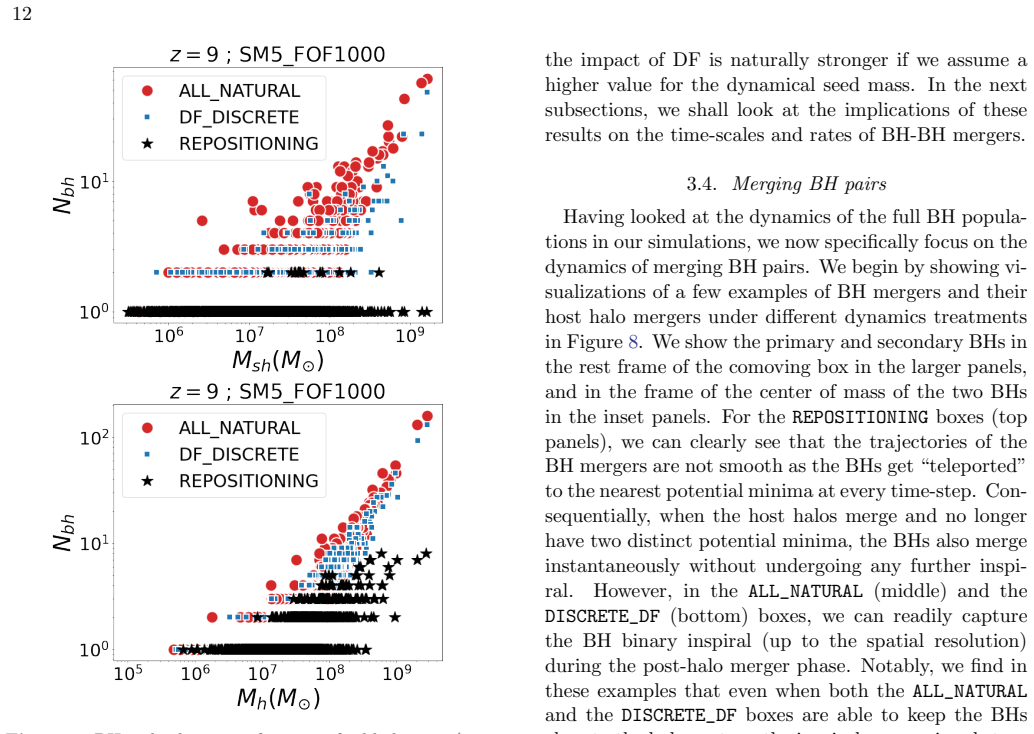
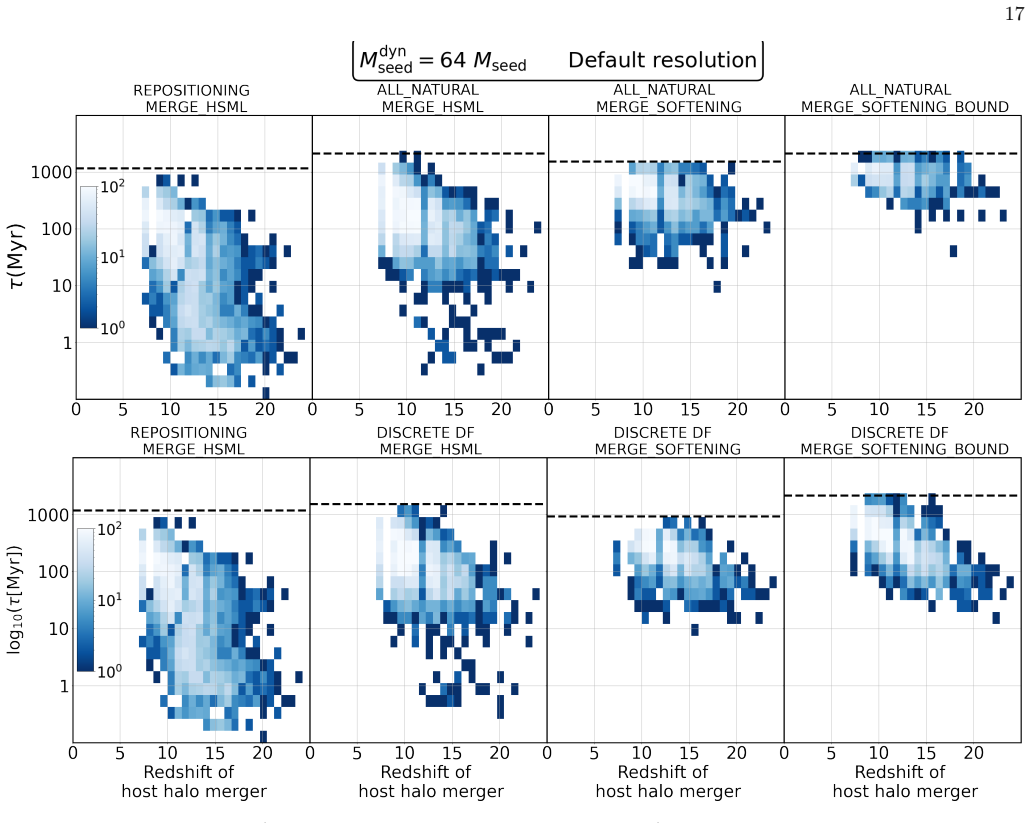
Summary. The paper presents a new suite of BRAHMA cosmological hydrodynamic simulations that replace the previous BH-repositioning scheme with the Ma et al. (2023) subgrid dynamical-friction model. It studies the dynamics of ~2e3 M_sun BH seeds in (4.5 Mpc)^3 and (9 Mpc)^3 boxes at z>5, comparing three dynamics treatments (repositioning, subgrid DF, and purely natural dynamics), three merger criteria, four seed models, and dynamical seed masses ranging from 3 to 64 M_seed. The main findings are that subgrid DF is required for seeds to sink to halo centers and become gravitationally bound, that post-halo-merger BH merger timescales are roughly 50-1000 Myr, that z>5 merger rates are reduced by a factor of about 4-10 relative to the repositioning scheme, and that the different seed models predict merger rates of about 100-1000 yr^-1 at z~5, with implications for LISA event rates.
Significance. This is a valuable and timely study: it addresses a known limitation of the original BRAHMA predictions and provides a well-controlled comparison of BH dynamics treatments while holding seeding and galaxy physics fixed. The qualitative conclusion that BH repositioning overestimates prompt high-redshift seed mergers is well supported by the internal comparisons, and the relative suppression factor of roughly 4-10 is robust across the tested dynamical seed masses. The study also benefits from systematic tests of merger criteria and seed models, and it is transparent about many caveats. The absolute LISA-relevant rates, however, are conditioned on an ad hoc enhanced dynamical seed mass and should be read as upper limits with a substantial, only partially quantified systematic uncertainty.
major comments (3)
- [§2.2.2, §3.4.3, §3.4.4 (Eqs. 4–5, Fig. 14, Fig. 15)] The headline absolute rates in the abstract and in Figure 15 are not independent of the uncalibrated enhanced dynamical mass M_dyn_seed. In the default BRAHMA-9 boxes, M_dyn_seed = 24 M_seed corresponds to roughly 2.2 dark-matter particle masses, while the M23 model is stated to work best when the BH mass is about 10 times the background particle mass; the actual seed mass is 2.2e3 M_sun, below the DM particle mass resolution. Figure 14 shows that changing M_dyn_seed from 64 to 3 M_seed alters the z>5 merger counts by roughly a factor of three (1223 versus 403), and the fiducial BRAHMA-9 value lies in the middle of this range. Because the quoted 100-1000 yr^-1 rates are extracted from this parameter, the manuscript should either calibrate M_dyn_seed with an idealized sinking test or present the rates as a conditional band with the M_dyn_seed dependence made explicit. The relative suppression factor of 4-10 relative to repositioning is, by contrast, robust across the tested range and is not affected by this concern.
- [§3.4.4, §4.3, Fig. 15] The merger rates are plotted as events per year and are quoted without an explicit volume normalization or uncertainty budget. Because the production volumes are only (9 Mpc)^3 and Section 4.3 itself quotes a cosmic-variance factor of about two, the range 100-1000 yr^-1 across seed models cannot be taken as a precise prediction. I ask for error bands or at minimum an explicit statement in the figure caption and abstract that the rates carry at least this systematic uncertainty.
- [§4.2, Summary bullet 5] The paper suggests that the enhanced dynamical seed mass may physically correspond to seeds embedded in nuclear star clusters, but no nuclear star cluster model is implemented. An extended, tidally stripped cluster does not necessarily exert the same point-mass dynamical friction as a more massive point particle, so this interpretation should be labeled as speculative rather than as a modeled process. This matters because the absolute rates are sensitive to the dynamical mass, as noted in the first major comment.
minor comments (5)
- [Abstract, §3.4.4] The phrase 'merger rates between ~100-1000 events per year at z>5' is ambiguous: in the text the rates are evaluated at z~5. Please state explicitly whether the quoted number is a differential rate at z~5 or a cumulative rate integrated over z>5.
- [Fig. 14, §3.4.3] The left panels of Figure 14 show cumulative merger counts (1223, 663, and 403) while the text refers to them as 'merge rates'; please clarify the axes, the normalization, and the relation to the rates in Figure 15.
- [§2.2.1, Eq. (4)] The BH mass in Eq. (4) is written as M_bh, but the calculations use M_dyn_seed; this substitution should be stated explicitly where the formula is introduced.
- [Throughout] The naming convention is inconsistent: the text and Figure 1 use both DF_DISCRETE and DISCRETE_DF for the same dynamics model; please standardize.
- [Various] There are several typographical errors, including 'consequentual' in Section 2, 'uncertainity' and 'scattening' in Section 4.3, and 'Thompson scattering' for 'Thomson scattering' near Eq. (3).
Circularity Check
No significant circularity: the merger-rate predictions are simulation outputs from an external subgrid DF estimator, and the M_dyn_seed sensitivity is a transparent modeling caveat rather than a circular step.
full rationale
The paper's central dynamics ingredient is the M23 subgrid dynamical-friction estimator (Eqs. 4-5), which is an external, parameter-free formula that the authors apply to their simulated BH populations; it is not derived from, nor fitted to, the merger rates that are later quoted. The enhanced dynamical seed mass M_dyn_seed is an input parameter introduced in Section 2.2.2 to mitigate numerical heating, and the paper explicitly quantifies its effect in Section 3.4.3 (Figure 14), showing that z>5 merger counts vary from 1223 to 403 as M_dyn_seed is varied from 64 to 3 M_seed. The fiducial BRAHMA-9 predictions then use M_dyn_seed = 24 M_seed and are explicitly presented as conditional upper limits (Section 3.4.4 and Section 4.3). This is a robustness and calibration concern, not a circular reduction: no parameter is fit to the headline 100-1000 yr^-1 rates, and the factor-of-4-10 suppression versus repositioning is reported as a range across the tested M_dyn_seed values rather than being imposed by construction. Self-citations to earlier BRAHMA work supply the seeding prescriptions and initial conditions, but those are established prior inputs, not results manufactured to force the merger-rate conclusion. The M23 citation includes a co-author, but the model is published, externally testable, and compared with independent works such as Chen et al. (2022) and Genina et al. (2024), so no load-bearing self-citation chain is present. The paper's own caveats about missing sub-softening impact parameters, unresolved sub-kpc hardening, and unmodeled NSC fractions are stated limitations that affect the physical interpretation, not evidence that the derivation is equivalent to its inputs.
Assumptions & free parameters
free parameters (1)
- Dynamical seed mass M_dyn_seed =
24 M_seed for fiducial BRAHMA-9 boxes; 3, 8, 64 M_seed in tests
assumptions (4)
- domain assumption M23 subgrid DF estimator (Eq. 5) correctly describes unresolved dynamical friction in a softened N-body potential for BH masses below the background particle mass.
- domain assumption The BRAHMA gas-based seed formation criteria (dense and metal-poor gas mass and halo mass thresholds) produce a representative population of ~10^3 M_sun seeds.
- domain assumption Merging BH pairs at separations of 2 times the gravitational softening length with a gravitational binding check is a valid proxy for eventual coalescence.
- domain assumption The TNG galaxy formation model (feedback, star formation, Bondi accretion) adequately describes the low-mass halos and gas at z>5 for the purposes of seed dynamics.
Cite this review
Pith. "Pith review of Dynamics of low-mass black hole seeds in the BRAHMA simulations using subgrid-dynamical friction: Impact on merger-driven black hole growth in the high redshift Universe." pith.science (2026). https://pith.science/paper/5FJSJDDI
@misc{pith2026250609184,
  author       = {Pith},
  title        = {Pith review of: Dynamics of low-mass black hole seeds in the BRAHMA simulations using subgrid-dynamical friction: Impact on merger-driven black hole growth in the high redshift Universe},
  year         = {2026},
  howpublished = {\url{https://pith.science/paper/5FJSJDDI}},
  note         = {Machine review of arXiv:2506.09184}
}
abstract
We analyze the dynamics of low-mass black hole (BH) seeds in the high-redshift ($z\gtrsim5$) Universe using a suite of $[4.5~\mathrm{Mpc}]^3$ and $[9~\mathrm{Mpc}]^3$ BRAHMA cosmological hydrodynamic simulations. The simulations form seeds with mass $M_{\mathrm{seed}}=2.2\times10^3~M_{\odot}$ in halos that exceed critical thresholds of dense & metal-poor gas mass ($5-150~M_{\mathrm{seed}}$) and the halo mass ($1000-10000~M_{\mathrm{seed}}$). While the initial BRAHMA boxes pinned the BHs to the halo centers, here we implement a sub-grid dynamical friction (DF) model. We also compare simulations where the BH is allowed to wander without the added DF. We investigate the spatial and velocity offsets of BHs in their host subhalos, as well as BH merger rates. We find that subgrid DF is crucial to ensure that a significant fraction of BHs effectively sink to halo centers by $z\sim5$, thereby enabling them to get gravitationally bound and merge with other BHs at separations close to the spatial resolution ($\sim0.2-0.4~\rm kpc$) of the simulation. For the BHs that merge, the associated merger time scales lag between $\sim100-1000~\mathrm{Myr}$ after their host halos merge. Compared to predictions using BH repositioning, the overall $z\gtrsim5$ BH merger rates under subgrid DF decrease by a factor of $\sim4-10$. Under subgrid DF, the different seed models predict merger rates between $\sim100-1000$ events per year at $z\gtrsim5$. These mergers dominate early BH growth, assembling BHs up to $\sim10^4-10^5~M_{\odot}$ by $z\sim5$, wherein $\lesssim2~\%$ of their mass is assembled via gas accretion. Our results highlight the promise for constraining seeding mechanisms using gravitational waves from future facilities such as the Laser Interferometer Space Antenna.
Figures


Figures from the paper (14 more)





Forward citations
Cited by 1 Pith paper
-
Tracing black hole and galaxy growth across environments since cosmic noon
Central black holes in ASTRID and TNG300 follow a tight, redshift-invariant M_BH–M_⋆ relation from z=2 to 0.5; departures mark merger-driven high-mass quenchers, tidally stripped overmassive satellites, and undermassi...
Reference graph
Works this paper leans on
-
[1]
P., Abbott, R., Adhikari, R., et al
Abbott, B. P., Abbott, R., Adhikari, R., et al. 2009, Reports on Progress in Physics, 72, 076901, doi: 10.1088/0034-4885/72/7/076901
-
[2]
Abbott, R., Abbott, T. D., Abraham, S., et al. 2020, ApJL, 900, L13, doi: 10.3847/2041-8213/aba493
-
[3]
2014, Science, 345, 1330, doi: 10.1126/science.1251053
Alexander, T., & Natarajan, P. 2014, Science, 345, 1330, doi: 10.1126/science.1251053
-
[4]
2017, arXiv e-prints, arXiv:1702.00786
Amaro-Seoane, P., Audley, H., Babak, S., et al. 2017, arXiv e-prints, arXiv:1702.00786. https://arxiv.org/abs/1702.00786 Angl´ es-Alc´ azar, D., Dav´ e, R., Faucher-Gigu` ere, C.-A.,¨Ozel, F., & Hopkins, P. F. 2017a, MNRAS, 464, 2840, doi: 10.1093/mnras/stw2565 Angl´ es-Alc´ azar, D., Faucher-Gigu` ere, C.-A., Quataert, E., et al. 2017b, MNRAS, 472, L109,...
arXiv 2017
-
[5]
Armitage, P. J., & Natarajan, P. 2002, ApJL, 567, L9, doi: 10.1086/339770 Bah´ e, Y. M., Schaye, J., Schaller, M., et al. 2022, MNRAS, 516, 167, doi: 10.1093/mnras/stac1339
doi:10.1086/339770 2002
-
[6]
Banik, N., Tan, J. C., & Monaco, P. 2019, MNRAS, 483, 3592, doi: 10.1093/mnras/sty3298
-
[7]
2012, MNRAS, 423, 2533, doi: 10.1111/j.1365-2966.2012.21057.x
Barausse, E. 2012, MNRAS, 423, 2533, doi: 10.1111/j.1365-2966.2012.21057.x
arXiv 2012
-
[8]
1986, Nature, 324, 446, doi: 10.1038/324446a0
Barnes, J., & Hut, P. 1986, Nature, 324, 446, doi: 10.1038/324446a0
doi:10.1038/324446a0 1986
Show all 110 references
-
[9]
C., & Silk, J
Begelman, M. C., & Silk, J. 2023, MNRAS, 526, L94, doi: 10.1093/mnrasl/slad124
2023 doi
-
[11]
2011, ApJ, 742, 13, doi: 10.1088/0004-637X/742/1/13 28
Bellovary, J., Volonteri, M., Governato, F., et al. 2011, ApJ, 742, 13, doi: 10.1088/0004-637X/742/1/13 28
2011 doi
-
[12]
M., Hayoune, S., Chafla, K., et al
Bellovary, J. M., Hayoune, S., Chafla, K., et al. 2021, MNRAS, 505, 5129, doi: 10.1093/mnras/stab1665
2021 doi
-
[13]
K., Blecha, L., Torrey, P., et al
Bhowmick, A. K., Blecha, L., Torrey, P., et al. 2022a, MNRAS, 510, 177, doi: 10.1093/mnras/stab3439 —. 2024a, MNRAS, 529, 3768, doi: 10.1093/mnras/stae780 —. 2021, MNRAS, 507, 2012, doi: 10.1093/mnras/stab2204
2021 doi
-
[14]
K., Blecha, L., Ni, Y., et al
Bhowmick, A. K., Blecha, L., Ni, Y., et al. 2022b, MNRAS, 516, 138, doi: 10.1093/mnras/stac2238
- [15]
-
[16]
2003, ApJ, 596, 34, doi: 10.1086/377529
Bromm, V., & Loeb, A. 2003, ApJ, 596, 34, doi: 10.1086/377529
2003 doi
-
[17]
C., et al
Cammelli, V., Monaco, P., Tan, J. C., et al. 2025, MNRAS, 536, 851, doi: 10.1093/mnras/stae2663
2025 doi
-
[18]
2022, ApJ, 926, 205, doi: 10.3847/1538-4357/ac332d C ¸ atmabacak, O., Feldmann, R., Angl´ es-Alc´ azar, D., et al
Cappelluti, N., Hasinger, G., & Natarajan, P. 2022, ApJ, 926, 205, doi: 10.3847/1538-4357/ac332d C ¸ atmabacak, O., Feldmann, R., Angl´ es-Alc´ azar, D., et al. 2022, MNRAS, 511, 506, doi: 10.1093/mnras/stac040
2022 doi
-
[19]
2003, PASP, 115, 763, doi: 10.1086/376392
Chabrier, G. 2003, PASP, 115, 763, doi: 10.1086/376392
2003 doi
-
[20]
2023, ApJ, 946, 51, doi: 10.3847/1538-4357/acbea6
Chadayammuri, U., Bogd´ an,´A., Ricarte, A., & Natarajan, P. 2023, ApJ, 946, 51, doi: 10.3847/1538-4357/acbea6
2023 doi
-
[21]
1943, ApJ, 97, 255, doi: 10.1086/144517
Chandrasekhar, S. 1943, ApJ, 97, 255, doi: 10.1086/144517
1943 doi
-
[22]
D., et al
Chen, N., Mukherjee, D., Matteo, T. D., et al. 2024, The Open Journal of Astrophysics, 7, 28, doi: 10.33232/001c.116179
2024 doi
-
[23]
2022, MNRAS, 510, 531, doi: 10.1093/mnras/stab3411
Chen, N., Ni, Y., Tremmel, M., et al. 2022, MNRAS, 510, 531, doi: 10.1093/mnras/stab3411
2022 doi
-
[24]
2024, ApJ, 977, 200, doi: 10.3847/1538-4357/ad9561
Natarajan, P. 2024, ApJ, 977, 200, doi: 10.3847/1538-4357/ad9561
2024 doi
-
[25]
M., & Cornell, J
Choquette, J., Cline, J. M., & Cornell, J. M. 2019, JCAP, 2019, 036, doi: 10.1088/1475-7516/2019/07/036
2019 doi
-
[26]
2024, A&A, 692, A81, doi: 10.1051/0004-6361/202450021
Damiano, A., Valentini, M., Borgani, S., et al. 2024, A&A, 692, A81, doi: 10.1051/0004-6361/202450021
2024 doi
-
[27]
Das, A., Schleicher, D. R. G., Basu, S., & Boekholt, T. C. N. 2021a, MNRAS, doi: 10.1093/mnras/stab1428
-
[28]
Das, A., Schleicher, D. R. G., Leigh, N. W. C., & Boekholt, T. C. N. 2021b, MNRAS, 503, 1051, doi: 10.1093/mnras/stab402
-
[29]
B., Miller, M
Davies, M. B., Miller, M. C., & Bellovary, J. M. 2011, ApJL, 740, L42, doi: 10.1088/2041-8205/740/2/L42
2011 doi
-
[30]
M., Shiralilou, B., et al
Dayal, P., Rossi, E. M., Shiralilou, B., et al. 2019, MNRAS, 486, 2336, doi: 10.1093/mnras/stz897
2019 doi
-
[31]
2020, MNRAS, 491, 4973, doi: 10.1093/mnras/stz3309 Di Matteo, T., Khandai, N., DeGraf, C., et al
DeGraf, C., & Sijacki, D. 2020, MNRAS, 491, 4973, doi: 10.1093/mnras/stz3309 Di Matteo, T., Khandai, N., DeGraf, C., et al. 2012, ApJL, 745, L29, doi: 10.1088/2041-8205/745/2/L29 Di Matteo, T., Ni, Y., Chen, N., et al. 2023, MNRAS, 525, 1479, doi: 10.1093/mnras/stad2198 Dong-P...
-
[32]
2016, MNRAS, 463, 3948, doi: 10.1093/mnras/stw2265
Dubois, Y., Peirani, S., Pichon, C., et al. 2016, MNRAS, 463, 3948, doi: 10.1093/mnras/stw2265
2016 doi
-
[33]
2018, MP-Gadget/MP-Gadget: A tag for getting a DOI, FirstDOI, Zenodo, doi: 10.5281/zenodo.1451799
Pedersen, C. 2018, MP-Gadget/MP-Gadget: A tag for getting a DOI, FirstDOI, Zenodo, doi: 10.5281/zenodo.1451799
2018 doi
-
[34]
A., et al
Feng, Y., Di-Matteo, T., Croft, R. A., et al. 2016, MNRAS, 455, 2778, doi: 10.1093/mnras/stv2484
2016 doi
-
[35]
L., Woosley, S
Fryer, C. L., Woosley, S. E., & Heger, A. 2001, ApJ, 550, 372, doi: 10.1086/319719
2001 doi
-
[36]
2024, MNRAS, 534, 957, doi: 10.1093/mnras/stae2144 Grant Roberts, M., Braff, L., Garg, A., et al
Genina, A., Springel, V., & Rantala, A. 2024, MNRAS, 534, 957, doi: 10.1093/mnras/stae2144 Grant Roberts, M., Braff, L., Garg, A., et al. 2025, JCAP, 2025, 060, doi: 10.1088/1475-7516/2025/01/060
2024 doi
-
[37]
2017, MNRAS, 468, 3935, doi: 10.1093/mnras/stx666
Habouzit, M., Volonteri, M., & Dubois, Y. 2017, MNRAS, 468, 3935, doi: 10.1093/mnras/stx666
2017 doi
-
[38]
2016, MNRAS, 463, 529, doi: 10.1093/mnras/stw1924
Peirani, S. 2016, MNRAS, 463, 529, doi: 10.1093/mnras/stw1924
2016 doi
-
[40]
2025, arXiv e-prints, arXiv:2503.23710, doi: 10.48550/arXiv.2503.23710
Jiang, F., Jia, Z., Zheng, H., et al. 2025, arXiv e-prints, arXiv:2503.23710, doi: 10.48550/arXiv.2503.23710
2025 doi
-
[41]
2022, MNRAS, 511, 4005, doi: 10.1093/mnras/stab3710
Kannan, R., Garaldi, E., Smith, A., et al. 2022, MNRAS, 511, 4005, doi: 10.1093/mnras/stab3710
2022 doi
-
[42]
2023, MNRAS, 524, 2594, doi: 10.1093/mnras/stac3743
Kannan, R., Springel, V., Hernquist, L., et al. 2023, MNRAS, 524, 2594, doi: 10.1093/mnras/stac3743
2023 doi
-
[43]
H., & Hernquist, L
Katz, N., Weinberg, D. H., & Hernquist, L. 1996, ApJS, 105, 19, doi: 10.1086/192305
1996 doi
-
[44]
2017, MNRAS, 467, 4739, doi: 10.1093/mnras/stx126
Kaviraj, S., Laigle, C., Kimm, T., et al. 2017, MNRAS, 467, 4739, doi: 10.1093/mnras/stx126
2017 doi
-
[45]
Z., Blecha, L., & Hernquist, L
Kelley, L. Z., Blecha, L., & Hernquist, L. 2017, MNRAS, 464, 3131, doi: 10.1093/mnras/stw2452
2017 doi
-
[46]
2015, MNRAS, 450, 1349, doi: 10.1093/mnras/stv627
Khandai, N., Di Matteo, T., Croft, R., et al. 2015, MNRAS, 450, 1349, doi: 10.1093/mnras/stv627
2015 doi
-
[47]
Y., Rubin, S
Khlopov, M. Y., Rubin, S. G., & Sakharov, A. S. 2005, Astroparticle Physics, 23, 265, doi: 10.1016/j.astropartphys.2004.12.002
2005 doi
-
[48]
2020, MNRAS, 498, 5652, doi: 10.1093/mnras/staa2276
Kroupa, P., Subr, L., Jerabkova, T., & Wang, L. 2020, MNRAS, 498, 5652, doi: 10.1093/mnras/staa2276
2020 doi
-
[49]
2021, MNRAS, 505, 172, doi: 10.1093/mnras/stab1205
Lapiner, S., Dekel, A., & Dubois, Y. 2021, MNRAS, 505, 172, doi: 10.1093/mnras/stab1205
2021 doi
-
[50]
2024, arXiv e-prints, arXiv:2410.07856, doi: 10.48550/arXiv.2410.07856 29
Trebitsch, M. 2024, arXiv e-prints, arXiv:2410.07856, doi: 10.48550/arXiv.2410.07856 29
2024 doi
-
[51]
2006, MNRAS, 371, 1813, doi: 10.1111/j.1365-2966.2006.10801.x —
Lodato, G., & Natarajan, P. 2006, MNRAS, 371, 1813, doi: 10.1111/j.1365-2966.2006.10801.x —. 2007, MNRAS, 377, L64, doi: 10.1111/j.1745-3933.2007.00304.x
2006
-
[52]
2018, MNRAS, 476, 3523, doi: 10.1093/mnras/sty362
Luo, Y., Ardaneh, K., Shlosman, I., et al. 2018, MNRAS, 476, 3523, doi: 10.1093/mnras/sty362
2018 doi
-
[53]
2020, MNRAS, 492, 4917, doi: 10.1093/mnras/staa153
Luo, Y., Shlosman, I., Nagamine, K., & Fang, T. 2020, MNRAS, 492, 4917, doi: 10.1093/mnras/staa153
2020 doi
-
[54]
2014, MNRAS, 442, 3616, doi: 10.1093/mnras/stu1120
Lupi, A., Colpi, M., Devecchi, B., Galanti, G., & Volonteri, M. 2014, MNRAS, 442, 3616, doi: 10.1093/mnras/stu1120
2014 doi
-
[55]
F., Kelley, L
Ma, L., Hopkins, P. F., Kelley, L. Z., & Faucher-Gigu` ere, C.-A. 2023, MNRAS, 519, 5543, doi: 10.1093/mnras/stad036
2023 doi
-
[56]
F., Ma, X., et al
Ma, L., Hopkins, P. F., Ma, X., et al. 2021, MNRAS, 508, 1973, doi: 10.1093/mnras/stab2713
2021 doi
-
[57]
Madau, P., & Rees, M. J. 2001, ApJL, 551, L27, doi: 10.1086/319848
2001 doi
-
[58]
W., Feinberg, L
McElwain, M. W., Feinberg, L. D., Perrin, M. D., et al. 2023, PASP, 135, 058001, doi: 10.1088/1538-3873/acada0
2023 doi
-
[59]
2013, Classical and Quantum Gravity, 30, 244005, doi: 10.1088/0264-9381/30/24/244005
Merritt, D. 2013, Classical and Quantum Gravity, 30, 244005, doi: 10.1088/0264-9381/30/24/244005
2013 doi
-
[60]
Meshveliani, T., Zavala, J., & Lovell, M. R. 2023, PhRvD, 107, 083010, doi: 10.1103/PhysRevD.107.083010
2023 doi
- [61]
-
[62]
2021, MNRAS, 501, 1413, doi: 10.1093/mnras/staa3724
Natarajan, P. 2021, MNRAS, 501, 1413, doi: 10.1093/mnras/staa3724
2021 doi
-
[63]
2019a, Computational Astrophysics and Cosmology, 6, 2, doi: 10.1186/s40668-019-0028-x
Nelson, D., Springel, V., Pillepich, A., et al. 2019a, Computational Astrophysics and Cosmology, 6, 2, doi: 10.1186/s40668-019-0028-x
-
[64]
2019b, MNRAS, 490, 3234, doi: 10.1093/mnras/stz2306
Nelson, D., Pillepich, A., Springel, V., et al. 2019b, MNRAS, 490, 3234, doi: 10.1093/mnras/stz2306
- [65]
-
[66]
2022, MNRAS, 513, 670, doi: 10.1093/mnras/stac351
Ni, Y., Di Matteo, T., Bird, S., et al. 2022, MNRAS, 513, 670, doi: 10.1093/mnras/stac351
2022 doi
-
[67]
2011, MNRAS, 418, 1392, doi: 10.1111/j.1365-2966.2011.19591.x
Pakmor, R., Bauer, A., & Springel, V. 2011, MNRAS, 418, 1392, doi: 10.1111/j.1365-2966.2011.19591.x
2011
-
[68]
2016, MNRAS, 462, 2603, doi: 10.1093/mnras/stw1761
Springel, V. 2016, MNRAS, 462, 2603, doi: 10.1093/mnras/stw1761
2016 doi
-
[69]
P., et al
Pakmor, R., Springel, V., Coles, J. P., et al. 2023, MNRAS, 524, 2539, doi: 10.1093/mnras/stac3620
2023 doi
-
[70]
2024, MNRAS, 532, 4681, doi: 10.1093/mnras/stae1712
Partmann, C., Naab, T., Rantala, A., et al. 2024, MNRAS, 532, 4681, doi: 10.1093/mnras/stae1712
2024 doi
-
[71]
2019, MNRAS, 486, 101, doi: 10.1093/mnras/stz822
Pfister, H., Volonteri, M., Dubois, Y., Dotti, M., & Colpi, M. 2019, MNRAS, 486, 101, doi: 10.1093/mnras/stz822
2019 doi
-
[72]
2018a, MNRAS, 473, 4077, doi: 10.1093/mnras/stx2656
Pillepich, A., Springel, V., Nelson, D., et al. 2018a, MNRAS, 473, 4077, doi: 10.1093/mnras/stx2656
-
[73]
2018b, MNRAS, 475, 648, doi: 10.1093/mnras/stx3112 Planck Collaboration, Ade, P
Pillepich, A., Nelson, D., Hernquist, L., et al. 2018b, MNRAS, 475, 648, doi: 10.1093/mnras/stx3112 Planck Collaboration, Ade, P. A. R., Aghanim, N., et al. 2016, A&A, 594, A13, doi: 10.1051/0004-6361/201525830
2016 doi
-
[74]
E., Condon, J
Reines, A. E., Condon, J. J., Darling, J., & Greene, J. E. 2020, ApJ, 888, 36, doi: 10.3847/1538-4357/ab4999
2020 doi
-
[75]
S., Kara, E
Reynolds, C. S., Kara, E. A., Mushotzky, R. F., et al. 2023, in Society of Photo-Optical Instrumentation Engineers (SPIE) Conference Series, Vol. 12678, UV, X-Ray, and Gamma-Ray Space Instrumentation for Astronomy XXIII, ed. O. H. Siegmund & K. Hoadley, 126781E, doi: 10.1117/1...
2023 doi
-
[76]
2018, MNRAS, 481, 3278, doi: 10.1093/mnras/sty2448
Ricarte, A., & Natarajan, P. 2018, MNRAS, 481, 3278, doi: 10.1093/mnras/sty2448
2018 doi
-
[77]
2021, MNRAS, 503, 6098, doi: 10.1093/mnras/stab866
Quinn, T. 2021, MNRAS, 503, 6098, doi: 10.1093/mnras/stab866
2021 doi
-
[78]
G., Sakharov, A
Rubin, S. G., Sakharov, A. S., & Khlopov, M. Y. 2001, Soviet Journal of Experimental and Theoretical Physics, 92, 921, doi: 10.1134/1.1385631
2001 doi
-
[79]
2021, MNRAS, 506, 613, doi: 10.1093/mnras/stab1737
Sassano, F., Schneider, R., Valiante, R., et al. 2021, MNRAS, 506, 613, doi: 10.1093/mnras/stab1737
2021 doi
-
[80]
Z., et al
Sayeb, M., Blecha, L., Kelley, L. Z., et al. 2021, MNRAS, 501, 2531, doi: 10.1093/mnras/staa3826
2021 doi
-
[81]
A., Bower, R
Schaye, J., Crain, R. A., Bower, R. G., et al. 2015, MNRAS, 446, 521, doi: 10.1093/mnras/stu2058
2015 doi
-
[82]
2007, MNRAS, 377, 1711, doi: 10.1111/j.1365-2966.2007.11734.x
Sesana, A., Volonteri, M., & Haardt, F. 2007, MNRAS, 377, 1711, doi: 10.1111/j.1365-2966.2007.11734.x
2007
- [83]
-
[84]
2015, MNRAS, 452, 575, doi: 10.1093/mnras/stv1340
Sijacki, D., Vogelsberger, M., Genel, S., et al. 2015, MNRAS, 452, 575, doi: 10.1093/mnras/stv1340
2015 doi
-
[85]
Singh, J., Monaco, P., & Tan, J. C. 2023, MNRAS, 525, 969, doi: 10.1093/mnras/stad2346
2023 doi
-
[86]
2023, MNRAS, 522, 2707, doi: 10.1093/mnras/stad1131
Siwek, M., Weinberger, R., & Hernquist, L. 2023, MNRAS, 522, 2707, doi: 10.1093/mnras/stad1131
2023 doi
-
[87]
2008, MNRAS, 385, 1443, doi: 10.1111/j.1365-2966.2008.12922.x
Smith, B., Sigurdsson, S., & Abel, T. 2008, MNRAS, 385, 1443, doi: 10.1111/j.1365-2966.2008.12922.x
2008
-
[88]
D., Regan, J
Smith, B. D., Regan, J. A., Downes, T. P., et al. 2018, MNRAS, 480, 3762, doi: 10.1093/mnras/sty2103
2018 doi
-
[89]
2023, MNRAS, 518, 4672, doi: 10.1093/mnras/stac3169
Izquierdo-Villalba, D. 2023, MNRAS, 518, 4672, doi: 10.1093/mnras/stac3169
2023 doi
-
[90]
2010, MNRAS, 401, 791, doi: 10.1111/j.1365-2966.2009.15715.x
Springel, V. 2010, MNRAS, 401, 791, doi: 10.1111/j.1365-2966.2009.15715.x
2010
-
[91]
2003, MNRAS, 339, 289, doi: 10.1046/j.1365-8711.2003.06206.x 30
Springel, V., & Hernquist, L. 2003, MNRAS, 339, 289, doi: 10.1046/j.1365-8711.2003.06206.x 30
2003
- [92]
-
[93]
2015, MNRAS, 448, 1835, doi: 10.1093/mnras/stv139
Taylor, P., & Kobayashi, C. 2015, MNRAS, 448, 1835, doi: 10.1093/mnras/stv139
2015 doi
-
[94]
A., Bell, E
Terrazas, B. A., Bell, E. F., Pillepich, A., et al. 2020, MNRAS, 493, 1888, doi: 10.1093/mnras/staa374
2020 doi
-
[95]
2014, MNRAS, 438, 1985, doi: 10.1093/mnras/stt2295
Torrey, P., Vogelsberger, M., Genel, S., et al. 2014, MNRAS, 438, 1985, doi: 10.1093/mnras/stt2295
2014 doi
-
[96]
Tremmel, M., Governato, F., Volonteri, M., & Quinn, T. R. 2015, MNRAS, 451, 1868, doi: 10.1093/mnras/stv1060
2015 doi
-
[97]
2017, MNRAS, 470, 1121, doi: 10.1093/mnras/stx1160
Tremmel, M., Karcher, M., Governato, F., et al. 2017, MNRAS, 470, 1121, doi: 10.1093/mnras/stx1160
2017 doi
-
[98]
2023, MNRAS, 519, 4753, doi: 10.1093/mnras/stac3768
Trinca, A., Schneider, R., Maiolino, R., et al. 2023, MNRAS, 519, 4753, doi: 10.1093/mnras/stac3768
2023 doi
-
[99]
2022, MNRAS, 511, 616, doi: 10.1093/mnras/stac062
Trinca, A., Schneider, R., Valiante, R., et al. 2022, MNRAS, 511, 616, doi: 10.1093/mnras/stac062
2022 doi
-
[100]
2013, MNRAS, 436, 3031, doi: 10.1093/mnras/stt1789
Vogelsberger, M., Genel, S., Sijacki, D., et al. 2013, MNRAS, 436, 3031, doi: 10.1093/mnras/stt1789
2013 doi
-
[101]
2020, Nature Reviews Physics, 2, 42, doi: 10.1038/s42254-019-0127-2
Vogelsberger, M., Marinacci, F., Torrey, P., & Puchwein, E. 2020, Nature Reviews Physics, 2, 42, doi: 10.1038/s42254-019-0127-2
2020 doi
-
[102]
2014a, Nature, 509, 177, doi: 10.1038/nature13316 —
Vogelsberger, M., Genel, S., Springel, V., et al. 2014a, Nature, 509, 177, doi: 10.1038/nature13316 —. 2014b, MNRAS, 444, 1518, doi: 10.1093/mnras/stu1536
-
[103]
2016, MNRAS, 460, 2979, doi: 10.1093/mnras/stw1123
Volonteri, M., Dubois, Y., Pichon, C., & Devriendt, J. 2016, MNRAS, 460, 2979, doi: 10.1093/mnras/stw1123
2016 doi
-
[104]
S., et al
Volonteri, M., Pfister, H., Beckmann, R. S., et al. 2020, MNRAS, 498, 2219, doi: 10.1093/mnras/staa2384
2020 doi
- [105]
-
[106]
2020, ApJS, 248, 32, doi: 10.3847/1538-4365/ab908c
Weinberger, R., Springel, V., & Pakmor, R. 2020, ApJS, 248, 32, doi: 10.3847/1538-4365/ab908c
2020 doi
-
[107]
2017, MNRAS, 465, 3291, doi: 10.1093/mnras/stw2944
Weinberger, R., Springel, V., Hernquist, L., et al. 2017, MNRAS, 465, 3291, doi: 10.1093/mnras/stw2944
2017 doi
-
[108]
H., Regan, J
Wise, J. H., Regan, J. A., O’Shea, B. W., et al. 2019, Nature, 566, 85, doi: 10.1038/s41586-019-0873-4
2019 doi
-
[109]
H., & Norman, M
Xu, H., Wise, J. H., & Norman, M. L. 2013, ApJ, 773, 83, doi: 10.1088/0004-637X/773/2/83
2013 doi
-
[110]
2024, Science China Physics, Mechanics, and Astronomy, 67, 109512, doi: 10.1007/s11433-024-2433-3
Yuan, G.-W., Lei, L., Wang, Y.-Z., et al. 2024, Science China Physics, Mechanics, and Astronomy, 67, 109512, doi: 10.1007/s11433-024-2433-3
2024 doi
- [111]
- [112]
Reviewed August 7, 2026 · model on record in the stance chip above.
Discussion (0). Sign in to comment.