DeepSWIP: Quotient-WMC Counterfactuals for Neural Probabilistic Logic Programs
Pith reviewed 2026-06-26 17:31 UTC · model grok-4.3
The pith
DeepSWIP computes exact counterfactuals for neural logic programs by materializing neural predicates into standard ProbLog choices.
A machine-rendered reading of the paper's core claim, the machinery that carries it, and where it could break.
Core claim
Under finite grounding and unique-supported-model assumptions, DeepSWIP is exact relative to the learned materialized FCM. Neural materialization reduces fixed-context neural predicates to ordinary ProbLog choices. Counterfactuals are then computed by applying SWIPs and WMC over a single transformed program. The standard quotient-WMC form of ProbLog conditionals identifies active neural probabilities and explains intervention cleaning, calibration sensitivity, and rare-evidence instability.
What carries the argument
Neural materialization that reduces fixed-context neural predicates to ordinary ProbLog choices, combined with SWIPs and quotient-WMC on a single transformed program.
If this is right
- Exact counterfactuals relative to the materialized model under finite grounding and unique supported models.
- Quotient-WMC identifies active neural probabilities.
- It explains intervention cleaning, calibration sensitivity, and rare-evidence instability.
- 2.14 times speedup by avoiding twin model duplication.
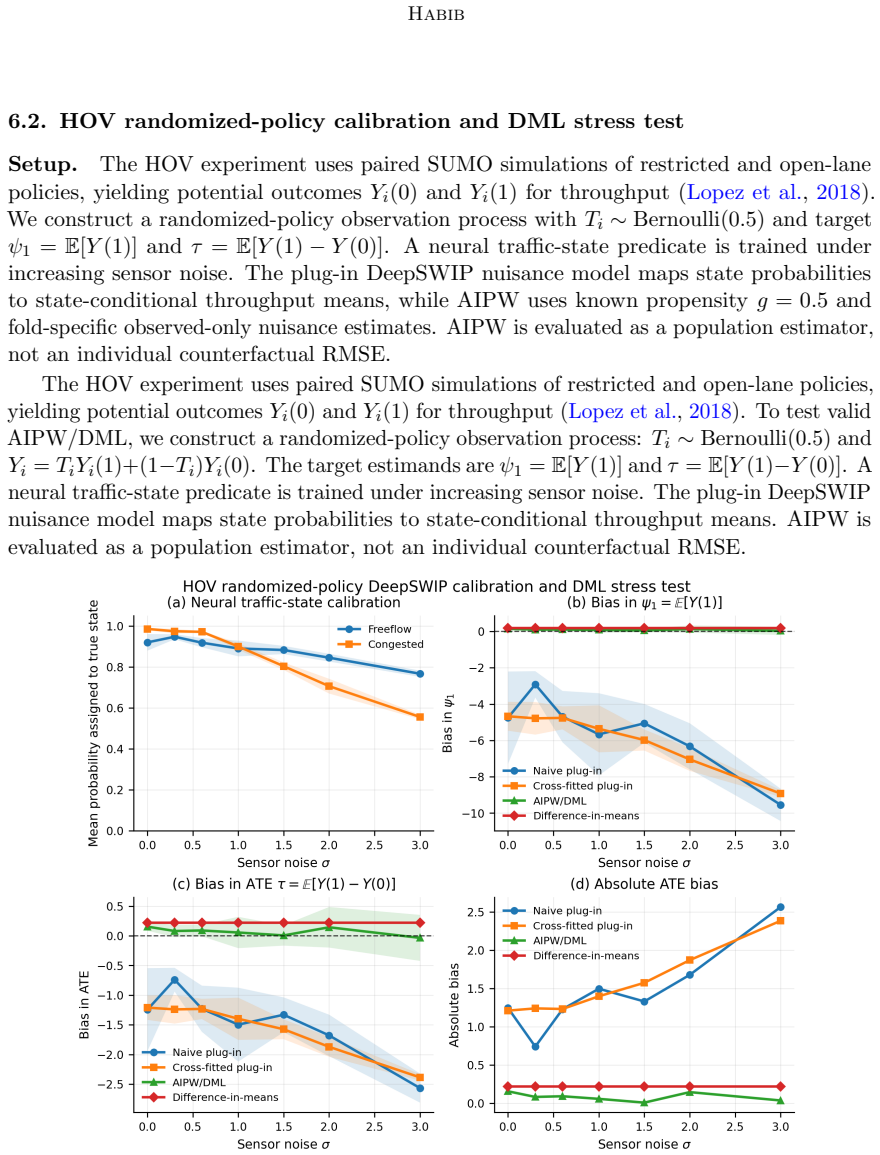
- Randomized-policy AIPW estimator removes most first-order bias for mean and ATE despite calibration degradation.
Where Pith is reading between the lines
- The single-program approach could extend to counterfactual reasoning in other neurosymbolic systems.
- Understanding calibration effects via quotient-WMC may suggest training methods to stabilize causal estimates.
- Efficiency gains from avoiding duplication might apply to related causal inference tasks in hybrid models.
Load-bearing premise
Neural materialization correctly reduces fixed-context neural predicates to ordinary ProbLog choices without loss of the original neural semantics, and the unique-supported-model assumption holds for the queries of interest.
What would settle it
An input where the materialized model's counterfactuals differ from direct computation on the original neural predicates, or a query with multiple supported models producing inconsistent results.
Figures
read the original abstract
Neurosymbolic systems such as DeepProbLog combine neural perception with probabilistic logic, but standard inference is associational. Counterfactual reasoning additionally requires a causal semantics for interventions and evidence. We introduce DeepSWIP, a single-world counterfactual semantics for DeepProbLog programs. Using neural materialization, we reduce fixed-context neural predicates to ordinary ProbLog choices, apply Single World Intervention Programs (SWIPs), and compute counterfactuals by weighted model counting (WMC) over a single transformed program. Under finite grounding and unique-supported-model assumptions, DeepSWIP is exact relative to the learned materialized FCM. The standard quotient-WMC form of ProbLog conditionals identifies active neural probabilities and explains intervention cleaning, calibration sensitivity, and rare-evidence instability. Experiments on MPI3D confirm the transformation against a DeepTwin construction against 12,000 queries, as predicted and a 2.14$\times$ inference speedup from avoiding the Twin's endogenous duplication. A SUMO HOV experiment shows that neural calibration degradation biases plug-in estimates, while a correctly scoped randomized-policy AIPW estimator removes most first-order bias for population mean and ATE estimands. Code is at https://github.com/saibib/deep_SWIP.
Editorial analysis
A structured set of objections, weighed in public.
Referee Report
Summary. The paper introduces DeepSWIP, a single-world counterfactual semantics for DeepProbLog programs. Using neural materialization, fixed-context neural predicates are reduced to ordinary ProbLog choices; SWIPs are then applied and counterfactuals are obtained by quotient-WMC over the transformed program. Under finite grounding and unique-supported-model assumptions, DeepSWIP is claimed to be exact relative to the learned materialized FCM. The quotient-WMC form is used to explain intervention cleaning, calibration sensitivity, and rare-evidence instability. Experiments on MPI3D (12 000 queries vs. DeepTwin) confirm the transformation and report a 2.14× speedup; a SUMO HOV experiment shows bias reduction via a correctly scoped AIPW estimator. Public code is provided.
Significance. If the exactness claim holds, the work supplies a practical, WMC-based route to counterfactual inference inside neurosymbolic systems that already combine neural perception with ProbLog. The explicit statement of the two assumptions, the direct empirical check against DeepTwin, the SUMO AIPW result, and the released code constitute reproducible and falsifiable contributions. The interpretive use of quotient-WMC to account for observed instabilities is a useful side benefit.
major comments (2)
- [Abstract / DeepSWIP construction] Abstract and DeepSWIP construction paragraph: the claim that DeepSWIP is exact relative to the learned materialized FCM under finite grounding and unique-supported-model assumptions is asserted without any derivation steps, proof sketch, or error-bound analysis showing how the assumptions produce equivalence. This is load-bearing for the central theoretical contribution.
- [DeepSWIP construction] Paragraph on DeepSWIP construction (weakest-assumption discussion): neural materialization is stated to reduce fixed-context neural predicates to ordinary ProbLog choices without loss of original neural semantics, yet no formal argument or verification procedure is supplied for why the unique-supported-model assumption holds for the queries of interest.
Simulated Author's Rebuttal
We thank the referee for the careful reading and for highlighting the need for explicit theoretical support. We agree that the exactness claim is central and will strengthen the manuscript by adding the requested derivations and arguments.
read point-by-point responses
-
Referee: [Abstract / DeepSWIP construction] Abstract and DeepSWIP construction paragraph: the claim that DeepSWIP is exact relative to the learned materialized FCM under finite grounding and unique-supported-model assumptions is asserted without any derivation steps, proof sketch, or error-bound analysis showing how the assumptions produce equivalence. This is load-bearing for the central theoretical contribution.
Authors: We agree that a derivation is required. In the revision we will insert a new subsection that derives the exact equivalence: finite grounding ensures the materialized program is a finite ProbLog theory; the unique-supported-model assumption guarantees that the neural predicates behave as deterministic choices once materialized; the SWIP transformation and subsequent quotient-WMC then compute the counterfactual probability exactly by construction. Because the result is an identity rather than an approximation, no error-bound analysis is needed; we will state this explicitly. revision: yes
-
Referee: [DeepSWIP construction] Paragraph on DeepSWIP construction (weakest-assumption discussion): neural materialization is stated to reduce fixed-context neural predicates to ordinary ProbLog choices without loss of original neural semantics, yet no formal argument or verification procedure is supplied for why the unique-supported-model assumption holds for the queries of interest.
Authors: We acknowledge the absence of a formal argument. The revision will add a paragraph showing that, for queries whose neural predicates have fixed context, materialization replaces each neural atom with a deterministic choice whose truth value is fixed by the neural network output; because the grounding is finite and the neural network is a function, the resulting program admits exactly one supported model. We will also outline a simple verification procedure: ground the program and check that the supported-model computation yields a singleton. revision: yes
Circularity Check
No significant circularity
full rationale
The paper's derivation applies external ProbLog WMC and SWIP machinery to a transformed program obtained via neural materialization. Exactness is explicitly conditioned on declared assumptions (finite grounding, unique-supported-model) rather than derived from fitted parameters or self-referential definitions. Empirical checks against an independent DeepTwin construction and SUMO AIPW results provide external verification. No load-bearing self-citation, self-definitional reduction, or renaming of fitted inputs as predictions appears in the reported construction; the central claim remains independent of its own outputs.
Axiom & Free-Parameter Ledger
axioms (1)
- domain assumption Finite grounding and unique-supported-model assumptions hold for the programs and queries considered
Reference graph
Works this paper leans on
-
[1]
Advances in Neural Information Processing Systems , year=
DeepProbLog: Neural Probabilistic Logic Programming , author=. Advances in Neural Information Processing Systems , year=
-
[2]
Proceedings of the ACM SIGPLAN Conference on Programming Language Design and Implementation , year=
Scallop: A Language for Neurosymbolic Programming , author=. Proceedings of the ACM SIGPLAN Conference on Programming Language Design and Implementation , year=
-
[3]
Proceedings of the International Joint Conference on Artificial Intelligence , year=
ProbLog: A Probabilistic Prolog and Its Application in Link Discovery , author=. Proceedings of the International Joint Conference on Artificial Intelligence , year=
-
[4]
arXiv preprint arXiv:2305.15318 , year=
``What if?'' in Probabilistic Logic Programming , author=. arXiv preprint arXiv:2305.15318 , year=
-
[5]
Journal of Applied Logic , volume=
Algebraic model counting , author=. Journal of Applied Logic , volume=
-
[6]
Proceedings of the AAAI Conference on Artificial Intelligence , year=
The Gradient of Algebraic Model Counting , author=. Proceedings of the AAAI Conference on Artificial Intelligence , year=
-
[7]
arXiv preprint arXiv:2603.20505 , year=
Efficient Counterfactual Reasoning in ProbLog via Single World Intervention Programs , author=. arXiv preprint arXiv:2603.20505 , year=
-
[8]
Working paper , year=
Single World Intervention Graphs: A Unification of the Counterfactual and Graphical Approaches to Causality , author=. Working paper , year=
-
[9]
Probabilistic and Causal Inference: The Works of Judea Pearl , publisher=
Single World Intervention Graphs , author=. Probabilistic and Causal Inference: The Works of Judea Pearl , publisher=
-
[10]
Causality: Models, Reasoning, and Inference , author=
-
[11]
Actual Causality , author=
-
[12]
Theory and Practice of Logic Programming , volume=
CP-logic: A Language of Causal Probabilistic Events and Its Relation to Logic Programming , author=. Theory and Practice of Logic Programming , volume=
-
[13]
arXiv preprint arXiv:2501.18202 , year=
On Scaling Neurosymbolic Programming through Guided Logical Inference , author=. arXiv preprint arXiv:2501.18202 , year=
-
[14]
Advances in Neural Information Processing Systems , year=
Deep Structural Causal Models for Tractable Counterfactual Inference , author=. Advances in Neural Information Processing Systems , year=
-
[15]
arXiv preprint arXiv:2107.00793 , year=
The Causal-Neural Connection , author=. arXiv preprint arXiv:2107.00793 , year=
-
[16]
arXiv preprint arXiv:2109.04173 , year=
Relating Graph Neural Networks to Structural Causal Models , author=. arXiv preprint arXiv:2109.04173 , year=
-
[17]
The Econometrics Journal , volume=
Double/Debiased Machine Learning for Treatment and Structural Parameters , author=. The Econometrics Journal , volume=
-
[18]
Journal of the American Statistical Association , volume=
Estimation of Regression Coefficients When Some Regressors Are Not Always Observed , author=. Journal of the American Statistical Association , volume=
-
[19]
Advances in Neural Information Processing Systems , year=
On the Transfer of Inductive Bias from Simulation to the Real World: A New Disentanglement Dataset , author=. Advances in Neural Information Processing Systems , year=
-
[20]
IEEE International Conference on Intelligent Transportation Systems , year=
Microscopic Traffic Simulation using SUMO , author=. IEEE International Conference on Intelligent Transportation Systems , year=
-
[21]
Treewidth-. Proceedings of the International Conference on Principles of Knowledge Representation and Reasoning , author =. 2021 , note =. doi:10.24963/kr.2021/26 , abstract =
discussion (0)
Sign in with ORCID, Apple, or X to comment. Anyone can read and Pith papers without signing in.