REVIEW 3 major objections 3 minor 30 references
CurveFP: Co-Designing Numerical Representation and Product Arithmetic for Language Models
T0 review · 3 major / 3 minor · reviewed 2026-08-14 · deepseek-v4-flash
Pith's one-line read CurveFP co-designs a low-precision number format with its product arithmetic, claiming that 7-bit log-curve codebooks can match or beat FP8 for language-model inference and training.
desk verdict Carefully built block-scaled LNS variant with an honest matched-experiment suite; the core training claim rests on a 128M run, but the math is correct and the paper deserves a serious referee. read the letter →
The pith
A machine-rendered reading of the paper's core claim, the machinery that carries it, and where it could break.
The reading
What carries the argument
The load-bearing object is the CurveFP codebook: a block of values sharing one power-of-two scale $2^{a_b}$, each nonzero element storing a sign, an exponent $e$, and a curve index $k\in\{0,\dots,K-1\}$, with magnitude $2^{a_b}r^{e+k/K}$ where $r=2^{p/q}$ is a reduced rational radix and $K=2^C$. The uniform curve index is what carries the argument: multiplication becomes sign XOR, $(k_x+k_w)\bmod K$, and $e_x+e_w+\lfloor(k_x+k_w)/K\rfloor$, so product formation needs no general multiplier and no codebook lookup. The radix $r$ then fixes the phase count $H=qK/\gcd(p,qK)$ of Equation 4, which schedules accumulation as a sum over $H$ fixed phase weights of binary-shifted integer counts, making the hardware cost of a precision choice explicit.
What would settle it
On a model whose activations contain per-block outliers larger than the chosen power-of-two scale, measure CurveFP8 versus FP8 perplexity at block sizes 64 and 512; if the fraction of values saturating the CurveFP endpoint grows enough to push its perplexity more than 0.02 above FP8's, the block-log-uniform premise is the limiting factor.
Extended reading notes
Core claim
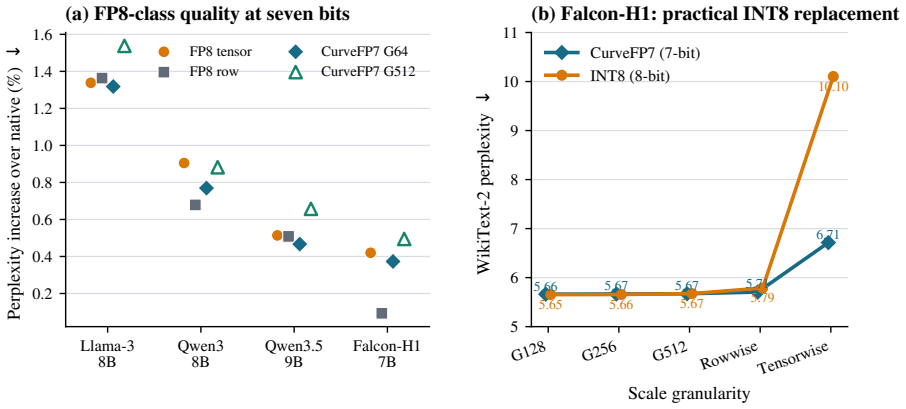
On its own terms, CurveFP's discovery is that uniform spacing of the curve index makes the product of any two representable values exactly representable in the same codebook: signs XOR, curve indices add modulo $K$ with a carry into the exponent, exponents add, and shared power-of-two scales add. Because magnitudes sit on a rational-radix lattice $r^{e+k/K}=2^{p(eK+k)/(qK)}$, the number of distinct fractional phases a dot product must accumulate is $H=qK/\gcd(p,qK)$, so every range–resolution choice carries an explicit accumulation contract. Instantiated as CurveFP8 E4C3/E5C2 and CurveFP7 E3C3, this structure reaches FP8-class pretraining parity—mean BF16-inference perplexity 22.5366 versus 22.5407 for FP8 across three matched 3B-token runs—and CurveFP7 at seven bits beats tensorwise FP8 perplexity on four 7B–9B models while staying within 1.32% of native quality. It also reports a preliminary routed tile in which CurveFP8 closes at 500 MHz with one fewer product register and 4.6% less area than the timing-closing FP8 tile.
Load-bearing premise
The load-bearing premise is that, within each block, magnitudes are approximately log-uniform, so a single power-of-two scale plus the fixed log lattice can represent activations and weights accurately; because CurveFP has no per-element exponent, any outlier that the block scale cannot absorb is saturated or coarsely quantized.
Editorial extensions
If this is right
- Training GEMMs can drop the general mantissa multiplier: with the same role split as FP8 (E4C3 forward, E5C2 gradients), every nonzero product is a few integer additions, and the product path closes timing at 500 MHz without an extra register in the preliminary tile.
- Seven-bit inference becomes a practical operating point: at block size 64, CurveFP7 beats tensorwise FP8 perplexity on all four tested 7B–9B models and stays within 1.32% of native quality, and at block size 512 it crosses INT8.
- The phase law $H=qK/\gcd(p,qK)$ gives designers an explicit quality–complexity dial: a denser radix such as $r=2^{3/4}$ improves perplexity by 0.0055–0.0259 but requires 32 phases instead of 8.
- Matching training and runtime arithmetic nearly halves the out-of-distribution penalty for CurveFP8, and the CurveFP8-trained checkpoint transfers to seven-bit runtime, so one numeric family can span training and deployment without retraining.
- The paper's hardware evidence is limited to a feasibility tile: area savings of 4.6% at equal peak throughput come with memory, interconnect, scale transport, and workload effects explicitly excluded from both designs.
Reading between the lines
- Beyond the paper: if within-block log-uniformity holds for larger models, CurveFP's phase schedule could combine with outlier-aware scale selection (per-row or per-token scales) to absorb activation outliers without a conventional multiplier; the paper tests only fixed block sizes 64–512.
- Beyond the paper: the phase law suggests a hardware experiment the paper does not run—fix tile area and sweep radix from $p/q=1$ to $3/4$, and measure whether the added phase-reduction logic erodes the 4.6% area advantage as $H$ grows from 8 to 32.
- Beyond the paper: the codebook is parameter-free apart from E, C, p/q, and block scale, so the same closed-product algebra could be applied to KV-cache or attention-score tensors, whose distributions may not be log-uniform; that remains untested.
- Beyond the paper: because the paper's training evidence is one 128.3M-parameter architecture at 3B tokens, a direct extension is a matched FP8-versus-CurveFP8 run at 7B+ scale, where activation distributions may deviate further from log-uniform blocks.
Signed reviews
Editorial analysis
A structured set of objections, weighed in public.
Referee Report
Summary. CurveFP is a block-scaled number format family in which each element stores a sign, an E-bit exponent, and a C-bit curve index under a shared power-of-two scale and a rational radix r=2^{p/q}. The paper shows that multiplication is exactly closed in the code domain (sign XOR, curve-index addition with carry, exponent addition) and derives H=qK/gcd(p,qK) phase classes for accumulation. It instantiates E4C3/E5C2 for training and E3C3 for 7-bit inference, and reports: FP8-class post-training perplexity on four 7B-9B models; lower NMSE in all 36 paired training-GEMM windows; three matched 3B-token pretraining runs at 128.3M parameters showing mean BF16-inference perplexity 22.5366 versus 22.5407 for FP8; downstream transfer parity; and a 4x4 Nangate45 tile that closes at 500 MHz with one fewer product register and about 4.6% smaller area than FP8.
Significance. If the results hold, CurveFP is a genuinely useful co-design: it replaces general product-forming multipliers with small integer additions and sign/carry logic, makes the accumulation cost explicit through the phase law, and appears to reach FP8-class accuracy with a seven-bit inference format. The paper is unusually careful in its statistical hedging: it matches seeds, token order, and schedules across training modes, reports uncertainties, and states parity rather than superiority. It also ships machine-checked hardware verification and an artifact-based reproducibility plan. The main weaknesses are that from-scratch training evidence is limited to a single 128.3M-parameter model trained on 3B tokens, and the per-block scaling configuration in the training protocol is under-specified; these gaps weaken but do not invalidate the central 'FP8-class training' claim.
major comments (3)
- [§4.5, §B.2, Eq. (6)] The matched pretraining protocol never states the block size G or the scale-exponent width S used by CurveFP8's per-block power-of-two scales, even though Eq. (6) makes the storage rate depend on S/G and Figure 2b shows inference quality depends strongly on G. The same section also does not state the scale granularity used for the FP8 baseline; if FP8 used per-tensor scales while CurveFP8 used per-block scales, the comparison in Table 4 confounds datatype with scaling policy. Please report these parameters for both formats.
- [§3.1, Eq. (1)] For E4C3, Eq. (1) gives each block an element field that spans only a fixed magnitude ratio of 2^{15.875}, about 6×10^4. Since the scale exponent a_b is shared across the block, ceil-absmax scaling shifts this window but cannot widen it; any block whose max/min ratio exceeds this window will force small elements to the smallest positive magnitude or to saturation, with relative errors well above 10% for affected values. The paper does not report outlier statistics, block-level max/min ratios, or sensitivity of the Table 4 results to this failure mode, so the central parity claim rests on an unverified assumption that LLM activations and weights are approximately log-uniform within each block. Please add this analysis or explicitly qualify the claim.
- [§4.5, §6] The only from-scratch training evidence is a 128.3M-parameter model trained on 3B tokens; the 7B-9B results are post-training quantization only. Since activation and gradient outliers typically become more severe as model scale grows, the conclusion that CurveFP8 provides an 'FP8-class training path' is not established at the scale where FP8 is most relevant. Either extend the training study to a larger model or narrow the claim in the abstract and conclusion to the tested scale.
minor comments (3)
- [§3.1, Table 1] The sentence 'We reserve magnitude index zero as a sentinel and omit the smallest nonzero exponent/curve combination, leaving 2^{E+C}-1 positive magnitudes' is internally inconsistent: reserving a sentinel and additionally omitting the smallest nonzero combination would leave 2^{E+C}-2 positive levels, not 2^{E+C}-1. Please clarify the codebook construction.
- [§1, §5, Table 6] The area reductions in the introduction (4.4% and 3.9%) differ from those in the abstract, Section 5, and Table 6 (4.6% and 4.1%); please make the numbers consistent.
- [§4.4, Table 3] Table 3 reports only aggregate NMSE ratios per model and GEMM role; if the text claims all 36 paired comparisons are wins, the individual paired values should be included in the supplementary material for verification.
Circularity Check
No significant circularity: core quality results are measured against external FP8/BF16/INT8 baselines, and the closed-product and phase-count properties follow from the stated definitions.
full rationale
The paper's central claims are not circular. CurveFP's closed-product rule and phase count are derived from the defining codebook in Section 3: Equation 1 defines the rational-radix element code, Equation 2 defines the index update, and Equation 4 derives H = qK/gcd(p, qK) from the additive subgroup generated by p in Z_{qK}. These are definitional algebraic facts, not empirical discoveries dressed as predictions, and the paper explicitly presents product closure as a designed property rather than a fitted outcome. The main empirical comparisons are all against external baselines: CurveFP7 is compared with FP8 and INT8 on four public models (Section 4.2), CurveFP8 is compared with FP8 on paired training-GEMM windows from Pythia and Llama (Section 4.4), and the matched pretraining study compares CurveFP8, FP8, and BF16 under shared initialization, tokens, optimizer, and schedule (Section 4.5). The scale selection procedure (reconstruction-MSE search for static operands, ceil-absmax for dynamic operands) is standard quantization calibration and is applied to both CurveFP and the baselines; it does not encode the reported perplexity or error outcomes. Self-citations to TeLLMe, FASQ, and APEX-Q appear only as related work and are not load-bearing premises for any derivation or empirical claim. No fitted parameter is renamed as a prediction, and no uniqueness or impossibility result is imported from the authors' prior work. Any concern about the bounded within-block dynamic range of the format is a correctness or generalization risk, not circularity.
Assumptions & free parameters
free parameters (3)
- Block size G =
64, 128, 256, 512 (swept; G512 used for principal inference results)
- Scale exponent width S =
not explicitly specified
- Radix p/q =
1/1 default; ablated at 8/9 and 3/4
assumptions (3)
- standard math Properties of exponentiation and modular arithmetic used to derive the phase count (Eq. 4).
- domain assumption Within each block, LLM activations and weights are approximately log-uniform so a single power-of-two scale plus the log lattice gives FP8-class accuracy.
- domain assumption Training with quantized forward operands and output gradients under AdamW converges to the same quality as FP8 training on the tested setup.
invented entities (1)
-
CurveFP format family (E4C3, E5C2, E3C3 variants)
independent evidence
Cite this review
Pith. "Pith review of CurveFP: Co-Designing Numerical Representation and Product Arithmetic for Language Models." pith.science (2026). https://pith.science/paper/5FX2UV5U
@misc{pith2026260810010,
  author       = {Pith},
  title        = {Pith review of: CurveFP: Co-Designing Numerical Representation and Product Arithmetic for Language Models},
  year         = {2026},
  howpublished = {\url{https://pith.science/paper/5FX2UV5U}},
  note         = {Machine review of arXiv:2608.10010}
}
read the original abstract
Low-precision formats usually optimize scalar fidelity while inheriting conventional product arithmetic. We introduce CurveFP, a block-scaled family that distributes magnitudes across interleaved logarithmic curves. Uniform curve indices make every nonzero product an exact sign and integer-index update, while a rational radix exposes the finite phase schedule required for accumulation. We instantiate the algebra as CurveFP8 E4C3/E5C2 for training and CurveFP7 E3C3 for compact inference. On four 7B-9B models, CurveFP7 beats tensorwise FP8 perplexity with one fewer element bit and stays within 1.32% of native quality. CurveFP8 lowers error in all 36 paired training-GEMM comparisons. Across three matched 3B-token pretraining triplets, it reaches mean BF16-inference perplexity 22.5366 versus 22.5407 for FP8 and has a lower format penalty in every seed. Downstream evaluation shows transfer parity and a consistent WikiText-103 gain. In a preliminary 4x4 Nangate45 spatial accelerator tile, CurveFP8 uses one fewer product register and 4.6% less area than timing-closing FP8 at 500 MHz. These results support CurveFP as a numerical and arithmetic co-design, while leaving system-level efficiency to future study.
Figures


Figures from the paper (4 more)


Reference graph
Works this paper leans on
-
[1]
Croci, Bo Li, Pashmina Cameron, Martin Jaggi, Dan Alistarh, and Torsten Hoefler
Saleh Ashkboos, Amirkeivan Mohtashami, Maximilian L. Croci, Bo Li, Pashmina Cameron, Martin Jaggi, Dan Alistarh, and Torsten Hoefler. QuaRot: Outlier-free 4-bit inference in rotated LLMs.arXiv preprint arXiv:2404.00456,
-
[2]
Cells Setup WS Setup TNS Hold WS pJ/MAC CurveFP8 P0 0 49,282.9 37,999+0.0640+0.1044.78 CurveFP8 P1 1 49,540.1 33,868+0.4260+0.1044.78 FP8 P0 0 53,245.5 41,077−0.045−1.223 +0.105– FP8 P1 1 51,646.8 35,716+0.3020+0.1064.75 C.2 Verification, tools, and power method All 256 E4M3FN byte patterns were checked against PyTorch 2.6, and all 16,384 CurveFP E4 magni...
work page 2026
-
[3]
14 BF16 FP8 CurveFP8CurveFP7 Runtime format BF16 FP8 CurveFP8Training arithmetic 0 +6.94 +7.02 +7.40 0 +3.48 +4.66 +4.94 0 +5.56 +4.01 +4.27 (a) OOD ΔNLL (milli) ↓ BF16 FP8 CurveFP8CurveFP7 Runtime format 0 -0.03 -0.14 -0.17 0 -0.06 +0.10 +0.19 0 -0.15 -0.02 -0.16 (b) Zero-shot Δacc. (pt) ↑ BF16 FP8 CurveFP8CurveFP7 Runtime format 0 -0.25 -0.24 -0.45 0 -0...
work page 2024
-
[7]
Reena Elangovan, Charbel Sakr, Anand Raghunathan, and Brucek Khailany
URL https://arxiv.org/ abs/1804.01526. Reena Elangovan, Charbel Sakr, Anand Raghunathan, and Brucek Khailany. LO-BCQ: Block clustered quantization for 4-bit (W4A4) LLM inference.Transactions on Machine Learning Research,
-
[9]
URLhttps://arxiv.org/abs/2407.21783
doi: 10.48550/arXiv.2407.21783. URLhttps://arxiv.org/abs/2407.21783. Ioannis Kouretas and Vassilis Paliouras. Logarithmic number system for deep learning. In2018 7th International Conference on Modern Circuits and Systems Technologies, pp. 1–4,
-
[10]
URLhttps://doi.org/10.1109/MOCAST.2018.8376572
doi: 10.1109/ MOCAST.2018.8376572. URLhttps://doi.org/10.1109/MOCAST.2018.8376572. 11 Yuhang Li, Xin Dong, and Wei Wang. Additive powers-of-two quantization: An efficient non-uniform discretization for neural networks. InInternational Conference on Learning Representations,
arXiv 2018
-
[11]
URL https://arxiv.org/abs/1909.13144. Zechun Liu, Changsheng Zhao, Igor Fedorov, Bilge Soran, Dhruv Choudhary, Raghuraman Krishnamoorthi, Vikas Chandra, Yuandong Tian, and Tijmen Blankevoort. SpinQuant: LLM quantization with learned rotations. InInternational Conference on Learning Representations,
arXiv 1909
-
[12]
URL https://arxiv. org/abs/2405.16406. Stephen Merity, Caiming Xiong, James Bradbury, and Richard Socher. Pointer sentinel mixture models. arXiv preprint arXiv:1609.07843,
Show all 30 references
- [14]
-
[15]
URL https://arxiv.org/abs/1603.01025
doi: 10.48550/arXiv.1603.01025. URL https://arxiv.org/abs/1603.01025. Denis Paperno, Germ´an Kruszewski, Angeliki Lazaridou, Ngoc-Quan Pham, Raffaella Bernardi, Sandro Pezzelle, Marco Baroni, Gemma Boleda, and Raquel Fern´andez. The LAMBADA dataset: Word prediction requiring a...
-
[16]
URL https://aclanthology.org/P16-1144/
doi: 10.18653/v1/P16-1144. URL https://aclanthology.org/P16-1144/. Guilherme Penedo, Hynek Kydl´ıˇcek, Loubna Ben Allal, Anton Lozhkov, Margaret Mitchell, Colin Raffel, Leandro von Werra, and Thomas Wolf. The FineWeb datasets: Decanting the web for the finest text data at scal...
-
[17]
URL https: //arxiv.org/abs/2406.17557
doi: 10.48550/arXiv.2406.17557. URL https: //arxiv.org/abs/2406.17557. Ye Qiao, Zhiheng Chen, Yifan Zhang, Yian Wang, and Sitao Huang. TeLLMe: An efficient end-to-end ternary LLM prefill and decode accelerator with table-lookup matmul on edge FPGAs. InProceedings of the 2026 A...
- [20]
- [21]
-
[22]
URL https: //doi.org/10.1609/aaai.v40i48.42293
doi: 10.1609/aaai.v40i48.42293. URL https: //doi.org/10.1609/aaai.v40i48.42293. Alex Warstadt, Alicia Parrish, Haokun Liu, Anhad Mohananey, Wei Peng, Sheng-Fu Wang, and Samuel R. Bowman. BLiMP: The benchmark of linguistic minimal pairs for english.Transactions of the Associati...
-
[23]
URL https://doi.org/ 10.1162/tacl_a_00321
doi: 10.1162/tacl a 00321. URL https://doi.org/ 10.1162/tacl_a_00321. Guangxuan Xiao, Ji Lin, Mickael Seznec, Hao Wu, Julien Demouth, and Song Han. SmoothQuant: Accurate and efficient post-training quantization for large language models. InProceedings of the 40th International...
-
[24]
An Yang et al
URLhttps://proceedings.mlr.press/v202/xiao23c.html. An Yang et al. Qwen3 technical report.arXiv preprint arXiv:2505.09388,
- [25]
-
[26]
URLhttps://aclanthology.org/P19-1472/
doi: 10.18653/v1/P19-1472. URLhttps://aclanthology.org/P19-1472/. Jiawei Zhao, Steve Dai, Rangharajan Venkatesan, Brian Zimmer, Mustafa Ali, Ming-Yu Liu, Brucek Khailany, William J. Dally, and Anima Anandkumar. LNS-Madam: Low-precision training in logarithmic number system usi...
-
[27]
URLhttps://doi.org/10.1109/TC.2022.3202747
doi: 10.1109/TC.2022.3202747. URLhttps://doi.org/10.1109/TC.2022.3202747. Jingwei Zuo et al. Falcon-H1: A family of hybrid-head language models redefining efficiency and perfor- mance.arXiv preprint arXiv:2507.22448,
2022
-
[28]
13 A Algorithmic Details A.1 Closed-product addressing and accumulator bounds Let g= gcd(p, qK), nx =e xK+k x, nw =e wK+k w, and u=p(n x +n w)
URLhttps://arxiv.org/abs/2507.22448. 13 A Algorithmic Details A.1 Closed-product addressing and accumulator bounds Let g= gcd(p, qK), nx =e xK+k x, nw =e wK+k w, and u=p(n x +n w). Each nonzero product contributes δ= (−1)sx⊕sw , h= umodqK g , t=a x +a w + u qK (7) to integer b...
-
[2016]
URL https://arxiv
doi: 10.48550/arXiv.1609.07843. URL https://arxiv. org/abs/1609.07843. Paulius Micikevicius, Dusan Stosic, Neil Burgess, Marius Cornea, Pradeep Dubey, Richard Grisenth- waite, Sangwon Ha, Alexander Heinecke, Patrick Judd, John Kamalu, Naveen Mellempudi, Stuart Ober- man, Moham...
- [2018]
- [2019]
-
[2020]
Maxime Christ, Florent de Dinechin, and Fr´ed´eric P´etrot
URLhttps://arxiv.org/abs/1911.11641. Maxime Christ, Florent de Dinechin, and Fr´ed´eric P´etrot. Low-precision logarithmic arithmetic for neural network accelerators. In2022 IEEE 33rd International Conference on Application-Specific Systems, Architectures and Processors, pp. 72–79,
1911 arXiv
-
[2022]
URL https: //doi.org/10.1109/ASAP54787.2022.00021
doi: 10.1109/ASAP54787.2022.00021. URL https: //doi.org/10.1109/ASAP54787.2022.00021. Peter Clark, Isaac Cowhey, Oren Etzioni, Tushar Khot, Ashish Sabharwal, Carissa Schoenick, and Oyvind Tafjord. Think you have solved question answering? try ARC, the AI2 reasoning challenge.a...
2022
-
[2023]
URL https://arxiv.org/abs/2304.01373
doi: 10.48550/arXiv.2304.01373. URL https://arxiv.org/abs/2304.01373. Yonatan Bisk, Rowan Zellers, Ronan Le Bras, Jianfeng Gao, and Yejin Choi. PIQA: Reasoning about physical commonsense in natural language. InProceedings of the AAAI Conference on Artificial Intelligence,
-
[2024]
URL https://arxiv.org/abs/2404
doi: 10.48550/arXiv.2404.00456. URL https://arxiv.org/abs/2404. 00456. Stella Biderman, Hailey Schoelkopf, Quentin Anthony, Herbie Bradley, Kyle O’Brien, Eric Hallahan, Mohammad Aflah Khan, Shivanshu Purohit, USVSN Sai Prashanth, Edward Raff, Aviya Skowron, Lintang Sutawika, a...
-
[2025]
URLhttps://arxiv.org/abs/2502.05376
doi: 10.48550/arXiv.2502.05376. URLhttps://arxiv.org/abs/2502.05376. Aaron Grattafiori et al. The Llama 3 herd of models.arXiv preprint arXiv:2407.21783,
-
[2026]
URL https://qwen.ai/ blog?id=qwen3.5. Jack W. Rae, Anna Potapenko, Siddhant M. Jayakumar, and Timothy P. Lillicrap. Compressive transformers for long-range sequence modelling.arXiv preprint arXiv:1911.05507,
1911 arXiv
Reviewed August 14, 2026 · model on record in the stance chip above.
Discussion (0). Continue with ORCID to comment.