REVIEW 3 major objections 5 minor 30 references
Macroscopic electron-hole distribution in silicon and cubic silicon carbide
T0 review · 3 major / 5 minor · reviewed 2026-08-14 · deepseek-v4-flash
Pith's one-line read Electron and hole quasi-temperatures stay finite tens of nanometers deep in silicon and 3C-SiC, with profiles set by tunneling versus multiphoton absorption and by band structure.
desk verdict New depth-resolved quasi-temperature profiles from TDDFT+Maxwell for Si and 3C-SiC, but the deep-region temperatures are likely artifacts of projecting nonthermal occupations onto a single Fermi-Dirac form. read the letter →
The pith
A machine-rendered reading of the paper's core claim, the machinery that carries it, and where it could break.
The reading
What carries the argument
The central machinery is a multiscale implementation that solves the Maxwell wave equation for the laser pulse on a macroscopic depth coordinate X, while at each X a time-dependent Kohn–Sham equation evolves the lattice-periodic electron orbitals in the microscopic coordinate r. Occupations of conduction and valence states at the final time are obtained by projecting the time-dependent orbitals onto the initial ground-state orbitals, giving the change in electron distribution δO at every depth. From those occupations, the reduced internal energies in the valence and conduction bands (Eq. 7) are used with the quasi-temperature model of Ref. 24 to assign electron and hole quasi-temperatures per depth, and the Keldysh parameter γ classifies the local excitation process as tunneling (γ ≪ 1) or multiphoton (γ ≫ 1).
What would settle it
A time-resolved photoemission or transient-absorption experiment that measures the carrier energy distribution at depths beyond 100 nm in silicon under 800 nm, 10 fs-scale pulses at ~$10^{13}$ W/$cm^{2}$ would settle the claim: if the deep distribution shows only narrow, intensity-independent multiphoton peaks without a broad ~1 eV thermal tail, the extracted quasi-temperatures are artifacts of the temperature-model projection.
Extended reading notes
Core claim
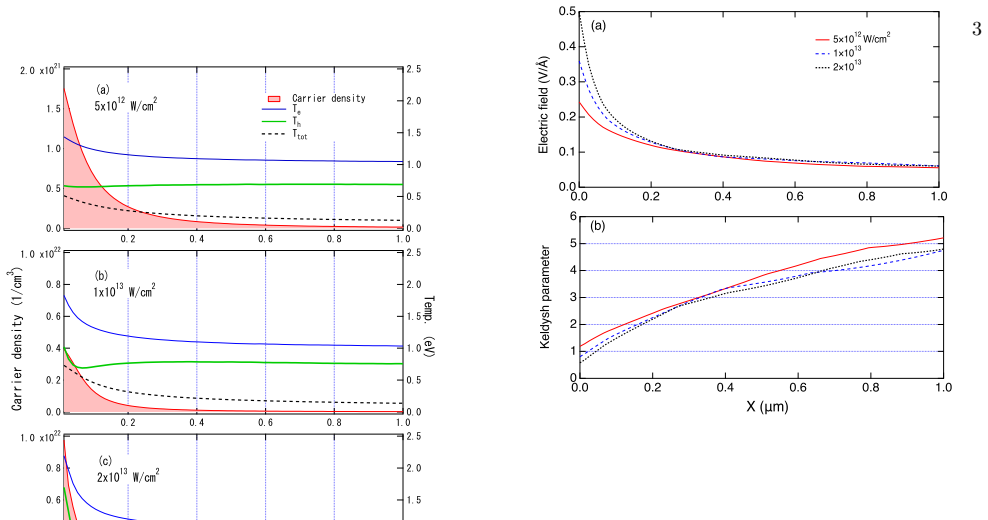
Under an 800-nm femtosecond pulse at intensities around 5×$10^{12}$ to 2×$10^{13}$ W/$cm^{2}$, the excited electron and hole occupation functions in silicon and 3C-SiC acquire quasi-temperatures whose spatial decay is not monotonic. In silicon, the electron quasi-temperature drops steeply in the first 100 nm, passes through a small dip in the hole temperature where the Keldysh parameter crosses unity, and then saturates at ~1.0 eV independent of laser intensity; the full profile fits a double exponential with a constant offset. In 3C-SiC, the quasi-temperatures instead show stepwise drops as the number of contributing conduction bands changes with depth, and the hole temperature ends up much higher than the electron temperature. The paper concludes that both the excitation mechanism (tunneling versus multiphoton) and the band structure determine the macroscopic electron-hole distribution, and that quantum-mechanical simulation is needed to supply electron-lattice models with accurate initial carrier temperatures.
Load-bearing premise
The result rests on assuming that at each depth the entire nonthermal, laser-generated carrier population can be represented by one quasi-temperature per carrier type; if the carriers are not actually thermalized within the 48 fs simulation time, the reported temperatures are projections of the model rather than physical temperatures.
Editorial extensions
If this is right
- Two-temperature-model simulations of femtosecond laser processing should not assume that carrier temperatures decay monotonically; a finite deep-region temperature must be included.
- The value of the saturation temperature in silicon (~1 eV) is set by a multiphoton absorption channel and is nearly independent of laser intensity.
- The stepwise temperature profiles in 3C-SiC show that band-structure details, not just absorbed energy, control the carrier distribution; simulations for each material are needed.
- The Keldysh parameter alone can locate the crossover depth between tunneling and multiphoton regimes, as the crossover shows up directly as a feature in the hole quasi-temperature.
Reading between the lines
- If the deep-region carriers are as hot as the simulation suggests, then the initial electron-lattice coupling in the two-temperature model begins from a hot and spatially extended carrier gas, which would shift predicted damage thresholds and heat-affected zones deeper than in current models.
- The stepwise drop in 3C-SiC suggests a testable prediction: changing the laser wavelength to move a different set of conduction bands into resonance should change the depth at which the steps occur.
- The simulation stops at 48 fs, before carrier–phonon scattering; one could extend the same method with a longer time window or couple it to molecular dynamics to see how quickly the hot deep-region distribution thermalizes with the lattice.
Signed reviews
Editorial analysis
A structured set of objections, weighed in public.
Referee Report
Summary. The paper reports multiscale time-dependent density functional theory (TDDFT) plus Maxwell equation simulations of femtosecond laser excitation at silicon and 3C-SiC surfaces. It computes the depth-dependent absorbed energy, electron-hole density, and electron and hole quasi-temperatures extracted from band-resolved occupation probabilities. The main findings are that, near the surface, the quasi-temperatures decrease exponentially with depth, but they remain finite at larger depths because of multi-photon absorption peaks that produce position-independent narrow structures; in silicon the depth profile is smooth and fitted by a double exponential, whereas in 3C-SiC it shows a stepwise decrease attributed to changes in the contributing bands. The paper also connects the depth variation of the Keldysh parameter with the transition between multiphoton and tunneling excitation regimes.
Significance. If the quasi-temperature extraction is valid, the paper provides a first-principles, parameter-free description of the depth-resolved electron-hole distribution in two important semiconductors under femtosecond irradiation, which is useful input for two-temperature-model simulations of laser processing. The simulation setup itself is creditable: the multiscale TDDFT+Maxwell scheme is self-contained, the Keldysh classification is an external criterion, and no target quantity is fitted to force the reported trends. The qualitative consistency between the Keldysh parameter crossing and the dip in the hole quasi-temperature is a genuinely interesting observation that would be valuable if supported by a validated thermalization analysis. The principal weakness is that the central quantitative output, the quasi-temperatures Te and Th, depends on an unvalidated projection onto a quasi-temperature model.
major comments (3)
- [Section III, Eq. (7) and text following] The quasi-temperature extraction is load-bearing and is not validated. Equation (7) defines only the band-resolved internal energies UX,c and UX,v; the text then states 'We can assume the quasi-temperatures' from these moments using the QTM/STM model of reference [24], but does not give the inversion equations, the assumed occupation form, or any consistency check. Figures 2 and 7 show that in the deep region the occupations are narrow, position-independent peaks (for example, around ±3 eV in 3C-SiC, attributed to four-photon absorption), not broad thermal tails. For such a distribution the first energy moment does not uniquely determine a Fermi-Dirac temperature; a narrow peak located several eV above the band edge can map to a large effective 'quasi-temperature' even if the distribution has no thermal width. Therefore the central claim that Te and Th remain finite far from the surface may be an artifact of the projection procedure rather than a property of a thermalized carrier population. The authors should show a direct Fermi-Dirac fit to the occupation functions, report goodness-of-fit or residual measures, and validate the QTM/STM model on nonthermal, low-density distributions before the quantitative temperatures are used to support the conclusions.
- [Section II, Eqs. (2) and (4); Figures 4 and 8] The laser frequency omega_0 is never specified. The pulse envelope and total duration are given (Tp = 10.81 fs, Te = 48.38 fs) and intensities are listed, but the carrier frequency is absent from Eq. (4) and from the parameter discussion. This omission prevents the reader from checking the assignment of the ±3 eV peaks in 3C-SiC to four-photon absorption (which implies a photon energy of about 1.5 eV), and from recomputing the Keldysh parameter plotted in Figs. 4 and 8. The wavelength or angular frequency must be stated explicitly, together with the effective mass and gap values used in the Keldysh formula.
- [Section III.A and III.B, numerical parameters] The conclusions about band-structure-dependent stepwise quasi-temperatures are not backed by convergence checks. The silicon calculation uses 16^3 k-points and approximately 100 conduction bands, while 3C-SiC uses 8^3 k-points and 84 conduction bands; the macroscopic mesh spacing is 13 nm and the simulation ends at 48 fs. Since the stepwise features in Fig. 7(d)-(f) are attributed to 'the change of the number of contributing bands,' the result should be shown to be converged with respect to the number of conduction bands, the k-point sampling, and the macroscopic mesh size. A convergence test for Te and Th would materially strengthen the claim that the band structure, rather than a truncation artifact, causes the stepwise behavior.
minor comments (5)
- [Abstract] There are typos in the abstract: 'silicone' should be 'silicon' and 'descrease' should be 'decrease'.
- [Section III.A, first paragraph] The silicon setup states 'The cubic unit cell containing eight carbon atoms was discretized into grids of 16^3.' This should presumably read 'eight silicon atoms.'
- [Section III.B, text near Fig. 7] The sentence '3C-SiC shows a stepwise structure in Fig. 6 (d)-(f)' should refer to Fig. 7, since the stepwise quasi-temperature curves appear in panels (d)-(f) of Fig. 7.
- [Section III.A, paragraph on fitting parameters] The sentence 'the deviation between T1 and T1 indicates that a change in the excitation process occurs' should read 'deviation between T1 and T2.'
- [General] Quasi-temperatures are reported in eV but the text also refers to 'temperature'; the authors should state the conversion to Kelvin or explicitly define the units of Te and Th.
Circularity Check
Mild circularity: quasi-temperatures are imported from the author's own QTM/STM model, but the TDDFT simulation core is self-contained.
-
ansatz smuggled in via citation
[Section III A, Eq. (7) and following paragraph]
"We can estimate the quasi-temperatures of the electron and hole with the QTM, and the temperature of the total system with the STM 24. ... We can assume the quasi-temperatures of carrier (Te) and hole ( Th) at each X from UX,v(c), and the temperature (Ttot) from the UX,tot =UX,v +UX,c."
Te and Th, the paper's central reported quantities, are not outputs of the TDDFT propagation alone; they are obtained by applying the QTM/STM model of the author's own Ref. [24] to the band-resolved energy moments UX,v(c) of Eq. (7). That model embodies the ansatz that each nonthermal, laser-generated carrier distribution can be represented by a single Fermi-Dirac quasi-temperature. The deep-region result that Te and Th remain finite therefore follows from this assumed mapping: narrow occupation peaks at nonzero energy (e.g., ±3 eV in 3C-SiC) are converted into large effective temperatures by construction, even though the distributions are not thermally broadened.
full rationale
The TDDFT+Maxwell simulation is self-contained: occupations, carrier densities, and energy deposition are propagated from first principles with no target quantity fitted to produce the absorption or depth profiles. The Keldysh-parameter classification is an external criterion, and the double-exponential form of Eq. (8) is explicitly a fit to the computed Te(X), not a predicted observable. The only circularity-adjacent element is the quasi-temperature extraction, which imports the author's own QTM/STM model (Ref. [24]) to convert the energy moments of Eq. (7) into Te and Th. The deep-region result that Te and Th stay finite is thus partly an artifact of that assumed projection; however, the paper labels this as an estimation using QTM/STM, presents the underlying occupation changes in Figs. 2 and 7, and does not use the temperature model to generate the raw excitation dynamics. Accordingly, the central simulation content is independent, and the circularity burden is limited to a mild self-citation/assumption in the diagnostic step.
Assumptions & free parameters
free parameters (2)
- Double-exponential fit parameters T0, T1, T2, tau1, tau2 =
Not tabulated; plotted in Fig. 5 (T0 near 1 eV, T1/T2 and tau1/tau2 intensity dependent)
- Quasi-temperature model parameters (temperature and effective chemical potentials) =
Not stated in text
assumptions (6)
- domain assumption Adiabatic LDA exchange-correlation potential accurately describes the laser-driven electron dynamics in Si and 3C-SiC.
- domain assumption Occupation numbers can be obtained by projecting the time-dependent wavefunction onto the initial ground-state Kohn-Sham states.
- domain assumption A single quasi-temperature per carrier type represents the nonthermal excited distribution.
- domain assumption The macroscopic-microscopic coordinate split is valid at the 13 nm macroscopic mesh.
- domain assumption No electron-lattice or electron-electron relaxation occurs within the 48 fs simulation window.
- domain assumption The Keldysh parameter classification with effective mass and band gap is applicable to the regimes studied.
Cite this review
Pith. "Pith review of Macroscopic electron-hole distribution in silicon and cubic silicon carbide." pith.science (2026). https://pith.science/paper/5G5BZSMY
@misc{pith2026190805379,
  author       = {Pith},
  title        = {Pith review of: Macroscopic electron-hole distribution in silicon and cubic silicon carbide},
  year         = {2026},
  howpublished = {\url{https://pith.science/paper/5G5BZSMY}},
  note         = {Machine review of arXiv:1908.05379}
}
read the original abstract
Electron excitations at silicon and 3C-SiC surfaces caused by an intense femtosecond laser pulse can be calculated by solving the time-dependent density functional theory and the Maxwell's equation simultaneously. The energy absorption, carrier density, and electron-hole quasi-temperatures decrease exponentially in 100 nm from the surface. The electron and hole quasi-temperatures have finite values even at large distances from the surface because of a specific photo-absorption channel. Although the quasi-temperature in the silicone shows smooth exponential descrease, 3C-SiC shows stepwise decrease because of the change of concerning bands. The quasi-temperature depends not only on the excitation process, i.e., tunnel and multi-photon absorption, but also on the band structure significantly.
Figures


Figures from the paper (2 more)


Reference graph
Works this paper leans on
-
[24]
author author T. Otobe , author T. Hayashi , \ and\ author M. Nishikino ,\ 10.1063/1.4997363 journal journal Applied Physics Letters \ volume 111 ,\ pages 171107 ( year 2017 ) ,\ http://arxiv.org/abs/https://doi.org/10.1063/1.4997363 https://doi.org/10.1063/1.4997363 NoStop
-
[1]
author author B. N. \ Chichkov , author C. Momma , author S. Nolte , author F. von Alvensleben , \ and\ author A. T \"u nnermann ,\ 10.1007/BF01567637 journal journal Applied Physics A \ volume 63 ,\ pages 109 ( year 1996 ) NoStop
-
[2]
author author B. C. \ Stuart , author M. D. \ Feit , author S. Herman , author A. M. \ Rubenchik , author B. W. \ Shore , \ and\ author M. D. \ Perry ,\ 10.1103/PhysRevB.53.1749 journal journal Phys. Rev. B \ volume 53 ,\ pages 1749 ( year 1996 ) NoStop
-
[3]
author author X. Liu , author D. Du , \ and\ author G. Mourou ,\ 10.1109/3.631270 journal journal IEEE Journal of Quantum Electronics \ volume 33 ,\ pages 1706 ( year 1997 ) NoStop
-
[4]
author author M. Lenzner , author J. Kr\"uger , author S. Sartania , author Z. Cheng , author C. Spielmann , author G. Mourou , author W. Kautek , \ and\ author F. Krausz ,\ 10.1103/PhysRevLett.80.4076 journal journal Phys. Rev. Lett. \ volume 80 ,\ pages 4076 ( year 1998 ) NoStop
-
[5]
author author M. Geissler , author G. Tempea , author A. Scrinzi , author M. Schn\"urer , author F. Krausz , \ and\ author T. Brabec ,\ 10.1103/PhysRevLett.83.2930 journal journal Phys. Rev. Lett. \ volume 83 ,\ pages 2930 ( year 1999 ) NoStop
-
[6]
author author M. Lenzner , author F. Krausz , author J. Kr \"u ger , \ and\ author W. Kautek ,\ https://doi.org/10.1016/S0169-4332(99)00432-8 journal journal Applied Surface Science \ volume 154-155 ,\ pages 11 ( year 2000 ) NoStop
-
[7]
author author L. Sudrie , author A. Couairon , author M. Franco , author B. Lamouroux , author B. Prade , author S. Tzortzakis , \ and\ author A. Mysyrowicz ,\ 10.1103/PhysRevLett.89.186601 journal journal Phys. Rev. Lett. \ volume 89 ,\ pages 186601 ( year 2002 ) NoStop
Show all 30 references
-
[8]
Doumy , author F
author author G. Doumy , author F. Qu\'er\'e , author O. Gobert , author M. Perdrix , author P. Martin , author P. Audebert , author J. C. \ Gauthier , author J.-P. \ Geindre , \ and\ author T. Wittmann ,\ 10.1103/PhysRevE.69.026402 journal journal Phys. Rev. E \ volume 69 ,\ ...
-
[9]
Amoruso , author G
author author S. Amoruso , author G. Ausanio , author R. Bruzzese , author M. Vitiello , \ and\ author X. Wang ,\ 10.1103/PhysRevB.71.033406 journal journal Phys. Rev. B \ volume 71 ,\ pages 033406 ( year 2005 ) NoStop
2005 doi
-
[10]
author author R. R. \ Gattass \ and\ author E. Mazur ,\ https://doi.org/10.1038/nphoton.2008.47 journal journal Nature Photonics \ volume 2 ,\ pages 219 EP ( year 2008 ) NoStop
2008 doi
-
[11]
Gamaly ,\ https://doi.org/10.1016/j.physrep.2011.07.002 journal journal Physics Reports \ volume 508 ,\ pages 91 ( year 2011 ) NoStop
author author E. Gamaly ,\ https://doi.org/10.1016/j.physrep.2011.07.002 journal journal Physics Reports \ volume 508 ,\ pages 91 ( year 2011 ) NoStop
2011 doi
-
[12]
Chimier , author O
author author B. Chimier , author O. Ut\'eza , author N. Sanner , author M. Sentis , author T. Itina , author P. Lassonde , author F. L\'egar\'e , author F. Vidal , \ and\ author J. C. \ Kieffer ,\ 10.1103/PhysRevB.84.094104 journal journal Phys. Rev. B \ volume 84 ,\ pages 09...
-
[13]
Li \ and\ author H
author author H. Li \ and\ author H. Ki ,\ 10.1063/1.2388853 journal journal Journal of Applied Physics \ volume 100 ,\ pages 104907 ( year 2006 ) ,\ http://arxiv.org/abs/https://doi.org/10.1063/1.2388853 https://doi.org/10.1063/1.2388853 NoStop
2006 doi
-
[14]
Rethfeld , author D
author author B. Rethfeld , author D. S. \ Ivanov , author M. E. \ Garcia , \ and\ author S. I. \ Anisimov ,\ 10.1088/1361-6463/50/19/193001 journal journal Journal of Physics D: Applied Physics \ volume 50 ,\ pages 193001 ( year 2017 ) NoStop
-
[15]
author author S. I. \ Snishimov , author B. L. \ Kapeliovicj , \ and\ author T. L. \ Perel'man ,\ @noop journal journal Sov. Phys.-JETP \ volume 39 ,\ pages 375 ( year 1975 ) NoStop
1975
-
[16]
author author P. B. \ Allen ,\ 10.1103/PhysRevLett.59.1460 journal journal Phys. Rev. Lett. \ volume 59 ,\ pages 1460 ( year 1987 ) NoStop
1987 doi
-
[17]
author author E. P. \ Silaeva , author A. Vella , author N. Sevelin-Radiguet , author G. Martel , author B. Deconihout , \ and\ author T. E. \ Itina ,\ 10.1088/1367-2630/14/11/113026 journal journal New Journal of Physics \ volume 14 ,\ pages 113026 ( year 2012 ) NoStop
-
[18]
Gallais , author D.-B
author author L. Gallais , author D.-B. \ Douti , author M. Commandr \'e , author G. Batavi c i \=u t \.e , author E. Pupka , author M. S c iuka , author L. Smalakys , author V. Sirutkaitis , \ and\ author A. Melninkaitis ,\ 10.1063/1.4922353 journal journal Journal of Applied...
-
[19]
Noda , author S
author author M. Noda , author S. A. \ Sato , author Y. Hirokawa , author M. Uemoto , author T. Takeuchi , author S. Yamada , author A. Yamada , author Y. Shinohara , author M. Yamaguchi , author K. Iida , author I. Floss , author T. Otobe , author K.-M. \ Lee , author K. Ishi...
-
[20]
author author G. F. \ Bertsch , author J.-I. \ Iwata , author A. Rubio , \ and\ author K. Yabana ,\ 10.1103/PhysRevB.62.7998 journal journal Phys. Rev. B \ volume 62 ,\ pages 7998 ( year 2000 ) NoStop
-
[21]
Yabana , author T
author author K. Yabana , author T. Sugiyama , author Y. Shinohara , author T. Otobe , \ and\ author G. F. \ Bertsch ,\ 10.1103/PhysRevB.85.045134 journal journal Phys. Rev. B \ volume 85 ,\ pages 045134 ( year 2012 ) NoStop
2012 doi
-
[22]
author author J. P. \ Perdew \ and\ author A. Zunger ,\ 10.1103/PhysRevB.23.5048 journal journal Phys. Rev. B \ volume 23 ,\ pages 5048 ( year 1981 ) NoStop
1981 doi
-
[23]
Otobe , author M
author author T. Otobe , author M. Yamagiwa , author J.-I. \ Iwata , author K. Yabana , author T. Nakatsukasa , \ and\ author G. F. \ Bertsch ,\ 10.1103/PhysRevB.77.165104 journal journal Phys. Rev. B \ volume 77 ,\ pages 165104 ( year 2008 ) NoStop
-
[25]
author author L. V. \ Keldysh ,\ @noop journal journal Sov. Phys.-JETP \ volume 20 ,\ pages 1307 ( year 1965 ) NoStop
1965
-
[26]
Persson \ and\ author U
author author C. Persson \ and\ author U. Lindefelt ,\ 10.1103/PhysRevB.54.10257 journal journal Phys. Rev. B \ volume 54 ,\ pages 10257 ( year 1996 ) NoStop
1996 doi
-
[27]
Morko c , author S
author author H. Morko c , author S. Strite , author G. B. \ Gao , author M. E. \ Lin , author B. Sverdlov , \ and\ author M. Burns ,\ 10.1063/1.358463 journal journal Journal of Applied Physics \ volume 76 ,\ pages 1363 ( year 1994 ) ,\ http://arxiv.org/abs/https://doi.org/10...
-
[28]
Matsunami \ and\ author T
author author H. Matsunami \ and\ author T. Kimoto ,\ https://doi.org/10.1016/S0927-796X(97)00005-3 journal journal Materials Science and Engineering: R: Reports \ volume 20 ,\ pages 125 ( year 1997 ) ,\ note r20 NoStop
1997 doi
-
[29]
author author N. T. \ Son , author P. N. \ Hai , author W. M. \ Chen , author C. Hallin , author B. Monemar , \ and\ author E. Janz\'en ,\ 10.1103/PhysRevB.61.R10544 journal journal Phys. Rev. B \ volume 61 ,\ pages R10544 ( year 2000 ) NoStop
-
[30]
Choi , author H
author author I. Choi , author H. Y. \ Jeong , author H. Shin , author G. Kang , author M. Byun , author H. Kim , author A. M. \ Chitu , author J. S. \ Im , author R. S. \ Ruoff , author S.-Y. \ Choi , \ and\ author K. J. \ Lee ,\ https://doi.org/10.1038/ncomms13562 journal jo...
Reviewed August 14, 2026 · model on record in the stance chip above.
Discussion (0). Continue with ORCID to comment.