REVIEW 4 major objections 5 minor 24 references
RoboTwin: A Robotic Teleoperation Framework Using Digital Twins
T0 review · 4 major / 5 minor · reviewed 2026-08-07 · deepseek-v4-flash
Pith's one-line read RoboTwin shows that a dual digital twin—one local to the surgeon, one beside the robot—can replace live video streaming with point-cloud and coordinate updates, reducing workload and cutting object-rendering bandwidth by 25x.
desk verdict A genuine dual-digital-twin teleoperation testbed with a sensible architecture, undermined by a thin user study and a bandwidth claim that doesn't match its own numbers. read the letter →
The pith
A machine-rendered reading of the paper's core claim, the machinery that carries it, and where it could break.
The reading
What carries the argument
The load-bearing mechanism is the pair of synchronized digital twins arranged in two nested control loops. Loop 1 closes the operator's actions and haptic feedback around the local twin, effectively removing network latency from perception. Loop 2 transmits only the five-value pose (x, y, z, open/close) from the operator twin to the remote twin, which uses RMPflow inverse kinematics to drive the real robot and a synthetic-versus-real camera comparison (SSIM on RGB and depth) to produce a point cloud of discrepancies that is sent back and rendered into the local scene. This replacement of full video streaming with a continuously updated local simulation is what carries the accuracy, workload, and bandwidth claims.
What would settle it
Run the same spiral tracing and haptic-contact task with a real robot while introducing a controlled mismatch between twin and reality—for example, displacing the synthetic camera by 5 cm, softening contact gains, or placing an object in the twin at a different position than in the real scene—and record NASA-TLX and tracing accuracy; if performance does not degrade measurably, the claimed benefit is not attributable to twin fidelity.
Extended reading notes
Core claim
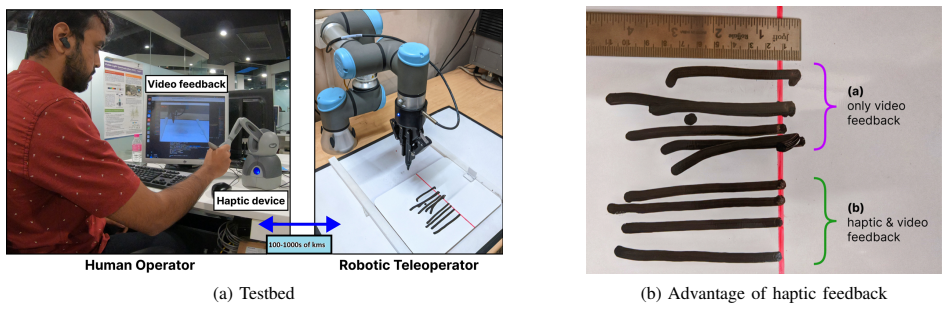
The paper's central claim is that decoupling the operator from the network round trip through two synchronized digital twins yields better teleoperation accuracy and user experience than conventional video-based remote control. In the proposed loop, the operator moves a haptic stylus that is immediately followed by a locally rendered twin (DT Robot 1), and contact sensors in the simulation provide force feedback. DT Robot 1 sends only the end-effector pose and gripper state to the remote side, where DT Robot 2, co-located with the real robot, computes joint trajectories and sends them to the physical robot. The remote twin also aligns a synthetic camera with a real RGB-D camera and uses SSIM on RGB and depth images to create a discrepancy point cloud, so known and foreign objects appear in the operator's scene without streaming video. Experimental results with NASA-TLX and a spiral-drawing task show lower workload across all six dimensions and more stable tracing under delay, and the object-rendering data rate is reported to be 25 times lower than video streaming.
Load-bearing premise
The framework assumes the digital twin is a faithful model of the remote physical environment—geometry, contact forces, and vision—so that what the operator experiences in simulation transfers reliably to the real robot.
Editorial extensions
If this is right
- Teleoperation no longer needs sub-20 ms end-to-end latency to feel local: the operator's interaction loop is closed inside the simulation, so network delay affects only synchronization of the twins.
- The 25x bandwidth reduction arises because rendering a known object requires only its 3D coordinates rather than the full image stream, making the architecture viable on bandwidth-constrained networks.
- The remote twin acts as a safety gate: unsafe poses can be blocked or modified before ROS2 commands reach the real robot.
- Motion scaling lets microsurgery benefit from large haptic gestures at the operator side while the physical robot executes small, tremor-suppressed movements.
Reading between the lines
- The bandwidth and workload advantages are only as valid as the twin's fidelity; a real deployment would need to quantify how much simulation error (contact stiffness, lighting, deformable tissue) the operator can tolerate before the haptic cues mislead rather than help.
- The paper does not quantify the task-acceptance threshold for twin divergence; a useful follow-up would deliberately perturb the twin and measure the workload and accuracy breakpoint.
- Because the operator only sees what the remote twin renders, occluded or undetected foreign objects could be absent from the operator's scene, implying a safety-critical dependency on the SSIM and YOLO detection pipeline that the paper leaves implicit.
- The 25x figure applies to object identification rather than full scene transmission, so combining the approach with on-demand video streaming could give both low steady-state bandwidth and fault-tolerant verification.
Editorial analysis
A structured set of objections, weighed in public.
Referee Report
Summary. The paper presents RoboTwin, a dual-digital-twin teleoperation framework in which the operator interacts locally with Digital Twin Robot 1 (DT Robot 1) using a haptic device, while a second Digital Twin Robot 2 (DT Robot 2) resides at the remote side, mirrors the real robot, provides a safety layer, and sends condensed pose and discrepancy information over the network. The authors report a user study with 17 participants performing a spiral-tracing task, comparing video feedback with digital-twin feedback under 1 ms and 100 ms round-trip times, and claim improved NASA-TLX workload scores, better task completion quality, a motion-scaling feature, and a 25x reduction in network data rate for object rendering. The paper also describes known and foreign object detection using YOLOv8 and SSIM-based discrepancy detection.
Significance. If the claims hold, the dual-twin architecture is a useful step toward low-latency, low-bandwidth teleoperation with improved operator experience. The paper's strengths include a working hardware testbed (UR3 robot with Isaac Sim), the integration of a simulation-based safety layer, motion scaling, and the use of a single RGB-D camera for object detection. However, the experimental evidence is limited in scale and rigor, and the headline bandwidth claim is internally inconsistent with the reported packet counts. The paper is best viewed as a demonstration of a system concept with preliminary results rather than a validated clinical or even quantitative teleoperation study.
major comments (4)
- [Section V-A, Fig. 6] The NASA-TLX user study has only 17 participants and reports no inferential statistics, confidence intervals, or effect sizes; the radar chart shows averaged scores without error bars. The abstract's claims of 'vastly improved' quality of surgery and enhanced user experience are therefore not supported by the presented analysis. Please provide per-condition distributions, a paired statistical test appropriate to the ordinal TLX scale, effect sizes, and a justification of the sample size, or restrict the claims to descriptive observations.
- [Section V-D, Fig. 8, and the abstract] The claimed 25x reduction in network data rate is not consistent with the data shown. The conventional approach transfers 17,500 packets of 1,500 bytes, totaling approximately 26.25 MB, while the proposed approach transfers 600 packets of 46 bytes, totaling 27.6 KB; this is a ratio of roughly 951:1, not 25:1. If the 25x figure is based on a per-second bandwidth calculation using the inter-arrival times plotted on the y-axis, then the y-axis values and the calculation must be reported explicitly. As written, the claim is unsupported and should be corrected.
- [Section III-B and III-E] The digital twin is constructed from a URDF and a single home-position pose calibration, with no quantitative validation of the twin's fidelity to the real robot. The safety layer in Section IV-B and the haptic feedback in Section III-D rely on the simulation's contact physics being accurate, and the SSIM-based discrepancy detection in Algorithm 1 assumes the synthetic camera's geometry, lighting, and pose match the real camera. Without measurements of end-effector tracking error, force/torque agreement, or camera alignment error, the claimed improvements in accuracy and workload could be due to the twin being a simplified rendering rather than a faithful model. Please add validation experiments, e.g., comparing commanded and actual robot trajectories and contact forces between the twin and the real robot.
- [Section V-B, Fig. 7] Task completion quality is assessed only through selected spiral images, with no quantitative scoring. The claim that the RoboTwin condition enables 'more stable and accurate tracing' is not testable from the paper. Please provide an objective metric (e.g., RMS deviation from the printed spiral path, fraction of time within the path, or an automated scoring method) and report values for all conditions and participants.
minor comments (5)
- [Section III-C] There is a typo: 'DT Robo1 1' should be 'DT Robot 1'.
- [Section V-A] The NASA-TLX is described as using a 1-7 scale, whereas the standard NASA-TLX typically uses 0-20 or 1-20 bipolar scales; please clarify or justify the modified scale.
- [Fig. 8] The figures lack axis labels and units on both axes; the x-axis appears to be a category label but is described as showing packet counts, and the y-axis 'inter-arrival time' is not defined. Please redraw with clear labels and units.
- [Table I] The column heading 'Bytes Transmitted (KB)' is ambiguous; specify whether the unit is kilobytes or kilobits, and clarify how the bytes were counted across the two loops.
- [Section V-C] The motion-scaling results are reported as completion time and bytes transmitted, but no task-quality measure is provided for macro, normal, and micro conditions; the statement that the micro image is 'superior' needs quantitative support.
Circularity Check
No significant circularity: the paper's performance and bandwidth claims are empirical measurements or architectural consequences, not reduced to their inputs.
full rationale
The paper's central claims are not loaded into their premises. The NASA-TLX workload comparison (Section V-A) and spiral-tracing task quality (Section V-B) are direct experimental measurements with 17 participants under two feedback conditions; the outcome is not a fitted parameter renamed as a prediction. The bandwidth reduction (Section V-D, Fig. 8) compares the number and size of packets needed for video-based rendering versus coordinate-based object rendering; whatever the fairness of the comparison, it is an arithmetic consequence of the architecture, not a definitional equivalence. The unvalidated twin fidelity noted by the skeptic is a genuine safety and correctness gap, but it is not circular: the paper does not define fidelity in terms of, or fit it to, the TLX or bandwidth results. Self-citations to EdgeP4 [3] and the TSN-DetNet testbed [4] are used for background latency measurements and motivation; the present paper's conclusions rest on its own user study and data-flow design, so those citations are not load-bearing. No uniqueness theorem or ansatz is smuggled in via citation. Hence no circular step can be exhibited.
Assumptions & free parameters
free parameters (3)
- Motion scaling gain for micro movements =
1.3 (1.3 mm haptic per 1 mm robot)
- Motion scaling gain for macro movements =
0.7 (0.7 mm haptic per 1 mm robot)
- SSIM discrepancy threshold
assumptions (3)
- domain assumption The digital twin is a faithful model of the real remote environment, including physics, contact forces, and visual rendering.
- domain assumption YOLOv8 object detection reliably identifies known surgical tools and objects in the real camera feed.
- domain assumption SSIM between synthetic and real RGB-D images is a sufficient signal for detecting unknown/foreign objects.
Cite this review
Pith. "Pith review of RoboTwin: A Robotic Teleoperation Framework Using Digital Twins." pith.science (2026). https://pith.science/paper/5G5OOX6A
@misc{pith2026250601027,
  author       = {Pith},
  title        = {Pith review of: RoboTwin: A Robotic Teleoperation Framework Using Digital Twins},
  year         = {2026},
  howpublished = {\url{https://pith.science/paper/5G5OOX6A}},
  note         = {Machine review of arXiv:2506.01027}
}
read the original abstract
Robotic surgery imposes a significant cognitive burden on the surgeon. This cognitive burden increases in the case of remote robotic surgeries due to latency between entities and thus might affect the quality of surgery. Here, the patient side and the surgeon side are geographically separated by hundreds to thousands of kilometres. Real-time teleoperation of robots requires strict latency bounds for control and feedback. We propose a dual digital twin (DT) framework and explain the simulation environment and teleoperation framework. Here, the doctor visually controls the locally available DT of the patient side and thus experiences minimum latency. The second digital twin serves two purposes. Firstly, it provides a layer of safety for operator-related mishaps, and secondly, it conveys the coordinates of known and unknown objects back to the operator's side digital twin. We show that teleoperation accuracy and user experience are enhanced with our approach. Experimental results using the NASA-TLX metric show that the quality of surgery is vastly improved with DT, perhaps due to reduced cognitive burden. The network data rate for identifying objects at the operator side is 25x lower than normal.
Figures


Figures from the paper (3 more)


Reference graph
Works this paper leans on
-
[1]
Ssi mantra – surgical robotic system,
S. I. I. Inc., “Ssi mantra – surgical robotic system,” 2024, accessed: 2025-05-06. [Online]. Available: https://ssinnovations. com/ssi-mantra/
work page 2024
-
[2]
Technical review of the da vinci surgical telema- nipulator,
C. Freschi, V . Ferrari, F. Melfi, M. Ferrari, F. Mosca, and A. Cuschieri, “Technical review of the da vinci surgical telema- nipulator,” The International Journal of Medical Robotics and Computer Assisted Surgery , vol. 9, no. 4, pp. 396–406, 2013
work page 2013
-
[3]
Edgep4: In-network edge intelligence for a tactile cyber-physical system testbed across cities,
N. K. Gnani, J. Pal, D. Choudhary, H. Verma, S. K. Rana, K. S. Mhapsekar, T. V . Prabhakar, and C. Singh, “Edgep4: In-network edge intelligence for a tactile cyber-physical system testbed across cities,” in IEEE INFOCOM 2024 - IEEE Conference on Computer Communications Workshops (INFOCOM WKSHPS) , 2024, pp. 1–6
work page 2024
-
[4]
Towards a tsn-detnet intercity testbed for tactile cyber-physical systems,
J. Pal, D. Choudhary, N. K. Gnani, T. V . Prabhakar, C. Singh, H. K. Atluri, and A. Paventhan, “Towards a tsn-detnet intercity testbed for tactile cyber-physical systems,” in IEEE INFOCOM 2024 - IEEE Conference on Computer Communications Work- shops (INFOCOM WKSHPS) , 2024, pp. 1–6
work page 2024
-
[5]
3GPP, “Service requirements for cyber-physical control appli- cations in vertical domains; stage 1 (release 19),” Technical Specification Group Services and System Aspects , June, 2024
work page 2024
-
[6]
Accuracy of virtual planning in orthognathic surgery: a systematic review,
A. Alkhayer, J. Piffk ´o, C. Lippold et al. , “Accuracy of virtual planning in orthognathic surgery: a systematic review,” Head & Face Medicine , vol. 16, no. 1, p. 34, 2020. [Online]. Available: https://head-face-med.biomedcentral.com/articles/10. 1186/s13005-020-00250-2
work page 2020
-
[7]
K. Dubron, M. Verbist, R. Jacobs, R. Olszewski, E. Shaheen, and R. Willaert, “Augmented and virtual reality for preoperative trauma planning, focusing on orbital reconstructions: A systematic review,” Journal of Clinical Medicine , vol. 12, no. 16, 2023. [Online]. Available: https://www.mdpi.com/ 2077-0383/12/16/5203
work page 2023
-
[8]
M. Longeac, A. Depeyre, B. Pereira, I. Barthelemy, and N. Pham Dang, “Virtual surgical planning and three-dimensional printing for the treatment of comminuted zygomaticomaxillary complex fracture,” Journal of Stomatology, Oral and Maxillofacial Surgery, vol. 122, no. 4, pp. 386–390, 2021, 56th SFSCMFCO Congress. [Online]. Available: https://www.sciencedir...
work page 2021
Show all 24 references
-
[9]
Simplant - digital dental implant planning software,
Dentsply Sirona, “Simplant - digital dental implant planning software,” https://www.dentsplysirona.com/en/discover/ discover-by-brand/simplant.html, 2025, accessed: 2025-05- 02
2025
-
[10]
Dolphin imag- ing software,
Dolphin Imaging & Management Solutions, “Dolphin imag- ing software,” https://www.dolphinimaging.com, 2025, accessed: 2025-05-02
2025
-
[11]
Medical digital twin: A review on technical principles and clinical applications,
M. Tortora, F. Pacchiano, S. F. Ferraciolli, S. Criscuolo, C. Gagliardo, K. Jaber, M. Angelicchio, F. Briganti, F. Caranci, F. Tortora, and A. Negro, “Medical digital twin: A review on technical principles and clinical applications,” Journal of Clinical Medicine , vol. 14, no....
2025
-
[12]
Exploring the revolution in healthcare systems through the applications of digital twin technology,
A. Haleem, M. Javaid, R. Pratap Singh, and R. Suman, “Exploring the revolution in healthcare systems through the applications of digital twin technology,” Biomedical Technology, vol. 4, pp. 28–38, 2023. [Online]. Available: https://www. sciencedirect.com/science/article/pii/S2...
2023
-
[13]
Digital twins’ advancements and applications in healthcare, towards precision medicine,
K. Papachristou, P. F. Katsakiori, P. Papadimitroulas, L. Strigari, and G. C. Kagadis, “Digital twins’ advancements and applications in healthcare, towards precision medicine,” Journal of Personalized Medicine , vol. 14, no. 11, 2024. [Online]. Available: https://www.mdpi.com/...
2024
-
[14]
Digital twins in healthcare: Methodological challenges and opportunities,
C. Meijer, H.-W. Uh, and S. el Bouhaddani, “Digital twins in healthcare: Methodological challenges and opportunities,” Journal of Personalized Medicine, vol. 13, no. 10, 2023. [Online]. Available: https://www.mdpi.com/2075-4426/13/10/1522
2023
-
[15]
A testbed system for robotically assisted percutaneous pattern therapy,
A. Bzostek, A. C. Barnes, R. Kumar, J. H. Anderson, and R. H. Taylor, “A testbed system for robotically assisted percutaneous pattern therapy,” in Medical Image Computing and Computer-Assisted Intervention – MICCAI’99 , ser. Lecture Notes in Computer Science, C. Taylor and A. ...
1999
-
[16]
Touch™ Haptic Device,
3D Systems, “Touch™ Haptic Device,” 2025, accessed: 2025-05-09. [Online]. Available: https://www.3dsystems.com/ haptics-devices/touch
2025
-
[17]
Nvidia isaac sim,
NVIDIA Corporation, “Nvidia isaac sim,” https://developer. nvidia.com/isaac/sim, 2025, accessed: 2025-05-09
2025
-
[18]
[Online]
CB3, Universal Robots. [Online]. Available: https://www. universal-robots.com/products/cb3/
-
[19]
Riemannian motion policies,
N. D. Ratliff, J. Issac, D. Kappler, S. Birchfield, and D. Fox, “Riemannian motion policies,” 2018. [Online]. Available: https://arxiv.org/abs/1801.02854
2018 arXiv
-
[20]
[Online]
Intel® RealSense™ Depth Camera D415 , Intel. [Online]. Available: https://www.intelrealsense.com/depth-camera-d415/
-
[21]
Ultralytics yolov8,
G. Jocher, A. Chaurasia, and J. Qiu, “Ultralytics yolov8,” 2023. [Online]. Available: https://github.com/ultralytics/ultralytics
2023
-
[22]
TLX @ NASA Ames - Home
“TLX @ NASA Ames - Home.” [Online]. Available: https: //humansystems.arc.nasa.gov/groups/TLX/
-
[23]
Applicability of spiral drawing test for mental fatigue modelling,
O. Senkiv, S. N ˜omm, and A. Toomela, “Applicability of spiral drawing test for mental fatigue modelling,” IFAC- PapersOnLine, vol. 51, no. 34, pp. 190–195, 2019, 2nd IFAC Conference on Cyber-Physical and Human Systems CPHS 2018. [Online]. Available: https://www.sciencedirect....
2019
-
[1107]
Available: https://link.springer.com/chapter/10
[Online]. Available: https://link.springer.com/chapter/10. 1007/10704282 119
Reviewed August 7, 2026 · model on record in the stance chip above.
Discussion (0). Sign in to comment.