REVIEW 5 major objections 6 minor 25 references
TinyThinker: Distilling Reasoning through Coarse-to-Fine Knowledge Internalization with Self-Reflection
T0 review · 5 major / 6 minor · reviewed 2026-08-11 · deepseek-v4-flash
Pith's one-line read TinyThinker claims that small T5 models gain stronger commonsense reasoning by training sequentially on recall, analyze, and summarize stages and then refining themselves with iterative DPO.
desk verdict TinyThinker's three-stage distillation recipe is worth knowing, but the paper's own Table 2 contradicts its headline superiority claim and the evaluation needs a matched re-run. read the letter →
The pith
A machine-rendered reading of the paper's core claim, the machinery that carries it, and where it could break.
The reading
What carries the argument
The load-bearing object is the three-stage recall-analyze-summarize process, trained with stage-specific objectives: the student first generates general knowledge (Rec), then option-specific knowledge conditioned on that recall (Ana), and finally a summary that selects the answer (Sum). The second phase replaces the summarize stage with iterative DPO on pairwise self-generated recall and analyze outputs; the paper's binary reward rule labels a generated recall or analyze output as preferred if the final summary produced from it is correct, and dispreferred if not. This binary labeling is what connects the DPO reward to knowledge internalization, making it the mechanism the framework's gains depend on.
What would settle it
Run a trained TinyThinker model on a set of questions where the final summary is correct, and have a human or LLM judge whether the generated analyze steps (option-specific knowledge) are factually accurate. If a substantial fraction of correct-answer cases contain factually wrong intermediate knowledge, the binary reward rule mislabels those examples and the reported DPO gains may stem from a spurious correlation. A cleaner experiment is to compare DPO with binary summary-based labels against DPO with labels assigned by judging the intermediate knowledge directly; if the latter outperforms the former, the paper's credit-assignment assumption is false.
Extended reading notes
Core claim
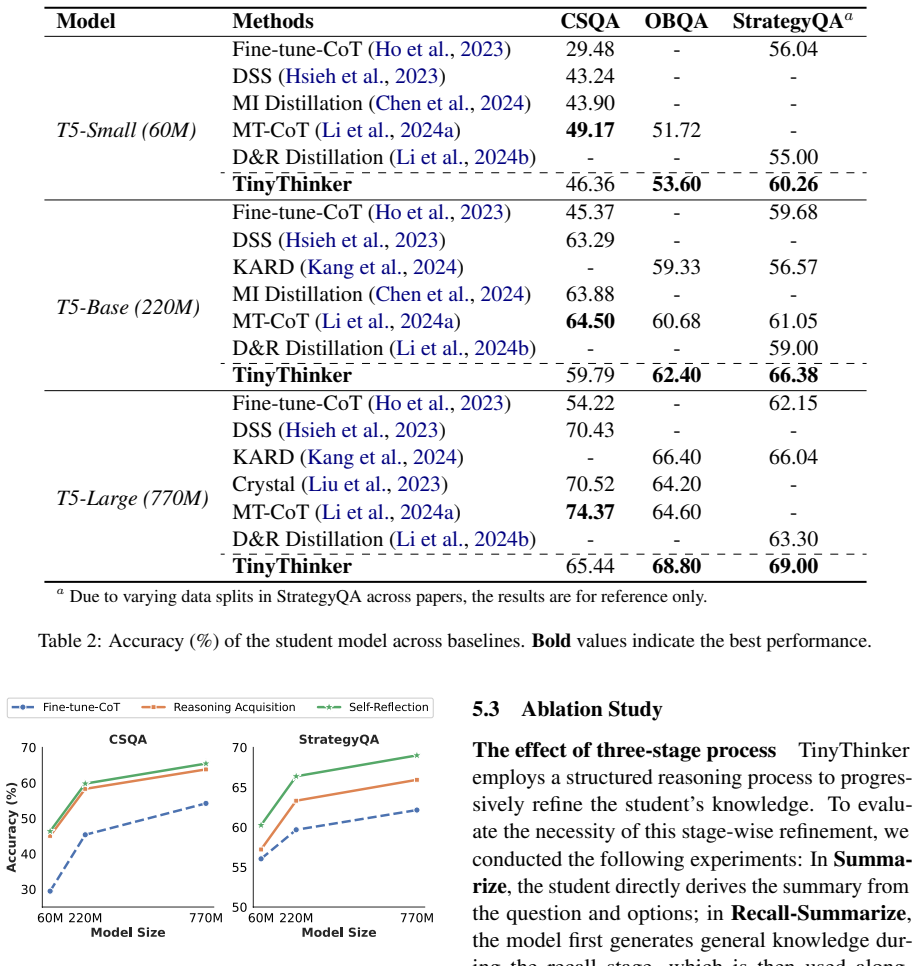
The central discovery claimed is that decomposing reasoning instruction into recall-analyze-summarize - with each stage trained on the previous stage's output - creates a knowledge-internalization effect that plain chain-of-thought fine-tuning lacks. The authors report that TinyThinker consistently outperforms the Fine-tune-CoT baseline across all tested T5 sizes, and achieves the best accuracy among compared methods on OpenBookQA and StrategyQA, with smaller gains on CommonsenseQA where MT-CoT remains ahead. The paper also claims that the self-reflection phase, which applies DPO to the recall and analyze stages using pairwise data generated by the student itself, further improves performance over the reasoning-acquisition phase alone.
Load-bearing premise
The paper assumes that a correct final summary is proof that the intermediate recall and analyze knowledge are also correct, and uses that assumption to decide which self-generated reasoning samples are good or bad for DPO training; if that link breaks, the preference signal can reward wrong intermediate knowledge.
Editorial extensions
If this is right
- TinyThinker's staged recall-analyze-summarize training can replace direct CoT fine-tuning for commonsense reasoning in small T5 models, removing the need for a large teacher at inference time.
- The self-reflection phase (iterative DPO) adds a consistent accuracy gain over the acquisition phase alone across all reported model sizes and datasets.
- Because the analyze stage produces the largest ablation gains, the framework's effectiveness hinges on teaching the student to generate option-specific knowledge rather than just a general gist.
- The same two-phase recipe is expected to transfer to other knowledge-intensive multiple-choice reasoning tasks beyond the three benchmarks tested.
Reading between the lines
- The binary reward rule carries untested credit-assignment risk; a useful extension is to track cases where a correct final summary comes with factually wrong intermediate knowledge, since those examples would be mislabeled for DPO.
- The largest reported gains on StrategyQA suggest the mechanism does not require per-option analysis, so it could extend to open-ended or yes/no QA where a verifier judges the summary.
- The paper's ablations hint that the analyze stage overwhelms the smallest model; a natural extension is to weight training steps toward analyze only as model capacity grows.
- Swapping the binary correct/incorrect reward for a continuous signal (for instance, the model's self-consistency probability over sampled summaries) could reduce the credit-assignment error while keeping the self-reflection loop.
Signed reviews
Editorial analysis
A structured set of objections, weighed in public.
Referee Report
Summary. The paper proposes TinyThinker, a framework for distilling reasoning capabilities from large teacher models into smaller T5 students. The method has two phases: (1) reasoning acquisition, in which the student is trained on teacher-generated data to follow a three-stage recall-analyze-summarize process that moves from general to specific knowledge, and (2) self-reflection, in which the student generates its own reasoning traces and is refined with iterative DPO using binary rewards derived from the correctness of the final summary. Experiments are reported on CommonsenseQA, OpenBookQA, and StrategyQA with T5-Small, T5-Base, and T5-Large, along with ablations of the three-stage process and of DPO applied to the recall and analyze stages. The central claim is that TinyThinker achieves superior performance compared to existing distillation baselines and consistently best performance on OBQA and StrategyQA.
Significance. If the empirical claims held, TinyThinker would be a useful recipe for knowledge-grounded reasoning distillation: the three-stage process is clearly motivated, the self-reflection design is a novel adaptation of iterative DPO with binary summary-based rewards, and the code release supports reproducibility. The paper also includes a dedicated limitations section, which is a strength. However, the significance is currently undercut by the evidence: the CSQA results directly contradict the abstract's 'superior performance' claim, the StrategyQA numbers are acknowledged to come from incomparable splits, and no uncertainty quantification is provided. The core idea is defensible, but the paper's headline claims need to be re-scoped or re-supported with matched, statistically grounded experiments.
major comments (5)
- [§5.1, Table 2] On CSQA, TinyThinker trails MT-CoT at every model size: 46.36 vs. 49.17 (T5-Small), 59.79 vs. 64.50 (T5-Base), and 65.44 vs. 74.37 (T5-Large). This directly contradicts the Abstract's 'superior performance compared to baselines' and the §5.1 statement that TinyThinker 'consistently achieves the best performance on both the OBQA and StrategyQA datasets.' The abstract and §5.1 need to be revised to re-scope the claim, or the authors need to provide a matched CSQA comparison and explain the underperformance.
- [Table 2 footnote; §5.1] The StrategyQA results are labeled 'for reference only' because different papers use different data splits, yet §5.1 reports margins of 3% to 7% over baselines based on those very numbers. A cross-split comparison does not establish the claimed advantage. The authors should run the baseline methods under the same split and evaluation protocol as TinyThinker (or use publicly available checkpoints and identical splits) before making quantitative superiority claims on StrategyQA.
- [§3.2, Data Collection] The binary reward rule assumes that a correct final summary implies correct intermediate recall and analyze outputs, and that an incorrect summary implies incorrect intermediate outputs. This credit assignment can be wrong in both directions: a student may reach the correct answer through flawed intermediate knowledge, or generate good intermediate knowledge but summarize incorrectly. Since DPO is applied at the recall and analyze stages using these summary-derived labels, the reported gains in Table 3 could be driven by the reward-noise distribution rather than by genuine reasoning improvement. The paper provides no validation of this assumption; I ask for evidence, such as agreement rates between summary correctness and stage-level correctness on a held-out set, or a variant using gold/human stage-level labels.
- [§5.3, Table 3] No error bars, multiple seeds, or significance tests are reported anywhere in the paper. Many of the ablations in Table 3 are small—for example, T5-Base on CSQA shows +0.41 for recall-DPO and +1.31 for analyze-DPO—and Figure 5 shows differences of a few points that could plausibly fall within run-to-run variance. Without repeated runs or significance testing, the claims of 'consistent performance improvements' and 'effectiveness of each component' are not statistically supported. Please report means and standard deviations over at least three seeds for the main results and key ablations.
- [§4.2, Table 2] The comparisons in Table 2 are said to use 'the same datasets and student model architectures,' but the teacher models used by the baselines are not specified in the paper. If Fine-tune-CoT, MT-CoT, DSS, MI Distillation, or Crystal were distilled from different teacher LMs (for instance, GPT-3.5 vs. GPT-4), some of the reported differences could be due to teacher quality rather than to the proposed method. Please state the teacher model and distillation data protocol for each baseline, or control for the teacher in a matched comparison.
minor comments (6)
- [§2] There are typos such as 'LLMs are refereed to as teacher models' (should be 'referred to').
- [Table 4] In the Hyperparameters table, 'Weight of NLL lose' should read 'Weight of NLL loss'.
- [§7] The Limitation section contains 'remains a challenges in this study'; this should be 'remains a challenge'.
- [References] The StrategyQA dataset citation appears as '?' in both §4.1 and the reference list; please supply the full citation (Geva et al., 2021). There is also a second '?' citation near the CSQA description in §1 that needs to be resolved.
- [Appendix C] In the CSQA prompt, Example 8 contains the misspelling 'Niagra Falls'.
- [Figures 2 and 3] The text in Figures 2 and 3 is very small and partially overlapping; the figures would benefit from higher resolution and larger fonts.
Circularity Check
No circularity found: TinyThinker's claims are empirical, evaluated on held-out benchmarks, and the self-reflection loop is anchored to external ground-truth labels.
full rationale
The paper makes no formal derivation that reduces to its inputs. The central technique is a distillation pipeline: GPT-4o generates stage-wise reasoning data (recall/analyze/summarize), the T5 student is trained with the corresponding negative log-likelihood losses (Eqs. 1–3), and then an iterative DPO loop (Eq. 4) refines the student. The preference pairs in Section 3.2 are not self-confirming: outputs are classified as preferred or dispreferred by whether the final summary matches the externally provided correct answer, so the training signal originates from the benchmark ground truth rather than from the student's own judgment. The reported results are empirical comparisons on CSQA, OBQA, and StrategyQA held-out splits, with no fitted parameter that is later renamed as a prediction. There are no load-bearing self-citations or imported uniqueness theorems; the cited prior work is used for standard techniques such as CoT prompting and iterative DPO. The heuristic that a correct summary indicates accurate intermediate knowledge is an assumption about credit assignment, but it is not a derivation that presupposes the conclusion. The Section 7 limitation explicitly concedes teacher hallucination and error-cascade risks, which are data-quality concerns rather than circular reasoning. The Table 2 footnote that StrategyQA results are 'for reference only' is a comparability caveat due to differing splits, not a sign that the conclusion is definitionally forced. Overall, the derivation chain is self-contained against external benchmarks, so no circularity is present.
Assumptions & free parameters
free parameters (5)
- beta (DPO weight) =
0.5
- alpha (NLL loss weight) =
0.5
- DPO iterations =
5
- data curation temperature =
0.8
- reasoning acquisition epochs =
10
assumptions (5)
- domain assumption The teacher model GPT-4o generates sufficiently accurate and diverse reasoning data for all stages.
- ad hoc to paper A correct final summary implies correct recall and analyze stage outputs, and an incorrect summary implies incorrect intermediate outputs.
- domain assumption Small T5 models can learn the three-stage process from the stage-specific supervised data.
- domain assumption Iterative DPO with self-generated data improves rather than degrades the student's reasoning.
- ad hoc to paper Published baseline numbers from different papers are comparable to the authors' runs on the same datasets.
Cite this review
Pith. "Pith review of TinyThinker: Distilling Reasoning through Coarse-to-Fine Knowledge Internalization with Self-Reflection." pith.science (2026). https://pith.science/paper/5GA5BNSA
@misc{pith2026241208024,
  author       = {Pith},
  title        = {Pith review of: TinyThinker: Distilling Reasoning through Coarse-to-Fine Knowledge Internalization with Self-Reflection},
  year         = {2026},
  howpublished = {\url{https://pith.science/paper/5GA5BNSA}},
  note         = {Machine review of arXiv:2412.08024}
}
read the original abstract
Large Language Models exhibit impressive reasoning capabilities across diverse tasks, motivating efforts to distill these capabilities into smaller models through generated reasoning data. However, direct training on such synthesized reasoning data may lead to superficial imitation of reasoning process, rather than fostering a genuine integration of reasoning capabilities with underlying knowledge. To address this, we propose TinyThinker, a framework introducing two novel approaches. First, we introduce a three-stage process that incrementally guides the student model through the reasoning process, progressively refining knowledge from coarse to fine granularity. Second, we develop a two-phase training framework comprising an initial reasoning acquisition phase followed by a self-reflection phase utilizing self-generated data. Experiments on commonsense reasoning benchmarks demonstrate that TinyThinker achieves superior performance compared to baselines. Ablation studies further validate the effectiveness of each component in our framework. We expect that TinyThinker can be extended to other knowledge-intensive reasoning tasks, offering an alternative strategy for developing effective reasoning capabilities in smaller language models. Codes are available at https://github.com/shengminp/TinyThinker
Figures


Figures from the paper (2 more)

Reference graph
Works this paper leans on
-
[1]
The fox walked from the city into the forest, what was it looking for? Options: (A) pretty flowers (B) hen house (C) natural habitat (D) storybook Key Information: The motivations of a fox moving from an urban to a forest environment, focusing on natural instincts or necessities. Explanations: A is incorrect. Because Foxes seeking pretty flowers does not ...
-
[2]
Advances in Neu- ral Information Processing Systems, 36
Direct preference optimization: Your language model is secretly a reward model. Advances in Neu- ral Information Processing Systems, 36. Colin Raffel, Noam Shazeer, Adam Roberts, Katherine Lee, Sharan Narang, Michael Matena, Yanqi Zhou, Wei Li, and Peter J Liu. 2020. Exploring the lim- its of transfer learning with a unified text-to-text transformer. Jour...
arXiv 2024
-
[3]
What do people use to absorb extra ink from a fountain pen? Options: (A) shirt pocket (B) calligrapher’s hand (C) inkwell (D) desk drawer (E) blotter Key Information: People use a specific tool or material to absorb extra ink from a fountain pen. Explanations: A is incorrect. Because a shirt pocket may catch ink accidentally but is not used intentionally ...
-
[4]
Sammy wanted to go to where the people were. Where might he go? Options: (A) populated areas (B) race track (C) desert (D) apartment (E) roadblock Key Information: Sammy seeks location that is likely to be frequented by or filled with individuals. Explanations: A is correct. Because populated areas naturally have many people, aligning with Sammy’s goal. B...
-
[5]
Where do you put your grapes just before checking out? Options: (A) mouth (B) grocery cart (C) super market, (D) fruit basket (E) fruit market Key Information: One would place grapes in the immediate moments before proceeding to the checkout in a shopping context, as part of the grocery purchasing process. Explanations: A is incorrect. Because putting gra...
-
[6]
Before getting a divorce, what did the wife feel who was doing all the work? Options: (A) harder (B) anguish (C) bitterness (D) tears (E) sadness Key Information: The emotional state of a wife who perceived imbalance of responsibilities before deciding on divorce, suggesting feelings stemming from stress, imbalance, or discontent. Explanations: A is incor...
-
[7]
What home entertainment equipment requires cable? Options: (A) radio shack (B) substation (C) television (D) cabinet Key Information: Devices used for entertainment purposes within a home setting that necessitate a connection through a physical cable for operation or functionality Explanations: A is incorrect. Because radio shack refers to a place rather ...
-
[8]
Google Maps and other highway and street GPS services have replaced what? Options: (A) United States (B) Mexico (C) countryside (D) atlas Key Information: There is a transition from traditional navigation tools to modern navigation tools, focusing on what has been predominantly replaced by digital mapping and GPS services in terms of functionality. Explan...
Show all 25 references
-
[10]
Explanations: A is incorrect
The man laid on the soft moss and looked up at the trees, where was the man? Options: (A) Niagra Falls (B) forest (C) waterfall (D) ground (E) tree Key Information: The scenario describes a natural setting characterized by soft moss and an upward view of trees, suggesting a lo...
-
[11]
Explanations: A is correct
As a car approaches you in the night, Options: (A) the headlights become more intense (B) the headlights recede into the dark (C) the headlights remain at a constant (D) the headlights turn off Key Information: The intensity of headlights appears to increase as a car approache...
-
[12]
Explanations: A is correct
What is the most likely to be an effect of acid rain on an aquatic environment? Options: (A) decrease in plant life (B) increase in fish population (C) increase in plant growth (D) cleaner and clearer water Key Information: Acid rain, containing harmful acidic compounds, detri...
-
[13]
Explanations: A is incorrect
The moon’s surface Options: (A) is smooth on the entire surface (B) contains large cavities cause by explosions (C) contains an internal core of cheese (D) is filled with lakes Key Information: The moon’s surface is characterized by a variety of geological features, including ...
-
[14]
Explanations: A is incorrect
When the weather changes as it does from Christmas to Easter, Options: (A) the air may chill (B) the ground may freeze (C) the plants may die (D) the ground may warm Key Information: The period from Christmas to Easter typically involves a transition from winter to spring in m...
-
[15]
Explanations: A is correct
Heat and moisture in the ocean is a good recipe for Options: (A) a violent storm (B) violent sea animals (C) condensation (D) inland storms Key Information: Heat and moisture in the ocean contribute to the formation of storms by providing the energy and water vapor necessary f...
-
[16]
Explanations: A is incorrect
Hummingbirds take what with them Options: (A) Bees (B) energy (C) Pollen (D) Honey Key Information: As pollinators, hummingbirds interact with flowers for nectar, during which they inadvertently collect and transfer pollen. Explanations: A is incorrect. Because hummingbirds do...
-
[17]
Explanations: A is incorrect
What covers over 90% of the Earth’s surface and 0% of the moon’s surface Options: (A) a magnesium iron silicate mineral (B) chemical element with the symbol S (C) the element with the symbol Fe (D) that which contains 2 hydrogen and 1 oxygen molecules Key Information: A substa...
-
[18]
Explanations: A is correct
Do hamsters provide food for any animals? (A) yes (B) no Key Information: Hamsters serve as prey for other animals in the food chain. Explanations: A is correct. Because hamsters are prey for various predators, reflecting their role in the food chain and ecosystem interconnect...
-
[19]
Explanations: A is correct
Could Brooke Shields succeed at University of Pennsylvania? (A) yes (B) no Key Information: The potential for success of an individual, Brooke Shields, at a specific academic institution, University of Pennsylvania, implying considerations of her capability, ambition, and the ...
-
[20]
Explanations: A is incorrect
Hydrogen’s atomic number squared exceeds number of Spice Girls? (A) yes (B) no Key Information: Hydrogen’s atomic number is 1, and the Spice Girls group consists of 5 members. Explanations: A is incorrect. Because hydrogen’s atomic number squared (1) does not exceed the Spice ...
-
[21]
Explanations: A is correct
Is it common to see frost during some college commencements? (A) yes (B) no Key Information: College commencements in certain regions or during certain times of the year might coincide with colder weather conditions, which can lead to the formation of frost. Explanations: A is...
-
[22]
Explanations: A is incorrect
Could a llama birth twice during War in Vietnam (1945-46)? (A) yes (B) no Key Information: The natural gestation period of a llama is approximately 11 months, and the specific duration of the War in Vietnam stated to be 6 months. Explanations: A is incorrect. Because the llama...
1945
-
[23]
Explanations: A is incorrect
Would a pear sink in water? (A) yes (B) no Key Information: The density of pear would determine if it sinks or floats in water. Explanations: A is incorrect. Because pears float due to a density less than water, attributed to their fibrous and airy composition. B is correct. B...
-
[24]
Explanations: A is incorrect
Is Albany, Georgia the most populous US Albany? (A) yes (B) no Key Information: Comparing the population size between Albany, Georgia and Albany, New York. Explanations: A is incorrect. Because Albany, New York, has a larger population than Albany, Georgia, making the latter n...
-
[25]
Explanations: A is incorrect
Can the Great Depression be treated with Prozac? (A) yes (B) no Key Information: Great Depression is a historical event and Prozac is a medication used to treat clinical depression. Explanations: A is incorrect. Because Prozac treats clinical depression, not historical events ...
-
[2024]
arXiv preprint arXiv:2404.19733
Iterative reasoning preference optimization. arXiv preprint arXiv:2404.19733. Rafael Rafailov, Archit Sharma, Eric Mitchell, Christo- pher D Manning, Stefano Ermon, and Chelsea Finn
Reviewed August 11, 2026 · model on record in the stance chip above.
Discussion (0). Continue with ORCID to comment.