REVIEW 4 major objections 5 minor 43 references
Long-range dispersal promotes spatial synchrony but reduces the length and time scales of synchronous fluctuations
T0 review · 4 major / 5 minor · reviewed 2026-08-07 · deepseek-v4-flash
Pith's one-line read Rare long-range dispersal changes the size and lifetime of out-of-phase clusters in synchronized populations.
desk verdict Solid simulation study; the qualitative claim about long-range dispersal promoting synchrony holds up, but the new quantitative cluster-size result needs validation of the Lorentzian fit and between-run error bars. read the letter →
The pith
A machine-rendered reading of the paper's core claim, the machinery that carries it, and where it could break.
The reading
What carries the argument
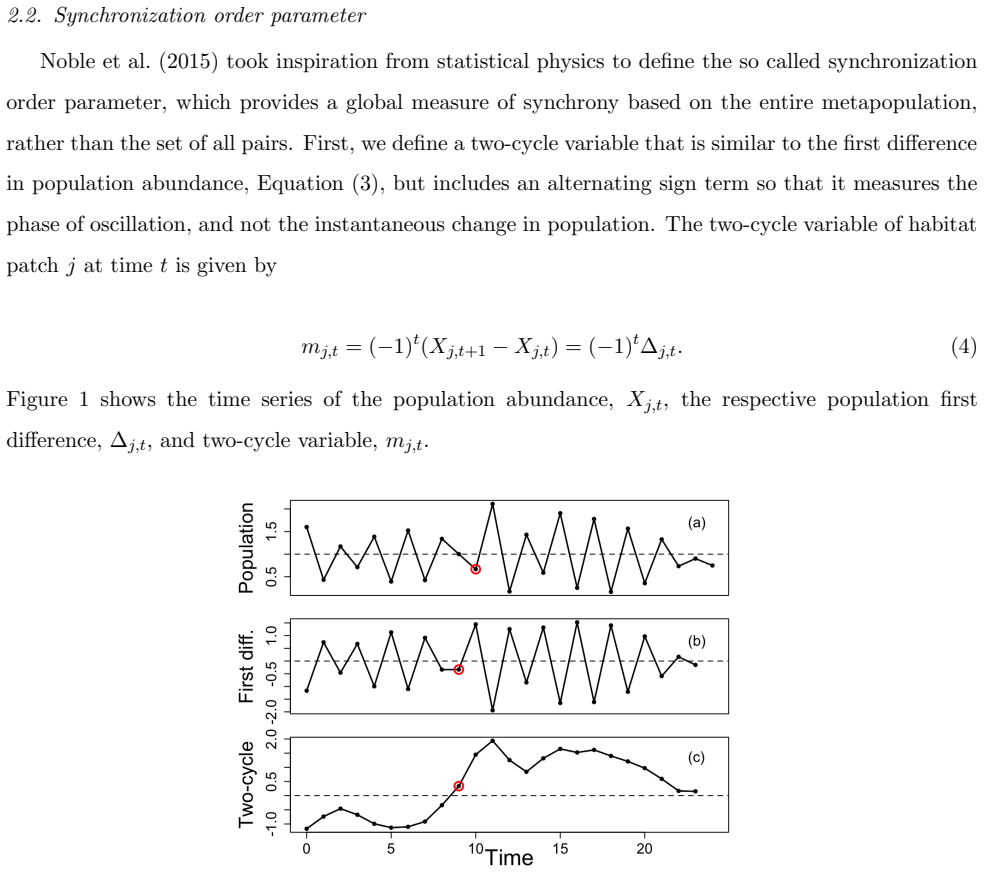
The central object is the two-cycle variable $m_{j,t}=(-1)^t(X_{j,t+1}-X_{j,t})$, which removes the period-2 oscillation and changes sign only when a patch flips phase. Its spatial average gives the instantaneous synchronization order parameter $m_t$, a global rather than pairwise measure of synchrony, and the connected correlation function $G_t(|r|)=\sum_j (m_{j,t}-m_t)(m_{j+r,t}-m_t)$ captures the spatial scale of phase deviations. The fluctuation correlation length is extracted by fitting the Fourier transform of $G_t$ to a Lorentzian at low wavenumbers, following standard statistical-physics practice. The model itself is the noisy Ricker map on an $L\times L$ square lattice with dynamic rewiring: at each time step, each nearest-neighbor connection is replaced with probability $p$ by a random long-range connection, holding the total emigration fraction $\epsilon$ fixed. This machinery lets the paper separate global synchrony from local spatial correlation and measure both the size and the lifetime of out-of-phase clusters.
What would settle it
Run the same model on an $L=128$ lattice at $\sigma=0.15$ with $p=0$ and $p=0.02$, label connected clusters of out-of-phase patches directly, and compare their mean size with the Lorentzian-derived correlation length; if mean cluster size does not decrease with $p$, or the two measures disagree, the paper's central claim fails.
Extended reading notes
Core claim
The central discovery is that, at fixed total dispersal rate, shifting dispersal from nearest-neighbor to random long-range links moves the phase boundary between asynchronous and synchronous oscillation toward higher noise, shrinks the fluctuation correlation length—the typical size of clusters of subpopulations whose two-cycle phase deviates from the global average—and shortens the equilibration time after a synchronizing event. Near the critical line, the stepping-stone case $p=0$ exhibits long-lived fractal clusters and critical slowing down, while even $p=0.02$ strongly reduces cluster size and transient lifetime. The paper measures this with the global synchronization order parameter $m_t = |(1/N)\sum_j m_{j,t}|$, using $m_{j,t}=(-1)^t(X_{j,t+1}-X_{j,t})$, and with the connected correlation function $G_t(|r|)$ whose low-wavenumber Fourier transform yields the fluctuation correlation length. The conclusion is that long-range dispersal acts as a mixing mechanism that homogenizes phase structure and accelerates relaxation to the asymptotic state.
Load-bearing premise
The central quantitative claim about cluster sizes rests on the assumption that the low-wavenumber Fourier transform of the connected correlation function is Lorentzian, so that the fitted fluctuation correlation length equals the physical size of out-of-phase clusters.
Editorial extensions
If this is right
- If a small $p$ suffices to shrink out-of-phase clusters and accelerate relaxation, then empirical estimates of extinction risk from pairwise correlations may understate homogenization in species with rare long-distance dispersal.
- Near the critical noise level, transients can last much longer than ecological observation windows; the paper implies the observed state may reflect a past synchronizing event, not the asymptotic equilibrium, and that this memory is shortened by long-range dispersal.
- Global order-parameter time series, rather than distance-decay of pairwise correlation, are better at distinguishing transient synchrony from true asymptotic synchrony.
- Because the result is argued to hold for any over-compensatory density-dependent map, not just the Ricker map, the qualitative predictions should apply broadly to period-2 cyclic populations.
Reading between the lines
- Not in the paper: the same dynamic rewiring could be tested on one-dimensional lattices, where nearest-neighbor dispersal alone is thought insufficient for long-range synchrony; the prediction is that very small $p$ would restore synchrony and shorten transients.
- A testable consequence is that management or conservation estimates based on pairwise correlation decay will underestimate how spatially homogenized populations become when long-range dispersal is present; a global order parameter would reveal the difference.
- Because long-range dispersal raises synchrony while shortening transients, it may create a trade-off between higher regional extinction risk from synchronized lows and faster recovery after climate-driven synchronizing events.
- The Lorentzian-fit assumption could be checked directly by cluster-size percolation analysis; if multi-scale clusters persist near criticality, a single correlation length would not fully describe the spatial texture.
Editorial analysis
A structured set of objections, weighed in public.
Referee Report
Summary. This paper studies a two-dimensional lattice metapopulation of Ricker-type oscillators coupled by nearest-neighbor dispersal plus a tunable fraction p of temporary long-range connections. Starting from a globally synchronized initial condition, the authors examine how p affects the maintenance of spatial synchrony, the spatial scale of out-of-phase fluctuations, and the time needed to reach the asymptotic state. They report that increasing p raises the critical noise level for synchrony, decreases the fluctuation correlation length (interpreted as the size of out-of-phase clusters), and shortens the equilibration time after a synchronizing event. The synchrony-promotion part is supported by order-parameter time series and snapshots; the cluster-size and time-scale claims rely on Fourier-space fitting in Figure 6 and on a companion preprint, respectively.
Significance. If the quantitative claims hold, this is a useful contribution: it moves beyond the familiar result that long-range dispersal promotes synchrony and argues that it also changes the spatial texture of fluctuations and the lifetime of transients, with practical implications for extinction risk and for interpreting short ecological time series. The simulation design is clearly specified and includes a fixed-total-dispersal control, several lattice sizes, multiple noise levels, and an order parameter defined independently of the conclusions. These are genuine strengths. However, the central new length-scale conclusion is currently supported only by an unvalidated Lorentzian fitting procedure with no run-to-run error bars in the asymptotic regime, and the time-scale conclusion is not measured in this manuscript. The underlying ideas are plausible and the qualitative patterns are visible in the snapshots, but the quantitative evidence needs strengthening.
major comments (4)
- [Section 2.2 and Figure 6] The manuscript asserts that the connected correlation function G_t(|r|) in Eq. (6) decays exponentially at long distances, but no diagnostic is shown to support that assertion, and the fluctuation correlation length is extracted only by fitting the low-wavenumber Fourier transform to a Lorentzian. This fitted length is the sole quantitative basis for the central claim that long-range dispersal reduces the size of out-of-phase clusters. The concern is concrete: in the p=1 limit, dispersal is distance-independent and G_t(r) for r>0 should be essentially flat, so its Fourier transform is not Lorentzian and a Lorentzian fit cannot meaningfully identify an exponential decay length. Please validate the assumed functional form in real space (e.g., log-linear plots of G_t versus r) and/or measure cluster sizes directly from the snapshots, then show that the fitted xi corresponds to the physical cluster size.
- [Figure 6 caption and Section 2.3] The asymptotic panels of Figure 6 are computed from 100 snapshots of a single simulation run per parameter set, with no run-to-run error bars. Near the critical line, where the paper itself emphasizes large fluctuations and long transients, single-run estimates of a correlation length are especially unreliable, and a systematic fitting bias cannot be distinguished from a real p-dependent trend. Multiple independent runs with error bars are needed before the quantitative length-scale claim can be assessed.
- [Abstract, Section 4, Figure 4] The abstract and the title claim that long-range dispersal reduces the time scale of synchronous fluctuations, but no equilibration-time statistic is defined or measured in this manuscript. The evidence consists of visual inspection of the order-parameter time series in Figure 4 and a citation to Nobre et al. 2025, which is an arXiv preprint. Please either define and measure a relaxation time (for example, the time for the order parameter to reach its asymptotic plateau, or an autocorrelation time) or explicitly attribute the time-scale claim to prior work rather than presenting it as a new result of this paper.
- [Figure 3 and Section 3] The phase diagram separating synchronous and asynchronous states is imported entirely from Nobre et al. 2025, including the critical line used to assign solid/open symbols in Figure 6. Because that source is an unpublished preprint, readers cannot independently verify the classification of the simulated points. The authors should either provide the critical-point methodology and results in this paper or otherwise make the phase diagram reproducible without relying on an inaccessible source.
minor comments (5)
- [Equation (1)] The quantity z_j is not clearly defined for the rewired network; the rewiring procedure can change local degrees, so please specify how z_j is updated and whether multiple simultaneous rewires are allowed.
- [Figure 4 caption] The caption contains a typo: "for p = 0.165" should read "for σ = 0.165".
- [References] Several references contain typographical errors, for example "Syncrhony" in Liebhold et al. (2004) and "Stensetii" in Bjørnstad et al. (1999); these should be corrected.
- [Section 2, after Eq. (6)] The sentence contains a duplicate article: "where the the distance between habitat patches" should be "where the distance between habitat patches".
- [Section 2] The statement that the functional form of f does not qualitatively affect the results is not supported by any simulation or reference in this manuscript; please add supporting evidence or soften the claim.
Circularity Check
No circular reduction found: the cluster-size and equilibration-time claims are direct simulation measurements, with only minor self-citations that are not load-bearing.
full rationale
The derivation chain is not circular. The synchronization order parameter m_t (Eq. 5) and the connected correlation function G_t(|r|) (Eq. 6) are defined independently of the paper's conclusions, and the fluctuation correlation length is obtained by a standard Lorentzian fit to the low-wavenumber Fourier transform of G_t, following statistical-physics references (Janke 2008; Janke et al. 1994; Grigera 2021). The claim that long-range dispersal reduces fluctuation length scales is a comparison of these fitted lengths across p, not a parameter fitted to reproduce that trend. The p=1 concern raised by the skeptic is a methodological validity question about whether the Lorentzian form is appropriate, not a circularity; it belongs to correctness risk. Several passages cite the authors' own prior work, notably Nobre et al. 2025 for the phase boundary (Section 3, Figure 3) and for rigorous measurement of shorter equilibration times, and Noble et al. 2015 for the order-parameter and Ising universality. These self-citations supply context and quantitative critical-line values, but the present paper's own Figures 2, 4, and 6 independently illustrate the same synchrony-promotion and transient-time behaviors, so the central claims do not reduce to the self-citation chain. No equation is defined in terms of the quantity it is used to predict, and no fitted parameter is renamed as a prediction. The main caveats are the unvalidated exponential-decay/Lorentzian assumption and single-run asymptotic panels in Figure 6, both of which are empirical and methodological limitations rather than circular steps.
Assumptions & free parameters
free parameters (4)
- Dispersal rate epsilon =
0.025
- Ricker growth rate r =
2.3
- Noise standard deviation sigma =
12 values in [0.14, 0.195]
- Initial condition mean and standard deviation =
normal(1.6, 0.2)
assumptions (3)
- domain assumption Noise is multiplicative log-normal and independent across sites and time.
- domain assumption The functional form of local density dependence does not qualitatively change the results as long as it is overcompensatory.
- domain assumption The critical noise line separating synchronous and asynchronous states is taken from Nobre et al. 2025.
Cite this review
Pith. "Pith review of Long-range dispersal promotes spatial synchrony but reduces the length and time scales of synchronous fluctuations." pith.science (2026). https://pith.science/paper/5GAKL6I4
@misc{pith2026250608304,
  author       = {Pith},
  title        = {Pith review of: Long-range dispersal promotes spatial synchrony but reduces the length and time scales of synchronous fluctuations},
  year         = {2026},
  howpublished = {\url{https://pith.science/paper/5GAKL6I4}},
  note         = {Machine review of arXiv:2506.08304}
}
read the original abstract
Synchronous oscillations of spatially disjunct populations are widely observed in ecology. Even in the absence of spatially synchronized exogenous forces, metapopulations may synchronize via dispersal. For many species, most dispersal is local, but rare long-distance dispersal events also occur. While even small amounts of long-range dispersal are known to be important for processes like invasion and spatial spread rates, their potential influence on population synchrony is often overlooked, since local dispersal on its own can be strongly synchronizing. In this work, we investigate the effect of random, rare, long-range dispersal on the spatial synchrony of a metapopulation and find profound effects not only on synchrony but also on properties of the resulting spatial patterns. While controlling for the overall amount of emigration from each local subpopulation, we vary the fraction of dispersal that occurs locally (to nearest neighbors) versus globally (to random locations, irrespective of distance). Using a metric that measures the instantaneous level of global synchrony, we show that this form of long-range dispersal significantly favors the spatially synchronous state and homogenizes the population by decreasing the size of clusters of subpopulations that are out of phase with the rest of the metapopulation. Moreover, the addition of non-local dispersal significantly decreases the equilibration time of the metapopulation.
Figures


Figures from the paper (4 more)


Reference graph
Works this paper leans on
-
[1]
Abbott, K.C., 2007. Does the pattern of population synchrony through space reveal if the moran effect is acting? Oikos 116, 903–912
work page 2007
-
[2]
A dispersal-induced paradox: synchrony and stability in stochastic metapopula- tions
Abbott, K.C., 2011. A dispersal-induced paradox: synchrony and stability in stochastic metapopula- tions. Ecol. Lett. 14, 1158–1169
work page 2011
-
[3]
Migration alone can produce persistence of host-parasitoid models
Adler, F.R., 1993. Migration alone can produce persistence of host-parasitoid models. Am. Nat. 141, 642–650
work page 1993
-
[4]
Synchronization and stability in noisy population dynamics
Araujo, S.B.L., de Aguiar, M.A.M., 2008. Synchronization and stability in noisy population dynamics. Phys. Rev. E 77, 022903
work page 2008
-
[5]
Evolution of dispersal, in: Hastings, A., Gross, L.J
Baskett, M., 2012. Evolution of dispersal, in: Hastings, A., Gross, L.J. (Eds.), Encyclopedia of Theo- retical Ecology. University of California Press, Berkeley and Los Angeles, California, pp. 377–385. Bjørnstad, O.N., Stensetii, N.C., Saitoh, T., 1999. Synchrony and scaling in dynamics of voles and mice in northern japan. Ecology 80, 622–637
work page 2012
-
[6]
Measuring and testing spatial synchrony
Buonaccorsi, J.P., Elkinton, J.S., Evans, S.R., Liebhold, A.M., 2001. Measuring and testing spatial synchrony. Ecology 82, 1668–1679
work page 2001
-
[7]
Detection of imperfect population synchrony in an uncertain world
Cazelles, B., Stone, L.S., 2003. Detection of imperfect population synchrony in an uncertain world. J. Anim. Ecol. 72, 953–968. 17
work page 2003
-
[8]
Non-random dispersal in the butterfly maniola jurtina: implications for metapopulation models
Conradt, L., Bodsworth, E.J., Roper, T.J., Thomas, C.D., 2000. Non-random dispersal in the butterfly maniola jurtina: implications for metapopulation models. Proc. R. Soc. Lond. B 267, 1505–1510
work page 2000
Show all 43 references
-
[9]
Stochastic spatial models
Durrett, R., Levin, S., 1999. Stochastic spatial models. SIAM 41, 677–718
1999
-
[10]
Stochastic spatial models: a user’s guide to ecological applications
Durrett, R., Levin, S.A., 1994. Stochastic spatial models: a user’s guide to ecological applications. Phil. Trans. R. Soc. Lond. B 343, 329–350
1994
-
[11]
Density dependent resource budget model for alternate bearing
Esmaeili, S., Hastings, A., Abbott, K., Machta, J., Nareddy, V.R., 2021. Density dependent resource budget model for alternate bearing. J. Theor. Biol. 509, 110498
2021
-
[12]
Noise-induced versus intrinsic oscillation in ecological systems
Esmaeili, S., Hastings, A., Abbott, K.C., Machta, J., Nareddy, V.R., 2022. Noise-induced versus intrinsic oscillation in ecological systems. Ecol. Lett. 25, 814–827
2022
-
[13]
Ecological processes can synchronize marine popula- tion dynamics over continental scales
Gouhier, T.C., Guichard, F., Menge, B.A., 2010. Ecological processes can synchronize marine popula- tion dynamics over continental scales. PNAS 107 (18), 8281–8286
2010
-
[14]
Correlation functions as a tool to study collective behaviour phenomena in bio- logical systems
Grigera, T.S., 2021. Correlation functions as a tool to study collective behaviour phenomena in bio- logical systems. J.Phys.Complex. 2, 045016
2021
-
[15]
Complex interactions between dispersal and dynamics: Lessons from coupled logistic equations
Hastings, A., 1993. Complex interactions between dispersal and dynamics: Lessons from coupled logistic equations. Ecology 34, 1362–1372
1993
-
[16]
Persistence of transients in spatially structure ecological models
Hastings, A., Higgins, K., 1994. Persistence of transients in spatially structure ecological models. Science 263, 1133–1136
1994
-
[17]
Occasional long distance dispersal increases spatial synchrony of population cycles
Hopson, J., Fox, J., 2018. Occasional long distance dispersal increases spatial synchrony of population cycles. J Animal Ecol 116:903
2018
-
[18]
Spatial synchronization of vole population dynamics by predatory birds
Ims, R.A., Andreassen, H.P., 2000. Spatial synchronization of vole population dynamics by predatory birds. Nature 408, 194–196
2000
-
[19]
Monte carlo methods in classical statistical physics, in: Fehske, H., Schneider, R., Weiße, A
Janke, W., 2008. Monte carlo methods in classical statistical physics, in: Fehske, H., Schneider, R., Weiße, A. (Eds.), Computational Many-Particle Physics. Springer, Heidelberg, pp. 79–140
2008
-
[20]
Single-cluster monte carlo study of the ising model on two-dimensional random lattices
Janke, W., Katoot, M., Villanova, R., 1994. Single-cluster monte carlo study of the ising model on two-dimensional random lattices. Phys. Rev. B 49(14), 9644–9657
1994
-
[21]
Metapopulation persistence in dynamic landscapes: the role of dispersal distance
Johst, K., Brandl, R., Eber, S., 2002. Metapopulation persistence in dynamic landscapes: the role of dispersal distance. Oikos 98, 1263–270. 18
2002
-
[22]
Metapopulation moments: coupling, stochasticity and persistence
Keeling, M.J., 2000. Metapopulation moments: coupling, stochasticity and persistence. J. Anim. Ecol. 69, 725–736
2000
-
[23]
XY model in small-world networks
Kim, B.J., Hong, H., Holme, P., Jeon, G.S., Minnhagen, P., Choi, M.Y., 2001. XY model in small-world networks. Phys. Rev. E 64(5), 056135
2001
-
[24]
Spatial syncrhony in population dynamics
Liebhold, A., Koenig, W.D., Bjørnstad, O.N., 2004. Spatial syncrhony in population dynamics. Annu. Rev. Ecol. Evol. Syst. 35, 467–490. Mart ´ ı, A.C., Masoller, C., 2003. Delay-induced synchronization phenomena in an array of globally coupled logistic maps. Phys. Rev. E 67, 056219
2004
-
[25]
The statistical analysis of the canadian lynx cycle
Moran, P.A.P., 1953. The statistical analysis of the canadian lynx cycle. Aust. J. Zool. 1, 291–298
1953
-
[26]
Dynamical ising model of spatially coupled ecological oscillators
Nareddy, V.R., Machta, J., Abbott, K.C., Esmaeili, S., Hastings, A., 2020. Dynamical ising model of spatially coupled ecological oscillators. J. R. Soc. Interface 17:20200571
2020
-
[27]
Monte Carlo Methods in Statistical Physics
Newman, M.E.J., Barkema, G.T., 2001. Monte Carlo Methods in Statistical Physics. Oxford University
2001
-
[28]
Emergent long-range synchronization of oscillating eco- logical populations without external forcing described by ising universality
Noble, A.E., Machta, J., Hastings, A., 2015. Emergent long-range synchronization of oscillating eco- logical populations without external forcing described by ising universality. Nat Commun 6, 6664
2015
-
[29]
Spatial patterns of tree yield explained by endogenous forces through a correspondence between the ising model and ecology
Noble, A.E., Rosenstock, T.S., Brown, P.H., Machta, J., Hastings, A., 2018. Spatial patterns of tree yield explained by endogenous forces through a correspondence between the ising model and ecology. PNAS 115, 1825:1830
2018
-
[30]
Behavior of ising spins and ecological oscillators on dynamically rewired small world networks
Nobre, D.A., Abbott, K.C., Machta, J., Hastings, A., 2025. Behavior of ising spins and ecological oscillators on dynamically rewired small world networks. arXiv:2502.10619
2025 arXiv
-
[31]
Pulsed resources and community dynamics of consumers in terrestrial ecosystems
Ostfeld, R.S., Keesing, F., 2000. Pulsed resources and community dynamics of consumers in terrestrial ecosystems. Trends Ecol. Evol. 15, 232–237
2000
-
[32]
Statistical mechanics
Pathria, R.K., Beale, P.D., 2011. Statistical mechanics. Butterworth-Heinemann Elsevier, Oxford
2011
-
[33]
Pair approximations, in: Hastings, A., Gross, L.J
Payne, J.L., 2012. Pair approximations, in: Hastings, A., Gross, L.J. (Eds.), Encyclopedia of Theoret- ical Ecology. University of California Press, Berkeley and Los Angeles, California, pp. 943–948
2012
-
[34]
Direct coupling: a pos- sible strategy to control fruit production in alternate bearing
Prasad, A., Sakai, K., Hoshino, Y., 2017. Direct coupling: a pos- sible strategy to control fruit production in alternate bearing. Sci. Rep. 7 (39890), 1–11. 19
2017
-
[35]
Synchronization of animal population dynamics by large-scale climate
Prost, E., Forchhammer, M.C., 2002. Synchronization of animal population dynamics by large-scale climate. Nature 420, 168–171
2002
-
[36]
Spatially autocorrelated disturbances and patterns in population synchrony
Ranta, E., Veijo, K., Lindstr¨ oom, J., 1999. Spatially autocorrelated disturbances and patterns in population synchrony. Proceedings of the Royal Society of London. Series B: Biological Sciences 266, 1851–1856
1999
-
[37]
Stability, variability, and persistence in host-parasitoid systems
Reeve, J.D., 1990. Stability, variability, and persistence in host-parasitoid systems. Ecology 71, 422– 426
1990
-
[38]
Stock and recruitment
Ricker, W.E., 1954. Stock and recruitment. J. Fish. Res. Bd. Canada 11(5), 558–623. de Roos, A.M., McCauley, E., Wilson, W.G., 1998. Pattern formation and the spatial scale of interaction between predators and their prey. Theor. Popul. Biol. 53, 108–130
1954
-
[39]
Pollen coupling of forest trees: Forming synchronized and periodic repro- duction out of chaos
Satake, A., Iwasa, Y., 2000. Pollen coupling of forest trees: Forming synchronized and periodic repro- duction out of chaos. J. Theor. Biol. 203, 63–84
2000
-
[40]
Effects of noise on some dynamical models in ecology
Schaffer, W.M., Ellner, S., Kot, M., 1986. Effects of noise on some dynamical models in ecology. J. Math. Biol. 24, 479–523. Sol´ e, R.V., 2011. Phase transitions. Princeton University Press, Princeton, New Jersey
1986
-
[41]
Spatial and temporal patterns of small rodent population dynamics at a regional scale
Steen, H., Ims, R.A., Sonerud, G.A., 1996. Spatial and temporal patterns of small rodent population dynamics at a regional scale. Ecology 77, 85–95
1996
-
[42]
Frequency entrainment of a phase coherent attractor
Stone, E.F., 1992. Frequency entrainment of a phase coherent attractor. Phys. Lett. A 163, 367–374
1992
-
[43]
Animal dispersal, in: Hastings, A., Gross, L.J
Yates, G., Boyce, M.S., 2012. Animal dispersal, in: Hastings, A., Gross, L.J. (Eds.), Encyclopedia of Theoretical Ecology. University of California Press, Berkeley and Los Angeles, California, pp. 369–376. 20
2012
Reviewed August 7, 2026 · model on record in the stance chip above.
Discussion (0). Sign in to comment.