Pseudoscalar charmonium and bottomonium: light-front wave functions, distribution amplitudes and distribution functions
Pith reviewed 2026-06-30 01:33 UTC · model grok-4.3
The pith
A modified non-separable light-front wave function ansatz reproduces the properties of heavy pseudoscalar quarkonia and yields their zero-skewness GPDs plus electromagnetic and gravitational form factors.
A machine-rendered reading of the paper's core claim, the machinery that carries it, and where it could break.
Core claim
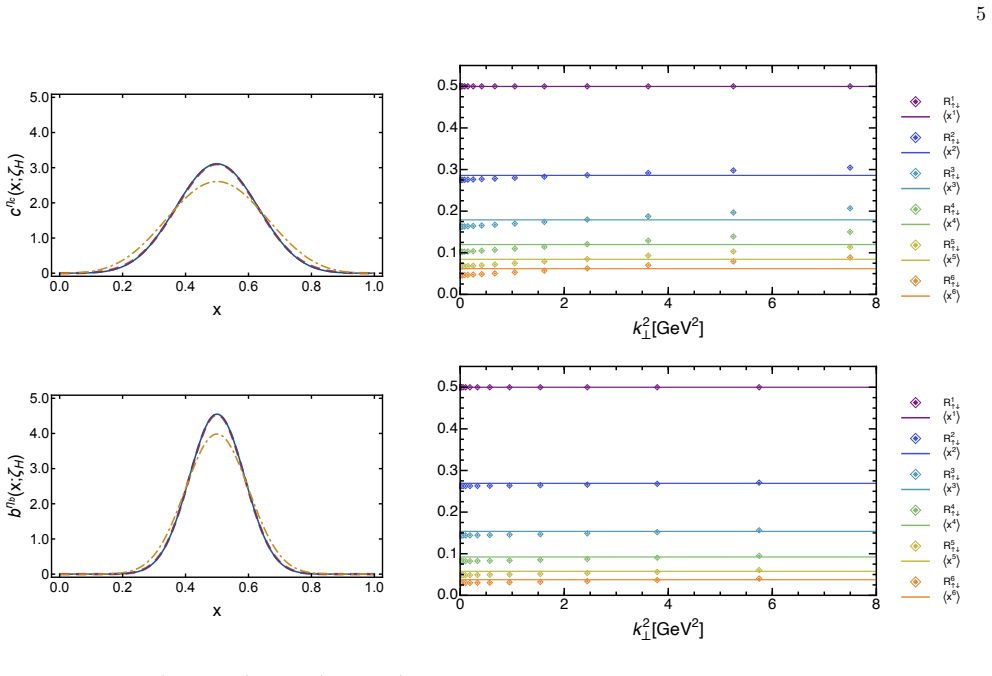
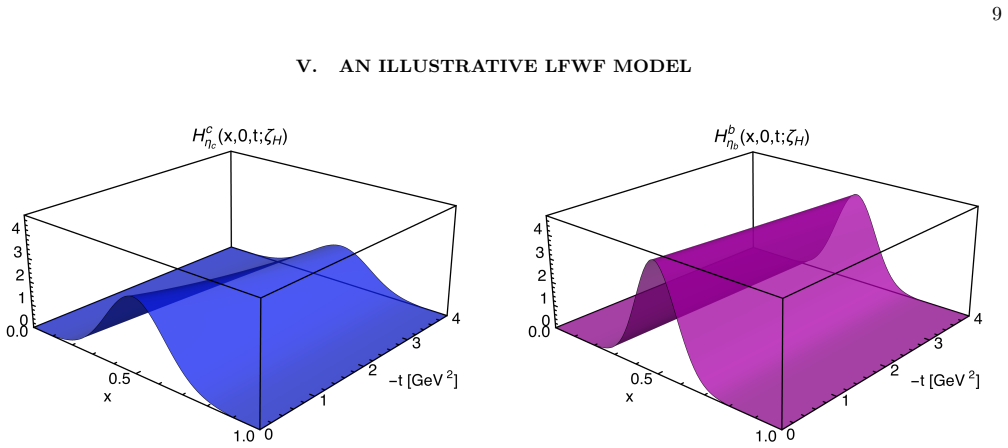
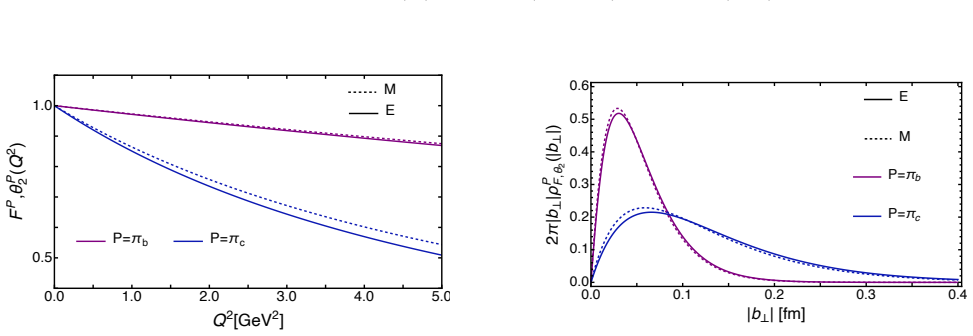
Using continuum Schwinger methods, the authors compute light-front wave functions for pseudoscalar charmonium and bottomonium, taking the fictitious π_s meson as benchmark. They find clear deviations from the approximate separability of longitudinal and transverse light-cone momentum dependence that holds for light mesons. Motivated by these deviations, they construct a modified non-separable LFWF ansatz that reproduces the computed wave functions and meson properties, thereby permitting direct evaluation of distribution amplitudes, distribution functions, zero-skewness generalised parton distributions, electromagnetic and gravitational form factors, and the associated transverse charge and
What carries the argument
The modified non-separable LFWF ansatz, which replaces the separable form used for light mesons and directly incorporates the coupled longitudinal-transverse momentum dependence obtained from the Bethe-Salpeter wave functions.
If this is right
- The ansatz reproduces the computed light-front wave functions and static properties of heavy pseudoscalar quarkonia.
- Zero-skewness generalised parton distributions become directly accessible from the same wave functions.
- Electromagnetic and gravitational form factors follow from the same construction.
- Transverse charge and mass distributions can be extracted without additional model input.
- Distribution amplitudes and parton distribution functions are obtained for the same states.
Where Pith is reading between the lines
- The same non-separable construction could be tested on vector charmonia or bottomonia to check consistency across spin states.
- Predictions for the transverse distributions could be confronted with future measurements at electron-ion colliders.
- The framework might be used to trace how the degree of separability evolves with quark mass between the light and heavy regimes.
- Independent lattice calculations of the same GPDs or form factors would provide a direct numerical test of the Schwinger-method results.
Load-bearing premise
The Dyson-Schwinger and Bethe-Salpeter equations remain quantitatively reliable when applied to bound states whose mass scale is comparable to the QCD scale.
What would settle it
A lattice QCD calculation or experimental measurement of the electromagnetic form factor or transverse charge distribution of the η_c or η_b that deviates substantially from the values obtained with the modified ansatz would falsify the claim that the ansatz and framework are reliable for these heavy systems.
Figures
read the original abstract
Light-front wave functions play a central role in the program of understanding the structure of hadrons as QCD bound states. Using continuum Schwinger methods, based on Dyson-Schwinger and Bethe-Salpeter equations, they can be computed directly within a framework connected to QCD. For light pseudoscalar mesons, previous studies revealed an approximate separability of longitudinal and transverse lightcone momentum dependences in the LFWFs, leading to a simple relation between distribution functions and amplitudes. In this work, we extend those previous studies to the case of pseudoscalar charmonium and bottomonium, using the fictitious $\pi_s$ meson as a benchmark. Motivated by the observed deviations, we propose a modified non-separable LFWF ansatz that successfully reproduces the properties of heavy pseudoscalar quarkonia and allows the calculation of zero-skewness generalised parton distribution functions, electromagnetic and gravitational form factors, and transverse charge and mass distributions.
Editorial analysis
A structured set of objections, weighed in public.
Referee Report
Summary. The manuscript uses Dyson-Schwinger and Bethe-Salpeter equations in the continuum Schwinger framework to compute light-front wave functions (LFWFs) for pseudoscalar charmonium and bottomonium, benchmarked against the fictitious π_s. Observing deviations from the longitudinal-transverse separability found in light pseudoscalars, the authors propose a modified non-separable LFWF ansatz that is asserted to reproduce the properties of heavy pseudoscalar quarkonia and is then employed to compute zero-skewness GPDs, electromagnetic and gravitational form factors, and transverse charge and mass distributions.
Significance. If the underlying LFWFs are quantitatively reliable, the work supplies a QCD-connected route to hadronic structure observables for heavy quarkonia that could inform phenomenology of charmonium and bottomonium. The explicit construction of a non-separable ansatz and its use for GPDs and form factors would constitute a concrete extension of prior light-meson studies.
major comments (3)
- [Abstract] Abstract: the assertion that the modified ansatz 'successfully reproduces' the properties of heavy pseudoscalar quarkonia is unsupported by any quantitative measures, error estimates, or tabulated comparisons to lattice QCD decay constants, radii, or form factors.
- [§4 (LFWF results and ansatz construction)] The central claim that the computed LFWFs enable reliable GPD and form-factor calculations rests on the quantitative accuracy of the DSE/BSE framework for systems whose mass scale is comparable to Λ_QCD; no independent cross-check (e.g., against lattice results for η_c or η_b decay constants or electromagnetic radii) is supplied to validate the transfer from light to heavy systems.
- [§5] §5 (GPD and form-factor calculations): because the ansatz parameters are fixed by the same DSE/BSE solutions whose accuracy for heavy quarks is unverified, it is unclear whether the reported GPDs and transverse distributions constitute independent predictions or are shaped by the same inputs used to define the ansatz.
minor comments (2)
- [§2] Define the fictitious π_s meson parameters and its relation to the physical pion more explicitly in the text.
- [Figures 3-5] Ensure all figures comparing LFWFs or distribution amplitudes include error bands or sensitivity estimates from the model parameters.
Simulated Author's Rebuttal
We thank the referee for the careful and constructive review of our manuscript. We respond to each major comment below, indicating where we agree revisions are warranted and where we maintain the original framing.
read point-by-point responses
-
Referee: [Abstract] Abstract: the assertion that the modified ansatz 'successfully reproduces' the properties of heavy pseudoscalar quarkonia is unsupported by any quantitative measures, error estimates, or tabulated comparisons to lattice QCD decay constants, radii, or form factors.
Authors: We agree the abstract phrasing is assertive. The manuscript shows reproduction via the ansatz matching the non-separable structure and transverse momentum dependence obtained from the DSE/BSE solutions for the heavy systems, in contrast to the light-meson case. To strengthen the claim, we will revise the abstract to 'captures the essential properties' and add a table in section 4 with quantitative comparisons of decay constants to available lattice results. revision: yes
-
Referee: [§4 (LFWF results and ansatz construction)] The central claim that the computed LFWFs enable reliable GPD and form-factor calculations rests on the quantitative accuracy of the DSE/BSE framework for systems whose mass scale is comparable to Λ_QCD; no independent cross-check (e.g., against lattice results for η_c or η_b decay constants or electromagnetic radii) is supplied to validate the transfer from light to heavy systems.
Authors: The rainbow-ladder DSE/BSE setup employed here is the same as in earlier works that successfully describe both light pseudoscalars and heavy quarkonia when parameters are fixed to meson masses. We will expand section 4 with a paragraph discussing the framework's prior validation for heavy systems and explicitly note the lack of new lattice cross-checks for electromagnetic radii as a limitation of the present study. revision: partial
-
Referee: [§5] §5 (GPD and form-factor calculations): because the ansatz parameters are fixed by the same DSE/BSE solutions whose accuracy for heavy quarks is unverified, it is unclear whether the reported GPDs and transverse distributions constitute independent predictions or are shaped by the same inputs used to define the ansatz.
Authors: The GPDs, form factors and transverse distributions are obtained by direct use of the DSE/BSE LFWFs through the constructed ansatz; they are therefore not independent predictions but consistent extensions within the same continuum framework. This is the intended strength of the approach, ensuring the observables inherit the QCD-connected features of the computed wave functions. We do not plan revisions on this point. revision: no
Circularity Check
No significant circularity; derivation is self-contained model construction
full rationale
The paper computes LFWFs directly via DSE/BSE within the continuum Schwinger framework, observes deviations from light-meson separability using the fictitious π_s benchmark, and proposes a modified non-separable ansatz motivated by those deviations. The ansatz is then used to compute GPDs, form factors and distributions. This is a standard model-building step in which an ansatz is calibrated to one set of computed quantities (LFWFs/properties) to enable analytic access to derived quantities; no equation reduces to its input by construction, no parameter is fitted to a subset and then relabeled as an independent prediction of a closely related observable, and no load-bearing premise rests solely on self-citation. The chain remains externally falsifiable against lattice data or other frameworks and does not exhibit any of the enumerated circular patterns.
Axiom & Free-Parameter Ledger
Reference graph
Works this paper leans on
-
[1]
Accardi, et al., Electron Ion Collider: The Next QCD Frontier, Eur
A. Accardi, et al., Electron Ion Collider: The Next QCD Frontier, Eur. Phys. J. A 52 (2016) 268. 14
2016
-
[2]
Arrington, et al., Revealing the structure of light pseudoscalar mesons at the electron–ion collider, J
J. Arrington, et al., Revealing the structure of light pseudoscalar mesons at the electron–ion collider, J. Phys. G 48 (2021) 075106
2021
-
[3]
D. P. Anderle, et al., Electron-ion collider in China, Front. Phys. (Beijing) 16 (2021) 64701
2021
-
[4]
Quintans, The New AMBER Experiment at the CERN SPS, Few Body Syst
C. Quintans, The New AMBER Experiment at the CERN SPS, Few Body Syst. 63 (2022) 72
2022
-
[5]
A. Accardi, et al., Strong Interaction Physics at the Luminosity Frontier with 22 GeV Electrons at Jefferson Lab – arXiv:2306.09360 [nucl-ex] (2023)
arXiv 2023
-
[6]
F. M. Dittes, D. M¨ uller, D. Robaschik, B. Geyer, J. Hoˇ rejˇ si, The Altarelli-Parisi Kernel as Asymptotic Limit of an Extended Brodsky-Lepage Kernel, Phys. Lett. B 209 (1988) 325–329. doi:doi:10.1016/0370-2693(88)90955-0
-
[7]
Wave Functions, Evolution Equations and Evolution Kernels from Light-Ray Operators of QCD
D. M¨ uller, D. Robaschik, B. Geyer, F. M. Dittes, J. Hoˇ rejˇ si, Wave functions, evolution equations and evolution kernels from light ray operators of QCD, Fortsch. Phys. 42 (1994) 101–141. doi:doi:10.1002/prop.2190420202.arXiv:hep-ph/9812448
work page internal anchor Pith review Pith/arXiv arXiv doi:10.1002/prop.2190420202.arxiv:hep-ph/9812448 1994
-
[8]
Radyushkin, Scaling limit of deeply virtual Compton scattering, Phys
A. Radyushkin, Scaling limit of deeply virtual Compton scattering, Phys. Lett. B 380 (1996) 417–425
1996
-
[9]
Ji, Deeply virtual Compton scattering, Phys
X.-D. Ji, Deeply virtual Compton scattering, Phys. Rev. D 55 (1997) 7114–7125. doi:doi:10.1103/PhysRevD.55.7114
-
[10]
Pasquini, P
B. Pasquini, P. Schweitzer, Pion transverse momentum dependent parton distributions in a light-front constituent approach, and the Boer-Mulders effect in the pion-induced Drell-Yan process, Phys. Rev. D 90 (2014) 014050
2014
-
[11]
M. V. Polyakov, P. Schweitzer, Forces inside hadrons: pressure, surface tension, mechanical radius, and all that, Int. J. Mod. Phys. A 33 (2018) 1830025
2018
-
[12]
Diehl, Generalized parton distributions, Phys
M. Diehl, Generalized parton distributions, Phys. Rept. 388 (2003) 41–277
2003
-
[13]
Burkardt, Impact parameter dependent parton distributions and off forward parton distributions forζ >0, Phys
M. Burkardt, Impact parameter dependent parton distributions and off forward parton distributions forζ >0, Phys. Rev. D 62 (2000) 071503
2000
-
[14]
Burkardt, Impact parameter space interpretation for generalized parton distributions, Int
M. Burkardt, Impact parameter space interpretation for generalized parton distributions, Int. J. Mod. Phys. A 18 (2003) 173–208
2003
-
[15]
S. J. Brodsky, G. P. Lepage, Perturbative Quantum Chromodynamics, Prog. Math. Phys. 4 (1979) 255–422
1979
-
[16]
M. V. Polyakov, Hard exclusive electroproduction of two pions and their resonances, Nucl. Phys. B 555 (1999) 231. doi:doi:10.1016/S0550-3213(99)00314-4
-
[17]
Chang, I
L. Chang, I. C. Cloet, J. J. Cobos-Martinez, C. D. Roberts, S. M. Schmidt, P. C. Tandy, Imaging dynamical chiral symmetry breaking: pion wave function on the light front, Phys. Rev. Lett. 110 (2013) 132001
2013
-
[18]
Chang, C
L. Chang, C. Mezrag, H. Moutarde, C. D. Roberts, J. Rodr´ ıguez-Quintero, P. C. Tandy, Basic features of the pion valence-quark distribution function, Phys. Lett. B 737 (2014) 23–29
2014
-
[19]
Z.-F. Cui, M. Ding, F. Gao, K. Raya, D. Binosi, L. Chang, C. D. Roberts, J. Rodr´ ıguez-Quintero, S. M. Schmidt, Kaon and pion parton distributions, Eur. Phys. J. C 80 (2020) 1064
2020
-
[20]
Z.-F. Cui, M. Ding, F. Gao, K. Raya, D. Binosi, L. Chang, C. D. Roberts, J. Rodr´ ıguez-Quintero, S. M. Schmidt, Higgs modulation of emergent mass as revealed in kaon and pion parton distributions, Eur. Phys. J. A (Lett.) 57 (2021) 5
2021
- [21]
-
[22]
K. Raya, J. Rodr´ ıguez-Quintero, Highlights of pion and kaon structure from continuum analyses, Rev. Mex. Fis. Suppl. 3 (2022) 0308008. doi:doi:10.31349/SuplRevMexFis.3.0308008.arXiv:2204.01642
work page doi:10.31349/suplrevmexfis.3.0308008.arxiv:2204.01642 2022
-
[23]
K. Raya, A. Bashir, D. Binosi, C. D. Roberts, J. Rodr´ ıguez-Quintero, Pseudoscalar Mesons and Emergent Mass, Few Body Syst. 65 (2024) 60
2024
-
[24]
C. D. Roberts, D. G. Richards, T. Horn, L. Chang, Insights into the emergence of mass from studies of pion and kaon structure, Prog. Part. Nucl. Phys. 120 (2021) 103883
2021
-
[25]
Mezrag, L
C. Mezrag, L. Chang, H. Moutarde, C. D. Roberts, J. Rodr´ ıguez-Quintero, F. Sabati´ e, S. M. Schmidt, Sketching the pion’s valence-quark generalised parton distribution, Phys. Lett. B 741 (2015) 190–196
2015
-
[26]
Chouika, C
N. Chouika, C. Mezrag, H. Moutarde, J. Rodr´ ıguez-Quintero, A Nakanishi-based model illustrating the covariant extension of the pion GPD overlap representation and its ambiguities, Phys. Lett. B 780 (2018) 287–293
2018
-
[27]
Zhang, K
J.-L. Zhang, K. Raya, L. Chang, Z.-F. Cui, J. M. Morgado, C. D. Roberts, J. Rodr´ ıguez-Quintero, Measures of pion and kaon structure from generalised parton distributions, Phys. Lett. B 815 (2021) 136158
2021
-
[28]
Raya, Z.-F
K. Raya, Z.-F. Cui, L. Chang, J.-M. Morgado, C. D. Roberts, J. Rodr´ ıguez-Quintero, Revealing pion and kaon structure via generalised parton distributions, Chin. Phys. C 46 (2022) 013105
2022
-
[29]
J. M. M. Chavez, V. Bertone, F. De Soto Borrero, M. Defurne, C. Mezrag, H. Moutarde, J. Rodr´ ıguez-Quintero, J. Segovia, Pion generalized parton distributions: A path toward phenomenology, Phys. Rev. D 105 (2022) 094012
2022
-
[30]
J. M. M. Ch´ avez, V. Bertone, F. De Soto Borrero, M. Defurne, C. Mezrag, H. Moutarde, J. Rodr´ ıguez-Quintero, J. Segovia, Accessing the Pion 3D Structure at US and China Electron-Ion Colliders, Phys. Rev. Lett. 128 (2022) 202501
2022
-
[31]
Albino, I
L. Albino, I. M. Higuera-Angulo, K. Raya, A. Bashir, Pseudoscalar mesons: Light front wave functions, GPDs, and PDFs, Phys. Rev. D 106 (2022) 034003
2022
-
[32]
B. Almeida-Zamora, J. J. Cobos-Mart´ ınez, A. Bashir, K. Raya, J. Rodr´ ıguez-Quintero, J. Segovia, Light-front wave functions of vector mesons in an algebraic model, Phys. Rev. D 107 (2023) 074037. doi:doi:10.1103/PhysRevD.107.074037. arXiv:2303.09581
-
[33]
B. Almeida-Zamora, J. J. Cobos-Mart´ ınez, A. Bashir, K. Raya, J. Rodr´ ıguez-Quintero, J. Segovia, Algebraic model to study the internal structure of pseudoscalar mesons with heavy-light quark content, Phys. Rev. D 109 (2024) 014016. doi:doi:10.1103/PhysRevD.109.014016.arXiv:2309.17282
work page doi:10.1103/physrevd.109.014016.arxiv:2309.17282 2024
-
[34]
C. D. Roberts, Strong QCD and Dyson-Schwinger Equations, IRMA Lect. Math. and Theor. Phys. 21 (2015) 356–458. arXiv:1203.5341 [nucl-th]
Pith/arXiv arXiv 2015
-
[35]
Binosi, L
D. Binosi, L. Chang, J. Papavassiliou, C. D. Roberts, Bridging a gap between continuum-QCD andab initiopredictions of hadron observables, Phys. Lett. B 742 (2015) 183–188. 15
2015
-
[36]
Eichmann, H
G. Eichmann, H. Sanchis-Alepuz, R. Williams, R. Alkofer, C. S. Fischer, Baryons as relativistic three-quark bound states, Prog. Part. Nucl. Phys. 91 (2016) 1–100
2016
-
[37]
S.-X. Qin, C. D. Roberts, Impressions of the Continuum Bound State Problem in QCD, Chin. Phys. Lett. 37 (2020) 121201
2020
-
[38]
Z. F. Cui, M. Ding, J. M. Morgado, K. Raya, D. Binosi, L. Chang, J. Papavassiliou, C. D. Roberts, J. Rodr´ ıguez-Quintero, S. M. Schmidt, Concerning pion parton distributions, Eur. Phys. J. A 58 (2022) 10
2022
-
[39]
Z. F. Cui, M. Ding, J. M. Morgado, K. Raya, D. Binosi, L. Chang, F. De Soto, C. D. Roberts, J. Rodr´ ıguez-Quintero, S. M. Schmidt, Emergence of pion parton distributions, Phys. Rev. D 105 (2022) L091502
2022
-
[40]
Y. Lu, L. Chang, K. Raya, C. D. Roberts, J. Rodr´ ıguez-Quintero, Proton and pion distribution functions in counterpoint, Phys. Lett. B 830 (2022) 137130
2022
-
[41]
Yin, Y.-Z
P.-L. Yin, Y.-Z. Xu, Z.-F. Cui, C. D. Roberts, J. Rodr´ ıguez-Quintero, All-Orders Evolution of Parton Distributions: Principle, Practice, and Predictions, Chin. Phys. Lett.Express40 (2023) 091201
2023
-
[42]
K. Raya, A. Bashir, J. Rodr´ ıguez-Quintero, Mapping Spatial Distributions within Pseudoscalar Mesons, Chin. Phys. Lett. 42 (2025) 020201
2025
-
[43]
A. S. Miramontes, J. Papavassiliou, J. M. Pawlowski, Electromagnetic properties of heavy-light mesons, Eur. Phys. J. C 85 (2025) 1390. doi:doi:10.1140/epjc/s10052-025-15121-w.arXiv:2508.20631
work page doi:10.1140/epjc/s10052-025-15121-w.arxiv:2508.20631 2025
-
[44]
A. S. Miramontes, J. M. Morgado, J. Papavassiliou, Baryonic form factors of light pseudoscalar mesons, Phys. Lett. B 878 (2026) 140531. doi:doi:10.1016/j.physletb.2026.140531.arXiv:2604.00959
work page doi:10.1016/j.physletb.2026.140531.arxiv:2604.00959 2026
-
[45]
W. Broniowski, E. Ruiz Arriola, Gravitational form factors of the pion and meson dominance, Phys. Lett. B 859 (2024) 139138. doi:doi:10.1016/j.physletb.2024.139138.arXiv:2405.07815
work page doi:10.1016/j.physletb.2024.139138.arxiv:2405.07815 2024
-
[46]
E. Ydrefors, W. de Paula, J. H. A. Nogueira, T. Frederico, G. Salm´ e, Pion electromagnetic form factor with Minkowskian dynamics, Phys. Lett. B 820 (2021) 136494. doi:doi:10.1016/j.physletb.2021.136494.arXiv:2106.10018
work page doi:10.1016/j.physletb.2021.136494.arxiv:2106.10018 2021
-
[47]
Y.-Z. Xu, K. Raya, Z.-F. Cui, C. D. Roberts, J. Rodr´ ıguez-Quintero, Empirical Determination of the Pion Mass Distribu- tion, Chin. Phys. Lett.Express40 (2023) 041201
2023
-
[48]
C. D. Roberts, Perspective on the origin of hadron masses, Few Body Syst. 58 (2017) 5
2017
-
[49]
T. Horn, C. D. Roberts, The pion: an enigma within the Standard Model, J. Phys. G. 43 (2016) 073001
2016
-
[50]
S.-S. Xu, L. Chang, C. D. Roberts, H.-S. Zong, Pion and kaon valence-quark parton quasidistributions, Phys. Rev. D 97 (2018) 094014
2018
-
[51]
C. Chen, L. Chang, C. D. Roberts, S. Wan, H.-S. Zong, Valence-quark distribution functions in the kaon and pion, Phys. Rev. D 93 (2016) 074021
2016
-
[52]
H.-Y. Xing, W.-H. Bian, Z.-F. Cui, C. D. Roberts, Kaon and Pion Fragmentation Functions – arXiv:2504.08142 [hep-ph], Eur. Phys. J. C (2025)in press
arXiv 2025
- [53]
-
[54]
Z.-N. Xu, D. Binosi, C. Chen, K. Raya, C. D. Roberts, J. Rodr´ ıguez-Quintero, Kaon distribution functions from empirical information, Phys. Lett. B 865 (2025) 139451
2025
-
[55]
X. Y. Zeng, Y. Y. Xiao, Z. N. Xu, C. D. Roberts, J. Rodr´ ıguez-Quintero, Distribution amplitudes and functions of ground-state scalar and pseudoscalar charmonia (2026).arXiv:2604.06510
Pith/arXiv arXiv 2026
-
[56]
Z. N. Xu, Z. Q. Yao, D. Binosi, M. Ding, C. D. Roberts, J. Rodr´ ıguez-Quintero, Distribution functions of a radially excited pion, Eur. Phys. J. C 85 (2025) 330
2025
-
[57]
I. C. Cloet, L. Chang, C. D. Roberts, S. M. Schmidt, P. C. Tandy, Pion distribution amplitude from lattice-QCD, Phys. Rev. Lett. 111 (2013) 092001
2013
-
[58]
G. P. Lepage, S. J. Brodsky, Exclusive Processes in Perturbative Quantum Chromodynamics, Phys. Rev. D 22 (1980) 2157–2198
1980
-
[59]
K. Raya, Z.-N. Xu, Z.-Q. Yao, J. Rodr´ ıguez-Quintero, Pion structure from its light-front wave function (2026). arXiv:2606.20998
Pith/arXiv arXiv 2026
-
[60]
pi- and K-meson Bethe-Salpeter Amplitudes
P. Maris, C. D. Roberts, Pi- and K meson Bethe-Salpeter amplitudes, Phys. Rev. C 56 (1997) 3369–3383. doi:doi: 10.1103/PhysRevC.56.3369.arXiv:nucl-th/9708029
work page internal anchor Pith review Pith/arXiv arXiv doi:10.1103/physrevc.56.3369.arxiv:nucl-th/9708029 1997
-
[61]
S.-x. Qin, L. Chang, Y.-x. Liu, C. D. Roberts, D. J. Wilson, Interaction model for the gap equation, Phys. Rev. C 84 (2011) 042202. doi:doi:10.1103/PhysRevC.84.042202.arXiv:1108.0603
work page internal anchor Pith review Pith/arXiv arXiv doi:10.1103/physrevc.84.042202.arxiv:1108.0603 2011
-
[62]
M. Ding, K. Raya, D. Binosi, L. Chang, C. D. Roberts, S. M. Schmidt, Symmetry, symmetry breaking, and pion parton distributions, Phys. Rev. D 101 (2020) 054014
2020
-
[63]
M. Ding, K. Raya, D. Binosi, L. Chang, C. D. Roberts, S. M. Schmidt, Drawing insights from pion parton distributions, Chin. Phys. C (Lett.) 44 (2020) 031002
2020
-
[64]
Belitsky, A
A. Belitsky, A. Radyushkin, Unraveling hadron structure with generalized parton distributions, Phys. Rept. 418 (2005) 1–387
2005
-
[65]
Mezrag, An Introductory Lecture on Generalised Parton Distributions, Few Body Syst
C. Mezrag, An Introductory Lecture on Generalised Parton Distributions, Few Body Syst. 63 (2022) 62
2022
-
[66]
Mezrag, Generalised Parton Distributions in Continuum Schwinger Methods: Progresses, Opportunities and Challenges, Particles 6 (2023) 262–296
C. Mezrag, Generalised Parton Distributions in Continuum Schwinger Methods: Progresses, Opportunities and Challenges, Particles 6 (2023) 262–296
2023
-
[67]
G. A. Miller, Defining the proton radius: A unified treatment, Phys. Rev. C 99 (2019) 035202. doi:doi: 10.1103/PhysRevC.99.035202.arXiv:1812.02714
work page internal anchor Pith review Pith/arXiv arXiv doi:10.1103/physrevc.99.035202.arxiv:1812.02714 2019
-
[68]
G. A. Miller, M. Strikman, C. Weiss, Pion transverse charge density from timelike form factor data, Phys. Rev. D 83 (2011) 013006. doi:doi:10.1103/PhysRevD.83.013006
-
[69]
R. Hofstadter, F. Bumiller, M. R. Yearian, Electromagnetic Structure of the Proton and Neutron, Rev. Mod. Phys. 30 16 (1958) 482. doi:doi:10.1103/RevModPhys.30.482
-
[70]
F. J. Ernst, R. G. Sachs, K. C. Wali, Electromagnetic form factors of the nucleon, Phys. Rev. 119 (1960) 1105–1114. doi:doi:10.1103/PhysRev.119.1105
-
[71]
Sachs, High-Energy Behavior of Nucleon Electromagnetic Form Factors, Phys
R. Sachs, High-Energy Behavior of Nucleon Electromagnetic Form Factors, Phys. Rev. 126 (1962) 2256–2260
1962
-
[72]
R. L. Jaffe, Ambiguities in the definition of local spatial densities in light hadrons, Phys. Rev. D 103 (2021) 016017
2021
-
[73]
Freese, G
A. Freese, G. A. Miller, Unified formalism for electromagnetic and gravitational probes: Densities, Phys. Rev. D 105 (2022) 014003
2022
-
[74]
Epelbaum, J
E. Epelbaum, J. Gegelia, N. Lange, U. G. Meißner, M. V. Polyakov, Definition of Local Spatial Densities in Hadrons, Phys. Rev. Lett. 129 (2022) 012001
2022
-
[75]
Y. Chen, C. Lorc´ e, Pion and nucleon relativistic electromagnetic four-current distributions, Phys. Rev. D 106 (2022) 116024. doi:doi:10.1103/PhysRevD.106.116024.arXiv:2210.02908
work page doi:10.1103/physrevd.106.116024.arxiv:2210.02908 2022
-
[76]
C. Lorc´ e, P. Wang, Deuteron relativistic charge distributions, Phys. Rev. D 105 (2022) 096032. doi:doi: 10.1103/PhysRevD.105.096032.arXiv:2204.01465
work page doi:10.1103/physrevd.105.096032.arxiv:2204.01465 2022
-
[77]
Lorc´ e, Charge Distributions of Moving Nucleons, Phys
C. Lorc´ e, Charge Distributions of Moving Nucleons, Phys. Rev. Lett. 125 (2020) 232002. doi:doi: 10.1103/PhysRevLett.125.232002.arXiv:2007.05318
work page doi:10.1103/physrevlett.125.232002.arxiv:2007.05318 2020
-
[78]
Y. Chen, C. Lorc´ e, Nucleon relativistic polarization and magnetization distributions, Phys. Rev. D 107 (2023) 096003. doi:doi:10.1103/PhysRevD.107.096003.arXiv:2302.04672
work page doi:10.1103/physrevd.107.096003.arxiv:2302.04672 2023
-
[79]
Y. Z. Xu, K. Raya, J. Rodr´ ıguez-Quintero, J. Segovia, Charge distributions of pseudoscalar and vector mesons from Dyson-Schwinger equations, Phys. Rev. D 110 (2024) 054031. doi:doi:10.1103/PhysRevD.110.054031.arXiv:2406.13306
work page doi:10.1103/physrevd.110.054031.arxiv:2406.13306 2024
-
[80]
Modelling the nucleon structure
M. Burkardt, B. Pasquini, Modelling the nucleon structure, Eur. Phys. J. A 52 (2016) 161. doi:doi:10.1140/epja/i2016- 16161-7.arXiv:1510.02567
work page internal anchor Pith review Pith/arXiv arXiv doi:10.1140/epja/i2016- 2016
discussion (0)
Sign in with ORCID, Apple, or X to comment. Anyone can read and Pith papers without signing in.