REVIEW 3 major objections 4 minor 1 cited by
The WEST code for large-scale excited-state materials simulations
T0 review · 3 major / 4 minor · reviewed 2026-08-02 · deepseek-v4-flash
Pith's one-line read One open-source code, WEST, unifies full-frequency GW, quantum-defect embedding, BSE, and TDDFT in a framework that skips virtual electronic states, so excited-state simulations of more than one thousand atoms become practical.
desk verdict Useful consolidated overview of a mature excited-state code, but the headline scaling claim rests on a figure with no raw timings. read the letter →
The pith
A machine-rendered reading of the paper's core claim, the machinery that carries it, and where it could break.
The reading
What carries the argument
The load-bearing object is the projective dielectric eigenpotential (PDEP) expansion of the density–density response function, which supplies a low-rank representation of dielectric screening that both G0W0 and the Bethe-Salpeter equation draw upon without constructing large dielectric matrices or empty-state sums. Around it, the code builds a common algorithmic core: density-matrix perturbation theory recasts BSE/TDDFT diagonalization as an action on occupied wave functions, Wannier localization prunes the Coulomb integrals to spatially overlapping pairs, and the adaptively compressed exchange (ACE) method keeps hybrid-functional calculations at semilocal cost. These components are unified
What would settle it
Compare WEST's BSE and TDDFT excitation energies against a conventional full BSE calculation on a set of small molecules, intentionally varying the PDEP truncation count and the Wannier interaction cutoff, and check for monotonic drift or a sudden onset of large errors as the approximations are loosened.
Extended reading notes
Core claim
The central discovery, on the paper's own terms, is that the dominant cost of excited-state calculations — the explicit enumeration of empty electronic states — can be removed across four distinct formalisms and replaced by a common set of scalable operations. The projective dielectric eigenpotential (PDEP) technique iteratively diagonalizes the symmetrized density–density response function, expressing the screened Coulomb interaction as a low-rank sum of a few eigenpotentials (Eq. 5). The Bethe-Salpeter and TDDFT problems are reformulated in terms of the density-matrix perturbation theory, so the Liouville superoperator acts only on occupied states, and Wannier localization of the occupied
Load-bearing premise
The scalability and accuracy claims rest on the assumption that the low-rank and localization approximations do not systematically degrade results across the diverse materials discussed: a limited number of PDEP eigenpotentials and Wannier-truncated Coulomb integrals must preserve accuracy for spin defects, perovskites, and water and ice alike.
Editorial extensions
If this is right
- Quasiparticle energies, neutral excitation energies, optical and photoluminescence spectra, excited-state forces, non-adiabatic couplings, and radiative/non-radiative decay rates become available for supercells of 1,000+ atoms, including environments with dislocations, surfaces, and interfaces.
- Because all methods share one framework and one set of numerical parameters, results across different levels of theory (TDDFT vs BSE vs QDET) become directly comparable on identical geometries, removing a common source of inconsistency in the literature.
- The convergence of response functions is controlled by a single parameter — the number of PDEP eigenpotentials — rather than a separate empty-state cutoff, making convergence checks more systematic.
- The same first-principles output can be piped into quantum chemistry solvers for embedded multi-configurational states, vibronic coupling calculations, and quantum-computing diagonalization workflows, extending the reach of each individual method.
- The scalability demonstrated opens the door to generating large, high-fidelity excited-state datasets for machine-learning potentials and high-throughput screening campaigns.
Reading between the lines
- If the scalability and accuracy claims hold, the most natural next stress test is metallic or small-gap systems, where the dielectric response is more delocalized and the PDEP low-rank form may require many more eigenpotentials — the code's own approximations predict where the approach will get harder.
- Since energies, forces, and non-adiabatic couplings are all available at the same level of theory, the framework should enable ab initio non-adiabatic molecular dynamics in extended heterogeneous systems, a step the paper describes as crucial but does not itself demonstrate.
- The Wannier-localization speedup suggests a testable scaling law: for sparse systems, wall time should grow roughly with the number of overlapping occupied-state pairs rather than the square of the number of atoms, a prediction a user could verify with controlled supercell sizes.
- The claim that empty states can be avoided altogether could be probed by blind comparisons against a conventional full-BSE implementation on a shared set of small molecules, reusing identical geometries and pseudopotentials.
Editorial analysis
A structured set of objections, weighed in public.
Referee Report
Summary. The manuscript presents the WEST code, an open-source plane-wave pseudopotential package for large-scale excited-state materials simulations. It reviews the theoretical foundations (full-frequency G0W0, QDET, BSE, TDDFT), the algorithmic strategies that avoid explicit empty-state summations (PDEP, DMPT, Wannier localization, ACE), the hierarchical CPU/GPU parallelization, and interoperability with external packages. It reports a new strong-scaling benchmark (Fig. 2) on up to 4,096 GPUs for 999-atom NV− calculations, and illustrates capabilities through applications: NV− optical cycle, SiV0 finite-size extrapolation, NV centers near dislocations in 1,727-atom supercells, spin defects in oxides/nitrides/2D materials/molecular qubits, self-trapped excitons in perovskites, and water/ice optical response. The central claim is that WEST delivers near-ideal scaling to thousands of GPUs and enables accurate excited-state simulations of systems with more than a thousand atoms across diverse material classes.
Significance. If the claims are substantiated, WEST is a significant community resource: one open-source code providing quasiparticle energies, neutral excitation energies, spectra, excited-state forces, and non-adiabatic couplings without explicit virtual states, with demonstrated applications to experimentally relevant systems. The manuscript is a code overview rather than a new methodological derivation; most algorithmic advances are published elsewhere. Its strengths are the broad and coherent set of validated applications (GW100 benchmarks and experimental comparisons for NV−, SiV0, perovskites, water/ice), the open-source release with documentation and continuous integration, and the clear acknowledgment of approximation caveats (TDA, static screening, single-excitation restriction, frequency-independent QDET Hamiltonian). The main new evidence is the GPU scaling figure, which is also the weakest link: it lacks absolute timings, raw wall-clock values, parallel-efficiency numbers, and error bars, making the headline scalability claim difficult to verify.
major comments (3)
- [Fig. 2 and Sec. III.B] The strong-scaling claim of 'near-ideal scaling to thousands of GPUs' rests almost entirely on Fig. 2, which plots wall time vs. GPU count without reporting absolute wall-clock values, per-point timings, parallel efficiency percentages, or repeated-run statistics. The caption attributes deviations to I/O and communication overhead, but no quantitative evidence is given. This is a load-bearing claim for the abstract and introduction ('thousands of GPUs', 'more than a thousand atoms'). Please provide a table of timings (or in-figure labels), compute parallel efficiencies relative to the 64-GPU point, and specify whether these are single runs. The benchmarks should be reproducible from the open-source code and stated parameters.
- [Eq. (29) and Sec. IV.B.1] The finite-size extrapolation of the bound-exciton VEE uses Eq. (29) with fitting parameters A, B, and D, where D is varied over [10,40] Å, yielding E_BE(∞) ∈ [1.33,1.50] eV. The paper reports this as 'close agreement' with experiment (1.39 eV), but the 0.17 eV spread is comparable to the spread in the other VEE comparisons and is not propagated to the conclusion. Since D is a screening length with a plausible but not uniquely determined range, the uncertainty in the extrapolated value should be discussed explicitly and the sensitivity to D shown, rather than presenting a point-like agreement.
- [Sec. IV.A.2 / Sec. II.C] The manuscript explicitly acknowledges key approximations (TDA, neglect of dynamical screening, restriction to single excitations in TDDFT/BSE; frequency-independent effective Hamiltonian in QDET) but does not provide a systematic convergence or error analysis across the claimed range of applications. Given the breadth of systems (spin defects, perovskites, water/ice, 2D materials), the reader is asked to rely on selected benchmarks. Adding a concise table of convergence parameters (N_PDEP, k-points, supercell size) and, where possible, estimated errors from these approximations for representative cases would materially strengthen the accuracy claim.
minor comments (4)
- [Sec. IV.A.4] Typo: 'Owing to the complexity of the ISC and ISC processes' should read 'ISC and IC processes'.
- [Fig. 2] The caption states 'minor deviations from ideal scaling' but no error bars or repeated runs are shown; a statement about wall-clock time per QDET/G0W0/BSE/TDDFT calculation (e.g., in minutes) would help judge practical utility.
- [Sec. III.B] The claim of 'excellent scalability to 25,920 GPUs' cites reference 20 but is not shown or quantified in this manuscript; clarify that this is from prior work and refer to the specific data.
- [Eqs. (10)-(11)] The number of Coulomb integrals reduced 'by more than an order of magnitude' by Wannier localization is stated without a quantitative example or reference for the 999-atom system; a concrete number would strengthen the efficiency argument.
Circularity Check
No significant circularity: central capability claims are supported by external benchmarks and disclosed fits, not by definitional reduction.
full rationale
This is a software-overview paper rather than a derivation of a new physical law, and its central claims—that WEST implements full-frequency G0W0, QDET, BSE, and TDDFT without explicit virtual states and that these implementations are accurate and scalable—are tested against external experimental data (NV− ZPL and lifetimes, SiV0 VEEs, perovskite emission, water/ice absorption) and the external GW100 benchmark. The many self-citations document the methods and earlier benchmarks, but they are not used as a uniqueness proof, as an ansatz smuggled in by citation, or as a substitute for the new scaling data in Fig. 2. The one place where fitting is explicit is Eq. 29 for the bound-exciton finite-size extrapolation: the paper states that A and B are fit parameters and that D is varied over a published range [10,40] Å; the experimental value 1.39 eV is not an input to the fit, so the reported agreement is a genuine consistency test rather than a constructed identity. Likewise, Fig. 11 explicitly states that computed spectra were shifted to align peak positions, so the line-shape comparison is not presented as a parameter-free prediction of absolute peak energy; this is a disclosed limitation, not circularity. The strong-scaling claim in Fig. 2 is weakened by the absence of raw wall-clock times, parallel-efficiency numbers, and error bars, but missing evidential detail is a reproducibility concern, not a circular-reasoning defect. Overall, no load-bearing step reduces by definition or by self-citation to its own inputs; the appropriate finding is no significant circularity.
Assumptions & free parameters
free parameters (5)
- N_PDEP
- A and B in Eq. 29 =
not given
- D (screening length) in Eq. 29 =
range [10, 40] Angstrom
- Spectral alignment shift (Fig. 11) =
not given
- DDH exact-exchange fraction (18%) =
18%
assumptions (5)
- domain assumption Kohn-Sham DFT with plane-wave pseudopotentials (Eq. 1) provides an adequate starting point for excited-state calculations.
- domain assumption The random-phase approximation and a non-self-consistent G0W0 framework are sufficient for quasiparticle energies.
- domain assumption The Tamm-Dancoff approximation and restriction to single excitations are adequate for the BSE/TDDFT excitation energies reported.
- domain assumption QDET's static, frequency-independent effective Hamiltonian with a partially screened Coulomb interaction captures multi-configurational defect states.
- domain assumption The phonons used for PL spectra and vibrational overlaps can be computed at the DFT or TDDFT level with the stated functionals.
Cite this review
Pith. "Pith review of The WEST code for large-scale excited-state materials simulations." pith.science (2026). https://pith.science/paper/5GL453MT
@misc{pith2026260714025,
  author       = {Pith},
  title        = {Pith review of: The WEST code for large-scale excited-state materials simulations},
  year         = {2026},
  howpublished = {\url{https://pith.science/paper/5GL453MT}},
  note         = {Machine review of arXiv:2607.14025}
}
read the original abstract
We present WEST, an open-source plane-wave pseudopotential code for large-scale excited-state materials simulations, and describe its theoretical foundations, software architecture, and capabilities. WEST implements full-frequency GW, quantum defect embedding theory, the Bethe-Salpeter equation, and time-dependent density functional theory within a common algorithmic framework that avoids the explicit computation of virtual electronic states. By combining density functional and density matrix perturbation theory, low-rank representations of the dielectric screening and exact exchange, and localization techniques, WEST achieves favorable computational scaling with system size. The code supports the calculation of quasi-particle and neutral excitation energies, optical and photoluminescence spectra, excited-state forces, and non-adiabatic couplings, with interoperable workflows connecting to quantum chemistry, vibronic coupling, and quantum computing packages. A hierarchical parallelization strategy and GPU acceleration deliver near-ideal strong scaling to thousands of GPUs, enabling accurate excited-state simulations of systems with more than a thousand atoms. Representative applications, spanning the full optical cycle of solid-state spin defects, self-trapped excitons in metal-halide perovskites, and the optical response of liquid water and ice, demonstrate the accuracy and versatility of the code across diverse material classes. The capabilities implemented in WEST establish the code as a scalable platform for predictive excited-state simulations, high-throughput materials discovery, and the generation of high-fidelity datasets for machine learning in computational materials science.
Figures


Figures from the paper (9 more)


Forward citations
Cited by 1 Pith paper
-
Analytical Forces from the Bethe-Salpeter Equation for Large-Scale Excited-State Relaxation
A scalable plane-wave implementation of analytical BSE excited-state forces, built on a Z-vector Lagrangian and low-rank dielectric screening, enables BSE-relaxed geometries in hundreds-atom supercells and identifies ...
Reference graph
Works this paper leans on
-
[1]
This approach eliminates the need to construct large Hamiltonians in an electron-hole basis and enables efficient calculations for large systems
Vertical excitation energies and optical absorption spectra In WEST, the BSE and TDDFT implementations avoid explicit summations over empty states by reformulating the problem within DMPT 23–25,27,28. This approach eliminates the need to construct large Hamiltonians in an electron-hole basis and enables efficient calculations for large systems. Within the...
-
[2]
Analytical excited-state nuclear forces Analytical excited-state nuclear forces within the TDDFT27 and BSE 65 frameworks are implemented in WEST using the extended Lagrangian formalism 66, supporting both spin- conserving and spin-flip excited states as well as the use of hybrid functionals. The forces of thes-th excited state are computed as Fs,Iα =F GS,...
-
[3]
Non-adiabatic coupling (NAC) Many excited-state phenomena, including ultrafast pho- tochemical and photophysical processes, charge and energy transfer, and non-radiative decays, are governed by non- adiabatic processes, i.e., non-radiative spin-conserving transi- tions between electronic states induced by the nuclear motion. Therefore, the description of ...
-
[4]
Planar averages alongxy,yz, orzxplanes and spherical averages can be computed
Ground-state electronic structure • Visualization of KS wave functions{ψ i(r)}and the electron density, ρ(r) = Nocc ∑ v |ψv(r)|2 .(18) V olumetric data can be exported in the Gaussian cube format. Planar averages alongxy,yz, orzxplanes and spherical averages can be computed. • Computation and plotting of density of states (DOS), DOS(E) =∑ i δ(E−ε i),(19) ...
-
[5]
G 0W0 and QDET results • Visualization of PDEP functions{ ¯ϕa}in the cube for- mat. • Analysis and plotting of frequency dependence of the self-energy, which can be used to assess the validity of solving equation 2 by linearization, and diagnose the issue of multiple roots. • Diagonalization of QDET Hamiltonians using FCI or SCI as implemented in PySCF. B...
-
[6]
• Decomposition of excited states into electron-hole pairs, cs,vc =⟨a s,v|ψc⟩,(25) wherev=1,
BSE/TDDFT excited states • Visualization of the transition density ∆ρs(r) = Nocc ∑ v as,v(r)ψ ∗ v (r),(24) and the unrelaxed differential density (equation 14). • Decomposition of excited states into electron-hole pairs, cs,vc =⟨a s,v|ψc⟩,(25) wherev=1, . . . ,Nocc andc=N occ +1, . . . ,Nocc + Nempty. • Computation of the transition dipole moment µs = Z d...
-
[7]
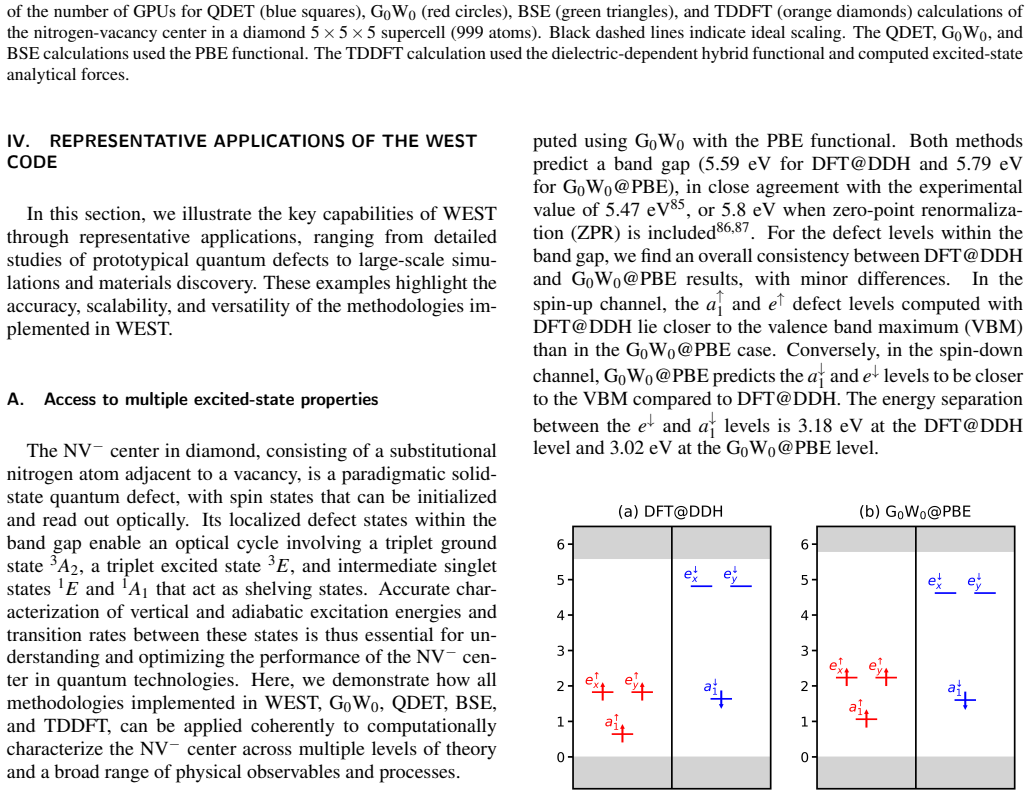
Defect levels We begin by examining the single-particle electronic struc- ture of the NV − center. Figure 3 compares band edges and defect energy levels obtained using hybrid DFT with the DDH functional (with 18% exact exchange) and QP energies com- puted using G 0W0 with the PBE functional. Both methods predict a band gap (5.59 eV for DFT@DDH and 5.79 eV...
-
[8]
The computed ⟨S2⟩values yield the correct spin multiplicity for each state
Vertical excitation energies Starting from a single-particle picture, we computed the VEEs of the 1E, 1A1, and 3Eexcited states using TDDFT, BSE, and QDET, with the singlet states obtained with the spin-flip TDDFT and BSE implementations. The computed ⟨S2⟩values yield the correct spin multiplicity for each state. In figure 4, we compare VEEs computed with...
Show all 15 references
-
[9]
Upon excitation from the 3A2 ground state to the 3Eexcited state, the defect undergoes a Jahn–Teller distortion that lowers the C3v symmetry
Excited-state geometries Excited-state structural relaxation plays a central role in the optical cycle of the NV− center, including in determining the zero-phonon line (ZPL) and photoluminescence (PL). Upon excitation from the 3A2 ground state to the 3Eexcited state, the defec...
-
[10]
Here, we 10 FIG
Radiative and non-radiative decay rates By combining the various capabilities of the WEST code, we are able to fully characterize, from first principles, all tran- sitions involved in the optical cycle of spin defects. Here, we 10 FIG. 5. Unrelaxed differential density of the ...
2022
-
[11]
This defect pos- sessesD 3d symmetry, with thee g type defect levels localized in the band gap of diamond and thee u type defect levels res- onant with the valence bands
Finite-size effects on vertical excitation energies The neutral silicon vacancy center (SiV0) in diamond, con- sisting of a substitutional silicon adjacent to a vacancy, ex- hibits long spin coherence time along with a near-infrared flu- orescence signal and has emerged as a p...
2024
-
[12]
In principle, arrays of spin defects may be engi- neered by exploiting the strain fields induced by dislocations in crystals
Complex supercells representing heterogeneous environments In the solid state, controlling and scaling defect-based qubits into coherent, interconnected arrays remains a major challenge. In principle, arrays of spin defects may be engi- neered by exploiting the strain fields i...
-
[13]
Spin qubits in emerging platforms While diamond and silicon carbide remain leading hosts for solid-state spin qubits, recently increased attention has fo- 13 FIG. 9. (a) Diamond supercell including two dislocations oriented in opposite directions and one NV − center. Carbon at...
2026
-
[14]
A notable feature of many metal-halide perovskites is the for- mation of STEs, where an exciton becomes localized through a lattice distortion induced by the exciton itself
Self-trapped excitons in metal-halide perovskites Metal-halide perovskites are a versatile class of optoelec- tronic materials due to the remarkable tunability of their prop- erties through chemical composition and dimensionality. A notable feature of many metal-halide perovsk...
-
[15]
Optical absorption and emission of water and ice Understanding the interaction of light with water and ice is of fundamental importance in environmental, atmospheric, and astrophysical sciences. The WEST G 0W0 implementa- tion was combined with molecular dynamics simulations a...
2024
Reviewed August 2, 2026 · model on record in the stance chip above.
Discussion (0). Continue with ORCID to comment.