REVIEW 5 major objections 5 minor 52 references
UCDR-Adapter: Exploring Adaptation of Pre-Trained Vision-Language Models for Universal Cross-Domain Retrieval
T0 review · 5 major / 5 minor · reviewed 2026-08-11 · deepseek-v4-flash
Pith's one-line read UCDR-Adapter claims that dynamic prompts, synthesized by attending over masked source prompts, let a frozen CLIP model retrieve across unseen domains and classes more accurately than static-prompt baselines.
desk verdict A reasonably built parameter-efficient prompt-tuning variant for UCDR, but the 'consistently outperforms' headline doesn't survive contact with its own tables. read the letter →
The pith
A machine-rendered reading of the paper's core claim, the machinery that carries it, and where it could break.
The reading
What carries the argument
The load-bearing object is the Target Prompt Generation (TPG) module. Given masked source prompts $U' = U \circ (1-\delta_d)$ and $V' = V \circ (1-\delta_c)$, it computes attention weights $w_d = \text{Attn}(I_g, U')$ and $w_c = \text{Attn}(I_g, V')$, then forms target prompts as weighted combinations of the masked rows (the paper's Eqs. 5-8). These are concatenated, projected to the encoder input dimension, and added to the image features of a frozen CLIP ViT-B/32 encoder. The same module serves all three retrieval subtasks without modification, and it is what distinguishes UCDR-Adapter from static-prompt methods like ProS.
What would settle it
The claim that UCDR-Adapter 'consistently outperforms ProS in most cases' is tested directly by the paper's Tables 2 and 4: on the Quickdraw holdout ProS achieves 0.2842 mAP@200 against 0.2794 for UCDR-Adapter, and on TU-Berlin ProS achieves 0.6675 mAP@All against 0.6581. An additional experiment that would localize the cause is to substitute uniform attention weights for the learned weights in Eqs. 7-8; if retrieval accuracy is unchanged, the attention weighting itself is not the source of the gains.
Extended reading notes
Core claim
The paper claims that adapting a pre-trained vision-language model to unseen domains and classes in retrieval is better done with dynamic, image-conditioned prompts than with static prompts. The mechanism is a Target Prompt Generation (TPG) module that masks the rows of the learned domain prompt matrix U and class prompt matrix V, computes soft-attention weights between the input image features and the masked rows, and forms target prompts as the weighted combinations of those masked rows. These generated prompts are injected into the frozen image encoder, and the resulting features are aligned to text embeddings through the contrastive loss from phase one. At test time, the text encoder and all textual inputs are discarded, so retrieval uses only the image branch. The authors report consistent improvements over the static-prompt ProS method 'in most cases' and larger gains over SASA, with the full system reaching 0.6591 mAP@200 on the DomainNet UCDR Sketch holdout versus 0.6457 for ProS.
Load-bearing premise
The premise that carries the method is that prompts useful for an unseen class or domain can be synthesized as a soft-attention-weighted combination of the masked rows of the source prompt matrices; if the masked rows do not span a space containing useful prompts for novel inputs, the Target Prompt Generation stage contributes nothing beyond the phase-one prompts.
Editorial extensions
If this is right
- If the central claim is right, a frozen CLIP model with 2.36M trainable parameters can serve retrieval when both domain and class are unseen, eliminating test-time text input entirely.
- The TPG masking strategy becomes a general recipe for synthesizing prompts for novel categories and domains from a fixed source-prompt bank, applicable beyond retrieval to classification or detection.
- The reported UcCDR gains on Sketchy and TU-Berlin suggest the method transfers to fine-grained, sketch-based retrieval and would apply to other sketch-photo benchmarks.
- The momentum queues and triplet loss are claimed to improve inter-class separation for unseen classes, implying the adapted features are more linearly separable than raw CLIP features.
Reading between the lines
- The largest ablation gain comes from adding the two-phase TPG schedule (+6.82% mAP over one-phase training), while isolating the masking itself gains only +0.66% (Table 5); this suggests the benefit may come more from the two-phase optimization than from the attention-weighted masking, a distinction the paper does not make.
- A natural extension, untested in the paper, is whether the same mask-and-attend prompt synthesis transfers to very different visual distributions such as medical or satellite imagery; the current benchmarks are all natural-image domains.
- Because the paper reports single-run results without variance or significance tests, the margins under one mAP point separating UCDR-Adapter from ProS on several configurations would need repeated-run evidence to support the claim of consistent superiority.
Editorial analysis
A structured set of objections, weighed in public.
Referee Report
Summary. The paper proposes UCDR-Adapter, a method for universal cross-domain retrieval (UCDR) that adapts a frozen CLIP model by learning domain- and class-specific prompt matrices in a first phase and then generating target prompts for unseen domains/classes through soft attention over masked source prompts in a second phase. Training uses a triplet loss with momentum-updated queues and an image-text contrastive loss with a learnable textual semantic template. At test time, only the image branch and the generated prompts are used. Experiments are reported on DomainNet, Sketchy, and TU-Berlin for UCDR, UdCDR, and UcCDR tasks, comparing with SnMpNet, SCNNet, SASA, Zero-Shot CLIP, and ProS. The paper claims superior performance, with an ablation study in Table 5 and a parameter count of 2.36M trainable parameters in Table 6.
Significance. The proposed idea of synthesizing target prompts by attending to masked source prompts is a plausible and low-cost approach to handling unseen domains and classes, and the two-phase design with momentum queues is well motivated. If the empirical claims were robustly established, the method would be a useful parameter-efficient baseline for UCDR. However, the evidence presented is mixed: the method loses to ProS on several configurations, and no significance testing or variance analysis is given. The paper also contains an apparent typo in the core TPG equations (Eqs. 7-8) and does not describe an explicit adapter module despite the title. The conceptual contribution is still interesting, and the ablation table (Table 5) provides some support for the design choices, but the central performance claim is not fully supported in the current form.
major comments (5)
- [Section 4.2, Eqs. (7)-(8)] The target prompt computation as written swaps the matrices. With wd = Attn(Ig, U') and wc = Attn(Ig, V'), the weighted combinations should be Pd = U' wd and Pc = V' wc. As written, Pd = V' wd and Pc = U' wc are dimensionally incompatible because U' has |Dtr| rows and V' has |Ctr| rows. Please correct the equations and clarify the intended dimensions of the attention weights and the generated prompts.
- [Tables 2-4 and Abstract] The claim of 'consistently outperforms ProS in most cases' is not supported by the reported numbers. ProS is better on Quickdraw and Infograph in Table 2 (e.g., mAP@200 0.2842 vs 0.2794 for Quickdraw and 0.5798 vs 0.5714 for Infograph), on Sketch in Table 3 (mAP@200 0.7385 vs 0.7332), and on TU-Berlin in Table 4 (mAP@All 0.6675 vs 0.6581). The average gains over ProS are only about +0.19 mAP points on the UCDR table and +0.38 mAP points on the UdCDR table, and no error bars, seeds, or paired tests are reported. Please either soften the claims to match the data or add repeated runs with statistical significance tests and discuss the cases where the method underperforms.
- [Sections 4.1-4.3] The paper's title and Section 4 promise an adapter-based method, but no adapter architecture is actually described. The text describes only learnable prompt vectors added to image features and a learnable text template; Table 6 reports 2.36M training parameters, which is plausible for prompt tuning, but the 'adapter' module itself (e.g., a bottleneck MLP inserted in the ViT) is never specified. Please state exactly which parameters constitute the adapters and how they are inserted and trained, or rename the method to avoid misleading readers.
- [Section 4.3 vs Section 4.1] There is a contradiction about which components are frozen. Section 4.3 says 'Frozen Image Encoder from the pre-trained CLIP model does not require any extra modifications,' but Section 4.1 states that prompts 'are optimized via backpropagation along with the vision transformer encoder parameters.' Please clarify which parameters are trainable in each phase and whether the image encoder is frozen or fine-tuned.
- [Section 4, first paragraph] The text calls the pipeline a 'three-phase approach' (Source Prompt Learning, Target Prompt Generation, and test-time), while the abstract and the rest of the paper refer to a 'two-phase training strategy.' This inconsistency should be reconciled, for instance by describing the test-time procedure as a separate inference phase rather than a training phase.
minor comments (5)
- [Abstract and Section 1] The phrase 'consistently outperforms ProS in most cases' is self-contradictory; either report consistent wins or acknowledge that the method wins in most but not all cases.
- [Section 4.1] The text uses 'ternary loss' instead of 'triplet loss' in the description of Eq. (2), and the sentence 'LT ripletloss on these samples' contains a spacing typo; please correct these.
- [Section 5.2] The UdCDR results section discusses gains over SASA but does not mention the comparison with ProS in the text; please report the relative differences to ProS and address the mixed results explicitly.
- [Figure 4 caption] The caption says 'Where Pd and Pc are target prompts generated for unseen domains and classes,' but the figure does not clearly label Pd and Pc; please add labels to the figure to match the text.
- [Implementation Details] The paper gives a project page but no code or configuration details; consider adding a reproducibility appendix with dataset splits, hyperparameter values, and the source of the ProS baseline numbers.
Circularity Check
No significant circularity: UCDR-Adapter's central claims are empirical benchmark results, not derivations from their own inputs.
full rationale
UCDR-Adapter's central claim is empirical: a two-phase training procedure plus a Target Prompt Generation module improves retrieval on DomainNet, Sketchy, and TU-Berlin. I traced the derivation chain: Phase 1 optimizes class/domain prompts U, V and a textual template using LITC and triplet losses (Eqs. 1-4); Phase 2 masks the learned prompts and synthesizes target prompts via soft attention (Eqs. 5-8); at test time only the image branch is used. There is no step in which an input is defined in terms of the output, nor any fitted parameter that is later renamed a prediction. The TPG module is trained on seen classes/domains and evaluated on held-out classes/domains, so the evaluation is not forced by construction. The main baseline ProS (Ref. [12]) is co-authored by current author Zhi-Qi Cheng, but the comparison is an external benchmark run reported in Tables 2-4, not a self-citation used to justify a premise; the method is independently implemented and the results are not derived from ProS's equations. The swapped subscripts in Eqs. (7)-(8) are a potential typo and a correctness/dimensionality concern, but they do not make the central claim equivalent to its inputs. No circular step is present.
Assumptions & free parameters
free parameters (7)
- Domain prompt matrix U =
Learned (|D_tr| x 768)
- Class prompt matrix V =
Learned (|C_tr| x 768)
- Text template domain vectors v_1..v_N =
Learned
- Momentum rate alpha =
0.001
- Triplet margin b =
0.5
- ITC temperature tau =
0.07
- Queue length per class =
20
assumptions (3)
- domain assumption CLIP ViT-B/32 pre-trained on web-scale image-text data provides transferable representations.
- domain assumption The UCDR benchmark splits (DomainNet 245/55/45, Sketchy 93/11/21, etc.) are valid proxies for real-world cross-domain retrieval.
- ad hoc to paper Masked source prompts attended by image features can synthesize useful target prompts for unseen classes and domains.
Cite this review
Pith. "Pith review of UCDR-Adapter: Exploring Adaptation of Pre-Trained Vision-Language Models for Universal Cross-Domain Retrieval." pith.science (2026). https://pith.science/paper/5IA4R3A7
@misc{pith2026241210680,
  author       = {Pith},
  title        = {Pith review of: UCDR-Adapter: Exploring Adaptation of Pre-Trained Vision-Language Models for Universal Cross-Domain Retrieval},
  year         = {2026},
  howpublished = {\url{https://pith.science/paper/5IA4R3A7}},
  note         = {Machine review of arXiv:2412.10680}
}
read the original abstract
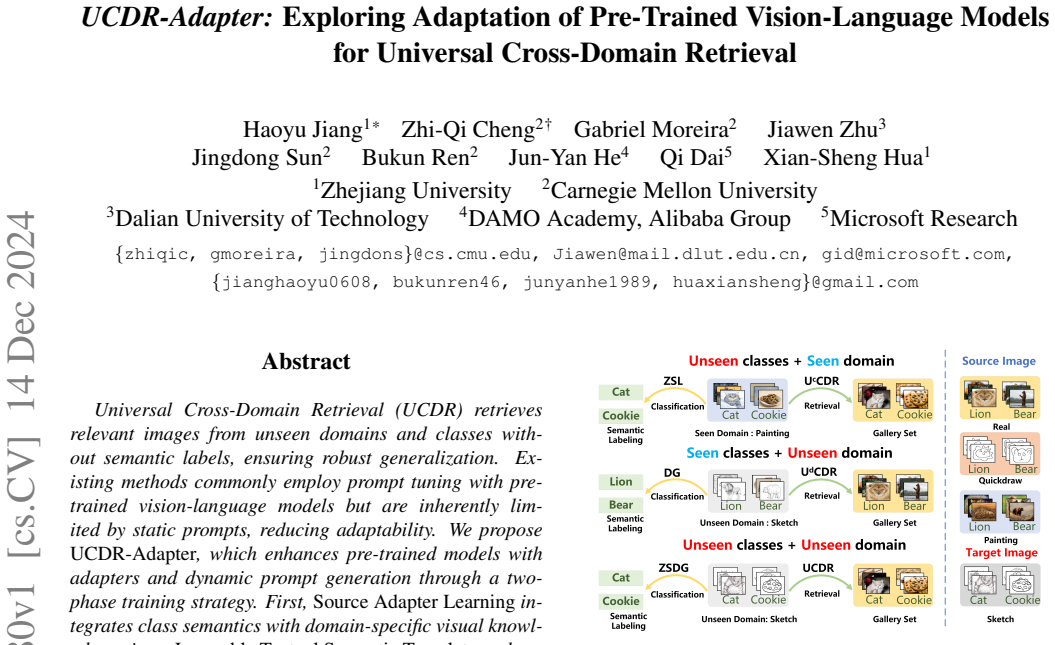
Universal Cross-Domain Retrieval (UCDR) retrieves relevant images from unseen domains and classes without semantic labels, ensuring robust generalization. Existing methods commonly employ prompt tuning with pre-trained vision-language models but are inherently limited by static prompts, reducing adaptability. We propose UCDR-Adapter, which enhances pre-trained models with adapters and dynamic prompt generation through a two-phase training strategy. First, Source Adapter Learning integrates class semantics with domain-specific visual knowledge using a Learnable Textual Semantic Template and optimizes Class and Domain Prompts via momentum updates and dual loss functions for robust alignment. Second, Target Prompt Generation creates dynamic prompts by attending to masked source prompts, enabling seamless adaptation to unseen domains and classes. Unlike prior approaches, UCDR-Adapter dynamically adapts to evolving data distributions, enhancing both flexibility and generalization. During inference, only the image branch and generated prompts are used, eliminating reliance on textual inputs for highly efficient retrieval. Extensive benchmark experiments show that UCDR-Adapter consistently outperforms ProS in most cases and other state-of-the-art methods on UCDR, U(c)CDR, and U(d)CDR settings.
Figures


Figures from the paper (2 more)


Reference graph
Works this paper leans on
-
[1]
Contrastive learning of semantic concepts for open-set cross-domain retrieval
Aishwarya Agarwal, Srikrishna Karanam, Balaji Vasan Srinivasan, and Biplab Banerjee. Contrastive learning of semantic concepts for open-set cross-domain retrieval. In WACV, pages 4115–4124, 2023. 2, 7
work page 2023
-
[2]
Handling class-imbalance for improved zero-shot domain generaliza- tion
Ahmad Arfeen, Titir Dutta, and Soma Biswas. Handling class-imbalance for improved zero-shot domain generaliza- tion. In BMVC, page 728, 2022. 1, 2
work page 2022
-
[3]
General- izing from several related classification tasks to a new unla- beled sample
Gilles Blanchard, Gyemin Lee, and Clayton Scott. General- izing from several related classification tasks to a new unla- beled sample. NeurIPS, 24, 2011. 2
work page 2011
-
[4]
Stylip: Multi-scale style- conditioned prompt learning for clip-based domain general- ization
Shirsha Bose, Ankit Jha, Enrico Fini, Mainak Singha, Elisa Ricci, and Biplab Banerjee. Stylip: Multi-scale style- conditioned prompt learning for clip-based domain general- ization. In WACV, pages 5542–5552, 2024. 2
work page 2024
-
[5]
A review on multi- modal zero-shot learning
Weipeng Cao, Yuhao Wu, Yixuan Sun, Haigang Zhang, Jin Ren, Dujuan Gu, and Xingkai Wang. A review on multi- modal zero-shot learning. Wiley Interdisciplinary Reviews: Data Mining and Knowledge Discovery, 13(2):e1488, 2023. 2
work page 2023
-
[6]
Uniter: Universal image-text representation learning
Yen-Chun Chen, Linjie Li, Licheng Yu, Ahmed El Kholy, Faisal Ahmed, Zhe Gan, Yu Cheng, and Jingjing Liu. Uniter: Universal image-text representation learning. In ECCV, pages 104–120, 2020. 2
work page 2020
-
[7]
Video ecommerce: Towards online video advertising
Zhi-Qi Cheng, Yang Liu, Xiao Wu, and Xian-Sheng Hua. Video ecommerce: Towards online video advertising. In Proceedings of the 24th ACM international conference on Multimedia, pages 1365–1374, 2016. 2
work page 2016
-
[8]
Video ecommerce++: Toward large scale online video adver- tising
Zhi-Qi Cheng, Xiao Wu, Yang Liu, and Xian-Sheng Hua. Video ecommerce++: Toward large scale online video adver- tising. IEEE transactions on multimedia, 19(6):1170–1183,
Show all 52 references
-
[9]
Video2shop: Exact matching clothes in videos to online shopping images
Zhi-Qi Cheng, Xiao Wu, Yang Liu, and Xian-Sheng Hua. Video2shop: Exact matching clothes in videos to online shopping images. In Proceedings of the IEEE conference on computer vision and pattern recognition, pages 4048–4056,
-
[10]
On the selection of anchors and targets for video hyperlink- ing
Zhi-Qi Cheng, Hao Zhang, Xiao Wu, and Chong-Wah Ngo. On the selection of anchors and targets for video hyperlink- ing. In Proceedings of the 2017 acm on international con- ference on multimedia retrieval, pages 287–293, 2017. 2
2017
-
[11]
An evaluation of descriptors for large-scale image retrieval from sketched feature lines
Mathias Eitz, Kristian Hildebrand, Tamy Boubekeur, and Marc Alexa. An evaluation of descriptors for large-scale image retrieval from sketched feature lines. Computers & Graphics, 34(5):482–498, 2010. 5
2010
-
[12]
Pros: Prompting-to-simulate generalized knowledge for universal cross-domain retrieval
Kaipeng Fang, Jingkuan Song, Lianli Gao, Pengpeng Zeng, Zhi-Qi Cheng, Xiyao Li, and Heng Tao Shen. Pros: Prompting-to-simulate generalized knowledge for universal cross-domain retrieval. In Proceedings of the IEEE/CVF Conference on Computer Vision and Pattern Recognition , pag...
2024
-
[13]
Domain adaptation via prompt learning
Chunjiang Ge, Rui Huang, Mixue Xie, Zihang Lai, Shiji Song, Shuang Li, and Gao Huang. Domain adaptation via prompt learning. IEEE Transactions on Neural Networks and Learning Systems, 2023. 2
2023
-
[14]
Improv- ing diversity with adversarially learned transformations for domain generalization
Tejas Gokhale, Rushil Anirudh, Jayaraman J Thiagarajan, Bhavya Kailkhura, Chitta Baral, and Yezhou Yang. Improv- ing diversity with adversarially learned transformations for domain generalization. In WACV, pages 434–443, 2023. 2
2023
-
[15]
Mixup as locally linear out-of-manifold regularization
Hongyu Guo, Yongyi Mao, and Richong Zhang. Mixup as locally linear out-of-manifold regularization. In AAAI, pages 3714–3722, 2019. 2
2019
-
[16]
Momentum contrast for unsupervised visual rep- resentation learning
Kaiming He, Haoqi Fan, Yuxin Wu, Saining Xie, and Ross Girshick. Momentum contrast for unsupervised visual rep- resentation learning. In CVPR, pages 9729–9738, 2020. 4
2020
-
[17]
Vi- sual prompt tuning
Menglin Jia, Luming Tang, Bor-Chun Chen, Claire Cardie, Serge Belongie, Bharath Hariharan, and Ser-Nam Lim. Vi- sual prompt tuning. In ECCV, pages 709–727, 2022. 2
2022
-
[18]
Bert: Pre-training of deep bidirectional trans- formers for language understanding
Jacob Devlin Ming-Wei Chang Kenton and Lee Kristina Toutanova. Bert: Pre-training of deep bidirectional trans- formers for language understanding. In NAACL-HLT, pages 4171–4186, 2019. 2
2019
-
[19]
Maple: Multi-modal prompt learning
Muhammad Uzair Khattak, Hanoona Rasheed, Muhammad Maaz, Salman Khan, and Fahad Shahbaz Khan. Maple: Multi-modal prompt learning. In Proceedings of the IEEE/CVF Conference on Computer Vision and Pattern Recognition, pages 19113–19122, 2023. 2
2023
-
[20]
Self-regulating prompts: Foundational model adaptation without forgetting
Muhammad Uzair Khattak, Syed Talal Wasim, Muzam- mal Naseer, Salman Khan, Ming-Hsuan Yang, and Fa- had Shahbaz Khan. Self-regulating prompts: Foundational model adaptation without forgetting. In Proceedings of the IEEE/CVF International Conference on Computer Vision , pages 15...
2023
-
[21]
Interpretability be- yond feature attribution: Quantitative testing with concept activation vectors (tcav)
Been Kim, Martin Wattenberg, Justin Gilmer, Carrie Cai, James Wexler, Fernanda Viegas, et al. Interpretability be- yond feature attribution: Quantitative testing with concept activation vectors (tcav). In ICML, pages 2668–2677, 2018. 2
2018
-
[22]
The power of scale for parameter-efficient prompt tuning
Brian Lester, Rami Al-Rfou, and Noah Constant. The power of scale for parameter-efficient prompt tuning. In EMNLP, pages 3045–3059, 2021. 2
2021
-
[23]
Blip: Bootstrapping language-image pre-training for unified vision-language understanding and generation
Junnan Li, Dongxu Li, Caiming Xiong, and Steven Hoi. Blip: Bootstrapping language-image pre-training for unified vision-language understanding and generation. In ICML, pages 12888–12900, 2022. 1
2022
-
[24]
Align before fuse: Vision and language representation learn- ing with momentum distillation
Junnan Li, Ramprasaath Selvaraju, Akhilesh Gotmare, Shafiq Joty, Caiming Xiong, and Steven Chu Hong Hoi. Align before fuse: Vision and language representation learn- ing with momentum distillation. In NeurIPS, volume 34, pages 9694–9705, 2021. 2
2021
-
[25]
Oscar: Object-semantics aligned pre-training for vision-language tasks
Xiujun Li, Xi Yin, Chunyuan Li, Pengchuan Zhang, Xiaowei Hu, Lei Zhang, Lijuan Wang, Houdong Hu, Li Dong, Furu Wei, et al. Oscar: Object-semantics aligned pre-training for vision-language tasks. In ECCV, pages 121–137, 2020. 2
2020
-
[26]
Prefix-tuning: Optimizing continuous prompts for generation
Xiang Lisa Li and Percy Liang. Prefix-tuning: Optimizing continuous prompts for generation. In ACL, pages 4582– 4597, 2021. 2
2021
-
[27]
Deep sketch hashing: Fast free-hand sketch-based im- age retrieval
Li Liu, Fumin Shen, Yuming Shen, Xianglong Liu, and Ling Shao. Deep sketch hashing: Fast free-hand sketch-based im- age retrieval. In CVPR, pages 2862–2871, 2017. 5
2017
-
[28]
Cocoa: Context-conditional adaptation for recognizing unseen classes in unseen do- mains
Puneet Mangla, Shivam Chandhok, Vineeth N Balasubrama- nian, and Fahad Shahbaz Khan. Cocoa: Context-conditional adaptation for recognizing unseen classes in unseen do- mains. In WACV, pages 865–874, 2022. 1, 2
2022
-
[29]
Seic: Semantic embed- ding with intermediate classes for zero-shot domain general- ization
Biswajit Mondal and Soma Biswas. Seic: Semantic embed- ding with intermediate classes for zero-shot domain general- ization. In ACCV, pages 789–806, 2022. 1, 2, 5, 6
2022
-
[30]
Vireo@ trecvid 2017: Video-to-text, ad-hoc video search and video hyper- linking
Phuong Anh Nguyen, Qing Li, Zhi-Qi Cheng, Yi-Jie Lu, Hao Zhang, Xiao Wu, and Chong-Wah Ngo. Vireo@ trecvid 2017: Video-to-text, ad-hoc video search and video hyper- linking. In TREC video retrieval evaluation, 2017. 2
2017
-
[31]
Towards calibrated robust fine-tuning of vision-language models
Changdae Oh, Hyesu Lim, Mijoo Kim, Dongyoon Han, Sangdoo Yun, Jaegul Choo, Alexander Hauptmann, Zhi-Qi Cheng, and Kyungwoo Song. Towards calibrated robust fine-tuning of vision-language models. In arXiv preprint arXiv:2311.01723, 2024. 2
2024 arXiv
-
[32]
Ro- bust adaptation of foundation models with black-box visual prompting
Changdae Oh, Gyeongdeok Seo, Geunyoung Jung, Zhi-Qi Cheng, Hosik Choi, Jiyoung Jung, and Kyungwoo Song. Ro- bust adaptation of foundation models with black-box visual prompting. In arXiv preprint arXiv:2407.17491, 2024. 2
2024 arXiv
-
[33]
Universal cross-domain retrieval: Generalizing across classes and do- mains
Soumava Paul, Titir Dutta, and Soma Biswas. Universal cross-domain retrieval: Generalizing across classes and do- mains. In ICCV, pages 12056–12064, 2021. 1, 2, 5, 6, 7, 8
2021
-
[34]
Clipping: Distilling clip-based models with a student base for video- language retrieval
Renjing Pei, Jianzhuang Liu, Weimian Li, Bin Shao, Song- cen Xu, Peng Dai, Juwei Lu, and Youliang Yan. Clipping: Distilling clip-based models with a student base for video- language retrieval. In CVPR, pages 18983–18992, 2023. 1
2023
-
[35]
Moment matching for multi-source domain adaptation
Xingchao Peng, Qinxun Bai, Xide Xia, Zijun Huang, Kate Saenko, and Bo Wang. Moment matching for multi-source domain adaptation. In ICCV, pages 1406–1415, 2019. 5
2019
-
[36]
Language models as knowledge bases? In EMNLP, pages 2463–2473, 2019
Fabio Petroni, Tim Rockt ¨aschel, Sebastian Riedel, Patrick Lewis, Anton Bakhtin, Yuxiang Wu, and Alexander Miller. Language models as knowledge bases? In EMNLP, pages 2463–2473, 2019. 2
2019
-
[37]
Learn- ing transferable visual models from natural language super- vision
Alec Radford, Jong Wook Kim, Chris Hallacy, Aditya Ramesh, Gabriel Goh, Sandhini Agarwal, Girish Sastry, Amanda Askell, Pamela Mishkin, Jack Clark, et al. Learn- ing transferable visual models from natural language super- vision. In ICML, pages 8748–8763, 2021. 1, 2, 6
2021
-
[38]
Visual semantic segmentation based on few/zero-shot learning: An overview
Wenqi Ren, Yang Tang, Qiyu Sun, Chaoqiang Zhao, and Qing-Long Han. Visual semantic segmentation based on few/zero-shot learning: An overview. IEEE/CAA Journal of Automatica Sinica, 2023. 2
2023
-
[39]
Clip for all things zero-shot sketch-based image retrieval, fine- grained or not
Aneeshan Sain, Ayan Kumar Bhun0ia, Pinaki Nath Chowd- hury, Subhadeep Koley, Tao Xiang, and Yi-Zhe Song. Clip for all things zero-shot sketch-based image retrieval, fine- grained or not. In CVPR, pages 2765–2775, 2023. 1
2023
-
[40]
The sketchy database: learning to retrieve badly drawn bunnies
Patsorn Sangkloy, Nathan Burnell, Cusuh Ham, and James Hays. The sketchy database: learning to retrieve badly drawn bunnies. Transactions on Graphics, 35(4):1–12, 2016. 5
2016
-
[41]
Structure-aware semantic-aligned network for universal cross-domain retrieval
Jialin Tian, Xing Xu, Kai Wang, Zuo Cao, Xunliang Cai, and Heng Tao Shen. Structure-aware semantic-aligned network for universal cross-domain retrieval. In SIGIR, pages 278– 289, 2022. 1, 2, 5, 6, 7, 8
2022
-
[42]
Generalizing to unseen domains: A survey on domain generalization
Jindong Wang, Cuiling Lan, Chang Liu, Yidong Ouyang, Tao Qin, Wang Lu, Yiqiang Chen, Wenjun Zeng, and Philip Yu. Generalizing to unseen domains: A survey on domain generalization. IEEE Transactions on Knowledge and Data Engineering, 2022. 2
2022
-
[43]
Image as a foreign language: Beit pretraining for vision and vision- language tasks
Wenhui Wang, Hangbo Bao, Li Dong, Johan Bjorck, Zhil- iang Peng, Qiang Liu, Kriti Aggarwal, Owais Khan Mo- hammed, Saksham Singhal, Subhojit Som, et al. Image as a foreign language: Beit pretraining for vision and vision- language tasks. In CVPR, pages 19175–19186, 2023. 2
2023
-
[44]
Ra-clip: Retrieval augmented contrastive language-image pre-training
Chen-Wei Xie, Siyang Sun, Xiong Xiong, Yun Zheng, Deli Zhao, and Jingren Zhou. Ra-clip: Retrieval augmented contrastive language-image pre-training. In CVPR, pages 19265–19274, 2023. 2
2023
-
[45]
Towards zero-shot learning: A brief review and an attention-based embedding network
Guo-Sen Xie, Zheng Zhang, Huan Xiong, Ling Shao, and Xuelong Li. Towards zero-shot learning: A brief review and an attention-based embedding network. IEEE Transactions on Circuits and Systems for Video Technology, 33(3):1181– 1197, 2023. 2
2023
-
[46]
A fourier-based framework for domain generaliza- tion
Qinwei Xu, Ruipeng Zhang, Ya Zhang, Yanfeng Wang, and Qi Tian. A fourier-based framework for domain generaliza- tion. In CVPR, pages 14383–14392, 2021. 2
2021
-
[47]
Mixup without hesitation
Hao Yu, Huanyu Wang, and Jianxin Wu. Mixup without hesitation. In ICIG, pages 143–154, 2021. 2
2021
-
[48]
Coca: Contrastive captioners are image-text foundation models
Jiahui Yu, Zirui Wang, Vijay Vasudevan, Legg Yeung, Mo- jtaba Seyedhosseini, and Yonghui Wu. Coca: Contrastive captioners are image-text foundation models. In TMLR,
-
[49]
mixup: Beyond empirical risk minimiza- tion
Hongyi Zhang, Moustapha Cisse, Yann N Dauphin, and David Lopez-Paz. mixup: Beyond empirical risk minimiza- tion. In ICLR, 2018. 2
2018
-
[50]
Domain generalization: A survey
Kaiyang Zhou, Ziwei Liu, Yu Qiao, Tao Xiang, and Chen Change Loy. Domain generalization: A survey. IEEE Transactions on Pattern Analysis and Machine Intelligence, 45(04):4396–4415, 2023. 2
2023
-
[51]
Conditional prompt learning for vision-language models
Kaiyang Zhou, Jingkang Yang, Chen Change Loy, and Zi- wei Liu. Conditional prompt learning for vision-language models. In CVPR, pages 16816–16825, 2022. 2
2022
-
[52]
Learning to prompt for vision-language models
Kaiyang Zhou, Jingkang Yang, Chen Change Loy, and Ziwei Liu. Learning to prompt for vision-language models. In- ternational Journal of Computer Vision, 130(9):2337–2348,
Reviewed August 11, 2026 · model on record in the stance chip above.
Discussion (0). Continue with ORCID to comment.