REVIEW 1 major objections 7 minor 30 references
Multiple curved beams outperform single beam for obstacle blockage robustness
Reviewed by Pith at T0; open to challenge. T0 means a machine referee read the full paper against a public rubric. the ladder, T0–T4 →
Partitioning a transmit array into sub-arrays generating multiple coordinated Airy beams reduces sensitivity to obstacle-geometry estimation errors compared to single-Airy beamforming.
T0 review reviewed 2026-07-09 challenge →
load-bearing objection Multi-Airy beamforming with clean phase-alignment derivation; robustness bound is an upper bound on sensitivity, not a performance guarantee, and trajectory selection is a black box. the 1 major comments →
Blockage-Robust Beamforming for Near-Field Communications: From Single-Airy to Multi-Airy
The pith
A machine-rendered reading of the paper's core claim, the machinery that carries it, and where it could break.
The reading
Core claim
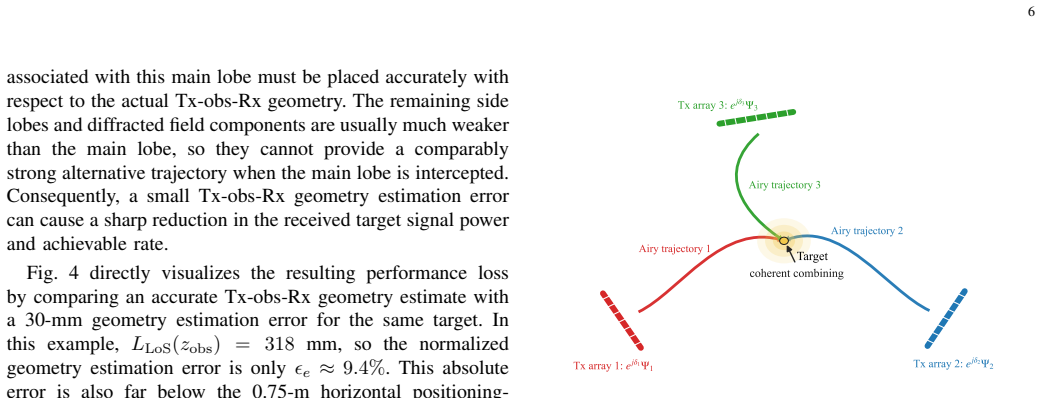
The central discovery is a phase-alignment rule (Theorem 1, Equation 29) showing that M independently generated Airy beams can be coherently combined at a target point by assigning each a constant phase offset equal to the negative of its individual response phase. This rule is general—it does not depend on how the beams are generated or where their source arrays are located—and it enables a constructive beamforming procedure: partition the array, assign each sub-array a tailored Airy trajectory, compute the phase offsets, and combine. The robustness improvement is then bounded analytically (Equations 55 and 58) by showing that a geometry-error strip at the obstacle plane intersects only a *
What carries the argument
The mechanism has three load-bearing parts. First, the sensitivity bound (Equation 55): the relative change in received energy under a geometry error is controlled by a factor χ that is the ratio of the incident field energy inside the error strip to the nominal received energy. For a single Airy beam, the error strip can overlap the dominant main lobe, making χ large and the denominator small. Second, the phase-alignment condition (Theorem 1): the maximum coherent-combining power is achieved when all beam responses share the same phase, with offsets δ_m = φ_0 − φ_m. Third, the multi-Airy robustness bound (Equation 58): by the triangle inequality, the multi-beam sensitivity factor χ_M is a *
Load-bearing premise
The entire analysis uses a zero-thickness, single-sided opaque screen as the blockage model, with free-space diffraction on either side. Real obstacles have finite thickness, complex shapes, multiple scattering surfaces, and material-dependent penetration—none of which are captured.
What would settle it
The multi-Airy robustness advantage would collapse if the obstacle simultaneously blocks all sub-array trajectories, if the trajectories overlap at the obstacle plane (so a single error strip intersects multiple main lobes), or if sub-array partitioning reduces the nominal received energy J_M excessively. The paper states these conditions explicitly (Section V-B).
If this is right
- The coordinated multi-Airy generation method extends directly to distributed antenna systems, since the phase-alignment rule requires no assumption that the sub-arrays share a common aperture or orientation.
- The trajectory-diversity principle could generalize to other self-accelerating or structured wavefronts beyond Airy beams, wherever a single dominant path creates vulnerability to obstacle-position uncertainty.
- Beam-training protocols for multi-Airy systems need development: the paper assumes trajectory parameters are found by a separate search stage, but jointly optimizing trajectory selection and phase alignment remains open.
- The UPA validation (6.41 dB improvement) suggests the benefit scales with aperture dimensionality, making the approach increasingly attractive for future large planar arrays.
Editorial analysis
A structured set of objections, weighed in public.
Referee Report
Summary. This paper proposes a multi-Airy beamforming scheme for blockage-robust near-field communications. The authors first analyze the sensitivity of conventional single-Airy beamforming to transmitter-obstacle-receiver (Tx-obs-Rx) geometry estimation errors, showing that a small error can destroy the single dominant Airy main lobe. They then derive a phase-alignment rule (Theorem 1) for coherently combining multiple Airy beams at a target user, partition the transmit array into sub-arrays each generating a tailored Airy beam, and analyze a robustness bound showing that trajectory diversity reduces sensitivity. Simulations demonstrate significant rate improvements and robustness gains over single-Airy and focused beam schemes under a planar-screen blockage model.
Significance. The paper addresses a practically important problem: blockage in high-frequency near-field links. The phase-alignment derivation (Theorem 1 and Appendix A) is clean and correct. The sensitivity analysis of single-Airy beamforming (Section IV-A, quantified by the 95.2% energy loss example) is a valuable contribution that motivates the multi-Airy approach. The robustness bound in Eq. (55)-(59), while an upper bound, provides useful intuition for why trajectory diversity helps. The UPA validation (Section VI-E) demonstrates extensibility beyond 1D arrays. Reproducible code is promised. The overall framework is constructive and the simulation results are convincing within the adopted model.
major comments (1)
- Section V-A, Eq. (43)-(47) and Algorithm 1: The trajectory parameters η = {(B_m, F_m, θ_m)} are treated as specified inputs, and the trajectory-selection stage is explicitly deferred to external beam training (e.g., [29]). This creates a gap between the theoretical robustness claim and the practical procedure. The robustness bound in Eq. (58) is an upper bound on sensitivity that does not guarantee high nominal energy J_M(x_e); it could be satisfied trivially by a configuration with near-zero energy. The paper itself flags trajectory overlap at the obstacle plane as a failure mode, but the bound does not prevent this because the triangle inequality is loose when trajectories are correlated. The authors should either (a) provide a trajectory-selection heuristic or criterion that explicitly promotes spatial diversity at the obstacle plane, or (b) clearly state as a limitation that therobst
minor comments (7)
- Section II-B, Eq. (6): The definition of b_l allows values > 1 as a geometric extrapolation, but this is only explained later. A forward reference or brief note at first introduction would help the reader.
- Section III-B, Eq. (18): The Gaussian aperture width ω_0 and Airy truncation factor α_A are free parameters. Their values are not clearly specified in the simulation setup (Section VI-A). Please state the values used.
- Section IV-A: The 95.2% energy loss is computed from a dB difference (-5.8 dB to -19.0 dB). It would help to show the linear-scale calculation explicitly for clarity.
- Section VI-C, Fig. 9: The figure caption should specify which multi-Airy configuration is 'best' and list the trajectory parameters or at least the selection rule, so the comparison is reproducible.
- Section VI-D, Fig. 10: At b_l = 0 (no blockage), the focused uniform beam appears to outperform some Airy schemes. Please discuss whether this is expected and whether Airy schemes incur a baseline penalty in unblocked scenarios.
- Reference [14] (Darsena et al., arXiv:2508.13714) and several other arXiv preprints ([6], [15], [25], [29]) have 2025-2026 dates. Please verify these are correctly cited and update with published versions if available.
- The notation eF in Eq. (21) uses a subscript that may render ambiguously. Please ensure it is clearly typeset as a single symbol 'e'. Please clarify.
Circularity Check
No circularity found; derivation is self-contained with first-principles proofs
full rationale
The paper's central derivation chain is self-contained and not circular. Theorem 1 (phase-alignment condition, Eq. 29) is a standard coherent-combining result proven from first principles in Appendix A using the triangle inequality — it does not depend on any prior result by the authors. The robustness bounds (Eq. 55, 58–59) are derived analytically from the blocked propagation operator (Eq. 13) and the operator norm (Eq. 52), again without fitting parameters to the target result or invoking self-cited premises. The multi-Airy beamforming procedure (Algorithm 1, Eq. 45–47) is a constructive method that takes trajectory parameters as specified inputs and applies the phase-alignment rule; it does not claim to solve the trajectory-selection problem, which is explicitly deferred to a separate beam-training stage. The skeptic's concerns — that the bound is an upper bound on sensitivity rather than a lower bound on performance, and that trajectory selection is unspecified — are correctness/completeness issues, not circularity. No load-bearing step reduces to its own inputs by construction or by self-citation. The cited works [15], [29] for single-Airy generation and beam training are by different authors (Zhao, Han, Björnson), not by the present paper's authors (Wang, Dai).
Axiom & Free-Parameter Ledger
free parameters (3)
- Gaussian aperture width ω_0 =
Not specified numerically
- Airy truncation factor α_A =
Not specified numerically
- Trajectory parameters η = {(B_m, F_m, θ_m)} =
Selected by beam training
axioms (3)
- domain assumption Paraxial/Fresnel approximation for near-field propagation
- domain assumption Planar-screen blockage model with zero-thickness obstacle
- domain assumption Single-antenna receiver with finite target window
Cite this review
Pith. "Pith review of Blockage-Robust Beamforming for Near-Field Communications: From Single-Airy to Multi-Airy." pith.science (2026). https://pith.science/paper/5IAM6BEC
@misc{pith2026260707278,
  author       = {Pith},
  title        = {Pith review of: Blockage-Robust Beamforming for Near-Field Communications: From Single-Airy to Multi-Airy},
  year         = {2026},
  howpublished = {\url{https://pith.science/paper/5IAM6BEC}},
  note         = {Machine review of arXiv:2607.07278}
}
read the original abstract
High-frequency communications strongly depend on the line-of-sight (LoS) path, and obstacle blockage can severely degrade the received signal power and achievable rate. Near-field Airy beams with curved trajectories can circumvent obstacles, offering a promising way to alleviate blockage. However, since an Airy beam carries most useful energy along a single curved trajectory, existing Airy beamforming methods are highly sensitive to estimation errors of transmitter-obstacle-receiver geometry. That is to say, even a small error in the estimated geometry may cause the mismatched Airy trajectory, leading to severe performance loss. To address this problem, we propose a multi-Airy beamforming scheme for blockage-robust near-field communications. Specifically, we first reveal and analyze the sensitivity mechanism of single-Airy beamforming. This mechanism motivates us to extend the single-Airy generation method to a coordinated multi-Airy generation method by deriving the phase offsets required to coherently combine multiple Airy beams at the target user. Based on this coordinated generation method, we partition the transmit array into multiple sub-arrays and configure a tailored Airy beam for each sub-array, so that the resulting Airy beams formed by multiple curved trajectories can be coherently combined at the target user. Simulation results verify the sensitivity of single-Airy beamforming and the robustness of multi-Airy beamforming under estimation errors of transmitter-obstacle-receiver geometry. Moreover, the proposed scheme achieves higher achievable rates than single-Airy beamforming in blocked scenarios without geometry estimation errors.
Figures




Reference graph
Works this paper leans on
-
[1]
A tutorial on extremely large-scale MIMO for 6G: Fundamentals, signal processing, and applications,
Z. Wang, J. Zhang, H. Du, D. Niyato, S. Cui, B. Ai, M. Debbah, K. B. Letaief, and H. V . Poor, “A tutorial on extremely large-scale MIMO for 6G: Fundamentals, signal processing, and applications,”IEEE Commun. Surveys Tuts., vol. 26, no. 3, pp. 1560–1605, 2024
work page 2024
-
[2]
T. K ¨urner, D. M. Mittleman, and T. Nagatsuma, Eds.,THz Communica- tions: Paving the Way Towards Wireless Tbps (Springer Series in Optical Sciences, 234). Springer Cham, 2021
work page 2021
-
[3]
J. W. Goodman,Introduction to Fourier Optics. McGraw-Hill, 1968
work page 1968
-
[4]
Channel estimation for extremely large-scale MIMO: Far-field or near-field?
M. Cui and L. Dai, “Channel estimation for extremely large-scale MIMO: Far-field or near-field?”IEEE Trans. Commun., vol. 70, no. 4, pp. 2663–2677, Apr. 2022
work page 2022
-
[5]
Empirical blockage characterization and detection in indoor Sub-THz communi- cations,
A. Shurakov, D. Moltchanov, A. Prikhodko, A. Khakimov, E. Mokrov, V . Begishev, I. Belikov, Y . Koucheryavy, and G. Gol’tsman, “Empirical blockage characterization and detection in indoor Sub-THz communi- cations,”Comput. Commun., vol. 201, pp. 48–58, 2023
work page 2023
-
[6]
Terahertz wireless data center: Gaussian beam or Airy beam?
W. Zhao, S. Abadal, G. Song, J. Jiang, and C. Han, “Terahertz wireless data center: Gaussian beam or Airy beam?”IEEE Trans. Wireless Commun., vol. 25, pp. 7922–7938, 2026
work page 2026
-
[7]
Millimeter-wave base station diversity for 5G coordinated multipoint (CoMP) applications,
G. R. MacCartney and T. S. Rappaport, “Millimeter-wave base station diversity for 5G coordinated multipoint (CoMP) applications,”IEEE Trans. Wireless Commun., vol. 18, no. 7, pp. 3395–3410, Jul. 2019
work page 2019
-
[8]
Blockage-aware reliable mmWave access via coordinated multi-point connectivity,
D. Kumar, J. Kaleva, and A. T ¨olli, “Blockage-aware reliable mmWave access via coordinated multi-point connectivity,”IEEE Trans. Wireless Commun., vol. 20, no. 7, pp. 4238–4252, Jul. 2021
work page 2021
-
[9]
Recent progress in Terahertz metasurfaces,
I. Al-Naib and W. Withayachumnankul, “Recent progress in Terahertz metasurfaces,”J. Infrared Millim. Terahertz Waves, vol. 38, no. 9, pp. 1067–1084, Sep. 2017
work page 2017
-
[10]
Towards intelligent reflecting surface empowered 6G Terahertz communications: A survey,
Z. Chen, X. Ma, C. Han, and Q. Wen, “Towards intelligent reflecting surface empowered 6G Terahertz communications: A survey,”China Commun., vol. 18, no. 5, pp. 93–119, May 2021
work page 2021
-
[11]
Airy beams and accelerating waves: an overview of recent advances,
N. K. Efremidis, Z. Chen, M. Segev, and D. N. Christodoulides, “Airy beams and accelerating waves: an overview of recent advances,”Optica, vol. 6, no. 5, pp. 686–701, May 2019
work page 2019
-
[12]
Self- healing properties of optical Airy beams,
J. Broky, G. A. Siviloglou, A. Dogariu, and D. N. Christodoulides, “Self- healing properties of optical Airy beams,”Opt. Express, vol. 16, no. 17, pp. 12 880–12 891, 2008
work page 2008
-
[13]
Analytical study of the self-healing property of Airy beams,
X. Chu, G. Zhou, and R. Chen, “Analytical study of the self-healing property of Airy beams,”Phys. Rev. A, vol. 85, no. 1, p. 013815, 2012
work page 2012
-
[14]
Airy beams for radiative near-field communications: Fundamentals, potentials, and limitations
D. Darsena, F. Verde, M. Di Renzo, and V . Galdi, “Airy beams for near- field communications: Fundamentals, potentials, and limitations,”arXiv preprint arXiv:2508.13714, 2025
work page internal anchor Pith review Pith/arXiv arXiv 2025
-
[15]
W. Zhao, C. Han, and E. Bj ¨ornson, “Airy beam engineering in near- field communications: A tractable closed-form analysis in the Terahertz band,”arXiv preprint arXiv:2603.13866, 2026
-
[16]
H. Chen, A. Kludze, Y . Ghasempour, N. L. Bot, E. Bergin, and F. Gillespie, “A physics-informed Airy beam learning framework for blockage avoidance in Sub-Terahertz wireless networks,”Nat. Commun., vol. 16, no. 1, pp. 1–10, 2025
work page 2025
-
[17]
M. V . Berry and N. L. Balazs, “Nonspreading wave packets,”Am. J. Phys., vol. 47, no. 3, pp. 264–267, Mar. 1979. [Online]. Available: https://doi.org/10.1119/1.11855
- [18]
-
[19]
Uniqueness of the Airy packet in quantum mechanics,
K. Unnikrishnan and A. Rau, “Uniqueness of the Airy packet in quantum mechanics,”Am. J. Phys., vol. 64, no. 8, pp. 1034–1035, 1996
work page 1996
-
[20]
Ob- servation of accelerating Airy beams,
G. A. Siviloglou, J. Broky, A. Dogariu, and D. Christodoulides, “Ob- servation of accelerating Airy beams,”Phys. Rev. Lett., vol. 99, no. 21, p. 213901, Nov. 2007
work page 2007
-
[21]
Ballistic dynamics of Airy beams,
G. Siviloglou, J. Broky, A. Dogariu, and D. Christodoulides, “Ballistic dynamics of Airy beams,”Opt. Lett., vol. 33, no. 3, pp. 207–209, Feb. 2008
work page 2008
-
[22]
Y . Kaganovsky and E. Heyman, “Wave analysis of Airy beams,”Opt. Express, vol. 18, no. 8, pp. 8440–8452, Apr. 2010
work page 2010
-
[23]
Accelerating finite energy Airy beams,
G. A. Siviloglou and D. N. Christodoulides, “Accelerating finite energy Airy beams,”Opt. Lett., vol. 32, no. 8, pp. 979–981, Apr. 2007
work page 2007
-
[24]
D. Inserra and G. Wen, “Demystifying self-healing property of accelerat- ing beams for obstacles circumvention in communication applications,” inProc. Photonics & Electromagnetics Research Symposium (PIERS), 2022, pp. 673–681
work page 2022
-
[25]
Breaking near-field communica- tion barriers: Focused, curved, or Airy beamforming?
S. Zhang, B. Di, and L. Song, “Breaking near-field communica- tion barriers: Focused, curved, or Airy beamforming?”arXiv preprint arXiv:2604.01704, 2026
-
[26]
Beam manipulation for Terahertz communications,
M. Li, J. M. Jornet, D. M. Mittleman, and C. Han, “Beam manipulation for Terahertz communications,”Commun. Eng., vol. 5, p. 83, 2026
work page 2026
-
[27]
Experimental demonstration of wireless transmission using Airy beams in Sub-THz band,
D. Lee, Y . Yagi, K. Suzuoki, and R. Kudo, “Experimental demonstration of wireless transmission using Airy beams in Sub-THz band,”IEEE Open J. Commun. Soc., vol. 6, pp. 1091–1102, Jan. 2025
work page 2025
-
[28]
Curving THz wireless data links around obstacles,
H. Guerboukha, B. Zhao, Z. Fang, E. Knightly, and D. M. Mittleman, “Curving THz wireless data links around obstacles,”Commun. Eng., vol. 3, no. 1, p. 58, 2024
work page 2024
-
[29]
Efficient Airy Beam Training for Quasi-LoS Terahertz Near-Field Communications
W. Zhao and C. Han, “Efficient Airy beam training for quasi-LoS Terahertz near-field communications,”arXiv preprint arXiv:2605.09895, 2026
work page internal anchor Pith review Pith/arXiv arXiv 2026
-
[30]
From vision to design targets: Technical performance requirements for IMT-2030,
L. Ma, M. Grant, H. Lin, J. Skold, R. Liu, and J. Shao, “From vision to design targets: Technical performance requirements for IMT-2030,” IEEE Commun. Mag., vol. 64, no. 6, pp. 6–9, Jun. 2026
work page 2030
This paper was first reviewed by glm-5.2 on July 9, 2026.
discussion (0)
Sign in with ORCID, Apple, or X to comment. Anyone can read and Pith papers without signing in.