REVIEW 3 major objections 5 minor 2 cited by
Scalable Multi-Task Reinforcement Learning for Generalizable Spatial Intelligence in Visuomotor Agents
T0 review · 3 major / 5 minor · reviewed 2026-08-06 · deepseek-v4-flash
Pith's one-line read RL post-training on 100,000 auto-generated Minecraft tasks quadruples a visuomotor agent's interaction success and transfers that spatial skill zero-shot to unseen worlds, including a real robot.
desk verdict RL post-training at 100k-task scale looks real and useful, but the zero-shot transfer claim hinges on an undocumented mask-input question. read the letter →
The pith
A machine-rendered reading of the paper's core claim, the machinery that carries it, and where it could break.
The reading
What carries the argument
Cross-view goal specification (CVGS): a task is specified by an initial egocentric view, a goal image from a distinct third-person camera, a segmentation mask of the target object inside that goal image, and an interaction event such as break, use, pick up, or approach. Its work in the argument is to serve as a unified task space that is open (any viewable object can be a goal), unambiguous (the mask pins the exact instance), scalable (rewards derive automatically from voxel-change detection), and curriculum-friendly (the distance between the two views sets the difficulty). Because every task reduces to one operation — aligning the current view with the masked goal view — the policy learns a single transferable skill, cross-view spatial reasoning, rather than a collection of environment-specific behaviors.
What would settle it
Retrain the pipeline with a corrupted reward that fires on any voxel change within a small radius of the target rather than a change to the target's own voxels, then test zero-shot transfer on the DMLab fruit task and the real robot; if transfer success is unchanged, the policy learned a proximity shortcut and the 4× gain does not demonstrate spatial reasoning, whereas a collapse would confirm the reward tracks true alignment with the masked goal view.
Extended reading notes
Core claim
The paper's central claim is that RL post-training enhances the spatial reasoning of a pretrained visuomotor policy, and that the enhanced capability generalizes zero-shot across 3D environments. Tasks are synthesized by sampling a Minecraft world seed, terrain, a camera distance of 20, 40, or 60 blocks, and a target object; the goal is specified as a third-person image with a SAM-generated segmentation mask of that object. A binary outcome reward is produced automatically by detecting voxel changes in the simulator, so 100,000 tasks require no manual reward design. PPO with a KL constraint toward the pretrained policy raises average success from 7% to 28% across Approach, Break, Interact, Melee Hunt, and Archery, with Archery jumping from under 1% to 28%. The same policy, using only the action mapping in Table 4, improves DMLab30 fruit collection, Unreal Zoo casualty rescue, and real-robot ball finding, including cases where the target is invisible in the egocentric view and visible only in the goal image; the visibility and centroid prediction heads also keep working after RL even though only the action head was trained. The authors conclude that the cross-view goal space is what unifies multi-task RL and enables the transfer.
Load-bearing premise
The load-bearing premise is that the automatic reward, which fires when the target object's voxels change in Minecraft, truly measures cross-view spatial reasoning, and that the rule-based action mapping in Table 4 preserves each task's meaning when the policy is deployed in DMLab, Unreal, and the real robot.
Editorial extensions
If this is right
- Average interaction success on the Minecraft task suite rises from 7% to 28% across all five skill types, with hard tasks improving as well, which the authors read as the model acquiring exploration ability.
- Archery goes from under 1% after pre-training to 28% after RL, showing that RL can unlock abilities that imitation learning left latent.
- The same policy, with no environment-specific training, transfers to DMLab30 fruit collection, Unreal Zoo rescue, and a real robot car, with real-world ball-finding success up by as much as 41%.
- A mixed-difficulty curriculum that samples easy, medium, and hard tasks uniformly trains faster and reaches higher value-function explained variance than hard-only training.
- The KL constraint toward the pretrained policy prevents the performance collapse seen in KL-free runs, and policies trained from scratch fail entirely, so RL post-training only works on top of a strong imitation-learned foundation.
Reading between the lines
- If the mechanism holds, the pretrain-then-RL-post-train recipe from language modeling transfers to embodied agents: one simulator rich enough for procedural task generation could replace per-environment fine-tuning wherever action spaces can be mapped.
- The near-zero performance of the language-conditioned baseline suggests the representation, not RL itself, carries the generalization; a clean test would train RL on identical voxel-change rewards under both goal representations and compare transfer curves.
- The paper's documented failures — long visually homogeneous corridors, low robot camera heights, and absent skills such as door-opening — point to the next lever: scaling the diversity of training worlds, not just the number of tasks.
- A testable extension is running the same pipeline in a photorealistic simulator; if viewpoint alignment is the true abstraction, gains should reach the real robot with a smaller visual-texture gap than Minecraft training leaves.
Editorial analysis
A structured set of objections, weighed in public.
Referee Report
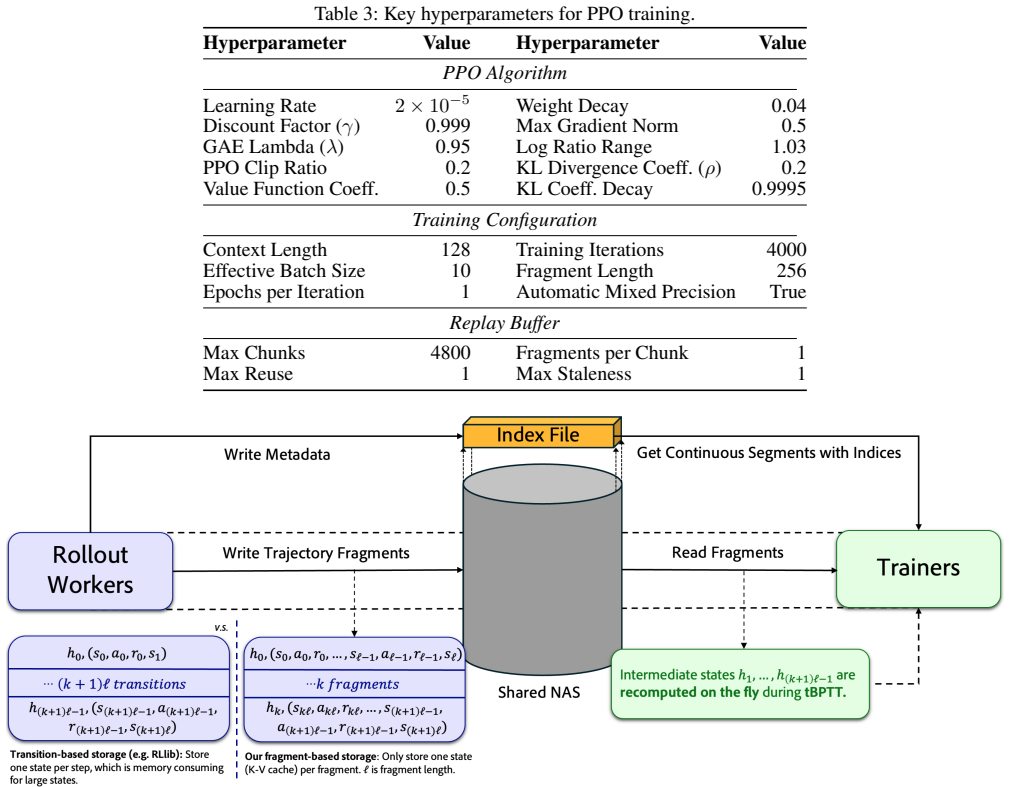
Summary. The paper studies whether RL post-training can improve a pretrained visuomotor policy's cross-view spatial reasoning in 3D worlds. The method defines tasks in the Cross-View Goal Specification (CVGS) space T = <O1, Og, Mg, E>, synthesizes roughly 100,000 Minecraft tasks by sampling the camera view, distance, target object, and interaction type, and fine-tunes a 0.3B ROCKET-2 policy with PPO plus a KL constraint against the pretrained policy. The authors report a 4x improvement in Minecraft interaction success rate (from 7% to 28% on average), ablation evidence favoring the KL constraint and mixed-difficulty curriculum, and zero-shot deployment to DMLab, Unreal Engine, and a real Mecanum-wheeled robot via a manually defined action mapping. The paper also contributes a distributed RL framework with fragment-based storage for long-sequence Transformer policies.
Significance. If the central claim holds, the paper is a meaningful step toward making RL a viable post-training stage for visuomotor policies, analogous to RL fine-tuning for LLMs. The empirical scope is unusually broad for a single paper: multiple independent simulated environments and a physical robot, with informative ablations (with/without KL, with/without curriculum, no-pretraining RL, language-based STEVE-1). The authors also release code and an RL framework, and the supplementary failure analysis is candid. However, the strongest evidence for the headline contribution—zero-shot transfer to unseen domains—depends on the deployment-time task specification actually being CVGS, and the current manuscript does not document how the required segmentation mask Mg is obtained in DMLab, Unreal, or the real robot. Without that documentation, the transfer results could reflect a different input format, and the central interpretation would be unsupported. This is a documentation gap that can be settled by inspection of the release, not an internal contradiction.
major comments (3)
- [Section 4 (Task Formulation) and Supplementary D] The paper defines CVGS as T = <O1, Og, Mg, E> and the architecture in Supplementary D encodes Mg separately with a trainable ViT-tiny and fuses it with the goal image before SpatialFusion; the policy therefore does not receive a goal image alone at training time. The three transfer protocols in Supplementary C.2 describe only a goal image or a language prompt: Unreal uses "images of the injured person," DMLab uses "human-generated prompts curated from live gameplay," and the real robot is given a top-down goal image. No statement explains how Mg is computed or supplied in these domains. If mask-free goal inputs are used at deployment, the zero-shot evaluation is not an evaluation of the CVGS policy, and the measured gains cannot be attributed to cross-view spatial reasoning. Please document mask generation for each target domain, or restrict the generalization claim to the actual deployment input format.
- [Section 5.2 and Figure 3f/g; Supplementary C.2] The central quantitative claims are reported as point estimates without appropriate uncertainty: the headline improvement from 7% to 28% is a single average, and the real-world comparison is based on 12 trials per condition (3/12 vs. 8/12 in the hard variant). DMLab and Unreal results are given without episode counts, raw trial numbers, confidence intervals, or multiple seeds. Given that the abstract and introduction describe a "remarkable 4x" and "compelling" zero-shot generalization, the paper should report variances and sample sizes; otherwise the strength of the central claim is overstated.
- [Table 4] The hand-mapped action table appears inconsistent in the transverse channel: Minecraft "right=1" maps to Unreal "velocity = -100," while Minecraft "left=1" maps to Unreal "/" (masked), and the same Minecraft actions map to "0.1 meters left/right" for the robot car. Without signed coordinate conventions for each environment and validation that the mapping preserves task semantics, Table 4 does not by itself establish that the transferred policy is solving the same task. Please add coordinate definitions and per-action validation results in each target environment.
minor comments (5)
- [Abstract and Section 5.2] The text should define whether the "4x" and "up to 41%" figures are relative improvements or absolute percentage-point increases; currently "up to 41%" is ambiguous.
- [Section 5.4 and Supplementary C.2] The real-world robot operates at 2 Hz while Minecraft runs at 15+ Hz; this temporal control mismatch is a confound for the real-world transfer results and should be discussed quantitatively, not only mentioned in passing.
- [Figure 3(d)] The caption and text refer to "current SOTA goal-conditioned agents," but the table mixes single-task RL agents, language-conditioned agents, and multi-task baselines with different problem setups; please add a column specifying task space, number of tasks, and evaluation conditions.
- [Supplementary E] The failure analysis is a useful addition, but several explanations (e.g., the marble-hallway hypothesis) are presented after the outcome; please label them explicitly as post hoc hypotheses rather than measured causes.
- [Equation (5)] The rotation-matrix convention for yaw and pitch is not stated; please specify the axis order and sign conventions used in the coordinate transformation.
Circularity Check
No significant circularity: the central RL gains are measured as a before/after delta and as zero-shot transfer to external worlds, and the cited prior work is only a building block, not a load-bearing self-referential proof.
full rationale
The derivation chain is an empirical claim: start from a pre-trained ROCKET-2 policy, run PPO post-training on automatically synthesized CVGS tasks in Minecraft, and measure success. Each link is independently checkable: the 7% to 28% Minecraft figure is a before/after comparison of the same policy family on the same task distribution; the DMLab, Unreal, and real-robot results are out-of-distribution evaluations that require no fitted parameter and are not constructed from the training objective. The CVGS task space is indeed cited to Cai et al. 2025, also by the authors, but the citation is used as a prior building block (the pretrained checkpoint and goal representation), not as the argument for the paper's conclusion; the experimental design compares ROCKET-2 before and after RL and against other baselines, so the conclusion does not reduce to the self-citation. The voxel-change outcome reward is a simulator ground-truth success signal, and using the same signal for evaluation is a standard measurement choice, not a fitted input renamed as a prediction. No equation in the paper defines a predicted quantity in terms of a fitted coefficient, no uniqueness theorem is imported from the authors' prior work to force a choice, and no ansatz is smuggled in via citation. The reviewer-flagged absence of documented segmentation masks in DMLab/Unreal/real goal inputs is a potential construct-validity and reporting gap, but it is a documentation issue, not circularity, because it would weaken the transfer claim rather than make it tautological. Therefore no circular step is exhibitable under the required reduction standard.
Assumptions & free parameters
free parameters (3)
- KL divergence coefficient (rho) =
0.2
- PPO clip ratio =
0.2
- Curriculum difficulty distances =
20/40/60 blocks
assumptions (4)
- domain assumption Cross-view goal specification (segmentation mask in a third-person view) is a sufficient and unambiguous goal representation for learning generalizable spatial reasoning.
- domain assumption The voxel-change outcome reward in Minecraft is a faithful proxy for task success and rewards the intended cross-view spatial reasoning.
- ad hoc to paper The pretrained ROCKET-2 policy contains latent spatial reasoning that RL can unlock; the paper shows no-pretraining RL fails, making this load-bearing.
- domain assumption The action-space mapping in Table 4 preserves task semantics across Minecraft, DMLab, Unreal, and the real robot.
Cite this review
Pith. "Pith review of Scalable Multi-Task Reinforcement Learning for Generalizable Spatial Intelligence in Visuomotor Agents." pith.science (2026). https://pith.science/paper/5IH6CBLM
@misc{pith2026250723698,
  author       = {Pith},
  title        = {Pith review of: Scalable Multi-Task Reinforcement Learning for Generalizable Spatial Intelligence in Visuomotor Agents},
  year         = {2026},
  howpublished = {\url{https://pith.science/paper/5IH6CBLM}},
  note         = {Machine review of arXiv:2507.23698}
}
abstract
While Reinforcement Learning (RL) has achieved remarkable success in language modeling, its triumph hasn't yet fully translated to visuomotor agents. A primary challenge in RL models is their tendency to overfit specific tasks or environments, thereby hindering the acquisition of generalizable behaviors across diverse settings. This paper provides a preliminary answer to this challenge by demonstrating that RL-finetuned visuomotor agents in Minecraft can achieve zero-shot generalization to unseen worlds. Specifically, we explore RL's potential to enhance generalizable spatial reasoning and interaction capabilities in 3D worlds. To address challenges in multi-task RL representation, we analyze and establish cross-view goal specification as a unified multi-task goal space for visuomotor policies. Furthermore, to overcome the significant bottleneck of manual task design, we propose automated task synthesis within the highly customizable Minecraft environment for large-scale multi-task RL training, and we construct an efficient distributed RL framework to support this. Experimental results show RL significantly boosts interaction success rates by $4\times$ and enables zero-shot generalization of spatial reasoning across diverse environments, including real-world settings. Our findings underscore the immense potential of RL training in 3D simulated environments, especially those amenable to large-scale task generation, for significantly advancing visuomotor agents' spatial reasoning.
Figures


Figures from the paper (6 more)


Forward citations
Cited by 2 Pith papers
-
GROW: Aligning GRPO with State-Action Modeling for Open-World VLM Agents
GROW decomposes trajectories into state-action samples for GRPO training of VLM agents and reports state-of-the-art results on over 800 Minecraft tasks.
-
GROW: Aligning GRPO with State-Action Modeling for Open-World VLM Agents
GROW decomposes trajectories into state-action samples to enable GRPO for multi-turn VLM agents and reports state-of-the-art results on more than 800 Minecraft tasks.
Reference graph
Works this paper leans on
-
[1]
, " * write output.state after.block = add.period write newline
ENTRY address archivePrefix author booktitle chapter edition editor eid eprint howpublished institution isbn journal key month note number organization pages publisher school series title type volume year label extra.label sort.label short.list INTEGERS output.state before.all mid.sentence after.sentence after.block FUNCTION init.state.consts #0 'before.a...
-
[2]
write newline
" write newline "" before.all 'output.state := FUNCTION n.dashify 't := "" t empty not t #1 #1 substring "-" = t #1 #2 substring "--" = not "--" * t #2 global.max substring 't := t #1 #1 substring "-" = "-" * t #2 global.max substring 't := while if t #1 #1 substring * t #2 global.max substring 't := if while FUNCTION word.in bbl.in capitalize " " * FUNCT...
-
[3]
write newline
" write newline "" before.all 'output.state := FUNCTION n.dashify 't := "" t empty not t #1 #1 substring "-" = t #1 #2 substring "--" = not "--" * t #2 global.max substring 't := t #1 #1 substring "-" = "-" * t #2 global.max substring 't := while if t #1 #1 substring * t #2 global.max substring 't := if while FUNCTION format.date year duplicate empty "emp...
-
[4]
J.; Adler, S.; Agarwal, S.; Ahmad, L.; Akkaya, I.; Aleman, F
Achiam, O. J.; Adler, S.; Agarwal, S.; Ahmad, L.; Akkaya, I.; Aleman, F. L.; Almeida, D.; Altenschmidt, J.; Altman, S.; et al. 2023. GPT-4 Technical Report
work page 2023
-
[5]
Baker, B.; Akkaya, I.; Zhokhov, P.; Huizinga, J.; Tang, J.; Ecoffet, A.; Houghton, B.; Sampedro, R.; and Clune, J. 2022. Video PreTraining (VPT): Learning to Act by Watching Unlabeled Online Videos. ArXiv, abs/2206.11795
arXiv 2022
-
[6]
Z.; Teplyashin, D.; Kaufmann, T
Beattie, C.; Leibo, J. Z.; Teplyashin, D.; Kaufmann, T. K.; Siddharth, N.; Clark, A.; Phillps, L.; Hughes, E.; Lamb, A.; Kelly, A.; Rowland, D. J.; Merel, J.; Wayne, G.; Porcel, N.; Noury, S.; Clark, S.; Babuschkin, I.; and Botvinick, M. 2016. DeepMind Lab . arXiv preprint arXiv:1612.03801
arXiv 2016
-
[7]
Brohan, A.; Brown, N.; Carbajal, J.; Chebotar, Y.; Chen, X.; Choromanski, K.; Ding, T.; Driess, D.; Dubey, A.; Finn, C.; et al. 2023. Rt-2: Vision-language-action models transfer web knowledge to robotic control. arXiv preprint arXiv:2307.15818
arXiv 2023
-
[8]
Brohan, A.; Brown, N.; Carbajal, J.; Chebotar, Y.; Dabis, J.; Finn, C.; Gopalakrishnan, K.; Hausman, K.; Herzog, A.; Hsu, J.; Ibarz, J.; Ichter, B.; Irpan, A.; Jackson, T.; Jesmonth, S.; Joshi, N. J.; Julian, R. C.; Kalashnikov, D.; Kuang, Y.; Leal, I.; Lee, K.-H.; Levine, S.; Lu, Y.; Malla, U.; Manjunath, D.; Mordatch, I.; Nachum, O.; Parada, C.; Peralta...
arXiv 2022
Show all 46 references
-
[9]
B.; Mann, B.; Ryder, N.; Subbiah, M.; Kaplan, J.; Dhariwal, P.; Neelakantan, A.; Shyam, P.; Sastry, G.; Askell, A.; Agarwal, S.; Herbert-Voss, A.; Krueger, G.; Henighan, T
Brown, T. B.; Mann, B.; Ryder, N.; Subbiah, M.; Kaplan, J.; Dhariwal, P.; Neelakantan, A.; Shyam, P.; Sastry, G.; Askell, A.; Agarwal, S.; Herbert-Voss, A.; Krueger, G.; Henighan, T. J.; Child, R.; Ramesh, A.; Ziegler, D. M.; Wu, J.; Winter, C.; Hesse, C.; Chen, M.; Sigler, E....
2020 arXiv
-
[10]
Cai, S.; Mu, Z.; Liu, A.; and Liang, Y. 2025. ROCKET-2: Steering Visuomotor Policy via Cross-View Goal Alignment. arXiv preprint arXiv:2503.02505
2025 arXiv
-
[11]
Cai, S.; Wang, Z.; Lian, K.; Mu, Z.; Ma, X.; Liu, A.; and Liang, Y. 2024. ROCKET-1: Master Open-World Interaction with Visual-Temporal Context Prompting. arXiv preprint arXiv:2410.17856
2024 arXiv
-
[12]
Cai, S.; Wang, Z.; Ma, X.; Liu, A.; and Liang, Y. 2023 a . Open-World Multi-Task Control Through Goal-Aware Representation Learning and Adaptive Horizon Prediction. 2023 IEEE/CVF Conference on Computer Vision and Pattern Recognition (CVPR), 13734--13744
2023
-
[13]
Cai, S.; Zhang, B.; Wang, Z.; Ma, X.; Liu, A.; and Liang, Y. 2023 b . GROOT: Learning to Follow Instructions by Watching Gameplay Videos. In The Twelfth International Conference on Learning Representations
2023
-
[14]
Caron, M.; Touvron, H.; Misra, I.; J\'egou, H.; Mairal, J.; Bojanowski, P.; and Joulin, A. 2021. Emerging Properties in Self-Supervised Vision Transformers. In Proceedings of the International Conference on Computer Vision (ICCV)
2021
-
[15]
DeepSeek-AI; Guo, D.; Yang, D.; Zhang, H.; Song, J.-M.; Zhang, R.; Xu, R.; Zhu, Q.; Ma, S.; Wang, P.; Bi, X.; Zhang, X.; Yu, X.; Wu, Y.; Wu, Z. F.; Gou, Z.; Shao, Z.; Li, Z.; Gao, Z.; Liu, A.; Xue, B.; Wang, B.-L.; Wu, B.; Feng, B.; Lu, C.; Zhao, C.; Deng, C.; Zhang, C.; Ruan,...
2025 arXiv
-
[16]
Dosovitskiy, A.; Beyer, L.; Kolesnikov, A.; Weissenborn, D.; Zhai, X.; Unterthiner, T.; Dehghani, M.; Minderer, M.; Heigold, G.; Gelly, S.; Uszkoreit, J.; and Houlsby, N. 2020. An Image is Worth 16x16 Words: Transformers for Image Recognition at Scale. ArXiv, abs/2010.11929
2020 arXiv
-
[17]
J.; Wang, G.; Jiang, Y.; Mandlekar, A.; Yang, Y.; Zhu, H.; Tang, A.; Huang, D.-A.; Zhu, Y.; and Anandkumar, A
Fan, L. J.; Wang, G.; Jiang, Y.; Mandlekar, A.; Yang, Y.; Zhu, H.; Tang, A.; Huang, D.-A.; Zhu, Y.; and Anandkumar, A. 2022. MineDojo: Building Open-Ended Embodied Agents with Internet-Scale Knowledge. ArXiv, abs/2206.08853
2022 arXiv
-
[18]
H.; Houghton, B.; Topin, N.; Wang, P.; Codel, C.; Veloso, M
Guss, W. H.; Houghton, B.; Topin, N.; Wang, P.; Codel, C.; Veloso, M. M.; and Salakhutdinov, R. 2019. MineRL: A Large-Scale Dataset of Minecraft Demonstrations. In International Joint Conference on Artificial Intelligence
2019
-
[19]
Ilon, B. E. 1975. Wheeled vehicle
1975
-
[20]
Krantz, J.; Gervet, T.; Yadav, K.; Wang, A.; Paxton, C.; Mottaghi, R.; Batra, D.; Malik, J.; Lee, S.; and Chaplot, D. S. 2023. Navigating to objects specified by images. In Proceedings of the IEEE/CVF International Conference on Computer Vision, 10916--10925
2023
-
[21]
Li, J.; Wang, Q.; Wang, Y.; Jin, X.; Li, Y.; Zeng, W.; and Yang, X. 2025. Open-World Reinforcement Learning over Long Short-Term Imagination. In ICLR
2025
-
[22]
E.; Jordan, M
Liang, E.; Liaw, R.; Nishihara, R.; Moritz, P.; Fox, R.; Goldberg, K.; Gonzalez, J. E.; Jordan, M. I.; and Stoica, I. 2017. RLlib: Abstractions for Distributed Reinforcement Learning. In International Conference on Machine Learning
2017
-
[23]
Lifshitz, S.; Paster, K.; Chan, H.; Ba, J.; and McIlraith, S. A. 2023. STEVE-1: A Generative Model for Text-to-Behavior in Minecraft. ArXiv, abs/2306.00937
2023 arXiv
-
[24]
Lin, H.; Wang, Z.; Ma, J.; and Liang, Y. 2023. Mcu: A task-centric framework for open-ended agent evaluation in minecraft. arXiv preprint arXiv:2310.08367
2023 arXiv
-
[25]
Liu, S.; Yuan, H.; Hu, M.; Li, Y.; Chen, Y.; Liu, S.; Lu, Z.; and Jia, J. 2024. RL-GPT : Integrating Reinforcement Learning and Code-as-policy. arXiv preprint arXiv:2402.19299
2024 arXiv
-
[26]
A.; Veness, J.; Bellemare, M
Mnih, V.; Kavukcuoglu, K.; Silver, D.; Rusu, A. A.; Veness, J.; Bellemare, M. G.; Graves, A.; Riedmiller, M. A.; Fidjeland, A. K.; Ostrovski, G.; Petersen, S.; Beattie, C.; Sadik, A.; Antonoglou, I.; King, H.; Kumaran, D.; Wierstra, D.; Legg, S.; and Hassabis, D. 2015. Human-l...
2015
-
[27]
I.; and Stoica, I
Moritz, P.; Nishihara, R.; Wang, S.; Tumanov, A.; Liaw, R.; Liang, E.; Paul, W.; Jordan, M. I.; and Stoica, I. 2017. Ray: A Distributed Framework for Emerging AI Applications. ArXiv, abs/1712.05889
2017 arXiv
-
[28]
Ouyang, L.; Wu, J.; Jiang, X.; Almeida, D.; Wainwright, C.; Mishkin, P.; Zhang, C.; Agarwal, S.; Slama, K.; Ray, A.; et al. 2022. Training language models to follow instructions with human feedback. Advances in neural information processing systems, 35: 27730--27744
2022
-
[29]
Padalkar, A.; Pooley, A.; Jain, A.; Bewley, A.; Herzog, A.; Irpan, A.; Khazatsky, A.; Rai, A.; Singh, A.; Brohan, A.; et al. 2023. Open x-embodiment: Robotic learning datasets and rt-x models. arXiv preprint arXiv:2310.08864
2023 arXiv
-
[30]
Pomerleau, D. A. 1988. Alvinn: An autonomous land vehicle in a neural network. Advances in neural information processing systems, 1
1988
-
[31]
Radford, A.; Wu, J.; Child, R.; Luan, D.; Amodei, D.; Sutskever, I.; et al. 2019. Language models are unsupervised multitask learners. OpenAI blog, 1(8): 9
2019
-
[32]
V.; Carion, N.; Wu, C.-Y.; Girshick, R.; Doll \'a r, P.; and Feichtenhofer, C
Ravi, N.; Gabeur, V.; Hu, Y.-T.; Hu, R.; Ryali, C.; Ma, T.; Khedr, H.; R \"a dle, R.; Rolland, C.; Gustafson, L.; Mintun, E.; Pan, J.; Alwala, K. V.; Carion, N.; Wu, C.-Y.; Girshick, R.; Doll \'a r, P.; and Feichtenhofer, C. 2024. SAM 2: Segment Anything in Images and Videos. ...
2024 arXiv
-
[33]
Ross, S.; Gordon, G.; and Bagnell, D. 2011. A reduction of imitation learning and structured prediction to no-regret online learning. In Proceedings of the fourteenth international conference on artificial intelligence and statistics, 627--635. JMLR Workshop and Conference Proceedings
2011
-
[34]
Schulman, J.; Moritz, P.; Levine, S.; Jordan, M.; and Abbeel, P. 2015. High-dimensional continuous control using generalized advantage estimation. arXiv preprint arXiv:1506.02438
2015 arXiv
-
[35]
Schulman, J.; Wolski, F.; Dhariwal, P.; Radford, A.; and Klimov, O. 2017. Proximal Policy Optimization Algorithms. ArXiv, abs/1707.06347
2017 arXiv
-
[36]
Silver, D.; Huang, A.; Maddison, C. J.; Guez, A.; Sifre, L.; van den Driessche, G.; Schrittwieser, J.; Antonoglou, I.; Panneershelvam, V.; Lanctot, M.; Dieleman, S.; Grewe, D.; Nham, J.; Kalchbrenner, N.; Sutskever, I.; Lillicrap, T. P.; Leach, M.; Kavukcuoglu, K.; Graepel, T....
2016
-
[37]
E.; and Stone, P
Taylor, M. E.; and Stone, P. 2011. An introduction to intertask transfer for reinforcement learning. Ai Magazine, 32(1): 15--15
2011
-
[38]
Vithayathil Varghese, N.; and Mahmoud, Q. H. 2020 a . A survey of multi-task deep reinforcement learning. Electronics, 9(9): 1363
2020
-
[39]
Vithayathil Varghese, N.; and Mahmoud, Q. H. 2020 b . A Survey of Multi-Task Deep Reinforcement Learning. Electronics, 9(9)
2020
-
[40]
Ye, D.; Liu, Z.; Sun, M.; Shi, B.; Zhao, P.; Wu, H.; Yu, H.; Yang, S.; Wu, X.; Guo, Q.; et al. 2020. Mastering complex control in moba games with deep reinforcement learning. In Proceedings of the AAAI conference on artificial intelligence, volume 34, 6672--6679
2020
-
[41]
Yuan, H.; Mu, Z.; Xie, F.; and Lu, Z. 2024. Pre-training goal-based models for sample-efficient reinforcement learning. In The Twelfth International Conference on Learning Representations
2024
-
[42]
Ze, Y.; Hansen, N.; Chen, Y.; Jain, M.; and Wang, X. 2023. Visual reinforcement learning with self-supervised 3d representations. IEEE Robotics and Automation Letters, 8(5): 2890--2897
2023
-
[43]
Zhong, F.; Wu, K.; Wang, C.; Chen, H.; Ci, H.; Li, Z.; and Wang, Y. 2024. Unrealzoo: Enriching photo-realistic virtual worlds for embodied ai. arXiv preprint arXiv:2412.20977
2024 arXiv
-
[44]
@esa (Ref
\@ifxundefined[1] #1\@undefined \@firstoftwo \@secondoftwo \@ifnum[1] #1 \@firstoftwo \@secondoftwo \@ifx[1] #1 \@firstoftwo \@secondoftwo [2] @ #1 \@temptokena #2 #1 @ \@temptokena \@ifclassloaded agu2001 natbib The agu2001 class already includes natbib coding, so you should ...
-
[45]
\@lbibitem[] @bibitem@first@sw\@secondoftwo \@lbibitem[#1]#2 \@extra@b@citeb \@ifundefined br@#2\@extra@b@citeb \@namedef br@#2 \@nameuse br@#2\@extra@b@citeb \@ifundefined b@#2\@extra@b@citeb @num @parse #2 @tmp #1 NAT@b@open@#2 NAT@b@shut@#2 \@ifnum @merge>\@ne @bibitem@firs...
-
[46]
Pattern Anal
@open @close @open @close and [1] URL: #1 \@ifundefined chapter * \@mkboth \@ifxundefined @sectionbib * \@mkboth * \@mkboth\@gobbletwo \@ifclassloaded amsart * \@ifclassloaded amsbook * \@ifxundefined @heading @heading NAT@ctr thebibliography [1] @ \@biblabel @NAT@ctr \@bibset...
2021 arXiv
Reviewed August 6, 2026 · model on record in the stance chip above.
Discussion (0). Sign in to comment.