REVIEW 4 major objections 5 minor 52 references
SenDaL: An Effective and Efficient Calibration Framework of Low-Cost Sensors for Daily Life
T0 review · 4 major / 5 minor · reviewed 2026-08-08 · deepseek-v4-flash
Pith's one-line read SenDaL is a neural-network calibration framework that routes each low-cost sensor reading either to a fast linear layer or to a deep model, and the paper reports it keeps deep-model accuracy while running at near-linear speed.
desk verdict Practical adaptive-inference framework with a thorough hardware evaluation, but the real-time accuracy claim rests on a possibly non-causal HP filter that the paper never discusses. read the letter →
The pith
A machine-rendered reading of the paper's core claim, the machinery that carries it, and where it could break.
The reading
What carries the argument
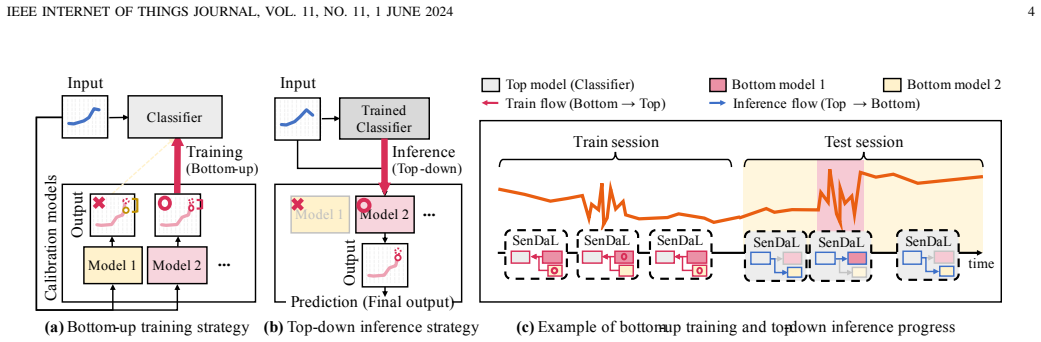
The load-bearing object is the embedding layer $E = \sigma \circ L$: a linear layer followed by a sigmoid that classifies each time-series window as stable or unstable. Training proceeds bottom-up: first the linear layer $f_c$ and the component layer $C$ are trained independently; then soft class labels $y^*_i$ are built from their relative errors, a smoothed-hard label, an instability factor, and a magnifier, and $E$ is trained by binary cross-entropy; finally all layers are fine-tuned together with $E$ frozen, using threshold $\theta = 0.5$ to route each window. At inference the framework applies $F(S) = C(S)$ if $E(S) > \theta$ and $F(S) = f_c(S)$ otherwise, and it may skip evaluating $E$ on every window when nearby windows are stable. This routing mechanism is what converts deep-model accuracy into linear-model cost.
What would settle it
Re-run the Env1-Env3 experiments with a strictly causal reference: replace the two-sided Hodrick-Prescott filter with a one-sided or online filter, and compare SenDaL's RMSE and miss ratio against the linear baseline. If the accuracy gap disappears or shrinks to the level of the baselines, the router's reported gain came from future information baked into the labels rather than from the routing mechanism itself.
Extended reading notes
Core claim
The paper's central claim is that you do not need to run an expensive deep model on every sensor reading to get deep-model accuracy. SenDaL trains a deep model and a linear model side by side, then trains a third component — an embedding layer with a sigmoid output — to predict which of the two will do better on the current window of readings. During inference the embedding layer alone chooses the path: stable windows go through the linear layer, unstable windows go through the deep component. Because stable windows dominate in daily-life data, average inference cost lands near the linear model while calibration error stays at the deep-model level; the miss-ratio results indicate the framework also reduces the large errors to which plain linear calibration is prone.
Load-bearing premise
The evaluation treats the smoothed average of eight laser fine-dust sensors as the correct value the framework must reproduce; if that reference signal is not actually available in real time — for example, because the smoothing filter uses future readings — the reported accuracy improvement would not carry over to live deployment.
Editorial extensions
If this is right
- On CPU-only embedded boards, SenDaL runs an order of magnitude faster than the corresponding deep model: roughly 7x faster with GRU and 20x faster with Phased LSTM on the reported Raspberry Pi measurements.
- Because the embedding layer can be paired with any component model, the same framework can trade accuracy for speed by swapping LSTM, GRU, Transformer, Reformer, or Performer as hardware resources change.
- The miss-ratio results say the framework does not merely match average error; it cuts the rate of large calibration errors relative to linear regression, e.g. a 43.5% improvement at threshold 30 in the reported experiments.
- The trained embedding layer gives a running stability signal for the environment, so the framework can flag unstable periods that deserve the more expensive correction path.
- ONNX and FlatBuffers conversions keep the speed advantage on microcontrollers such as Arduino Nano, widening the range of devices that can host it.
Reading between the lines
- Beyond the paper, the same train-a-router-on-two-teachers recipe should transfer to other cheap-sensor pairs, such as temperature, humidity, gas, or air-pressure sensors, where a stable baseline is common and a high-cost reference is available only during training; SenDaL itself is demonstrated only on fine dust.
- One could add an explicit budget to the classifier so the fraction of deep-path calls is capped, turning the accuracy-cost trade into a user-set knob; the paper fixes the threshold at 0.5 and does not explore this.
- If the locality assumption justifies skipping the embedding layer between stable windows, an adaptive scheduler could skip more aggressively as the environment becomes calm, further reducing cost without retraining.
- The framework's behavior on unusual or adversarial inputs is untested: the router will classify a genuinely novel pattern as unstable and pay the deep cost, but there is no guarantee the deep component is accurate on distributions absent from training.
Editorial analysis
A structured set of objections, weighed in public.
Referee Report
Summary. The paper proposes SenDaL, a gating framework for calibrating low-cost IoT sensors. It trains a linear calibration layer fc and a deeper 'component' layer C (LSTM, GRU, Transformer, etc.) separately, then trains an embedding classifier E on soft labels derived from which layer achieved lower error on each training window. At inference, E selects one of the two layers, so the deep model is only invoked on windows classified as unstable. The authors evaluate on fine-dust data collected with PPD42NS infrared sensors and PMS7003 laser sensors in three environments, reporting RMSE, miss ratio, CPU latency, and energy consumption on desktop CPUs, Raspberry Pi 3/4, Jetson Nano, and Arduino Nano. They report that SenDaL approaches or improves on the accuracy of the deep component while reducing latency and energy by large factors.
Significance. If the reported accuracy numbers hold, SenDaL is a practically useful routing scheme: it gives a concrete way to keep most inferences on a cheap linear model while reserving a deep model for unstable segments, and the paper's hardware evaluation is unusually thorough (multiple boards, PyTorch/ONNX/FlatBuffers formats, miss-ratio analysis). The central accuracy evidence, however, depends on preprocessing choices that are not fully specified (notably the direction of the HP filter), and several router hyperparameters are not reported. The contribution is therefore significant but conditional.
major comments (4)
- [Section IV-A, Eq. (2), Table II] The manuscript does not state whether the Hodrick-Prescott filter used to construct the ground truth y is causal. The standard HP filter solves a global smoothing problem over the whole series, so the smoothed value at time i depends on future observations; the same is true of the linear interpolation step if it uses neighboring future samples. If the standard two-sided filter was used, then the targets y_i in Eqs. (2)-(4) and in the RMSE of Table II contain information unavailable to F(S_i) in Eq. (9), and the reported absolute real-time accuracy is not attainable. Please specify the exact filter implementation, state whether it is one-sided or two-sided, and re-run the accuracy evaluation with a strictly causal preprocessing pipeline, or provide a direct comparison showing the effect of using causal targets.
- [Section V-B, Section VI] The ground truth is the average of eight PMS7003 sensors, which are themselves low-cost consumer-grade laser sensors, not a reference instrument. Section VI acknowledges this, but the abstract and introduction claim that SenDaL produces data 'accurate' and 'close to high-cost sensors'; the experiments only support accuracy relative to this proxy. The authors should either add a validation against a reference-grade instrument (e.g., a beta-ray monitor) for at least one environment, or soften the absolute-accuracy claims to claims about agreement with the multi-sensor laser average.
- [Section IV-D, Section V-E] Several free parameters control the router and therefore the accuracy/latency tradeoff: the margin xi in Eq. (4), the smoothing factor lambda in Eqs. (5)-(6), the weight w and magnifier n in Eq. (3), and the threshold theta used in Eqs. (8)-(9). Section V-E reports only N and hidden sizes. Without the chosen values and a sensitivity analysis, the claim that SenDaL 'approaches or surpasses' the component accuracy across environments is not yet robustly supported, since xi and theta directly determine how often the deep model is used.
- [Table III] The improvement percentages in Table III do not match the listed miss ratios. For theta_M=30, the linear miss ratio is 0.033 and SenDaL's is 0.023, which is a 30.3% decrease, not the reported 43.5%; similar discrepancies appear at theta_M=3, 5, and 10. Please correct the computations or clarify the definition of 'Impv.'.
minor comments (5)
- [Table IV] The average latency for Performer Vanilla on PyTorch is listed as 4.118 microseconds, but the three environment values are 7.287, 6.633, and 7.434 microseconds, whose average is approximately 7.118 microseconds. Please correct the typo.
- [Section IV-E] The sentence 'If we assume locality... By adjusting the period through E, the inference time of E is also reduced' is vague; please specify how the evaluation period is chosen and how it affects the reported latency.
- [Section V-B] There is a typo: 'find-dust' should be 'fine-dust'.
- [Section V-D] The paper reports averages of five latency measurements without variance or confidence intervals; given the large improvement factors claimed, reporting standard deviations would strengthen the hardware results.
- [References] Several references (e.g., [14], [21], [22], [24]) lack complete publication venues; please complete them.
Circularity Check
No significant circularity: SenDaL's gating labels are ordinary supervised targets and its accuracy, latency, and energy claims are benchmarked against external baselines on held-out folds.
full rationale
SenDaL's derivation chain is self-contained and does not reduce to its own inputs. The classifier labels in Eq. (3) through Eq. (6) are generated from the empirical calibration errors of the linear and component layers on training data, which is standard supervised gating rather than a definitional identity; Eq. (8) fine-tunes the two calibration layers under the classifier's decisions, and Eq. (9) is a conditional inference rule. Accuracy, latency, and energy are then measured on held-out walk-forward folds (Section V-D) against external baselines (LSTM, GRU, Phased LSTM, Transformer, Reformer, Performer, and linear regression) on three datasets and multiple embedded hardware platforms, so the reported gains are not forced by construction. The only self-citation is [2], a general IoT survey used for context in Section I, and it is not load-bearing. The potential HP-filter causality issue in Sections IV-A and V-B is a correctness or leakage risk, not a circularity, because the ground truth is not defined in terms of SenDaL's own output. Therefore, no circular step is present.
Assumptions & free parameters
free parameters (7)
- Window size N =
20
- Decision margin xi
- Smoothing factor lambda
- Weight w in soft label
- Magnifier parameter n
- Routing threshold theta =
0.5
- Hidden sizes for LSTM and Transformer =
16 / 8
assumptions (4)
- domain assumption Averaged readings from eight PMS7003 laser sensors are a valid ground truth y.
- domain assumption SMA and HP filtering plus linear interpolation preserve the calibration relationship while removing sensor artifacts.
- ad hoc to paper The classifier E trained on soft labels derived from fc and C errors generalizes to unseen windows.
- domain assumption Anchored walk-forward folds are independent despite temporal autocorrelation in the sensor series.
Cite this review
Pith. "Pith review of SenDaL: An Effective and Efficient Calibration Framework of Low-Cost Sensors for Daily Life." pith.science (2026). https://pith.science/paper/5IJAPCIM
@misc{pith2026250210460,
  author       = {Pith},
  title        = {Pith review of: SenDaL: An Effective and Efficient Calibration Framework of Low-Cost Sensors for Daily Life},
  year         = {2026},
  howpublished = {\url{https://pith.science/paper/5IJAPCIM}},
  note         = {Machine review of arXiv:2502.10460}
}
read the original abstract
The collection of accurate and noise-free data is a crucial part of Internet of Things (IoT)-controlled environments. However, the data collected from various sensors in daily life often suffer from inaccuracies. Additionally, IoT-controlled devices with low-cost sensors lack sufficient hardware resources to employ conventional deep-learning models. To overcome this limitation, we propose sensors for daily life (SenDaL), the first framework that utilizes neural networks for calibrating low cost sensors. SenDaL introduces novel training and inference processes that enable it to achieve accuracy comparable to deep learning models while simultaneously preserving latency and energy consumption similar to linear models. SenDaL is first trained in a bottom-up manner, making decisions based on calibration results from both linear and deep learning models. Once both models are trained, SenDaL makes independent decisions through a top-down inference process, ensuring accuracy and inference speed. Furthermore, SenDaL can select the optimal deep learning model according to the resources of the IoT devices because it is compatible with various deep learning models, such as long short-term memory-based and Transformer-based models. We have verified that SenDaL outperforms existing deep learning models in terms of accuracy, latency, and energy efficiency through experiments conducted in different IoT environments and real-life scenarios.
Figures


Figures from the paper (1 more)

Reference graph
Works this paper leans on
-
[1]
K. K. Patel and S. M. Patel, “Internet of things-iot: Definition, char- acteristics, architecture, enabling technologies, application & future challenges,” 2016
work page 2016
-
[2]
A survey on stan- dards for interoperability and security in the internet of things,
E. Lee, Y .-D. Seo, S.-R. Oh, and Y .-G. Kim, “A survey on stan- dards for interoperability and security in the internet of things,” IEEE Communications Surveys & Tutorials, vol. 23, no. 2, pp. 1020–1047, 2021
work page 2021
-
[3]
Robot learning in homes: Improving generalization and reducing dataset bias,
A. Gupta, A. Murali, D. Gandhi, and L. Pinto, “Robot learning in homes: Improving generalization and reducing dataset bias,” 2018. [Online]. Available: https://arxiv.org/abs/1807.07049
arXiv 2018
-
[4]
Scaling data-driven robotics with reward sketching and batch reinforcement learning,
S. Cabi, S. G. Colmenarejo, A. Novikov, K. Konyushkova, S. Reed, R. Jeong, K. Zolna, Y . Aytar, D. Budden, M. Vecerik, O. Sushkov, D. Barker, J. Scholz, M. Denil, N. de Freitas, and Z. Wang, “Scaling data-driven robotics with reward sketching and batch reinforcement learning,” 2019. [Online]. Available: https://arxiv.org/abs/1909.12200
arXiv 2019
-
[5]
A survey on learning-based robotic grasping,
K. Kleeberger, R. Bormann, W. Kraus, and M. F. Huber, “A survey on learning-based robotic grasping,” Current Robotics Reports, vol. 1, no. 4, pp. 239–249, Dec 2020. [Online]. Available: https://doi.org/10.1007/s43154-020-00021-6
-
[6]
A data-driven review of soft robotics,
B. Jumet, M. D. Bell, V . Sanchez, and D. J. Preston, “A data-driven review of soft robotics,” Advanced Intelligent Systems, vol. 4, no. 4, p. 2100163, 2022
work page 2022
-
[7]
Soft sensor development and applications based on lstm in deep neural networks,
W. Ke, D. Huang, F. Yang, and Y . Jiang, “Soft sensor development and applications based on lstm in deep neural networks,” 11 2017, pp. 1–6
work page 2017
-
[8]
J. Loy-Benitez, S. Heo, and C. Yoo, “Soft sensor validation for monitor- ing and resilient control of sequential subway indoor air quality through memory-gated recurrent neural networks-based autoencoders,” Control Engineering Practice, vol. 97, p. 104330, 2020
work page 2020
Show all 52 references
-
[9]
Soft sensor transferability: A survey,
F. Curreri, L. Patan ´e, and M. Xibilia, “Soft sensor transferability: A survey,” Applied Sciences, vol. 11, p. 7710, 08 2021
2021
-
[10]
A survey on deep learning for data-driven soft sensors,
Q. Sun and Z. Ge, “A survey on deep learning for data-driven soft sensors,” IEEE Transactions on Industrial Informatics, vol. 17, no. 9, pp. 5853–5866, 2021. IEEE INTERNET OF THINGS JOURNAL, VOL. 11, NO. 11, 1 JUNE 2024 11
2021
-
[11]
A tinyml soft-sensor approach for low-cost detection and monitoring of vehicular emissions,
P. Andrade, I. Silva, M. Silva, T. Flores, J. Cassiano, and D. G. Costa, “A tinyml soft-sensor approach for low-cost detection and monitoring of vehicular emissions,” Sensors, vol. 22, no. 10, 2022. [Online]. Available: https://www.mdpi.com/1424-8220/22/10/3838
2022
-
[12]
Long Short-Term Memory,
S. Hochreiter and J. Schmidhuber, “Long Short-Term Memory,” Neural Computation, vol. 9, no. 8, pp. 1735–1780, 11 1997
1997
-
[13]
On the properties of neural machine translation: Encoder-decoder approaches,
K. Cho, B. van Merrienboer, D. Bahdanau, and Y . Bengio, “On the properties of neural machine translation: Encoder-decoder approaches,”
-
[14]
Phased lstm: Accelerating recurrent network training for long or event-based sequences,
D. Neil, M. Pfeiffer, and S.-C. Liu, “Phased lstm: Accelerating recurrent network training for long or event-based sequences,” 2016
2016
-
[15]
Attention is all you need,
A. Vaswani, N. Shazeer, N. Parmar, J. Uszkoreit, L. Jones, A. N. Gomez, L. Kaiser, and I. Polosukhin, “Attention is all you need,” 2017. [Online]. Available: https://arxiv.org/abs/1706.03762
2017 arXiv
-
[16]
Reformer: The efficient transformer,
N. Kitaev, Ł. Kaiser, and A. Levskaya, “Reformer: The efficient transformer,” 2020. [Online]. Available: https://arxiv.org/abs/2001.04451
2020 arXiv
-
[17]
Rethinking attention with performers,
K. Choromanski, V . Likhosherstov, D. Dohan, X. Song, A. Gane, T. Sarlos, P. Hawkins, J. Davis, A. Mohiuddin, L. Kaiser, D. Belanger, L. Colwell, and A. Weller, “Rethinking attention with performers,”
-
[18]
Smart home systems based on internet of things,
M. Domb, “Smart home systems based on internet of things,” in Internet of Things (IoT) for Automated and Smart Applications, Y . Ismail, Ed. Rijeka: IntechOpen, 2019, ch. 3. [Online]. Available: https://doi.org/10.5772/intechopen.84894
2019 doi
-
[19]
Relsen: An optimization-based framework for simultaneously sensor reliability monitoring and data cleaning,
C. Feng, X. Liang, D. Schneegass, and P. Tian, “Relsen: An optimization-based framework for simultaneously sensor reliability monitoring and data cleaning,” 2020. [Online]. Available: https: //arxiv.org/abs/2004.08762
2020 arXiv
-
[20]
C- lstm: Enabling efficient lstm using structured compression techniques on fpgas,
S. Wang, Z. Li, C. Ding, B. Yuan, Y . Wang, Q. Qiu, and Y . Liang, “C- lstm: Enabling efficient lstm using structured compression techniques on fpgas,” 2018. [Online]. Available: https://arxiv.org/abs/1803.06305
2018 arXiv
-
[21]
Efficient LSTM training with eligibility traces,
M. Hoyer, S. Eivazi, and S. Otte, “Efficient LSTM training with eligibility traces,” in Lecture Notes in Computer Science. Springer Nature Switzerland, 2022, pp. 334–346
2022
-
[22]
Energy-efficient lstm inference accelerator for real-time causal prediction,
Z. Chen, H. T. Blair, and J. Cong, “Energy-efficient lstm inference accelerator for real-time causal prediction,” ACM Trans. Des. Autom. Electron. Syst., vol. 27, no. 5, jun 2022. [Online]. Available: https://doi.org/10.1145/3495006
2022 doi
-
[23]
Informer: Beyond efficient transformer for long sequence time-series forecasting,
H. Zhou, S. Zhang, J. Peng, S. Zhang, J. Li, H. Xiong, and W. Zhang, “Informer: Beyond efficient transformer for long sequence time-series forecasting,” 2020. [Online]. Available: https://arxiv.org/abs/2012.07436
2020 arXiv
-
[24]
Pyraformer: Low-complexity pyramidal attention for long-range time series modeling and forecasting,
S. Liu, H. Yu, C. Liao, J. Li, W. Lin, A. X. Liu, and S. Dust- dar, “Pyraformer: Low-complexity pyramidal attention for long-range time series modeling and forecasting,” in International Conference on Learning Representations, 2021
2021
-
[25]
Ecoformer: Energy- saving attention with linear complexity,
J. Liu, Z. Pan, H. He, J. Cai, and B. Zhuang, “Ecoformer: Energy- saving attention with linear complexity,” 2022. [Online]. Available: https://arxiv.org/abs/2209.09004
2022 arXiv
-
[26]
Transformer hawkes process,
S. Zuo, H. Jiang, Z. Li, T. Zhao, and H. Zha, “Transformer hawkes process,” 2020. [Online]. Available: https://arxiv.org/abs/2002.09291
2020 arXiv
-
[27]
Ensembles for time series forecasting,
M. Oliveira and L. Torgo, “Ensembles for time series forecasting,” in Proceedings of the Sixth Asian Conference on Machine Learning, ser. Proceedings of Machine Learning Research, D. Phung and H. Li, Eds., vol. 39. Nha Trang City, Vietnam: PMLR, 26–28 Nov 2015, pp. 360–370. [O...
2015
-
[28]
Time series forecasting using ensemble learning methods for emergency prevention in hydroelectric power plants with dam,
S. F. Stefenon, M. H. D. M. Ribeiro, A. Nied, K.-C. Yow, V . C. Mariani, L. dos Santos Coelho, and L. O. Seman, “Time series forecasting using ensemble learning methods for emergency prevention in hydroelectric power plants with dam,” Electric Power Systems Research, vol. 202,...
2022
-
[29]
A study on ensemble learning for time series forecasting and the need for meta- learning,
J. Gastinger, S. Nicolas, D. Stepi ´c, M. Schmidt, and A. Sch¨ulke, “A study on ensemble learning for time series forecasting and the need for meta- learning,” 2021. [Online]. Available: https://arxiv.org/abs/2104.11475
2021 arXiv
-
[30]
Ensemble learning- based modeling and short-term forecasting algorithm for time series with small sample,
Y . Zhang, G. Ren, X. Liu, G. Gao, and M. Zhu, “Ensemble learning- based modeling and short-term forecasting algorithm for time series with small sample,” Engineering Reports, vol. 4, no. 5, p. e12486, 2022
2022
-
[31]
Feature-weighted stacking for nonsea- sonal time series forecasts: A case study of the COVID-19 epidemic curves,
P. Cawood and T. L. van Zyl, “Feature-weighted stacking for nonsea- sonal time series forecasts: A case study of the COVID-19 epidemic curves,” in 2021 8th International Conference on Soft Computing & Machine Intelligence (ISCMI). IEEE, nov 2021
2021
-
[32]
A hybrid gpu-fpga based design methodology for enhancing machine learning applications performance,
X. Liu, H.-A. Ounifi, A. Gherbi, W. Li, and M. Cheriet, “A hybrid gpu-fpga based design methodology for enhancing machine learning applications performance,” Journal of Ambient Intelligence and Humanized Computing, vol. 11, no. 6, pp. 2309–2323, Jun 2020. [Online]. Available: ...
2020 doi
-
[33]
Tinyml- enabled edge implementation of transfer learning framework for domain generalization in machine fault diagnosis,
S. Asutkar, C. Chalke, K. Shivgan, and S. Tallur, “Tinyml- enabled edge implementation of transfer learning framework for domain generalization in machine fault diagnosis,” Expert Systems with Applications, vol. 213, p. 119016, 2023. [Online]. Available: https://www.sciencedir...
2023
-
[34]
Tensorflow lite micro: Embedded machine learning on tinyml systems,
R. David, J. Duke, A. Jain, V . J. Reddi, N. Jeffries, J. Li, N. Kreeger, I. Nappier, M. Natraj, S. Regev, R. Rhodes, T. Wang, and P. Warden, “Tensorflow lite micro: Embedded machine learning on tinyml systems,” 2021
2021
-
[35]
An opencl(tm) deep learning accelerator on arria 10,
U. Aydonat, S. O’Connell, D. Capalija, A. C. Ling, and G. R. Chiu, “An opencl(tm) deep learning accelerator on arria 10,” 2017
2017
-
[36]
Sensorformer: Efficient many- to-many sensor calibration with learnable input subsampling,
Y . Cheng, O. Saukh, and L. Thiele, “Sensorformer: Efficient many- to-many sensor calibration with learnable input subsampling,” IEEE Internet of Things Journal, vol. 9, no. 20, pp. 20 577–20 589, 2022
2022
-
[37]
Smart plants: Low-cost solution for monitoring indoor environments,
A. Zuniga, N. H. Motlagh, H. Flores, and P. Nurmi, “Smart plants: Low-cost solution for monitoring indoor environments,” IEEE Internet of Things Journal, vol. 9, no. 22, pp. 23 252–23 259, 2022
2022
-
[38]
Predict- ing low-cost gas sensor readings from transients using long short-term memory neural networks,
J. ˇCuli´c Gambiroˇza, T. Masteli´c, T. Kovaˇcevi´c, and M. ˇCagalj, “Predict- ing low-cost gas sensor readings from transients using long short-term memory neural networks,” IEEE Internet of Things Journal, vol. 7, no. 9, pp. 8451–8461, 2020
2020
-
[39]
Low-cost co sensor calibration using one dimensional convolutional neural network,
S. Ali, F. Alam, K. Arif, and J. Potgieter, “Low-cost co sensor calibration using one dimensional convolutional neural network,” Sensors, vol. 23, 01 2023
2023
-
[40]
Two step calibration method for ozone low-cost sensor: Field experiences with the urbansense dcus,
J. S ´a, H. Chojer, P. Branco, M. Alvim-Ferraz, F. Martins, and S. Sousa, “Two step calibration method for ozone low-cost sensor: Field experiences with the urbansense dcus,” Journal of Environmental Management, vol. 328, p. 116910, 2023. [Online]. Available: https://www.scien...
2023
-
[41]
Is smarter better? a comparison of adaptive, and simple moving average trading strategies,
C. A. Ellis and S. A. Parbery, “Is smarter better? a comparison of adaptive, and simple moving average trading strategies,” Research in International Business and Finance, vol. 19, no. 3, pp. 399–411, 2005
2005
-
[42]
Postwar u.s. business cycles: An empirical investigation,
R. J. Hodrick and E. C. Prescott, “Postwar u.s. business cycles: An empirical investigation,” Journal of Money, Credit and Banking, vol. 29, no. 1, pp. 1–16, 1997. [Online]. Available: http://www.jstor. org/stable/2953682
1997
-
[43]
Rectifier nonlinearities improve neural network acoustic models,
A. L. Maas, A. Y . Hannun, and A. Y . Ng, “Rectifier nonlinearities improve neural network acoustic models,” in in ICML Workshop on Deep Learning for Audio, Speech and Language Processing, 2013
2013
-
[44]
Low-cost outdoor air quality monitoring and sensor calibration: A survey and critical analysis,
F. Concas, J. Mineraud, E. Lagerspetz, S. Varjonen, X. Liu, K. Puo- lam¨aki, P. Nurmi, and S. Tarkoma, “Low-cost outdoor air quality monitoring and sensor calibration: A survey and critical analysis,” ACM Trans. Sen. Netw., vol. 17, no. 2, may 2021
2021
-
[45]
Field evaluation of low-cost particulate matter sensors in high- and low-concentration environments,
T. Zheng, M. H. Bergin, K. K. Johnson, S. N. Tripathi, S. Shirodkar, M. S. Landis, R. Sutaria, and D. E. Carlson, “Field evaluation of low-cost particulate matter sensors in high- and low-concentration environments,” Atmospheric Measurement Techniques, vol. 11, no. 8, pp. 4823...
2018
-
[46]
Long-term field comparison of multiple low-cost particulate matter sensors in an outdoor urban environment,
F. M. J. Bulot, S. J. Johnston, P. J. Basford, N. H. C. Easton, M. Apetroaie-Cristea, G. L. Foster, A. K. R. Morris, S. J. Cox, and M. Loxham, “Long-term field comparison of multiple low-cost particulate matter sensors in an outdoor urban environment,” Scientific Reports, vol....
2019 doi
-
[47]
A review of low-cost particulate matter sensors from the developers’ perspectives,
B. Alfano, L. Barretta, A. Del Giudice, S. De Vito, G. Di Francia, E. Esposito, F. Formisano, E. Massera, M. L. Miglietta, and T. Polichetti, “A review of low-cost particulate matter sensors from the developers’ perspectives,” Sensors, vol. 20, no. 23, 2020. [Online]. Availabl...
2020
-
[48]
D. A. Freedman, Statistical Models: Theory and Practice, 2nd ed. Cambridge University Press, 2009
2009
-
[49]
Machine learning for fore- casting mid-price movements using limit order book data,
P. Nousi, A. Tsantekidis, N. Passalis, A. Ntakaris, J. Kanniainen, A. Tefas, M. Gabbouj, and A. Iosifidis, “Machine learning for fore- casting mid-price movements using limit order book data,” Ieee Access, vol. 7, pp. 64 722–64 736, 2019
2019
-
[50]
Rmse is not enough: Guidelines to robust data-model comparisons for magnetospheric physics,
M. W. Liemohn, A. D. Shane, A. R. Azari, A. K. Petersen, B. M. Swiger, and A. Mukhopadhyay, “Rmse is not enough: Guidelines to robust data-model comparisons for magnetospheric physics,” Journal of Atmospheric and Solar-Terrestrial Physics, vol. 218, p. 105624, 2021. [Online]. ...
2021
-
[2014]
Available: https://arxiv.org/abs/1409.1259
[Online]. Available: https://arxiv.org/abs/1409.1259
-
[2021]
Available: https://arxiv.org/abs/2009.14794
[Online]. Available: https://arxiv.org/abs/2009.14794
2009 arXiv
Reviewed August 8, 2026 · model on record in the stance chip above.
Discussion (0). Continue with ORCID to comment.