REVIEW 4 major objections 6 minor 72 references
No Helium Detected in LHS 1140 b from Four JWST NIRISS/SOSS Transits
T0 review · 4 major / 6 minor · reviewed 2026-08-14 · deepseek-v4-flash
Pith's one-line read Four JWST NIRISS/SOSS transits of LHS 1140 b show no metastable helium absorption, rejecting the reported ground-based detection of atmospheric escape.
desk verdict Four independent SOSS transits make the LHS 1140 b helium claim hard to sustain—solid, cautious paper with soft statistical spots but a believable null result. read the letter →
The pith
A machine-rendered reading of the paper's core claim, the machinery that carries it, and where it could break.
The reading
What carries the argument
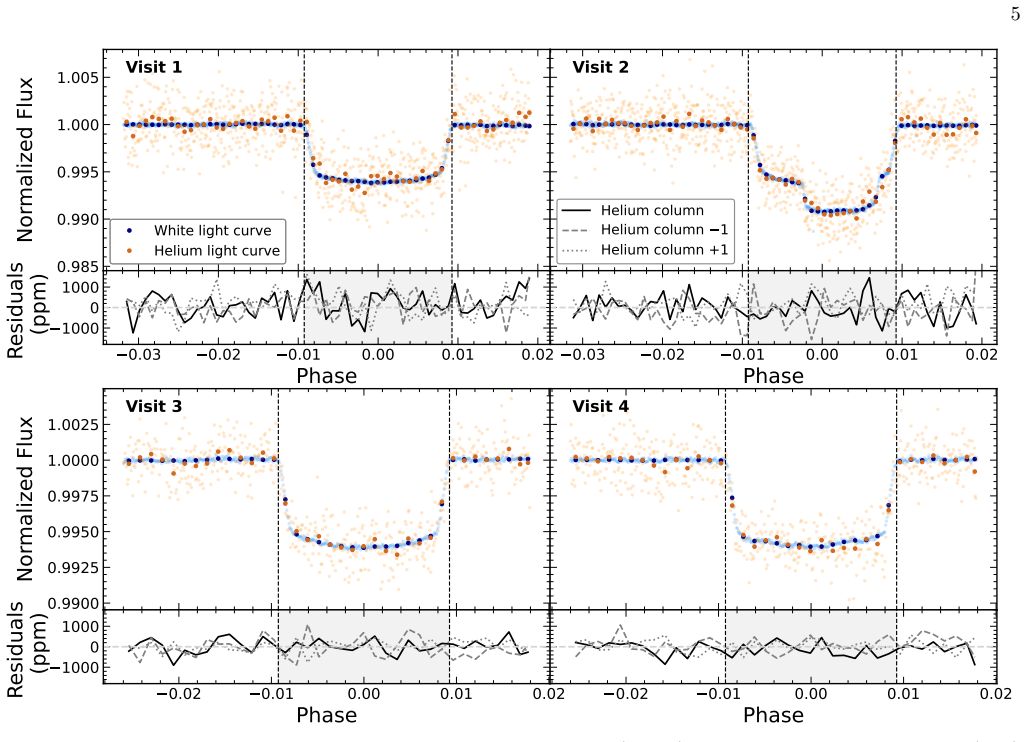
The load-bearing observable is the metastable helium triplet at $1.0833\,\mu$m, a standard tracer of atmospheric escape, which falls within a single SOSS pixel. The analysis uses column-level light curves around the triplet, compared with the white-light curve and with neighboring columns, to maximize sensitivity to a narrow feature. To quantify the expected signal, the reported ground-based escape model is convolved with an idealized Gaussian kernel representing the SOSS point-spread function at $R\approx700$, predicting a roughly 600 ppm feature at pixel resolution, and the predicted spectrum is tested against the data with a $\chi^2$ statistic. The same escape framework, with all input parameters fixed to the ground-based study's values, is then used to translate nondetection depths into upper limits on mass-loss rate.
What would settle it
If an independent re-reduction of these four visits solves for the helium line position as a free parameter (allowing offsets beyond one pixel) or uses an empirically measured point-spread function and recovers the predicted ~600 ppm feature, the nondetection claim would collapse; a future transit showing helium at the reported depth would instead prove the signal is real but variable.
Extended reading notes
Core claim
Across four NIRISS/SOSS transits spanning three years, no excess absorption is seen at the metastable helium triplet in the column-level light curves or in the transmission spectra, and adjacent columns show no leaked signal. The best-fit escape model from the reported ground-based detection, convolved to SOSS resolution, is discrepant with each visit at $>3\sigma$ and with the combined spectrum at $9.9\sigma$. The resulting $2\sigma$ upper limits on helium absorption correspond to mass-loss rates of roughly $5\times10^6$ to $3\times10^7$ g s$^{-1}$, several orders of magnitude below the reported $2\times10^8$ g s$^{-1}$ detection. With six total observations over three years, the single 2024 detection is an outlier; if helium escape is genuinely variable, it must be active less than about half the time, with a duty cycle below 53% at $2\sigma$.
Load-bearing premise
The conclusion assumes the reported ground-based helium signal, if real, would land in the one pixel column the wavelength solution points to, which requires the signal's line shape, the telescope's focus, and the wavelength calibration all to be accurate to within about a pixel.
Editorial extensions
If this is right
- The 1.24% helium absorption reported from the 2024 ground-based transit is not persistent; four JWST transits reject the model at $>3\sigma$ each and $9.9\sigma$ combined.
- If the signal is real but time-variable, it must occur in fewer than about 53% of transits at $2\sigma$, making the escape episode rare or stochastic.
- Under the adopted escape-model assumptions, mass-loss rates above roughly $10^7$ g s$^{-1}$ are excluded at $2\sigma$, contradicting the $2\times10^8$ g s$^{-1}$ inference from the detection.
- LHS 1140 b's nature—mini-Neptune versus water world—remains open, since the helium nondetection does not discriminate between these interpretations.
Reading between the lines
- Editorial inference: simultaneous ground-based and JWST observations of the same transit would directly test whether the 2024 detection was a real but rare escape event or a systematic artifact.
- Editorial inference: the persistent nondetections indirectly favor a high mean-molecular-weight atmosphere over a hydrogen/helium envelope, since an escaping H/He envelope would normally produce a detectable helium signature.
- Editorial inference: the template-convolution comparison used here could be applied to other ground-based helium detections to check their consistency with low-resolution space-based spectra.
- Editorial inference: a re-analysis of the 2024 ground-based data with careful treatment of telluric and instrumental systematics would test whether the single detection could be spurious.
Editorial analysis
A structured set of objections, weighed in public.
Referee Report
Summary. The paper analyzes four JWST NIRISS/SOSS transits of LHS 1140 b observed between 2023 and 2026, searching for metastable helium absorption at 1.0833 µm. Two independent reductions (FIREFLy and exoTEDRF) agree; the authors find no excess absorption in the helium light curves, in the column-level spectra, or in adjacent columns for any visit. They place 2σ upper limits on helium absorption depth at both SOSS and ground-based resolutions, translate the best-fit ground-based model of Cherubim et al. (2026) into an expected ~600 ppm SOSS feature, and report that each visit rejects this model at >3σ, with a combined rejection at 9.9σ. They also use pwinds to derive mass-loss rate upper limits, finding no trend over time and arguing that the 2024 reported detection is an outlier. The paper concludes that the ground-based detection may be spurious or, if time-variable, occurs in fewer than about 50% of transits.
Significance. If the conclusion holds, this is an important result that directly challenges a published detection of metastable helium escape from a high-profile temperate exoplanet, with implications for the planet's atmospheric composition and for the reliability of ground-based helium surveys. The paper is methodologically careful in several respects: it uses two independent reduction pipelines, checks adjacent columns for signal leakage, discusses wavelength-solution offsets explicitly, and makes its data products available. The strength of the nondetection is credible. However, the headline rejection significances depend on converting a model-dependent equivalent width into an expected SOSS signal and on a χ²/N-to-σ conversion that does not fully account for correlated systematics. These issues are fixable and do not undermine the basic finding that no helium is visible in these four transits, but they affect the paper's strongest quantitative claims.
major comments (4)
- [§4.3, Figure 2] The expected SOSS signal of ~600 ppm is computed by convolving the pwinds best-fit model from Cherubim et al. (2026) with a Gaussian SOSS PSF, rather than by directly integrating the equivalent width measured in the WINERED spectrum. If the true line profile has a smaller equivalent width than the model (e.g., a narrower core or different continuum placement), the predicted SOSS signal could be substantially lower, and the per-visit rejection significances would drop from >3σ to roughly 1–2σ. The adjacent-column checks in §4.1 mitigate sub-pixel centroid issues but do not calibrate the absolute amplitude of the prediction. Please either derive the expected SOSS signal from the measured equivalent width of the ground-based detection, or provide a sensitivity grid over plausible line widths, centroids, and triplet morphologies.
- [§4.3, Figure 2] The stated rejection significances are obtained by converting χ²/N to a Gaussian sigma via the chi-square distribution, under the assumption that the per-column errors are independent and Gaussian. The transmission spectra are subject to correlated systematics from 1/f noise and possible spot crossings, and the χ²/N values of 2.6–3.8 may reflect underestimated uncertainties rather than genuine model rejection. I recommend an injection-recovery test: add the convolved model at full amplitude (and at half amplitude) to the actual light curves and evaluate how often the recovered signal exceeds 3σ. This would place the per-visit and combined significances on a more robust footing.
- [§4.4, Table 1, Figure 3] The mass-loss upper limits and the 'outlier' characterization of the 2024 detection are computed within pwinds varying only Ṁ while holding the other parameters fixed, as the authors acknowledge. Given the known degeneracies among Ṁ, T_wind, H:He, and XUV flux, and the non-monotonic behavior of the helium feature at high Ṁ due to self-shielding, the limits should be presented as conditional on the adopted model rather than as a direct measurement of the mass-loss rate. The text does include this caveat, but the abstract and conclusion statements ('no clear trend in mass-loss with time') could mislead readers who do not read the caveats.
- [§5, duty-cycle bound] The f<53% at 2σ bound assumes that a transit with the 2024 signal amplitude would always be detected in each of the four SOSS visits and that the four visits have equal sensitivity. Since the per-visit upper limits differ (0.02–0.04% at SOSS resolution) and the detection significance for a full-amplitude signal is only >3σ, the binomial calculation may underestimate the allowed variability window. Please incorporate the measured upper limits into the detection probability, or clearly label the bound as a first-order estimate.
minor comments (6)
- [§3.1] The claim that the FIREFLy reduction reproduces the Cadieux et al. (2024b) transmission spectrum for Visits 1 and 2 would benefit from a quantitative comparison (e.g., a plot or RMS of residuals) rather than a textual statement.
- [§4.2] The conversion of upper limits from SOSS to WINERED resolution assumes the same line morphology as the Cherubim et al. best-fit; please state this explicitly in the text.
- [Figure 2] The χ²/N values are given in the panels, but the number of spectral points N is not stated; please report N in the caption or text.
- [Abstract and §5] The abstract says '≲50%' while the text gives f<53% at 2σ; please make the numbers consistent.
- [§5] The word 'incontrovertible' is unnecessarily strong given the model-dependent caveats; please soften it.
- [References] The in-text citation 'C. Cherubim et al. (2026)' should match the reference entry 'Cherubim, C., Vissapragada, S., Cunningham, T., et al. 2026' in author order if applicable.
Circularity Check
No significant circularity: the paper tests an external ground-based model and detection against new JWST data without fitting the model to those data.
full rationale
The central claim (no helium detected; the reported ground-based model is rejected at >3 sigma per visit and ~9.9 sigma combined) is a comparison of an externally published model (Cherubim et al. 2026) with four new JWST/NIRISS/SOSS transmission spectra. The model is not fitted to the JWST spectra before the rejection is computed; the predicted ~600 ppm SOSS feature is obtained by convolving the externally published best-fit model with a Gaussian kernel approximating the SOSS PSF, and the paper explicitly tests the alternative empirical PSF and adjacent-column wavelength offsets, showing the conclusion is robust to those choices. The mass-loss upper limits are derived by varying only Mdot within pwinds while holding the external Cherubim et al. parameters fixed; this is model-dependent but not circular, and the paper explicitly cautions that Figure 3 shows relative mass-loss rates under uniform modeling assumptions rather than strict physical boundaries. Self-citations (FIREFLy, pastasoss, exoTIC-LD, etc.) are methodological descriptions of data reduction tools, not load-bearing evidence for the astrophysical conclusion, and the alternate exoTEDRF reduction independently confirms the null result. No equation reduces to its own input, no fitted parameter is renamed as a prediction, and no uniqueness theorem is imported from the authors. The derivation chain is therefore self-contained against an external benchmark.
Assumptions & free parameters
assumptions (6)
- domain assumption The SOSS PSF can be represented as an idealized Gaussian with R about 700 for convolving the ground-based model to JWST resolution.
- domain assumption The pastasoss wavelength solution places the 1.0833 micron helium triplet in the searched SOSS column within about 0.3 pixel at all epochs.
- domain assumption PWIND isothermal Parker wind models correctly connect metastable helium absorption to mass-loss rate given outflow temperature, H:He ratio, velocity, and stellar XUV flux.
- domain assumption The GJ 1132 XUV flux is a valid proxy for LHS 1140's XUV flux.
- domain assumption PHOENIX limb darkening with Teff=3096 K, log g=5.041, [M/H]=-0.15 is appropriate for the light-curve fits.
- domain assumption The adopted transit period of 24.73691 days with zero eccentricity is accurate enough to place all four visits fully in transit.
Cite this review
Pith. "Pith review of No Helium Detected in LHS 1140 b from Four JWST NIRISS/SOSS Transits." pith.science (2026). https://pith.science/paper/5KABWRRT
@misc{pith2026260813473,
  author       = {Pith},
  title        = {Pith review of: No Helium Detected in LHS 1140 b from Four JWST NIRISS/SOSS Transits},
  year         = {2026},
  howpublished = {\url{https://pith.science/paper/5KABWRRT}},
  note         = {Machine review of arXiv:2608.13473}
}
abstract
In the effort to determine which low-mass exoplanets have atmospheres, LHS 1140 b remains one of the most favorable targets. Its large size (5.6 $\rm M_{\oplus}$ and 1.7 $\rm R_{\oplus}$) and relatively long orbital period (24.7 days) imply an atmosphere may be likely, and notably, recent interior models favor either a hydrogen-dominated "mini-Neptune" or a "water world" over a true terrestrial planet. Another possibility is that it has a helium-rich atmosphere. This hypothesis is supported by recent ground-based observations that detected the metastable helium triplet during transit. These observations indicated there may be current helium escape from the planet's upper atmosphere, yet the signal was not detected during a subsequent observation, suggesting time-variable escape. Here we present four observations of LHS 1140 b with JWST NIRISS/SOSS, which covers the metastable helium triplet, obtained between 2023 and 2026. These observations span the epoch of the ground-based measurements, and although none were contemporaneous with the ground-based transits, all four are sensitive to helium absorption at the previously reported level. However, we detect no helium absorption in any visit. We reject the best-fit ground-based model at $>3\sigma$ in each visit, and find no clear trend in mass-loss with time. Our results suggest the reported ground-based detection may be spurious, although variability cannot be excluded if detectable helium absorption occurs in $\lesssim50\%$ of transits. The nature of LHS 1140 b thus remains a mystery until future transmission and emission analyses are complete.
Figures


Figures from the paper (1 more)

Reference graph
Works this paper leans on
-
[1]
Adams Redai, J., Wogan, N., Wallack, N. L., et al. 2025, AJ, 170, 219, doi: 10.3847/1538-3881/adee92
-
[2]
2025, ApJL, 985, L10, doi: 10.3847/2041-8213/add010
Ahrer, E.-M., Radica, M., Piaulet-Ghorayeb, C., et al. 2025, ApJL, 985, L10, doi: 10.3847/2041-8213/add010
-
[3]
2023, PASP, 135, 075001, doi: 10.1088/1538-3873/acd7a3
Albert, L., Lafreni` ere, D., Ren´ e, D., et al. 2023, PASP, 135, 075001, doi: 10.1088/1538-3873/acd7a3
-
[4]
Alderson, L., Batalha, N. E., Wakeford, H. R., et al. 2024, AJ, 167, 216, doi: 10.3847/1538-3881/ad32c9
-
[5]
Allard, F., Homeier, D., & Freytag, B. 2012, Philosophical Transactions of the Royal Society of London Series A, 370, 2765, doi: 10.1098/rsta.2011.0269
arXiv 2012
-
[6]
2025, Nature Communications, 16, 10822, doi: 10.1038/s41467-025-66628-5 Anthropic
Allart, R., Coulombe, L.-P., Carteret, Y., et al. 2025, Nature Communications, 16, 10822, doi: 10.1038/s41467-025-66628-5 Anthropic. 2025, Claude, https://www.anthropic.com Astropy Collaboration, Robitaille, T. P., Tollerud, E. J., et al. 2013, A&A, 558, A33, doi: 10.1051/0004-6361/201322068 Astropy Collaboration, Price-Whelan, A. M., Sip˝ ocz, B. M., et ...
-
[7]
Observations, Tech. Rep. Technical Report JWST-STScI-008571, STScI, doi: 10.48550/arXiv.2311.07771 11 0.9996 0.9998 1.0000 1.0002 1.0004 1.0006Normalized Flux Helium FWHM Visit 3 Visit 4 FIREFLy exoTEDRF 1.070 1.075 1.080 1.085 1.090 1.095 1 0 1 1.070 1.075 1.080 1.085 1.090 1.095 Residuals ( ) Wavelength ( m) Figure 4.Comparison betweenFIREFLyandexoTEDRF...
-
[8]
Observations, Tech. Rep. Technical Report JWST-STScI-008448, STScI, doi: 10.48550/arXiv.2311.07769
Show all 72 references
-
[9]
M., Charbonneau, D., Gilliland, R
Brown, T. M., Charbonneau, D., Gilliland, R. L., Noyes, R. W., & Burrows, A. 2001, ApJ, 552, 699, doi: 10.1086/320580
2001 doi
-
[10]
2022, JWST Calibration Pipeline, 1.8.2 Zenodo, doi: 10.5281/zenodo.7325378
Bushouse, H., Eisenhamer, J., Dencheva, N., et al. 2022, JWST Calibration Pipeline, 1.8.2 Zenodo, doi: 10.5281/zenodo.7325378
2022 doi
-
[11]
2024a, ApJL, 960, L3, doi: 10.3847/2041-8213/ad1691
Cadieux, C., Plotnykov, M., Doyon, R., et al. 2024a, ApJL, 960, L3, doi: 10.3847/2041-8213/ad1691
-
[12]
J., et al
Cadieux, C., Doyon, R., MacDonald, R. J., et al. 2024b, ApJL, 970, L2, doi: 10.3847/2041-8213/ad5afa
-
[13]
J., et al
Cherubim, C., Wordsworth, R., Bower, D. J., et al. 2025, ApJ, 983, 97, doi: 10.3847/1538-4357/adbca9
2025 doi
-
[14]
2024, ApJ, 967, 139, doi: 10.3847/1538-4357/ad3e77
Cherubim, C., Wordsworth, R., Hu, R., & Shkolnik, E. 2024, ApJ, 967, 139, doi: 10.3847/1538-4357/ad3e77
2024 doi
- [15]
-
[16]
2020, AJ, 159, 211, doi: 10.3847/1538-3881/ab8237
Cloutier, R., & Menou, K. 2020, AJ, 159, 211, doi: 10.3847/1538-3881/ab8237
2020 doi
-
[17]
2024, ApJL, 968, L22, doi: 10.3847/2041-8213/ad5204 de Wit, J., Householder, A., & Niraula, P
Damiano, M., Bello-Arufe, A., Yang, J., & Hu, R. 2024, ApJL, 968, L22, doi: 10.3847/2041-8213/ad5204 de Wit, J., Householder, A., & Niraula, P. 2026, ApJL, 996, L23, doi: 10.3847/2041-8213/ae2f5c
2024 doi
-
[18]
A., Irwin, J
Dittmann, J. A., Irwin, J. M., Charbonneau, D., et al. 2017, Nature, 544, 333, doi: 10.1038/nature22055 Dos Santos, L. A., Vidotto, A. A., Vissapragada, S., et al. 2022, A&A, 659, A62, doi: 10.1051/0004-6361/202142038
2017 doi
-
[19]
2021, AJ, 161, 44, doi: 10.3847/1538-3881/abc6a5
Edwards, B., Changeat, Q., Mori, M., et al. 2021, AJ, 161, 44, doi: 10.3847/1538-3881/abc6a5
2021 doi
-
[20]
2015, MNRAS, 450, 1879, doi: 10.1093/mnras/stv744
Espinoza, N., & Jord´ an, A. 2015, MNRAS, 450, 1879, doi: 10.1093/mnras/stv744
2015 doi
-
[21]
2019, MNRAS, 490, 2262, doi: 10.1093/mnras/stz2688
Espinoza, N., Kossakowski, D., & Brahm, R. 2019, MNRAS, 490, 2262, doi: 10.1093/mnras/stz2688
2019 doi
-
[22]
H., Glidden, A., et al
Espinoza, N., Allen, N. H., Glidden, A., et al. 2025, ApJL, 990, L52, doi: 10.3847/2041-8213/adf42e
2025 doi
-
[23]
D., Radica, M., Welbanks, L., et al
Feinstein, A. D., Radica, M., Welbanks, L., et al. 2023, Nature, 614, 670, doi: 10.1038/s41586-022-05674-1
2023 doi
-
[24]
W., Lang, D., & Goodman, J
Foreman-Mackey, D., Hogg, D. W., Lang, D., & Goodman, J. 2013, PASP, 125, 306, doi: 10.1086/670067
2013 doi
-
[25]
P., Diamond-Lowe, H., et al
Fortune, M., Gibson, N. P., Diamond-Lowe, H., et al. 2025, A&A, 701, A25, doi: 10.1051/0004-6361/202554198 12
2025 doi
-
[26]
J., Radica, M., et al
Fournier-Tondreau, M., MacDonald, R. J., Radica, M., et al. 2024, MNRAS, 528, 3354, doi: 10.1093/mnras/stad3813
2024 doi
-
[27]
2025, MNRAS, 539, 422, doi: 10.1093/mnras/staf489
Fournier-Tondreau, M., Pan, Y., Morel, K., et al. 2025, MNRAS, 539, 422, doi: 10.1093/mnras/staf489
2025 doi
-
[28]
K., et al
Fu, G., Espinoza, N., Sing, D. K., et al. 2022, ApJL, 940, L35, doi: 10.3847/2041-8213/ac9977
2022 doi
-
[29]
2025, ApJL, 990, L53, doi: 10.3847/2041-8213/adf62e
Glidden, A., Ranjan, S., Seager, S., et al. 2025, ApJL, 990, L53, doi: 10.3847/2041-8213/adf62e
2025 doi
-
[30]
2024, The Journal of Open Source Software, 9, 6816, doi: 10.21105/joss.06816
Grant, D., & Wakeford, H. 2024, The Journal of Open Source Software, 9, 6816, doi: 10.21105/joss.06816
2024 doi
-
[31]
Grant, D., & Wakeford, H. R. 2022, Exo-TiC/ExoTiC-LD: ExoTiC-LD v3.0.0, v3.0.0 Zenodo, doi: 10.5281/zenodo.7437681
2022 doi
-
[32]
R., Millman, K
Harris, C. R., Millman, K. J., van der Walt, S. J., et al. 2020, Nature, 585, 357, doi: 10.1038/s41586-020-2649-2
2020 doi
-
[33]
Hu, R., Seager, S., & Yung, Y. L. 2015, ApJ, 807, 8, doi: 10.1088/0004-637X/807/1/8
2015 doi
-
[34]
Hunter, J. D. 2007, Computing in Science and Engineering, 9, 90, doi: 10.1109/MCSE.2007.55
2007 doi
-
[35]
O., Wende-von Berg, S., Dreizler, S., et al
Husser, T. O., Wende-von Berg, S., Dreizler, S., et al. 2013, A&A, 553, A6, doi: 10.1051/0004-6361/201219058
2013 doi
-
[36]
L., Ribas, I., Lammer, H., et al
Khodachenko, M. L., Ribas, I., Lammer, H., et al. 2007, Astrobiology, 7, 167, doi: 10.1089/ast.2006.0127
2007
-
[37]
Kipping, D. M. 2013, MNRAS, 435, 2152, doi: 10.1093/mnras/stt1435
2013 doi
-
[38]
2015, PASP, 127, 1161, doi: 10.1086/683602
Kreidberg, L. 2015, PASP, 127, 1161, doi: 10.1086/683602
2015 doi
-
[39]
2026, Nature Astronomy, 10, 258, doi: 10.1038/s41550-025-02710-8
Krishnamurthy, V., Carteret, Y., Piaulet-Ghorayeb, C., et al. 2026, Nature Astronomy, 10, 258, doi: 10.1038/s41550-025-02710-8
2026 doi
-
[40]
V., et al
Lammer, H., Scherf, M., Erkaev, N. V., et al. 2025, Nature Astronomy, 9, 1022, doi: 10.1038/s41550-025-02550-6
2025 doi
-
[41]
Lammer, H., Lichtenegger, H. I. M., Kulikov, Y. N., et al. 2007, Astrobiology, 7, 185, doi: 10.1089/ast.2006.0128 Lamp´ on, M., L´ opez-Puertas, M., Lara, L. M., et al. 2020, A&A, 636, A13, doi: 10.1051/0004-6361/201937175
2007
-
[42]
2020, A&A, 642, A121, doi: 10.1051/0004-6361/202038922
Lillo-Box, J., Figueira, P., Leleu, A., et al. 2020, A&A, 642, A121, doi: 10.1051/0004-6361/202038922
2020 doi
-
[43]
2023, ApJL, 955, L22, doi: 10.3847/2041-8213/acf7c4
Lim, O., Benneke, B., Doyon, R., et al. 2023, ApJL, 955, L22, doi: 10.3847/2041-8213/acf7c4
2023 doi
-
[44]
M., et al
Lustig-Yaeger, J., Fu, G., May, E. M., et al. 2023, Nature Astronomy, doi: 10.1038/s41550-023-02064-z
2023 doi
-
[45]
M.-R., & Marounina, N
Malsky, I., Rogers, L., Kempton, E. M.-R., & Marounina, N. 2023, Nature Astronomy, 7, 57, doi: 10.1038/s41550-022-01823-8
2023 doi
-
[46]
Malsky, I., & Rogers, L. A. 2020, ApJ, 896, 48, doi: 10.3847/1538-4357/ab873f
2020 doi
-
[47]
Maxted, P. F. L. 2023, MNRAS, 519, 3723, doi: 10.1093/mnras/stac3741
2023 doi
-
[48]
A., Astudillo-Defru, N., et al
Ment, K., Dittmann, J. A., Astudillo-Defru, N., et al. 2019, AJ, 157, 32, doi: 10.3847/1538-3881/aaf1b1
2019 doi
-
[49]
Wakeford, H. R. 2018, AJ, 156, 252, doi: 10.3847/1538-3881/aae83a
2018 doi
-
[50]
E., Stevenson, K
Moran, S. E., Stevenson, K. B., Sing, D. K., et al. 2023, ApJL, 948, L11, doi: 10.3847/2041-8213/accb9c
2023 doi
-
[51]
K., Fu, G., et al
Mukherjee, S., Sing, D. K., Fu, G., et al. 2026, Science, 392, 858, doi: 10.1126/science.adx5903
2026 doi
-
[52]
B., & Ingargiola, A
Newville, M., Stensitzki, T., Allen, D. B., & Ingargiola, A. 2014, LMFIT: Non-Linear Least-Square Minimization and Curve-Fitting for Python, 0.8.0, Zenodo Zenodo, doi: 10.5281/zenodo.11813 Oklopˇ ci´ c, A. 2019, ApJ, 881, 133, doi: 10.3847/1538-4357/ab2f7f
2014 doi
-
[53]
E., & Jackson, A
Owen, J. E., & Jackson, A. P. 2012, MNRAS, 425, 2931, doi: 10.1111/j.1365-2966.2012.21481.x
2012
-
[54]
K., Charbonneau, D., & Vanderburg, A
Pass, E. K., Charbonneau, D., & Vanderburg, A. 2025, ApJL, 986, L3, doi: 10.3847/2041-8213/adda39
2025 doi
-
[55]
L., Hauschildt, P
Peacock, S., Barman, T., Shkolnik, E. L., Hauschildt, P. H., & Baron, E. 2019, ApJ, 871, 235, doi: 10.3847/1538-4357/aaf891
2019 doi
-
[56]
2024, The Journal of Open Source Software, 9, 6898, doi: 10.21105/joss.06898
Radica, M. 2024, The Journal of Open Source Software, 9, 6898, doi: 10.21105/joss.06898
2024 doi
-
[57]
2023, MNRAS, 524, 835, doi: 10.1093/mnras/stad1762
Radica, M., Welbanks, L., Espinoza, N., et al. 2023, MNRAS, 524, 835, doi: 10.1093/mnras/stad1762
2023 doi
-
[58]
2025, ApJL, 979, L5, doi: 10.3847/2041-8213/ada381
Radica, M., Piaulet-Ghorayeb, C., Taylor, J., et al. 2025, ApJL, 979, L5, doi: 10.3847/2041-8213/ada381
2025 doi
-
[59]
D., Maltagliati, L., Marley, M
Robinson, T. D., Maltagliati, L., Marley, M. S., & Fortney, J. J. 2014, Proceedings of the National Academy of Science, 111, 9042, doi: 10.1073/pnas.1403473111
2014 doi
-
[60]
2026, ApJL, 998, L39, doi: 10.3847/2041-8213/ae3da3
Rochon, A., Artigau, ´E., Weisserman, D., et al. 2026, ApJL, 998, L39, doi: 10.3847/2041-8213/ae3da3
2026 doi
-
[61]
Rogers, L. A. 2015, ApJ, 801, 41, doi: 10.1088/0004-637X/801/1/41
2015 doi
-
[62]
K., Liu, R., & Wang, A
Rustamkulov, Z., Sing, D. K., Liu, R., & Wang, A. 2022, ApJL, 928, L7, doi: 10.3847/2041-8213/ac5b6f
2022 doi
-
[63]
K., Mukherjee, S., et al
Rustamkulov, Z., Sing, D. K., Mukherjee, S., et al. 2023, Nature, 614, 659, doi: 10.1038/s41586-022-05677-y
2023 doi
-
[64]
Speagle, J. S. 2020, MNRAS, 493, 3132, doi: 10.1093/mnras/staa278
2020 doi
-
[65]
P., Sing, D
Thorngren, D. P., Sing, D. K., & Mukherjee, S. 2026, ApJS, 283, 10, doi: 10.3847/1538-4365/ae0e71 van Dokkum, P. G. 2001, PASP, 113, 1420, doi: 10.1086/323894 Van Looveren, G., G¨ udel, M., Boro Saikia, S., &
2026 doi
-
[66]
2024, A&A, 683, A153, doi: 10.1051/0004-6361/202348079
Kislyakova, K. 2024, A&A, 683, A153, doi: 10.1051/0004-6361/202348079
2024 doi
-
[67]
E., et al
Virtanen, P., Gommers, R., Oliphant, T. E., et al. 2020, Nature Methods, 17, 261, doi: 10.1038/s41592-019-0686-2 13
2020 doi
-
[68]
K., Diamond-Lowe, H., et al
Wachiraphan, P., Berta-Thompson, Z. K., Diamond-Lowe, H., et al. 2025, AJ, 169, 311, doi: 10.3847/1538-3881/adc990
2025 doi
-
[69]
K., et al
Wang, L.-C., Rustamkulov, Z., Sing, D. K., et al. 2026, AJ, 171, 147, doi: 10.3847/1538-3881/ae231b Wes McKinney. 2010, in Proceedings of the 9th Python in Science Conference, ed. St´ efan van der Walt & Jarrod Millman, 56 – 61, doi: 10.25080/Majora-92bf1922-00a
2026 doi
-
[70]
2021, Nature Astronomy, 5, 822, doi: 10.1038/s41550-021-01375-3
Yu, X., He, C., Zhang, X., et al. 2021, Nature Astronomy, 5, 822, doi: 10.1038/s41550-021-01375-3
2021 doi
-
[71]
J., & Catling, D
Zahnle, K. J., & Catling, D. C. 2017, ApJ, 843, 122, doi: 10.3847/1538-4357/aa7846
2017 doi
-
[72]
2023, Nature, 620, 746, doi: 10.1038/s41586-023-06232-z
Zieba, S., Kreidberg, L., Ducrot, E., et al. 2023, Nature, 620, 746, doi: 10.1038/s41586-023-06232-z
2023 doi
Reviewed August 14, 2026 · model on record in the stance chip above.
Discussion (0). Continue with ORCID to comment.