REVIEW 2 major objections 5 minor 76 references
Decoupling Dipolar Interactions in Dense Spin Ensembles
T0 review · 2 major / 5 minor · reviewed 2026-08-11 · deepseek-v4-flash
Pith's one-line read In dense spin solids with inhomogeneous fields, time-suspension pulse sequences hold coherence for tens of milliseconds while spectroscopic sequences decay in about a millisecond, and the gap is traced to local disorder.
desk verdict A useful head-to-head experimental benchmark of seven dipolar decoupling sequences, with a plausible but not airtight case that local disorder explains why time-suspension beats spectroscopic sequences. read the letter →
The pith
A machine-rendered reading of the paper's core claim, the machinery that carries it, and where it could break.
The reading
What carries the argument
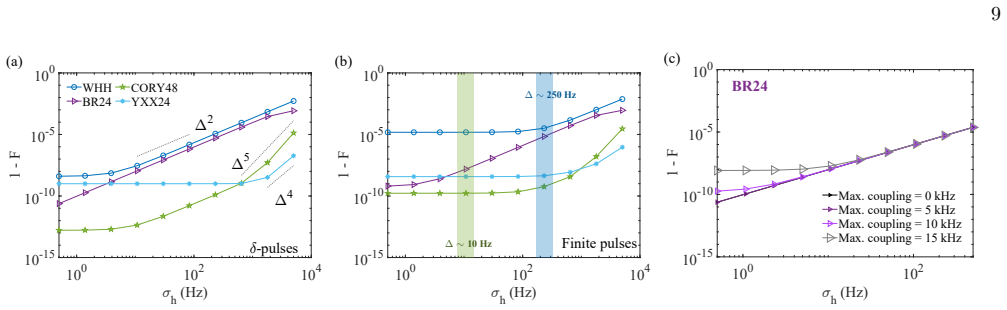
The load-bearing mechanism is Average Hamiltonian Theory with the Magnus expansion, which represents the stroboscopic effect of a periodic pulse train as an effective Hamiltonian $\bar H^{(0)}+\bar H^{(1)}+\dots$. The paper classifies each sequence by which terms in this expansion vanish: spectroscopic sequences (WHH, MREV8, MREV16, BR24) cancel low-order dipolar terms but leave a rescaled term $\Delta_{\text{SF}}\sum_i a_i S_{z'}$, with $a_i=\delta_i+h_i+\Delta\omega$, while time-suspension sequences (CORY48, YXX24, YXX48) leave $\bar H^{(0)}=0$ and cancel the stated higher-order terms as well. The quantitative comparisons are carried by a trace fidelity $F=\operatorname{Tr}(U^\dagger_{\text{th}} U_{\text{exp}}^{1/M})$ for 8-spin simulations and by the geometric-mean autocorrelation $C_{\text{avg}}=(C_{xx}C_{yy}C_{zz})^{1/3}$ in experiments, which approximates state fidelity. The local-disorder simulations then act as the discriminator: they introduce a Gaussian spread of offsets and show the signature $\sigma_h^2$ growth of infidelity that identifies the preserved disorder term as the cause of spectroscopic-sequence failure.
What would settle it
Repeat the adamantane decoupling experiment on a well-shimmed magnet with matched pulse calibration: if BR24 remains an order of magnitude worse than CORY48, the local-disorder explanation fails, while if the gap disappears when the 244 Hz inhomogeneity is removed, the claim is supported. A complementary check is to measure phase-transient amplitudes and $B_1$ inhomogeneity on both magnets and confirm in simulation that they cannot account for the observed gap.
Extended reading notes
Core claim
At its core, the paper argues that the practical quality of a decoupling sequence in a dense spin solid is governed less by how many orders of the dipolar Hamiltonian it cancels and more by whether it preserves the local disordered Zeeman term. In experiments on adamantane in an unshimmed 7 T magnet, CORY48 achieves effective coherence times up to 56.6 ms at an inter-pulse delay of 5.2 µs, while spectroscopic sequences WHH and BR24 remain below about 1 ms under the same conditions. Numerical simulations show that when local offsets are drawn from a Gaussian distribution with standard deviation near the experimental inhomogeneity, spectroscopic-sequence infidelity grows as $\sigma_h^2$, while time-suspension sequences are affected far less at the same disorder strengths; this scaling matches the algebraic fact that spectroscopic sequences have a nonzero average Hamiltonian $\bar H^{(0)} \propto \sum_i a_i S_{z'}$ with $a_i=\delta_i+h_i+\Delta\omega$. The paper also demonstrates that CORY48 can protect multiple-quantum correlations, extending their decay times by up to two orders of magnitude relative to free dipolar evolution, and that the machine-learned YXX24 and YXX48 sequences perform comparably to CORY48.
Load-bearing premise
The conclusion that local disorder, not some other experimental difference, drives the performance gap assumes that the unshimmed 7 T and shimmed 9.4 T setups differ only in static-field homogeneity; the paper does not report phase-transient amplitudes, radiofrequency inhomogeneity, or pulse-calibration residuals for either setup.
Editorial extensions
If this is right
- Quantum-information experiments in dense dipolar solids with inhomogeneous static fields should default to time-suspension sequences such as CORY48, since spectroscopic sequences cap coherence near one millisecond.
- The machine-learned YXX24 and YXX48 sequences perform comparably to CORY48, indicating that sequences discovered by automated search can serve as practical alternatives to analytically designed ones.
- Spectroscopic sequences remain the right tool for measuring resonance offsets or chemical shifts, but in the presence of local disorder they cannot simultaneously preserve quantum coherence.
- Time-suspension decoupling can extend the lifetime of multi-spin correlated states by up to two orders of magnitude, making many-body correlation measurements feasible on longer timescales.
- Sequence ranking is device-dependent: the best sequence for a given experiment is the one matched to that platform's disorder, pulse-width, rotation-error, and phase-transient budget.
Reading between the lines
- Beyond the paper: a decisive controlled test would be to sweep the inhomogeneous broadening on a single sample (for example with gradients or susceptibility inserts) and verify that the CORY48-versus-BR24 gap widens monotonically with disorder; the paper only compares two different magnets with different samples.
- Beyond the paper: the same spectroscopic-versus-time-suspension distinction should appear in electron-spin ensembles such as nitrogen-vacancy centers, where g-factor and strain variations create an analogous local disorder term, so time-suspension sequences should be tested there for quantum sensing and memory applications.
- Beyond the paper: the slow convergence of the Magnus expansion reported for WHH suggests that for strongly coupled systems, Hamiltonian-engineering design may need to move beyond truncation-based analytical methods; the paper raises this as an open question rather than a demonstrated result.
- Beyond the paper: because chemical shifts and local disorder have identical symmetry, the result implies an unavoidable trade-off between spectroscopy and coherence in dense solids; any sequence that learns the chemical-shift term will also preserve the disorder that kills coherence.
Signed reviews
Editorial analysis
A structured set of objections, weighed in public.
Referee Report
Summary. The paper benchmarks seven dipolar decoupling pulse sequences—WHH, MREV8, MREV16, BR24, CORY48, YXX24, and YXX48—using 8-spin numerical simulations and 1H NMR experiments on adamantane in an unshimmed 7 T magnet. It reports that time-suspension sequences (CORY48 and the reinforcement-learning-discovered YXX sequences) preserve coherence for tens of milliseconds, whereas spectroscopic sequences decay in about a millisecond under the same conditions, and it attributes this gap to local static-field disorder because spectroscopic sequences preserve S_z-type terms. The attribution is supported by numerical disorder simulations and by a control experiment on a liquid crystal in a shimmed 9.4 T magnet, where BR24 and CORY48 perform similarly. The paper also extends the comparison to resonance-offset sensing and to protection of multiple-quantum coherences, where CORY48 increases the decay time by up to two orders of magnitude.
Significance. If the central attribution holds, the paper gives a practically useful rule for quantum simulation and sensing in dense spin ensembles: under inhomogeneous static fields, time-suspension sequences are preferable to spectroscopic sequences, and machine-learned sequences such as YXX24/YXX48 are competitive with the CORY48 gold standard. The strength of the paper is its systematic experimental benchmark with raw decay curves, full pulse-sequence tables, F-matrix representations, and a direct comparison with Average Hamiltonian Theory. The numerical simulations are straightforward and reproducible, and the liquid-crystal control experiment is a genuinely falsifiable check of the disorder hypothesis. However, the headline causal claim is currently under-supported because the experimental comparison changes both the sample and the magnet without quantifying other control errors that the paper's own simulations show can affect sequences unequally.
major comments (2)
- [§IV A, Fig. 7, abstract] The central claim that local disorder is the distinguishing factor between spectroscopic and time-suspension sequences is not fully established by the experimental comparison. The adamantane/7 T data are compared with a liquid-crystal/9.4 T control in Fig. 7, but this changes not only the static-field homogeneity but also the spin system (a 3D dipolar solid vs. a nematic with only intramolecular couplings, as stated in §IV A) and the observable (Cavg for adamantane vs. Z autocorrelation for the liquid crystal). The paper does not report phase-transient amplitudes, RF B1 inhomogeneity, or pulse-calibration residuals for either setup, and §IV B explicitly states that the frame-change correction of Ref. [54] was not applied. Since the simulations in Fig. 8 show that rotation errors and phase transients degrade different sequences unequally, setup-specific control errors could in principle account for the order-of-magnitude gap in Fig. 1(b). Please either add control-error characterization for both magnets or reword the causal attribution to 'consistent with local disorder' rather than 'distinguishing factor.'
- [§III B, Eqs. (5)–(6), Fig. 4(e)–(f)] The quantitative claim of 'order of magnitude better coherence time' rests on fits to stretched exponentials with no reported uncertainties or parameter values. Equation (6) has five free parameters (C0, f, g, T2,eff, C1), and the fits constrain g to a range rather than reporting its fitted value for each condition. The qualitative gap between sequence classes is clearly visible in the raw decay curves, but the numerical T2,eff comparisons in Fig. 4(e)–(f) and Fig. 5(a)–(b) should report fit uncertainties and goodness-of-fit information so that the reader can assess whether the apparent differences are statistically significant.
minor comments (5)
- [§III A] The fidelity metric F = Tr(U†th Uexp^{1/M}) is not normalized; as written, the trace for a perfect unitary is 2^N, so 1−F would be negative for N>0. The plots show values between 0 and 1, so a normalized fidelity is clearly intended; please state the normalization explicitly.
- [§IV A, Fig. 6 caption] The text says the liquid-crystal field inhomogeneity is 'of the order of 30 Hz' and that the individual NMR peaks are about 30 Hz wide, but the Fig. 6 caption states the green shaded region represents 10 Hz. Please reconcile these numbers.
- [Appendix B 3] The spectroscopic fit is written as Cavg,spectro = C0 cos(2πft) + C1, which omits the stretched-exponential decay factor e^{-t^g/T2,eff} that appears in Eq. (6); this is presumably a typographical omission.
- [Fig. 3 caption] The caption contains a duplicated panel label '(c) CORY48(c) CORY48(c) CORY48'; please clean up the caption and ensure each panel is labeled once.
- [§III B] The text says maximum dipolar coupling in adamantane is approximately 420 Hz, while the simulations in §III A use 3σ = 5000 Hz as the maximum coupling. This mismatch is acknowledged as a mid-range choice, but a brief justification of why a 5000 Hz distribution is representative for the experimental comparison would help the reader connect the numerics to the adamantane data.
Circularity Check
No significant circularity: the paper's AHT analysis and experimental benchmarks are self-contained, and its self-citations are not load-bearing reductions.
full rationale
The derivation chain is not circular. The Average Hamiltonian Theory terms in Table I are computed from the stated definitions (Eqs. 3-4) and the pulse schedules in Appendix C, not imported as conclusions. The numerical fidelities are simulated from the defined spin Hamiltonians and pulse unitaries (Section III A), and the experimental coherence decays are measured on adamantane and a liquid crystal, with decay constants extracted from fits that are compared across sequences. The central claim that local disorder distinguishes spectroscopic from time-suspension sequences is an empirical attribution backed by disorder simulations (Figure 6) and a shimmed-magnet control (Figure 7); changing both sample and magnet introduces a potential confound, but that is a correctness risk, not circularity. The self-citations to Ref. [40] (the Cavg-to-fidelity approximation and the RL-discovered YXX sequences) and to Ref. [54] (the frame-change technique) are not used as derived inputs: the RL sequences are benchmarked here against new experiments, the Cavg approximation is used as a measurement proxy, and the frame-change technique is explicitly stated to have been not applied. No fitted parameter is renamed as a prediction, and no equation reduces to its own input by construction.
Assumptions & free parameters
free parameters (2)
- Stretched-exponential fit parameters (C0, g, T2,eff, f, C1) =
e.g., T2,eff = 56.6 ms for CORY48 at tau = 5.2 microseconds; g clustered near 1.5 for time-suspension sequences
- Simulated dipolar coupling distribution width (3 sigma) =
5000 Hz
assumptions (5)
- domain assumption Secular dipolar Hamiltonian with point-dipole coupling (Eq. 1) describes the relevant internal dynamics.
- domain assumption Average Hamiltonian Theory (Magnus expansion) converges at the used inter-pulse delays tau.
- domain assumption An 8-spin system with Gaussian-distributed couplings (3 sigma = 5000 Hz), averaged over 16 realizations, captures the physics of macroscopic dipolar solids.
- domain assumption The geometric-mean autocorrelation Cavg closely approximates the state fidelity of the decoupling sequence.
- ad hoc to paper Phase transients are symmetric (alpha_l = alpha_tr) and need not be measured.
Cite this review
Pith. "Pith review of Decoupling Dipolar Interactions in Dense Spin Ensembles." pith.science (2026). https://pith.science/paper/5KBSNXWN
@misc{pith2026241216851,
  author       = {Pith},
  title        = {Pith review of: Decoupling Dipolar Interactions in Dense Spin Ensembles},
  year         = {2026},
  howpublished = {\url{https://pith.science/paper/5KBSNXWN}},
  note         = {Machine review of arXiv:2412.16851}
}
abstract
Dense spin ensembles in solids present a natural platform for studying quantum many-body dynamics. Multiple-pulse coherent control can be used to manipulate the magnetic dipolar interaction between the spins to engineer their dynamics. Here, we investigate the performance of a series of well-known pulse sequences that aim to suppress inter-spin dipolar couplings. We use a combination of numerical simulations and solid-state nuclear magnetic resonance (NMR) experiments on adamantane to evaluate and compare sequence performance. We study the role of sequence parameters like inter-pulse delays and resonance offsets. Disagreements between experiments and theory are typically explained by the presence of control errors and experimental non-idealities. The simulations allow us to explore the influence of factors such as finite pulse widths, rotation errors, and phase transient errors. We also investigate the role of local disorder and establish that it is, perhaps unsurprisingly, a distinguishing factor in the decoupling efficiency of spectroscopic sequences (that preserve Hamiltonian terms proportional to $S_z$) and time-suspension sequences (which refocus all terms in the internal Hamiltonian). We discuss our findings in the context of previously known analytical results from Average Hamiltonian Theory. Finally, we explore the ability of time-suspension sequences to protect multi-spin correlations in the system.
Figures


Figures from the paper (6 more)




Reference graph
Works this paper leans on
-
[54]
M. M. Maricq, Application of average Hamiltonian the- ory to the NMR of solids, Physical Review B 25, 6622 (1982)
work page 1982
-
[1]
Choosing representative sequences Here, we include figures showing simulation results for the fidelity-response of all seven sequences discussed in Section III A. In addition to the four sequences (WHH, BR24, YXX24, and CORY48 shown in Figures 2, 6, and 8), we include MREV8, MREV16, and YXX24 in Figure A1. MREV8 and MREV16 exhibit responses to pulse error...
-
[2]
(Hz) 10-15 10-10 10-5 1 - F WHH BR24 CORY48 YXX24 / pulses
Global resonance offset error In Section IV A, we discuss the effect of local disorder on sequence fidelity. Figure A2 shows that numerical results for the effect of global offset error for infintesimal and finite pulses are very similar to the effect of local disorder (Figure 6). 0.01 0.1 1 10 Pulse width tw (7s) 10-15 10-10 10-5 1 - F (a) 100 102 " (Hz)...
-
[3]
(0)| #10-2 WHH MREV8 MREV16 BR24 CORY48 YXX24 YXX48 (f) 0 5 10 = (7s) 0 2 4 6|H
Average Hamiltonian Analysis In this section, we show our numerical results on the magnitudes of higher-order Magnus expansion terms and their effects on the fidelity of the dipolar decoupling sequences. Both spectroscopic and time-suspension se- quences are designed to cancel dipolar terms in the Mag- nus expansion up to a certain order, as shown in Tabl...
-
[4]
Raw data and analysis Figure A5 shows details of the raw NMR experimental data. The on-resonance free induction decay (FID) sig- nal fits the empirical function described by Abragam [68]. The FID is Fourier transformed into the frequency do- main to construct the spectrum. The signal at a given time is obtained by averaging over the entire peak of the cor...
-
[5]
Normalization We normalize the X, Y , and Z autocorrelation decays using signals from experiments with the same structure and delays as the decoupling experiments, only omitting the sequences themselves
-
[6]
(kHz) 0 0.1 0.2 0.3 0.4 0.5Sig. baseline (a. u.) WHH BR24 (c) -4 -2 0 2 4
Decay curve fits Figure A6 shows the details of the fit discussed in Section III B. The normalized decay curves are fit to a stretched exponential of the form Cavg, ts = C0e−tg/T2,eff for the time-suspension sequences. For spectroscopic se- quences, we fit the data to Cavg,spectro = C0 cos(2πf t) + C1. Here, we show the stretch factors ( g) and baselines ...
-
[7]
F-matrix representation In Figure A7, we give the frame matrix representations of the seven sequences, following the formalism devel- oped in [36]. This pictorial representation of the toggling frame orientation during a full cycle of a given sequence allows us to understand underlying patterns and conve- niently analyze sequence characteristics. For exam...
Show all 76 references
-
[8]
K. X. Wei, C. Ramanathan, and P. Cappellaro, Explor- ing Localization in Nuclear Spin Chains, Physical Review Letters 120, 070501 (2018)
2018
-
[9]
G. A. Alvarez, D. Suter, and R. Kaiser, Localization- delocalization transition in the dynamics of dipolar- coupled nuclear spins, Science 349, 846 (2015)
2015
-
[10]
Beatrez, O
W. Beatrez, O. Janes, A. Akkiraju, A. Pillai, A. Oddo, P. Reshetikhin, E. Druga, M. McAllister, M. Elo, B. Gilbert, D. Suter, and A. Ajoy, Floquet Prethermaliza- tion with Lifetime Exceeding 90 s in a Bulk Hyperpolar- ized Solid, Physical Review Letters 127, 170603 (2021)
2021
-
[11]
P. Peng, C. Yin, X. Huang, C. Ramanathan, and P. Cap- pellaro, Floquet prethermalization in dipolar spin chains, Nature Physics 17, 444 (2021)
2021
-
[12]
S. Choi, J. Choi, R. Landig, G. Kucsko, H. Zhou, J. Isoya, F. Jelezko, S. Onoda, H. Sumiya, V. Khemani, C. von Keyserlingk, N. Y. Yao, E. Demler, and M. D. Lukin, Ob- servation of discrete time-crystalline order in a disordered dipolar many-body system, Nature 543, 221 (2017)
2017
-
[13]
Stasiuk and P
A. Stasiuk and P. Cappellaro, Observation of a Prether- mal $U(1)$ Discrete Time Crystal, Physical Review X 13, 041016 (2023)
2023
-
[14]
Beatrez, C
W. Beatrez, C. Fleckenstein, A. Pillai, E. de Leon Sanchez, A. Akkiraju, J. Diaz Alcala, S. Conti, P. Reshetikhin, E. Druga, M. Bukov, and A. Ajoy, Crit- ical prethermal discrete time crystal created by two- frequency driving, Nature Physics 19, 407 (2023)
2023
-
[15]
P. Peng, B. Ye, N. Y. Yao, and P. Cappellaro, Exploit- ing disorder to probe spin and energy hydrodynamics, Nature Physics 19, 1027 (2023)
2023
-
[16]
C. Zu, F. Machado, B. Ye, S. Choi, B. Kobrin, T. Mittiga, S. Hsieh, P. Bhattacharyya, M. Markham, D. Twitchen, A. Jarmola, D. Budker, C. R. Laumann, J. E. Moore, and N. Y. Yao, Emergent hydrodynamics in a strongly interacting dipolar spin ensemble, Nature 597, 45 (2021)
2021
-
[17]
Cappellaro, J
P. Cappellaro, J. Emerson, N. Boulant, C. Ramanathan, S. Lloyd, and D. G. Cory, Entanglement Assisted Metrol- ogy, Physical Review Letters 94, 020502 (2005)
2005
-
[18]
Cappellaro and M
P. Cappellaro and M. D. Lukin, Quantum correlation in disordered spin systems: Applications to magnetic sens- ing, Physical Review A 80, 032311 (2009)
2009
-
[19]
Sahin, E
O. Sahin, E. de Leon Sanchez, S. Conti, A. Akkiraju, P. Reshetikhin, E. Druga, A. Aggarwal, B. Gilbert, S. Bhave, and A. Ajoy, High field magnetometry with hy- perpolarized nuclear spins, Nature Communications 13, 5486 (2022)
2022
-
[20]
Mehring, High Resolution NMR Spectroscopy in Solids (Springer Science & Business Media, 2012)
M. Mehring, High Resolution NMR Spectroscopy in Solids (Springer Science & Business Media, 2012)
2012
-
[21]
Lee and W
M. Lee and W. I. Goldburg, Nuclear-Magnetic- Resonance Line Narrowing by a Rotating rf Field, Phys- ical Review 140, A1261 (1965)
1965
-
[22]
Mehring and J
M. Mehring and J. S. Waugh, Magic-Angle NMR Exper- iments in Solids, Physical Review B 5, 3459 (1972)
1972
-
[23]
Bielecki, A
A. Bielecki, A. C. Kolbert, and M. H. Levitt, Frequency- switched pulse sequences: Homonuclear decoupling and dilute spin NMR in solids, Chemical Physics Letters155, 341 (1989)
1989
-
[24]
Vinogradov, P
E. Vinogradov, P. K. Madhu, and S. Vega, High- resolution proton solid-state NMR spectroscopy by phase-modulated Lee–Goldburg experiment, Chemical Physics Letters 314, 443 (1999)
1999
-
[25]
J. S. Waugh, L. M. Huber, and U. Haeberlen, Approach to High-Resolution nmr in Solids, Physical Review Let- ters 20, 180 (1968)
1968
-
[26]
Mansfield, Symmetrized pulse sequences in high reso- lution NMR in solids, Journal of Physics C: Solid State Physics 4, 1444 (1971)
P. Mansfield, Symmetrized pulse sequences in high reso- lution NMR in solids, Journal of Physics C: Solid State Physics 4, 1444 (1971)
1971
-
[27]
W.-K. Rhim, D. D. Elleman, and R. W. Vaughan, Analy- sis of multiple pulse NMR in solids, The Journal of Chem- ical Physics 59, 3740 (1973)
1973
-
[28]
W.-K. Rhim, D. D. Elleman, L. B. Schreiber, and R. W. Vaughan, Analysis of multiple pulse NMR in solids. II, The Journal of Chemical Physics 60, 4595 (1974)
1974
-
[29]
Haeberlen and J
U. Haeberlen and J. S. Waugh, Coherent Averaging Ef- fects in Magnetic Resonance, Physical Review 175, 453 (1968)
1968
-
[30]
Sakellariou, A
D. Sakellariou, A. Lesage, P. Hodgkinson, and L. Emsley, Homonuclear dipolar decoupling in solid-state NMR us- ing continuous phase modulation, Chemical Physics Let- ters 319, 253 (2000)
2000
-
[31]
Tabuchi, M
Y. Tabuchi, M. Negoro, and M. Kitagawa, Design method of dynamical decoupling sequences integrated with opti- mal control theory, Physical Review A96, 022331 (2017)
2017
-
[32]
H. Haas, D. Puzzuoli, F. Zhang, and D. G. Cory, Engi- neering Effective Hamiltonians, arXiv:1904.02702 [quant- ph] (2019), arXiv:1904.02702 [quant-ph]
2019 arXiv
-
[33]
W. Rose, H. Haas, A. Q. Chen, N. Jeon, L. J. Lauhon, D. G. Cory, and R. Budakian, High-Resolution Nanoscale Solid-State Nuclear Magnetic Resonance Spectroscopy, Physical Review X 8, 011030 (2018)
2018
-
[34]
I. I. Geru, Narrowing of the exciton lines using W AHUHA method of solid state NMR spectroscopy, Journal of Physics: Conference Series 324, 012023 (2011)
2011
-
[35]
Aslam, M
N. Aslam, M. Pfender, P. Neumann, R. Reuter, A. Zappe, F. F´ avaro de Oliveira, A. Denisenko, H. Sumiya, S. On- oda, J. Isoya, and J. Wrachtrup, Nanoscale nuclear mag- netic resonance with chemical resolution, Science 357, 67 (2017)
2017
-
[36]
M. H. Mohammady, H. Choi, M. E. Trusheim, A. Bayat, D. Englund, and Y. Omar, Low-control and robust quan- tum refrigerator and applications with electronic spins in diamond, Physical Review A 97, 042124 (2018)
2018
-
[37]
Farfurnik, Y
D. Farfurnik, Y. Horowicz, and N. Bar-Gill, Identifying and decoupling many-body interactions in spin ensembles in diamond, Physical Review A 98, 033409 (2018)
2018
-
[38]
Balasubramanian, C
P. Balasubramanian, C. Osterkamp, Y. Chen, X. Chen, T. Teraji, E. Wu, B. Naydenov, and F. Jelezko, Dc Mag- netometry with Engineered Nitrogen-Vacancy Spin En- sembles in Diamond, Nano Letters 19, 6681 (2019)
2019
-
[39]
Khazali and W
M. Khazali and W. Lechner, Scalable quantum processors empowered by the Fermi scattering of Rydberg electrons, Communications Physics 6, 1 (2023)
2023
-
[40]
A. M. Waeber, G. Gillard, G. Ragunathan, M. Hopkin- son, P. Spencer, D. A. Ritchie, M. S. Skolnick, and E. A. Chekhovich, Pulse control protocols for preserving coher- ence in dipolar-coupled nuclear spin baths, Nature Com- munications 10, 3157 (2019)
2019
-
[41]
S. R. Cohen and J. D. Thompson, Quantum Computing with Circular Rydberg Atoms, PRX Quantum 2, 030322 (2021)
2021
-
[42]
Geier, N
S. Geier, N. Thaicharoen, C. Hainaut, T. Franz, A. Salzinger, A. Tebben, D. Grimshandl, G. Z¨ urn, and 18 M. Weidem¨ uller, Floquet Hamiltonian engineering of an isolated many-body spin system, Science 374, 1149 (2021)
2021
-
[43]
J. Choi, H. Zhou, H. S. Knowles, R. Landig, S. Choi, and M. D. Lukin, Robust Dynamic Hamiltonian Engi- neering of Many-Body Spin Systems, Physical Review X 10, 031002 (2020)
2020
-
[44]
Tyler, H
M. Tyler, H. Zhou, L. S. Martin, N. Leitao, and M. D. Lukin, Higher-order methods for Hamiltonian engineer- ing pulse sequence design, Physical Review A 108, 062602 (2023)
2023
-
[45]
H. Zhou, J. Choi, S. Choi, R. Landig, A. M. Douglas, J. Isoya, F. Jelezko, S. Onoda, H. Sumiya, P. Cappel- laro, H. S. Knowles, H. Park, and M. D. Lukin, Quan- tum Metrology with Strongly Interacting Spin Systems, Physical Review X 10, 031003 (2020)
2020
-
[46]
H. Zhou, L. S. Martin, M. Tyler, O. Makarova, N. Leitao, H. Park, and M. D. Lukin, Robust Higher- Order Hamiltonian Engineering for Quantum Sensing with Strongly Interacting Systems, Physical Review Let- ters 131, 220803 (2023)
2023
-
[47]
P. Peng, X. Huang, C. Yin, L. Joseph, C. Ramanathan, and P. Cappellaro, Deep Reinforcement Learning for Quantum Hamiltonian Engineering, Physical Review Ap- plied 18, 024033 (2022)
2022
-
[48]
T. M. Hoang, J. Ahn, J. Bang, and T. Li, Electron spin control of optically levitated nanodiamonds in vacuum, Nature Communications 7, 12250 (2016)
2016
-
[49]
Y. Jin, K. Shen, P. Ju, X. Gao, C. Zu, A. J. Grine, and T. Li, Quantum control and Berry phase of electron spins in rotating levitated diamonds in high vacuum, Nature Communications 15, 5063 (2024)
2024
-
[50]
Mansfield, M
P. Mansfield, M. J. Orchard, D. C. Stalker, and K. H. B. Richards, Symmetrized Multipulse Nuclear-Magnetic- Resonance Experiments in Solids: Measurement of the Chemical-Shift Shielding Tensor in Some Compounds, Physical Review B 7, 90 (1973)
1973
-
[51]
B. C. Gerstein and C. R. Dybowski, Transient Techniques in NMR of Solids: An Introduction to Theory and Prac- tice, 1st ed. (Academic Press, Orlando, Fla, 1985)
1985
-
[52]
Magnus, On the exponential solution of differential equations for a linear operator, Communications on Pure and Applied Mathematics 7, 649 (1954)
W. Magnus, On the exponential solution of differential equations for a linear operator, Communications on Pure and Applied Mathematics 7, 649 (1954)
1954
-
[53]
Haeberlen, Line Narrowing by Multiple Pulse Tech- niques III
U. Haeberlen, Line Narrowing by Multiple Pulse Tech- niques III. Experimental Aspects, in Nuclear Magnetic Resonance in Solids, NATO Advanced Study Institutes Series, edited by L. Van Gerven (Springer US, Boston, MA, 1977) pp. 251–257
1977
-
[55]
M. M. Maricq, Long-Time Limitations of the Average Hamiltonian Theory: A Dressed-States Viewpoint, in Advances in Magnetic and Optical Resonance, Magnetic Resonance, Vol. 14, edited by W. S. Warren (Academic Press, 1990) pp. 151–182
1990
-
[56]
Haeberlen, High Resolution NMR in Solids Selective Averaging: Supplement 1 Advances in Magnetic Reso- nance (Elsevier, 2012)
U. Haeberlen, High Resolution NMR in Solids Selective Averaging: Supplement 1 Advances in Magnetic Reso- nance (Elsevier, 2012)
2012
-
[57]
Mansfield and J
P. Mansfield and J. G. Powles, Multiple-Pulse n.m.r. Ex- periments in Solids: An Introduction to Symmetrized Pulse Sequences [and Discussion], Philosophical Trans- actions of the Royal Society of London. Series A, Math- ematical and Physical Sciences 299, 479 (1981), 36669
1981
-
[58]
T. D. Ladd, D. Maryenko, Y. Yamamoto, E. Abe, and K. M. Itoh, Coherence time of decoupled nuclear spins in silicon, Physical Review B 71, 014401 (2005)
2005
-
[59]
D. P. Burum and W. K. Rhim, Analysis of multiple pulse NMR in solids. III, The Journal of Chemical Physics 71, 944 (1979)
1979
-
[60]
D. G. Cory, J. B. Miller, and A. N. Garroway, Time- suspension multiple-pulse sequences: Applications to solid-state imaging, Journal of Magnetic Resonance (1969) 90, 205 (1990)
1969
-
[61]
Stasiuk, P
A. Stasiuk, P. Peng, G. Heller, and P. Cappellaro, Frame Change Technique for Phase Transient Cancella- tion (2023), arXiv:2311.16291 [quant-ph]
2023 arXiv
-
[62]
Haeberlen, J
U. Haeberlen, J. D. Ellett, and J. S. Waugh, Resonance Offset Effects in Multiple-Pulse NMR Experiments, The Journal of Chemical Physics 55, 53 (1971)
1971
-
[63]
Ernst, A
M. Ernst, A. Verhoeven, and B. H. Meier, High- Speed Magic-Angle Spinning13C MAS NMR Spectra of Adamantane: Self-Decoupling of the Heteronuclear Scalar Interaction and Proton Spin Diffusion, Journal of Magnetic Resonance 130, 176 (1998)
1998
-
[64]
J. W. Emsley and J. C. Lindon, NMR Spectroscopy Using Liquid Crystal Solvents(Pergamon Press, 1975)
1975
-
[65]
Cappellaro, C
P. Cappellaro, C. Ramanathan, and D. G. Cory, Dynam- ics and control of a quasi-one-dimensional spin system, Physical Review A 76, 032317 (2007)
2007
-
[66]
Zhang, P
W. Zhang, P. Cappellaro, N. Antler, B. Pepper, D. G. Cory, V. V. Dobrovitski, C. Ramanathan, and L. Vi- ola, NMR multiple quantum coherences in quasi-one- dimensional spin systems: Comparison with ideal spin- chain dynamics, Physical Review A 80, 052323 (2009)
2009
-
[67]
Ramanathan, P
C. Ramanathan, P. Cappellaro, L. Viola, and D. G. Cory, Experimental characterization of coherent magnetization transport in a one-dimensional spin system, New Journal of Physics 13, 103015 (2011)
2011
-
[68]
J. Baum, M. Munowitz, A. N. Garroway, and A. Pines, Multiple-quantum dynamics in solid state NMR, The Journal of Chemical Physics 83, 2015 (1985)
1985
-
[69]
H. G. Krojanski and D. Suter, Scaling of Decoherence in Wide NMR Quantum Registers, Physical Review Letters 93, 090501 (2004)
2004
-
[70]
H. Cho, P. Cappellaro, D. G. Cory, and C. Ramanathan, Decay of highly correlated spin states in a dipolar- coupled solid: NMR study of Ca F 2, Physical Review B 74, 224434 (2006)
2006
-
[71]
J. T. Oon, S. C. Carrasco, C. A. Hart, G. Witt, V. S. Malinovsky, and R. Walsworth, Beyond Aver- age Hamiltonian Theory for Quantum Sensing (2024), arXiv:2410.04296 [quant-ph]
2024 arXiv
-
[72]
Casas, Sufficient conditions for the convergence of the Magnus expansion, Journal of Physics A: Mathematical and Theoretical 40, 15001 (2007)
F. Casas, Sufficient conditions for the convergence of the Magnus expansion, Journal of Physics A: Mathematical and Theoretical 40, 15001 (2007)
2007
-
[73]
D. P. Burum, Magnus expansion generator, Physical Re- view B 24, 3684 (1981)
1981
-
[74]
Klarsfeld and J
S. Klarsfeld and J. A. Oteo, Recursive generation of higher-order terms in the Magnus expansion, Physical Review A 39, 3270 (1989)
1989
-
[75]
Abragam, Principles of Nuclear Magnetism, Interna- tional Series of Monographs on Physics (Oxford Univer- sity Press, Oxford, New York, 1983)
A. Abragam, Principles of Nuclear Magnetism, Interna- tional Series of Monographs on Physics (Oxford Univer- sity Press, Oxford, New York, 1983)
1983
-
[76]
H. Zhou, H. Gao, N. T. Leitao, O. Makarova, I. Cong, A. M. Douglas, L. S. Martin, and M. D. Lukin, Robust Hamiltonian Engineering for Interacting Qudit Systems (2023), arXiv:2305.09757 [cond-mat, physics:quant-ph]
2023 arXiv
Reviewed August 11, 2026 · model on record in the stance chip above.
Discussion (0). Continue with ORCID to comment.