REVIEW 4 major objections 5 minor 30 references
Rethinking Attribute Representation and Injection for Sentiment Classification
T0 review · 4 major / 5 minor · reviewed 2026-08-14 · deepseek-v4-flash
Pith's one-line read This paper claims that the standard bias-in-attention method is the least effective way to use user and product attributes for sentiment classification.
desk verdict CHIM is a genuinely new attribute gating method and the four-location comparison is valuable; the sweeping 'attention is worst' claim isn't supported by the paper's own numbers. read the letter →
The pith
A machine-rendered reading of the paper's core claim, the machinery that carries it, and where it could break.
The reading
What carries the argument
Chunk-wise Importance Matrix (CHIM). For a target weight matrix $\mathbf{W}$ of shape $(D_1,D_2)$, the user and product embeddings are concatenated, linearly transformed, and reshaped into a chunk matrix $\mathbf{C}$ of shape $(D_1/C_1,D_2/C_2)$. This chunk is repeated $C_1 \times C_2$ times, concatenated, and passed through a sigmoid to become a gate matrix in $[0,1]^{D_1 \times D_2}$, which is broadcast-multiplied with $\mathbf{W}$ (the effective weight is $\mathbf{W}' \ast \mathbf{W}$). The chunking cuts the number of added parameters by the chunk-size factors, and the sigmoid gating keeps optimization stable by shrinking unimportant weights toward zero; the paper also frames the gate as a coarse-grained importance control over neurons. The same CHIM module is dropped into four locations—word embedding, BiLSTM encoder, attention, and classifier—to compare where attributes help most.
What would settle it
Run the same base model with CHIM at all four locations across ten random seeds on IMDB and Yelp 2013, and construct confidence intervals; if the attention-injected variant is not reproducibly the worst, the paper's headline conclusion fails.
Extended reading notes
Core claim
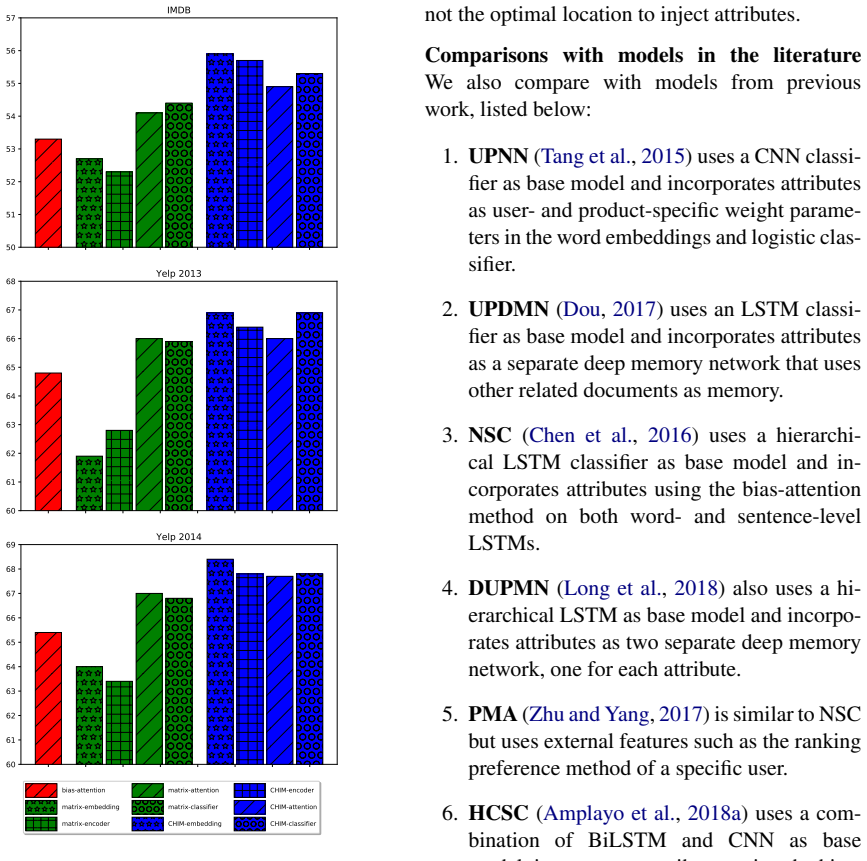
This paper's central claim is that attribute representation and injection matter more than model architecture: representing user and product attributes as chunk-wise importance matrices and injecting them into early or late parts of a simple BiLSTM classifier outperforms the field's default bias-in-attention method, and does so even against systems with much more elaborate architectures. Concretely, CHIM maps the concatenated user and product embeddings to a small matrix, tiles it to the shape of a target weight matrix $\mathbf{W}$, pushes it through a sigmoid, and broadcast-multiplies it into $\mathbf{W}$, so the text transformation itself becomes user- and product-dependent. In the reported results, CHIM injected into the embedding layer gives the best accuracy and CHIM into the classifier gives the best RMSE on the sentiment benchmarks, while the attention mechanism is consistently the worst CHIM injection location; the author concludes that attention is the worst location to inject attributes regardless of representation, contradicting earlier work.
Load-bearing premise
The paper assumes that single-run accuracy differences of around one point on held-out sets, without repeated seeds or significance tests, are enough to rank the four injection locations reliably; if those differences are noise, the conclusion that attention is the worst location collapses.
Editorial extensions
If this is right
- Replacing bias-in-attention with a multiplicative CHIM gate at another location is a concrete, low-cost change practitioners can make to sentiment classifiers.
- Reported gains over published systems imply that complex hierarchical or memory-network architectures are not necessary to exploit user and product information; attribute handling can do the work.
- CHIM attribute encodings trained for sentiment also carry information about product category, so they can be transferred to other tasks instead of being trained from scratch.
- Joint injection into attention plus another location can beat single-location injection, so the four locations are complementary rather than mutually exclusive.
- The parameter savings of chunking make attribute injection feasible at the embedding and encoder layers, where full matrix-based representations would be too costly to optimize.
Reading between the lines
- Because the paper's own results show the best location varies by metric and transfer task, a practical extension is to treat injection location as a tunable hyperparameter rather than a universal architectural rule.
- CHIM's gating mechanism resembles an input-dependent regularizer, so one testable extension is to inspect gate values for individual users and check whether they correlate with known preference profiles.
- The method is defined for user and product attributes but is attribute-agnostic; applying the same chunked importance matrix to location, time, topic, or aspect attributes would test how general the conclusion is.
- The transfer results suggest attribute encodings pretrained on large review corpora could serve as reusable personalization features for other NLP tasks, although the paper only demonstrates two transfer tasks.
Signed reviews
Editorial analysis
A structured set of objections, weighed in public.
Referee Report
Summary. The paper proposes a new way to represent user and product attributes for sentiment classification: chunk-wise importance weight matrices (CHIM), where attribute embeddings are transformed into a small chunked matrix, repeated and sigmoid-gated, and then used to modulate the weight matrix of a non-linear layer. The paper studies four injection locations (embedding, encoder, attention, classifier) and three representations (bias, matrix, CHIM) on a common BiLSTM-with-attention base model. It claims that the standard bias-in-attention method is the least effective, that attention is the worst injection location regardless of representation, and that the CHIM representation lets a simple base model outperform prior state-of-the-art architectures on IMDB, Yelp 2013, and Yelp 2014. It also reports transfer experiments to product category classification and review headline generation. The paper releases its code and datasets.
Significance. If the CHIM results are replicable, the paper makes a useful empirical contribution: a parameter-efficient attribute injection method that works with a simple BiLSTM and reports accuracy gains over more complex published systems. The public release of code and datasets supports reproducibility. The transfer experiments are a constructive addition, and the comparison across representations and locations is a reasonable study design. However, the headline interpretive claim that attention is the worst injection location 'regardless of representation' is not supported by the paper's own data, and the 'significant improvement' wording lacks statistical support. The core method can stand, but the paper's central claims need to be substantially reworded or re-validated.
major comments (4)
- [§3.2, Figure 3 and §5] The universal claim that 'injection to the attention mechanism, no matter which representation method is used, garners the worst performance' is contradicted by the paper's own development-set results. The text in §3.2 states that matrix-based representations perform worst when injected to embeddings and encoder, while matrix-attention improves over bias-attention; Figure 3 shows matrix-attention above matrix-embedding and matrix-encoder. The conclusion should be narrowed to the CHIM representation or backed by per-representation location comparisons.
- [§3.2, Table 2] The claim that 'CHIM-attention consistently performs the worst among CHIM-based representations' is not supported on Yelp 2014, where CHIM-attention (68.5) slightly exceeds CHIM-encoder (68.4). In addition, the sentiment-classification results are single runs with no variance estimates or significance tests; differences of 0.1–1.0 accuracy points are within plausible noise. The paper should report multiple seeds and statistical tests before drawing a strong ranking conclusion from these numbers.
- [§2.2–§2.3] The design does not support the 'regardless of representation' conclusion because the bias-based representation is only evaluated at the attention location (bias-attention). The representation and injection-location factors are therefore confounded for the bias condition; bias at embedding, encoder, and classifier is untested. The experiments should either include bias at all four locations or the claims must be restricted to the combinations actually compared.
- [§3.2, Table 2] The abstract and §5 describe the improvements as 'significant' without reporting any significance test. Given that the differences against prior work are small in absolute terms and no variance is reported, 'significant' should be replaced by a quantitative claim backed by significance testing or by a more cautious phrase such as 'consistent improvements'.
minor comments (5)
- [§3.3] The word 'satistfy' should be 'satisfy' in the dataset description.
- [Figure 1] The attention weights in Figure 1b are displayed with a large '4' that is not explained in the caption; it obscures the illustrative point rather than clarifying it.
- [§2.2, Eqs. (13)–(16)] The dimension definitions are confusing: Eq. (13) gives a vector w' of size D1*D2 for the matrix-based method, while the CHIM method reshapes a vector c into a chunked matrix C of shape (D1/C1, D2/C2). The text should explicitly define the size of c and how it is produced in the CHIM case.
- [Table 3] Perplexity is reported without variance intervals, while accuracy is reported with ± intervals over 10 runs; please report the same repeated-run statistics for perplexity.
- [§2.3] The explanation that matrix-attention and matrix-classifier are easier to optimize because their weight matrices are 'relatively smaller' is stated as fact but is an untested speculation; it could be flagged as a hypothesis.
Circularity Check
No circularity: CHIM's advantage and the attention-location finding are empirical results, not consequences of the method's definition or of self-citations.
full rationale
The paper's derivation chain is self-contained. The CHIM representation (Eqs. 13-17) is defined via attribute embeddings gated onto the base model's weight matrices; the improvement over bias-attention is obtained by comparing test-set accuracies against external baselines (Table 2) and by dev-set comparisons (Figure 3). Neither the definition of CHIM nor the four injection locations presupposes that attention is worst or that CHIM is best; those are empirical outcomes. The claim that attention is the worst location is an inductive generalization from experiments, not built into the method. Self-citations appear only as a baseline (HCSC, Amplayo et al. 2018a) and as optional inspiration for interpreting the gating mechanism (Amplayo et al. 2018b), neither of which is load-bearing: removing them would not change any equation or evaluation. Possible weaknesses in the strength of the attention-is-worst conclusion, such as single runs without significance tests and the observation that CHIM-attention slightly beats CHIM-encoder on Yelp 2014 in Table 2, are statistical-evidence concerns, not circularity. No equation reduces to its inputs and no fitted parameter is renamed as a prediction, so the paper does not exhibit the circularity patterns enumerated in the review rules.
Assumptions & free parameters
free parameters (2)
- Chunk size factors C1 and C2 =
15
- Attribute embedding dimension =
300
assumptions (4)
- domain assumption User and product attributes are informative for predicting the sentiment of a review.
- domain assumption A simple BiLSTM with attention and a logistic classifier is a sufficient base model for comparing attribute injection methods.
- domain assumption The dataset splits and the twenty-core filtering from Tang et al. (2015) provide a fair and standard benchmark.
- domain assumption Pre-trained GloVe embeddings provide a suitable initialization for word vectors.
Cite this review
Pith. "Pith review of Rethinking Attribute Representation and Injection for Sentiment Classification." pith.science (2026). https://pith.science/paper/5KDBDCJ2
@misc{pith2026190809590,
  author       = {Pith},
  title        = {Pith review of: Rethinking Attribute Representation and Injection for Sentiment Classification},
  year         = {2026},
  howpublished = {\url{https://pith.science/paper/5KDBDCJ2}},
  note         = {Machine review of arXiv:1908.09590}
}
read the original abstract
Text attributes, such as user and product information in product reviews, have been used to improve the performance of sentiment classification models. The de facto standard method is to incorporate them as additional biases in the attention mechanism, and more performance gains are achieved by extending the model architecture. In this paper, we show that the above method is the least effective way to represent and inject attributes. To demonstrate this hypothesis, unlike previous models with complicated architectures, we limit our base model to a simple BiLSTM with attention classifier, and instead focus on how and where the attributes should be incorporated in the model. We propose to represent attributes as chunk-wise importance weight matrices and consider four locations in the model (i.e., embedding, encoding, attention, classifier) to inject attributes. Experiments show that our proposed method achieves significant improvements over the standard approach and that attention mechanism is the worst location to inject attributes, contradicting prior work. We also outperform the state-of-the-art despite our use of a simple base model. Finally, we show that these representations transfer well to other tasks. Model implementation and datasets are released here: https://github.com/rktamplayo/CHIM.
Figures


Figures from the paper (1 more)

Reference graph
Works this paper leans on
-
[1]
Reinald Kim Amplayo, Jihyeok Kim, Sua Sung, and Seung-won Hwang. 2018a. Cold-start aware user and product attention for sentiment classification. In Proceedings of the 56th Annual Meeting of the As- sociation for Computational Linguistics, ACL 2018, Melbourne, Australia, July 15-20, 2018, Volume 1: Long Papers, pages 2535–2544. Reinald Kim Amplayo, Kyungja...
work page 2018
-
[6]
Controlling linguistic style aspects in neural language genera- tion. CoRR, abs/1707.02633. Tomohiro Fukuhara, Hiroshi Nakagawa, and Toyoaki Nishida
-
[9]
Deep residual learning for image recog- nition. In 2016 IEEE Conference on Computer Vi- sion and Pattern Recognition, CVPR 2016, Las Ve- gas, NV , USA, June 27-30, 2016, pages 770–778. Geoffrey E. Hinton, Nitish Srivastava, Alex Krizhevsky, Ilya Sutskever, and Ruslan Salakhut- dinov
work page 2016
-
[13]
Incorporat- ing reviewer and product information for review rat- ing prediction. In IJCAI 2011, Proceedings of the 22nd International Joint Conference on Artificial In- telligence, Barcelona, Catalonia, Spain, July 16-22, 2011, pages 1820–1825. Chenghua Lin and Yulan He
work page 2011
-
[16]
Extreme adap- tation for personalized neural machine translation. In Proceedings of the 56th Annual Meeting of the As- sociation for Computational Linguistics, ACL 2018, Melbourne, Australia, July 15-20, 2018, Volume 2: Short Papers, pages 312–318. Andrew Y . Ng
work page 2018
-
[17]
Personalized re- view generation by expanding phrases and attending on aspect-aware representations. In Proceedings of the 56th Annual Meeting of the Association for Com- putational Linguistics, ACL 2018, Melbourne, Aus- tralia, July 15-20, 2018, Volume 2: Short Papers , pages 706–711. Bo Pang and Lillian Lee
work page 2018
-
[18]
Retrieval of relevant opinion sentences for new products. In Proceedings of the 38th International ACM SIGIR Conference on Re- search and Development in Information Retrieval, Santiago, Chile, August 9-13, 2015, pages 393–402. Jeffrey Pennington, Richard Socher, and Christo- pher D. Manning
work page 2015
-
[19]
Glove: Global vectors for word representation. In Proceedings of the 2014 Conference on Empirical Methods in Natural Lan- guage Processing, EMNLP 2014, October 25-29, 2014, Doha, Qatar, A meeting of SIGDAT, a Special Interest Group of the ACL, pages 1532–1543. Yikang Shen, Shawn Tan, Alessandro Sordoni, and Aaron C. Courville
work page 2014
Show all 30 references
-
[21]
Journal of Machine Learning Research, 15(1):1929–1958
Dropout: a simple way to prevent neural networks from overfitting. Journal of Machine Learning Research, 15(1):1929–1958. Chenhao Tan, Lillian Lee, Jie Tang, Long Jiang, Ming Zhou, and Ping Li
1929
-
[22]
In Proceedings of the 17th ACM SIGKDD International Confer- ence on Knowledge Discovery and Data Mining, San Diego, CA, USA, August 21-24, 2011 , pages 1397–1405
User-level sentiment anal- ysis incorporating social networks. In Proceedings of the 17th ACM SIGKDD International Confer- ence on Knowledge Discovery and Data Mining, San Diego, CA, USA, August 21-24, 2011 , pages 1397–1405. Duyu Tang, Bing Qin, and Ting Liu
2011
-
[23]
Learning semantic representations of users and products for document level sentiment classification. In Proceed- ings of the 53rd Annual Meeting of the Association for Computational Linguistics and the 7th Interna- tional Joint Conference on Natural Language Pro- cessing of the...
2015
-
[24]
In Proceedings of the 2015 Conference on Empirical Methods in Natural Language Processing, EMNLP 2015, Lisbon, Portu- gal, September 17-21, 2015, pages 601–611
Sentiment flow - A general model of web review argumentation. In Proceedings of the 2015 Conference on Empirical Methods in Natural Language Processing, EMNLP 2015, Lisbon, Portu- gal, September 17-21, 2015, pages 601–611. Zhen Wu, Xin-Yu Dai, Cunyan Yin, Shujian Huang, and Jiajun Chen
2015
-
[25]
Improving review repre- sentations with user attention and product attention for sentiment classification. In Proceedings of the Thirty-Second AAAI Conference on Artificial Intelli- gence, (AAAI-18), the 30th innovative Applications of Artificial Intelligence (IAAI-18), and the 8...
2018
-
[26]
In Proceedings of the 2017 Conference on Empirical Methods in Natural Language Processing, EMNLP 2017, Copenhagen, Denmark, September 9-11, 2017, pages 527–533
Identifying and tracking sentiments and topics from social media texts during natural disasters. In Proceedings of the 2017 Conference on Empirical Methods in Natural Language Processing, EMNLP 2017, Copenhagen, Denmark, September 9-11, 2017, pages 527–533. Min Yang, Qiang Qu,...
2017
-
[27]
Hi- erarchical attention networks for document classifi- cation. In NAACL HLT 2016, The 2016 Conference of the North American Chapter of the Association for Computational Linguistics: Human Language Technologies, San Diego California, USA, June 12- 17, 2016, pages 1480–1489. Ma...
2016
-
[28]
CoRR, abs/1212.5701
ADADELTA: an adaptive learning rate method. CoRR, abs/1212.5701. Weinan Zhang, Ting Liu, Yifa Wang, and Qingfu Zhu
-
[29]
CoRR, abs/1701.02073
Neural personalized response generation as domain adaptation. CoRR, abs/1701.02073. Pengcheng Zhu and Yujiu Yang
-
[30]
In Proceedings of the Eighth International Sympo- sium on Information and Communication Technol- ogy, Nha Trang City, Viet Nam, December 7-8, 2017, pages 181–188
Parallel multi- feature attention on neural sentiment classification. In Proceedings of the Eighth International Sympo- sium on Information and Communication Technol- ogy, Nha Trang City, Viet Nam, December 7-8, 2017, pages 181–188
2017
-
[2004]
In COLING 2004, 20th International Conference on Computa- tional Linguistics, Proceedings of the Conference, 23-27 August 2004, Geneva, Switzerland
Deter- mining the sentiment of opinions. In COLING 2004, 20th International Conference on Computa- tional Linguistics, Proceedings of the Conference, 23-27 August 2004, Geneva, Switzerland. Fangtao Li, Nathan Nan Liu, Hongwei Jin, Kai Zhao, Qiang Yang, and Xiaoyan Zhu
2004
-
[2007]
In Proceedings of the First Inter- national Conference on Weblogs and Social Media, ICWSM 2007, Boulder, Colorado, USA, March 26- 28,
Understanding sentiment of peo- ple from news articles: Temporal sentiment analysis of social events. In Proceedings of the First Inter- national Conference on Weblogs and Social Media, ICWSM 2007, Boulder, Colorado, USA, March 26- 28,
2007
-
[2009]
In Pro- ceedings of the 18th ACM Conference on Infor- mation and Knowledge Management, CIKM 2009, Hong Kong, China, November 2-6, 2009 , pages 375–384
Joint senti- ment/topic model for sentiment analysis. In Pro- ceedings of the 18th ACM Conference on Infor- mation and Knowledge Management, CIKM 2009, Hong Kong, China, November 2-6, 2009 , pages 375–384. Bing Liu
2009
-
[2011]
InPro- ceedings of the Forth International Conference on Web Search and Web Data Mining, WSDM 2011, Hong Kong, China, February 9-12, 2011 , pages 815–824
Aspect and sentiment unification model for online review analysis. InPro- ceedings of the Forth International Conference on Web Search and Web Data Mining, WSDM 2011, Hong Kong, China, February 9-12, 2011 , pages 815–824. Jihyeok Kim, Reinald Kim Amplayo, Kyungjae Lee, Sua Sung...
2011
-
[2012]
CoRR, abs/1207.0580
Improving neural networks by preventing co-adaptation of feature detectors. CoRR, abs/1207.0580. Sepp Hochreiter and J ¨urgen Schmidhuber
-
[2013]
In Sixth International Joint Conference on Natu- ral Language Processing, IJCNLP 2013, Nagoya, Japan, October 14-18, 2013, pages 1107–1111
Modeling user leniency and product popularity for sentiment classification. In Sixth International Joint Conference on Natu- ral Language Processing, IJCNLP 2013, Nagoya, Japan, October 14-18, 2013, pages 1107–1111. Kaiming He, Xiangyu Zhang, Shaoqing Ren, and Jian Sun
2013
-
[2014]
In Proceedings of the 52nd An- nual Meeting of the Association for Computational Linguistics, ACL 2014, June 22-27, 2014, Baltimore, MD, USA, System Demonstrations, pages 55–60
The stanford corenlp natural language processing toolkit. In Proceedings of the 52nd An- nual Meeting of the Association for Computational Linguistics, ACL 2014, June 22-27, 2014, Baltimore, MD, USA, System Demonstrations, pages 55–60. Paul Michel and Graham Neubig
2014
-
[2015]
In 3rd Inter- national Conference on Learning Representations, ICLR 2015, San Diego, CA, USA, May 7-9, 2015, Conference Track Proceedings
Neural machine translation by jointly learning to align and translate. In 3rd Inter- national Conference on Learning Representations, ICLR 2015, San Diego, CA, USA, May 7-9, 2015, Conference Track Proceedings. Andrea Baruzzo, Antonina Dattolo, Nirmala Pudota, and Carlo Tasso
2015
-
[2016]
In Pro- ceedings of the 2016 Conference on Empirical Meth- ods in Natural Language Processing, EMNLP 2016, Austin, Texas, USA, November 1-4, 2016 , pages 1650–1659
Neural sentiment classi- fication with user and product attention. In Pro- ceedings of the 2016 Conference on Empirical Meth- ods in Natural Language Processing, EMNLP 2016, Austin, Texas, USA, November 1-4, 2016 , pages 1650–1659. Li Dong, Shaohan Huang, Furu Wei, Mirella Lapa...
2016
-
[2017]
In Proceedings of the 2017 Conference on Empirical Methods in Natural Lan- guage Processing, pages 521–526
Capturing user and product infor- mation for document level sentiment analysis with deep memory network. In Proceedings of the 2017 Conference on Empirical Methods in Natural Lan- guage Processing, pages 521–526. Association for Computational Linguistics. Jessica Ficler and Yo...
2017
-
[2018]
In Proceedings of the 2018 Conference on Empirical Methods in Natural Language Processing, Brussels, Belgium, October 31 - November 4, 2018 , pages 3675–3686
Summa- rizing opinions: Aspect extraction meets sentiment prediction and they are both weakly supervised. In Proceedings of the 2018 Conference on Empirical Methods in Natural Language Processing, Brussels, Belgium, October 31 - November 4, 2018 , pages 3675–3686. Dzmitry Bahd...
2018
-
[2019]
In 7th International Conference on Learn- ing Representations, ICLR 2019, New Orleans, LA, USA, May 6-9,
Ordered neurons: In- tegrating tree structures into recurrent neural net- works. In 7th International Conference on Learn- ing Representations, ICLR 2019, New Orleans, LA, USA, May 6-9,
2019
Reviewed August 14, 2026 · model on record in the stance chip above.
Discussion (0). Continue with ORCID to comment.