REVIEW 3 major objections 7 minor 65 references
SMDET-1 is a fast-moving infrared source that appears to be a Y dwarf within 7.4 pc of the Sun.
Reviewed by Pith at T0; open to challenge. T0 means a machine referee read the full paper against a public rubric. the ladder, T0–T4 →
T0 review · deepseek-v4-flash
2026-08-04 01:31 UTC pith:5KJSGJAK
load-bearing objection A genuinely new fast-moving cold brown dwarf candidate with a solid two-instrument discovery; the headline distance and temperature are photometric upper limits that survive the main modeling choice but not the metal-poor-outlier caveat. the 3 major comments →
SMDET-1: a Nearby Y Dwarf Candidate
The pith
A machine-rendered reading of the paper's core claim, the machinery that carries it, and where it could break.
Core claim
The paper's central claim is that SMDET-1 is a genuine, high–proper-motion (≈1.3 arcsec/yr) brown dwarf, detected at 4.5 μm by both WISE and Spitzer and absent from near-infrared JHK imaging, whose Spitzer color limit places it in the Y dwarf regime. Because Spitzer's 3.6 μm channel fails to detect it, the authors derive a 5σ limit of ch1 > 17.38 mag from a local fit to sources around the object, giving ch1 – ch2 > 2.81 mag. Applying published color–luminosity and color–temperature relations, this yields T_eff < 391 K, a photometric distance < 7.4 pc, and a phototype later than Y0.8. The object is therefore presented as a nearby Y dwarf candidate and as evidence that the coldest population o
What carries the argument
The argument turns on the conversion of a non-detection into a constraint: the Deep GLIMPSE catalog detects SMDET-1 only in the 4.5 μm (ch2) channel, and the authors translate the absence of a 3.6 μm (ch1) detection into a 5σ magnitude limit by fitting a second-order polynomial to the ch1 signal-to-noise versus magnitude trend of ~1,600 nearby catalog sources. That ch1 limit, combined with the measured ch2 flux, produces the color lower limit that anchors the temperature, distance, and phototype estimates. The discovery itself rests on the SMDET neural network, a recurrent convolutional architecture that scans sequences of time-resolved WISE coadds for faint, fast-moving sources.
Load-bearing premise
The core premise is that SMDET-1 has no real 3.6 μm emission, so the measured 3.4σ residual at its predicted position is treated as noise or imperfect subtraction of a bright neighbor rather than a faint detection; if that residual is real, the derived color, distance, and temperature all shift, though the Y dwarf classification would likely survive.
What would settle it
A detection of SMDET-1 at 3.6 μm with a point-source flux exceeding the adopted limit, or a J-band detection at J ≤ 21.16, would overturn the color lower limit that drives the Y dwarf classification. Conversely, if forced photometry at the predicted position yields a clean 5σ ch1 detection, the current distance and temperature limits would be replaced by values near 5.6 pc and ~349 K.
If this is right
- SMDET-1, if confirmed, becomes one of the closest known brown dwarfs, with a photometric distance under 7.4 pc, joining the small set of Y dwarfs in the solar neighborhood.
- The object's extreme ch1–ch2 color and J-band non-detection make it a strong target for JWST or large-telescope spectroscopy to measure its temperature and composition.
- The successful recovery of a moving source in a crowded Galactic-plane field suggests that similar pixel-level deep-learning searches can find other overlooked nearby objects in archival WISE and Spitzer data.
- A trigonometric parallax from high-resolution follow-up would convert the photometric distance into a precise measurement and test the Y dwarf interpretation.
- If the sub-threshold ch1 flux is real rather than contamination, the object would be even closer (≈5.6 pc) and cooler (≈349 K), strengthening its status.
Where Pith is reading between the lines
- The paper's property estimates inherit a systematic risk: the adopted ch1 depth is 0.42 mag shallower than the survey's quoted sensitivity, and a 3.4σ residual flux sits at the predicted position. A deeper 3.6 μm observation would either confirm a real detection (shrinking the distance to ~5.6 pc) or push the limiting color even redder.
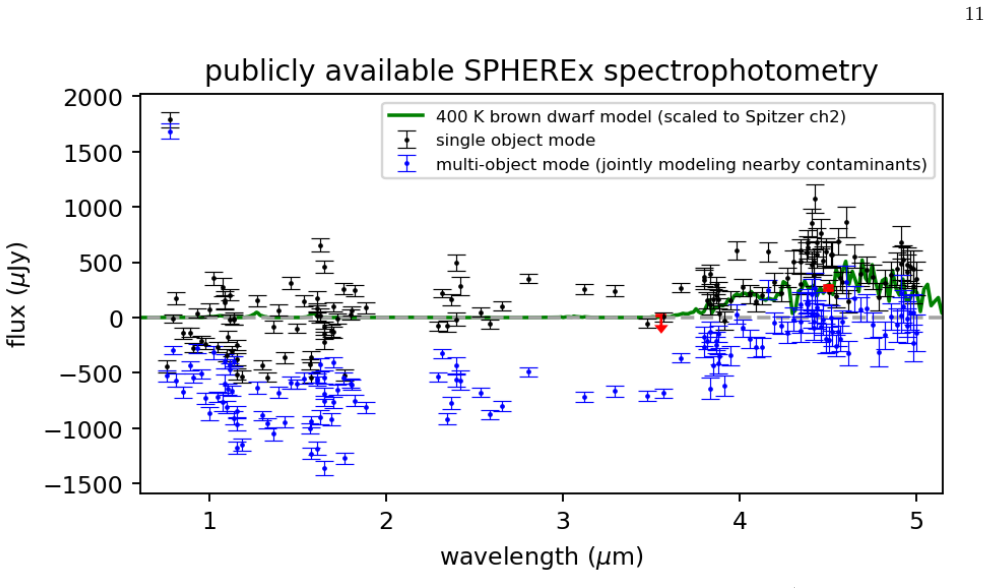
- SMDET-1's nondetection in early SPHEREx data is presented as consistent with expectations, but a dedicated stacking analysis as more SPHEREx passes accumulate could provide an independent 4–5 μm detection without waiting for a new telescope.
- This discovery suggests the low-mass cutoff of star formation may be even closer than the current census implies, and that similarly cold objects are likely hidden in the same archival data where traditional point-source catalogs fail due to crowding and blending.
Editorial analysis
A structured set of objections, weighed in public.
Referee Report
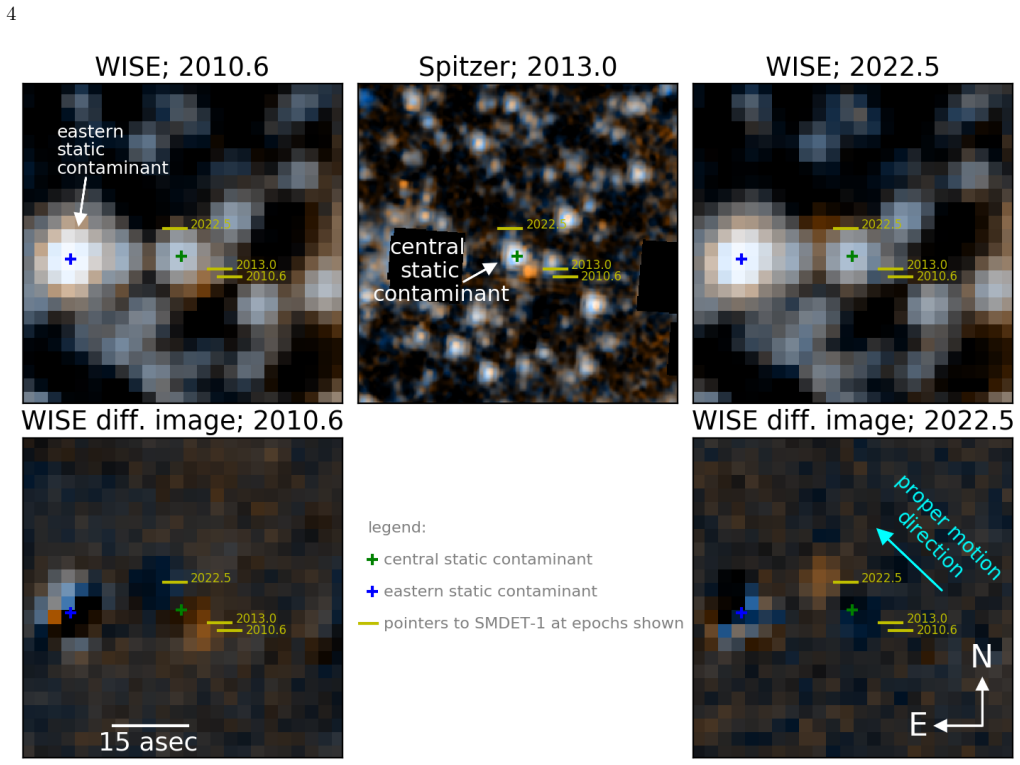
Summary. The paper reports the discovery of SMDET-1, a high proper motion (~1.3"/yr) object identified through the SMDET pixel-level deep learning search on time-resolved unWISE coadds. The object is independently confirmed by a 2012 Spitzer/Deep GLIMPSE detection at 4.5 μm and by additional WISE detections spanning ~12.4 years. It is undetected in Spitzer ch1 and in near-infrared JHK imaging, yielding a Spitzer color limit ch1−ch2 > 2.81 mag. From this color limit the authors derive a photometric temperature limit T_eff < 391 K, a photometric distance limit d < 7.4 pc, and a Y dwarf phototype. The paper also presents early SPHEREx observations that are inconclusive. The central claim is that SMDET-1 is a newly discovered, very nearby Y dwarf candidate.
Significance. If the characterization holds, SMDET-1 is a valuable addition to the incomplete census of the coldest brown dwarfs within ~20 pc and demonstrates the utility of deep learning for discovering faint moving objects in crowded fields. The discovery layer is strong: the Spitzer ch2 detection at ~2'' resolution corroborates the WISE detections, the motion is consistent across multiple epochs, and the paper carefully distinguishes the 5σ ch1 limit from the sub-threshold forced-photometry residual. The authors also cross-check their temperature and color relations against multiple published polynomials, and they explicitly flag the possibility of metal-poor outliers. The main risk is that the physical limits (T_eff < 391 K, d < 7.4 pc) are derived from photometric calibrations at the red edge of the color–temperature and color–absolute magnitude relations, so the quantitative headline numbers are conditional on SMDET-1 being a normal solar-metallicity field object.
major comments (3)
- [§4.1, Fig. 3] The T_eff(ch1−ch2) polynomial is fitted to JWST-based effective temperatures of a small sample (the black points in Fig. 3) and then evaluated at ch1−ch2 = 2.81, at or beyond the reddest calibration points. The paper notes that metal-poor objects can be very large outliers (Faherty et al. 2025) but does not quantify how this affects the T_eff < 391 K claim. Since this limit is a headline result, the authors should either (a) quantify the systematic scatter/extrapolation uncertainty using all published objects with ch1−ch2 > 2.5, including known outliers, or (b) explicitly present T_eff < 391 K as a solar-metallicity, field-age photometric estimate and modify the abstract accordingly. As written, the abstract implies a robust physical upper limit.
- [§3.2, §4.2] The paper adopts the 5σ ch1 limit (ch1 > 17.38) over the forced-photometry residual (ch1 = 17.66 ± 0.38/0.28, 3.4σ). The three arguments given are reasonable, but the residual is not negligible. If real, it would change the color to ~3.09 mag, the photometric distance to ~5.6 pc, and T_eff to ~349 K. While §4.2 discusses this alternative, it is absent from the abstract and conclusion. I recommend that the abstract/conclusion state that the primary limits are based on the adopted 5σ non-detection and explicitly note the alternate sub-threshold interpretation, or that Table 1 include the forced-photometry values as a separate row.
- [§3.3, Table 1] The proper motion fit has a poor reduced chi-squared for μα (χ²_ν = 13.9), and the paper acknowledges that the formal uncertainties may be underestimated due to WISE blending. This matters because the predicted positions anchor the JHK non-detection limits (§3.4, §3.5) and the v_tan < 44.9 km/s limit (§4.1). The authors should add a systematic error floor to the WISE astrometric points (e.g., based on the fit scatter) and demonstrate that the NIR non-detections and v_tan limit are robust to the resulting enlarged positional uncertainty. Without this, the reader cannot assess how conservative the derived limits are.
minor comments (7)
- [§2.3] Use 'December 2012' instead of 'late-2012' or '2012 December' for consistency.
- [Table 1] The photometry header 'JM KO', 'HM KO', 'KM KO' appears to be a formatting artifact; it should read 'J (MKO)', 'H (MKO)', 'K (MKO)'.
- [§4.1] The reduced proper motion H_ch2 ≈ 20.1 mag is mentioned without a definition or equation; define it or cite the standard formula so the value is reproducible.
- [Figure 3] The fitted T_eff(ch1−ch2) polynomial is shown as a dotted line, but the coefficients and the number of calibration points are not given. Please provide the polynomial coefficients and the calibration sample size, ideally in a footnote or in the text.
- [§3.6] The term 'L VF' should be 'LVF' (linear variable filter) consistently throughout the section.
- [References] Several references are listed only as arXiv e-prints (e.g., Meisner et al. 2022, Caselden et al. 2026, Leggett 2026). If any have been accepted or published, please update to the journal reference. Also, the Meisner et al. 2022 entry lacks a DOI.
- [§3.1] The notation 'ch1' and 'ch2' is used throughout; ensure the first use explicitly defines the Spitzer/IRAC channel wavelengths (this appears in footnote 14, but might be worth stating in the main text as well, especially since the abstract uses [3.6] and [4.5]).
Circularity Check
No significant circularity: the discovery and characterization rest on external data and independent calibrations.
full rationale
I walked the full derivation chain from discovery to the headline claims. The moving-object discovery is anchored in external archival data: WISE/unWISE time-resolved coadds, the unTimely catalog, and Spitzer Deep GLIMPSE imaging, with the Spitzer ch2 detection independently resolving the source. The ch1 non-detection is converted into a magnitude limit using a second-order polynomial fit to ~1,600 Deep GLIMPSE field objects, an empirical sensitivity estimate that does not use SMDET-1 itself. The resulting color limit ch1-ch2 > 2.81 mag is then converted to T_eff and distance using external polynomial relations (Kirkpatrick et al. 2021, Beiler et al. 2024, Leggett 2026); the paper's own Teff polynomial is cross-checked against three independent Leggett relations, so the temperature limit is not a fitted input renamed as a prediction. The paper's self-citations (SMDET methodology, unTimely, Kirkpatrick et al. 2021) are methodological or external empirical calibrations, not load-bearing uniqueness arguments. The alternative interpretation of the sub-threshold 3.4-sigma ch1 forced-photometry residual is explored transparently and does not change the qualitative Y-dwarf conclusion. The stated concern about metal-poor outliers is a correctness risk, not a circularity. No step reduces by construction to its own input.
Axiom & Free-Parameter Ledger
free parameters (2)
- 5σ ch1 depth at SMDET-1's position (second-order polynomial fit) =
ch1 = 17.38 mag (Vega)
- Quadratic coefficients of the T_eff(ch1−ch2) polynomial =
not tabulated (green dashed line, Fig. 3)
axioms (5)
- domain assumption W2 and Spitzer ch2 magnitudes are essentially equal for cold brown dwarfs
- domain assumption The Deep GLIMPSE ch2-only source and the three WISE detections are the same object following linear motion with constant W2 flux
- domain assumption Published polynomial calibrations (M_ch2 versus ch1−ch2, SpT versus ch1−ch2; Kirkpatrick et al. 2021) remain valid at ch1−ch2 > 2.81 mag
- ad hoc to paper The 3.4σ residual ch1 flux at SMDET-1's predicted position is not a real point source
- domain assumption SMDET-1 is not an extreme-metallicity or unusual-gravity outlier in the T_eff versus ch1−ch2 plane
Cite this review
Pith. "Pith review of SMDET-1: a Nearby Y Dwarf Candidate." pith.science (2026). https://pith.science/paper/5KJSGJAK
@misc{pith2026260800046,
  author       = {Pith},
  title        = {Pith review of: SMDET-1: a Nearby Y Dwarf Candidate},
  year         = {2026},
  howpublished = {\url{https://pith.science/paper/5KJSGJAK}},
  note         = {Machine review of arXiv:2608.00046}
}
read the original abstract
We present the discovery of SMDET-1, a red, fast-moving object ($\mu \approx 1.3$"/yr) identified in time-resolved unWISE coadds using a pixel-level deep learning methodology called SMDET. Despite being relatively bright at 4.5 microns compared to many other recent WISE-based brown dwarf discoveries ($m_{[4.5]} \approx 14.6$ mag Vega), SMDET-1 had remained overlooked due to its location in a very crowded Galactic plane field ($b \approx 2.25^{\circ}$) and contamination from brighter background objects. SMDET-1 is also serendipitously detected at 4.5 microns in late-2012 Spitzer Deep GLIMPSE survey imaging. SMDET-1 is undetected in UKIDSS and Palomar/WIRC near-infrared imaging, with the strongest constraint on its temperature ($T_{\rm eff}$ < 391 K) arising from its Deep GLIMPSE color limit of $m_{[3.6]} - m_{[4.5]} > 2.81$ mag, which also implies a very nearby photometric distance < 7.4 pc. The Spitzer color bound corresponds to a Y dwarf phototype. SMDET-1 illustrates the importance of continued searches for nearby brown dwarfs within archival datasets like WISE and Spitzer, as well as the potential of pixel-level deep learning to discover astronomical moving objects that challenge traditional data analysis approaches.
Figures


Reference graph
Works this paper leans on
-
[1]
Albert, L., Leggett, S. K., Calissendorff, P., et al. 2025, AJ, 169, 163, doi: 10.3847/1538-3881/adadf9 Bardalez Gagliuffi, D. C., Faherty, J. K., Schneider, A. C., et al. 2020, ApJ, 895, 145, doi: 10.3847/1538-4357/ab8d25
-
[2]
Barnard, E. E. 1916, AJ, 29, 181, doi: 10.1086/104156
-
[3]
Beiler, S. A., Cushing, M. C., Kirkpatrick, J. D., et al. 2024, ApJ, 973, 107, doi: 10.3847/1538-4357/ad6301
-
[4]
Bock, J. J., Aboobaker, A. M., Adamo, J., et al. 2026, ApJ, 999, 139, doi: 10.3847/1538-4357/ae2be2
-
[5]
Brooks, H., Kirkpatrick, J. D., Caselden, D., et al. 2022, AJ, 163, 47, doi: 10.3847/1538-3881/ac3a0a
-
[6]
Brooks, H., Caselden, D., Kirkpatrick, J. D., et al. 2024, AJ, 168, 211, doi: 10.3847/1538-3881/ad77d2
-
[7]
Burgasser, A. J., Gonzales, E. C., Beiler, S. A., et al. 2025, Science, 390, 697, doi: 10.1126/science.adu0401
-
[8]
2023, ApJL, 947, L30, doi: 10.3847/2041-8213/acc86d
Calissendorff, P., De Furio, M., Meyer, M., et al. 2023, ApJL, 947, L30, doi: 10.3847/2041-8213/acc86d
-
[9]
2020, in American Astronomical Society Meeting Abstracts, Vol
Caselden, D., Colin, G., Lack, L., et al. 2020, in American Astronomical Society Meeting Abstracts, Vol. 235, American Astronomical Society Meeting Abstracts #235, 274.18
2020
-
[10]
2018, WiseView: Visualizing motion and variability of faint WISE sources,, Astrophysics Source Code Library, record ascl:1806.004 http://ascl.net/1806.004
Colin, G. 2018, WiseView: Visualizing motion and variability of faint WISE sources,, Astrophysics Source Code Library, record ascl:1806.004 http://ascl.net/1806.004
2018
-
[11]
Caselden, D., Kirkpatrick, J. D., Lack, L., et al. 2026, AJ, 171, 303, doi: 10.3847/1538-3881/ae593c
-
[12]
Churchwell, E., Babler, B. L., Meade, M. R., et al. 2009, PASP, 121, 213, doi: 10.1086/597811 12
doi:10.1086/597811 2009
-
[13]
Cushing, M. C., Kirkpatrick, J. D., Gelino, C. R., et al. 2011, ApJ, 743, 50, doi: 10.1088/0004-637X/743/1/50 De Furio, M., Faherty, J. K., Bardalez Gagliuffi, D. C., et al. 2025, ApJL, 990, L63, doi: 10.3847/2041-8213/adfee1 Dor´ e, O., Bock, J., Ashby, M., et al. 2014, arXiv e-prints, arXiv:1412.4872, doi: 10.48550/arXiv.1412.4872 Euclid Collaboration, ...
-
[14]
2025, Nature, 645, 62, doi: 10.1038/s41586-025-09369-1
Faherty, J., Meisner, A., Burningham, B., et al. 2025, Nature, 645, 62, doi: 10.1038/s41586-025-09369-1
-
[15]
K., Bardalez Gagliuffi, D
Faherty, J. K., Bardalez Gagliuffi, D. C., Beichman, C. A., et al. 2021, Explaining the Diversity of Cold Worlds,, JWST Proposal. Cycle 1, ID. #2124
2021
-
[16]
K., Burningham, B., Gagn´ e, J., et al
Faherty, J. K., Burningham, B., Gagn´ e, J., et al. 2024, Nature, 628, 511, doi: 10.1038/s41586-024-07190-w
-
[17]
Fazio, G. G., Hora, J. L., Allen, L. E., et al. 2004, ApJS, 154, 10, doi: 10.1086/422843 Gagn´ e, J., Faherty, J. K., Ruiz Diaz, A., et al. 2026, arXiv e-prints, arXiv:2604.22012, doi: 10.48550/arXiv.2604.22012 Gagn´ e, J., Faherty, J. K., Ruiz Diaz, A., et al. 2026, The SPHEREx Photometry and Image Fitting Framework (SPIFF) Spectrophotometry Library, QR2...
-
[18]
Hsu, C.-C., Burgasser, A. J., Theissen, C. A., et al. 2021, ApJS, 257, 45, doi: 10.3847/1538-4365/ac1c7d Ivezi´ c,ˇZ., Kahn, S. M., Tyson, J. A., et al. 2019, ApJ, 873, 111, doi: 10.3847/1538-4357/ab042c
-
[19]
Jones, E. M. 1972, ApJ, 173, 671, doi: 10.1086/151454
-
[20]
Kirkpatrick, J. D., Cushing, M. C., Gelino, C. R., et al. 2011, ApJS, 197, 19, doi: 10.1088/0067-0049/197/2/19
-
[21]
Kirkpatrick, J. D., Gelino, C. R., Cushing, M. C., et al. 2012, ApJ, 753, 156, doi: 10.1088/0004-637X/753/2/156
-
[22]
D., Metchev, S
Kirkpatrick, J. D., Metchev, S. A., Hillenbrand, L. A., et al. 2019, BAAS, 51, 108
2019
-
[23]
Kirkpatrick, J. D., Gelino, C. R., Faherty, J. K., et al. 2021, ApJS, 253, 7, doi: 10.3847/1538-4365/abd107
-
[24]
Kirkpatrick, J. D., Marocco, F., Gelino, C. R., et al. 2024, ApJS, 271, 55, doi: 10.3847/1538-4365/ad24e2
-
[25]
2022, unTimely Catalog explorer: A search and visualization tool for the unTimely Catalog,, Astrophysics Source Code Library, record ascl:2211.005
Kiwy, F. 2022, unTimely Catalog explorer: A search and visualization tool for the unTimely Catalog,, Astrophysics Source Code Library, record ascl:2211.005
2022
-
[26]
M., Bock, J
Korngut, P. M., Bock, J. J., Akeson, R., et al. 2018, in Society of Photo-Optical Instrumentation Engineers (SPIE) Conference Series, Vol. 10698, Space Telescopes and Instrumentation 2018: Optical, Infrared, and Millimeter Wave, ed. M. Lystrup, H. A. MacEwen, G. G
2018
-
[27]
Fazio, N. Batalha, N. Siegler, & E. C. Tong, 106981U, doi: 10.1117/12.2312860
-
[28]
Lawrence, A., Warren, S. J., Almaini, O., et al. 2007, MNRAS, 379, 1599, doi: 10.1111/j.1365-2966.2007.12040.x
arXiv 2007
-
[29]
Discovery of Cold Brown Dwarfs or Free-Floating Giant Planets Close to the Sun
Leggett, S., Apai, D., Burgasser, A., et al. 2019, BAAS, 51, 95, doi: 10.48550/arXiv.1903.04686
work page internal anchor Pith review Pith/arXiv arXiv doi:10.48550/arxiv.1903.04686 2019
-
[30]
Leggett, S. K. 2026, arXiv e-prints, arXiv:2603.24740, doi: 10.48550/arXiv.2603.24740
-
[31]
Leggett, S. K., Morley, C. V., Marley, M. S., & Saumon, D. 2015, ApJ, 799, 37, doi: 10.1088/0004-637X/799/1/37
-
[32]
Leggett, S. K., Phillips, M. W., & Tremblin, P. 2025, ApJ, 991, 193, doi: 10.3847/1538-4357/adf21f
-
[33]
Leggett, S. K., & Tremblin, P. 2023, ApJ, 959, 86, doi: 10.3847/1538-4357/acfdad
-
[34]
Leggett, S. K., Tremblin, P., Esplin, T. L., Luhman, K. L., & Morley, C. V. 2017, ApJ, 842, 118, doi: 10.3847/1538-4357/aa6fb5
-
[35]
2008, in A Giant Step: from Milli- to Micro-arcsecond Astrometry, ed
Lindegren, L., Babusiaux, C., Bailer-Jones, C., et al. 2008, in A Giant Step: from Milli- to Micro-arcsecond Astrometry, ed. W. J. Jin, I. Platais, & M. A. C
2008
-
[36]
248, 217–223, doi: 10.1017/S1743921308019133
Perryman, Vol. 248, 217–223, doi: 10.1017/S1743921308019133
-
[37]
2021, LOWZ model atmosphere spectra, V1 Harvard Dataverse, doi: 10.7910/DVN/SJRXUO
Line, M. 2021, LOWZ model atmosphere spectra, V1 Harvard Dataverse, doi: 10.7910/DVN/SJRXUO
-
[38]
Lucas, P. W., Hoare, M. G., Longmore, A., et al. 2008, MNRAS, 391, 136, doi: 10.1111/j.1365-2966.2008.13924.x
arXiv 2008
-
[39]
Luhman, K. L. 2014, ApJL, 786, L18, doi: 10.1088/2041-8205/786/2/L18
-
[40]
Mainzer, A., Cushing, M. C., Skrutskie, M., et al. 2011, ApJ, 726, 30, doi: 10.1088/0004-637X/726/1/30
-
[41]
Mainzer, A. K., Masiero, J. R., Abell, P. A., et al. 2023, PSJ, 4, 224, doi: 10.3847/PSJ/ad0468
-
[42]
2005, in Astronomical Society of the Pacific Conference Series, Vol
Makovoz, D., & Khan, I. 2005, in Astronomical Society of the Pacific Conference Series, Vol. 347, Astronomical Data Analysis Software and Systems XIV, ed. P. Shopbell, M. Britton, & R. Ebert, 81
2005
-
[43]
Marocco, F., Caselden, D., Meisner, A. M., et al. 2019, ApJ, 881, 17, doi: 10.3847/1538-4357/ab2bf0
-
[44]
Marocco, F., Kirkpatrick, J. D., Smart, R. L., et al. 2026, AJ, 171, 284, doi: 10.3847/1538-3881/ae5061
-
[45]
2019, unwise psf: PSF models for unWISE coadds,, Astrophysics Source Code Library, record ascl:1901.004 http://ascl.net/1901.004 13
Meisner, A., & Schlafly, E. 2019, unwise psf: PSF models for unWISE coadds,, Astrophysics Source Code Library, record ascl:1901.004 http://ascl.net/1901.004 13
2019
-
[46]
Meisner, A. M., Caselden, D., Schlafly, E. F., & Kiwy, F. 2022, arXiv e-prints, arXiv:2209.14327. https://arxiv.org/abs/2209.14327
Pith/arXiv arXiv 2022
-
[47]
Meisner, A. M., Lang, D., & Schlegel, D. J. 2018, AJ, 156, 69, doi: 10.3847/1538-3881/aacbcd
-
[48]
Meisner, A. M., Leggett, S. K., Logsdon, S. E., et al. 2023, AJ, 166, 57, doi: 10.3847/1538-3881/acdb68
-
[49]
Meisner, A. M., Faherty, J. K., Kirkpatrick, J. D., et al. 2020, ApJ, 899, 123, doi: 10.3847/1538-4357/aba633
-
[50]
Meisner, A. M., Schneider, A. C., Burgasser, A. J., et al. 2021, ApJ, 915, 120, doi: 10.3847/1538-4357/ac013c
-
[51]
Morley, C. V., Fortney, J. J., Marley, M. S., et al. 2012, ApJ, 756, 172, doi: 10.1088/0004-637X/756/2/172
-
[52]
Morley, C. V., Marley, M. S., Fortney, J. J., et al. 2014, ApJ, 787, 78, doi: 10.1088/0004-637X/787/1/78
-
[53]
2023, arXiv e-prints, arXiv:2307.07642, doi: 10.48550/arXiv.2307.07642
Paladini, R., Zucker, C., Benjamin, R., et al. 2023, arXiv e-prints, arXiv:2307.07642, doi: 10.48550/arXiv.2307.07642
-
[54]
Rieke, M. J., Kelly, D. M., Misselt, K., et al. 2023, PASP, 135, 028001, doi: 10.1088/1538-3873/acac53
-
[55]
Robbins, G., Meisner, A. M., Schneider, A. C., et al. 2023, ApJ, 958, 94, doi: 10.3847/1538-4357/ad0043
-
[56]
Rowland, M. J., Morley, C. V., Miles, B. E., et al. 2024, ApJL, 977, L49, doi: 10.3847/2041-8213/ad9744
-
[57]
Schlafly, E. F. 2021, crowdsource: Crowded field photometry pipeline,, Astrophysics Source Code Library, record ascl:2106.004 http://ascl.net/2106.004
2021
-
[58]
Schlafly, E. F., Meisner, A. M., & Green, G. M. 2019, ApJS, 240, 30, doi: 10.3847/1538-4365/aafbea
-
[59]
Schlafly, E. F., Green, G. M., Lang, D., et al. 2018, ApJS, 234, 39, doi: 10.3847/1538-4365/aaa3e2
-
[60]
Schneider, A. C., Burgasser, A. J., Gerasimov, R., et al. 2020, ApJ, 898, 77, doi: 10.3847/1538-4357/ab9a40
-
[61]
2015, arXiv e-prints, arXiv:1503.03757, doi: 10.48550/arXiv.1503.03757 SPHEREx Team
Spergel, D., Gehrels, N., Baltay, C., et al. 2015, arXiv e-prints, arXiv:1503.03757, doi: 10.48550/arXiv.1503.03757 SPHEREx Team. 2025, SPHEREx Quick Release Spectral Images - QR2, NASA/IPAC Infrared Science Archive, doi: 10.26131/IRSA652
-
[62]
Werner, M. W., Roellig, T. L., Low, F. J., et al. 2004, ApJS, 154, 1, doi: 10.1086/422992
doi:10.1086/422992 2004
-
[63]
2011, Deep GLIMPSE: Exploring the Far Side of the Galaxy,, Spitzer Proposal ID #80074
Whitney, B., Benjamin, R., Churchwell, E., et al. 2011, Deep GLIMPSE: Exploring the Far Side of the Galaxy,, Spitzer Proposal ID #80074
2011
-
[64]
Wilson, J. C., Eikenberry, S. S., Henderson, C. P., et al. 2003, in Society of Photo-Optical Instrumentation Engineers (SPIE) Conference Series, Vol. 4841, Instrument Design and Performance for Optical/Infrared Ground-based Telescopes, ed. M. Iye & A. F. M. Moorwood, 451–458, doi: 10.1117/12.460336
-
[65]
Wright, E. L., Eisenhardt, P. R. M., Mainzer, A. K., et al. 2010, AJ, 140, 1868, doi: 10.1088/0004-6256/140/6/1868
discussion (0)
Sign in with ORCID, Apple, or X to comment. Anyone can read and Pith papers without signing in.