REVIEW 4 major objections 5 minor 152 references
SaNDi-SHoP: Searching for Satellites'N'Disks with a Star-Hopping Program II. Spectrophotometric analysis and orbital monitoring of directly imaged companions
T0 review · 4 major / 5 minor · reviewed 2026-08-02 · deepseek-v4-flash
Pith's one-line read This paper uses 13 directly imaged planets and brown dwarfs to argue that wide-orbiting substellar companions are systematically eccentric, pointing to formation by gravitational fragmentation or dynamical scattering rather than core accret
desk verdict Useful astrometric and photometric survey, but the 'all non-circular' conclusion outruns what short-arc orbits can support. read the letter →
The pith
A machine-rendered reading of the paper's core claim, the machinery that carries it, and where it could break.
The reading
What carries the argument
The central object is the 13-companion sample; the carrying mechanism is Keplerian orbit fitting of high-contrast-imaging astrometry, supplemented where available by absolute proper-motion anomalies and radial-velocity time series, using a parallel-tempered Markov-chain Monte Carlo sampler to map posterior distributions over semimajor axis, eccentricity, inclination, and companion mass. The diagnostic element is the eccentricity posterior: formation by core accretion should leave e near zero, while a uniform prior on e in [0,1] provides a benchmark with median 0.5. Photometric and low-resolution spectroscopic extraction supplies the spectral classifications.
What would settle it
For one of the four first-orbit systems, compare the eccentricity posterior against the uniform prior: if the posterior is indistinguishable from the prior, or if a decade of additional astrometry shifts e toward zero, the claim that wide-orbit companions are systematically eccentric would not survive.
Extended reading notes
Core claim
The central claim, stated on the paper's own terms, is that the updated orbital fits for 13 wide-orbit substellar companions are consistent with non-circular orbits in all cases. The sample includes the first orbital solutions for CT Cha b, HIP 78530 B, HIP 64892 B, and RX J1609.5-2105 b, and tighter constraints for the rest. Companion masses range roughly 7-70 Jupiter masses and semimajor axes 25-500 au, and spectral types derived from color-magnitude diagrams and low-resolution YJ spectra span mid-M to mid-L. The authors argue that near-zero eccentricity is the signature of core accretion, so the retrieved eccentricities (0.21-0.82) potentially disfavor that pathway and instead point to mo
Load-bearing premise
The argument that all thirteen orbits are non-circular rests on eccentricity posteriors that, for the seven systems with less than one percent of the orbit observed, are assumed to be driven by the astrometry rather than by the adopted uniform prior.
Editorial extensions
If this is right
- The four first solutions (CT Cha b, HIP 78530 B, HIP 64892 B, RX J1609.5-2105 b) give quantitative orbital elements where none existed, so future epochs can directly test and refine them.
- If the eccentricities are real, core-accretion formation in the circumstellar disk becomes unlikely for this population; gravitational fragmentation or disk instability becomes the more probable route, consistent with the wide separations.
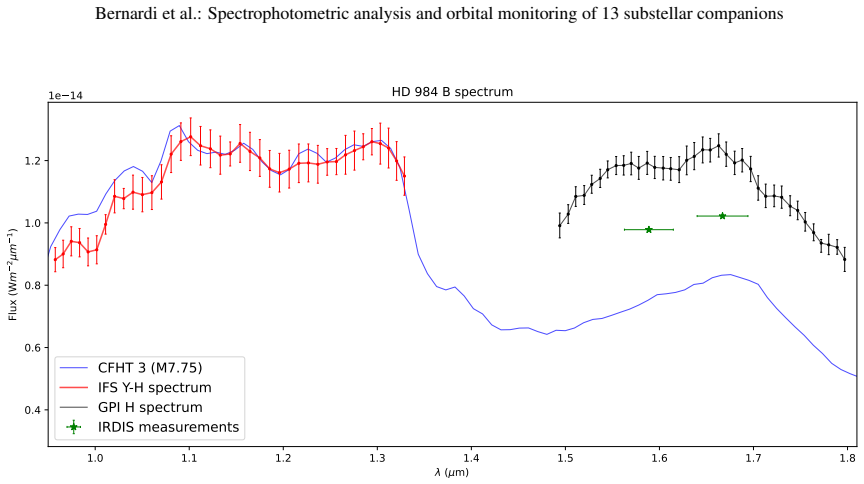
- The refined classifications—GQ Lup B M8-M8.5, PZ Tel B M5-M6.5, HD 984 B M7.75-M8.5—change the inferred luminosities and, through evolutionary models, the companion masses and temperatures used in later atmospheric studies.
- The 5-sigma detection limits rule out additional 1-15 Jupiter-mass companions out to roughly 300 au in these systems, so any scattering origin for the eccentric orbits must involve either unseen lower-mass companions, satellites, or objects interior to the coronagraph.
- Most of the dynamical masses are still unconstrained; only PZ Tel B and HD 984 B have enough orbital coverage for reliable masses, meaning the formation argument rests on eccentricities rather than on measured masses.
Reading between the lines
- The paper's own note that the eta Tel posteriors 'remain largely prior-driven' suggests the same may hold for the seven systems with less than 1% orbital coverage; a uniform eccentricity prior peaks at 0.5, so the reported medians near 0.5-0.6 could partly reflect the prior rather than the astrometry.
- A sharper comparison would be eccentricity versus system age: the youngest targets (<10 Myr) should retain the birth eccentricity from formation, while older systems have had time for scattering or circularization; the present sample is too small and too heterogeneous to separate these effects.
- If GQ Lup B is truly M8-M8.5 rather than the L6 classification, its bolometric luminosity and evolutionary mass likely drop, which would affect claims about its circumplanetary disk and whether it straddles the deuterium-burning limit.
- The null detection of additional wide companions suggests that if planet-planet scattering produced these orbits, the scattering partner has since been ejected or now orbits at sub-arcsecond separations; a targeted search for close-in companions in these systems would test that scenario.
Editorial analysis
A structured set of objections, weighed in public.
Referee Report
Summary. This paper presents new VLT/SPHERE IRDIS H2H3 photometry and astrometry for 13 directly imaged substellar companions, IFS YJ spectra for three of them, updated orbitize! orbital fits combining the new epochs with literature astrometry and, where available, RVs and Hipparcos-Gaia accelerations, and the first orbital solutions for CT Cha b, HIP 78530 B, HIP 64892 B, and RX J1609.5-2105 b. The authors derive spectral types from color-magnitude diagrams and template matching, and use the orbital fits to argue that all companions have non-circular orbits (e ~ 0.21-0.82), which they interpret as disfavoring core-accretion formation in favor of cloud/disk fragmentation or dynamical scattering.
Significance. The observational data products are valuable: the new SPHERE epochs extend orbital baselines for 13 systems, four of which previously had no published orbit, and the IFS spectra provide useful spectral-type constraints. The paper also compiles homogeneous astrometric and photometric tables. However, the central scientific claim — that the eccentricities are well enough determined to discriminate formation pathways — is not supported for the seven systems with less than 1% orbital coverage, whose eccentricity posteriors are largely prior-dominated (as the paper itself admits for eta Tel in Sec. 6.1). If the claim were robust, it would be an important contribution to the formation of wide-orbit substellar companions, but in its current form the inference overreaches the data. The paper's main value is thus the data compilation and the improved orbits for the better-covered systems, not the population-level formation conclusion.
major comments (4)
- [Abstract and Sec. 6.2] The claim that all 13 companions have non-circular orbits is not supported for the seven systems with <1% orbital coverage (Table B.1): AB Pic, TYC 8047-232-1, CT Cha, HIP 78530, DH Tau, HIP 64892, RX J1609.5-2105. Their eccentricity posteriors (e.g., AB Pic 0.54+0.32-0.28, CT Cha 0.60+0.29-0.38, DH Tau 0.58+0.32-0.26) are consistent with the uniform e∈[0,1] prior median of 0.5 and do not exclude e=0 at high significance. The paper itself states for eta Tel (Sec. 6.1) that 'the posteriors remain largely prior-driven.' A prior-sensitivity test (e.g., a beta prior or a fixed-e=0 model comparison) is required before any formation inference; without it, the abstract's 'consistent with non-circular orbits in all cases' is a prior artifact.
- [Sec. 4 and Sec. 6.1] There is a circularity in the mass treatment: the Gaussian Mtot priors in the orbit fits are constructed from the paper's own photometric companion masses (Table 2, derived from H2 photometry and ATMO/AMES-Dusty models in Sec. 3). Later, the same fits are used to quote 'dynamical masses' that are compared with evolutionary masses as if they were independent confirmations (e.g., Sec. 6.1 discussions of AB Pic, CT Cha, HIP 78530). For short-arc systems the companion mass posterior is essentially the prior, so these 'dynamical masses' are not independent. The authors should either use literature-only stellar masses and a wide companion-mass prior, or explicitly label Table B.1 masses as prior-informed, and avoid presenting them as independent dynamical constraints.
- [Sec. 5.2.6 and Sec. 5.2.7] The post-hoc exclusion of published astrometric epochs is not rigorously justified. For HIP 78530, the Bailey et al. (2013) 2011 epoch is excluded because its large uncertainties 'inflated uncertainties in the posterior' — this is not a valid reason for exclusion, since large uncertainties are naturally downweighted by the likelihood. For DH Tau, two Bryan et al. (2016) epochs are excluded as >15σ outliers based partly on a comparison with one SPHERE epoch; the reasoning is plausible but the paper does not demonstrate that the orbital results are robust to their inclusion. The authors should show fits with and without these epochs, or employ a robust outlier model; otherwise the eccentricity posteriors for these two systems are conditional on the exclusions.
- [Sec. 6.3 and Sec. 7] The formation conclusion is overstated. Even if the eccentricities were well measured, the paper itself notes (Sec. 6.3) that dynamical scattering can produce e up to ~0.8 and that several systems are young enough that gas-disk dissipation may not have completed. The phrase 'disfavoring core-accretion formation within their circumstellar disks' is too strong for data that are merely 'consistent with non-circular orbits'; the posterior probability of e=0 is not quantified. The conclusion should be restricted to the few systems with >3% orbital coverage (GQ Lup, PZ Tel, HD 984) where the eccentricity is actually constrained, and the rest should be described as unconstrained rather than as evidence against core accretion.
minor comments (5)
- [Sec. 6] The text says 'only four show an orbital coverage greater than 3% (Table B.1)', but Table B.1 lists only three systems with coverage >3%: GQ Lup B (4.0%), PZ Tel B (12.9%), HD 984 B (12.6%). Please check and correct.
- [Sec. 5.2.13] In the eta Tel paragraph, the sentence fragment '(Desidera et al. 2021).' appears before 'It is a member of the β Pictoris moving group...' This looks like a leftover reference and should be removed or integrated.
- [Table B.1] The table mixes quantities: some rows report Mtot (e.g., AB Pic, TYC 8047-232-1, CT Cha, DH Tau, RX J1609, HII 1348) and others report Mstar and Mcomp separately (HIP 78530, HIP 64892, PZ Tel, HD 984, eta Tel). The header and caption should clarify which parameters were directly fitted and which are derived, and should flag that Mcomp values for short-arc systems are prior-dominated.
- [Throughout] Typos and reference formatting: 'distint' (Secs. 5.2.5, 5.2.11), 'Tetzlaffet al.' (Refs), 'Proocedings' (Refs), 'V ousden' (Refs), inconsistent 'Lafrèniere' vs 'Lafrenière'. Please proofread.
- [Sec. 2] The paper states 'eight targets were previously observed within the SHINE GTO program' but then describes the sample as 13 targets; the relationship between the SHINE subsample and the full sample could be stated more clearly for readers not familiar with Paper I.
Circularity Check
The 'non-circular in all cases' result is built into the uniform e∈[0,1] prior for the seven <1%-coverage systems, and several reported 'dynamical masses' are echoes of photometric-mass priors.
-
self definitional
[Table 4; Sec. 6.1 (eta Tel); Sec. 6.3]
"Eccentricity (e) Uniform on [0, 1] ... the posteriors remain largely prior-driven ... Even when accounting for the uncertainties, all our retrieved eccentricities are consistent with non-circular orbits for nearly all substellar companions in our sample."
The prior places zero probability on exactly circular orbits (e=0 is a measure-zero point under a continuous uniform distribution on [0,1]). For the seven targets with less than 1% of the orbit sampled (Sec. 6), the astrometry provides only a short arc, and the paper itself concedes for eta Tel that the posterior is 'largely prior-driven'. The eccentricity posteriors for such systems therefore inherit the prior's exclusion of e=0; concluding that they are 'consistent with non-circular orbits' is a restatement of the prior's support, not a measurement. The subsequent inference that core accretion is 'potentially disfavored' for these systems is thus premised on the prior rather than on the data.
-
fitted input called prediction
[Sec. 5.2.4 (CT Cha); Sec. 7]
"We performed an orbital fit adopting a prior on the total system mass of 0.81±0.05 M⊙, based on a companion mass of 9.7+1.2−1.1 MJup, and a stellar mass of 0.80±0.05 M⊙ ... We derived a total dynamical mass of 0.807+0.050−0.051 M⊙ ... With the exception of PZ Tel B and HD 984 B ... the dynamical masses of all other companions remain essentially unconstrained."
The Gaussian prior on total system mass is constructed directly from the photometric companion mass (H2 photometry plus ATMO/AMES-Dusty evolutionary models) added to the stellar mass. The 'derived total dynamical mass' posterior for CT Cha (0.807 M⊙) is essentially identical to the input prior (0.81 M⊙), and similar near-prior values appear for other short-arc systems (e.g., DH Tau, where the prior is 0.422 M⊙ and the derived mass is 0.418 M⊙). Labeling these as 'dynamical' masses and comparing them with literature evolutionary masses in Sec. 6.1 presents a photometric prior as an independently derived result, even though Sec. 7 concedes that these masses are essentially unconstrained by the orbital data.
full rationale
The paper's headline result, that all companions have non-circular orbits and that this 'potentially disfavors' core accretion, is substantially prior-driven for the seven systems with <1% orbital coverage. Because the adopted eccentricity prior is uniform on [0,1], it has zero prior mass at exactly e=0, so the statement 'consistent with non-circular orbits' is guaranteed by the prior for any system with weak astrometric constraints. The paper explicitly acknowledges this for eta Tel and notes that most dynamical masses are unconstrained, yet the abstract and Sec. 6.3 still elevate the prior-induced eccentricities to a formation-scenario conclusion. A second, lesser circularity is the use of photometric companion masses to build the Mtot prior and the subsequent presentation of near-prior posterior values as 'derived dynamical masses.' The paper is honest in Sec. 7 about the lack of mass constraints, which limits the severity, and the well-covered systems (PZ Tel B, HD 984 B, HII 1348 B, GQ Lup B) provide independent eccentricity information. Overall, the central claim is partially circular rather than fully so, warranting a score of 6.
Assumptions & free parameters
free parameters (3)
- PZ Tel RV uncertainty inflation factor =
10
- Photometric companion masses used as M_tot priors =
9.7-75 M_Jup across systems
- Excluded astrometric epochs =
DH Tau 2014.934/2015.844 (Bryan+16); HIP 78530 2011.397 (Bailey+13)
assumptions (5)
- standard math Each companion follows a Keplerian two-body orbit around its host star.
- domain assumption Adopted stellar masses and system ages from the literature are accurate to the stated uncertainties.
- domain assumption SpeX Prism field-dwarf templates are valid spectral comparators for young, low-gravity substellar companions.
- ad hoc to paper The excluded astrometric epochs (Bryan et al. 2016 for DH Tau; Bailey et al. 2013 for HIP 78530) are true outliers.
- ad hoc to paper orbitize! priors do not dominate the eccentricity posteriors for short-arc systems.
Cite this review
Pith. "Pith review of SaNDi-SHoP: Searching for Satellites'N'Disks with a Star-Hopping Program II. Spectrophotometric analysis and orbital monitoring of directly imaged companions." pith.science (2026). https://pith.science/paper/5KR372C2
@misc{pith2026260713545,
  author       = {Pith},
  title        = {Pith review of: SaNDi-SHoP: Searching for Satellites'N'Disks with a Star-Hopping Program II. Spectrophotometric analysis and orbital monitoring of directly imaged companions},
  year         = {2026},
  howpublished = {\url{https://pith.science/paper/5KR372C2}},
  note         = {Machine review of arXiv:2607.13545}
}
read the original abstract
Over the past decade, advances in high-contrast imaging instrumentation, coupled with extreme adaptive optics systems, have enabled the discovery of tens of planets and brown dwarfs orbiting at wide separations from their host stars (a larger than 10 au). The existence of companions at these separations challenges current planet-formation paradigms, highlighting the importance of high-contrast imaging as the only technique capable of directly probing this region of planetary systems. In this paper, we present a survey of thirteen planets and brown dwarfs observed with VLT/SPHERE between June 2023 and July 2025. These data provide updated photometry in the 1.0-1.7 micron range and new high-precision astrometry, enabling tighter constraints on their orbital properties. We used the IRDIS subsystem to acquire dual-band H2H3 images (H2 = 1.593 microns, H3 = 1.667 microns) for all companions in our sample. For the three objects located within the IFS field of view (GQ Lup B, PZ Tel B, and HD 984 B), we additionally obtained low-resolution (R ~ 50) near-infrared (0.96-1.34 micron) spectra. We combined our new astrometric measurements with those available in the literature to derive updated orbital solutions. The orbital fitting was performed using the orbitize! Python package. For CT Cha b, HIP 78530 B, HIP 64892 B, and RX J1609.5-2105 b, this work provides the first orbital solutions to date. We derived new photometry for all objects, which, when compared with field dwarfs in color-magnitude diagrams, indicates spectral types ranging from mid-M to mid-L. For the companions observed with IFS, their spectra are best matched by those of M6-M8.5 field dwarfs. Our updated orbital fits provide tighter constraints for nearly all companions and are consistent with non-circular orbits in all cases, potentially disfavoring core-accretion formation within their circumstellar disks.
Figures


Figures from the paper (4 more)


Reference graph
Works this paper leans on
-
[1]
M., Natta, A., Manara, C
Alcalá, J. M., Natta, A., Manara, C. F., et al. 2014, A&A, 561, A2
2014
-
[2]
H., Alexander, D
Allard, F., Hauschildt, P. H., Alexander, D. R., et al. 2001, ApJ, 556, 357
2001
-
[3]
2012, RSPTA, 370, 2765A
Allard, F., Homeier, D., & Freytag, B. 2012, RSPTA, 370, 2765A
2012
-
[4]
Backman, D. E. & Paresce, F. 1993, in Protostars and Planets III, 1253
1993
-
[5]
2014, Publications of the Astronomical Society of Australia, 31, e043
Bailey, J. 2014, Publications of the Astronomical Society of Australia, 31, e043
2014
-
[6]
M., Currie, T., et al
Bailey, V ., Hinz, P. M., Currie, T., et al. 2013, ApJ, 767, 31
2013
-
[7]
1998, A&A, 337, 403 Bardalez Gagliuffi, D
Baraffe, I., Chabrier, G., Allard, F., et al. 1998, A&A, 337, 403 Bardalez Gagliuffi, D. C., Balmer, W. O., Pueyo, L., et al. 2025, ApJL, 988, L18
1998
-
[8]
R., Bonnell, I
Bate, M. R., Bonnell, I. A., & Bromm, V . 2002, MNRAS, 332, L65
2002
Show all 152 references
-
[9]
2008, A&A, 492, 277
Bayo, A., Rodrigo, C., Barrado Y Navascués, D., et al. 2008, A&A, 492, 277
2008
-
[10]
2016, A&A, 587, A89
Beust, H., Bonnefoy, M., Maire, A.-L., et al. 2016, A&A, 587, A89
2016
-
[11]
L., Vigan, A., Mouillet, D., et al
Beuzit, J. L., Vigan, A., Mouillet, D., et al. 2019, A&A, 631, A155
2019
-
[12]
A., Liu, M
Biller, B. A., Liu, M. C., Wahhaj, Z., et al. 2010, ApJL, 720, L82
2010
-
[13]
2023, AJ, 166, 257
Blunt, S., Balmer, W.-O., Wang, J.-J., et al. 2023, AJ, 166, 257
2023
-
[14]
2024, The Journal of Open Source Software, 9, 6756
Blunt, S., Wang, J., Hirsch, L., et al. 2024, The Journal of Open Source Software, 9, 6756
2024
-
[15]
J., Angelo, I., et al
Blunt, S., Wang, J. J., Angelo, I., et al. 2020, AJ, 159, 89
2020
-
[16]
Boley, A. C. 2009, ApJ, 695, L53
2009
-
[17]
2022, MNRAS, 513, 5588
Bonavita, M., Fontanive, C., Gratton, R., et al. 2022, MNRAS, 513, 5588
2022
-
[18]
2014, A&A, 562, A127
Bonnefoy, M., Chauvin, G., Lagrange, A.-M., et al. 2014, A&A, 562, A127
2014
-
[19]
L., et al
Bonnefoy, M., Zurlo, A., Baudino, J. L., et al. 2015, A&A, 587, A58
2015
-
[20]
Boss, A. P. 1997, Science, 276, 1836
1997
-
[21]
1997, A&A, 323, 139
Bouvier, J., Rigaut, F., & Nadeau, D. 1997, A&A, 323, 139
1997
-
[22]
P., Blunt, S
Bowler, B. P., Blunt, S. C., & Nielsen, E. L. 2020, AJ, 159, 63
2020
-
[23]
P., Dupuy, T
Bowler, B. P., Dupuy, T. J., Endl, M., et al. 2018, AJ, 155, 159
2018
-
[24]
Brandt, T. D. 2021, ApJ Supplement Series, 254, 42
2021
-
[25]
L., Bowler, B
Bryan, M. L., Bowler, B. P., Knutson, H. A., et al. 2016, ApJ, 827, 100
2016
-
[26]
Burgasser, A. J. 2014, in Astronomical Society of India Conference Series, V ol. 11, 7–16
2014
-
[27]
J., McElwain, M
Burgasser, A. J., McElwain, M. W., Kirkpatrick, J. D., et al. 2004, AJ, 127, 2856
2004
-
[28]
Cannon, A. J. & Pickering, E. C. 1901, Annals of Harvard College Observatory, 28, 129
1901
-
[29]
H., Worthen, K., et al
Chai, Y ., Chen, C. H., Worthen, K., et al. 2024, ApJ, 976, 167
2024
-
[30]
E., Wetherill, G
Chambers, J. E., Wetherill, G. W., & Boss, A. P. 1996, Icarus, 119, 261
1996
-
[31]
2004, A&A, 425, L29
Chauvin, G., Lagrange, A.-M., Dumas, C., et al. 2004, A&A, 425, L29
2004
-
[32]
2003, A&A, 404, 157
Chauvin, G., Thomson, M., & Dumas, C. 2003, A&A, 404, 157
2003
-
[33]
2018, A&A, 615
Cheetham, A., Bonnefoy, M., Desidera, S., et al. 2018, A&A, 615
2018
-
[34]
2006, AJ, 131, 2722
Chiu, K., Fan, X., Leggett, S., et al. 2006, AJ, 131, 2722
2006
-
[35]
2023, The Journal of Open Source Software, 4774
Christiaens, V ., Gonzalez, C., Farkas, R., et al. 2023, The Journal of Open Source Software, 4774
2023
-
[36]
U., Turatto, M., Gratton, R
Claudi, R. U., Turatto, M., Gratton, R. G., et al. 2008, SPIE Conf. Serv., 7014, 70143E
2008
-
[37]
M., van Capelleveen, R
Close, L. M., van Capelleveen, R. F., Weible, G., et al. 2025, ApJL, 990, L9
2025
-
[38]
& Nelson, R
Cresswell, P. & Nelson, R. P. 2008, A&A, 482, 677
2008
-
[39]
& Grant, S
Cugno, G. & Grant, S. L. 2025, ApJL, 991, L46
2025
-
[40]
2024, ApJL, 966, L21
Cugno, G., Patapis, P., Banzatti, A., et al. 2024, ApJL, 966, L21
2024
-
[41]
Dahm, S. E. 2015, ApJ, 813, 108 D’Angelo, G., Weidenschilling, S. J., Lissauer, J. J., & Bodenheimer, P. 2014, Icarus, 241, 298 D’Antona, F. & Mazzitelli, I. 1994, ApJS, 90, 467 De Rosa, R. J., Nielsen, E. L., Wahhaj, Z., et al. 2023, A&A, 672, A94
2015
-
[42]
2017, in SF2A-2017: Proceedings of the Annual meeting of the French Society of Astronomy and Astrophysics, ed
Delorme, P., Meunier, N., Albert, D., et al. 2017, in SF2A-2017: Proceedings of the Annual meeting of the French Society of Astronomy and Astrophysics, ed. C. Reylé, P. Di Matteo, F. Herpin, E. Lagadec, A. Lançon, Z. Meliani, & F. Royer
2017
-
[43]
2021, A&A, 651, A70
Desidera, S., Chauvin, G., Bonavita, M., et al. 2021, A&A, 651, A70
2021
-
[44]
2008, SPIE Conf
Dohlen, K., Langlois, M., Saisse, M., et al. 2008, SPIE Conf. Serv., 7014, 70143L
2008
-
[45]
& Dawson, R
Dong, R. & Dawson, R. 2016, ApJ, 825, 77
2016
-
[46]
E., Henning, T., et al
Fedele, D., van den Ancker, M. E., Henning, T., et al. 2010, A&A, 510, A72
2010
-
[47]
Feiden, G. A. 2016, A&A, 593, A99 Ferrer-Chávez, R., Wang, J. J., & Blunt, S. 2021, AJ, 161, 241
2016
-
[48]
W., Lang, D., et al
Foreman-Mackey, D., Hogg, D. W., Lang, D., et al. 2013, PASP, 125, 306
2013
-
[49]
& Bowler, B
Franson, K. & Bowler, B. P. 2023, AJ, 165, 246
2023
-
[50]
P., Bonavita, M., et al
Franson, K., Bowler, B. P., Bonavita, M., et al. 2023, AJ, 165, 39
2023
-
[51]
P., Brandt, T
Franson, K., Bowler, B. P., Brandt, T. D., et al. 2022, AJ, 163, 50
2022
-
[52]
P., Zhou, Y ., et al
Franson, K., Bowler, B. P., Zhou, Y ., et al. 2023b, ApJL, 950, L19 Gagné, J., Mamajek, E. E., Malo, L., et al. 2018, ApJ, 856, 23 Gaia Collaboration. 2023, A&A, 674, A1
2018
-
[53]
2018, A&A, 615, A92
Galicher, R., Boccaletti, A., Mesa, D., et al. 2018, A&A, 615, A92
2018
-
[54]
P., Mather, J
Gardner, J. P., Mather, J. C., Clampin, M., et al. 2006, Space Sci. Rev., 123, 485 Geißler, K., Chauvin, G., Sterzik, M. F., et al. 2008, A&A, 480, 193 Geißler, K., Metchev, S. A., Pham, A., et al. 2012, ApJ, 746, 44
2006
-
[55]
2024, A&A, 685, A52
Ginski, C., Garufi, A., Benisty, M., et al. 2024, A&A, 685, A52
2024
-
[56]
2013, MNRAS, 438, 1102
Ginski, C., Mugrauer, M., Neuhäuser, R., et al. 2013, MNRAS, 438, 1102
2013
-
[57]
Ginski, C., Schmidt, T. O. B., Mugrauer, M., et al. 2014, MNRAS, 444, 2280 Gomez Gonzalez, C. A., Wertz, O., Absil, O., et al. 2017, AJ, 154, 7
2014
-
[58]
M., Keppler, M., et al
Grandjean, A., Lagrange, A. M., Keppler, M., et al. 2020, A&A, 633, A44
2020
-
[59]
2024, A&A, 685, A119 Gravity+Collaboration, Abuter, R., Allouche, F., et al
Gratton, R., Bonavita, M., Mesa, D., et al. 2024, A&A, 685, A119 Gravity+Collaboration, Abuter, R., Allouche, F., et al. 2026, A&A, 707, A115 GRA VITY Collaboration et al. 2019, A&A, 623, L11
2024
-
[60]
D., Kasdin, N
Groff, T. D., Kasdin, N. J., Limbach, M. A., et al. 2015, in Society of Photo- Optical Instrumentation Engineers (SPIE) Conference Series, V ol. 9605, Techniques and Instrumentation for Detection of Exoplanets VII, ed. S. Shak- lan, 96051C
2015
-
[61]
W., Neuhäuser, R., Huélamo, N., et al
Guenther, E. W., Neuhäuser, R., Huélamo, N., et al. 2001, A&A, 365, 514
2001
-
[62]
2019, Nature Astronomy, 3, 749
Haffert, S.-Y ., Bohn, A.-J., de Boer, J., et al. 2019, Nature Astronomy, 3, 749
2019
-
[63]
Herbig, G. H. 1977, ApJ, 214, 747
1977
-
[64]
1978, Dept
Houk, N. 1978, Dept. of Astronomy, University of Michigan : distributed by University Microfilms International
1978
-
[65]
& Cowley, A
Houk, N. & Cowley, A. P. 1975, University of Michigan Catalogue of two- dimensional spectral types for the HD stars. V olume I. Declinations -90_ to -53_ƒ0
1975
-
[66]
& Swift, C
Houk, N. & Swift, C. 1999, Michigan Spectral Survey
1999
-
[67]
J., Kraus, A., Martinache, F., et al
Ireland, M. J., Kraus, A., Martinache, F., et al. 2011, ApJ, 726, 113 Article number, page 14 of 30 Bernardi et al.: Spectrophotometric analysis and orbital monitoring of 13 substellar companions
2011
-
[68]
2005, ApJ, 620, 984
Itoh, Y ., Hayashi, M., Tamura, M., et al. 2005, ApJ, 620, 984
2005
-
[69]
2006, A&A, 453, 609
Janson, M., Brandner, W., Henning, T., et al. 2006, A&A, 453, 609
2006
-
[70]
S., Pavlenko, Y
Jenkins, J. S., Pavlenko, Y . V ., Ivanyuk, O., et al. 2012, MNRAS, 420, 3587
2012
-
[71]
& Lambrechts, M
Johansen, A. & Lambrechts, M. 2017, Annual Review of Earth and Planetary Sciences, 45, 359
2017
-
[72]
J., et al
Johnson-Groh, M., Marois, C., De Rosa, R. J., et al. 2017, AJ, 153, 190
2017
-
[73]
O., Lacour, S., et al
Kammerer, J., Winterhalder, T. O., Lacour, S., et al. 2025, A&A, 704, A318
2025
-
[74]
2021, The Messenger, 182, 38
Kasper, M., Cerpa Urra, N., Pathak, P., et al. 2021, The Messenger, 182, 38
2021
-
[75]
2018, A&A, 617, A44
Keppler, M., Benisty, M., Müller, A., et al. 2018, A&A, 617, A44
2018
-
[76]
2022, A&A, 657, A7
Kervella, P., Arenou, F., & Thévenin, F. 2022, A&A, 657, A7
2022
-
[77]
M., Marois, C., Macintosh, B
Konopacky, Q. M., Marois, C., Macintosh, B. A., et al. 2016, AJ, 152, 28
2016
-
[78]
Kouwenhoven, M. B. N., Brown, A. G. A., Zinnecker, H., et al. 2005, A&A, 430, 137
2005
-
[79]
2015, ApJ, 802, 61 Lafrenière, D., Jayawardhana, R., Janson, M., et al
Lachapelle, F.-R., Lafrenière, D., Gagné, J., et al. 2015, ApJ, 802, 61 Lafrenière, D., Jayawardhana, R., Janson, M., et al. 2011, ApJ, 730, 42 Lafrenière, D., Jayawardhana, R., & van Kerkwijk, M. H. 2008, ApJ, 689, L153 Lafrèniere, D., Jayawardhana, R., & van Kerkwijk, M. H. ...
2015
-
[80]
2010, Science, 329, 57
Lagrange, A.-M., Bonnefoy, M., Chauvin, G., et al. 2010, Science, 329, 57
2010
-
[81]
2025, arXiv e-prints
Lagrange, A.-M., Kiefer, F., Rubini, P., et al. 2025, arXiv e-prints
2025
-
[82]
2023, A&A, 677, A71
Lagrange, A.-M., Philipot, F., Rubini, P., et al. 2023, A&A, 677, A71
2023
-
[83]
2021, A&A, 651, A71
Langlois, M., Gratton, R., Lagrange, A.-M., et al. 2021, A&A, 651, A71
2021
-
[84]
2020, A&A, 641, A131
Lazzoni, C., Zurlo, A., Desidera, S., et al. 2020, A&A, 641, A131
2020
-
[85]
2026, arXiv e-prints [2603.24796]
Lazzoni, C., Zurlo, A., Desidera, S., et al. 2026, arXiv e-prints [2603.24796]
2026
-
[86]
J., Schneider, G., Davy Kirkpatrick, J., et al
Lowrance, P. J., Schneider, G., Davy Kirkpatrick, J., et al. 2000, ApJ, 541, 390
2000
-
[87]
Ma, B. & Ge, J. 2014, MNRAS, 439, 2781
2014
-
[88]
A., Wilner, D
MacGregor, M. A., Wilner, D. J., Czekala, I., et al. 2017, ApJ, 835, 17
2017
-
[89]
R., Ingraham, P., et al
Macintosh, B., Graham, J. R., Ingraham, P., et al. 2014, Proceedings of the Na- tional Academy of Science, 111, 12661
2014
-
[90]
2016, A&A, 587, A56
Maire, A.-L., Bonnefoy, M., Ginski, C., et al. 2016, A&A, 587, A56
2016
-
[91]
2021, Journal of Astronomical
Maire, A.-L., Langlois, M., Delorme, P., et al. 2021, Journal of Astronomical
2021
-
[92]
R., Close, L
Males, J. R., Close, L. M., Haffert, S. Y ., et al. 2024, in Society of Photo-Optical Instrumentation Engineers (SPIE) Conference Series, V ol. 13097, Adaptive Optics Systems IX, ed. K. J. Jackson, D. Schmidt, & E. Vernet, 1309709
2024
-
[93]
R., Close, L
Males, J. R., Close, L. M., Miller, K., et al. 2018, in Society of Photo-Optical Instrumentation Engineers (SPIE) Conference Series, V ol. 10703, Adaptive Optics Systems VI, ed. L. M. Close, L. Schreiber, & D. Schmidt, 1070309
2018
-
[94]
Marcussen, M. L. & Albrecht, S. H. 2023, AJ, 165, 266
2023
-
[95]
A.-L., Leleu, A., et al
Marleau, G.-D., Coleman, G. A.-L., Leleu, A., et al. 2019, A&A, 624, A20
2019
-
[96]
2008, Science, 322, 1348
Marois, C., Macintosh, B., Barman, T., et al. 2008, Science, 322, 1348
2008
-
[97]
M., et al
Marois, C., Zuckerman, B., Konopacky, Q. M., et al. 2010, Nature, 468, 1080
2010
-
[98]
Martinez, R. A. & Kraus, A. L. 2022, AJ, 163, 36
2022
-
[99]
2004, ApJ, 609, 1045
Mayer, L., Quinn, T., Wadsley, J., & Stadel, J. 2004, ApJ, 609, 1045
2004
-
[100]
& Queloz, D
Mayor, M. & Queloz, D. 1995, Nature, 378, 355
1995
-
[101]
W., Metchev, S
McElwain, M. W., Metchev, S. A., Larkin, J. E., et al. 2007, ApJ, 656, 505
2007
-
[102]
2023, A&A, 672, A93
Mesa, D., Gratton, R., Kervella, P., et al. 2023, A&A, 672, A93
2023
-
[103]
2015, A&A, 576, A121
Mesa, D., Gratton, R., Zurlo, A., et al. 2015, A&A, 576, A121
2015
-
[104]
2019, A&A, 632, A25
Mesa, D., Keppler, M., Cantalloube, F., et al. 2019, A&A, 632, A25
2019
-
[105]
E., et al
Meshkat, T., Bonnefoy, M., Mamajek, E. E., et al. 2015, MNRAS, 453, 2378
2015
-
[106]
& Hekker, S
Mints, A. & Hekker, S. 2017, A&A, 604, A108
2017
-
[107]
A., Lada, C
Muench, A. A., Lada, C. J., Luhman, K. L., et al. 2007, AJ, 134, 411
2007
-
[108]
2012, MNRAS, 424, 1714
Mugrauer, M., Röll, T., Ginski, C., et al. 2012, MNRAS, 424, 1714
2012
-
[109]
2010, A&A, 523, L1
Mugrauer, M., V ogt, N., Neuhäuser, R., et al. 2010, A&A, 523, L1
2010
-
[110]
J., Gray, R
Murphy, S. J., Gray, R. O., & Corbally, C. J. 2020, MNRAS, 499, 2701 Musso Barcucci, A., Cugno, G., Launhardt, R., et al. 2019, A&A, 631, A84
2020
-
[111]
1995, Nature, 378, 463 Neuhäuser, R., Ginski, C., Schmidt, T
Nakajima, T., Oppenheimer, B.-R., Kulkarni, S.-R., et al. 1995, Nature, 378, 463 Neuhäuser, R., Ginski, C., Schmidt, T. O. B., et al. 2011, MNRAS, 416, 2 Neuhäuser, R., Guenther, E. W., Alves, J., et al. 2003, Astronomische Nachrichten, 324, 535 Neuhäuser, R., Guenther, E. W.,...
1995
-
[112]
L., De Rosa, R
Nielsen, E. L., De Rosa, R. J., Wang, J. J., et al. 2020, AJ, 159, 71
2020
-
[113]
L., Liu, M
Nielsen, E. L., Liu, M. C., Wahhaj, Z., et al. 2013, ApJ, 776, 4
2013
-
[114]
H., Lazzoni, C., Zurlo, A., et al
Nogueira, P. H., Lazzoni, C., Zurlo, A., et al. 2024, A&A, 687, A301
2024
-
[115]
2025, A&A, 701, A51
Palma-Bifani, P., Bonnefoy, M., Chauvin, G., et al. 2025, A&A, 701, A51
2025
-
[116]
2023, A&A, 670, A90
Palma-Bifani, P., Chauvin, G., Bonnefoy, M., et al. 2023, A&A, 670, A90
2023
-
[117]
J., Mamajek, E
Pecaut, M. J., Mamajek, E. E., & Bubar, E. J. 2012, ApJ, 746, 154
2012
-
[118]
Perets, H. B. & Kouwenhoven, M. B. N. 2012, ApJ, 750, 83
2012
-
[119]
W., Tremblin, P., Baraffe, I., et al
Phillips, M. W., Tremblin, P., Baraffe, I., et al. 2020, A&A, 637, A38
2020
-
[120]
B., Hubickyj, O., Bodenheimer, P., et al
Pollack, J. B., Hubickyj, O., Bodenheimer, P., et al. 1996, Icarus, 124, 62
1996
-
[121]
Pu, B. & Wu, Y . 2015, ApJ, 807, 44
2015
-
[122]
2013, A&A, 553, A60
Rameau, J., Chauvin, G., Lagrange, A.-M., et al. 2013, A&A, 553, A60
2013
-
[123]
C., Ireland, M
Rizzuto, A. C., Ireland, M. J., & Kraus, A. L. 2015, MNRAS, 448, 2737
2015
-
[124]
Schmidt, T. O. B., Neuhäuser, R., Mugrauer, M., et al. 2009, AIP Conference Proocedings, 1094, 852
2009
-
[125]
Schmidt, T. O. B., Neuhäuser, R., Seifahrt, A., et al. 2008, A&A, 491, 311
2008
-
[126]
J., et al
Schwarz, H., Ginski, C., de Kok, R. J., et al. 2016, A&A, 593, A74
2016
-
[127]
D., Wu, Y .-L., Eisner, J
Sheehan, P. D., Wu, Y .-L., Eisner, J. A., et al. 2019, ApJ, 874, 136
2019
-
[128]
R., et al
Sota, A., Maíz Apellániz, J., Walborn, N. R., et al. 2011, ApJS, 193, 24
2011
-
[129]
S., Burrows, A., & Milsom, J
Spiegel, D. S., Burrows, A., & Milsom, J. A. 2011, ApJ, 727, 57
2011
-
[130]
2026, arXiv e-prints, arXiv:2605.27247
Squicciarini, V ., Desidera, S., Chauvin, G., et al. 2026, arXiv e-prints, arXiv:2605.27247
2026 arXiv
-
[131]
2025, A&A, 693, A54
Squicciarini, V ., Mazoyer, J., Lagrange, A.-M., et al. 2025, A&A, 693, A54
2025
-
[132]
G., Oelkers, R
Stassun, K. G., Oelkers, R. J., Paegert, M., et al. 2019, AJ, 158, 138
2019
-
[133]
Y ., Kesseli, A
Stolker, T., Haffert, S. Y ., Kesseli, A. Y ., et al. 2021, AJ, 162, 286
2021
-
[134]
P., Todorov, K
Stolker, T., Quanz, S. P., Todorov, K. O., et al. 2020, A&A, 635, A182
2020
-
[135]
Tanaka, H., Takeuchi, T., & Ward, W. R. 2002, ApJ, 565, 1257
2002
-
[136]
Tetzlaff, N., Neuhäuser, R., & Hohle, M. M. 2011, MNRAS, 410, 190
2011
-
[137]
Torres, C. A. O., Quast, G. R., da Silva, L., et al. 2006, A&A, 460, 695
2006
-
[138]
2020, A&A, 636, A74
Trifonov, T., Tal-Or, L., Zechmeister, M., et al. 2020, A&A, 636, A74
2020
-
[139]
2017, AJ, 153, 106 van Capelleveen, R
Uyama, T., Hashimoto, J., Kuzuhara, M., et al. 2017, AJ, 153, 106 van Capelleveen, R. F., Ginski, C., Kenworthy, M. A., et al. 2025, ApJL, 990, L8 van Leeuwen, F. 2007, A&A, 474, 653
2017
-
[140]
J., et al
Venkatesan, V ., Blunt, S., Wang, J. J., et al. 2025, ApJ, 993, 69
2025
-
[141]
R., & Ford, E
Veras, D., Crepp, J. R., & Ford, E. B. 2009, ApJ, 696, 1600
2009
-
[142]
2010, MNRAS, 407, 71 V ousden, W
Vigan, A., Moutou, C., Langlois, M., et al. 2010, MNRAS, 407, 71 V ousden, W. D., Farr, W. M., & Mandel, I. 2016, MNRAS, 455, 1919
2010
-
[143]
C., Biller, B
Wahhaj, Z., Liu, M. C., Biller, B. A., et al. 2011, ApJ, 729, 139
2011
-
[144]
W., González Picos, D., et al
Wang, G., Xuan, J. W., González Picos, D., et al. 2026, ApJ, 997, 195
2026
-
[145]
2025, AJ, 169
Weible, G., Wagner, K., Stone, J., et al. 2025, AJ, 169
2025
-
[146]
Weidenschilling, S. J. & Marzari, F. 1996, Nature, 384, 619
1996
-
[147]
D., Males, J
Wu, Y .-L., Sheehan, P. D., Males, J. R., et al. 2017, ApJ, 836, 223
2017
-
[148]
W., Chih-Chun, H., Finnerty, L., et al
Xuan, J. W., Chih-Chun, H., Finnerty, L., et al. 2024, ApJ, 970, 71
2024
-
[149]
2013, Publications of the Astronom- ical Society of Japan, 65, 90
Yamamoto, K., Matsuo, T., Shibai, H., et al. 2013, Publications of the Astronom- ical Society of Japan, 65, 90
2013
-
[150]
J., Kraus, A
Zhou, Y ., Herczeg, G. J., Kraus, A. L., et al. 2014, ApJL, 783, L17
2014
-
[151]
2026, in Encyclopedia of Astrophysics, V olume 1, V ol
Zurlo, A. 2026, in Encyclopedia of Astrophysics, V olume 1, V ol. 1, 395–418
2026
-
[152]
2014, A&A, 572, A85 Zúñiga-Fernández, S., Bayo, A., Elliott, P., et al
Zurlo, A., Vigan, A., Mesa, D., et al. 2014, A&A, 572, A85 Zúñiga-Fernández, S., Bayo, A., Elliott, P., et al. 2021, A&A, 645, A30 Article number, page 15 of 30 A&A proofs:manuscript no. aa58743-25 Appendix A: Orbital fits (a) AB Pic b (b) TYC 7084-794-1 B (c) TYC 8047-232-1 B...
2014
Reviewed August 2, 2026 · model on record in the stance chip above.
Discussion (0). Sign in to comment.