Pulse-Duration Scaling of Ultrafast Laser-Induced Damage Threshold in Hybrid Gratings
Pith reviewed 2026-06-27 11:55 UTC · model grok-4.3
The pith
Ultrafast laser damage thresholds in hybrid gratings scale with pulse duration depending on bandgap and field distribution.
A machine-rendered reading of the paper's core claim, the machinery that carries it, and where it could break.
Core claim
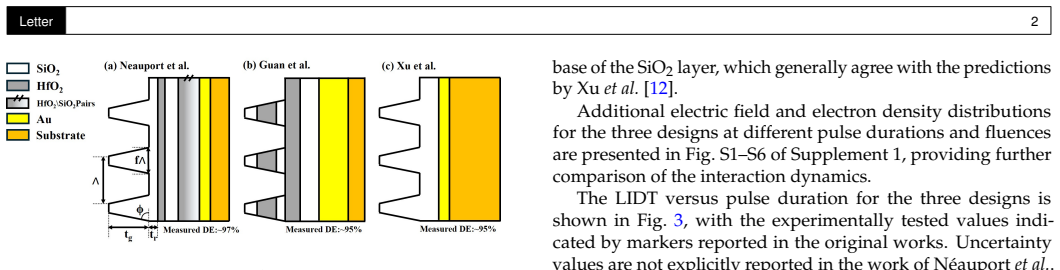
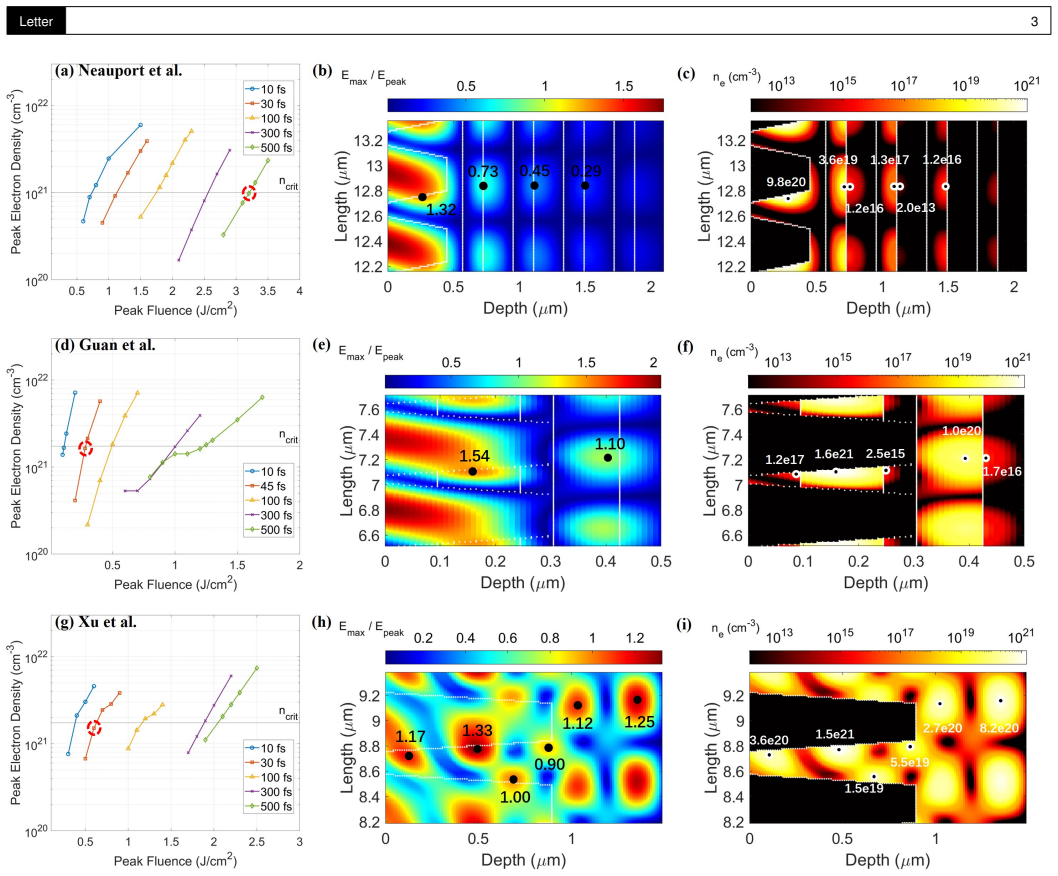
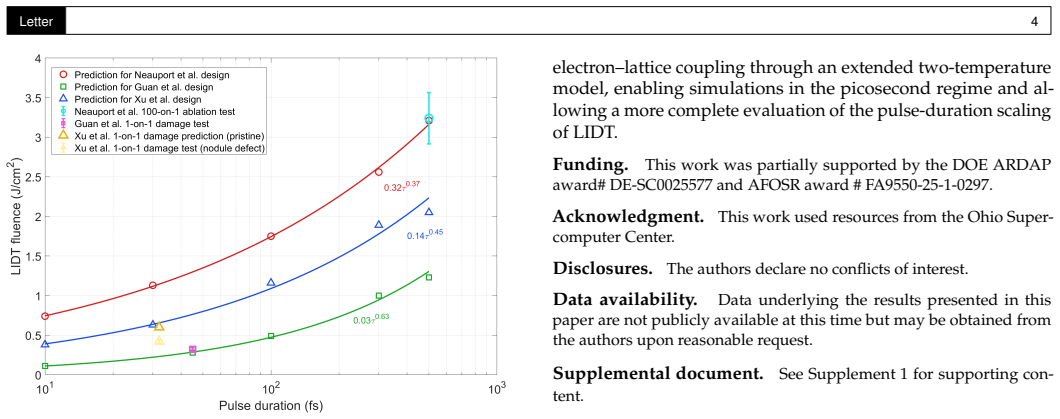
The dynamic finite-difference time-domain model incorporated with linear and non-linear absorption models produces simulations that agree with reported experimental LIDT values for three representative hybrid grating designs and predict scaling exponents which vary with pulse durations ranging from 10 to 500 fs. The results reveal strong dependence on both material bandgap and grating field distribution, providing guidance for designing high LIDT gratings.
What carries the argument
Dynamic finite-difference time-domain model with incorporated linear and non-linear absorption models
If this is right
- Scaling exponents for LIDT change across pulse durations from 10 to 500 fs.
- Material bandgap strongly affects the damage threshold scaling.
- Grating field distribution influences the LIDT behavior.
- The model can predict performance for new designs without immediate experiments.
Where Pith is reading between the lines
- The approach may extend to predicting damage in other nanostructured optics.
- Designers could tailor gratings for specific laser pulse lengths to maximize threshold.
- Further experiments at extreme pulse durations could test the model's limits.
Load-bearing premise
The dynamic finite-difference time-domain model accurately captures the physical mechanisms of laser-induced damage in hybrid gratings without needing extra adjustments.
What would settle it
An experiment measuring LIDT for a new hybrid grating design at several pulse durations between 10 and 500 fs and finding scaling exponents that deviate from the model's predictions.
Figures
read the original abstract
High damage threshold gratings are in demand worldwide as critical components for next generation ultrahigh intensity lasers. Here we investigate the pulse-duration dependence of ultrafast laser-induced damage thresholds (LIDT) in hybrid multilayer dielectric gratings, touted to combine superior performance properties of both metallic and multilayer dielectric (MLD) gratings, using a dynamic finite-difference time-domain model incorporated with linear and non-linear absorption models. Simulations agree with reported experimental LIDT values for three representative designs and predict scaling exponents which vary with pulse durations ranging from 10 to 500 fs. The results reveal strong dependence on both material bandgap and grating field distribution, providing guidance for designing high LIDT gratings.
Editorial analysis
A structured set of objections, weighed in public.
Referee Report
Summary. The manuscript develops a dynamic finite-difference time-domain (FDTD) simulation incorporating linear and non-linear absorption to examine the pulse-duration scaling of laser-induced damage thresholds (LIDT) in hybrid multilayer dielectric gratings. It reports agreement between simulated and experimental LIDT values for three representative grating designs and derives pulse-duration-dependent scaling exponents over 10–500 fs that depend on material bandgap and local field distribution.
Significance. If the model validation holds without parameter fitting to the target experiments, the work would supply concrete design rules for high-LIDT hybrid gratings in ultrahigh-intensity laser systems, quantifying how bandgap and field localization control the scaling exponent across the femtosecond regime.
major comments (3)
- [Results] Results section (comparison with experiment): Agreement is shown only for three designs at unspecified pulse durations; it is not demonstrated that the experimental data span the full 10–500 fs interval or that the non-linear absorption coefficients were constrained independently of those data. This directly affects the reliability of the predicted variation in scaling exponents.
- [Methods] Methods, dynamic FDTD model: The linear and non-linear absorption terms are stated to be incorporated, but no independent validation (e.g., against single-material thin-film damage data or known multi-photon coefficients) is provided to confirm that the duration dependence emerges from the physics rather than from model assumptions.
- [Discussion] Discussion of scaling exponents: The claim that exponents vary with bandgap and field distribution rests on the model’s ability to extrapolate beyond the three validated designs; without a sensitivity analysis or additional test cases outside the fitted range, the load-bearing conclusion on design guidance remains under-supported.
minor comments (2)
- [Figures] Figure captions should explicitly state the pulse durations used for each experimental comparison point.
- [Methods] Notation for the non-linear absorption coefficient should be defined once and used consistently; several instances appear without prior definition.
Simulated Author's Rebuttal
We thank the referee for the careful and constructive review of our manuscript. We address each major comment below with point-by-point responses and indicate where revisions will be made.
read point-by-point responses
-
Referee: [Results] Results section (comparison with experiment): Agreement is shown only for three designs at unspecified pulse durations; it is not demonstrated that the experimental data span the full 10–500 fs interval or that the non-linear absorption coefficients were constrained independently of those data. This directly affects the reliability of the predicted variation in scaling exponents.
Authors: The experimental comparisons use LIDT values reported in the literature for the three specific hybrid grating designs, which were measured at pulse durations in the 100–300 fs range. In the revised manuscript we will explicitly tabulate these measurement durations alongside the simulated values. The non-linear absorption coefficients are taken directly from independent literature values for the constituent dielectric materials and were not adjusted to match the grating data. The model is then applied across the full 10–500 fs interval to obtain the scaling exponents. We will add a clarifying sentence in the Results section to make this independence explicit. revision: partial
-
Referee: [Methods] Methods, dynamic FDTD model: The linear and non-linear absorption terms are stated to be incorporated, but no independent validation (e.g., against single-material thin-film damage data or known multi-photon coefficients) is provided to confirm that the duration dependence emerges from the physics rather than from model assumptions.
Authors: The linear absorption uses measured imaginary refractive indices, while the non-linear terms employ standard multi-photon absorption models with coefficients drawn from published material data. To address the concern we will expand the Methods section with additional references to prior independent validations of these absorption models against single-material thin-film LIDT measurements, thereby confirming that the pulse-duration dependence arises from the underlying physics. revision: yes
-
Referee: [Discussion] Discussion of scaling exponents: The claim that exponents vary with bandgap and field distribution rests on the model’s ability to extrapolate beyond the three validated designs; without a sensitivity analysis or additional test cases outside the fitted range, the load-bearing conclusion on design guidance remains under-supported.
Authors: The three designs already span a useful range of bandgaps and field localizations. Nevertheless, we agree that a dedicated sensitivity study would strengthen the design-guidance claim. In the revised Discussion we will add simulations in which bandgap and local-field enhancement are varied parametrically while holding other parameters fixed, and we will report the resulting changes in the extracted scaling exponents. revision: yes
Circularity Check
No significant circularity: validation against external experiments leaves predictions as independent extrapolations
full rationale
The paper presents a dynamic FDTD model incorporating linear and non-linear absorption, reports agreement with independently reported experimental LIDT values on three designs, and then computes scaling exponents over 10-500 fs. No quoted equations or self-citations reduce the predicted scaling exponents to fitted inputs by construction, nor does any load-bearing premise collapse to a self-citation chain. The central claim rests on external experimental benchmarks rather than internal redefinition or renaming, satisfying the default expectation of a non-circular derivation.
Axiom & Free-Parameter Ledger
Reference graph
Works this paper leans on
-
[1]
Zhang, W
W. Zhang, W. Kong, G. Wang,et al., Opt. Eng.60, 020902 (2021)
2021
-
[2]
Poole, S
P . Poole, S. Trendafilov, G. Shvets,et al., Opt. Express21, 26341 (2013)
2013
-
[3]
Papadopoulos, J
D. Papadopoulos, J. Zou, C. Le Blanc,et al., High Power Laser Sci. Eng.4, e34 (2016)
2016
-
[4]
J. A. Britten, W. A. Molander, A. M. Komashko, and C. P . Barty. Proc. SPIE5273, 1 (2004)
2004
-
[5]
Cotel, N
A. Cotel, N. Forget, C. Brach,et al., Conf. on Lasers Electro- Optics/Quantum Electron. Laser Sci. Photonic Appl. Syst. Technol. p. JFB6 (2005)
2005
-
[6]
H. Guan, Y . Jin, S. Liu,et al., Laser Phys.23, 115301 (2013)
2013
-
[7]
Zhang, M
S. Zhang, M. Tripepi, A. AlShafey,et al., Opt. Express29, 39983 (2021)
2021
-
[8]
Z. Su, M. Y . Noor, E. DeAngelis,et al., Proc. SPIEPC13729, PC1372907 (2025)
2025
-
[9]
Steinmeyer, Appl
G. Steinmeyer, Appl. Opt.45, 1484 (2006)
2006
-
[10]
Néauport, N
J. Néauport, N. Bonod, S. Hocquet,et al., Opt. Express18, 23776 (2010)
2010
-
[11]
H. Guan, H. Chen, J. Wu,et al., Opt. Lett.39, 170 (2014)
2014
-
[12]
J. Xu, X. Zou, J. Chen,et al., Opt. Lett.44, 2871 (2019)
2019
-
[13]
B. C. Stuart, M. D. Feit, A. M. Rubenchik,et al., Phys. Rev. Lett.74, 2248 (1995)
1995
-
[14]
B. C. Stuart, M. D. Feit, S. Herman,et al., Phys. Rev. B53, 1749 (1996)
1996
-
[15]
Zhang, C
S. Zhang, C. Menoni, V. Gruzdev, and E. Chowdhury, Nanomaterials 12(2022)
2022
-
[16]
Ultrafast laser interaction with dielectric– metal hybrid coatings: A 2d fdtd modeling study,
Z. Su and E. Chowdhury, “Ultrafast laser interaction with dielectric– metal hybrid coatings: A 2d fdtd modeling study,” (2026). Accepted at High Power Laser Science and Engineering
2026
-
[17]
Néauport, N
J. Néauport, N. Bonod, S. Hocquet,et al., Proc. SPIE7842, 784209 (2010)
2010
-
[18]
Neauport, E
J. Neauport, E. Lavastre, G. Razé,et al., Opt. Express15, 12508 (2007)
2007
-
[19]
F . Kong, H. Huang, L. Wang,et al., Opt. & Laser Technol.97, 339 (2017)
2017
-
[20]
J. H. Campbell, F . Rainer, M. R. Kozlowski,et al., Proc. SPIE1441, 444 (1991)
1991
-
[21]
S. V. Garnov, A. S. Epifanov, S. M. Klimentov, and A. A. Manenkov, Proc. SPIE1848, 403 (1993)
1993
-
[22]
M. Mero, J. Liu, W. Rudolph,et al., Phys. Rev. B71, 115109 (2005)
2005
-
[23]
Déziel, L
J.-L. Déziel, L. J. Dubé, and C. Varin, Phys. Rev. B104, 045201 (2021)
2021
-
[24]
D. A. Alessi, C. W. Carr, R. P . Hackel,et al., Opt. Express23, 15532 (2015)
2015
-
[25]
F . Kong, Y . Jin, D. Li,et al., Proc. SPIE8530, 85300L (2012)
2012
-
[26]
F . Kong, Y . Jin, S. Liu,et al., Chin. Opt. Lett.11, 102302 (2013)
2013
discussion (0)
Sign in with ORCID, Apple, or X to comment. Anyone can read and Pith papers without signing in.