REVIEW 4 major objections 6 minor 3 references
Computational predictions of nutrient precipitation for intensified cell 1 culture media via amino acid solution thermodynamics
T0 review · 4 major / 6 minor · reviewed 2026-08-04 · deepseek-v4-flash
Pith's one-line read The paper claims that a single set of UNIFAC group-interaction parameters, fit to binary activity-coefficient data and forty ternary solubility datasets, predicts amino-acid solubility and precipitation in multicomponent cell culture media,
desk verdict A useful dataset and a plausible UNIFAC parameter set, but the media-precipitation claims outrun the pure-solid assumption and the paper blurs training fit with prediction. read the letter →
The pith
A machine-rendered reading of the paper's core claim, the machinery that carries it, and where it could break.
The reading
What carries the argument
The load-bearing object is the modified UNIFAC group-contribution model, which computes amino-acid activity coefficients from a combinatorial size-and-shape term plus residual interactions among fifteen functional groups, including water, NH2, COOH, and side-chain groups such as OH, ACH, CH3S, and ring groups. Because amino acids share functional groups, parameters fit to simple amino acids transfer to complex ones, and rare side-chain pair interactions are filled in from ternary solubility data. Solubility predictions use the constant-saturation-activity relation: at fixed temperature, each amino acid's activity at its solubility limit is set by its binary solubility in water, and the multi
What would settle it
Equilibrate a tyrosine–serine–water slurry at a fixed temperature, filter, and analyze the residual solid composition by HPLC or X-ray diffraction. The model assumes the solid is pure tyrosine, so detecting serine or a mixed solid phase in the precipitate would directly falsify the constant-saturation-activity assumption and require a solid-solution correction.
Extended reading notes
Core claim
The central claim is that short-range intermolecular interactions among amino acids in water can be captured by a single set of functional-group interaction parameters rather than molecule-specific parameters. The paper regresses these parameters against activity coefficients for nineteen amino acids in water and solubility data for forty ternary systems (two amino acids plus water), including what the authors describe as the largest reported set of ternary amino-acid solubility data. The resulting B+T parameter set predicts ternary solubility with an average normalized individual error around 3%, and it reproduces quaternary solubility measurements for alanine, leucine, and valine. The pape
Load-bearing premise
Every solubility prediction assumes the solid that forms is the pure amino acid, so each solute's saturation activity stays at its pure-water value; in real media, where precipitates are mixtures, that fixed point moves.
Editorial extensions
If this is right
- Media developers can screen amino-acid combinations computationally, flagging pairs like tyrosine and serine where solubility drops sharply even though each solute is below its pure-water solubility limit.
- The model supports splitting feeds into separate amino-acid 'pots' whose members mutually raise solubility; the paper lists 30 predicted triplets designed for this purpose.
- Because UNIFAC is group-based rather than molecule-based, the same fitted parameters apply to new amino acids built from known groups, and the quaternary validation suggests the approach extends beyond ternary systems.
- The current model is limited to neutral amino acids at fixed pH and temperature; the paper states that charged amino acids require long-range electrostatic terms, with pH and temperature effects left as planned extensions.
- The heatmap generated from the model gives a screening matrix that can guide which nutrients should be co-formulated in concentrated media without precipitation.
Reading between the lines
- A direct test of group additivity would be to measure quaternary systems containing rare side chains—tyrosine, methionine, tryptophan, phenylalanine—where pair parameters were partly inferred from ternary data; if predictions degrade, higher-order non-additivity is present.
- Relaxing the pure-solid assumption would let the framework treat mixed amino-acid precipitates as non-ideal solid solutions, which matters for real media where the solid contains several amino acids rather than a single one.
- The pairwise heatmap could be embedded in a media-design optimization loop that chooses which nutrients belong in the same feed pot, turning solubility prediction into a design constraint for process intensification rather than a post-hoc check.
- Adding salt and pH effects will likely require coupling short-range UNIFAC terms with long-range electrostatic terms; the paper's own roadmap points there, and this would make the model testable against full 50-to-100-component media rather than amino-acid-only solutions.
Signed reviews
Editorial analysis
A structured set of objections, weighed in public.
Referee Report
Summary. The paper develops a UNIFAC group-contribution framework for predicting amino-acid solubilities in aqueous multicomponent solutions, motivated by precipitation problems in intensified cell culture media. The authors compile and generate a large dataset of binary activity coefficients and 40 ternary amino-acid solubility systems, regress a single set of group interaction parameters (B+T, Table 5), and present ternary system 'predictions' (Figure 6, Table 6), a solubility heatmap (Figure 7), proposed amino-acid clusters (Table 8), and a six-point quaternary system check (Figure 8). A separate parameter set (B, Table S2) is regressed from binary data alone and used to make genuine out-of-sample ternary predictions (Figure 4, reported ~8% error). The manuscript's central claim is that this approach can serve as a 'digital twin' for cell culture media formulation.
Significance. If fully supported, the paper would be a useful contribution to the bioprocess media-design literature. The assembled ternary solubility dataset appears to be the largest reported for amino acids, and the group-contribution concept is well matched to the problem of many components sharing functional groups. Credit is due for the B-only parameter exercise in Figure 4: those predictions are genuinely out-of-sample and demonstrate that the functional-group approach can capture solubility changes from binary data alone. However, the strength of the evidence is lower than the text claims. The B+T results in Figure 6 and Table 6 are in-sample regressions, not predictions; the quaternary validation is only six points from one simple aliphatic amino-acid family; and the equilibrium model in Eq. (5) rests on a pure-solid assumption that is not met in the target application to real cell culture media precipitates. These issues are correctable through careful reframing and additional validation, but they affect the load-bearing claim.
major comments (4)
- [Section 3.3, Eq. (5)] Equation (5) treats a_i^sat = x_i gamma_i at the solubility limit as a constant independent of other solutes. This is only valid if the equilibrating solid phase is pure amino acid i. In the paper's own target application, the introduction cites Hoang et al. showing an AMBIC feed-media precipitate containing tyrosine (77 wt%), phenylalanine (4 wt%), and about eight other amino acids. For a mixed solid phase, equilibrium requires x_i^L gamma_i^L = a_i^sat (x_i^S gamma_i^S), so a_i^sat is not constant but depends on solid-phase composition and nonideality. Equation (5) therefore cannot describe co-precipitation or solid-solution formation. Section 4.5 lists pH, temperature, and salts as future work, but never flags the solid-phase assumption as a limitation. This is a scope error rather than an internal inconsistency for the pure-excess-solid experiments in the present ternary/quaternary s
- [Section 4.2, Eq. (7)] The B+T ternary results shown in Figure 6 and Table 6 are not predictions; they are in-sample fits. Equation (7) explicitly includes the ternary solubility residuals in the objective function F(IP), so the optimization minimizes those residuals. The reported normalized individual error of approximately 3% is therefore a training error, and the repeated use of 'prediction' for these results is circular. Genuine out-of-sample evidence exists in Figure 4, where the B-only parameter set (not exposed to ternary solubility data) reproduces ternary solubilities with reported ~8% error. The authors should separate regression quality from predictive validity, for example by reporting cross-validated held-out ternary systems, and should revise the terminology throughout Section 4.2 and Table 6.
- [Section 4.4, Figure 8] The quaternary validation consists of only six experimental points, all from one literature source and all involving alanine, valine, and leucine. These amino acids share simple aliphatic side chains whose group interactions are already well represented in the fitted matrix. No numeric error metric is reported for Figure 8; the conclusion that the model 'generalizes to even larger combinations' is not quantitatively supported. This is independent evidence for the media-prediction claim, not a replacement for a larger holdout set. The authors should report the actual prediction errors and either add more quaternary and realistic (tyrosine/phenylalanine-containing) validation or temper the stated conclusions.
- [Equations (10)-(13)] The qualitative effect classifications appear to have reversed labels. Equation (10) defines Experimental metric = (Final ternary solubility - Binary solubility)/Binary solubility, so a positive value means the ternary solubility is higher than binary. Equation (11), however, labels 'Increased' as metric < -0.05 and 'Decreased' as metric > 0.05. The same inversion appears in the Predicted effect definition in Eqs. (12)-(13). This sign error affects the interpretation of Table 6 and the qualitative claims in Section 4.2 and the heatmap. The authors should verify whether the table entries and heatmap were generated with the intended (correct) convention and fix the displayed equations and any affected entries.
minor comments (6)
- [Section 3.4, Eq. (7)] The notation in Eq. (7) is ambiguous: the same symbol n appears in both sums and the indices for the activity-coefficient term and solubility term are not clearly bounded. Please define all index ranges explicitly.
- [Section 4.2 heading] The heading 'Regression and prediction of ternary system' conflates fitting with prediction. Consider 'Regression and in-sample evaluation of ternary systems' or similar.
- [Figure 8] Add numerical error values (e.g., absolute and relative differences) to each bar or to a table; visual inspection alone is insufficient for a quantitative claim of close agreement.
- [Table 7] The green-box designation for experimental data is not visible in grayscale or color-blind accessible reproduction. Use symbols such as asterisks or boldface.
- [Table 2] Minor typo: 'isoleucine' is lowercased, unlike the other entries; also check 'Tianxin Xang' on the title page versus 'Tianxin Zhang' in the acknowledgments.
- [Data availability] The data availability statement says data are 'available upon request' and mentions extended materials, but no repository link or persistent identifier is given. For reproducibility, consider depositing the raw solubility and activity-coefficient data in a public repository.
Circularity Check
The 40 ternary 'predictions' in Fig. 6/Table 6 are the same solubility residuals minimized by Eq. 7, so the headline ternary verification is a training-set fit; genuine out-of-sample checks are limited to Fig. 4 and the six quaternary points.
-
fitted input called prediction
[Section 3.4, Eq. (7); Section 4.2, Fig. 6 caption and Table 6]
"In this work, the objective function used to determine the optimal set of interaction parameters ... is a function of the sum of squares of residuals of the activity coefficient data as well as the ternary system solubility data taken collectively. F(IP)=... (7) ... The ternary system regression results obtained from regression of the interaction parameters to both binary system activity coefficient data and the ternary system solubility data (Equation 7) are shown in Figure 6."
The 40 ternary systems in Fig. 6 and Table 6 are exactly the Solubility_exp terms in the second residual sum of Eq. 7; the B+T parameters were optimized by minimizing that sum. Reporting the resulting residuals as 'predictions' or as verification of ternary behavior is therefore equivalent to evaluating the fitting objective on the training data. The ~3% normalized individual error is a training error. The paper's abstract claim that 'predictions ... have been verified with experimentally measured ternary and quaternary amino acid solutions' is thus partly circular for the ternary part; independent support comes instead from Fig. 4 (binary-only parameters) and six held-out quaternary points in Fig. 8.
-
fitted input called prediction
[Section 4.2, after Fig. 5]
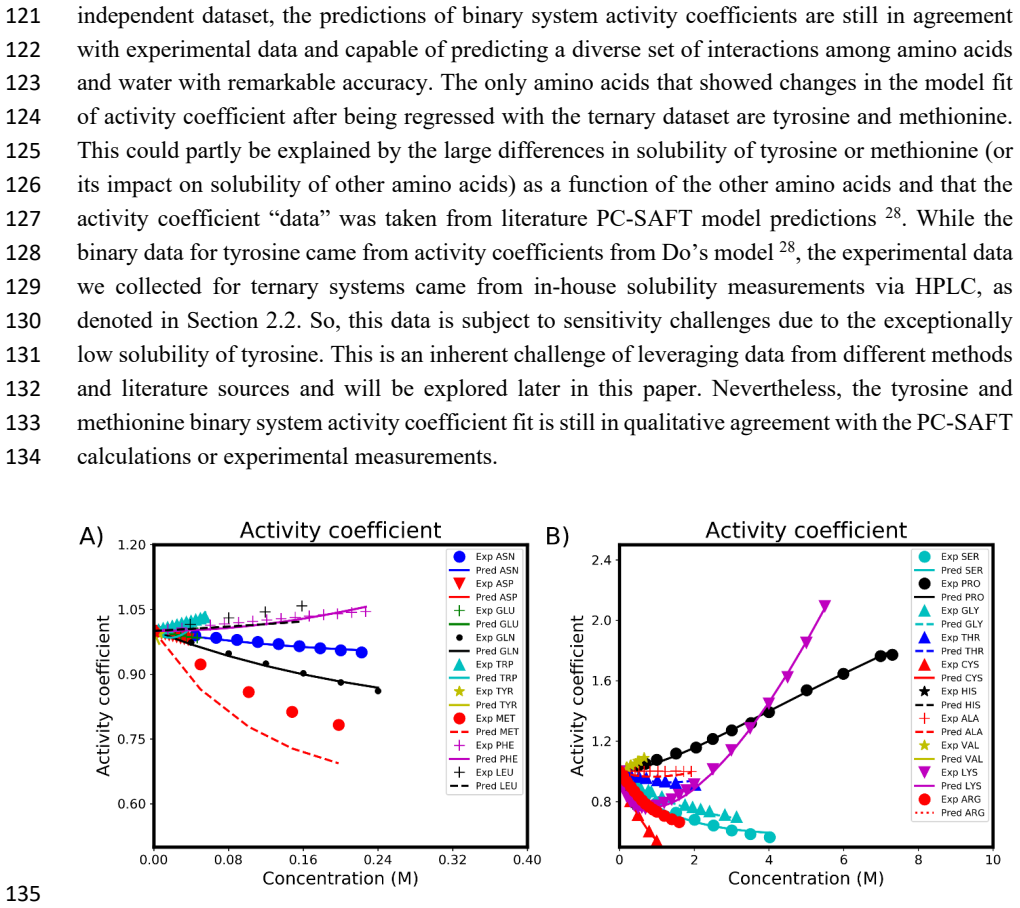
"As a first check of the validity of the parameter set, we tested this newly fit data set on its ability to predict binary amino acid system activity coefficients. ... despite the addition of a new, more complex, and independent dataset, the predictions of binary system activity coefficients are still in agreement with experimental data."
The binary activity-coefficient data plotted in Fig. 5 are the first residual term of the same objective function Eq. 7 used to fit B+T. Calling this a 'prediction' and calling the ternary dataset 'independent' is inaccurate: both terms are in the fitted objective. This is a minor circular labeling, secondary to the ternary fitting issue.
full rationale
The paper's central, load-bearing quantitative claim is that one UNIFAC parameter set can predict multicomponent amino-acid solubility. That claim is supported by three displays: (i) ternary predictions from binary-only B parameters (Fig. 4), which is a genuine out-of-sample check; (ii) B+T 'predictions' on 40 ternary systems (Fig. 6/Table 6), which are training fits because Eq. 7 minimizes those solubility residuals; and (iii) six quaternary points (Fig. 8), which are out-of-sample. Because the largest and most emphasized ternary display reduces by construction to the fitting objective, the paper exhibits partial circularity: at least two 'predictions' are fitted inputs relabeled. This is not a fully circular derivation: Fig. 4 and Fig. 8 provide real, if limited, independent evidence. The pure-solid assumption in Eq. 5 is a thermodynamic modeling assumption rather than a circular step, and the few self-citations (refs. 40-42) are not load-bearing. Therefore score 6.
Assumptions & free parameters
free parameters (4)
- UNIFAC B+T interaction parameter matrix =
Table 5, 159 nonzero entries
- a_i^sat activity constants per amino acid =
one per amino acid, from binary solubility
- Heatmap perturbation dose =
1/1000th of secondary amino acid solubility
- Effect classification threshold =
0.05
assumptions (6)
- domain assumption UNIFAC group additivity and Larsen's modified UNIFAC apply to aqueous amino acid solutions
- domain assumption Amino acids are represented as uncharged neutral molecules with the listed functional groups; zwitterionic charge effects are bundled into short-range parameters
- domain assumption The activity of amino acid i at its solubility limit, a_i^sat, is constant regardless of other solutes; the solid phase is pure i
- ad hoc to paper Long-range electrostatic interactions are negligible for amino acids with similar isoelectric points; acidic and basic amino acids are excluded
- domain assumption PC-SAFT model outputs can stand in for experimental activity coefficients for 8 amino acids
- standard math Newton-Raphson iteration converges to the physical root of the nonlinear solubility equation
Cite this review
Pith. "Pith review of Computational predictions of nutrient precipitation for intensified cell 1 culture media via amino acid solution thermodynamics." pith.science (2026). https://pith.science/paper/5L5RW7X4
@misc{pith2026250906271,
  author       = {Pith},
  title        = {Pith review of: Computational predictions of nutrient precipitation for intensified cell 1 culture media via amino acid solution thermodynamics},
  year         = {2026},
  howpublished = {\url{https://pith.science/paper/5L5RW7X4}},
  note         = {Machine review of arXiv:2509.06271}
}
read the original abstract
The majority of therapeutic monoclonal antibodies (mAbs) on the market are produced using Chinese Hamster Ovary (CHO) cells cultured at scale in chemically defined cell culture medium. Because of the high costs associated with mammalian cell cultures, obtaining high cell densities to produce high product titers is desired. These bioprocesses require high concentrations of nutrients in the basal media and periodically adding concentrated feed media to sustain cell growth and therapeutic protein productivity. Unfortunately, the desired or optimal nutrient concentrations of the feed media are often solubility limited due to precipitation of chemical complexes that form in the solution. Experimentally screening the various cell culture media configurations which contain 50 to 100 compounds can be expensive and laborious. This article lays the foundation for utilizing computational tools to understand precipitation of nutrients in cell culture media by studying the pairwise interactions between amino acids in thermodynamic models. Activity coefficient data for one amino acid in water and amino acid solubility data of two amino acids in water have been used to determine a single set of UNIFAC group interaction parameters to predict the thermodynamic behavior of the multi-component systems found in mammalian cell culture media. The data collected in this study is, to our knowledge, the largest set of ternary system amino acid solubility data reported to date. These amino acid precipitation predictions have been verified with experimentally measured ternary and quaternary amino acid solutions. Thus, we demonstrate the utility of our model as a digital twin to identify optimal cell culture media compositions by replacing empirical approaches for nutrient precipitation with computational predictions based on thermodynamics of individual media components in complex mixtures.
Figures


Figures from the paper (4 more)


Reference graph
Works this paper leans on
-
[3]
Weinreich, D.M. et al. REGN-COV2, a Neutralizing Antibody Cocktail, in Outpatients 434 with Covid-19. New England Journal of Medicine 384, 238-251 (2021). 435 4. Walsh, G. & Walsh, E. Biopharmaceutical benchmarks 2022. Nature Biotechnology 40, 436 1722-1760 (2022). 437 5. Intellegence, M. Biopharmaceutical Industry Size & Share Analysis - Growth Trends & ...
work page 2021
-
[18]
Pinho, S.P., Silva, C.M. & Macedo, E.A. Solubility of Amino Acids: A Group-471 Contribution Model Involving Phase and Chemical Equilibria. Industrial & Engineering 472 Chemistry Research 33, 1341-1347 (1994). 473 19. Kuramochi, H., Noritomi, H., Hoshino, D. & Nagahama, K. Measurements of Solubilities 474 of Two Amino Acids in Water and Prediction by the U...
work page 1994
-
[32]
Soto, A., Arce, A., K. Khoshkbarchi, M. & Vera, J.H. Measurements and modelling of the 507 solubility of a mixture of two amino acids in aqueous solutions. Fluid Phase Equilibria 508 158-160, 893-901 (1999). 509 33. Jin, X.Z. & Chao, K.C. Solubility of four amino acids in water and of four pairs of amino 510 acids in their water solutions. Journal of Chem...
work page 1999
Reviewed August 4, 2026 · model on record in the stance chip above.
Discussion (0). Continue with ORCID to comment.