REVIEW 3 major objections 5 minor 37 references
High-Precision Formation Control for Heterogeneous Multi-Robot Systems via Hierarchical Hybrid Physics-Informed Deep Reinforcement Learning
T0 review · 3 major / 5 minor · reviewed 2026-07-12 · grok-4.5
Pith's one-line read A two-layer hybrid of physics feedforward, PD control and residual deep RL lets an Ackermann leader and omnidirectional followers keep high-precision formations with 100% simulated success.
desk verdict Solid hybrid residual-RL packaging for Ackermann-plus-omni formations with clean sim ablations, undercut by a no-comms claim that contradicts the 20-D follower state. read the letter →
The pith
A machine-rendered reading of the paper's core claim, the machinery that carries it, and where it could break.
The reading
What carries the argument
HM-DRL formation law: the follower velocity command is the sum of a physics-based feed-forward velocity (linear, tangential, centripetal and Euler terms), a classical PD correction on position error, and a low-dimensional SAC residual; hierarchical rewards (approach, spacing, high-precision holding bonus, progress, soft collision) train the residual.
What would settle it
Retrain and re-test the identical HM-DRL policies after stripping every global and peer feature from the follower state vector so that only local self-error and leader kinematics remain; if average position error rises above 0.5 m or success rate falls below 100% under the paper’s own success definition, the claim that the hybrid alone produces the reported precision collapses.
Extended reading notes
Core claim
Decomposing heterogeneous formation control into an SAC-trained Ackermann navigation layer and an HM-DRL layer that adds only a residual correction on top of physics feed-forward plus PD yields policies that achieve 100% success rate and sub-0.2 m average position error, outperforming pure residual RL or incomplete hybrids.
Load-bearing premise
Each follower is assumed to observe a 20-dimensional state that already contains the global average formation error and relative neighbour states even though the problem statement asserts no inter-robot communication.
Editorial analysis
A structured set of objections, weighed in public.
Referee Report
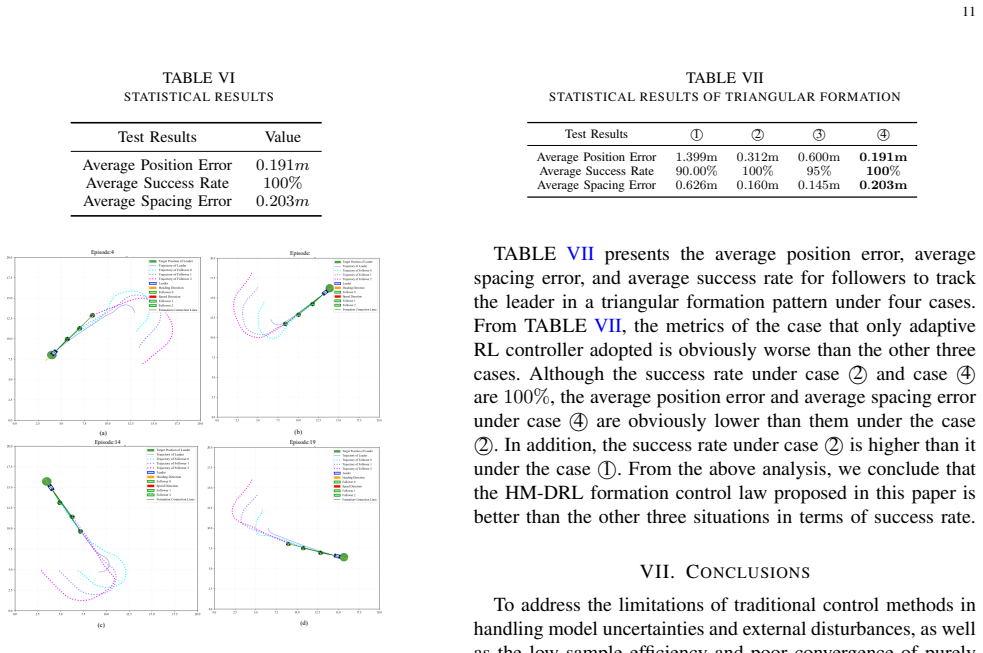
Summary. The paper proposes HHy-PIDRL, a two-layer framework for formation control of heterogeneous multi-robot systems with an Ackermann-steering leader and omnidirectional followers. The upper layer trains a SAC policy for leader navigation to random targets under a nonholonomic kinematic model. The lower layer trains per-follower SAC residual policies on top of a physics feedforward controller (linear, tangential, centripetal, and Euler terms) plus a PD feedback controller (HM-DRL). A hierarchical reward with a near-zero holding bonus is used for followers. In ideal 2D kinematic simulation, both layers report 100% success; ablation (Table VII) shows the full hybrid achieves lower average position error (0.191 m, triangular) than pure residual RL or partial hybrids.
Significance. If the results hold under a sensing model consistent with the problem statement, the work is a useful systems contribution: residual RL on a physics+PD base is a practical way to improve sample efficiency and precision for heterogeneous formation tracking, and the hierarchical holding reward is a concrete design choice that addresses vanishing incentive near zero error. Strengths include a clear four-way ablation (Table VII), explicit kinematic models rather than particles, and reproducible training curves and 20-episode test statistics. The contribution is empirical and engineering-oriented rather than theoretical; its impact depends on resolving the information assumptions and moving beyond noise-free simulation.
major comments (3)
- [Sec. IV and V.B (state space, Eqs. 22–29)] Sec. IV states that each robot self-localizes and that “there is no need for communication between robots.” In V.B the follower state is a 20-D vector that explicitly includes S_i,peers (relative positions/velocities of neighbors, Eqs. (22)–(25)) and S_global (formation-wide average position and spacing errors, Eqs. (28)–(29)), plus S_leader (leader velocity, angular rate, and accelerations). The residual SAC policies—and therefore the 100% success rates and the Table VII ablation that favor the full hybrid—are trained with this information. Without an explicit sensing, broadcast, or estimation model that supplies those quantities under the stated no-communication assumption, the headline performance numbers are not guaranteed to be realizable as claimed. Please either (i) revise Sec. IV to specify the information graph / sensing model, or (ii) retrain and re-evaluate residual policies w
- [Sec. VI; Abstract] All reported “experiments” (Sec. VI) are noise-free kinematic simulations (Euler integration for followers, ideal Ackermann kinematics for the leader) with perfect state. There is no process noise, actuator lag, localization error, or hardware trial, despite the section title “Simulation and Experiment Results” and the abstract’s claim of high-precision, highly responsive control under model uncertainty and disturbances. The central comparative claim (full hybrid best; 100% success) is therefore only supported inside an ideal simulator. At minimum, add disturbance/noise trials and/or a clear limitation statement; ideally include a hardware or higher-fidelity validation for the residual policies.
- [Sec. VI.C, Table VII] The ablation (Table VII) compares only internal variants of the authors’ residual architecture (pure RL; FF+RL; PD+RL; full hybrid). There is no baseline against standard formation controllers used in the related-work discussion (e.g., distributed MPC, consensus/virtual-structure with PD, or end-to-end multi-agent RL without the hybrid base) under the same leader trajectories and success criteria. Without that, the claim that HHy-PIDRL overcomes classical and end-to-end RL limitations remains only partially substantiated. Please add at least one external baseline under identical evaluation metrics.
minor comments (5)
- [V.B, Eqs. (28)–(29)] Eqs. (28)–(29) label the global features as s_9 and s_10; they should be s_11 and s_12 given the preceding history features.
- [Throughout] Typos and formatting: “repsectively,” “F ormation,” “peplay,” “Trainning,” “DW A,” “A ∗,” and inconsistent spacing in section headings (e.g., “SIMULATIONANDEXPERIMENTRESULTS”).
- [Abstract; Sec. VI.B] Success is defined with a specific last-30%-of-episode error threshold (0.5 m). State this definition earlier when 100% success is claimed in the abstract and introduction so readers can interpret the metric.
- [V.B Action Space] a_scaling for the residual action is mentioned but not given a numerical value; list it with the other free parameters (Tables I, V).
- [Fig. 2] Fig. 2 caption and body text largely restate each other; tighten the caption and ensure the diagram clearly marks which signals require inter-robot information.
Circularity Check
Empirical hybrid control paper with no derivation-by-construction circularity; minor author self-cites in related work are not load-bearing for the 100% success or ablation claims.
full rationale
This is a simulation-based robotics/ML control paper, not a first-principles derivation. The physics feed-forward terms (Eqs. 11–16) follow standard rigid-body kinematics of the Ackermann leader (linear, tangential, centripetal, Euler) and are independent of the reported success rates. PD gains (Kp=5, Kd=1.5) and hierarchical reward coefficients (C_pos=8, k_pos=2, C_holding=6, etc.) are free design parameters, not fitted to the test metrics and then re-presented as predictions. SAC training and 20-episode held-out tests (Tables III, VI, VII) measure average position/spacing error and success under an explicit success definition; the ablation numbers (full hybrid 0.191 m vs pure RL 1.399 m) are comparative measurements, not tautologies of the training objective. Self-citations ([12] Zhong et al., [13] Li et al.) appear only as related DRL formation baselines and do not supply a uniqueness theorem or force the hybrid architecture. The global/peer state features vs. “no communication” tension is an assumption/consistency issue, not circular reduction of a claimed prediction to its inputs. No step reduces Eq. X to Eq. Y by construction or renames a fit as a prediction. Score 1 only for ordinary non-load-bearing author self-reference in the literature review.
Assumptions & free parameters
free parameters (5)
- PD gains Kp, Kd =
Kp=5, Kd=1.5
- Follower reward coefficients (C_pos, k_pos, C_spacing, k_spacing, C_holding, k_holding, tau_holding, C_progress, C_prox, =
e.g. C_pos=8, k_pos=2, C_holding=6, k_holding=10, tau_holding=0.3, d_safe,L=1.8m, d_safe,F=2.25m
- Leader reward scales and speed bands =
R_dist=10*exp(-0.2 Dt), R_reach=1000, etc.
- Residual action scaling a_scaling
- SAC and PER training hyperparameters =
e.g. critic lr 3e-4, actor 3e-5, gamma 0.99, episodes 10000/50000
assumptions (4)
- domain assumption Ackermann leader kinematics (1) and omnidirectional Euler integration (2)–(4) are adequate plant models for the claimed high-precision control.
- ad hoc to paper Each robot can self-localize perfectly and form global average error and neighbor states without inter-robot communication.
- domain assumption SAC with clipped double Q, entropy tuning, and PER is a valid off-policy learner for continuous formation residual control.
- domain assumption Desired formation offsets in the leader frame are known and fixed (triangular/line geometry).
invented entities (2)
-
HHy-PIDRL / HM-DRL hybrid control law (v_ff + v_pd + v_rl)
-
Hierarchical holding reward R_i,holding with sharp near-zero bonus
Cite this review
Pith. "Pith review of High-Precision Formation Control for Heterogeneous Multi-Robot Systems via Hierarchical Hybrid Physics-Informed Deep Reinforcement Learning." pith.science (2026). https://pith.science/paper/5LGOROMC
@misc{pith2026260703512,
  author       = {Pith},
  title        = {Pith review of: High-Precision Formation Control for Heterogeneous Multi-Robot Systems via Hierarchical Hybrid Physics-Informed Deep Reinforcement Learning},
  year         = {2026},
  howpublished = {\url{https://pith.science/paper/5LGOROMC}},
  note         = {Machine review of arXiv:2607.03512}
}
read the original abstract
Existing classical control methods commonly require precise models and struggle to cope with model uncertainties and external disturbances, while end-to-end reinforcement learning (RL) approaches suffer from low sample efficiency and poor convergence. To overcome these challenges, this paper proposes a hierarchical hybrid physics-informed deep reinforcement learning (HHy-PIDRL) framework, aiming to realize high-precision, highly responsive formation control for heterogeneous multi-robot systems (HMRSs). The proposed framework contains two layers. Specifically, first, the upper layer designs an autonomous navigation policy network for Ackermann-steering leader based on the Soft Actor-Critic (SAC) deep reinforcement learning (DRL) algorithm. Second, the lower module integrates a high-fidelity physical feed-forward controller, a classical proportional-derivative (PD) controller, and an adaptive DRL residual controller to propose an effective hybrid model and DRL (HM-DRL)-based formation control policy network. Third, a unique hierarchical reward function is designed for training Omnidirectional followers, which effectively guides agents toward a refined, stable control policy. Experimental results demonstrate that, the success rate of both the upper-layer autonomous navigation policy network and the HM-DRL based formation control policy networks reach 100%. Meanwhile, ablation experiments are conducted to verify the validity and credibility of the proposed method.
Figures


Figures from the paper (8 more)



Reference graph
Works this paper leans on
-
[1]
Multi-robot environmental coverage with a two-stage coordination strategy via deep reinforcement learning,
L. Zhu, J. Cheng, H. Zhang, W. Zhang, and Y . Liu, “Multi-robot environmental coverage with a two-stage coordination strategy via deep reinforcement learning,”IEEE Trans. Intell. Transp. Syst., vol. 25, no. 6, pp. 5022-5033, 2024
2024
-
[2]
Development of a search and rescue robot system for the underground building environment,
G. Wang, W. Wang, P. Ding, Y . Liu, H. Wang, Z. Fan, H. Bai, Z. Hongbiao, and Z. Du, “Development of a search and rescue robot system for the underground building environment,”J. Field Robot., vol. 40, no. 3, pp. 655-683, 2023
2023
-
[3]
A reinforced neighborhood search method combined with genetic algorithm for multi-objective multi-robot transportation system,
P. Chen, J. Liang, K.-J. Qiao, H. Song, P. N. Suganthan, L.-L. Dai, and X.-X. Ban, “A reinforced neighborhood search method combined with genetic algorithm for multi-objective multi-robot transportation system,” IEEE Trans. Intell. Transp. Syst., vol. 26, no. 8, pp. 12586-12599, 2025. 12 (a) Perimeter formation (b) Rectangular formation (c) Horizontal lin...
2025
-
[4]
Forma- tion control of nonholonomic multirobot systems over robot coordinate frames and its application to LiDAR-based robots,
K. Sakurama, C. Peng, R. Asai, H. Sakata, and M. Yamazumi, “Forma- tion control of nonholonomic multirobot systems over robot coordinate frames and its application to LiDAR-based robots,”IEEE Trans. Control Syst. Technol., vol. 32, no. 6, pp. 2075-2089, 2024
-
[5]
Deform: Adaptive formation reconfig- uration of multi-robot systems in confined environments,
J. Li, Y . Xu, X. Shi, and L. Li, “Deform: Adaptive formation reconfig- uration of multi-robot systems in confined environments,”IEEE Robot. Automation Lett., vol. 10, no. 5, pp. 4706-4713, 2025
2025
-
[6]
Heterogeneous multi-robot cooperation with asynchronous multi-agent reinforcement learning,
H. Zhang, X. Zhang, Z. Feng, and X. Xiao, “Heterogeneous multi-robot cooperation with asynchronous multi-agent reinforcement learning,” IEEE Robot. Automation Lett., vol. 9, no. 1, pp. 159-166, 2024
2024
-
[7]
Z. Xiao, H. Xu, J. Tao, R. Lu, and P. Shi, “Leader-following formation of heterogeneous multi-agent systems with time-varying topology: A virtual neighbor framework,”IEEE Trans. Autom. Sci. Eng., early access, Sep. 05, 2025, doi: 10.1109/TASE.2025.3606489
-
[8]
PD and PI control for the lag consensus of nonlinear multiagent systems with and without external disturbances,
J. L. Wang, X. Han, T. Huang, “PD and PI control for the lag consensus of nonlinear multiagent systems with and without external disturbances,” IEEE Trans. Cybern., vol. 54, no. 6, pp. 3716-3726, 2024
2024
Show all 37 references
-
[9]
A heuristic-guided dynamical multi-rover motion planning framework for planetary surface missions,
S. Nayak, M. Paton, and M. W. Otte, “A heuristic-guided dynamical multi-rover motion planning framework for planetary surface missions,” IEEE Robot. Automation Lett., vol. 8, no. 5, pp. 2542-2549, 2023
2023
-
[10]
Online trajectory generation with distributed model predictive control for multi-robot motion planning,
C. E. Luis, M. Vukosavljev, and A. P. Schoellig, “Online trajectory generation with distributed model predictive control for multi-robot motion planning,”IEEE Robot. Automation Lett., vol. 5, no. 2, pp. 604- 611, 2020
2020
-
[11]
Incorporating control barrier functions in distribut- edmodel predictive control for multirobot coordinated control,
C. Jiang and Y . Guo, “Incorporating control barrier functions in distribut- edmodel predictive control for multirobot coordinated control,”IEEE Trans. Control Netw. Syst., vol. 11, no. 1, pp. 547-557, 2024
2024
-
[12]
Distributed deep reinforcement learning for Ackermann multi-robot formation: A weighted multi-objective optimization,
W. Zhong, B. Xie, Y . Li, L. Cascone, Y . Lu, and S. He, “Distributed deep reinforcement learning for Ackermann multi-robot formation: A weighted multi-objective optimization,”IEEE Trans. Consum. Electron., early access, Aug. 27, 2025, doi: 10.1109/TCE.2025.3603259
2025 doi
-
[13]
Distributed deep reinforcement learning based on bi-objective framework for multi-robot formation,
J. Li, Q. Liu, and G. Chi, “Distributed deep reinforcement learning based on bi-objective framework for multi-robot formation,”Neural Netw., vol. 171, pp. 61-72, 2024
2024
-
[14]
Multi-UA V adaptive cooperative formation trajectory planning based on an improved MATD3 algorithm of deep reinforcement learning,
X. Xing, Z. Zhou, Y . Li, B. Xiao, and Y . Xun, “Multi-UA V adaptive cooperative formation trajectory planning based on an improved MATD3 algorithm of deep reinforcement learning,”IEEE Trans. V eh. Technol., vol. 73, no. 9, pp. 12484-12499, 2024
2024
-
[15]
Safe multi-agent reinforcement learning for behavior-based cooperative navigation,
M. Dawood, S. Pan, N. Dengler, S. Zhou, A. P. Schoellig, and M. Ben- newitz, “Safe multi-agent reinforcement learning for behavior-based cooperative navigation,”IEEE Robot. Automation Lett., vol. 10, no. 6, pp. 6256-6263, 2025
2025
-
[16]
Research on global path planning algorithm for mobile robots based on improvedA ∗,
X. Xu, J. Zeng, Y . Zhao, and X. L ¨u, “Research on global path planning algorithm for mobile robots based on improvedA ∗,”Expert Syst. Appl., vol. 243, pp. 122922, 2024
2024
-
[17]
An improvedA ∗ algorithm for the industrial robot path planning with high success rate and short length
B. Fu, L. Chen, Y . Zhou, D. Zheng, Z. Wei, J. Dai, and H. Pan, “An improvedA ∗ algorithm for the industrial robot path planning with high success rate and short length.”Rob. Auton. Syst., vol. 10, pp. 26-37, 2018
2018
-
[18]
A self-rotating, single-actuated UA V with extended sensor field of view for autonomous navigation,
N. Chen, F. Kong, W. Xu, Y . Cai, H. Li, D. He, Y . Qin, and F. Zhang, “A self-rotating, single-actuated UA V with extended sensor field of view for autonomous navigation,”Sci. Robot., vol. 8, no. 76, pp. eade4538, 2023
2023
-
[19]
Au- tonomous navigation for robot-assisted intraluminal and endovascular procedures: A systematic review,
A. Pore, Z. Li, D. Dall’Alba, A. Hernansanz, E. De Momi, A. Menciassi, A. C. Gelpi, J. Dankelman, P. Fiorini, and E. Vander Poorten, “Au- tonomous navigation for robot-assisted intraluminal and endovascular procedures: A systematic review,”IEEE Trans. Robot., vol. 39, no. 4, p...
2023
-
[20]
Hybrid feedback for autonomous navigation in planar environments with convex obstacles,
M. Sawant, S. Berkane, I. Polushin, and A. Tayebi, “Hybrid feedback for autonomous navigation in planar environments with convex obstacles,” IEEE Trans. Autom. Control, vol. 68, no. 12, pp. 7342-7357, 2023
2023
-
[21]
Improved RRT global path planning algorithm based on bridge test,
H. Tu, Y . Deng, Q. Li, M. Song, and X. Zheng, “Improved RRT global path planning algorithm based on bridge test,”Rob. Auton. Syst., vol. 171, pp. 104570, 2024
2024
-
[22]
Efficient reliability-based path planning of off-road autonomous ground vehicles through the coupling of surrogate modeling and RRT,
J. Yin, Z. Hu, Z. P. Mourelatos, D. Gorsich, A. Singh, and S. Tau, “Efficient reliability-based path planning of off-road autonomous ground vehicles through the coupling of surrogate modeling and RRT,”IEEE Trans. Intell. Transp. Syst., vol. 24, no. 12, pp. 15035-15050, 2023
2023
-
[23]
CDT-Dijkstra: Fast planning of globally optimal paths for all points in 2D continuous space,
J. Liu, M. Fu, W. Zhang, B. Chen, R. Prakapovich, and U. Sychou, “CDT-Dijkstra: Fast planning of globally optimal paths for all points in 2D continuous space,” inProc.IEEE/RSJ Int. Conf. Intell. Robots Syst., 2023, pp. 2224-2231
2023
-
[24]
Research on hybrid path planning of underground degraded environment inspection robot based on improvedA ∗ algorithm and DW A algorithm,
C. Gu, S. Liu, H. Li, K. Yuan, and W. Bao, “Research on hybrid path planning of underground degraded environment inspection robot based on improvedA ∗ algorithm and DW A algorithm,”Robotica, vol. 43, no. 3, pp. 15035-15050, 2025
2025
-
[25]
Simultaneous learning and planning within sensing range: An approach for local path planning,
L. Kumar, A. K. Sadhu, and R. Dasgupta, “Simultaneous learning and planning within sensing range: An approach for local path planning,” IEEE Trans. Artif. Intell., vol. 5, no. 12, pp. 6399-6411, 2024
2024
-
[26]
Supervised learning of human welder behaviors for intelligent robotic welding,
Y .K. Liu, Y .M. Zhang, “Supervised learning of human welder behaviors for intelligent robotic welding,”IEEE Trans. Autom. Sci. Eng., vol. 14, no. 3, pp. 1532-1541, 2017
2017
-
[27]
Badgr: An autonomous self- supervised learning-based navigation system,
G. Kahn, P. Abbeel, and S. Levine, “Badgr: An autonomous self- supervised learning-based navigation system,”IEEE Robot. Automation Lett., vol. 6, no. 2, pp. 1312-1319, 2021
2021
-
[28]
Autonomous navigation of mobile robots in unknown environments using off-policy reinforcement learning with curriculum learning,
Y . Yin, Z. Chen, G. Liu, J. Yin, and J. Guo, “Autonomous navigation of mobile robots in unknown environments using off-policy reinforcement learning with curriculum learning,”Expert Syst. Appl., vol. 247, pp.123202, 2024
2024
-
[29]
Distributed formation control for a multirobotic fish system with model-based event-triggered communication mechanism,
S. Dai, Z. Wu, P. Zhang, M. Tan, and J. Yu, “Distributed formation control for a multirobotic fish system with model-based event-triggered communication mechanism,”IEEE Trans. Ind. Electron., vol. 70, no. 11, pp. 11433-11442, 2023
2023
-
[30]
Formation control of unmanned aerial vehicle swarms: A comprehensive review,
Q. Ouyang, Z. Wu, Y . Cong, and Z. Wang, “Formation control of unmanned aerial vehicle swarms: A comprehensive review,”Asian J. Control, vol. 25, no. 1, pp. 570-593, 2023
2023
-
[31]
Unmanned aerial vehicle formation control method based on improved artificial potential field and consensus,
Y . Wang, Y . Zhong, Y . Zhang, Y . Shi, and H. Chen, “Unmanned aerial vehicle formation control method based on improved artificial potential field and consensus,”IET Contr . Theory Appl, vol. 18, no. 8, pp. 2555- 2567, 2024
2024
-
[32]
An improved artificial potential field method for path planning and formation control of the multi-UA V systems,
Z. Pan, C. Zhang, Y . Xia, H. Xiong, and X. Shao, “An improved artificial potential field method for path planning and formation control of the multi-UA V systems,”IEEE Trans. Circuit Syst. II Express Briefs, vol. 69, no. 3, pp. 1129-1133, 2022
2022
-
[33]
Bearing-based formation control simultaneously involving several heterogeneous multi-agent systems with nonlinear 13 uncertainties,
Y . Wang and S. Liu, “Bearing-based formation control simultaneously involving several heterogeneous multi-agent systems with nonlinear 13 uncertainties,” inProc. IEEE Conf. Decis. Control., 2023, pp. 4429- 4434
2023
-
[34]
Decentralized behavior-based formation control of multiple robots considering obstacle avoidance,
G. Lee and D. Chwa, “Decentralized behavior-based formation control of multiple robots considering obstacle avoidance,”Intel. Serv. Robotics, vol. 11, pp. 127-138, 2018
2018
-
[35]
Soft actor-critic: Off- policy maximum entropy deep reinforcement learning with a stochastic actor,
T. Haarnoja, A. Zhou, P. Abbeel, and S. Levine, “Soft actor-critic: Off- policy maximum entropy deep reinforcement learning with a stochastic actor,” inProc. Int. Conf. Mach. Learn., 2018, pp. 1861-1870
2018
-
[36]
Scalable safe multi-agent rein- forcement learning for multi-agent system,
H. Du, F. Gou, and Y . Cai, “Scalable safe multi-agent rein- forcement learning for multi-agent system,” 2025,arXiv preprint arXiv:2501.13727
2025 arXiv
-
[37]
Graph neu- ral network-based multi-agent reinforcement learning for resilient dis- tributed coordination of multi-robot systems,
A. Goeckner, Y . Sui, N. Martinet, X. Li, and Q. Zhu, “Graph neu- ral network-based multi-agent reinforcement learning for resilient dis- tributed coordination of multi-robot systems,” inProc. IEEE/RSJ Int. Conf. Intell. Robots Syst., 2024, pp. 5732-5739
2024
Reviewed July 12, 2026 · model on record in the stance chip above.
Discussion (0). Continue with ORCID to comment.