Vector Scaffolding: Inter-Scale Orchestration for Differentiable Image Vectorization
Pith reviewed 2026-06-30 22:25 UTC · model grok-4.3
The pith
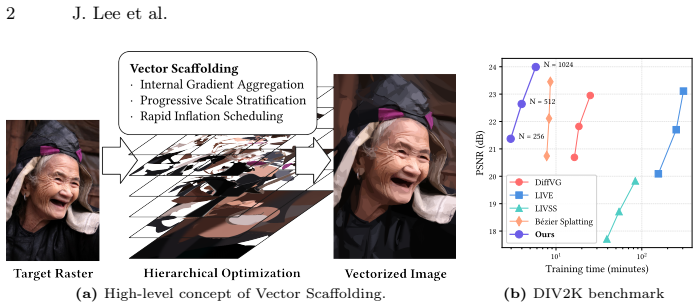
Vector Scaffolding organizes curve optimization into hierarchical stages to prevent topology collapse during differentiable image vectorization.
A machine-rendered reading of the paper's core claim, the machinery that carries it, and where it could break.
Core claim
By replacing flat pixel-matching with a staged topological construction that first stabilizes learning through Interior Gradient Aggregation and then densifies primitives via Progressive Stratification and Rapid Inflation Scheduling, the optimization converges to editable vector graphics without the redundant structures that previously limited practical use.
What carries the argument
Interior Gradient Aggregation, which corrects the scale imbalance between area and boundary gradient contributions inside the differentiable rendering loss.
If this is right
- Optimization finishes in roughly 2.5 times less wall-clock time than the prior state of the art.
- Final rasterized images reach up to 1.4 dB higher PSNR on standard test sets.
- The output vector files contain fewer redundant curves and preserve larger-scale structures, making manual editing more feasible.
- Learning rates fifty times larger than usual remain stable once the gradient aggregation is applied.
Where Pith is reading between the lines
- The same rebalancing step may reduce collapse in other differentiable rendering tasks that mix primitives at widely different scales.
- Adding one more stratification level could support still larger primitive budgets before collapse reappears.
- The stabilized high-rate schedule could be paired with user-specified topology constraints to produce vectors that match both image content and intended editability.
Load-bearing premise
The mathematical imbalance between area and boundary gradients is the main driver of topology collapse, and Interior Gradient Aggregation plus the two scheduling techniques fix it without creating new instabilities.
What would settle it
Reproducing the reported benchmarks with the proposed method and finding neither faster convergence nor higher PSNR, or observing the same degree of topology collapse, would falsify the claim.
Figures


read the original abstract
Differentiable vector graphics have enabled powerful gradient-based optimization of vector primitives directly from raster images. However, existing frameworks formulate this as a flat optimization problem, forcing hundreds to thousands of randomly initialized curves to blindly compete for pixel-level error reduction. This disordered optimization leads to topology collapse, where macroscopic structures are distorted by internal high-frequency noise, resulting in a redundant and uneditable "polygon soup" that limits practical editability. To address this limitation, we propose Vector Scaffolding, a novel hierarchical optimization framework that shifts from flat pixel-matching to structured topological construction tailored for vector graphics. By identifying a key cause of topology collapse as the mathematical imbalance between area and boundary gradients, we introduce Interior Gradient Aggregation to stabilize the learning dynamics of multi-scale curve mixtures. Upon this stabilized landscape, we employ Progressive Stratification and Rapid Inflation Scheduling to progressively densify vector primitives with extremely high learning rates ($\times 50$). Experiments demonstrate that our approach accelerates optimization by $2.5\times$ while simultaneously improving PSNR by up to 1.4 dB over the previous state of the art.
Editorial analysis
A structured set of objections, weighed in public.
Referee Report
Summary. The paper claims that topology collapse in flat differentiable vector graphics optimization stems from the mathematical imbalance between area and boundary gradients; it introduces Vector Scaffolding with Interior Gradient Aggregation to stabilize multi-scale curve mixtures, plus Progressive Stratification and Rapid Inflation Scheduling to enable ×50 learning rates, yielding 2.5× faster optimization and up to 1.4 dB PSNR gains over prior state-of-the-art methods.
Significance. If the reported gains hold under rigorous validation, the work would advance practical differentiable vectorization by producing more topologically coherent and editable outputs, addressing a recognized limitation in converting raster images to vector primitives for graphics applications.
major comments (2)
- [Abstract] Abstract and §1: the central attribution of topology collapse to area-boundary gradient imbalance, and the claim that Interior Gradient Aggregation directly corrects it, is load-bearing for the 2.5× speed-up and 1.4 dB PSNR results, yet no gradient-magnitude measurements, separate ablations of re-weighting the baseline loss, or tests isolating initialization/curvature effects are described; without these the mechanism remains unsubstantiated.
- [Experiments] Experiments section: the abstract states clear quantitative improvements but supplies no baselines, datasets, error bars, or statistical significance tests, preventing assessment of whether the gains generalize or are attributable to the proposed scaffolding rather than hyper-parameter tuning.
minor comments (2)
- [Abstract] The abstract refers to 'extremely high learning rates (×50)' without stating the reference learning rate or the precise form of Rapid Inflation Scheduling.
- Notation for the three proposed components (Interior Gradient Aggregation, Progressive Stratification, Rapid Inflation Scheduling) is introduced without an accompanying diagram or pseudocode in the provided text.
Simulated Author's Rebuttal
We thank the referee for the constructive comments. We address each major point below and will revise the manuscript accordingly to strengthen the claims with additional evidence.
read point-by-point responses
-
Referee: [Abstract] Abstract and §1: the central attribution of topology collapse to area-boundary gradient imbalance, and the claim that Interior Gradient Aggregation directly corrects it, is load-bearing for the 2.5× speed-up and 1.4 dB PSNR results, yet no gradient-magnitude measurements, separate ablations of re-weighting the baseline loss, or tests isolating initialization/curvature effects are described; without these the mechanism remains unsubstantiated.
Authors: Section 3.1 derives the area-boundary gradient imbalance from first principles as the source of topology collapse in flat optimization. Interior Gradient Aggregation is introduced precisely to rebalance these gradients during multi-scale curve optimization. We agree that direct empirical validation would strengthen the argument and will add gradient-magnitude measurements before/after aggregation, ablations isolating re-weighting from the baseline loss, and controlled experiments holding initialization and curvature fixed. revision: yes
-
Referee: [Experiments] Experiments section: the abstract states clear quantitative improvements but supplies no baselines, datasets, error bars, or statistical significance tests, preventing assessment of whether the gains generalize or are attributable to the proposed scaffolding rather than hyper-parameter tuning.
Authors: The current experiments section compares against prior state-of-the-art differentiable vectorization methods and reports the stated speed-up and PSNR gains. To enable rigorous assessment, the revision will explicitly enumerate all baselines, name the datasets, report standard deviations from multiple independent runs, and include statistical significance tests (e.g., paired t-tests) confirming that the improvements arise from the scaffolding components rather than hyper-parameter differences alone. revision: yes
Circularity Check
No significant circularity in derivation or claims
full rationale
The provided abstract and context contain no equations, fitted parameters, or self-citations that reduce any claimed prediction, cause identification, or performance gain to the inputs by construction. The core claims rest on an empirical identification of gradient imbalance as a cause of topology collapse, followed by proposed stabilization techniques whose efficacy is asserted via experimental speed and PSNR improvements. These are external benchmarks rather than self-referential derivations. No load-bearing step matches any of the enumerated circularity patterns, as there are no quoted reductions of the form 'X is defined in terms of Y' or 'fitted input renamed as prediction.' The reader's preliminary score of 2.0 is consistent with the absence of any detectable circularity.
Axiom & Free-Parameter Ledger
free parameters (1)
- Rapid Inflation Scheduling multiplier
axioms (1)
- domain assumption Mathematical imbalance between area and boundary gradients is the key cause of topology collapse
Reference graph
Works this paper leans on
-
[1]
Agustsson, E., Timofte, R.: NTIRE 2017 challenge on single image super- resolution: Dataset and study. In: Proceedings of the IEEE Conference on Com- puter Vision and Pattern Recognition Workshops (CVPRW). pp. 1122–1131 (2017).https://doi.org/10.1109/CVPRW.2017.150
-
[2]
In: Proceedings of the IEEE/CVF Conference on Computer Vision and Pattern Recognition (CVPR)
Cao, D., Wang, Z., Echevarria, J., Liu, Y.: SVGformer: Representation learning for continuous vector graphics using transformers. In: Proceedings of the IEEE/CVF Conference on Computer Vision and Pattern Recognition (CVPR). pp. 10093– 10102 (2023)
2023
-
[3]
Capsfusion: Rethinking image-text data at scale
Chen, Y., Ni, B., Liu, J., Huang, X., Chen, X.: Towards high-fidelity artistic image vectorization via texture-encapsulated shape parameterization. In: Proceedings of the IEEE/CVF Conference on Computer Vision and Pattern Recognition (CVPR). pp. 15877–15886 (2024).https://doi.org/10.1109/CVPR52733.2024.01503
-
[4]
ACM Transactions on Graphics42(4), 1– 13 (2023).https://doi.org/10.1145/3592128
Du, Z.J., Kang, L.F., Tan, J., Gingold, Y., Xu, K.: Image vectorization and editing via linear gradient layer decomposition. ACM Transactions on Graphics42(4), 1– 13 (2023).https://doi.org/10.1145/3592128
-
[5]
Dataset (1999), https://r0k.us/graphics/kodak/, accessed: 2026-05-12
Eastman Kodak Company: Kodak lossless true color image suite. Dataset (1999), https://r0k.us/graphics/kodak/, accessed: 2026-05-12
1999
-
[6]
Capsfusion: Rethinking image-text data at scale
Guédon, A., Lepetit, V.: SuGaR: Surface-aligned gaussian splatting for efficient 3D mesh reconstruction and high-quality mesh rendering. In: Proceedings of the IEEE/CVF Conference on Computer Vision and Pattern Recognition (CVPR). pp. 5354–5363 (2024).https://doi.org/10.1109/CVPR52733.2024.00512
-
[7]
In: International Conference on Learning Representations (ICLR) (2025)
Guo, M., Wang, B., He, K., Matusik, W.: TetSphere splatting: Representing high- quality geometry with lagrangian volumetric meshes. In: International Conference on Learning Representations (ICLR) (2025)
2025
-
[8]
Hirschorn, O., Jevnisek, A., Avidan, S.: Optimize & reduce: A top-down approach for image vectorization. Proceedings of the AAAI Conference on Artificial Intelli- gence38(3), 2148–2156 (2024).https://doi.org/10.1609/aaai.v38i3.27987
-
[9]
In: Ad- vances in Neural Information Processing Systems
Ho, J., Jain, A.N., Abbeel, P.: Denoising diffusion probabilistic models. In: Ad- vances in Neural Information Processing Systems. vol. 33, pp. 6840–6851 (2020)
2020
-
[10]
In: ACM SIGGRAPH 2024 Conference Papers
Huang, B., Yu, Z., Chen, A., Geiger, A., Gao, S.: 2D gaussian splatting for geomet- rically accurate radiance fields. In: ACM SIGGRAPH 2024 Conference Papers. pp. 1–11. Association for Computing Machinery (2024).https://doi.org/10.1145/ 3641519.3657428
-
[11]
Jain, A., Xie, A., Abbeel, P.: VectorFusion: Text-to-SVG by abstracting pixel- baseddiffusionmodels.In:ProceedingsoftheIEEE/CVFConferenceonComputer VisionandPatternRecognition(CVPR).pp.1911–1920(2023).https://doi.org/ 10.1109/CVPR52729.2023.00190
-
[12]
Kerbl, B., Kopanas, G., Leimkühler, T., Drettakis, G.: 3D gaussian splatting for real-time radiance field rendering. ACM Transactions on Graphics42(4), 1–14 (2023).https://doi.org/10.1145/3592433
-
[13]
Li, T.M., Lukáč, M., Gharbi, M., Ragan-Kelley, J.: Differentiable vector graphics rasterization for editing and learning. ACM Transactions on Graphics39(6), 1–15 (2020).https://doi.org/10.1145/3414685.3417871
-
[14]
In: Advances in Neural Information Processing Systems (2025)
Liu, X., Zhou, C., Zhao, N., Huang, S.: Bézier splatting for fast and differentiable vector graphics rendering. In: Advances in Neural Information Processing Systems (2025)
2025
-
[15]
In: 2019 IEEE/CVF International Conference on Computer Vision (ICCV)
Lopes,R.G.,Ha,D.,Eck,D.,Shlens,J.:Alearnedrepresentationforscalablevector graphics. In: Proceedings of the IEEE/CVF International Conference on Computer 16 J. Lee et al. Vision (ICCV). pp. 7930–7939 (2019).https://doi.org/10.1109/ICCV.2019. 00802
-
[16]
In: 2024 International Conference on 3D Vision (3DV)
Luiten, J.T., Kopanas, G., Leibe, B., Ramanan, D.: Dynamic 3D gaussians: Track- ing by persistent dynamic view synthesis. In: 2024 International Conference on 3D Vision (3DV). pp. 800–809 (2024).https://doi.org/10.1109/3DV62453.2024. 00044
-
[17]
Ma, X., Zhou, Y., Xu, X., Sun, B., Filev, V., Orlov, N., Fu, Y., Shi, H.: To- wardslayer-wiseimagevectorization.In:ProceedingsoftheIEEE/CVFConference on Computer Vision and Pattern Recognition (CVPR). pp. 16314–16323 (2022). https://doi.org/10.1109/CVPR52688.2022.01583
-
[18]
Müller, T., Evans, A., Schied, C., Keller, A.: Instant neural graphics primitives with a multiresolution hash encoding. ACM Transactions on Graphics41(4), 1–15 (2022).https://doi.org/10.1145/3528223.3530127
-
[19]
NASA Goddard Photo and Video: Most amazing high definition image of earth – blue marble 2012. Flickr image, NASA Goddard Space Flight Center (2012), https://www.flickr.com/photos/gsfc/6760135001, public domain (NASA me- dia usage guidelines). Accessed: 2026-05-12
-
[20]
Reddy, P., Gharbi, M., Lukáč, M., Mitra, N.J.: Im2Vec: Synthesizing vector graph- ics without vector supervision. In: Proceedings of the IEEE/CVF Conference on Computer Vision and Pattern Recognition (CVPR). pp. 7342–7351 (2021). https://doi.org/10.1109/CVPR46437.2021.00726
-
[21]
In: Advances in Neural Information Processing Systems
Sitzmann, V., Martel, J.N.P., Bergman, A.W., Lindell, D.B., Wetzstein, G.: Im- plicit neural representations with periodic activation functions. In: Advances in Neural Information Processing Systems. vol. 33, pp. 7462–7473 (2020)
2020
-
[22]
In: International Conference on Learning Representations (ICLR) (2024)
Tang, J., Ren, J., Zhou, H., Liu, Z., Zeng, G.: DreamGaussian: Generative gaussian splatting for efficient 3D content creation. In: International Conference on Learning Representations (ICLR) (2024)
2024
-
[23]
In: Proceedings of the IEEE/CVF Confer- ence on Computer Vision and Pattern Recognition (CVPR)
Wang, Z., Huang, J., Sun, Z., Gong, Y., Cohen-Or, D., Lu, M.: Layered image vec- torization via semantic simplification. In: Proceedings of the IEEE/CVF Confer- ence on Computer Vision and Pattern Recognition (CVPR). pp. 7728–7738 (2025)
2025
-
[24]
Capsfusion: Rethinking image-text data at scale
Wu, G., Yi, T., Fang, J., Xie, L., Zhang, X., Wei, W., Liu, W., Tian, Q., Wang, X.: 4D gaussian splatting for real-time dynamic scene rendering. In: Proceedings of the IEEE/CVF Conference on Computer Vision and Pattern Recognition (CVPR). pp. 20310–20320 (2024).https://doi.org/10.1109/CVPR52733.2024.01920
-
[25]
Xie, X., Zhou, P., Li, H., Lin, Z., Yan, S.: Adan: Adaptive nesterov momentum al- gorithm for faster optimizing deep models. IEEE Transactions on Pattern Analysis and Machine Intelligence46(12), 9508–9520 (2024).https://doi.org/10.1109/ TPAMI.2024.3423382
-
[26]
In: Advances in Neural Information Processing Systems
Xing, X., Wang, C., Zhou, H., Zhang, J., Yu, Q., Xu, D.: DiffSketcher: Text guided vector sketch synthesis through latent diffusion models. In: Advances in Neural Information Processing Systems. vol. 36, pp. 15869–15889 (2023)
2023
-
[27]
Capsfusion: Rethinking image-text data at scale
Xing, X., Zhou, H., Wang, C., Zhang, J., Xu, D., Yu, Q.: SVGDreamer: Text guided SVG generation with diffusion model. In: Proceedings of the IEEE/CVF Conference on Computer Vision and Pattern Recognition (CVPR). pp. 4546–4555 (2024).https://doi.org/10.1109/CVPR52733.2024.00435
-
[28]
Capsfusion: Rethinking image-text data at scale
Yi, T., Fang, J., Wang, J., Wu, G., Xie, L., Zhang, X., Liu, W., Tian, Q., Wang, X.: GaussianDreamer: Fast generation from text to 3D gaussians by bridging 2D and 3D diffusion models. In: Proceedings of the IEEE/CVF Conference on Computer Vision and Pattern Recognition (CVPR). pp. 6796–6807 (2024).https://doi. org/10.1109/CVPR52733.2024.00649 Vector Scaff...
-
[29]
ACM Transactions on Graphics43(4), 1–13 (2024).https://doi.org/10
Zhang, P., Zhao, N., Liao, J.: Text-to-vector generation with neural path represen- tation. ACM Transactions on Graphics43(4), 1–13 (2024).https://doi.org/10. 1145/3658204
2024
-
[30]
In: 2018 IEEE/CVF Con- ference on Computer Vision and Pattern Recognition
Zhang, R., Isola, P., Efros, A.A., Shechtman, E., Wang, O.: The unreasonable effectiveness of deep features as a perceptual metric. In: Proceedings of the IEEE Conference on Computer Vision and Pattern Recognition (CVPR). pp. 586–595 (2018).https://doi.org/10.1109/CVPR.2018.00068
-
[31]
doi:10.1007/978-3-031- 53274-0_10 Mohammed J
Zhang, X., Ge, X., Xu, T., He, D., Wang, Y., Qin, H., Lu, G., Geng, J., Zhang, J.: GaussianImage: 1000 FPS image representation and compression by 2D gaussian splatting. In: Computer Vision – ECCV 2024. Lecture Notes in Computer Science, vol. 15067, pp. 327–345. Springer (2024).https://doi.org/10.1007/978-3-031- 72673-6_18
-
[32]
In: ACM SIGGRAPH 2025 Conference Papers
Zhang, Y., Li, B., Kuznetsov, A., Jindal, A., Diolatzis, S., Chen, K., Sochenov, A., Kaplanyan, A., Sun, Q.: Image-GS: Content-adaptive image representation via 2D gaussians. In: ACM SIGGRAPH 2025 Conference Papers. pp. 1–11. Association for Computing Machinery (2025).https://doi.org/10.1145/3721238.3730596
-
[33]
Zwicker, M., Pfister, H., van Baar, J., Gross, M.: EWA volume splatting. In: Pro- ceedings Visualization, 2001. VIS ’01. pp. 29–36. IEEE Computer Society (2001). https://doi.org/10.5555/601671.601674 18 J. Lee et al. Supplementary Material Vector Scaffolding: Inter-Scale Orchestration for Differentiable Image Vectorization Jaerin Lee, Kanggeon Lee, Kyoung...
discussion (0)
Sign in with ORCID, Apple, or X to comment. Anyone can read and Pith papers without signing in.