REVIEW 4 major objections 5 minor 65 references
Task-Specific Zero-shot Quantization-Aware Training for Object Detection
T0 review · 4 major / 5 minor · reviewed 2026-08-06 · deepseek-v4-flash
Pith's one-line read The paper claims that task-specific synthetic calibration sets, generated by adaptively sampling bounding boxes and categories from a pre-trained detector, let zero-shot quantization-aware training match or beat real-data QAT.
desk verdict A genuinely task-specific ZSQ mechanism for object detection, but the headline W8A8 claim rests on undertuned LSQ/LSQ+ baselines and needs stronger evidence. read the letter →
The pith
A machine-rendered reading of the paper's core claim, the machinery that carries it, and where it could break.
The reading
What carries the argument
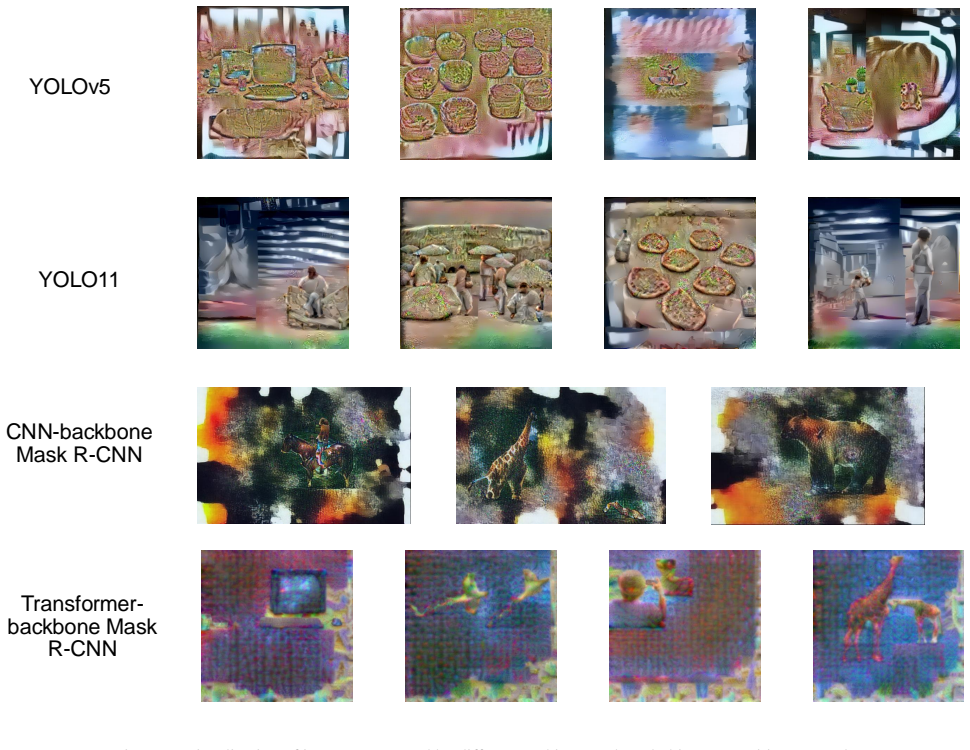
The load-bearing mechanism is adaptive label sampling: a Gaussian-noise image is optimized against a randomly initialized single-object label, then periodically the pre-trained detector re-detects objects in the evolving image, high-confidence boxes are added as labels, low-confidence ones are removed, and the image is re-optimized against the updated label set. This converts the teacher's stored statistics into bounding-box and category pseudo-labels, making the calibration set task-specific. The same labels then feed a quantization-aware training objective that combines KL prediction matching, feature-map alignment, and the detection loss itself, enabling the quantized student to learn directly from box and category information.
What would settle it
Generate the 2,000-image calibration set with the adaptive label sampler from a detector whose batch-normalization statistics have been replaced by those of a randomly initialized network, keeping all other steps identical; if the quantized model still matches real-data QAT, the paper's assumption that teacher statistics carry the label distribution is not doing the work.
Extended reading notes
Core claim
The paper's central discovery is that the bottleneck in zero-shot detection quantization is not image quality but task-specificity: images generated only to match a detector's internal statistics recover generic textures, whereas images generated against detection losses with adaptively sampled labels recover object categories, locations, and sizes. With these task-specific images, a quantized student trained with prediction-matching KL distillation, feature-level distillation, and the detection loss itself can match or beat real-data QAT. The paper reports W8A8 YOLOv5-l mAP of 47.3 with 2,000 synthetic images versus 46.0 for LSQ on the full COCO train set, with comparable results at W6A6 and W4A8, and 2–3 mAP gains over task-agnostic ZSQ baselines.
Load-bearing premise
The approach assumes that the pre-trained detector's stored statistics and its high-confidence predictions carry enough information about the real training labels—which categories appear, where, and how big—for a 2,000-image synthetic set to stand in for the full data.
Editorial extensions
If this is right
- At 8-bit weights and activations, zero-shot QAT with 2,000 synthetic images can beat full-data LSQ and LSQ+ on YOLOv5 and YOLO11 detectors, for example 47.3 versus 46.0 mAP on YOLOv5-l.
- At 6-bit weight settings, the method matches full-data QAT and outperforms same-data LSQ/LSQ+ by roughly 2–6 mAP across the tested YOLO models.
- On CNN- and Transformer-backbone Mask R-CNN, the method matches full-data LSQ at 8-bit on MS-COCO and exceeds it on Pascal VOC while using 1/60 or 1/100 of the training data.
- Removing the task-specific detection loss from quantization-aware training causes measurable drops, such as YOLO11-s W8A8 falling from 45.6 to 43.6 mAP, confirming that the task-specific loss is what drives the gain.
- A fully data-free variant using adaptive label sampling still exceeds grid-tile and multi-sample proxy labels by about 2.3 mAP at W6A6 and comes within 0.7 mAP of images generated with real labels.
Reading between the lines
- The paper leaves unquantified whether adaptive label sampling faithfully reproduces the long-tail category distribution of the real training set, so a divergence measurement between sampled and real category frequencies would determine whether the method scales to heavily imbalanced detection benchmarks.
- The same two-stage recipe of task-specific synthetic calibration and task-specific distillation plausibly transfers to other structured prediction tasks such as instance segmentation or keypoint detection, but the paper does not test those tasks.
- Because the 2,000-image calibration set is reusable, the method's efficiency advantage should grow with dataset size, and the reported up-to-16 times faster convergence suggests the synthetic set acts as a distilled prior rather than a random subsample.
Editorial analysis
A structured set of objections, weighed in public.
Referee Report
Summary. The paper proposes a two-stage zero-shot quantization-aware training (ZSQ-QAT) framework for object detection. In Stage I, a task-specific calibration set is synthesized by optimizing Gaussian-noise images against a pretrained full-precision detector using BN-statistics/feature alignment, a detection-style loss, and an adaptive label sampler that adds/removes boxes based on the teacher's own high-confidence detections. In Stage II, the quantized detector is fine-tuned with a combination of KL prediction distillation, feature-level distillation, and a task-specific detection loss. Experiments on YOLOv5, YOLO11, CNN-based Mask R-CNN, and Swin-based Mask R-CNN on MS-COCO and Pascal VOC compare against real-data LSQ/LSQ+ baselines and task-agnostic ZSQ methods, with the headline claim that 2k synthetic images outperform full-data LSQ/LSQ+ at W8A8 and are competitive or better at several other precisions.
Significance. If the empirical claims hold, the paper would be a useful step for zero-shot quantization of object detectors, since existing ZSQ methods for detection mostly use task-agnostic images. The adaptive label sampling idea is simple, the experimental coverage is broad (three detector families and multiple bit-widths), and the code is publicly available, which are clear strengths. The central claim, however, is comparative: 2k synthetic images allegedly beat full-data LSQ/LSQ+. That claim currently rests on baseline implementations that are not validated, on single-run results with no variance, and on a two-table numerical inconsistency. These issues are fixable within the scope of the manuscript, but they are load-bearing for the paper's main message.
major comments (4)
- [Sec. 4.1, Table 1; Appendix B.3] The headline W8A8 comparison against full-data LSQ/LSQ+ is not yet convincing because the baselines appear undertuned and are not validated. Appendix B.3 states that LSQ was extended by the authors to object detection, but no comparison against published LSQ-based detection results is provided. In Table 1, full-data LSQ on YOLOv5-l at W8A8 gives 46.0 mAP versus 49.0 FP (a 3.0 mAP drop); LSQ+ gives 46.3. Similarly, Table 2 shows Mask R-CNN LSQ dropping from 38.1 to 35.0. These gaps are substantially larger than what is typically expected of a well-configured 8-bit QAT pipeline. If the real-data baselines are weak, then the 0.3-1.0 mAP advantages claimed for the proposed method are artifacts of the comparison rather than evidence of zero-shot superiority. Please validate the baselines against known strong results (e.g., use official or hyperparameter-tuned LSQ/LSQ+ implementations, report per-model QAT hyperparameters and training curves, or add a strong reference detection-QAT baseline such as standard YOLO PTQ/QAT), and re-evaluate the central comparison after that validation.
- [Sec. 4.1, Tables 1-3] All tables report single runs, with no standard deviations, seed counts, or significance tests. The W8A8 advantages that drive the central claim are only 0.3-1.0 mAP, which is within the plausible seed-to-seed variation of detection training and quantization experiments. Please report mean and standard deviation over at least three seeds for the main comparisons, or otherwise establish that the reported margins are not noise. This is particularly important because the 'outperforms full-data LSQ/LSQ+' claim in Section 4.1 is based on very small margins.
- [Sec. 3.2, Algorithm 1; Sec. 4.4, Table 5; Fig. 3(b)] The adaptive label sampler is self-referential in a mild but important way: the teacher network detects objects on an image that the teacher itself helped synthesize, and those detections become the labels used both for further synthesis and for student fine-tuning. This can over-represent easy, high-confidence objects and under-represent rare or hard categories. The paper claims to reconstruct the category, location, and size distribution of the real training set, but Figure 3(b) provides only a qualitative histogram without a similarity metric. Please add quantitative comparisons between the sampled label distribution and the MS-COCO training distribution (e.g., KL or JS divergence over categories, and distributions of box width, height, aspect ratio, and objects-per-image), and report per-category detection performance to check that rare classes are not systematically lost. Such analysis is needed to support the 'completely data-free' and 'without any prior knowledge' statements in Sections 3.2 and 4.4.
- [Table 1 vs. Appendix C.2, Table 8] There is a direct numerical inconsistency in one of the key W8A8 cells. Table 1 reports Ours at W8A8 on YOLOv5-s as 35.8 mAP, while Table 8 reports 35.4 for the same setting (YOLOv5-s, 2k synthetic images, MS-COCO). The corresponding full-data LSQ value is 35.7 in both tables, so the sign of the claimed advantage changes depending on which value is used. Please reconcile the two tables and clarify which protocol produced the numbers in Table 1.
minor comments (5)
- [Tables 3 and 4] Entries such as '45.1/66.747.1/68.8' concatenate two mAP/mAP50 pairs without a separating space, making the Swin-T and Swin-S columns hard to read; please separate the columns clearly.
- [Appendix B.2] The hyperparameter list uses αBN and α_detect, while Eq. (6) uses αprior and αdetect; please align the notation and define αBN in the main text.
- [Sec. 4.1] The text says 'our approach utilizes only 2k ground truth labels,' but the labels are synthetic labels generated by the teacher, not ground truth annotations; please rephrase to avoid implying real labels are used.
- [Sec. 5] There is a minor typo: 'we propose' should be capitalized at the beginning of the sentence in the Conclusions section.
- [Fig. 3(b)] The category histogram lacks axis labels and a quantitative legend; please add labeled axes and a reference to the quantitative metric used (or add the metric to the caption).
Circularity Check
No significant circularity: the synthetic-label loop is an inherent part of data-free distillation, and the final evaluation is on real COCO/VOC; baseline-tuning concerns are correctness issues, not circularity.
full rationale
The paper's derivation chain is empirical rather than definitional: (1) synthesize a calibration set by matching batch-normalization statistics and optimizing a detection loss; (2) adaptively sample labels from the pre-trained teacher's own detections; (3) fine-tune the quantized network with knowledge distillation, feature distillation, and detection loss; (4) evaluate on real MS-COCO and Pascal VOC validation images. No equation defines the claimed output in terms of itself. The adaptive label sampler does use the teacher's predictions as labels, but the teacher is a fixed, externally pre-trained model, not the quantized student or the evaluation metric; this is standard data-free knowledge transfer, not a fitted parameter renamed as a prediction. The claim that the method 'reconstructs object locations, sizes, and category distributions' is validated by comparing against real-label generation and by final mAP on held-out real data, not by construction. Self-citations (Refs [5,6]) appear only as related-work context and are not load-bearing. Appendix B.3 admits that LSQ was extended to detection without published validation; that is a baseline-quality or correctness concern about whether the full-data controls are well-tuned, but it is not circular reasoning. No uniqueness theorem is imported, and no ansatz is smuggled in via citation. The reported advantage over full-data LSQ/LSQ+ could be inflated if those baselines are undertuned, but that would be an experimental-control issue, not a circularity of the derivation.
Assumptions & free parameters
free parameters (4)
- alpha_detect per architecture =
0.5 (YOLOv5), 1e-3 (YOLO11), 5.0 (CNN Mask R-CNN), 10.0 (Transformer Mask R-CNN)
- beta_detect, beta_KL, beta_feat per architecture =
e.g. {0.04, 0.1, 1.0} for YOLOv5, {1.0, 1.0, 1.0} for Transformer Mask R-CNN
- sampling thresholds conf_thresh and iou_thresh =
not reported numerically
- calibration set size S = 2k =
2000
assumptions (4)
- domain assumption Batch normalization statistics of the pre-trained detector summarize the real training distribution well enough to synthesize representative images.
- domain assumption For Transformers without BN, Patch Similarity Entropy loss (L_PSE) aligns synthetic inputs with the original data distribution.
- domain assumption A small 2k synthetic set can cover the diversity of a 120k-image detection training set.
- standard math LSQ per-tensor symmetric quantization is a representative QAT scheme for the detection task.
Cite this review
Pith. "Pith review of Task-Specific Zero-shot Quantization-Aware Training for Object Detection." pith.science (2026). https://pith.science/paper/5ME2TFCW
@misc{pith2026250716782,
  author       = {Pith},
  title        = {Pith review of: Task-Specific Zero-shot Quantization-Aware Training for Object Detection},
  year         = {2026},
  howpublished = {\url{https://pith.science/paper/5ME2TFCW}},
  note         = {Machine review of arXiv:2507.16782}
}
read the original abstract
Quantization is a key technique to reduce network size and computational complexity by representing the network parameters with a lower precision. Traditional quantization methods rely on access to original training data, which is often restricted due to privacy concerns or security challenges. Zero-shot Quantization (ZSQ) addresses this by using synthetic data generated from pre-trained models, eliminating the need for real training data. Recently, ZSQ has been extended to object detection. However, existing methods use unlabeled task-agnostic synthetic images that lack the specific information required for object detection, leading to suboptimal performance. In this paper, we propose a novel task-specific ZSQ framework for object detection networks, which consists of two main stages. First, we introduce a bounding box and category sampling strategy to synthesize a task-specific calibration set from the pre-trained network, reconstructing object locations, sizes, and category distributions without any prior knowledge. Second, we integrate task-specific training into the knowledge distillation process to restore the performance of quantized detection networks. Extensive experiments conducted on the MS-COCO and Pascal VOC datasets demonstrate the efficiency and state-of-the-art performance of our method. Our code is publicly available at: https://github.com/DFQ-Dojo/dfq-toolkit .
Figures


Figures from the paper (6 more)




Reference graph
Works this paper leans on
-
[1]
Object detection in autonomous vehicles: Status and open chal- lenges
Abhishek Balasubramaniam and Sudeep Pasricha. Object detection in autonomous vehicles: Status and open chal- lenges. arXiv preprint arXiv:2201.07706, 2022. 1
arXiv 2022
-
[2]
Lsq+: Improving low-bit quantization through learnable offsets and better initializa- tion
Yash Bhalgat, Jinwon Lee, Markus Nagel, Tijmen Blankevoort, and Nojun Kwak. Lsq+: Improving low-bit quantization through learnable offsets and better initializa- tion. In Proceedings of the IEEE/CVF conference on com- puter vision and pattern recognition workshops, pages 696– 697, 2020. 6, 7, 12
work page 2020
-
[3]
Zeroq: A novel zero shot quantization framework
Yaohui Cai, Zhewei Yao, Zhen Dong, Amir Gholami, Michael W Mahoney, and Kurt Keutzer. Zeroq: A novel zero shot quantization framework. In Proceedings of the IEEE/CVF Conference on Computer Vision and Pattern Recognition, pages 13169–13178, 2020. 1, 3, 14, 15
work page 2020
-
[4]
Data-free knowledge distillation for object detec- tion
Akshay Chawla, Hongxu Yin, Pavlo Molchanov, and Jose Alvarez. Data-free knowledge distillation for object detec- tion. In Proceedings of the IEEE/CVF Winter Conference on Applications of Computer Vision, pages 3289–3298, 2021. 3
work page 2021
-
[5]
Adeq: Adaptive diversity enhancement for zero-shot quantization
Xinrui Chen, Renao Yan, Junru Cheng, Yizhi Wang, Yuqiu Fu, Yi Chen, Tian Guan, and Yonghong He. Adeq: Adaptive diversity enhancement for zero-shot quantization. InInterna- tional Conference on Neural Information Processing, pages 53–64. Springer, 2023. 12
work page 2023
-
[6]
Texq: Zero-shot network quanti- zation with texture feature distribution calibration
Xinrui Chen, Yizhi Wang, Renao Yan, Yiqing Liu, Tian Guan, and Yonghong He. Texq: Zero-shot network quanti- zation with texture feature distribution calibration. Advances in Neural Information Processing Systems , 36, 2024. 1, 3, 12
work page 2024
-
[7]
v2: A flexi- ble accelerator for emerging deep neural networks on mobile devices., 2019, 9
YH Chen, TJ Yang, J Emer, and V Sze Eyeriss. v2: A flexi- ble accelerator for emerging deep neural networks on mobile devices., 2019, 9. DOI: https://doi. org/10.1109/JETCAS , pages 292–308, 2019. 1, 2
doi:10.1109/jetcas 2019
-
[8]
Pact: Parameterized clipping activa- tion for quantized neural networks
Jungwook Choi, Zhuo Wang, Swagath Venkataramani, Pierce I-Jen Chuang, Vijayalakshmi Srinivasan, and Kailash Gopalakrishnan. Pact: Parameterized clipping activa- tion for quantized neural networks. arXiv preprint arXiv:1805.06085, 2018. 12
arXiv 2018
Show all 65 references
-
[9]
Qimera: Data-free quantization with synthetic boundary supporting samples
Kanghyun Choi, Deokki Hong, Noseong Park, Youngsok Kim, and Jinho Lee. Qimera: Data-free quantization with synthetic boundary supporting samples. Advances in Neural Information Processing Systems, 34:14835–14847, 2021. 3
2021
-
[10]
Mimiq: Low- bit data-free quantization of vision transformers with en- couraging inter-head attention similarity
Kanghyun Choi, Hye Yoon Lee, Dain Kwon, SunJong Park, Kyuyeun Kim, Noseong Park, and Jinho Lee. Mimiq: Low- bit data-free quantization of vision transformers with en- couraging inter-head attention similarity. arXiv preprint arXiv:2407.20021, 2024. 2, 4, 6, 8, 12
2024 arXiv
-
[11]
Model compression and hardware acceleration for neural networks: A comprehensive survey
Lei Deng, Guoqi Li, Song Han, Luping Shi, and Yuan Xie. Model compression and hardware acceleration for neural networks: A comprehensive survey. Proceedings of the IEEE, 108(4):485–532, 2020. 1, 2
2020
-
[12]
Improved regular- ization of convolutional neural networks with cutout
Terrance DeVries and Graham W Taylor. Improved regular- ization of convolutional neural networks with cutout. arXiv preprint arXiv:1708.04552, 2017. 13
2017 arXiv
-
[13]
Cbq: Cross-block quantization for large language mod- els
Xin Ding, Xiaoyu Liu, Yun Zhang, Zhijun Tu, Wei Li, Jie Hu, Hanting Chen, Yehui Tang, Zhiwei Xiong, Baoqun Yin, et al. Cbq: Cross-block quantization for large language mod- els. arXiv preprint arXiv:2312.07950, 2023. 5
2023 arXiv
-
[14]
An image is worth 16x16 words: Trans- formers for image recognition at scale
Alexey Dosovitskiy, Lucas Beyer, Alexander Kolesnikov, Dirk Weissenborn, Xiaohua Zhai, Thomas Unterthiner, Mostafa Dehghani, Matthias Minderer, Georg Heigold, Syl- vain Gelly, et al. An image is worth 16x16 words: Trans- formers for image recognition at scale. arXiv preprint a...
2010 arXiv
-
[15]
Learned step size quantization
Steven K Esser, Jeffrey L McKinstry, Deepika Bablani, Rathinakumar Appuswamy, and Dharmendra S Modha. Learned step size quantization. arXiv preprint arXiv:1902.08153, 2019. 3, 6, 7, 12, 13
1902 arXiv
-
[16]
The pascal visual object classes (voc) challenge
Mark Everingham, Luc Van Gool, Christopher KI Williams, John Winn, and Andrew Zisserman. The pascal visual object classes (voc) challenge. International journal of computer vision, 88:303–338, 2010. 6, 12
2010
-
[17]
Qft: Post-training quantization via fast joint finetuning of all degrees of freedom
Alex Finkelstein, Ella Fuchs, Idan Tal, Mark Grobman, Niv V osco, and Eldad Meller. Qft: Post-training quantization via fast joint finetuning of all degrees of freedom. In Computer Vision–ECCV 2022 Workshops: Tel Aviv, Israel, October 23– 27, 2022, Proceedings, Part VII , page...
2022
-
[18]
Optimal brain compres- sion: A framework for accurate post-training quantization and pruning
Elias Frantar and Dan Alistarh. Optimal brain compres- sion: A framework for accurate post-training quantization and pruning. Advances in Neural Information Processing Systems, 35:4475–4488, 2022. 12
2022
-
[19]
Squant: On-the-fly data-free quantization via diagonal hes- sian approximation
Cong Guo, Yuxian Qiu, Jingwen Leng, Xiaotian Gao, Chen Zhang, Yunxin Liu, Fan Yang, Yuhao Zhu, and Minyi Guo. Squant: On-the-fly data-free quantization via diagonal hes- sian approximation. arXiv preprint arXiv:2202.07471, 2022. 12
2022 arXiv
-
[20]
Deep com- pression: Compressing deep neural networks with pruning, trained quantization and huffman coding
Song Han, Huizi Mao, and William J Dally. Deep com- pression: Compressing deep neural networks with pruning, trained quantization and huffman coding. arXiv preprint arXiv:1510.00149, 2015. 1, 2
2015 arXiv
-
[21]
Mask r-cnn
Kaiming He, Georgia Gkioxari, Piotr Doll ´ar, and Ross Gir- shick. Mask r-cnn. In Proceedings of the IEEE international conference on computer vision, pages 2961–2969, 2017. 3, 6
2017
-
[22]
Distill- ing the knowledge in a neural network
Geoffrey Hinton, Oriol Vinyals, and Jeff Dean. Distill- ing the knowledge in a neural network. arXiv preprint arXiv:1503.02531, 2015. 5
2015 arXiv
-
[23]
Ge- nie: show me the data for quantization
Yongkweon Jeon, Chungman Lee, and Ho-young Kim. Ge- nie: show me the data for quantization. In Proceedings of the IEEE/CVF Conference on Computer Vision and Pattern Recognition, pages 12064–12073, 2023. 14, 15
2023
-
[24]
Ultralytics YOLO, 2023
Glenn Jocher, Jing Qiu, and Ayush Chaurasia. Ultralytics YOLO, 2023. 6
2023
-
[25]
Learning to quantize deep networks by op- timizing quantization intervals with task loss
Sangil Jung, Changyong Son, Seohyung Lee, Jinwoo Son, Jae-Joon Han, Youngjun Kwak, Sung Ju Hwang, and Changkyu Choi. Learning to quantize deep networks by op- timizing quantization intervals with task loss. InProceedings of the IEEE/CVF conference on computer vision and patter...
2019
-
[27]
Quantizing deep convolu- tional networks for efficient inference: A whitepaper
Raghuraman Krishnamoorthi. Quantizing deep convolu- tional networks for efficient inference: A whitepaper. arXiv preprint arXiv:1806.08342, 2018. 12
2018 arXiv
-
[28]
On information and sufficiency
Solomon Kullback and Richard A Leibler. On information and sufficiency. The annals of mathematical statistics, 22(1): 79–86, 1951. 5
1951
-
[29]
Hard sample matters a lot in zero-shot quantization
Huantong Li, Xiangmiao Wu, Fanbing Lv, Daihai Liao, Thomas H Li, Yonggang Zhang, Bo Han, and Mingkui Tan. Hard sample matters a lot in zero-shot quantization. In Pro- ceedings of the IEEE/CVF conference on Computer Vision and Pattern Recognition, pages 24417–24426, 2023. 5, 12
2023
-
[30]
Brecq: Pushing the limit of post-training quantization by block reconstruc- tion
Yuhang Li, Ruihao Gong, Xu Tan, Yang Yang, Peng Hu, Qi Zhang, Fengwei Yu, Wei Wang, and Shi Gu. Brecq: Pushing the limit of post-training quantization by block reconstruc- tion. arXiv preprint arXiv:2102.05426, 2021. 12
2021 arXiv
-
[31]
Patch similarity aware data-free quantization for vision transformers
Zhikai Li, Liping Ma, Mengjuan Chen, Junrui Xiao, and Qingyi Gu. Patch similarity aware data-free quantization for vision transformers. In European conference on computer vision, pages 154–170. Springer, 2022. 1, 4
2022
-
[32]
Psaq-vit v2: Toward accurate and general data-free quanti- zation for vision transformers
Zhikai Li, Mengjuan Chen, Junrui Xiao, and Qingyi Gu. Psaq-vit v2: Toward accurate and general data-free quanti- zation for vision transformers. IEEE Transactions on Neural Networks and Learning Systems, 2023. 2, 4, 6, 8, 12
2023
-
[33]
Microsoft coco: Common objects in context
Tsung-Yi Lin, Michael Maire, Serge Belongie, James Hays, Pietro Perona, Deva Ramanan, Piotr Doll´ar, and C Lawrence Zitnick. Microsoft coco: Common objects in context. In Computer Vision–ECCV 2014: 13th European Conference, Zurich, Switzerland, September 6-12, 2014, Proceeding...
2014
-
[34]
Zero-shot adversarial quantization
Yuang Liu, Wei Zhang, and Jun Wang. Zero-shot adversarial quantization. In Proceedings of the IEEE/CVF Conference on Computer Vision and Pattern Recognition , pages 1512– 1521, 2021. 1
2021
-
[35]
Swin transformer: Hierarchical vision transformer using shifted windows
Ze Liu, Yutong Lin, Yue Cao, Han Hu, Yixuan Wei, Zheng Zhang, Stephen Lin, and Baining Guo. Swin transformer: Hierarchical vision transformer using shifted windows. In Proceedings of the IEEE/CVF international conference on computer vision, pages 10012–10022, 2021. 4, 6, 7
2021
-
[36]
Sgdr: Stochas- tic gradient descent with warm restarts
Ilya Loshchilov and Frank Hutter. Sgdr: Stochas- tic gradient descent with warm restarts. arXiv preprint arXiv:1608.03983, 2016. 13
2016 arXiv
-
[37]
Understanding deep image representations by inverting them
Aravindh Mahendran and Andrea Vedaldi. Understanding deep image representations by inverting them. In Proceed- ings of the IEEE conference on computer vision and pattern recognition, pages 5188–5196, 2015. 4
2015
-
[38]
3d object detection for autonomous driving: A comprehensive survey
Jiageng Mao, Shaoshuai Shi, Xiaogang Wang, and Hong- sheng Li. 3d object detection for autonomous driving: A comprehensive survey. International Journal of Computer Vision, 131(8):1909–1963, 2023. 1
1909
-
[39]
A study on video surveillance system for object detection and tracking
Pawan Kumar Mishra and GP Saroha. A study on video surveillance system for object detection and tracking. In 2016 3rd international conference on computing for sus- tainable global development (INDIACom) , pages 221–226. IEEE, 2016. 1
2016
-
[40]
Data-free quantization through weight equal- ization and bias correction
Markus Nagel, Mart van Baalen, Tijmen Blankevoort, and Max Welling. Data-free quantization through weight equal- ization and bias correction. In Proceedings of the IEEE/CVF International Conference on Computer Vision, pages 1325– 1334, 2019. 1
2019
-
[41]
Data-free quantization through weight equal- ization and bias correction
Markus Nagel, Mart van Baalen, Tijmen Blankevoort, and Max Welling. Data-free quantization through weight equal- ization and bias correction. In Proceedings of the IEEE/CVF International Conference on Computer Vision, pages 1325– 1334, 2019. 12
2019
-
[42]
Up or down? adap- tive rounding for post-training quantization
Markus Nagel, Rana Ali Amjad, Mart Van Baalen, Chris- tos Louizos, and Tijmen Blankevoort. Up or down? adap- tive rounding for post-training quantization. In International Conference on Machine Learning, pages 7197–7206. PMLR,
-
[44]
A white paper on neural network quantization
Markus Nagel, Marios Fournarakis, Rana Ali Amjad, Yely- sei Bondarenko, Mart Van Baalen, and Tijmen Blankevoort. A white paper on neural network quantization. arXiv preprint arXiv:2106.08295, 2021. 12
2021 arXiv
-
[45]
Yolo v3: Visual and real-time ob- ject detection model for smart surveillance systems (3s)
Kanyifeechukwu Jane Oguine, Ozioma Collins Oguine, and Hashim Ibrahim Bisallah. Yolo v3: Visual and real-time ob- ject detection model for smart surveillance systems (3s). In 2022 5th Information Technology for Education and Devel- opment (ITED), pages 1–8. IEEE, 2022. 1
2022
-
[46]
Adaptive data-free quantization
Biao Qian, Yang Wang, Richang Hong, and Meng Wang. Adaptive data-free quantization. In Proceedings of the IEEE/CVF Conference on Computer Vision and Pattern Recognition, pages 7960–7968, 2023. 3
2023
-
[47]
Re- thinking data-free quantization as a zero-sum game
Biao Qian, Yang Wang, Richang Hong, and Meng Wang. Re- thinking data-free quantization as a zero-sum game. In Pro- ceedings of the AAAI conference on artificial intelligence , pages 9489–9497, 2023. 3
2023
-
[48]
Clamp-vit: Contrastive data-free learning for adaptive post- training quantization of vits
Akshat Ramachandran, Souvik Kundu, and Tushar Krishna. Clamp-vit: Contrastive data-free learning for adaptive post- training quantization of vits. In European Conference on Computer Vision, pages 307–325. Springer, 2024. 2, 4, 6, 8, 12
2024
-
[49]
You only look once: Unified, real-time object de- tection
Joseph Redmon, Santosh Divvala, Ross Girshick, and Ali Farhadi. You only look once: Unified, real-time object de- tection. In Proceedings of the IEEE conference on computer vision and pattern recognition, pages 779–788, 2016. 3
2016
-
[50]
Generative low-bitwidth data free quantization
Xu Shoukai, Li Haokun, Zhuang Bohan, Liu Jing, Cao Jiezhang, Liang Chuangrun, and Tan Mingkui. Generative low-bitwidth data free quantization. In The European Con- ference on Computer Vision, pages 1–17. Springer, 2020. 1, 12
2020
-
[51]
Yolov5: A state-of-the-art real-time object de- tection system
S Ultralytics. Yolov5: A state-of-the-art real-time object de- tection system. 2021. 6
2021
-
[52]
What makes a” good” data augmentation in knowledge distillation-a statistical perspective
Huan Wang, Suhas Lohit, Michael N Jones, and Yun Fu. What makes a” good” data augmentation in knowledge distillation-a statistical perspective. Advances in Neural In- formation Processing Systems , 35:13456–13469, 2022. 1, 2
2022
-
[53]
Qdrop: Randomly dropping quantization for extremely low-bit post-training quantization
Xiuying Wei, Ruihao Gong, Yuhang Li, Xianglong Liu, and Fengwei Yu. Qdrop: Randomly dropping quantization for extremely low-bit post-training quantization. arXiv preprint arXiv:2203.05740, 2022. 12 10
2022 arXiv
-
[54]
Generative low- bitwidth data free quantization
Shoukai Xu, Haokun Li, Bohan Zhuang, Jing Liu, Jiezhang Cao, Chuangrun Liang, and Mingkui Tan. Generative low- bitwidth data free quantization. In Computer Vision–ECCV 2020: 16th European Conference, Glasgow, UK, August 23– 28, 2020, Proceedings, Part XII 16 , pages 1–17. Springer,
2020
-
[55]
Dreaming to distill: Data-free knowledge transfer via deep- inversion
Hongxu Yin, Pavlo Molchanov, Jose M Alvarez, Zhizhong Li, Arun Mallya, Derek Hoiem, Niraj K Jha, and Jan Kautz. Dreaming to distill: Data-free knowledge transfer via deep- inversion. In Proceedings of the IEEE/CVF Conference on Computer Vision and Pattern Recognition , pages 8...
2020
-
[56]
Squeeze, recover and relabel: Dataset condensation at imagenet scale from a new perspective
Zeyuan Yin, Eric Xing, and Zhiqiang Shen. Squeeze, recover and relabel: Dataset condensation at imagenet scale from a new perspective. Advances in Neural Information Process- ing Systems, 36, 2024. 5
2024
-
[57]
Spiq: Data-free per-channel static input quan- tization
Edouard Yvinec, Arnaud Dapogny, Matthieu Cord, and Kevin Bailly. Spiq: Data-free per-channel static input quan- tization. In Proceedings of the IEEE/CVF Winter Confer- ence on Applications of Computer Vision, pages 3869–3878,
-
[58]
Diversifying sample generation for accurate data-free quantization
Xiangguo Zhang, Haotong Qin, Yifu Ding, Ruihao Gong, Qinghua Yan, Renshuai Tao, Yuhang Li, Fengwei Yu, and Xianglong Liu. Diversifying sample generation for accurate data-free quantization. In Proceedings of the IEEE/CVF con- ference on computer vision and pattern recognition ...
2021
-
[59]
In- traq: Learning synthetic images with intra-class heterogene- ity for zero-shot network quantization
Yunshan Zhong, Mingbao Lin, Gongrui Nan, Jianzhuang Liu, Baochang Zhang, Yonghong Tian, and Rongrong Ji. In- traq: Learning synthetic images with intra-class heterogene- ity for zero-shot network quantization. In Proceedings of the IEEE/CVF Conference on Computer Vision and Pa...
2022
-
[60]
Additionally, BRECQ [30] implemented block-wise and stage-wise reconstruction techniques, striking a balance between layer-wise and network-wise approaches
introduced a layer-wise adaptive rounding strategy, challenging the quantizers of rounding to the nearest value. Additionally, BRECQ [30] implemented block-wise and stage-wise reconstruction techniques, striking a balance between layer-wise and network-wise approaches. QDrop
-
[61]
Despite their simplicity and minimal data requirements, PTQ methods often face challenges related to local optima due to the limited calibration set available for fine-tuning
innovatively proposed randomly dropping activation quantization during block construction to achieve more uniformly optimized weights. Despite their simplicity and minimal data requirements, PTQ methods often face challenges related to local optima due to the limited calibrati...
-
[62]
new tgts = teacher(img).predictions[conf > confthresh]
-
[63]
ious = IOU(new tgts, tgts) # Add labels that do not overlap with the existing labels
-
[64]
add tgts = new tgts[(max(ious, dim= 1)< iouthresh)] # Remove labels from the existing list that are not detected by teacher
-
[65]
minus tgts = (max(ious, dim= 0)< iouthresh).bool()
-
[66]
tgts = tgts[∼ minus tgts]
-
[67]
Calibration Set Generation We apply Eq
tgts = cat([tgts, addtgts], dim= 0) B.2. Calibration Set Generation We apply Eq. 6 and set the optimal trade-off parame- ters for {αdetect, αBN , αT V, αl2 } as {0.5, 0.01, 0, 5e-4} for the YOLOv5 series model, {1e-3, 1e-3, 0, 5e-5} for the YOLO11 series model, {5.0, 2e-3, 0, ...
Reviewed August 6, 2026 · model on record in the stance chip above.
Discussion (0). Sign in to comment.