Open Nanoacoustic Resonators Based on SrTiO₃/YBa₂Cu₃O_(7-x) Superlattices
Pith reviewed 2026-06-29 02:58 UTC · model grok-4.3
The pith
SrTiO3/YBa2Cu3O7-x superlattices with Ni transducer form open nanophononic cavities confining sub-THz acoustic phonons.
A machine-rendered reading of the paper's core claim, the machinery that carries it, and where it could break.
Core claim
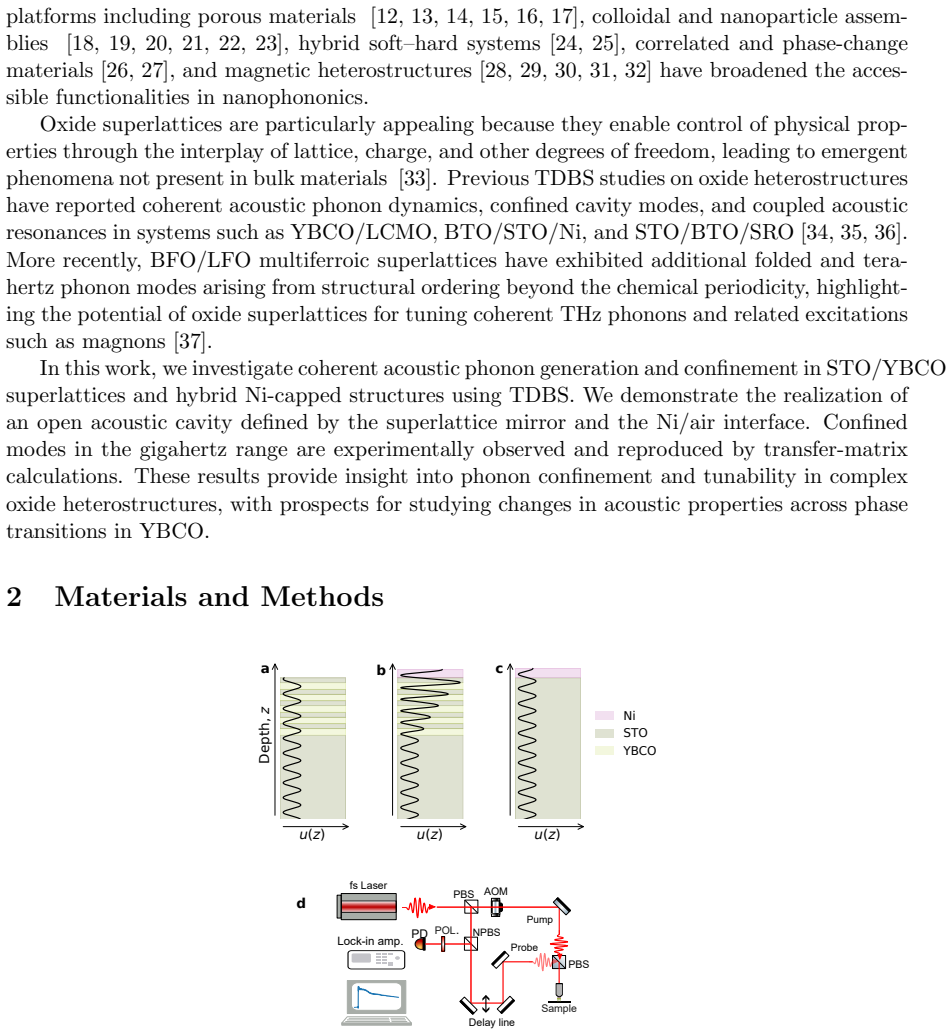
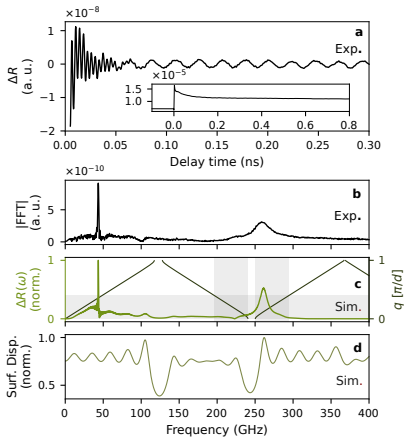
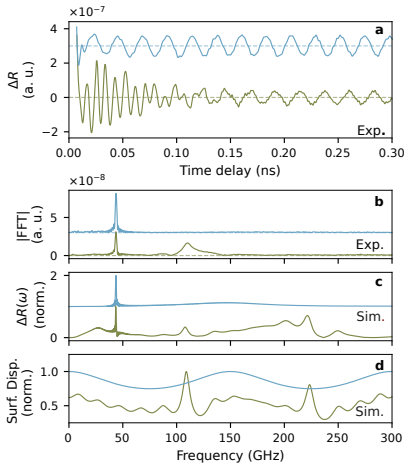
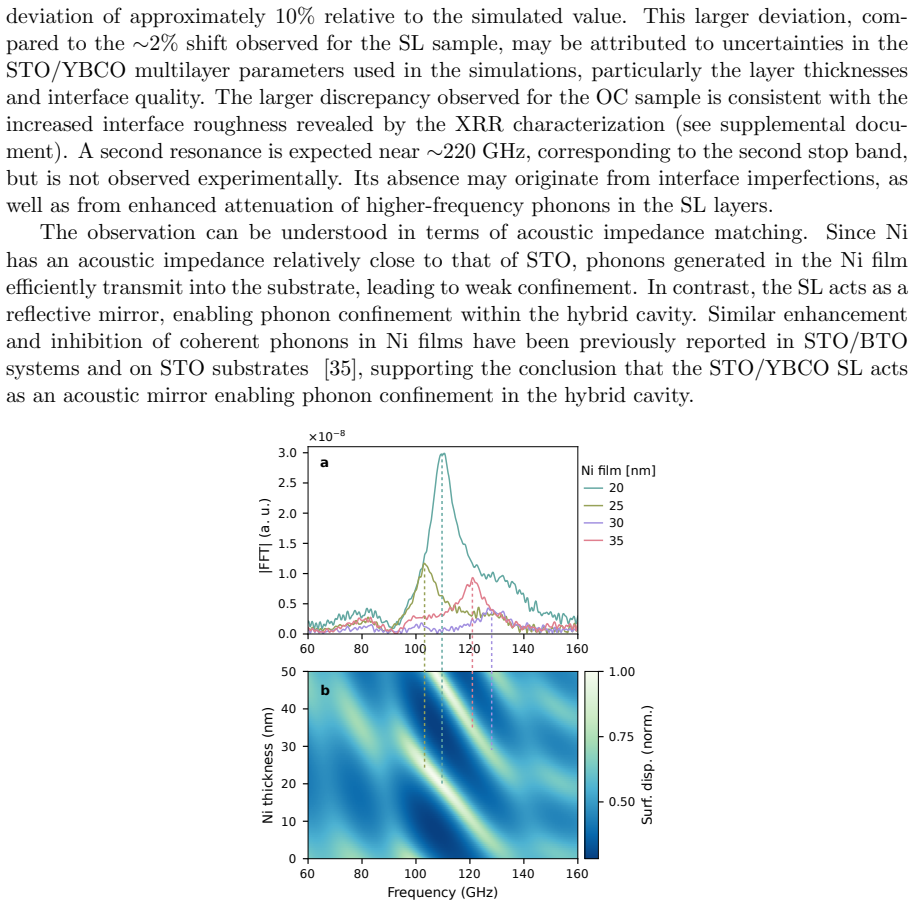
An open nanophononic cavity realized in a STO/YBCO superlattice with Ni transducer supports confined sub-THz longitudinal acoustic phonons, revealed by transient reflectivity signals that agree with transfer-matrix predictions of acoustic reflectivity and spatial mode profiles.
What carries the argument
The STO/YBCO periodic stack acting as an acoustic distributed Bragg reflector, combined with the Ni layer for coherent phonon generation and detection by time-domain Brillouin scattering.
If this is right
- Phonon confinement becomes possible inside multifunctional oxide heterostructures without requiring closed cavity geometries.
- Ultrafast optical methods can both generate and read out the confined acoustic modes in these stacks.
- The platform opens a route to phonon-based control of correlated electronic phases such as superconductivity.
- Transfer-matrix modeling can be used to design resonance frequencies by adjusting superlattice period and layer count.
Where Pith is reading between the lines
- Coupling the confined phonons to the superconducting order in YBCO could allow acoustic modulation of the critical temperature on ultrafast timescales.
- Replacing one or both oxides with other correlated materials would test whether the same confinement mechanism works across different electronic ground states.
- Embedding these resonators in devices could enable hybrid acoustic-electronic circuits where phonons serve as coherent intermediaries.
Load-bearing premise
The observed resonance arises specifically from acoustic phonon confinement inside the STO/YBCO stack rather than from optical, thermal, or interface effects unrelated to the superlattice periodicity.
What would settle it
A clear mismatch between the measured resonance frequency or quality factor and the prediction from transfer-matrix acoustic calculations performed with independently measured layer thicknesses and sound velocities, or the appearance of identical resonances in control samples lacking the periodic stack.
Figures
read the original abstract
We report the design and experimental demonstration of an open nanophononic cavity based on a hybrid oxide superlattice composed of SrTiO$_3$ (STO) and YBa$_2$Cu$_3$O$_{7-x}$ (YBCO), combined with a metallic Ni transducer for coherent phonon generation. The STO/YBCO periodic stack acts as an acoustic distributed Bragg reflector supporting confined longitudinal acoustic phonons in the sub-THz regime, while the Ni layer enables efficient ultrafast optical excitation and detection by time-domain Brillouin scattering. Transient reflectivity measurements reveal confined acoustic dynamics and a well-defined cavity resonance, in agreement with transfer-matrix calculations of acoustic reflectivity and mode profiles. These results demonstrate phonon confinement in multifunctional oxide heterostructures and establish complex oxide superlattices as a platform for hybrid nano-acoustic resonators and ultrafast phonon control of correlated electronic phases.
Editorial analysis
A structured set of objections, weighed in public.
Referee Report
Summary. The manuscript reports the design and experimental demonstration of an open nanophononic cavity in a SrTiO3/YBa2Cu3O7-x superlattice acting as an acoustic distributed Bragg reflector, combined with a Ni transducer layer. Transient reflectivity measurements are presented as revealing confined sub-THz longitudinal acoustic dynamics and a well-defined cavity resonance, stated to be in agreement with transfer-matrix calculations of acoustic reflectivity and mode profiles. The work positions complex oxide superlattices as a platform for hybrid nanoacoustic resonators enabling ultrafast phonon control of correlated electronic phases.
Significance. If the resonance attribution to acoustic confinement is substantiated, the result would establish a multifunctional oxide platform combining acoustic DBR behavior with YBCO superconductivity, which is of interest for nanoacoustics and correlated-electron devices. The approach of using periodic oxide stacks for phonon confinement in the sub-THz range, paired with optical excitation via a metallic transducer, offers a concrete route to hybrid acoustic-electronic experiments.
major comments (3)
- [Abstract and Results] Abstract and Results section on transient reflectivity: the central claim that the observed resonance originates from confined acoustic modes rests on agreement with the transfer-matrix model, yet the manuscript provides no explicit statement of whether the layer thicknesses, sound velocities, and densities in the model were taken from independent structural characterization (XRD/TEM) or adjusted to match the data; this parameter verification is load-bearing for the predictive value of the acoustic interpretation.
- [Results] Results section describing the transient reflectivity data: the identification of the resonance as acoustic requires exclusion of overlapping electronic or thermal signals common in ultrafast measurements on YBCO; the manuscript does not report control experiments (e.g., wavelength detuning, temperature dependence, or reference samples without the superlattice) that would isolate the acoustic contribution.
- [Methods] Methods or supplementary information on the transfer-matrix calculations: the acoustic mode profiles and reflectivity spectra are compared to experiment, but without tabulated values for the input parameters or a sensitivity analysis showing how resonance frequency shifts with plausible variations in layer thickness or velocity, the uniqueness of the acoustic assignment cannot be assessed.
minor comments (2)
- [Figures] Figure captions for the reflectivity traces and calculated spectra should include the exact resonance frequency extracted from both experiment and model for direct comparison.
- [Abstract] The abstract uses the phrase 'in agreement with' without quantifying the level of agreement (e.g., frequency offset or linewidth match); a brief numerical comparison would improve clarity.
Simulated Author's Rebuttal
We thank the referee for the careful and constructive review. The comments correctly identify areas where additional clarity on model parameters, signal attribution, and supporting analysis would strengthen the manuscript. We have revised the text and supplementary information accordingly, as detailed in the point-by-point responses below.
read point-by-point responses
-
Referee: [Abstract and Results] Abstract and Results section on transient reflectivity: the central claim that the observed resonance originates from confined acoustic modes rests on agreement with the transfer-matrix model, yet the manuscript provides no explicit statement of whether the layer thicknesses, sound velocities, and densities in the model were taken from independent structural characterization (XRD/TEM) or adjusted to match the data; this parameter verification is load-bearing for the predictive value of the acoustic interpretation.
Authors: We agree that an explicit statement on parameter provenance is required. Layer thicknesses were determined from independent XRD and TEM structural characterization performed on the same samples. Sound velocities and mass densities were taken from established literature values for bulk STO and YBCO (references now cited). No parameters were fitted or adjusted to match the transient reflectivity data. We have added a new paragraph in the Methods section and a supplementary table listing all input values with their sources. revision: yes
-
Referee: [Results] Results section describing the transient reflectivity data: the identification of the resonance as acoustic requires exclusion of overlapping electronic or thermal signals common in ultrafast measurements on YBCO; the manuscript does not report control experiments (e.g., wavelength detuning, temperature dependence, or reference samples without the superlattice) that would isolate the acoustic contribution.
Authors: We acknowledge that dedicated control experiments would provide additional isolation of the acoustic signal. The resonance frequency matches the independently calculated cavity mode to within experimental uncertainty, and the time-domain signal shows the expected oscillatory Brillouin-scattering form rather than the monotonic decay typical of electronic or thermal responses in YBCO. We have expanded the Results discussion to explicitly contrast the observed dynamics with expected electronic/thermal contributions on the basis of frequency content and functional form. No new control samples were measured, as the available heterostructures were limited; the revision therefore consists of strengthened textual argumentation rather than new data. revision: partial
-
Referee: [Methods] Methods or supplementary information on the transfer-matrix calculations: the acoustic mode profiles and reflectivity spectra are compared to experiment, but without tabulated values for the input parameters or a sensitivity analysis showing how resonance frequency shifts with plausible variations in layer thickness or velocity, the uniqueness of the acoustic assignment cannot be assessed.
Authors: We agree that tabulated parameters and a sensitivity analysis are necessary to evaluate uniqueness. A complete table of all acoustic parameters (thicknesses, longitudinal velocities, densities, and acoustic impedances) has been added to the Methods section. We have also performed and included a sensitivity analysis in the supplementary information demonstrating that the cavity resonance frequency varies by less than 4% under ±10% changes in layer thickness or sound velocity—well within the experimental linewidth. These additions allow direct assessment of the robustness of the acoustic assignment. revision: yes
Circularity Check
No significant circularity; experimental resonance matched to independent transfer-matrix acoustic model.
full rationale
The paper's central claim rests on transient reflectivity measurements of a resonance in the STO/YBCO superlattice, stated to be in agreement with separate transfer-matrix calculations of acoustic reflectivity and mode profiles. No quoted equations or steps reduce the observed dynamics to fitted parameters by construction, nor invoke self-citations as load-bearing uniqueness theorems, nor smuggle ansatzes, nor rename known results. The model uses standard acoustic parameters for the layers and is presented as an independent benchmark rather than a tautological fit; the derivation chain therefore remains self-contained against external experimental data.
Axiom & Free-Parameter Ledger
Reference graph
Works this paper leans on
-
[1]
Priya, E. R. Cardozo de Oliveira, and N. D. Lanzillotti-Kimura. Perspectives on high- frequency nanomechanics, nanoacoustics, and nanophononics.Applied Physics Letters, 122:140501, April 2023
2023
-
[2]
Colvard, R
C. Colvard, R. Merlin, M. V. Klein, and A. C. Gossard. Observation of Folded Acoustic Phonons in a Semiconductor Superlattice.Physical Review Letters, 45:298–301, 1980
1980
-
[3]
Coherent Zone- Folded Longitudinal Acoustic Phonons in Semiconductor Superlattices: Excitation and Detection.Physical Review Letters, 82:1044–1047, 1999
Albrecht Bartels, Thomas Dekorsy, Heinrich Kurz, and Klaus K¨ ohler. Coherent Zone- Folded Longitudinal Acoustic Phonons in Semiconductor Superlattices: Excitation and Detection.Physical Review Letters, 82:1044–1047, 1999
1999
-
[4]
Narayanamurti, H
V. Narayanamurti, H. L. St¨ ormer, M. A. Chin, A. C. Gossard, and W. Wiegmann. Selec- tive Transmission of High-Frequency Phonons by a Superlattice: The ”Dielectric” Phonon Filter.Physical Review Letters, 43:2012–2016, 1979
2012
-
[5]
N. D. Lanzillotti-Kimura, A. Fainstein, A. Lemaˆ ıtre, and B. Jusserand. Nanowave devices for terahertz acoustic phonons.Applied Physics Letters, 88:083113, 2006
2006
-
[6]
Yaremkevich, Alexey V
Dmytro D. Yaremkevich, Alexey V. Scherbakov, Serhii M. Kukhtaruk, Tetiana L. Lin- nik, Nikolay E. Khokhlov, Felix Godejohann, Olga A. Dyatlova, Achim Nadzeyka, Debi P. Pattnaik, Mu Wang, Syamashree Roy, Richard P. Campion, Andrew W. Rushforth, Vi- talyi E. Gusev, Andrey V. Akimov, and Manfred Bayer. Protected Long-Distance Guiding of Hypersound Underneath...
2021
-
[7]
Xiang, E
C. Xiang, E. R. Cardozo de Oliveira, S. Sandeep, K. Papatryfonos, M. Morassi, L. Le Gratiet, A. Harouri, I. Sagnes, A. Lemaitre, O. Ortiz, M. Esmann, and N. D. Lanzillotti- Kimura. Interference of ultrahigh frequency acoustic phonons from distant quasi-continuous sources, 2024
2024
-
[8]
Huynh, N
A. Huynh, N. D. Lanzillotti-Kimura, B. Jusserand, B. Perrin, A. Fainstein, M. F. Pascual- Winter, E. Peronne, and A. Lemaˆ ıtre. Subterahertz Phonon Dynamics in Acoustic Nanocavities.Physical Review Letters, 97:115502, 2006
2006
-
[9]
Fainstein, N
A. Fainstein, N. D. Lanzillotti-Kimura, B. Jusserand, and B. Perrin. Strong Optical- Mechanical Coupling in a Vertical GaAs/AlAs Microcavity for Subterahertz Phonons and Near-Infrared Light.Physical Review Letters, 110:037403, 2013
2013
-
[10]
Lanzillotti-Kimura, A
N.D. Lanzillotti-Kimura, A. Fainstein, and B. Jusserand. Towards ghz–thz cavity optome- chanics in dbr-based semiconductor resonators.Ultrasonics, 56:80–89, 2015
2015
-
[11]
Ezzahri, S
Y. Ezzahri, S. Grauby, J. M. Rampnoux, H. Michel, G. Pernot, W. Claeys, S. Dilhaire, C. Rossignol, G. Zeng, and A. Shakouri. Coherent phonons inSi/SiGesuperlattices.Physical Review B, 75, May 2007
2007
-
[12]
Fuertes, Paula C
Nicolas Lopez Abdala, Martin Esmann, Maria C. Fuertes, Paula C. Angelom´ e, Omar Ortiz, Axel Bruchhausen, Hernan Pastoriza, Bernard Perrin, Galo J. A. A. Soler-Illia, and Norberto D. Lanzillotti-Kimura. Mesoporous Thin Films for Acoustic Devices in the Gigahertz Range.The Journal of Physical Chemistry C, 124:17165–17171, August 2020
2020
-
[13]
E. R. Cardozo de Oliveira, C. Xiang, M. Esmann, N. Lopez Abdala, M. C. Fuertes, A. Bruchhausen, H. Pastoriza, B. Perrin, G. J. A. A. Soler-Illia, and N. D. Lanzillotti- Kimura. Probing gigahertz coherent acoustic phonons in TiO2 mesoporous thin films. Photoacoustics, 30:100472, April 2023
2023
-
[14]
Boggiano, Juan Ignacio Ramallo, Lin Nan, Andr´ es Litwiller, Emiliano Cort´ es, Stefan A
Hilario D. Boggiano, Juan Ignacio Ramallo, Lin Nan, Andr´ es Litwiller, Emiliano Cort´ es, Stefan A. Maier, Gustavo Grinblat, Mar´ ıa Cecilia Fuertes, Paula C. Angelom´ e, and An- drea V. Bragas. Optical Readout of the Mechanical Properties of Silica Mesoporous Thin Films Using Plasmonic Nanoantennas.ACS Photonics, 10:3998–4005, November 2023
2023
-
[15]
Cardozo De Oliveira, Gast´ on Grosman, Chushuang Xiang, Michael Zuarez- Chamba, Priscila Vensaus, Abdelmounaim Harouri, C´ edric Boissiere, Galo J
Edson R. Cardozo De Oliveira, Gast´ on Grosman, Chushuang Xiang, Michael Zuarez- Chamba, Priscila Vensaus, Abdelmounaim Harouri, C´ edric Boissiere, Galo J. A. A. Soler- Illia, and Norberto Daniel Lanzillotti-Kimura. Toward Environmentally Responsive Hy- persound Materials.Nano Letters, 26:1004–1010, January 2026
2026
-
[16]
Lomonosov, Adil Ayouch, Pascal Ruello, Gwenaelle Vaudel, Mikhail R
Alexey M. Lomonosov, Adil Ayouch, Pascal Ruello, Gwenaelle Vaudel, Mikhail R. Bak- lanov, Patrick Verdonck, Larry Zhao, and Vitalyi E. Gusev. Nanoscale Noncontact Subsur- face Investigations of Mechanical and Optical Properties of Nanoporous Low-kMaterial Thin Film.ACS Nano, 6:1410–1415, February 2012
2012
-
[17]
Vishnevskiy, Samuel Raetz, Sergej Naumov, Dmitry S
Sathyan Sandeep, Alexey S. Vishnevskiy, Samuel Raetz, Sergej Naumov, Dmitry S. Seregin, Artem Husiev, Konstantin A. Vorotilov, Vitalyi E. Gusev, and Mikhail R. Baklanov. In-Situ Imaging of a Light-Induced Modification Process in Organo-Silica Films via Time-Domain Brillouin Scattering.Nanomaterials, 12:1600, May 2022
2022
-
[18]
Observation and tuning of hypersonic bandgaps in colloidal crystals.Nature Materials, 5:830–836, October 2006
Wei Cheng, Jianjun Wang, Ulrich Jonas, George Fytas, and Nikolaos Stefanou. Observation and tuning of hypersonic bandgaps in colloidal crystals.Nature Materials, 5:830–836, October 2006
2006
-
[19]
A. V. Akimov, Y. Tanaka, A. B. Pevtsov, S. F. Kaplan, V. G. Golubev, S. Tamura, D. R. Yakovlev, and M. Bayer. Hypersonic Modulation of Light in Three-Dimensional Photonic and Phononic Band-Gap Materials.Physical Review Letters, 101:033902, July 2008. 8
2008
-
[20]
Elasticity of an Assembly of Disordered Nanoparticles InteractingviaEither van der Waals-Bonded or Covalent-Bonded Coating Layers.ACS Nano, 6:10614–10621, December 2012
Adil Ayouch, Xavier Dieudonn´ e, Gwena¨ elle Vaudel, Herv´ e Piombini, Karine Vall´ e, Vitalyi Gusev, Philippe Belleville, and Pascal Ruello. Elasticity of an Assembly of Disordered Nanoparticles InteractingviaEither van der Waals-Bonded or Covalent-Bonded Coating Layers.ACS Nano, 6:10614–10621, December 2012
2012
-
[21]
Multiband Hypersound Filtering in Two-Dimensional Colloidal Crystals: Adhesion, Resonances, and Periodicity.Nano Letters, 20:1883–1889, March 2020
Bartlomiej Graczykowski, Nicolas Vogel, Karina Bley, Hans-J¨ urgen Butt, and George Fy- tas. Multiband Hypersound Filtering in Two-Dimensional Colloidal Crystals: Adhesion, Resonances, and Periodicity.Nano Letters, 20:1883–1889, March 2020
2020
-
[22]
Progress in laser ultrasonics evaluation of micro- and nanoscale interfacial mechanics.Applied Physics Reviews, 11:041315, December 2024
Maroun Abi Ghanem and Thomas Dehoux. Progress in laser ultrasonics evaluation of micro- and nanoscale interfacial mechanics.Applied Physics Reviews, 11:041315, December 2024
2024
-
[23]
Cardozo De Oliveira, Rafael J
Pedro Moronta, Sandeep Sathyan, Edson R. Cardozo De Oliveira, Rafael J. Jim´ enez- Riob´ oo, Norberto Daniel Lanzillotti-Kimura, Pedro D. Garc´ ıa, and Cefe L´ opez. A self- assembled two-dimensional hypersonic phononic insulator.Nanophotonics, 14:3569–3577, October 2025
2025
-
[24]
Defect-Controlled Hypersound Propagation in Hybrid Superlattices.Physical Review Letters, 111:164301, October 2013
Dirk Schneider, Faroha Liaqat, El Houssaine El Boudouti, Ossama El Abouti, Wolfgang Tremel, Hans-J¨ urgen Butt, Bahram Djafari-Rouhani, and George Fytas. Defect-Controlled Hypersound Propagation in Hybrid Superlattices.Physical Review Letters, 111:164301, October 2013
2013
-
[25]
Phoxonic Hybrid Super- lattice.ACS Applied Materials & Interfaces, 7:12488–12495, June 2015
Elena Alonso-Redondo, Hannah Huesmann, El-Houssaine El Boudouti, Wolfgang Tremel, Bahram Djafari-Rouhani, Hans-Juergen Butt, and George Fytas. Phoxonic Hybrid Super- lattice.ACS Applied Materials & Interfaces, 7:12488–12495, June 2015
2015
-
[26]
Mogunov, Sergiy Lysenko, Anatolii E
Iaroslav A. Mogunov, Sergiy Lysenko, Anatolii E. Fedianin, F´ elix E. Fern´ andez, Armando R´ ua, Anthony J. Kent, Andrey V. Akimov, and Alexandra M. Kalashnikova. Large non- thermal contribution to picosecond strain pulse generation using the photo-induced phase transition in VO2.Nature Communications, 11:1690, 2020
2020
-
[27]
R. Gu, T. Perrault, V. Juv´ e, G. Vaudel, M. Weis, A. Bulou, N. Chigarev, A. Levchuk, S. Raetz, V.E. Gusev, Z. Cheng, H. Bhaskaran, and P. Ruello. Nonthermal Transport of Energy Driven by Photoexcited Carriers in Switchable Solid States of Ge Te.Physical Review Applied, 16:014055, 2021
2021
-
[28]
A. V. Scherbakov, A. S. Salasyuk, A. V. Akimov, X. Liu, M. Bombeck, C. Br¨ uggemann, D. R. Yakovlev, V. F. Sapega, J. K. Furdyna, and M. Bayer. Coherent Magnetization Precession in Ferromagnetic (Ga,Mn)As Induced by Picosecond Acoustic Pulses.Physical Review Letters, 105:117204, 2010
2010
-
[29]
Thevenard, E
L. Thevenard, E. Peronne, C. Gourdon, C. Testelin, M. Cubukcu, E. Charron, S. Vin- cent, A. Lemaˆ ıtre, and B. Perrin. Effect of picosecond strain pulses on thin layers of the ferromagnetic semiconductor (Ga,Mn)(As,P).Physical Review B, 82:104422, 2010
2010
-
[30]
Thevenard, I
L. Thevenard, I. S. Camara, S. Majrab, M. Bernard, P. Rovillain, A. Lemaˆ ıtre, C. Gourdon, and J.-Y. Duquesne. Precessional magnetization switching by a surface acoustic wave. Physical Review B, 93:134430, 2016
2016
-
[31]
Stupakiewicz, C
A. Stupakiewicz, C. S. Davies, K. Szerenos, D. Afanasiev, K. S. Rabinovich, A. V. Boris, A. Caviglia, A. V. Kimel, and A. Kirilyuk. Ultrafast phononic switching of magnetization. Nature Physics, 17:489–492, 2021
2021
-
[32]
V. S. Vlasov, A. V. Golov, L. N. Kotov, V. I. Shcheglov, A. M. Lomonosov, and V. V. Tem- nov. The Modern Problems of Ultrafast Magnetoacoustics (Review).Acoustical Physics, 68:18–47, 2022. 9
2022
-
[33]
Ramamoorthy Ramesh and Darrell G. Schlom. Creating emergent phenomena in oxide superlattices.Nature Reviews Materials, 4:257–268, March 2019
2019
-
[34]
Middey, J
Wei Li, Bin He, Chunfeng Zhang, Shenghua Liu, Xiaoran Liu, S. Middey, J. Chakhalian, Xiaoyong Wang, and Min Xiao. Coherent acoustic phonons in YBa2Cu3O7/La1/3Ca2/3MnO3 superlattices.Applied Physics Letters, 108:132601, March 2016
2016
-
[35]
N. D. Lanzillotti-Kimura, A. Fainstein, B. Perrin, B. Jusserand, A. Soukiassian, X. X. Xi, and D. G. Schlom. Enhancement and Inhibition of Coherent Phonon Emission of a Ni Film in a BaTiO 3 / SrTiO 3 Cavity.Physical Review Letters, 104:187402, May 2010
2010
-
[36]
A. E. Bruchhausen, N. D. Lanzillotti-Kimura, B. Jusserand, A. Soukiassian, L. Xie, X. Q. Pan, T. Dekorsy, D. G. Schlom, and A. Fainstein. Acoustic confinement phenomena in oxide multifunctional nanophononic devices.Physical Review Materials, 2:106002, October 2018
2018
-
[37]
R. Gu, R. Xu, F. Delodovici, B. Carcan, M. Khiari, G. Vaudel, V. Juv´ e, M. C. Weber, A. Poirier, P. Nandi, B. Xu, V. E. Gusev, L. Bellaiche, C. Laulh´ e, N. Jaouen, P. Manuel, B. Dkhil, C. Paillard, L. Yedra, H. Bouyanfif, and P. Ruello. Superorders and terahertz acoustic modes in multiferroic BiFeO3/LaFeO3 superlattices.Applied Physics Reviews, 11:04141...
2024
-
[38]
Baumberg, Roberto Li Voti, and Oliver B
Saori Kashiwada, Osamu Matsuda, Jeremy J. Baumberg, Roberto Li Voti, and Oliver B. Wright.In Situmonitoring of the growth of ice films by laser picosecond acoustics.Journal of Applied Physics, 100:073506, October 2006
2006
-
[39]
Brivio, D
S. Brivio, D. Polli, A. Crespi, R. Osellame, G. Cerullo, and R. Bertacco. Observation of anomalous acoustic phonon dispersion in SrTiO3 by broadband stimulated Brillouin scattering.Applied Physics Letters, 98:211907, May 2011
2011
-
[40]
Sathyan Sandeep, Samuel Raetz, Jerome Wolfman, Beatrice Negulescu, Guozhen Liu, Jean- Louis Longuet, Th´ eo Thr´ eard, and Vitalyi E. Gusev. Evaluation of Optical and Acousti- cal Properties of Ba1-xSrxTiO3 Thin Film Material Library via Conjugation of Picosec- ond Laser Ultrasonics with X-ray Diffraction, Energy Dispersive Spectroscopy, Electron Probe Mi...
2021
-
[41]
N. D. Lanzillotti-Kimura, A. Fainstein, A. Huynh, B. Perrin, B. Jusserand, A. Miard, and A. Lemaˆ ıtre. Coherent Generation of Acoustic Phonons in an Optical Microcavity.Physical Review Letters, 99:217405, November 2007
2007
-
[42]
M. F. Pascual-Winter, A. Fainstein, B. Jusserand, B. Perrin, and A. Lemaˆ ıtre. Spectral responses of phonon optical generation and detection in superlattices.Physical Review B, 85:235443, June 2012
2012
-
[43]
Matsuda and O
O. Matsuda and O. B. Wright. Reflection and transmission of light in multilayers perturbed by picosecond strain pulse propagation.Journal of the Optical Society of America B, 19:3028, December 2002
2002
-
[44]
M. F. Pascual Winter, G. Rozas, A. Fainstein, B. Jusserand, B. Perrin, A. Huynh, P. O. Vaccaro, and S. Saravanan. Selective Optical Generation of Coherent Acoustic Nanocavity Modes.Physical Review Letters, 98:265501, 2007
2007
-
[45]
Journal of Applied Crystallography, 55:1063–1071, August 2022
Artur Glavic and Matts Bj¨ orck.GenX 3: The latest generation of an established tool. Journal of Applied Crystallography, 55:1063–1071, August 2022. 10 Supplemental document: Structural and morphological analysis 0 1 2 3 4 5 103 105 Data Fit Ι 2θ (°) (a) 0 1 2 3 4 5 101 103 105 107 Data Fit Ι 2θ (°) (b) Figure S1: XRR of the (a) SL and (b) OC. The fits we...
2022
discussion (0)
Sign in with ORCID, Apple, or X to comment. Anyone can read and Pith papers without signing in.