REVIEW 4 major objections 4 minor 41 references
MEKiT: Multi-source Heterogeneous Knowledge Injection Method via Instruction Tuning for Emotion-Cause Pair Extraction
T0 review · 4 major / 4 minor · reviewed 2026-08-06 · deepseek-v4-flash
Pith's one-line read MEKiT injects two kinds of knowledge into LLM instruction tuning and raises ECPE F1 to 61.49, an absolute gain of 3.87 over the backbone.
desk verdict Useful ECPE knowledge-injection recipe, but the reported F1 gain is inflated by an unmatched test-time emotion cue and ratio selection on the test set. read the letter →
The pith
A machine-rendered reading of the paper's core claim, the machinery that carries it, and where it could break.
The reading
What carries the argument
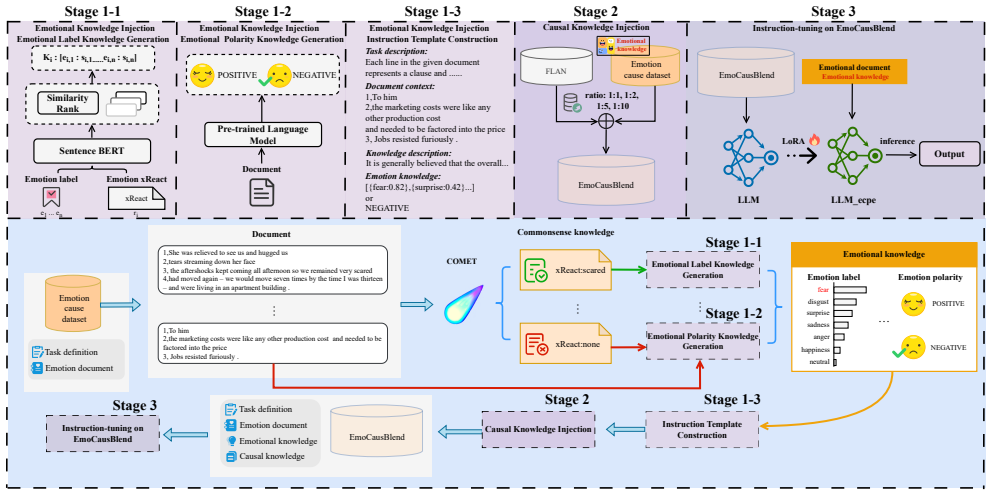
The load-bearing object is the instruction template plus training-mixture design called EmoCausBlend. For each document, COMET's xReact relation supplies a commonsense emotional reaction; when non-empty, SBERT ranks seven emotion labels by cosine similarity to form a label-distribution list for the prompt, and when empty (43% of cases) a transformer polarity classifier supplies POSITIVE or NEGATIVE. Separately, entries from the large FLAN instruction corpus are selected by sentence-embedding similarity to ECPE documents and mixed in at ratios from 1:1 to 1:10. The resulting blended set is used to LoRA fine-tune the LLM with next-token prediction; at inference, emotional knowledge is again inserted into the prompt for consistency.
What would settle it
Sample the mixed-in FLAN entries from the best 1:5 run and annotate whether each contains an explicit or implicit cause-effect relation. If most do not, or if swapping them for random non-causal instruction data reproduces the same F1 gain, then the causal-knowledge mechanism is not what carries the improvement.
Extended reading notes
Core claim
The central claim is that heterogeneous knowledge can be injected through two separate mechanisms with complementary effects: structured emotional knowledge belongs in the prompt template, while unstructured causal knowledge belongs in the training mixture. The paper reports that removing emotional knowledge costs 1.56 F1, removing causal knowledge costs 2.34 F1, and removing both returns the backbone's 57.62 F1, so causal-text mixing is the larger contributor in its setting. The best causal mixing ratio is 1:5 ECPE-to-FLAN entries; more causal data (1:10) degrades performance, which the paper attributes to the optimization objective shifting toward non-ECPE tasks. The method is presented as model-agnostic: it improves Vicuna-7B and LLaMA2-7B as well, though the optimal ratio differs.
Load-bearing premise
The causal-knowledge step assumes that the FLAN entries selected by text similarity actually contain cause-effect relations; the paper does not check this, so the measured gain could come from simply adding more instruction data rather than from causal knowledge.
Editorial extensions
If this is right
- On the NTCIR-13 ECPE benchmark, MEKiT reaches 65.04 precision, 58.31 recall, and 61.49 F1, beating all compared specialized ECPE models and few-shot GPT-4o.
- Causal-knowledge mixing at a moderate ratio of 1:5 helps, while a 1:10 ratio hurts, implying that there is an optimal balance between task data and auxiliary causal data.
- Emotional knowledge alone lifts the backbone from 57.62 to 59.15 F1, and causal knowledge alone lifts it to 59.93 F1, while the combined method reaches 61.49 F1.
- The same recipe improves Vicuna-7B and LLaMA2-7B, so the gains are not unique to Gemma-2-9B-it and appear to transfer across model families.
Reading between the lines
- A test the paper does not run: replace the FLAN entries selected by similarity with an equal amount of non-causal instruction data and re-measure F1. If the gain disappears, causal content is doing the work; if not, the mechanism is better described as general data mixing.
- The optimal-ratio result suggests a data-mixture interpretation: too much auxiliary data shifts the next-token objective away from ECPE. A testable consequence is that curriculum ordering, or weighting causal data by estimated causal content, would push the optimum beyond 1:5.
- The label-distribution/polarity fallback implies that knowledge quality matters more than knowledge format: single-label emotion classifiers injected into the same template did not help. This predicts that better label-distribution estimates should improve ECPE further.
Editorial analysis
A structured set of objections, weighed in public.
Referee Report
Summary. The paper proposes MEKiT, a knowledge-injection method for Emotion-Cause Pair Extraction (ECPE) based on instruction tuning. MEKiT generates emotional knowledge for each document using COMET xReact relations and either Sentence-BERT similarity to emotion labels or a sentiment-pipeline polarity label, incorporates this knowledge into instruction templates, and then mixes causally selected FLAN examples into the training set to form EmoCausBlend. The method is evaluated on NTCIR-13 with Gemma-2-9B-it, Vicuna-7B, and LLaMA2-7B, using LoRA instruction tuning. The central claim is that MEKiT improves instruction-tuned LLM performance on ECPE, with the best reported result of 61.49 F1 versus 57.62 F1 for the Gemma-2-9B-it instruction-tuned backbone, a 3.87-point absolute gain. The paper also reports ablations showing that removing emotional knowledge or causal knowledge reduces performance.
Significance. If the reported gains are substantiated under matched evaluation conditions, MEKiT would be a simple and practical recipe for injecting heterogeneous knowledge into instruction-tuned LLMs for ECPE, with evidence across three model families. The design has clear strengths: the framework is modular, the knowledge sources are publicly available, the ablations are clean in structure, and the paper explicitly tests compatibility with different LLM architectures. However, the current evaluation has a load-bearing asymmetry: MEKiT is evaluated on a test set enriched with emotional knowledge at inference time, while the instruction-tuned baseline is not. This means the headline gain may be an artifact of an extra test-time cue rather than evidence for the proposed training-time knowledge injection. The causal-knowledge component also lacks verification that the selected FLAN examples actually encode cause-effect relations, and the 1:5 mixing ratio is selected from the same test set used for the headline number. Because these issues are fixable with controlled experiments, the central idea is defensible but the evidence as presented is not yet sufficient.
major comments (4)
- [§3.3 ('Instruction-Tuning on EmoCausBlend')] The sentence 'we restrict the case to extracting emotion-cause pairs from the test set enriched with emotional knowledge during the inference phase for consistency' introduces a matched-conditions problem. The Gemma-2-9B-it* baseline in Table 1 is instruction-tuned without knowledge injection and is not described as receiving emotional-knowledge enrichment at test time. Therefore the reported comparison of 61.49 vs. 57.62 F1 words-conflates training-time knowledge injection with a test-time emotional cue that directly helps emotion detection, which is half of the ECPE task. The ablation 'w/o kno causal' (59.15 in Table 3) also uses the enriched test protocol, so it cannot separate the contribution of causal knowledge from the test-time emotional-knowledge hint. Please report (a) MEKiT without test-time emotional-knowledge enrichment and (b) the instruction-tuned baseline with the same test-time enrichment, for all conditions in Tables 1-3. Without these matched conditions, the central claim is not supported.
- [§3.2 ('Causal Knowledge Injection')] The paper never verifies that the FLAN entries selected by Sentence-BERT similarity actually contain cause-effect relations. The text states only that 'we extract causal knowledge in the form of natural text from FLAN by calculating the similarity between each entry in the emotion cause dataset and the FLAN corpus.' No examples of the retrieved data are shown, and no control is run with non-causal data of the same volume and format. The measured improvement from adding these FLAN entries could therefore be a generic data augmentation or regularization effect rather than evidence that causal knowledge improves causal reasoning. Please add a control condition that mixes an equal amount of non-causal FLAN data, and preferably also report a human or LLM audit of the retrieved entries to establish how many actually contain cause-effect relations.
- [§Table 2 and §'ECPE with Knowledge Injection'] The optimal causal-data mixing ratio (1:5) is selected from Table 2, which reports results on the same NTCIR-13 test set as the headline F1 of 61.49. This makes the headline number a selected maximum rather than an unbiased estimate, and the statement that the model 'achieves its best performance at the 1:5 mixing ratio' describes test-set optimization. No held-out validation split is used, no seed-to-seed variance is reported, and no significance test accompanies any comparison. Please either use a validation split for hyperparameter and ratio selection, or clearly characterize the reported numbers as test-set-tuned, and report mean and standard deviation over at least three runs with a paired significance test for the main comparisons.
- [§'Generality of MEKiT' and §'Experiment'] The generality claim rests on a single dataset (NTCIR-13) and a single run per configuration. Figure 3 reports results for Vicuna-7B and LLaMA2-7B without numerical values, error bars, or the underlying table, which makes the claimed consistent improvements impossible to assess quantitatively. Additionally, the observation that each model has a different optimal mixing ratio (1:10 for Vicuna, 1:2 for LLaMA2) is itself a post-hoc selection over the test set. Please tabulate the exact numbers behind Figure 3, include run-to-run variability, and ideally evaluate on a second ECPE dataset to support the cross-model generality claim.
minor comments (4)
- [Figure 1 and abstract] There are typos in Figure 1 ('The surgey was successful', 'Demotion cause') and in the abstract ('often underperform smaller language model'); these should be corrected.
- [§'Dicussion on Emotional Knowledge'] The section heading 'Dicussion on Emotional Knowledge' should be 'Discussion on Emotional Knowledge'.
- [References] Several references do not appear to be cited in the text, including Chalnick and Billman (1988), Feigenbaum (1963), Hill (1983), Matlock (2001), Newell and Simon (1972), Ohlsson and Langley (1985), and Shrager and Langley (1990). Please verify the citation list and remove or cite these entries.
- [Table 4] Table 4 would be easier to interpret if the exact generation procedure for each emotional-knowledge tool were described; in particular, it is unclear whether the three tools are used with the same instruction template and the same threshold for choosing label distribution versus polarity.
Circularity Check
No significant circularity: MEKiT is an empirical knowledge-injection pipeline evaluated against external NTCIR-13 labels; the main issues are evaluation asymmetry and test-set selection, not equation-level circularity.
full rationale
MEKiT is an empirical knowledge-injection pipeline rather than a formal derivation: emotional knowledge is generated with COMET and SBERT (or a sentiment polarity classifier), causal knowledge is sampled from FLAN by similarity, and LoRA instruction-tuning is evaluated on the fixed NTCIR-13 test set. No predicted quantity is computed by construction from the quantity it is claimed to predict, and the evaluation target is the external benchmark label set. The strongest validity concern is stated in the paper itself: in Section 'Instruction-Tuning on EmoCausBlend', the authors write that they 'restrict the case to extracting emotion-cause pairs from the test set enriched with emotional knowledge during the inference phase for consistency.' This means MEKiT receives an extra test-time emotional cue that the instruction-tuned Gemma-2-9B-it backbone does not receive, so the reported +3.87 F1 gain may partly reflect evaluation asymmetry rather than learned knowledge injection. In addition, the optimal 1:5 mixing ratio is selected from Table 2 on the test set, which adds selection pressure, and the assumption that similar FLAN entries actually contain causal relations is not verified. These are experimental-design weaknesses and threats to validity, but they are not circular reductions: no fitted parameter is renamed as a prediction, no equation is its own input, and no load-bearing self-citation appears. Accordingly, the circularity score is 0.
Assumptions & free parameters
free parameters (2)
- causal data mixing ratio =
1:5 (ECPE data to FLAN data) for Gemma-2-9B-it
- LoRA rank, alpha, and training hyperparameters =
not reported
assumptions (4)
- domain assumption COMET xReact outputs are a valid source of emotion knowledge for ECPE documents.
- domain assumption Emotion cognitive appraisal theory implies that injecting causal text data strengthens emotion-cause reasoning.
- domain assumption FLAN entries selected by similarity to ECPE documents actually contain causal knowledge.
- domain assumption The NTCIR-13 benchmark and its standard split measure ECPE ability.
Cite this review
Pith. "Pith review of MEKiT: Multi-source Heterogeneous Knowledge Injection Method via Instruction Tuning for Emotion-Cause Pair Extraction." pith.science (2026). https://pith.science/paper/5MHY475M
@misc{pith2026250714887,
  author       = {Pith},
  title        = {Pith review of: MEKiT: Multi-source Heterogeneous Knowledge Injection Method via Instruction Tuning for Emotion-Cause Pair Extraction},
  year         = {2026},
  howpublished = {\url{https://pith.science/paper/5MHY475M}},
  note         = {Machine review of arXiv:2507.14887}
}
read the original abstract
Although large language models (LLMs) excel in text comprehension and generation, their performance on the Emotion-Cause Pair Extraction (ECPE) task, which requires reasoning ability, is often underperform smaller language model. The main reason is the lack of auxiliary knowledge, which limits LLMs' ability to effectively perceive emotions and reason causes. To address this issue, we propose a novel \textbf{M}ulti-source h\textbf{E}terogeneous \textbf{K}nowledge \textbf{i}njection me\textbf{T}hod, MEKiT, which integrates heterogeneous internal emotional knowledge and external causal knowledge. Specifically, for these two distinct aspects and structures of knowledge, we apply the approaches of incorporating instruction templates and mixing data for instruction-tuning, which respectively facilitate LLMs in more comprehensively identifying emotion and accurately reasoning causes. Experimental results demonstrate that MEKiT provides a more effective and adaptable solution for the ECPE task, exhibiting an absolute performance advantage over compared baselines and dramatically improving the performance of LLMs on the ECPE task.
Figures


Reference graph
Works this paper leans on
-
[1]
bosselut2019comet APACrefauthors Bosselut, A. , Rashkin, H. , Sap, M. , Malaviya, C. , Celikyilmaz, A. \ Choi, Y. APACrefauthors \ 2019 . COMET: Commonsense transformers for automatic knowledge graph construction Comet: Commonsense transformers for automatic knowledge graph construction . arXiv preprint arXiv:1906.05317
arXiv 2019
-
[2]
ChalnickBillman1988a APACrefauthors Chalnick, A. \ Billman, D. APACrefauthors \ 1988 . Unsupervised learning of correlational structure Unsupervised learning of correlational structure . Proceedings of the Tenth Annual Conference of the Cognitive Science Society Proceedings of the tenth annual conference of the cognitive science society \ ( \ 510--516). H...
work page 1988
-
[3]
chen2020end APACrefauthors Chen, Y. , Hou, W. , Li, S. , Wu, C. \ Zhang, X. APACrefauthors \ 2020 . End-to-end emotion-cause pair extraction with graph convolutional network End-to-end emotion-cause pair extraction with graph convolutional network . Proceedings of the 28th international conference on computational linguistics Proceedings of the 28th inter...
work page 2020
-
[4]
chiang2023vicuna APACrefauthors Chiang, W L. , Li, Z. , Lin, Z. , Sheng, Y. , Wu, Z. , Zhang, H. others APACrefauthors \ 2023 . Vicuna: An open-source chatbot impressing gpt-4 with 90\ 90\ See https://vicuna. lmsys. org (accessed 14 April 2023) 2 3 6
work page 2023
-
[5]
ding2020ecpe APACrefauthors Ding, Z. , Xia, R. \ Yu, J. APACrefauthors \ 2020 1 . ECPE-2D: Emotion-cause pair extraction based on joint two-dimensional representation, interaction and prediction Ecpe-2d: Emotion-cause pair extraction based on joint two-dimensional representation, interaction and prediction . Proceedings of the 58th Annual Meeting of the A...
work page 2020
-
[6]
ding2020end APACrefauthors Ding, Z. , Xia, R. \ Yu, J. APACrefauthors \ 2020 2 . End-to-end emotion-cause pair extraction based on sliding window multi-label learning End-to-end emotion-cause pair extraction based on sliding window multi-label learning . Proceedings of the 2020 conference on empirical methods in natural language processing (EMNLP) Proceed...
work page 2020
-
[7]
ekman1992argument APACrefauthors Ekman, P. APACrefauthors \ 1992 . An argument for basic emotions An argument for basic emotions . Cognition & emotion 6 3-4 169--200
work page 1992
-
[8]
Feigenbaum1963a APACrefauthors Feigenbaum, E A. APACrefauthors \ 1963 . The simulation of verbal learning behavior The simulation of verbal learning behavior . E A. Feigenbaum\ J. Feldman\ ( ), Computers and thought. Computers and thought. New York McGraw-Hill
work page 1963
Show all 41 references
-
[9]
gao2017overview APACrefauthors Gao, Q. , Hu, J. , Xu, R. , Gui, L. , He, Y. , Wong, K F. \ Lu, Q. APACrefauthors \ 2017 . Overview of NTCIR-13 ECA Task. Overview of ntcir-13 eca task. NTCIR. Ntcir
2017
-
[10]
\ Thompson, R
gross2007emotion APACrefauthors Gross, J. \ Thompson, R. APACrefauthors \ 2007 . Emotion regulation: Conceptual foundations. Handbook of Emotion Regulation. G.(Ed.). New York. Emotion regulation: Conceptual foundations. handbook of emotion regulation. g.(ed.). new york. Guilford press
2007
-
[11]
APACrefauthors \ 1998
gross1998emerging APACrefauthors Gross, J J. APACrefauthors \ 1998 . The emerging field of emotion regulation: An integrative review The emerging field of emotion regulation: An integrative review . Review of general psychology 2 3 271--299
1998
-
[12]
APACrefauthors \ 1983
Hill1983a APACrefauthors Hill, J A C. APACrefauthors \ 1983 . A computational model of language acquisition in the two-year old A computational model of language acquisition in the two-year old . Cognition and Brain Theory 6 287--317
1983
-
[13]
, Shen, Y
hu2021lora APACrefauthors Hu, E J. , Shen, Y. , Wallis, P. , Allen-Zhu, Z. , Li, Y. , Wang, S. Chen, W. APACrefauthors \ 2021 . Lora: Low-rank adaptation of large language models Lora: Low-rank adaptation of large language models . arXiv preprint arXiv:2106.09685
2021 arXiv
-
[14]
, Yang, Y
huang2023emotion APACrefauthors Huang, W. , Yang, Y. , Huang, X. , Peng, Z. \ Xiong, L. APACrefauthors \ 2023 . Emotion-cause pair extraction based on interactive attention Emotion-cause pair extraction based on interactive attention . Applied Intelligence 53 9 10548--10558
2023
-
[15]
, Bhagavatula, C
hwang2021symbolic APACrefauthors Hwang, J D. , Bhagavatula, C. , Le Bras, R. , Da, J. , Sakaguchi, K. , Bosselut, A. \ Choi, Y. APACrefauthors \ 2021 . On symbolic and neural commonsense knowledge graphs On symbolic and neural commonsense knowledge graphs
2021
-
[16]
, Wang, S
jiang2023cognitive APACrefauthors Jiang, J. , Wang, S. , Li, Q. , Kong, L. \ Wu, C. APACrefauthors \ 2023 . A Cognitive Stimulation Dialogue System with Multi-source Knowledge Fusion for Elders with Cognitive Impairment A cognitive stimulation dialogue system with multi-source...
2023 arXiv
-
[17]
APACrefauthors \ 1991
lazarus1991emotion APACrefauthors Lazarus, R. APACrefauthors \ 1991 . Emotion and adaptation: Oxford University Press on Demand.[Google Scholar] Emotion and adaptation: Oxford university press on demand.[google scholar]
1991
-
[18]
, Li, J H
lee2022chinese APACrefauthors Lee, L H. , Li, J H. \ Yu, L C. APACrefauthors \ 2022 . Chinese EmoBank: Building valence-arousal resources for dimensional sentiment analysis Chinese emobank: Building valence-arousal resources for dimensional sentiment analysis . Transactions on...
2022
-
[19]
li2023effective APACrefauthors Li, C. , Hu, J. , Li, T. , Du, S. \ Teng, F. APACrefauthors \ 2023 . An effective multi-task learning model for end-to-end emotion-cause pair extraction An effective multi-task learning model for end-to-end emotion-cause pair extraction . Applied...
2023
-
[20]
, Zhu, X
li2021enhancing APACrefauthors Li, D. , Zhu, X. , Li, Y. , Wang, S. , Li, D. , Liao, J. \ Zheng, J. APACrefauthors \ 2021 . Enhancing emotion inference in conversations with commonsense knowledge Enhancing emotion inference in conversations with commonsense knowledge . Knowled...
2021
-
[21]
, Lin, Z
li2021past APACrefauthors Li, J. , Lin, Z. , Fu, P. \ Wang, W. APACrefauthors \ 2021 . Past, present, and future: Conversational emotion recognition through structural modeling of psychological knowledge Past, present, and future: Conversational emotion recognition through str...
2021
-
[22]
APACrefauthors \ 2001
Matlock2001 APACrefauthors Matlock, T. APACrefauthors \ 2001 . \ How real is fictive motion? How real is fictive motion? \ Doctoral dissertation . \ Psychology Department, University of California, Santa Cruz
2001
-
[23]
\ Simon, H A
NewellSimon1972a APACrefauthors Newell, A. \ Simon, H A. APACrefauthors \ 1972 . Human problem solving Human problem solving . Englewood Cliffs, NJ Prentice-Hall
1972
-
[24]
\ Langley, P
OhlssonLangley1985a APACrefauthors Ohlsson, S. \ Langley, P. APACrefauthors \ 1985 . Identifying solution paths in cognitive diagnosis Identifying solution paths in cognitive diagnosis \ \ \ CMU-RI-TR-85-2 . Pittsburgh, PA Carnegie Mellon University, The Robotics Institute
1985
-
[25]
, Zhang, A
qin2023chatgpt APACrefauthors Qin, C. , Zhang, A. , Zhang, Z. , Chen, J. , Yasunaga, M. \ Yang, D. APACrefauthors \ 2023 . Is ChatGPT a general-purpose natural language processing task solver? Is chatgpt a general-purpose natural language processing task solver? arXiv preprint...
2023 arXiv
-
[26]
APACrefauthors \ 2019
reimers2019sentence APACrefauthors Reimers, N. APACrefauthors \ 2019 . Sentence-BERT: Sentence Embeddings using Siamese BERT-Networks Sentence-bert: Sentence embeddings using siamese bert-networks . arXiv preprint arXiv:1908.10084
2019 arXiv
-
[27]
\ Langley, P
ShragerLangley1990a APACrefauthors Shrager, J. \ Langley, P. APACrefauthors \ ( ). \ 1990 . Computational models of scientific discovery and theory formation Computational models of scientific discovery and theory formation . San Mateo, CA Morgan Kaufmann
1990
-
[28]
, Hingane, S
singh2021end APACrefauthors Singh, A. , Hingane, S. , Wani, S. \ Modi, A. APACrefauthors \ 2021 . An end-to-end network for emotion-cause pair extraction An end-to-end network for emotion-cause pair extraction . arXiv preprint arXiv:2103.01544
2021 arXiv
-
[29]
, Zhang, C
song2020end APACrefauthors Song, H. , Zhang, C. , Li, Q. \ Song, D. APACrefauthors \ 2020 . End-to-end emotion-cause pair extraction via learning to link End-to-end emotion-cause pair extraction via learning to link . arXiv preprint arXiv:2002.10710
2020 arXiv
-
[30]
, Dong, L
sun2023pushing APACrefauthors Sun, X. , Dong, L. , Li, X. , Wan, Z. , Wang, S. , Zhang, T. others APACrefauthors \ 2023 . Pushing the limits of chatgpt on nlp tasks Pushing the limits of chatgpt on nlp tasks . arXiv preprint arXiv:2306.09719
2023 arXiv
-
[31]
, Mesnard, T
team2024gemma APACrefauthors Team, G. , Mesnard, T. , Hardin, C. , Dadashi, R. , Bhupatiraju, S. , Pathak, S. others APACrefauthors \ 2024 . Gemma: Open models based on gemini research and technology Gemma: Open models based on gemini research and technology . arXiv preprint a...
2024 arXiv
-
[32]
, Lavril, T
touvron2023llama APACrefauthors Touvron, H. , Lavril, T. , Izacard, G. , Martinet, X. , Lachaux, M A. , Lacroix, T. others APACrefauthors \ 2023 . Llama: Open and efficient foundation language models Llama: Open and efficient foundation language models . arXiv preprint arXiv:2...
2023 arXiv
-
[33]
, Xie, Q
wang2023chatgpt APACrefauthors Wang, Z. , Xie, Q. , Feng, Y. , Ding, Z. , Yang, Z. \ Xia, R. APACrefauthors \ 2023 . Is ChatGPT a good sentiment analyzer? A preliminary study Is chatgpt a good sentiment analyzer? a preliminary study . arXiv preprint arXiv:2304.04339
2023 arXiv
-
[34]
, Bosma, M
wei2021finetuned APACrefauthors Wei, J. , Bosma, M. , Zhao, V Y. , Guu, K. , Yu, A W. , Lester, B. Le, Q V. APACrefauthors \ 2021 . Finetuned language models are zero-shot learners Finetuned language models are zero-shot learners . arXiv preprint arXiv:2109.01652
2021 arXiv
-
[35]
, Zhao, J
wei2020effective APACrefauthors Wei, P. , Zhao, J. \ Mao, W. APACrefauthors \ 2020 . Effective inter-clause modeling for end-to-end emotion-cause pair extraction Effective inter-clause modeling for end-to-end emotion-cause pair extraction . Proceedings of the 58th annual meeti...
2020
-
[36]
, Shen, Y
wu2024enhancing APACrefauthors Wu, J. , Shen, Y. , Zhang, Z. \ Cai, L. APACrefauthors \ 2024 . Enhancing large language model with decomposed reasoning for emotion cause pair extraction Enhancing large language model with decomposed reasoning for emotion cause pair extraction ...
2024 arXiv
-
[37]
wu2021more APACrefauthors Wu, S. , Li, Y. , Wang, M. , Zhang, D. , Zhou, Y. \ Wu, Z. APACrefauthors \ 2021 . More is better: Enhancing open-domain dialogue generation via multi-source heterogeneous knowledge More is better: Enhancing open-domain dialogue generation via multi-s...
2021
-
[38]
\ Ding, Z
xia2019emotion APACrefauthors Xia, R. \ Ding, Z. APACrefauthors \ 2019 . Emotion-cause pair extraction: A new task to emotion analysis in texts Emotion-cause pair extraction: A new task to emotion analysis in texts . arXiv preprint arXiv:1906.01267
2019 arXiv
-
[39]
, Yang, B
yang2024qwen2 APACrefauthors Yang, A. , Yang, B. , Zhang, B. , Hui, B. , Zheng, B. , Yu, B. others APACrefauthors \ 2024 . Qwen2. 5 Technical Report Qwen2. 5 technical report . arXiv preprint arXiv:2412.15115
2024 arXiv
-
[40]
, Zhao, Y
zhao2023knowledge APACrefauthors Zhao, W. , Zhao, Y. , Li, Z. \ Qin, B. APACrefauthors \ 2023 . Knowledge-bridged causal interaction network for causal emotion entailment Knowledge-bridged causal interaction network for causal emotion entailment . Proceedings of the AAAI Confe...
2023
-
[41]
, Liu, Z
zheng2022ueca APACrefauthors Zheng, X. , Liu, Z. , Zhang, Z. , Wang, Z. \ Wang, J. APACrefauthors \ 2022 . Ueca-prompt: Universal prompt for emotion cause analysis Ueca-prompt: Universal prompt for emotion cause analysis . Proceedings of the 29th International Conference on Co...
2022
Reviewed August 6, 2026 · model on record in the stance chip above.
Discussion (0). Sign in to comment.