REVIEW 5 major objections 4 minor 67 references
Displacement-Field-Driven Transition between Superconductivity and Valley Ferromagnetism in Transition Metal Dichalcogenides
T0 review · 5 major / 4 minor · reviewed 2026-08-05 · deepseek-v4-flash
Pith's one-line read The paper argues that a displacement field D alone can switch a spin-orbit-coupled hexagonal system at van Hove filling between a chiral d/p-wave superconductor and a valley ferromagnet, through D-dependent inter-van-Hove interactions arisi
desk verdict A genuinely new D-controlled SC-to-vFM mechanism built on the authors' earlier patch-RG work, but a load-bearing sign inconsistency in the D-dependence of the couplings and an absent SM keep this from being fully checkable. read the letter →
The pith
A machine-rendered reading of the paper's core claim, the machinery that carries it, and where it could break.
The reading
What carries the argument
The machinery is a six-patch van Hove model: momentum is restricted to small patches around three VH points per valley (P1, P2, P3 and their negatives), justified by the logarithmically divergent density of states. The four inequivalent inter-patch couplings g2, g3, g6, and g6' come from projecting layer-resolved screened Coulomb interactions onto the top band, and their bare values depend on D through three Bloch-overlap functions Lambda1(D), Lambda2(D), and Lambda3(D). One-loop renormalization group flow in inverse energy scale then yields instability tendencies; the two leading are beta_d/p-SC = G2 - G3 and beta_vFM = -d(y)(G2 - 2G6 + 2G6'). Sign changes in g2 and g6 with increasing D dri
What would settle it
Measure magnetic circular dichroism and phase-sensitive pairing probes on 5° twisted bilayer WSe2 while sweeping D at van Hove filling: the paper predicts finite magnetization and valley-reconstructed bands only above D around 33 meV, and a fully gapped chiral E-irrep gap with Chern number 2 below it. Seeing an s-wave gap or a zero-magnetization antiferromagnetic order instead would rule out this specific mechanism.
Extended reading notes
Core claim
The central claim is that the displacement field controls the effective interactions among six van Hove singularities enough to generate a Stoner-like zero-temperature transition. At weak D, an inter-valley density-density interaction turns attractive through particle-hole fluctuations and, together with a repulsive inter-valley scattering, selects a two-component nodal d/p-wave pairing that condenses into a chiral topological superconductor with Chern number 2. At stronger D, the same interaction flips into a repulsion and an intra-valley interaction becomes attractive, so the dominant instability becomes valley ferromagnetism: a finite magnetization from imbalanced spin-up density in valle
Load-bearing premise
The quantitative phase boundary, Dc approximately 33 meV, rests on a phenomenological density-of-states normalization and an unspecified size for the six momentum patches, so the exact critical field could move even if the mechanism is right.
Editorial extensions
If this is right
- For D<Dc the favored superconducting state is a chiral d/p-wave gap in the two-dimensional E irrep of C3v, fully gapped and topological with Chern number 2.
- For D>Dc the valley ferromagnetic phase has finite magnetization that is spatially non-uniform, so it can be distinguished from antiferromagnetism by magnetic dichroism, ARPES, and spin-resolved local probes.
- The same six-van-Hove mechanism should appear in other few-layer hexagonal van der Waals systems with spin-valley locking near van Hove filling, including untwisted multilayers, as long as the Fermi surface away from the VH points has no perfect nesting.
- The d/p-wave pairing remains the leading superconducting instability away from the van Hove filling, with critical temperature peaked at the van Hove filling.
- Twist angle is another experimental knob that changes the van Hove interactions and could drive the same Stoner-like superconductivity-to-valley-ferromagnetism transition.
Reading between the lines
- If the mechanism is right, any knob that changes the Bloch wavefunction overlaps at the van Hove points—strain, dielectric screening, or layer number—should shift Dc in a predictable way, a test the paper does not spell out.
- The claim implies Fermi-surface details are largely irrelevant, so patch-only effective Hamiltonians with D-dependent renormalized couplings could make quantitative predictions for other twist angles without full continuum calculations.
- A finite-magnetization, time-reversal-breaking valley-ordered state should also appear in anomalous Hall or Kerr rotation measurements, beyond the dichroism and ARPES probes the paper lists.
- The same logic may extend to higher-order van Hove singularities with power-law density of states, where the stronger divergence could enlarge the superconducting region or shift Dc relative to the logarithmic-VHS case considered here.
Editorial analysis
A structured set of objections, weighed in public.
Referee Report
Summary. The paper proposes a displacement-field (D) controlled transition between chiral d/p-wave superconductivity and a spatially non-uniform valley ferromagnetic (vFM) phase in two-dimensional spin-orbit-coupled hexagonal systems at van Hove filling. The mechanism is built from a six-patch model centered on the three VHS per valley of a twisted homobilayer TMD continuum model; the D dependence enters through the Bloch-wave overlaps in the projection of screened Coulomb interactions onto the topmost bands, and one-loop renormalization group (RG) is used to compare instability tendencies. For parameters of 5° twisted bilayer WSe2, the authors find a superconductor for D<Dc≈33 meV and vFM for D>Dc, and they discuss experimental diagnostics and material platforms.
Significance. If the central result holds, the paper provides a relatively simple and general mechanism for the recently observed SC-to-magnetism transitions in twisted TMDs, with falsifiable predictions (magnetic dichroism, optical absorption, phase-sensitive pairing probes). A strength is that the D dependence is derived, not inserted by hand, and the RG approach treats competing instabilities on equal footing. However, the quantitative phase boundary and even the qualitative mechanism rely on assumptions and equations that are either inconsistent in the printed text or located in an unavailable Supplementary Material, so the current manuscript cannot be fully evaluated.
major comments (5)
- [Equation (5) and paragraph after Eq. (6)] The text states that since Λ1 is a decreasing function of D and Vll(0)−Vl̄l(0)>0, the couplings g̃2 and g̃′6 decrease with D. This is the opposite of what Eq. (5) gives: g̃2 = g̃′6 = Vll(0) − Λ1(D)(Vll(0) − Vl̄l(0)), so if Λ1 decreases, g̃2 and g̃′6 increase. The same paragraph asserts g̃6 increases, but g̃6 = g̃2 − g̃3, so with g̃2 increasing and g̃3 increasing the net trend is undetermined without numbers. This sign error is load-bearing because the D-dependence of the bare interactions is the proposed driving mechanism. Please correct the monotonicity statement or show explicitly how the numerical code treats Eq. (5).
- [Equation (8) and paragraph after Eq. (8)] Substituting the identities G6 = G2 − G3 and G′6 = G2 into the printed βvFM = −d(y)(G2 − 2G6 + 2G′6) gives βvFM = −d(y)(G2 + 2G3), i.e., G6 cancels identically. This contradicts the explanatory paragraph that says 'the intra-valley density-density interaction g6 flips from a relevant repulsion that hurts vFM into an attraction that supports vFM (see Eq. 8).' Either Eq. (8) is misprinted, or the mechanism described in the text is incorrect. This must be resolved before the RG interpretation can be trusted.
- [Renormalization group analysis (Eq. (7) and SM Section II)] The central quantitative results—the beta functions, the coefficients dlm, the linear combinations Γj, and the comparison of vFM vs AFM tendencies in Fig. 4—are all relegated to the Supplementary Material, which was not provided with the manuscript. As a result, the core RG flow cannot be independently checked. For a journal publication, the essential equations should either appear in the main text or be supplied in a form the referee can verify.
- [Patch model and footnote [61]] The quantitative value Dc≈33 meV depends on the phenomenological density-of-states normalization ν0=1/(2πW) and on the patch size kΛ, which is only constrained as kΛ≪G0. No sensitivity study is given, so it is unclear whether the phase boundary is robust to changes in these choices. Since the paper compares directly to experiment, please provide a scan over reasonable ν0 and kΛ or an argument that the phase boundary is insensitive to them.
- [Topological superconductivity section] The claim 'chiral d/p-wave SC that is topological with Chern number 2' is asserted without a calculation or a cited derivation. The chiral combination argument from the E irrep does not by itself fix the Chern number; a Berry-phase or winding-number evaluation is needed. This is a secondary result, but if it is to be advertised in the abstract and section heading, it should be supported.
minor comments (4)
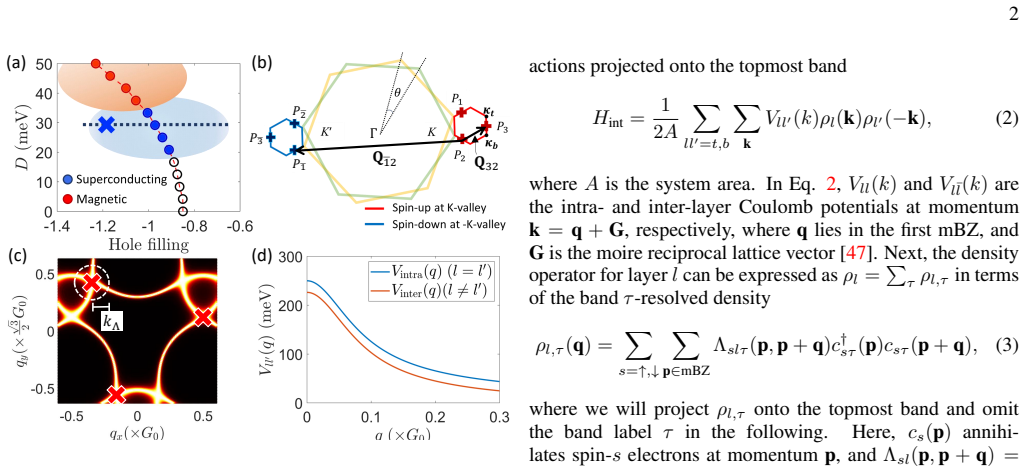
- [Fig. 1(a) caption] The caption refers to 'RG results in Fig. 4b' and 'mean-field calculation in Fig. 4c', but Fig. 4 has only panels (a) and (b). Probably a reference to Fig. 3(b,c) is intended.
- [Notation near Eq. (5)] The notation 'Λ1(2,3)' is ambiguous; write 'Λ1 and (Λ2,Λ3)' explicitly. Also define the overline l convention immediately before Eq. (5).
- [Equation (8)] State clearly whether G2, G3, G6, G′6 are the dimensionless running couplings gi(y) evaluated at y=y_c or the bare values; the notation is inconsistent with the tilde quantities in Eq. (5).
- [Reference [60]] The Supplementary Material reference contains only 'URL'; the actual URL should be provided in the bibliography.
Circularity Check
No circular derivation: the D-dependence is computed from band projections and the RG phase boundary is an output, not a fit.
full rationale
The central derivation is self-contained: the displacement-field dependence enters through the Bloch-overlap factors Λ_i(D) in Eqs. (5)–(6), which are obtained by projecting the layer-density operators of Eq. (2) onto the topmost band of the continuum model Eq. (1); no term in H_patch is adjusted by hand to produce the transition. The RG analysis then evolves these initial couplings using the one-loop beta functions of Ref. [28]; although Ref. [28] is a prior paper by one of the present authors, it is an independent, published methodological result with stated assumptions and is not an unverified uniqueness claim imported to force the conclusion. The numerical value D_c ≈ 33 meV is an output of the flow, not a fitted input; the experimental value U = 109 meV is used only for the off-VH-filling T_c curve in Fig. 3c and does not enter the SC-vFM competition in Fig. 2b. I therefore find no step where a prediction reduces by construction to its input. One non-circular internal inconsistency should be flagged for the correctness pass: the sentence after Eq. (6) states "since Λ_{1(2,3)} are decreasing (increasing) functions of D and V_ll(0) − V_{l̄l}(0) > 0, we find that g̃2 and g̃6 decrease with D while g̃3 and g̃6 increase with D," but Eq. (5) gives g̃2 = g̃′6 = V_ll(0) − Λ_1(D)(V_ll(0) − V_{l̄l}(0)), which increases as Λ_1 decreases. This is a sign/monotonicity error in the text, not a circularity, and it does not alter the fact that the phase diagram is computed from the equations.
Assumptions & free parameters
free parameters (6)
- U = 109 meV =
109 meV
- nu0 = 1/(2 pi W) =
1/(2 pi W), W unspecified
- Patch size k_Lambda =
not specified
- Coulomb screening parameters (h=3a0, eps=25, d=20 nm) =
h=3a0, eps=25, d=20 nm
- Continuum band parameters (m*=0.45me, a0=3.317 A, v=9.0 meV, psi=128 deg, w=18 meV) =
as listed
- Delta_vFM = 50 meV =
50 meV
assumptions (6)
- domain assumption The six VH patches with size k_Lambda << G0 capture all relevant Fermi-surface instabilities at nV(D).
- domain assumption Topmost valence bands at K and K' are spin-up and spin-down with Ising spin-orbit locking.
- domain assumption Coulomb interactions are screened double-gate potentials with G=0 components only, as V_ll'(k) decays fast in k.
- domain assumption One-loop RG for the four couplings g2,g3,g6,g6' correctly captures the leading instabilities in the weak-to-intermediate coupling regime.
- domain assumption Screened Coulomb interaction is stronger than electron-phonon coupling away from the VH filling.
- domain assumption The Fermi surface away from VH points has no perfect nesting in the 5 degree tWSe2 case.
Cite this review
Pith. "Pith review of Displacement-Field-Driven Transition between Superconductivity and Valley Ferromagnetism in Transition Metal Dichalcogenides." pith.science (2026). https://pith.science/paper/5MTGLO6M
@misc{pith2026250821119,
  author       = {Pith},
  title        = {Pith review of: Displacement-Field-Driven Transition between Superconductivity and Valley Ferromagnetism in Transition Metal Dichalcogenides},
  year         = {2026},
  howpublished = {\url{https://pith.science/paper/5MTGLO6M}},
  note         = {Machine review of arXiv:2508.21119}
}
abstract
Recent experiments have observed transitions between superconductivity and correlated magnetism in twisted bilayer WSe$_2$ near van-Hove fillings, driven by the displacement field $D$. Motivated by the experiment, we theoretically propose a general mechanism for a $D$-controlled transition between superconductivity and ferromagnetism in two-dimensional (2D) spin-orbit-coupled hexagonal systems, where van Hove singularities (VHS) lie on the Fermi level. We show that such a transition can be naturally captured by a simple VHS-only model without Fermi surface details, where the inter-VHS interactions that govern the Fermi surface instabilities is controlled by $D$ through the band projection of screened Coulomb interaction. By treating this simple model with renormalization group technique beyond mean-field level, we find that a chiral $d/p$-wave superconductivity naturally dominates under a weak displacement field $D<D_c$. At a stronger displacement field $D>D_c$, a \textit{valley ferromagnetic phase} (vFM) takes over, which is spatially non-uniform due to valley-modulated magnetization. Finally, we discuss generic conditions for the predicted superconductivity-to-ferromagnetism transition to take place in the rich family of few-layer hexagonal van der Waals material systems. Taking twisted bilayer WSe$_2$ as a case study, we discuss experimental detections that can falsify our prediction.
Figures


Figures from the paper (1 more)

Reference graph
Works this paper leans on
-
[28]
Y . Xia, Z. Han, K. Watanabe, T. Taniguchi, J. Shan, and K. F. Mak, Superconductivity in twisted bilayer wse2, Nature 637, 833 (2025)
work page 2025
-
[1]
As shown in Fig. 2a and b, the initial conditions ˜g2,3,6,6′ exhibit different field-dependence through the Bloch-function overlaps at y = 0 (see Eqs. 5, 6) so that the signs and rele- vance of gi(y) in the low-energy limit y → ∞, and thus the instability tendency βj, can qualitatively alter as D increases. A change in the dominant instability j can thus ...
-
[2]
S. Carr, D. Massatt, S. Fang, P. Cazeaux, M. Luskin, and E. Kaxiras, Twistronics: Manipulating the electronic properties of two-dimensional layered structures through their twist angle, Phys. Rev. B 95, 075420 (2017)
2017
-
[3]
K. Kim, A. DaSilva, S. Huang, B. Fallahazad, S. Laren- tis, T. Taniguchi, K. Watanabe, B. J. LeRoy, A. H. Mac- Donald, and E. Tutuc, Tunable moir ´e bands and strong cor- relations in small-twist-angle bilayer graphene, Proceedings of the National Academy of Sciences 114, 3364 (2017), https://www.pnas.org/doi/pdf/10.1073/pnas.1620140114
-
[4]
B. L. Chittari, G. Chen, Y . Zhang, F. Wang, and J. Jung, Gate- tunable topological flat bands in trilayer graphene boron-nitride moir´e superlattices, Phys. Rev. Lett. 122, 016401 (2019)
work page 2019
-
[5]
F. Wu, T. Lovorn, E. Tutuc, and A. H. MacDonald, Hubbard model physics in transition metal dichalcogenide moir ´e bands, Phys. Rev. Lett. 121, 026402 (2018)
work page 2018
-
[6]
4 are related to the Coulomb potentials in Eq
as well as the inter-valley scattering ˜g3 in Eq. 4 are related to the Coulomb potentials in Eq. 2 as ˜g2 = ˜g′ 6 = Vll(0) − Λ1(D)(Vll(0) − Vl¯l(0)), ˜g3 = Vll(Q)Λ2(D) + Vl¯l(Q)Λ3(D), ˜g6 = ˜g2 − ˜g3, (5) where Q ≡ Qnm = |Pn − Pm| for all patches n and m, and Λ1(D) = |Λ↑,t(P1, P1)Λ↑,b(P1, P1)|, Λ2(D) = |Λ↑,t(P1, P2)|2 + |Λ↑,b(P1, P2)|2, Λ3(D) = 2|Λ↑,t(P1,...
-
[7]
G. Chen, L. Jiang, S. Wu, B. Lyu, H. Li, B. L. Chittari, K. Watanabe, T. Taniguchi, Z. Shi, J. Jung, Y . Zhang, and F. Wang, Evidence of a gate-tunable mott insulator in a trilayer graphene moir´e superlattice, Nature Physics 15, 237 (2019)
work page 2019
Show all 67 references
-
[8]
X. Lu, P. Stepanov, W. Yang, M. Xie, M. A. Aamir, I. Das, C. Urgell, K. Watanabe, T. Taniguchi, G. Zhang, A. Bachtold, A. H. MacDonald, and D. K. Efetov, Superconductors, orbital magnets and correlated states in magic-angle bilayer graphene, Nature 574, 653 (2019)
2019
-
[9]
G. Chen, A. L. Sharpe, P. Gallagher, I. T. Rosen, E. J. Fox, L. Jiang, B. Lyu, H. Li, K. Watanabe, T. Taniguchi, J. Jung, Z. Shi, D. Goldhaber-Gordon, Y . Zhang, and F. Wang, Signa- tures of tunable superconductivity in a trilayer graphene moir ´e superlattice, Nature 572, 215 (2019)
2019
-
[10]
G. Chen, A. L. Sharpe, E. J. Fox, Y .-H. Zhang, S. Wang, L. Jiang, B. Lyu, H. Li, K. Watanabe, T. Taniguchi, Z. Shi, T. Senthil, D. Goldhaber-Gordon, Y . Zhang, and F. Wang, Tun- able correlated chern insulator and ferromagnetism in a moir ´e superlattice, Nature 579, 56–61 (2020)
2020
-
[11]
Y . Tang, L. Li, T. Li, Y . Xu, S. Liu, K. Barmak, K. Watan- abe, T. Taniguchi, A. H. MacDonald, J. Shan, and K. F. Mak, Simulation of hubbard model physics in wse2/ws2 moir´e super- lattices, Nature 579, 353 (2020)
2020
-
[12]
Y . Cao, D. Rodan-Legrain, O. Rubies-Bigorda, J. M. Park, K. Watanabe, T. Taniguchi, and P. Jarillo-Herrero, Tunable correlated states and spin-polarized phases in twisted bilayer– bilayer graphene, Nature 583, 215 (2020)
2020
-
[13]
N. P. Kazmierczak, M. Van Winkle, C. Ophus, K. C. Bustillo, S. Carr, H. G. Brown, J. Ciston, T. Taniguchi, K. Watanabe, and D. K. Bediako, Strain fields in twisted bilayer graphene, Nature Materials 20, 956 (2021)
2021
-
[14]
Y . Cao, V . Fatemi, S. Fang, K. Watanabe, T. Taniguchi, E. Kaxi- ras, and P. Jarillo-Herrero, Unconventional superconductivity in magic-angle graphene superlattices, Nature 556, 43 (2018)
2018
-
[15]
Y . Cao, V . Fatemi, A. Demir, S. Fang, S. L. Tomarken, J. Y . Luo, J. D. Sanchez-Yamagishi, K. Watanabe, T. Taniguchi, E. Kaxi- ras, R. C. Ashoori, and P. Jarillo-Herrero, Correlated insulator behaviour at half-filling in magic-angle graphene superlattices, Nature 556, 80 (2018)
2018
-
[16]
Yankowitz, S
M. Yankowitz, S. Chen, H. Polshyn, Y . Zhang, K. Watanabe, T. Taniguchi, D. Graf, A. F. Young, and C. R. Dean, Tuning superconductivity in twisted bilayer graphene, Science 363, 1059 (2019), https://www.science.org/doi/pdf/10.1126/science.aav1910
2019 doi
-
[17]
Kerelsky, L
A. Kerelsky, L. J. McGilly, D. M. Kennes, L. Xian, M. Yankowitz, S. Chen, K. Watanabe, T. Taniguchi, J. Hone, C. Dean, A. Rubio, and A. N. Pasupathy, Maximized electron interactions at the magic angle in twisted bilayer graphene, Na- ture 572, 95 (2019)
2019
-
[18]
Y . Choi, J. Kemmer, Y . Peng, A. Thomson, H. Arora, R. Polski, Y . Zhang, H. Ren, J. Alicea, G. Refael, F. von Oppen, K. Watan- abe, T. Taniguchi, and S. Nadj-Perge, Electronic correlations in twisted bilayer graphene near the magic angle, Nature Physics 15, 1174 (2019)
2019
-
[19]
Serlin, C
M. Serlin, C. L. Tschirhart, H. Polshyn, Y . Zhang, J. Zhu, K. Watanabe, T. Taniguchi, L. Balents, and A. F. Young, Intrinsic quantized anomalous hall effect in a moir ´e heterostructure, Science 367, 900 (2020), https://www.science.org/doi/pdf/10.1126/science.aay5533
2020 doi
-
[20]
A. L. Sharpe, E. J. Fox, A. W. Barnard, J. Finney, K. Watan- abe, T. Taniguchi, M. A. Kastner, and D. Goldhaber- Gordon, Emergent ferromagnetism near three-quarters fill- ing in twisted bilayer graphene, Science 365, 605 (2019), https://www.science.org/doi/pdf/10.1126/science....
2019 doi
-
[21]
S. L. Tomarken, Y . Cao, A. Demir, K. Watanabe, T. Taniguchi, P. Jarillo-Herrero, and R. C. Ashoori, Electronic compressibil- ity of magic-angle graphene superlattices, Phys. Rev. Lett.123, 046601 (2019)
2019
-
[22]
Wang, E.-M
L. Wang, E.-M. Shih, A. Ghiotto, L. Xian, D. A. Rhodes, C. Tan, M. Claassen, D. M. Kennes, Y . Bai, B. Kim, K. Watan- abe, T. Taniguchi, X. Zhu, J. Hone, A. Rubio, A. N. Pasupa- thy, and C. R. Dean, Correlated electronic phases in twisted bilayer transition metal dichalcogenid...
2020
-
[23]
Y . Xu, S. Liu, D. A. Rhodes, K. Watanabe, T. Taniguchi, J. Hone, V . Elser, K. F. Mak, and J. Shan, Correlated insulating states at fractional fillings of moir ´e superlattices, Nature 587, 214 (2020)
2020
-
[24]
C. Jin, Z. Tao, T. Li, Y . Xu, Y . Tang, J. Zhu, S. Liu, K. Watan- abe, T. Taniguchi, J. C. Hone, L. Fu, J. Shan, and K. F. Mak, Stripe phases in wse2/ws2 moir ´e superlattices, Nature Materi- als 20, 940 (2021)
2021
-
[25]
S. Carr, S. Fang, P. Jarillo-Herrero, and E. Kaxiras, Pressure dependence of the magic twist angle in graphene superlattices, Phys. Rev. B 98, 085144 (2018)
2018
-
[26]
Zhang, Y
Z. Zhang, Y . Wang, K. Watanabe, T. Taniguchi, K. Ueno, E. Tu- tuc, and B. J. LeRoy, Flat bands in twisted bilayer transition metal dichalcogenides, Nature Physics 16, 1093 (2020)
2020
-
[27]
Xiao, G.-B
D. Xiao, G.-B. Liu, W. Feng, X. Xu, and W. Yao, Coupled spin and valley physics in monolayers of mos2 and other group-vi dichalcogenides, Phys. Rev. Lett. 108, 196802 (2012)
2012
-
[29]
Y . Guo, J. Pack, J. Swann, L. Holtzman, M. Cothrine, K. Watan- abe, T. Taniguchi, D. G. Mandrus, K. Barmak, J. Hone, A. J. Millis, A. Pasupathy, and C. R. Dean, Superconductivity in 5.0° twisted bilayer wse2, Nature 637, 839 (2025)
2025
-
[30]
Y .-T. Hsu, F. Wu, and S. Das Sarma, Spin-valley locked in- stabilities in moir ´e transition metal dichalcogenides with con- ventional and higher-order van hove singularities, Phys. Rev. B 104, 195134 (2021)
2021
-
[31]
Zegrodnik and A
M. Zegrodnik and A. Biborski, Mixed singlet-triplet supercon- ducting state within the moir´e t−j−u model applied to twisted bilayer wse2, Phys. Rev. B 108, 064506 (2023)
2023
-
[32]
Zhou and Y .-H
B. Zhou and Y .-H. Zhang, Chiral and nodal superconductors in the t−j model with valley contrasting flux on a triangular moir´e lattice, Phys. Rev. B 108, 155111 (2023)
2023
-
[33]
Y .-M. Wu, Z. Wu, and H. Yao, Pair-density-wave and chiral superconductivity in twisted bilayer transition metal dichalco- genides, Phys. Rev. Lett. 130, 126001 (2023)
2023
-
[34]
Akbar, A
W. Akbar, A. Biborski, L. Rademaker, and M. Zegrodnik, Topo- logical superconductivity with mixed singlet-triplet pairing in moir´e transition metal dichalcogenide bilayers, Phys. Rev. B 110, 064516 (2024)
2024
-
[35]
Zhu, Y .-Z
J. Zhu, Y .-Z. Chou, M. Xie, and S. Das Sarma, Superconduc- tivity in twisted transition metal dichalcogenide homobilayers, Phys. Rev. B 111, L060501 (2025)
2025
-
[36]
F. Xie, L. Chen, S. Sur, Y . Fang, J. Cano, and Q. Si, Super- conductivity in twisted wse2 from topology-induced quantum fluctuations, Phys. Rev. Lett. 134, 136503 (2025)
2025
-
[37]
Guerci, D
D. Guerci, D. Kaplan, J. Ingham, J. H. Pixley, and A. J. Millis, Topological superconductivity from repulsive interactions in twisted wse2 (2024), arXiv:2408.16075 [cond-mat.supr-con]
2024 arXiv
-
[38]
Schrade and L
C. Schrade and L. Fu, Nematic, chiral, and topological super- conductivity in twisted transition metal dichalcogenides, Phys. Rev. B 110, 035143 (2024)
2024
-
[39]
Qin, W.-X
W. Qin, W.-X. Qiu, and F. Wu, Kohn-luttinger mechanism of superconductivity in twisted bilayer wse2: Gate-tunable uncon- ventional pairing symmetry (2024), arXiv:2409.16114 [cond- mat.supr-con]
2024
-
[40]
A. V . Chubukov and C. M. Varma, Quantum criticality and superconductivity in twisted transition metal dichalcogenides, Phys. Rev. B 111, 014507 (2025)
2025
-
[41]
Christos, P
M. Christos, P. M. Bonetti, and M. S. Scheurer, Approximate symmetries, insulators, and superconductivity in continuum- model description of twisted wse 2 (2024), arXiv:2407.02393 [cond-mat.supr-con]
2024 arXiv
-
[42]
S. Kim, J. F. Mendez-Valderrama, X. Wang, and D. Chowdhury, Theory of correlated insulators and superconductor at ν = 1 in twisted wse2, Nature Communications 16, 1701 (2025)
2025
-
[43]
Kn ¨uppel, J
P. Kn ¨uppel, J. Zhu, Y . Xia, Z. Xia, Z. Han, Y . Zeng, K. Watan- abe, T. Taniguchi, J. Shan, and K. F. Mak, Correlated states controlled by a tunable van hove singularity in moir ´e wse2 bi- layers, Nature Communications 16, 1959 (2025)
1959
-
[44]
L. Peng, C. D. Beule, D. Li, L. Yang, E. J. Mele, and S. Adam, Magnetism in twisted bilayer wse 2 (2025), arXiv:2503.09689 [cond-mat.str-el]
2025
-
[45]
Tuo, M.-R
C. Tuo, M.-R. Li, Z. Wu, W. Sun, and H. Yao, Theory of topological superconductivity and antiferromagnetic correlated insulators in twisted bilayer wse 2 (2024), arXiv:2409.06779 [cond-mat.str-el]
2024
-
[46]
Fischer, L
A. Fischer, L. Klebl, V . Cr ´epel, S. Ryee, A. Rubio, L. Xian, T. O. Wehling, A. Georges, D. M. Kennes, and A. J. Millis, The- ory of intervalley-coherent afm order and topological supercon- ductivity in twse2 (2024), arXiv:2412.14296 [cond-mat.str-el]
2024
-
[47]
Devakul, V
T. Devakul, V . Cr´epel, Y . Zhang, and L. Fu, Magic in twisted transition metal dichalcogenide bilayers, Nature Communica- tions 12, 6730 (2021)
2021
-
[48]
F. Wu, T. Lovorn, E. Tutuc, I. Martin, and A. H. MacDon- ald, Topological insulators in twisted transition metal dichalco- genide homobilayers, Phys. Rev. Lett. 122, 086402 (2019)
2019
-
[49]
1d (see Supplementary Material (SM) Section I [60])
By solving the Poisson equation with double-gate boundary conditions, we obtain the k-dependence of Vll′ (k) in Fig. 1d (see Supplementary Material (SM) Section I [60]). Since Vll′ (k) decays fast with k, we will neglect the G ̸= 0 com- ponents for simplicity
-
[50]
Shankar, Renormalization-group approach to interacting fermions, Rev
R. Shankar, Renormalization-group approach to interacting fermions, Rev. Mod. Phys. 66, 129 (1994)
1994
-
[51]
Furukawa, T
N. Furukawa, T. M. Rice, and M. Salmhofer, Truncation of a two-dimensional fermi surface due to quasiparticle gap forma- tion at the saddle points, Phys. Rev. Lett. 81, 3195 (1998)
1998
-
[52]
K. L. Hur and T. Maurice Rice, Superconductivity close to the mott state: From condensed-matter systems to superfluidity in optical lattices, Annals of Physics 324, 1452 (2009), july 2009 Special Issue
2009
-
[53]
A. V . Chubukov, D. V . Efremov, and I. Eremin, Magnetism, su- perconductivity, and pairing symmetry in iron-based supercon- ductors, Phys. Rev. B 78, 134512 (2008)
2008
-
[54]
Nandkishore, L
R. Nandkishore, L. S. Levitov, and A. V . Chubukov, Chiral su- perconductivity from repulsive interactions in doped graphene, Nature Physics 8, 158 (2012)
2012
-
[55]
Isobe, N
H. Isobe, N. F. Q. Yuan, and L. Fu, Unconventional supercon- ductivity and density waves in twisted bilayer graphene, Phys. Rev. X 8, 041041 (2018)
2018
-
[56]
Lin and R
Y .-P. Lin and R. M. Nandkishore, Chiral twist on the high- Tc phase diagram in moir ´e heterostructures, Phys. Rev. B 100, 085136 (2019)
2019
-
[57]
Y .-T. Hsu, F. Wu, and S. Das Sarma, Topological supercon- ductivity, ferromagnetism, and valley-polarized phases in moir´e systems: Renormalization group analysis for twisted double bi- layer graphene, Phys. Rev. B 102, 085103 (2020). 8
2020
-
[58]
Classen, A
L. Classen, A. V . Chubukov, C. Honerkamp, and M. M. Scherer, Competing orders at higher-order van hove points, Phys. Rev. B 102, 125141 (2020)
2020
-
[59]
Lin and R
Y .-P. Lin and R. M. Nandkishore, Parquet renormalization group analysis of weak-coupling instabilities with multiple high-order van hove points inside the brillouin zone, Phys. Rev. B 102, 245122 (2020)
2020
-
[60]
D.-C. Lu, T. Wang, S. Chatterjee, and Y .-Z. You, Correlated metals and unconventional superconductivity in rhombohedral trilayer graphene: A renormalization group analysis, Phys. Rev. B 106, 155115 (2022)
2022
-
[61]
J. H. Son, Y .-T. Hsu, and E.-A. Kim, Switching between su- perconductivity and current density waves in bernal bilayer graphene, Phys. Rev. B 111, 115144 (2025)
2025
-
[62]
Double- gate Coulomb interaction, II
See Supplementary Materials at URL for details on I. Double- gate Coulomb interaction, II. RG equations
-
[63]
The prefactor ν0 depends on the specific dispersion obtained from Eq. 1. For the RG calculation, we take the phenomenolog- ical value ν0 = 1 2πW for the bandwidth W
-
[65]
Y .-T. Hsu, F. Wu, and S. Das Sarma, Topological supercon- ductivity, ferromagnetism, and valley-polarized phases in moir´e systems: Renormalization group analysis for twisted double bi- layer graphene, Phys. Rev. B 102, 085103 (2020)
2020
-
[66]
Yang and Y .-T
H.-J. Yang and Y .-T. Hsu, Optical absorption signatures of su- perconductors driven by van hove singularities, Phys. Rev. B 111, 054514 (2025)
2025
-
[67]
Y .-T. Hsu, A. Vaezi, M. H. Fischer, and E.-A. Kim, Topolog- ical superconductivity in monolayer transition metal dichalco- genides, Nature Communications 8, 14985 (2017)
2017
-
[68]
B. Gao, M. Ghafariasl, M. J. Mehrabad, T.-S. Huang, L. Zhang, D. Session, P. Upadhyay, R. Ma, G. Alshalan, D. G. S. Forero, S. Sarkar, S. Park, H. Jang, K. Watanabe, T. Taniguchi, M. Xie, Y . Zhou, and M. Hafezi, Probing quantum anomalous hall states in twisted bilayer wse2 vi...
2025 arXiv
Reviewed August 5, 2026 · model on record in the stance chip above.
Discussion (0). Continue with ORCID to comment.